“He hath opened an inn and tavern, at the sign of the Fountain … in Market-street, Baltimore.”
As summer arrived in 1773, Daniel Grant opened a new inn and tavern in Baltimore. To attract patrons, he inserted advertisements in the Maryland Gazette, published in Annapolis, and the Pennsylvania Packet, published in Philadelphia, to supplement word-of-mouth news of his establishment in Baltimore. That city did not yet have its own newspaper, though William Goddard had recently opened a printing office there and distributed subscription proposals for the Maryland Journal. Even if Grant could have advertised in a local newspaper, it benefited him to alert colonizers throughout the regions served by the Maryland Gazette and the Pennsylvania Packet that they could avail themselves of his services if they had occasion to travel to Baltimore. Besides, those newspapers were the local newspapers, at least for another few months until Goddard commenced publication of the Maryland Journal near the end of August.
As part of his marketing efforts, Grant emphasized his experience running a tavern “at the sign of the Buck, near Philadelphia.” He extended “his most grateful thanks to the gentlemen who did mum the honour to frequent his former house.” In addition, he declared that “it shall ever be his study to please” and “he hopes for a continuance of their favours” when they visited Baltimore. Such sentiments communicated to those who had not previously visited the tavern “at the sign of the Buck” that Grant had successfully cultivated a clientele and would offer the same quality of service to patrons at the inn and tavern “at the sign of the Fountain … in Market-street, Baltimore.” He pledged that “those who choose to favour him with their custom, may be assured of his best endeavours to merit their approbation.” To that end, he promoted the “late and commodious house” that he converted into an inn and tavern and asserted that he “hath provided everything for the accommodation of gentlemen, their servants, and horses, in the best manner.” Apparently, Grant also operated a stable or made arrangements with a nearby associate to provide hosteling services. Whatever their needs and desires, Grant promised prospective patrons a pleasant stay at his inn and tavern.
“Seasonable notice will be given in this gazette, to give gentlemen an opportunity to advertise in the first number.”
William Goddard, the printer of the Pennsylvania Chronicle in Philadelphia, continued his efforts to establish a new operation in Baltimore. In the early 1770s, Maryland had only one newspaper, the Maryland Gazette, published by Anne Catherine Green and Son in Annapolis. In late October 1772, Goddard placed an advertisement in that newspaper to announce his intention to publish the Maryland Journal and Baltimore Advertiser “as soon … as I shall obtain a sufficient Number of Subscribers barely to defray the Expence of the Work.” He also solicited advertisements, stating that they “shall likewise be accurately published, in a conspicuous Manner, with great Punctuality, at the customary Prices.”
Nearly seven months later, Goddard inserted an update in the May 20, 1773, edition of the Maryland Gazette. He had opened a printing office “in Baltimore-town,” where “PRINTING in all it’s various branches, [was] performed in a neat,correct, and expeditious manner, on the most reasonable terms.” The printer also informed readers that he would begin publishing the Maryland Journal “As soon as proper posts or carriers are established.” They could expect at least one more update in the Maryland Gazette before that happened because Goddard wished “to give gentlemen an opportunity to advertise in the first number.” While advertising could aid merchants, shopkeepers, artisans, and others in capturing the markets served by Baltimore’s first newspaper, Goddard also knew from experience that advertisements accounted for an important revenue stream.
In his notice, Goddard attended to both advertisers and subscribers. He requested that the “gentlemen” who served as local agents “who have been so obliging as to take in subscriptions … transmit the subscription lists (or the subscribers names and places of abode) as speedily as possible” so he “may be enable to ascertain the number necessary to be printed” as well as make arrangements for delivering the newspapers “to every subscriber.” Goddard was still three months away from publishing “the first number” of the Maryland Journal and Baltimore Advertiser, but his notice in the Maryland Gazette kept the public, including prospective subscribers and advertisers, apprised of his progress. In the coming months, the Adverts 250 Project will examine Goddard’s success in attracting advertisers for “the first number” and subsequent editions of Baltimore’s first newspaper.
“For Neatness and Elegance … they are able to excel any of the Business ever arrived in Annapolis.”
When John Finlater and Company set up shop in Annapolis in the spring of 1773, they placed an advertisement that ran for six weeks in the Maryland Gazette. Newcomers to the town, the wheelwrights explained that they were “Late fromEurope” and “propose carrying on the various Branches of the Business.” They crafted “Wheels of all kinds” for a variety of carriages, including “Coaches, Berlins, Post-Chariots, Curricles, Sulkies, and single Horse Chaises.” In addition, they made wheels for “Waggons, Carts, Ploughs, and Harrows,” promising “the neatest Construction” for all their work. As an ancillary service, Finlater and Company also painted and varnished carriages and wheels “in the best Manner.”
Unlike other artisans who extolled their training and experience when they settled in the colonies after migrating across the Atlantic, Finlater and Company did not provide details about the work they had undertaken in Europe. They did, however, extend some of the usual promises to prospective clients. “Those who please to honour them with their Commands,” the wheelwrights declared, “may be assured, that a speedy Execution of their Work and Attention to Business will entitle them to their Favours.” In turn, Finalter and Company intended that the quality of their work with their initial customers would help in cultivating a good reputation and “in some Measure recommend them to the Encouragement of the Publick.” In other words, they hoped that satisfied customers would spread the word so others would seek out their services.
The wheelwrights concluded with a bold claim. When it came to “Neatness and Elegance” of the wheels they constructed and the carriages they painted and maintained, Finlater and Company proclaimed that “they are able to excel any of the Business ever arrived in Annapolis.” They were better wheelwrights than any who had previously labored in the town. In making that claim, they challenged prospective customers to test that assertion for themselves. As newcomers without an established reputation, Finlater and Company resorted to other means of attracting attention to their business and distinguishing themselves from the competition.
“Every Subscriber shall have his Name and Title printed in the Title Page, in a Label adapted for that Purpose, as in the above Scheme, provided their Signature come timely to Hand.”
For several weeks in the winter and spring of 1773, subscription proposals for Elie Vallette’s Deputy Commissary’s Guide within the Province of Maryland ran in the Maryland Gazette. When the advertisement first appeared in the February 25 edition, it filled an entire column. An excerpt from the preface accounted for approximately half of the space required to publish the notice. Vallette and the printers, Anne Catharine Green and Son, eventually revised the notice, eliminating the excerpt.
The advertisement retained its most distinctive feature: a “scheme” or depiction of a label to include the name, title, and county of the subscriber. Vallette and the Greens hoped that personalizing the title page would help in selling more books, but warned that only subscribers who placed their orders early would qualify for the labels. Those labels, however, do not seem to have been part of the book when it went to press. Instead, subscribers (and others who eventually purchased copies or received them as gifts) received something that they likely considered even better: an engraved title page that included a blank banner.
Curious to learn more about the proposed label, I examined the four copies of the Deputy Commissary’s Guide in the collections of the American Antiquarian Society. None of them featured the label depicted in the advertisements in the Maryland Gazette, but each of them did include a title page engraved by Thomas Sparrow. Annotations made by catalogers and curators indicated that Sparrow also engraved currency that circulated in Maryland in the early 1770s. In addition, those annotations also stated that the Deputy Commissary’s Guide was the first book with an engraved title page printed in America, certainly a premium for subscribers and other readers who acquired copies.
Title pages engraved by Thomas Sparrow (Elie Vallette, The Deputy Commissary’s Guide, 1774). Courtesy American Antiquarian Society.
The engraved title page certainly enhanced the book. The blank banner allowed colonizers to further enhance their copies in whatever manner they wished to personalize the title page. The banners in two of the copies at the American Antiquarian Society remain empty. One has the words “TO MR. J: MACNABB* *1775*” clumsily stamped within the banner. A handwritten note on another page reads, “The Gift of Elie Vallette to his Friend John McNabb.” The other copy has the name “R. Tilghman” gracefully written inside the banner.
Vallette and the Greens did not supply the personalized labels that they promoted in the subscription proposals for the Deputy Commissary’s Guide. That probably did not matter to most subscribers when they discovered the ornate and expensive engraved title page that they received instead. The author and the printers substituted an even better premium than the one they marketed to prospective subscribers.
A notice in the March 4, 1773, edition of the Maryland Gazette called on “Members of the LUNATICK CLUB” to gather for a meeting “at the Coffee-House” in Annapolis on March 8. The club convened for dinner on the evening of the full moon. That lunar phenomenon gave members an excuse to engage in revelries together.
The organizers apparently did not rely on newspaper notices alone to alert members about the gathering. A nota benedeclared that “Circular Letters are sent to the Members,” but surmised that they may have been overlooked. What were circular letters? In this case, they would have been similar to printed invitations. Rather than write the same message by hand over and over, one of the organizers wrote it once, submitted it to the printing office, and ordered multiple copies. The letter may have included space at the top to write a salutation to the recipient and space at the bottom for the organizer to sign it. If the club used the same circular letter each month, it likely resembled a form with blanks to fill in the date (as well as the time and location if they changed from month to month). After writing anything that needed to be added to the printed letter, the organizer folded it, sealed it with wax, wrote the name and address of the recipient on the exterior, and arranged for delivery via the post or messenger. This certainly saved time compared to writing out the entire invitation each time, especially if the club had many members.
Merchants, shopkeepers, and other entrepreneurs also distributed circular letters when they wished to contact associates or prospective customers. Again, rather than invest the time in writing the same letter multiple times, they instead had copies printed, personalized each copy for the intended recipient, and sent them through the post. When they did so, they relied on an eighteenth-century version of junk mail. Relatively few printed circular letters survive compared to other forms of early American advertising, but notices like the one the Lunatick Club placed in the Maryland Gazette imply that circular letters were more common than the examples in research libraries and historical societies suggest.
“The Publick have been greatly imposed on by many botching Pretenders.”
Artisans often highlighted their skill and experience in their advertisements. Their skill and experience, they asserted, meant that prospective customers could depend on them producing items of the best quality. Most artisans who placed newspaper advertisements focused on their own skill and experience, though occasionally some chose to denigrate their competitors. John Simnet, a watchmaker, for instance, engaged in public feuds with his competitors, first in the New-Hampshire Gazette and later in newspapers published in New York. Thomas Pryse, a “Coach-Harness-maker, Saddler, and Upholsterer,” did not make as direct references to his competitors, but he did take an aggressive tone in his advertisement in the November 26, 1772, edition of the Maryland Gazette.
Pryse announced that he “opened a Shop … where he intends carrying on his Trade in all its Branches.” He boasted that he did his work “in a Manner superior to any that ever has attempted it in these Parts,” leaning into his London origins and the training and experience that he gained there before migrating to Annapolis. Such appeals looked a lot like others deployed by artisans, but Pryse then turned up the temperature. In a derisive tone, he declared that “the Publick have been greatly imposed on by many botching Pretenders to that Branch of Business,” prompting him to make assurances that “he is the only one that has been regularly bred” or trained “to Harness-making now in this Province.” That being the case, Pryse was “determined to exert his best Endeavours to give Satisfaction to those that please to favour him with their Custom.” Following his attack on his competitors, he reverted to promises of customer service that mirrored those that appeared in advertisements placed by other artisans. Having made his point that his work was supposedly “superior” to anything made by “botching Pretenders,” he concluded with a list of items he made, sprinkling in phrases like “in the neatest and most approved manner” and “done in the best manner” to underscore his skill and experience.
Even if prospective customers did not care for Pryse’s tone in his advertisement, he challenged them to question the quality of the harnesses, saddles, and upholstery produced by his competitors. In seeding doubts and suggesting that he did better, he may have hoped to convince some consumers to give him a chance even if they had previously been happy with work by other aertisans.
“They are well acquainted with the newest Fashions.”
When they settled in Annapolis, Jane Nelson and Anne Nelson took out an advertisement in the Maryland Gazette to introduce themselves to the community and encourage “Ladies … to favour them with their Commands” or orders for “all Kind of Milliners and Mantua-makers Work.” As newcomers to the colony, they could not rely on their reputations to market their services. Instead, they emphasized their connections to London, the cosmopolitan center of the empire, and their knowledge of current styles there.
In the deadline for their advertisement, the Nelsons proclaimed that they “Just arrived from LONDON.” Artisans, tailors, milliners, and others often trumpeted that they were “from London” in their advertisements, sometimes long after they crossed the Atlantic. The Nelsons made it clear that they only recently made that journey. Accordingly, prospective clients could trust that they were indeed “well acquainted with the newest Fashions” and capable of making hats, cloaks, and other garments “in the most elegant and fashionable manner.” Having recently come from London, the Nelsons could also provide guidance about “Ladies fashionable dress and undress Caps” and other items.
The Nelsons also aimed to convince prospective clients that they offered exemplary customer service. They asserted that “Ladies … may depend on having their Work neatly done, and with the utmost Dispatch.” If given a chance, the Nelsons assured those ladies that “they will not be disappointed in their Endeavours to please, as it shall be their constant Study and greatest Ambition.” In addition to serving clients who visited them in Annapolis, the Nelsons also took “Orders from the Country,” pledging to punctually complete them.
These “Milliners and Mantua-makers” deployed a two-pronged approach to marketing their services upon arriving in Annapolis. They promoted their connections to London, underscoring their familiarity with the latest tastes there, while simultaneously vowing to meet and exceed the expectations of their clients in terms of customer service. The Nelsons hoped that combination of appeals would entice the ladies of Annapolis to engage their services.
“Intend shortly to exhibit Proposals for publishing a NEWS-PAPER.”
Robert Hodge and Frederick Shober took to the pages of the Maryland Gazette, published in Annapolis, in the fall of 1772 to advise prospective customers that they did “PRINTING In all it’s DIFFERENT BRANCHES … with the greatest neatness, accuracy and dispatch” at their “NEW PRINTING-OFFICE” in Baltimore. At the time, the Maryland Gazette was the only newspaper published in the colony, so it served Baltimore as well as Annapolis.
Hodge and Shober, however, had plans for establishing their own newspaper in Baltimore. They declared that they “intend shortly to exhibit Proposals for publishing a NEWS-PAPER, which shall be justly entitled to the Attention and Encouragement of this FLOURISHING TOWN and PROVINCE, both for ENTERTAINMENT and ELEGANCE.” They were not the only entrepreneurs to decide that Baltimore seemed ready for its first newspaper. A week earlier, the Maryland Gazette carried an extensive subscription proposal in which William Goddard announced his plans to publish “THE MARYLAND JOURNAL, AND BALTIMORE ADVERTISER … as soon therefore as I shall obtain a sufficient Number of Subscribers barely to defray the Expence of the Work.” In a market that did not yet have one newspaper, Hodge and Shober competed with Goddard in their efforts to launch two newspapers simultaneously.
Neither met with immediate success. Goddard, who was already printing the Pennsylvania Chronicle at the time he published his subscription proposal, did not manage to take the Maryland Journal to press until August 20, 1773, ten months after he announced his plans for the newspaper. Hodge and Shober never published a newspaper. In his monumental History of Printing in America (1810), Isaiah Thomas notes that the partners purchased “printing materials” in 1772 and “began business in Baltimore, where they intended to have published a newspaper; but, not meeting with the encouragement they expected, before the end of the year they left Baltimore, and settled in New York.”[1] A variety of factors likely contributed to their decision to relocate. Competing with Goddard for subscribers to Baltimore’s first newspaper probably did not help their prospects in the city.
After Goddard commenced publication of the Maryland Journal, Baltimore did gain a second newspaper less than two years later. John Dunlap, printer of the Pennsylvania Packet, established Dunlap’s Maryland Gazette; or the Baltimore General Advertiser on May 2, 1775. James Hayes, Jr., seems to have operated the publication on Dunlap’s behalf for three years before acquiring it for himself and changing the name to the Maryland Gazette, and Baltimore General Advertiser on September 15, 1778. Hodge and Shober were just a few years too early in their efforts, though the war almost certainly played a role in inciting interest to establish more than one newspaper in Baltimore. Under those difficult circumstances, however, Hayes removed to Annapolis just four months later. Baltimore did not have a second newspaper of any longevity until after the war.[2]
**********
[1] Isaiah Thomas, The History of Printing in America: With a Biography of Printers & an Account of Newspapers (1810; New York: Weathervane Books, 1970), 480.
[2] See entries in Clarence Brigham S. Brigham, History and Bibliography of American Newspapers, 1690-1820 (Worcester, Massachusetts: American Antiquarian Society, 1947) and Edward Connery Lathem, Chronological Tables of American Newspapers, 1690-1820 (Barre, Massachusetts: American Antiquarian Society and Barre Publishers, 1972).
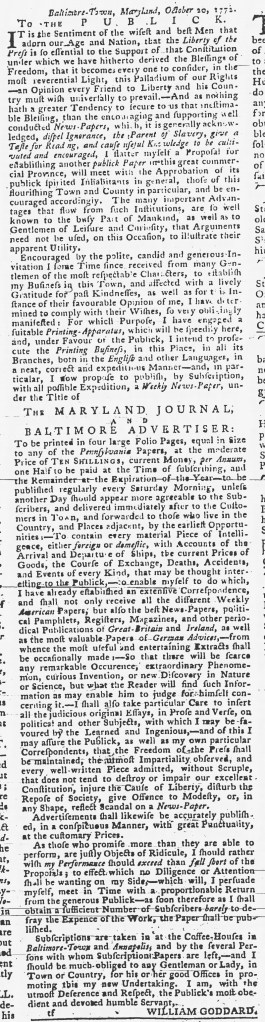
“I now propose to publish, by Subscription, … a Weekly News-Paper.”
Maryland had only one newspaper in 1772. William Goddard aimed to change that. To aid his efforts, he inserted a proposal in the October 29 edition of the Maryland Gazette, the publication that would be his competitor if he managed to launch “THE MARYLAND JOURNAL, AND BALTIMORE ADVERTISER.” Printed in Annapolis, the Maryland Gazette served the entire colony, but Goddard believed that a market existed, or would exist after some savvy advertising, to support two newspapers in the colony. In addition, he underscored the political utility of newspapers to prospective subscribers. “IT is the Sentiment of the wisest and best Men that adorn our Age and Nation,” Goddard declared in the first sentence of his proposal, “that the Liberty of the Press is so essential to the Support of that Constitution under which we have hitherto derived the Blessings of Freedom, that it becomes every one to consider, in the most reverential Light, this Palladium of our Rights.” The printer further explained that “well conducted News-Papers … dispel Ignorance, the Parent of Slavery, give a Taste for Reading, and cause useful Knowledge to be cultivated and encouraged.” Accordingly, he called on “every Friend to Liberty and his Country” to support his proposed project.
Goddard’s proposal filled nearly an entire column in the Maryland Gazette. In addition to expounding on the philosophy that prompted him to consider publishing a newspaper in Baltimore, he advised potential subscribers that he was indeed prepared to launch the venture “as soon … as I shall obtain a sufficient Number of Subscribers barely to defray the Expence of the Work.” Already in correspondence with “many Gentlemen of the most respectable Characters” in Baltimore, Goddard had “engaged a suitable Printing-Apparatus, which will be speedily here.” In addition, as printer of the Pennsylvania Chronicle he had already “established an extensive Correspondence, and shall not only receive all the different Weekly American Papers, but also the best News-Papers, political Pamphlets, Registers, Magazines, and other periodical Publications of Great-Britain and Ireland.” In addition to printer and publisher, Goddard assumed the responsibilities of editor, drawing the news from the letters, newspapers, and periodicals sent to him. Every American newspaper printer-editor reprinted extensively from other publications. Goddard even acquired “the most valuable Papers of German Advices” in order to provide news of interest to the growing German population in the backcountry.
The proposal also outlined the particulars of the publication and how to subscribe. The newspaper would be “printed in four large Folio Pages, equal in Size to any of the Pennsylvania Papers” that, along with the Maryland Gazette, operated as local newspapers for Baltimore and the region. Goddard intended to print and distribute the newspaper “regularly every Saturday Morning, unless another Day should appear more agreeable to the Subscribers.” Subscriptions cost ten shillings per year, with half to be paid immediately and the other half at the end of the year. Goddard briefly mentioned advertisements, noting they would be “accurately published, in a conspicuous Manner, with great Punctuality, at the customary Prices.” He did not list those prices. Colonizers interested in subscribing could leave their names “at the Coffee-Houses in Baltimore-Town and Annapolis” or with “several Persons with whom Subscription Papers are left.” Like other printers attempting to launch new projects, Goddard relied on a network of local agents who assisted in recruiting subscribers.
Beyond the particulars, Goddard emphasized that he pursued a higher purpose than merely generating revenues or turning a profit on the publication. He promised to publish news about every “remarkable Occurence, extraordinary Phenomemon, curious Invention, or New Discovery in Nature or Science” as well as “judicious original Essays … on political and other Subjects.” In selecting material to include in the Maryland Journal, Goddard pledged that “the Freedom of the Press shall be maintained, the utmost Impartiality observed, and every well written Piece admitted, without Scruple, that does not tend to destroy or impair our excellent Constitution, injure the Cause of Liberty, disturb the Repose of Society, give Offence to Modesty, or, in any Shape, reflect Scandal on a News-Paper.” In an era of upheaval as Parliament turned unwanted attention to the colonies, Goddard framed publishing a newspaper as a civic duty that served the commercial and political interests of the community.
Did the subscription proposal help Goddard to obtain that “sufficient Number of Subscribers barely to defray the Expence” and commence publication? Perhaps, but it took some time. The first issue appeared on August 20, 1773, ten months after Goddard initially proposed publishing the Maryland Journal and Baltimore Advertiser. The newspaper continued publication, under the guidance of various printers and proprietors, throughout the American Revolution and into the 1790s, transitioning from weekly to semi-weekly to tri-weekly to daily as newspaper publishing expanded throughout the new nation.
“Black Velvet Collars, which are now worn instead of Necklaces, with Danglers.”
In the summer of 1772, M. Evans ran advertisements in the Maryland Gazette to announce to “the Ladies in Annapolis, and the Publick in general” that she stocked a variety of millinery and other items at her shop in Baltimore. Her merchandise “Lately arrived from London.” That being the case, she made clear to prospective customers that she carried current styles from the cosmopolitan center of the empire. Her inventory included “the fashionable Net and Gauze Bonnets” and “fashionable Stomachers and Sleeve-knots with Italian Flowers.” In addition, Evans listed many other items, including “Hats and long Cloaks in the French gray Queen’s Silk,” “Bonnets and Tippets” for young ladies, and a variety of combs, pins, earrings, and “Danglers.” She concluded with “&c. &c. &c.” to indicate that she stocked much more than would fit in a newspaper advertisement.
In marketing her wares, Evans presented herself as a guide for prospective customers, not merely a shopkeeper. She was in a position to offer advice and suggestions as well as keep her clients apprised of the latest fashions. For instance, she included “black Velvet Collars … with Danglers” among her catalog of merchandise, explaining that they “are now worn instead of Necklaces.” Some of the “Ladies in Annapolis” may have already been aware of this trend, but Evans apparently believed that many were not yet familiar with it. Acting as a guide helped incite demand, tantalizing prospective customers with news of the latest styles while simultaneously encouraging them to acquire those styles for themselves. Shopkeepers, milliners, and others who sold clothing and accessories were in a position to exert considerable influence over the customers they served, provided that those customers considered them well-informed and trustworthy. Evans aimed to cultivate such relationships, marketing her knowledge of current fashions in her efforts to sell goods imported from London. Her familiarity with new styles and ability to provide guidance to her customers made her more than a mere purveyor of goods.