January 8

What was advertised in a colonial American newspaper 250 years ago today?
Maryland Journal (January 8, 1774).

“My Entreaty to a great Majority of the Subscribers … to pay the Entrance Money, (a small Sum!)”

Less than five months after William Goddard commenced publication of the Maryland Journal on August 20, 1773, he found the enterprise in a dire financial position, at least according to the notice that he placed in the January 8, 1774, edition.  It appeared under a heading for “New Advertisements,” the first item following news, letters, and editorials.  With a manicule to help draw attention to his message, the printer lamented, “IT gives me real Pain to find myself under the Necessity of repeating my Entreaty to a great Majority of the Subscribers for the Encouragement of this paper, to pay the Entrance Money, (a small Sum!) agreeable to Contract.”  Indeed, Goddard had specified in his subscription proposals that Baltimore’s first newspaper would cost “the moderate Price of TEN SHILLINGS, … per Annum, one Half to be paid at the Time of subscribing, and the Remainder at the Expiration of the Year.”  He also pledged to begin publication “as soon … as I shall obtain a sufficient Number of Subscribers barely to defray the Expence of this Work.”

Enough subscribers may have submitted payment “barely to defray” the cost of printing those first issues, but Goddard apparently did not insist that more subscribers actually pay the entrance fee before he launched the venture.  Publishing a newspaper was a complex endeavor.  With a large enough subscription base, printers could convince others to subscribe.  The size of that subscription base also testified to the circulation of the newspaper, important for bringing in advertisements.  Many printers considered advertising more lucrative than subscriptions, allowing credit for subscriptions but not advertisements.  Still, that was not the deal that Goddard outlined in the subscription proposals for the Maryland Journal.  He may have figured that subscribers would pay once he distributed the first issue, so he gambled on taking the newspaper to press before most subscribers paid.  Goddard may have also been concerned about the prospects of competition.  The growing port had reached the point that it might support its own newspaper instead of relying on newspapers published in Annapolis and Philadelphia … but could it support two newspapers?  At the same time that Goddard circulated proposals for the Maryland Journal, Robert Hodge and Frederick Shober announced that they “intend shortly to exhibit Proposals for publishing a NEWS-PAPER, which shall be justly entitled to the Attention and Encouragement of this FLOURISHING TOWN.”  In the end, Goddard printed a newspaper in Baltimore, while Hodge and Shober did not.  Perhaps Goddard overextended himself when he faced competition.

If the Maryland Journal failed and Goddard shuttered his printing shop in Baltimore, it would not be his fault.  At least that was what he claimed in his notice, asserting that “[t]hose who neglect complying with this reasonable Request” to pay the entrance fee “may consider themselves individually accessary to the Fall of the Maryland Journal.”   Goddard did not acknowledge that he may have been overzealous in publishing the newspaper before he secured sufficient funding, nor did he acknowledge reasons that some subscribers may have been dissatisfied.  For instance, publication had been sporadic at times in those first months.  From Goddard’s perspective, however, that did not absolve subscribers of their obligation to pay.  After all, publishing a newspaper was an “arduous and very expensive Undertaking” that would not endure without “that Assistance which was expected, according to the Terms of the Proposals.”  Even if Goddard got a little ahead of himself by publishing the newspaper before collecting the entrance fees, subscribers now had a duty to catch up with their payments.  Otherwise, the public would lose a newspaper that disseminated all sorts of advertisements and news, including coverage of the crisis over tea that resulted in colonizers in Boston dumping tea shipped by the East India Company into the harbor.

December 18

What was advertised in a colonial American newspaper 250 years ago today?

Maryland Journal (December 18, 1773).

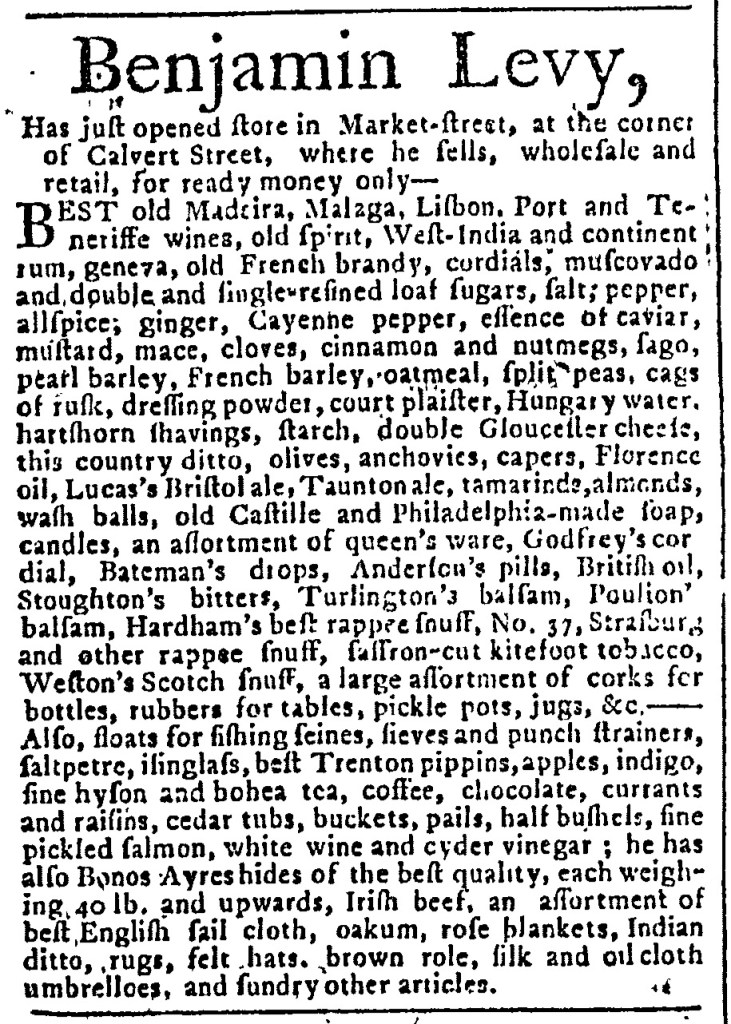
“Fine hyson and bohea tea.”

Benjamin Levy advertised a variety of groceries, including “fine hyson and bohea tea,” available at his store on Market Street in Baltimore in the December 18, 1773, edition of the Maryland Journal.  Two nights earlier, colonizers disguised as Indians boarded ships in Boston and tossed tea shipped by the East India Company into the harbor to protest the Tea Act.  While it would take a little time for that news to reach Baltimore, the newspaper carried other news about the escalating crisis.

The first page featured news from Boston, dated November 29: “Yesterday morning arrived here the ship Dartmouth, Capt. Hall, in 8 weeks from London, with 114 chests of the long expected and much talked of TEA.”  The following morning, a handbill posted around town proclaimed, “FRIENDS!  BRETHREN!  COUNTRYMEN!  THAT worst of plagues, the detested TEA, shipped for this port by the East-India Company, is now arrived in this harbour; the hour of destruction or manly opposition to the machinations of tyranny stares you in the face.”  In the face of this threat, “every friend to his country, to himself and posterity, is now called upon to meet at Faneuil Hall … to make a united and successful resistance to this last, worst and most destructive measure of administration.”  The remainder of the page and two columns on the second page provided an overview of the meeting, a response from the governor and Loyalist merchants, and a resolution from the town meeting stating that “if any person or persons shall hereafter import Tea from Great-Britain … until the said unrighteous Act shall be repealed, he or they shall be deemed by this body, an enemy of his country.”  In addition, “we will prevent the landing and sale of the same, and the payment of any duty thereon.  And we will effect the return thereof to the place from whence it shall come.”  Another resolution called for “the foregoing vote to be printed and sent to England, and all the sea-ports in this province.”  That news made it far beyond other ports in Massachusetts.

A much shorter piece followed the accounts from Boston.  A condescending note to women suggested that their enjoyment of tea played a significant role in precipitating the crisis, ignoring the fact that both men and women, poor, middling, and wealthy, all consumed tea.  “LADIES,” it declared, “HOWEVER coolly some of you may now esteem your husband, it might be worth your while to consider, whether by abandoning the accursed TEA, you will preserve your country and posterity in peace and good order, or expose twenty-five thousand of them to spill their blood, in defence of their undoubted birth-right.”  The anonymous correspondent anticipated an armed conflict over the English liberties that colonizers were supposed to possess, arguing that if that did indeed come to pass then women would be at fault for not abstaining from tea.  This echoed a sentiment so often expressed among the editorials in newspapers during the imperial crisis:  women presented dangers both political and cultural through their consumption of tea and other goods.

The Maryland Journal even included an inaccurate account of what occurred in Massachusetts: “A Gentleman just come to Town from Boston assures us, That the East India Company’s TEA, lately arrived at that Place, in several Ships, from London, for the Purpose of enslaving and impoverishing, if not poisoning, the People, was all sent back to the Proprietors, conformable to the noble and Spirited Resolves of the brave Inhabitants of the Town of Boston.”  That was not what happened at all, as colonizers in Baltimore would soon learn.  Even as Benjamin Levy advertised “fine hyson and bohea tea” for sale at his store in Baltimore, tea shipped by the East India Company floated in Boston Harbor.  A new stage of the imperial crisis was brewing as colonizers faced repercussions from Parliament for that act of protest.

November 20

What was advertised in a colonial American newspaper 250 years ago today?

Maryland Journal (November 20, 1773).

“Such unworthy motives as these are far from Dr. Gilbert’s intention.”

When Dr. H. Gilbert relocated from Philadelphia to Baltimore, he inserted an advertisement in the Maryland Journal to introduce himself to the community and solicit patients who wished to consult him about “all the disorders to which the human body is incident.”  His lively notice included commentary about the kinds of advertisements that others who provided medical services often placed. “It is now become almost customary,” the doctor observed, “at least many have of late thought proper to begin their address to the public with liberal encomiums on their own knowledge, practice, and abilities.”  When they arrived in new places, doctors could not rely on their reputations to encourage patients to see them; in the absence of such familiarity, many emphasized their training and experience to assure prospective patients that they would be in good hands.

Gilbert found a certain aspect of such introductions particularly unsavory and disingenuous.  Some doctors, he charged, “at once declare there is no disorder, however accute or malignant in its nature, that they cannot immediately not only give relief in, but effectually eradicate, without the least inconvenience or danger to the patient.”  Those claims appeared in too many newspaper advertisements and handbills, leading “persons who are unacquainted with the human frame” to believe that “many disorders exist altogether in the imagination, by the easy manner in which they are said to be expelled.”  Such marketing had two outcomes: “imposing on the ignorant” and “the emolument of the authors of such preposterous assertions.”  Unfortunately, patients often had a “fatal experience” under those circumstances.  Gilbert suggested that grandiose promises from doctors “must … appear in a very ridiculous light to every person of the smallest degree of penetration.”  In a backhanded fashion, he discouraged readers from seeking treatment from quacks and charlatans who seemed to promise too much.

Gilbert pledged that he would give patients false hopes by telling them merely what they wanted to hear and taking their money for cures that did not work.  He would not make “preposterous assertions” and swindle them: “such unworthy motives as these are far from Dr. Gilbert’s intention.”  He did relay his own credentials, “being regularly bred to his profession, as well as his having had several years experience and practice by land and sea, and in Germany, Holland, and America,” but did not make the kinds of unfounded assertions that he critiqued.  Instead, he stated that he would “exert his utmost abilities to serve” patients and “by good attendance and a particular attention to their respective cases, endeavour to merit the patronage of the public.”  In other words, Gilbert stressed the individualized care that he bestowed on each patient.  He assessed their particular symptoms and recommended care specific to their needs.  Rather than making self-promotion and dubious promises the centerpieces of his marketing efforts, he emphasized honesty and respect in his interactions with the public and his patients.

November 13

What was advertised in a colonial American newspaper 250 years ago today?

Maryland Journal (November 13, 1773).

“Mr. RATHELL thankfully acknowledges the receipt of a Letter signed ‘a Friend to Literary Institutions.’”

Joseph Rathell’s “PROPOSALS FOR ESTABLISHING A CIRCULATING LIBRARY IN BALTIMORE-TOWN appeared once again in the November 13, 1773, edition of the Maryland Journal.  So did William Aikman’s address “To the LADIES and GENTLEMEN of the Town of BALTIMORE concerning his efforts to establish a circulating library in Annapolis and deliver books to subscribers in Baltimore.  Aikman reported that he heard from prospective subscribers that they had concerns about “the trouble and risk they run of procuring and returning the books.”  To assuage such anxieties, he devised a plan for subscribers in Baltimore to submit orders and return books to a local merchant who would then forward them to Annapolis via a weekly packet ship.  Aikman planned to charge a dollar for delivery service in addition to the subscription fees.  Rathell mocked the additional fee in an advertisement that ran in the same issue of the Maryland Journal as Aikman’s notice.  He seemingly knew about Aikman’s advertisement before it appeared in print, perhaps tipped off by a friend in the printing office.

Whether or not that was the case, Rathell did receive other assistance from the Maryland Journal in marketing his circulating library.  The local news items included a blurb about his efforts and the response from residents of the city so far.  The blurb ran immediately below “SHIP NEWS” and before “PRICES CURRENT at BALTIMORE,” a prime spot for merchants and other readers to notice it.  It related that Rathell “thankfully acknowledges the receipt of a Letter signed ‘a Friend to Literary Institutions,’ enclosing the Names of sundry Ladies and Gentlemen, as Subscribers to his intended CIRCULATING LIBRARY.”  Readers may have doubted the veracity of this report, dismissing it as mere puffery.  Those who continued reading encountered commentary from Rathell that might have more appropriately appeared among the advertisements.  For instance, he pledged that “he will be particularly exact in selecting the Books, in which he will be principally governed by Gentlemen of known literary Skill, in Philadelphia, and New-York.”  In so doing, he directed attention away from Aikman’s library in Annapolis in favor of larger and more cosmopolitan port cities.  He also directly solicited requests from prospective subscribers to his library, proclaiming that “any Commands addressed to Mr. Rathell, directing his Attention to particular, scarce, or curious Publications, &c. shall meet due Regard.”  This advertisement masqueraded as a news item, supplementing the proposals that Rathell published elsewhere in the newspaper.  He could have incorporated all of the information into a single notice, but a news item doubled as an endorsement of his enterprise.  In the end, it did not matter.  Rathell did not manage to launch a circulating library in Baltimore.  Aikman had more success with his endeavor in Annapolis, at least prior to the Revolutionary War.

November 6

What was advertised in a colonial American newspaper 250 years ago this week?

Maryland Journal (November 6, 1773).

“PROPOSALS FOR ESTABLISHING A CIRCULATING LIBRARY IN BALTIMORE-TOWN.”

When he opened a circulating library in Annapolis in 1773, bookseller and stationer William Aikman faced competition in his efforts to recruit subscribers in Baltimore.  Joseph Rathell announced his own intention for “ESTABLISHING A CIRCULATING LIBRARY IN BALTIMORE-TOWN” in the October 23 edition of the Maryland Journal.  A week later, he published a longer advertisement, one that offered the same amenities, lower fees, and greater convenience for patrons than Aikman outlined in his notices.

In his updated address to prospective subscribers, Rathell emphasized the fees for “this much wish’d for Institution,” just “one Dollar a Quarter … (tho’ the Subscription to the Annapolis Library is One Guinea per Annum, besides the Expence of a Dollar a Year for Carriage of Books from thence to this Place by Water).”  He expected readers to recognize the bargain for the quarterly fee, while simultaneously mocking Aikman’s most recent advertisement.  Aikman apparently learned of Rathell’s “PROPOSALS” and, wary of the threat to his own efforts to expand his clientele beyond Annapolis, devised a plan to address the concerns that prospective subscribers had expressed about the “trouble and risk they run of procuring and returning the books.”  In an advertisement in the October 30 edition of the Maryland Journal, the first issue after Rathell’s original advertisement, Aikman presented what he considered a reasonable solution, “any orders for books left with Mr. Christopher Johnston, merchant, in Baltimore, will be regularly forwarded by a packet that goes weekly between Baltimore and Annapolis.”  Subscribers could request and return books for just a dollar a year, an additional fee that Rathell derided.  Somehow, the bookseller in Baltimore became aware of Aikman’s proposal before it appeared in print in the Maryland Journal.  In the same issue that Aikman first introduced delivery service Rathell published a rejoinder on another page.  The advertisements ran next to each other in the November 6 edition, drawing even more attention to the bargain that Rathell offered.  How did he know about Aikman’s newest proposal before reading the advertisement in the newspaper?  The annual subscription fee previously appeared in notices in the Maryland Gazette, advertisements that Rathell could have seen, but the delivery service was a new aspect of Aikman’s library.  Did someone in the printing office pass along that information?

Rathell sought to cater to “the Convenience of Gentlemen and Ladies of Literary Taste and Discernment” in Baltimore and surrounding towns, but he was not quite ready to launch his own circulating library.  His advertisement undercutting Aikman also served as an invitation to prospective subscribers to submit their names within three weeks of his advertisement’s first appearance in the Maryland Journal.  At that time, “if an adequate Number of Subscribers appear, the Library will be completed and opened without Delay.”  Rathell encouraged subscribers “to be speedy in entering their Names … that he may be the sooner enable to provide a COLLECTION OF BOOKS … very considerable in Number.”  He likely also intended that such haste would prompt prospective subscribers to choose between his library and Aikman’s library in Annapolis, boosting the prospects for his own by drawing subscribers away from a rival.  This ploy did not work, in part because prospective subscribers considered Aikman’s proposal the more viable option.  Rathell did not open a circulating library in Baltimore, despite the savvy appeals he made.  Other factors defeated his plan.  As Joseph Towne Wheeler explains, “the growing commercial town was still dependent upon the older community.”[1]  After all, the Maryland Journal, Baltimore’s first newspaper, commenced publication just a couple of months earlier.  “After the Revolution the situation was reversed,” Wheeler continues, noting that “when Parson Weems visited Annapolis in 1800, he could write, ‘There is not a book store in the whole town.’”[2]  Baltimore was not quite ready for the circulating library that Rathell envisioned.

**********

[1] Joseph Towne Wheeler, “Booksellers and Circulating Libraries in Colonial Maryland,” Maryland Historical Magazine 34, no. 2 (June 1939): 118.

[2] Wheeler, “Booksellers and Circulating Libraries,” 119.

October 30

What was advertised in a colonial American newspaper 250 years ago today?

Maryland Journal (October 30, 1773).

“Any orders for books … will be regularly forwarded by a packet that goes weekly between Baltimore and Annapolis.”

When William Aikman opened a circulating library in Annapolis in the summer of 1773, he hoped to gain subscribers in Baltimore and other towns.  Unlike modern public libraries open to all patrons, eighteenth-century circulating libraries lent books and other reading material only to subscribers who paid fees to access them.  To make the venture viable, Aikman needed to recruit as many subscribers as possible.  According to the advertisement he placed in the October 30 edition of the Maryland Journal, the newspaper only recently established in Baltimore, Aikman stated that he had learned that a “number of the friends of literature” in that city expressed interest in subscribing to his library yet refrained solely due to the “trouble and risk they run of procuring and returning the books” at such a distance.  His library catalog revealed which books subscribers could borrow, but the logistics of checking them out and returning them to the library remained an obstacle.

Aikman proposed a solution to that problem.  He instructed that “any orders for books left with Mr. Christopher Johnston,” a merchant in Baltimore, “will be regularly forwarded by a packet that goes weekly between Baltimore and Annapolis.”  Aikman charged an additional fee for this service, a dollar a year.  He also advised that it would go into effect “provided a proper number of subscribers can be got.”  In other words, prospective subscribers needed to consider not only the benefits that would accrue to them but also their duty to make the library more accessible to the “friends of literature” in their town.  Aikman promised “above two hundred volumes of all the new publications of merit” that subscribers could borrow rather than buy.

The bookseller and stationer in Annapolis may not have been aware that he faced a competitor.  Elsewhere in the October 30 edition of the Maryland Journal, Joseph Rathell published “PROPOSALS FOR ESTABLISHING A CIRCULATING LIBRARY IN BALTIMORE-TOWN,” offering residents a local alternative to the library in Annapolis.  The Adverts 250 Project will examine that advertisement, including Rathell’s dismissive reference to Aikman’s fees for delivering books to Baltimore, in another entry.

October 23

What was advertised in a colonial American newspaper 250 years ago today?

Maryland Journal (October 23, 1773).

“APOTHECARY in MARKET-STREET.”

Robert Bass ran an apothecary shop in Philadelphia in the early 1770s.  Along with several other apothecaries, he regularly advertised in the various newspapers published in the Quaker City.  In the fall of 1773, he expanded his marketing efforts to include the Maryland Journal and Baltimore Advertiser.  That newspaper, the first in Baltimore, commenced publication near the end of August.  Previously, residents of that growing port and nearby towns relied on the Maryland Gazette, printed in Annapolis, and newspapers from Philadelphia as their local newspapers.  Merchants, shopkeepers, and artisans in Baltimore sometimes placed advertisements in those publications.  Similarly, advertisers based in Philadelphia, including apothecaries, often mentioned that they served customers in the countryside and promptly filled orders that they received from a distance.  When Bass placed advertisements in the Pennsylvania Chronicle or the Pennsylvania Gazette, for instance, he expected that prospective customers in Baltimore (and many other towns) would see them.

The founding of the Maryland Journal altered the print culture landscape in the region.  The newspapers that previously served Baltimore and its environs continued to circulate there, but residents had more immediate access to a local newspaper.  Hoping to retain his share of the market or perhaps even make gains via advertising in the new publication, Bass quickly decided to place notices in the Maryland Journal.  His advertisement received a privileged place in the October 23 edition.  It appeared as the first item in the first column on the first page, below a masthead for “NEW ADVERTISEMENTS.”  The apothecary advised that he had just acquired “a very large supply of capital DRUGS and PATENT MEDICINES, to serve the fall and winter seasons.”  In addition, he “properly compounded” prescriptions at his shop.  Unfortunately for Bass, he was not the only advertiser who offered such services.  Two columns over, Patrick Kennedy, “Surgeon and Apothecary,” hawked “a large assortment of patent medicines” and declared that he “carefully prepared” prescriptions at his shop in Baltimore.  Readers who lived relatively close to Kennedy’s shop may have preferred to obtain their medicines from him as a matter of convenience, but for prospective customers in the countryside it may not have mattered whether they sent orders to Baltimore or Philadelphia.  Bass even expected that some readers would visit his shop, advising that he gave “constant attendance every day except Sundays.”  Although Baltimore now had its own newspaper, Bass did not consider it a separate local market.  Instead, he attempted to use the new publication to maintain or even expand his share of a regional market.  Whatever the outcome may have been, he considered it worth the investment of placing an advertisement in some of the first issues of the Maryland Journal.

October 16

What was advertised in a colonial American newspaper 250 years ago today?

Maryland Journal (October 16, 1773).

“As they are but new beginners, country merchants may depend on being served with any of the above articles at the lowest rates.”

When Daniel McHenry and Son advertised their “Wholesale and Retail store, on the east side of Calvert-street” in Baltimore in the October 16, 1773, edition of the Maryland Journal, they described themselves as “new beginners.”  Though they had little experience as merchants and shopkeepers, their advertisement followed a format familiar to readers and consumers.  Advertisements for goods and services were so ubiquitous by the 1770s that “new beginners” could craft their own newspaper notices by selecting from among many standard elements that regularly appeared in advertisements throughout the colonies.

McHenry and Son, for instance, emphasized consumer choice.  They described their inventory as “a large and various assortment of merchandize.”  To demonstrate, they listed more than two dozen items from among their “DRY GOODS,” mostly textiles but also “playing cards, rose and Indian blankets, [and] women’s made up cloaks.”  They promised that they stocked “HARD-WARE,” but did not enumerate any of those items.  McHenry and Son devoted a separate list to “GROCERIES.”  Both lists concluded with “&c.” (an abbreviation for et cetera) to indicate that customers would discover so much more on the shelves when they visited the store.  Additional elements of the advertisement replicated other newspaper notices.  McHenry and Son sold goods “suitable to the season.”  They also assured prospective customers that they carried new goods rather than hawking leftovers; they acquired their merchandise via “the last vessels from London, Liverpool, Ireland,” and other ports.  McHenry and Son also promoted “the quality of their goods” and low prices or “the lowest rates” for their customers, especially “country merchants” looking to stock their own shops.

McHenry and Son sought to take advantage of common advertising strategies to entice customers.  At the same time, they attempted to leverage their status as “new beginners,” asking prospective customers to take into account their willingness to set lower prices (for goods of the same quality) compared to merchants with more experience.  To establish their reputations and secure their position in the marketplace, McHenry and Son offered the best bargains in hopes that doing so “will induce the public to give them a trial” and then continue purchasing from them in the future.  They made their status as “new beginners” a selling point, even as they crafted an advertisement that otherwise testified to their understanding of what mattered most to colonial consumers.

September 25

What was advertised in a colonial American newspaper 250 years ago today?

Postscript to the Maryland Journal (September 25, 1773).

“At the Sign of the CUP and CROWN … in BALTIMORE.”

William Goddard quickly gained advertisers for the Maryland Journal and Baltimore Advertiser, the city’s first newspaper, when he commenced publication in August 1773.  So many advertisers submitted notices to the printing office that a two-page supplement accompanied the sixth issue.  That Postscript contained advertising exclusively.  In addition, paid notices filled the entire final page of the standard four-page edition, along with a couple advertisements below the prices current on the third page.  A lengthy list of winning tickets and prizes from the Frederick Street Lottery, likely also a paid advertisement, occupied the first page.  Christopher Hughes and Company, “GOLDSMITHS and JEWELLERS, At the Sign of the CUP and CROWN,” joined many others in using the new publication to market goods and services or disseminate information that did not appear among the articles and editorials selected by the editor.

The publication of the Maryland Journal, published on Saturdays, shifts the contours of the Adverts 250 Project.  The project currently incorporates approximately two dozen newspapers published in 1773 and subsequently digitized to make them more accessible.  Of those many newspapers, however, only the Providence Gazette was published on Saturdays.  Once a week, that made the Providence Gazette the only option for selecting an advertisement to feature on the Adverts 250 Project.  That allowed for examining that newspaper, as well as the city and the region it served, in greater depth, but it also resulted in disproportionate representation of the Providence Gazette, one out of seven entries on the Adverts 250 Project, relative to the total number of digitized newspapers currently available.  On occasion, this also significantly narrowed the choices in issues with few advertisements or with many advertisements previously featured on the Adverts 250 Project as a result of running for several weeks.

Goddard published the Maryland Journal on Saturdays for less than a year.  That means that my opportunity to consult both the Maryland Journal and the Providence Gazette when selecting which advertisement to feature will be temporary, but I plan to make good use of that opportunity while it lasts.  In addition, America’s Historical Newspapers provides access to the Maryland Journal into the 1790s, which means that the newspaper will continue to be part of the Adverts 250 Project and the Slavery Adverts 250 Project long “after” publication shifts to other days of the week.

September 18

What was advertised in a colonial American newspaper 250 years ago today?

Maryland Journal (September 18, 1773).

“A lecture on the necessity, advantage, beauty, and propriety of a just vocal expression.”

When Mr. Rathell, “formerly of Annapolis, Teacher of the English Language, Writing-master and Accomptant,” opened a school and offered private lessons in Baltimore he introduced himself to prospective students and their families with an advertisement in the Maryland Journal.  Much of the lengthy advertisement focused on establishing his experience and credentials.  Rathell noted that he “for some time superintended the Academy of the late eminent Mr. Dove, professor of oratory in Philadelphia.”  That led to Dove recommended him as a private tutor who earned “the approbation of many respectable families” in the largest city in the colonies.  Rathell claimed that he “can produce indubitable proofs” of Dove’s approval of his endeavors as a private tutor.  He also promised to strive to continue “to do justice to the recommendation of the celebrated teacher … whose memory is justly revered by the first literary character in America.”  If prospective students and their families were not familiar with “the late eminent Mr. Dove,” Rathell implicitly suggested that reflected on them and gave all the more reason that those who wished to rank among the genteel needed to engage his services.

Furthermore, the tutor gained additional experience in Lancaster, Pennsylvania.  “To give still greater weight to his credit as a private tutor,” Rathell exclaimed, “he cannot avoid mentioning, with very great respect, that at Lancaster he has been favoured with an attendance on several Ladies eminent for literary accomplishments.”  He lauded his former pupils, recognizing “their own happy genius,” while also insisting that their accomplishments “would give consequence to, and establish the reputation of, the most capital teacher at the first court in Europe.”  Despite the distance that separated Baltimore from London, Paris, and other centers of cultural and fashion, Rathell asserted that his students received instruction that rivaled that available to monarchs and nobles.

Rathell also used his advertisement to preview a program that he envisioned, one that had the potential to enhance his reputation in Baltimore and attract more students to his school.  He proposed “to read, in public, a few pieces from the most eminent English authors.”  The elocution of the “Teacher of the English Language” would be on full display for his audience.  In addition, he planned “to deliver a lecture on the necessity, advantage, beauty, and propriety of a just vocal expression, wherein the use and elegance of accent, quantity, emphasis, and cadence will be illustrated.”  Again, Rathell made an implicit argument to prospective students and their families.  It did not matter how expansive their knowledge of literature or how fashionably they dressed if their manner of speaking betrayed them as not truly genteel.  Learning to express themselves with “elegance” was an aspect of personal comportment vital to demonstrating status and sophistication.  Those who did not master their speech risked being considered imposters when they gathered with the better sort.  Like many other tutors, whether they taught elocution or dancing or French, Rathell played on the anxieties and insecurities of prospective students and their families while also trumpeting his experience successfully teaching others skills associated with gentility and social standing.