September 4

What was advertised in a colonial American newspaper 250 years ago today?

Maryland Journal (September 4, 1773).

Advertisements omitted, will be inserted in our next.”

William Goddard quickly attracted advertisers when he commenced publication of the Maryland Journal, the first newspaper printed in Baltimore, in August 1773.  Paid notices filled four and a half columns, out of twelve total, in the third issue, but that was not all of them submitted to the printing office.  Goddard included a brief note alerting readers and, especially, advertisers who expected to see their notices in print that “Advertisements omitted, will be inserted in our next.”  Advertising represented an important revenue stream for printers, so Goddard must have been pleased with his initial success in attracting advertisers for the Maryland Journal.

For their part, advertisers from Baltimore and beyond welcomed the opportunity to disseminate information in the new publication.  Eleven of the advertisements in the September 4 edition described runaway indentured servants or runaway convict servants and offered rewards for their capture and return to their masters.  Previously, residents of Baltimore and surrounding towns resorted to the Maryland Gazette, published in Annapolis, the Virginia Gazette, published in Williamsburg, and the several newspapers published in Philadelphia to alert colonizers about runaways and encourage them to participate in surveillance of strangers to assess whether they matched the descriptions in the public prints.  The Maryland Journal buttressed the efforts of certain colonizers to use the early American press to uphold what they considered the appropriate order in their communities.

Other advertisers, including purveyors of consumer goods and services, now had a truly local alternative for promoting their businesses.  In the September 4 edition, Ewing and Hart marketed rum, wine, and spirits at their store on Gay Street, John Flanagan hawked tea, coffee, and sugar at his store on Market Street, and Nicholas Brooks promoted jewelry and prints “at the CROWN and CUSHION, in BALTIMORE.”  In addition, John Hamilton, “TAILOR and HABIT-MAKER, from GLASGOW,” introduced himself to prospective clients with an announcement that he “has opened shop in Gay-street, BALTIMORE-TOWN … where he makes mens and womens clothes in the very newest fashions.”  He highlighted his experience “having wrought for eight years past in the best shops in Britain,” hoping that readers would be impressed enough to give the newcomer a chance to build a reputation in Baltimore.  He promised to make it “his constant endeavour to give, to the utmost of his power, entire satisfaction” to his customers in return for “suitable encouragement from the generous public.”  The Maryland Journal provided an introduction to prospective customers beyond those Hamilton happened to meet in the course of his daily routine.

Other advertisers sought the advantages of placing notices in Baltimore’s first newspaper, some with advertisements that ran on September 4 and others with advertisements delayed until the next edition.  A newspaper, complete with shipping news, prices current, and advertisements, marked the port’s growing size and significance in the region.

August 22

What was advertised in a colonial American newspaper 250 years ago this week?

Maryland Journal (August 20, 1773).

“He will be always ready to convey to his partner any new fashions.”

Just a few days before William Goddard distributed the inaugural issue of the Maryland Journal, the first newspaper published in Baltimore, Grant and Garritson, “TAYLORS from PHILADELPHIA,” submitted an advertisement to the printing office on Market Street.  Their advertisement was one of twenty that ran in the first issue of the newspaper.  About half of the notices promoted consumer goods and services.  Others included legal notices, real estate opportunities, an account of a lost bundle of papers, and a description of an indentured servant who ran away from his master.  Two advertisements concerned enslaved people, one seeking a young girl to purchase and the other offering a reward for the capture and return of Prince, an enslaved man who liberated himself and managed to elude his enslaver.  All in all, the advertisements in the Maryland Journal resembled those that ran in other newspapers throughout the colonies.

Grant and Garrison’s advertisement also looked similar to notices by tailors in other newspapers.  They stated that they “will be greatly obliged to all Gentlemen who will be pleased to favour them with their commands” and they pledged that their customers “may depend on having their work done in the neatest and most fashionable manner, with care and dispatch.”  With an economy of prose, Grant and Garritson made appeals to quality, fashion, customer service, and their own skill.  As many artisans did in their notices, the tailors also emphasized their previous experience working in another location, one known for its cosmopolitanism.  Tailors and others often described themselves as “from London” or “from Paris.”  In this instance, Grant and Garritson purposefully presented themselves as “TAYLORS from PHILADELPHIA,” the largest and most cosmopolitan city in the colonies.  Yet they did not merely possess a prior connection to that major urban port.  The tailors explained in a note at the end of their advertisement that Grant “resides and carries on the business in Philadelphia.”  That being the case, “he will be always ready to convey to his partner any new fashions, either in making or trimmings.”  Tailors, seamstresses, milliners, and others in the garment trades in Philadelphia and other port cities eagerly awaited news about new fashions from Europe.  Grant and Garritson provided a direct pipeline for disseminating that information to their clients in Baltimore, making sure that they kept pace with all the latest developments and perhaps even ahead of the curve compared to others colonizers who did not have tailors with such beneficial networks.  As Baltimore gained in prominence as a port and a center of commerce, Grant and Garrison offered their services in keeping their clients advised of the latest fashions so they could demonstrate their own influence.

August 21

What was advertised in a colonial American newspaper 250 years ago this week?

Maryland Journal (August 20, 1773).

“He rides POST from the town of Baltimore to the town of Frederick (once a week).”

The inaugural issue of the Maryland Journal carried twenty advertisements in addition to an address from William Goddard, the printer, news from London, Philadelphia, and Baltimore, an essay “On the SIMPLICITY OF DRESS,” a letter responding to an editorial in the Maryland Gazette, prices current for commodities in Baltimore, a list of letters arrived “by the Frederick-Town POST,” and a poem.  Like other colonial newspapers, the Maryland Journal featured a variety of content.  As Goddard explained in his address, the publication “shall contain not only the Public News, which I shall collect and compile with the greatest Care, but … I will supply the Room with such moral Pieces, from the best Writers, as will conduce most to inculcate good Principles and humane Behaviour, and now and then with Pieces of Wit and Humour, that tend both to amuse and instruct.”

The advertisements included one from the post rider who had delivered the letters from Frederick, a town about forty-five miles west of Baltimore.  Absalom Bonham informed the public that he made the journey between Baltimore and Frederick once a week.  In addition, he continued from Frederick on to Winchester, Virginia, delivering messages, carrying letters, and distributing newspapers.  The post rider also served as a subscription agent for the Maryland Journaland the Pennsylvania Chronicle, the newspaper that Goddard had published in Philadelphia for the past several years.  Bonham set off “from Mr. WILLIAM ADAMS’s, at the sign of the Race Horses, in Baltimore,” every Saturday afternoon, the day after the weekly edition of the Maryland Journal went to press.  He apparently figured that residents of Frederick, Winchester, and other towns along the way were already familiar enough with his comings and goings that he did not need to provide additional information about his route and schedule.

In another notice in the inaugural issue, Goddard offered employment to an “active faithful Man, who can write a tolerable Hand, and keep a fair Account, and is otherwise well qualified to ride as a private POST or CARRIER between this Town and Philadelphia, once a Week.”  The printer needed a trustworthy assistant bow that he oversaw publication of newspapers in two towns.  Both of these advertisements testified to the infrastructure for producing and, especially, disseminating newspapers in eighteenth-century America.  Goddard had already undertaken a campaign for attracting subscribers for the Maryland Journal.  Bonham, the post rider, continued those efforts as part of his duties in the towns he visited each week.

August 20

Who were the subjects of advertisements in a colonial American newspaper 250 years ago today?

Maryland Journal (August 20, 1773).

“A NEGRO GIRL, about 12 years old.”

“RAN away … Negro PRINCE.”

After many months of disseminating subscription proposals and promoting the Maryland Journal, the first newspaper published in Baltimore, William Goddard printed and distributed the first issue on August 20, 1773.  In addition to subscribers, he sought advertisers to generate revenues that would make the enterprise viable.  In an update that appeared in the May 20 edition of the Maryland Gazette, for instance, Goddard pledged that “seasonable notice will be given in this gazette, to give gentlemen an opportunity to advertise in the first number.”  Just as John Dunlap managed to do when he launched the Pennsylvania Packet, Goddard attracted a significant number of advertisers for the first issue of the Maryland Journal.  Advertising accounted for a little more than four of the twelve columns in the inaugural issue.

Those advertisements included some that previously appeared in other newspapers, including Daniel Grant’s notice that he opened an inn and tavern “at the Sign of the Fountain” in Baltimore and a lengthy notice concerning land in the Ohio River valley placed by Virginia planter and land speculator George Washington.  Other advertisers included Christopher Hughes and Company, “GOLDSMITHS and JEWELLERS,” David Evans, “CLOCK and WATCH-MAKER,” Francis Sanderson, “COPPERSMITH,” Grant and Garrison, “TAYLORS,” and Mr. Rathell, “Teacher of the ENGLISH Language, Writing-master and Accomptant.”

Maryland Journal (August 20, 1773).

In addition, Thomas Brereton, “COMMISSION and INSURANCE BROKER,” placed a short notice in which he “GRATEFULLY acknowledges the favours of his friends, and hopes for a continuance of their correspondence.”  He also reported that he “has now for sale, a Pocket of good HOPS, a 10-inch new CABLE – and wants to buy a NEGRO GIRL about 12 years old.”  In another advertisement, Richard Bennet Hall described a Black man, Prince, who had liberated himself the previously December.  Prince was captured once “at Susquehanna Lower Ferry, but made his escape, and is often seen in the neighbourhood.”  The formerly enslaved man managed to elude capture, but Hall hoped his advertisement would help put an end to that. He offered five dollars who anyone who detained Prince in a local jail “so that that the owner may get him again” or ten pounds and “reasonable charges” to anyone who delivered Prince to Hall in Prince George’s County.  In its very first issue, the Maryland Journal became an instrument for perpetuating slavery with both a brokerage notice related to the slave trade and an advertisement encouraging readers to engage in surveillance of Black men in order to identify an enslaved man who liberated himself and assist in returning him to captivity.  Goddard had prior experience publishing such advertisements in the Providence Gazette and the Pennsylvania Chronicle.  From New England to Georgia, no newspaper printer in the colonies rejected advertisements about enslaved people.  Instead, they solicited and accepted them as an integral part of generating revenues that underwrote publishing news and editorials.

May 20

What was advertised in a colonial American newspaper 250 years ago today?

Maryland Gazette (May 20, 1773).

“Seasonable notice will be given in this gazette, to give gentlemen an opportunity to advertise in the first number.”

William Goddard, the printer of the Pennsylvania Chronicle in Philadelphia, continued his efforts to establish a new operation in Baltimore.  In the early 1770s, Maryland had only one newspaper, the Maryland Gazette, published by Anne Catherine Green and Son in Annapolis.  In late October 1772, Goddard placed an advertisement in that newspaper to announce his intention to publish the Maryland Journal and Baltimore Advertiser “as soon … as I shall obtain a sufficient Number of Subscribers barely to defray the Expence of the Work.”  He also solicited advertisements, stating that they “shall likewise be accurately published, in a conspicuous Manner, with great Punctuality, at the customary Prices.”

Nearly seven months later, Goddard inserted an update in the May 20, 1773, edition of the Maryland Gazette.   He had opened a printing office “in Baltimore-town,” where “PRINTING in all it’s various branches, [was] performed in a neat,correct, and expeditious manner, on the most reasonable terms.”  The printer also informed readers that he would begin publishing the Maryland Journal “As soon as proper posts or carriers are established.”  They could expect at least one more update in the Maryland Gazette before that happened because Goddard wished “to give gentlemen an opportunity to advertise in the first number.”  While advertising could aid merchants, shopkeepers, artisans, and others in capturing the markets served by Baltimore’s first newspaper, Goddard also knew from experience that advertisements accounted for an important revenue stream.

In his notice, Goddard attended to both advertisers and subscribers.  He requested that the “gentlemen” who served as local agents “who have been so obliging as to take in subscriptions … transmit the subscription lists (or the subscribers names and places of abode) as speedily as possible” so he “may be enable to ascertain the number necessary to be printed” as well as make arrangements for delivering the newspapers “to every subscriber.”  Goddard was still three months away from publishing “the first number” of the Maryland Journal and Baltimore Advertiser, but his notice in the Maryland Gazette kept the public, including prospective subscribers and advertisers, apprised of his progress.  In the coming months, the Adverts 250 Project will examine Goddard’s success in attracting advertisers for “the first number” and subsequent editions of Baltimore’s first newspaper.

October 29

What was advertised in a colonial American newspaper 250 years ago today?

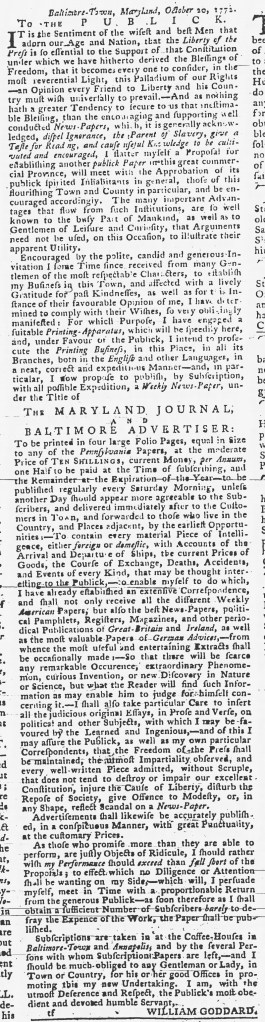
Maryland Gazette (October 29, 1772).

“I now propose to publish, by Subscription, … a Weekly News-Paper.”

Maryland had only one newspaper in 1772.  William Goddard aimed to change that.  To aid his efforts, he inserted a proposal in the October 29 edition of the Maryland Gazette, the publication that would be his competitor if he managed to launch “THE MARYLAND JOURNAL, AND BALTIMORE ADVERTISER.”  Printed in Annapolis, the Maryland Gazette served the entire colony, but Goddard believed that a market existed, or would exist after some savvy advertising, to support two newspapers in the colony.  In addition, he underscored the political utility of newspapers to prospective subscribers.  “IT is the Sentiment of the wisest and best Men that adorn our Age and Nation,” Goddard declared in the first sentence of his proposal, “that the Liberty of the Press is so essential to the Support of that Constitution under which we have hitherto derived the Blessings of Freedom, that it becomes every one to consider, in the most reverential Light, this Palladium of our Rights.”  The printer further explained that “well conducted News-Papersdispel Ignorance, the Parent of Slavery, give a Taste for Reading, and cause useful Knowledge to be cultivated and encouraged.”  Accordingly, he called on “every Friend to Liberty and his Country” to support his proposed project.

Goddard’s proposal filled nearly an entire column in the Maryland Gazette.  In addition to expounding on the philosophy that prompted him to consider publishing a newspaper in Baltimore, he advised potential subscribers that he was indeed prepared to launch the venture “as soon … as I shall obtain a sufficient Number of Subscribers barely to defray the Expence of the Work.”  Already in correspondence with “many Gentlemen of the most respectable Characters” in Baltimore, Goddard had “engaged a suitable Printing-Apparatus, which will be speedily here.”  In addition, as printer of the Pennsylvania Chronicle he had already “established an extensive Correspondence, and shall not only receive all the different Weekly American Papers, but also the best News-Papers, political Pamphlets, Registers, Magazines, and other periodical Publications of Great-Britain and Ireland.”  In addition to printer and publisher, Goddard assumed the responsibilities of editor, drawing the news from the letters, newspapers, and periodicals sent to him.  Every American newspaper printer-editor reprinted extensively from other publications. Goddard even acquired “the most valuable Papers of German Advices” in order to provide news of interest to the growing German population in the backcountry.

The proposal also outlined the particulars of the publication and how to subscribe.  The newspaper would be “printed in four large Folio Pages, equal in Size to any of the Pennsylvania Papers” that, along with the Maryland Gazette, operated as local newspapers for Baltimore and the region.  Goddard intended to print and distribute the newspaper “regularly every Saturday Morning, unless another Day should appear more agreeable to the Subscribers.” Subscriptions cost ten shillings per year, with half to be paid immediately and the other half at the end of the year. Goddard briefly mentioned advertisements, noting they would be “accurately published, in a conspicuous Manner, with great Punctuality, at the customary Prices.”  He did not list those prices.  Colonizers interested in subscribing could leave their names “at the Coffee-Houses in Baltimore-Town and Annapolis” or with “several Persons with whom Subscription Papers are left.”  Like other printers attempting to launch new projects, Goddard relied on a network of local agents who assisted in recruiting subscribers.

Beyond the particulars, Goddard emphasized that he pursued a higher purpose than merely generating revenues or turning a profit on the publication.  He promised to publish news about every “remarkable Occurence, extraordinary Phenomemon, curious Invention, or New Discovery in Nature or Science” as well as “judicious original Essays … on political and other Subjects.”  In selecting material to include in the Maryland Journal, Goddard pledged that “the Freedom of the Press shall be maintained, the utmost Impartiality observed, and every well written Piece admitted, without Scruple, that does not tend to destroy or impair our excellent Constitution, injure the Cause of Liberty, disturb the Repose of Society, give Offence to Modesty, or, in any Shape, reflect Scandal on a News-Paper.”  In an era of upheaval as Parliament turned unwanted attention to the colonies, Goddard framed publishing a newspaper as a civic duty that served the commercial and political interests of the community.

Did the subscription proposal help Goddard to obtain that “sufficient Number of Subscribers barely to defray the Expence” and commence publication?  Perhaps, but it took some time.  The first issue appeared on August 20, 1773, ten months after Goddard initially proposed publishing the Maryland Journal and Baltimore Advertiser.  The newspaper continued publication, under the guidance of various printers and proprietors, throughout the American Revolution and into the 1790s, transitioning from weekly to semi-weekly to tri-weekly to daily as newspaper publishing expanded throughout the new nation.