May 25

What was advertised in a colonial American newspaper 250 years ago today?
Pennsylvania Gazette (May 25, 1774).

“His Liquor shall ever be pure and unmixed.”

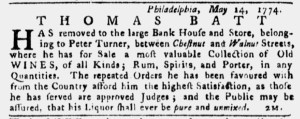
Thomas Batt believed in the power of advertising to yield success for his business.  In 1774, he took to the pages of the Pennsylvania Gazette to announce that he had “opened his WINE and SPIRIT STORE” on Water Street in Philadelphia, pledging “to render the retailing of Liquors as compleat and convenient to the Public, as it is in the Power of Expence and strict Attention to do.”  Not long after that advertisement concluded its run, Batt placed another advertisement, this one dated May 14, to alert the public to his new location at “the large Bank House and Store … between Chestnut and WalnutStreet.”

He took the opportunity to review his inventory with prospective customers, asserting that he stocked “a most valuable Collection of Old WINES, of all Kinds” as well as “Rum, Spirits, and Porter, in any Quantities.”  Batt made a similar appeal about customers purchasing whatever quantity they desired in his previous advertisement, declaring that he was “determined to sell any Quantity, from a Pipe [a large barrel] to a Gallon.”  Perhaps he sought to distinguish himself from local vendors known for selling only large quantities or only small quantities.  Batt emphasized convenience in his initial advertisement; allowing consumers to select the quantity that suited their needs helped him to deliver on that promise.

He also highlighted quality and satisfaction.  He concluded his advertisement with an assurance that “his Liquor shall ever be pure and unmixed.”  Batt did not water down his wine or dilute higher quality spirits with lesser quality ones to increase his profit margins by fooling customers.  The retailer was well on his way to securing a favorable reputation, especially considering the “repeated Orders” he received from “approved Judges” of wines and spirits.  Batt hoped that existing clientele would follow him to his new location as well as new customers seeking him there.  His advertisements suggested a variety of reasons for choosing him over other retailers.
February 26

What was advertised in a colonial American newspaper 250 years ago today?

Providence Gazette (February 26, 1774).

“He also attends the Sick as usual, either in Town or Country, upon the shortest Notice, with the greatest Care and Fidelity.”

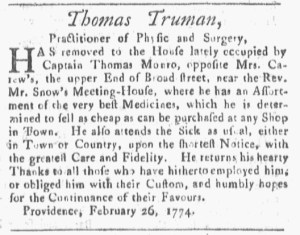
More than a year after he first positioned himself as the successor to “Doctor SAMUEL CAREW, late of Providence, deceased,” Thomas Truman, “Practitioner of Physic and Surgery,” continued to practice in that town.  As February 1774 came to an end, he once again took to the pages of the Providence Gazette, this time to announce that he “removed” to a new location.  In directing prospective patients to “the House lately occupied by Captain Thomas Munro, opposite Mrs. Carew’s, the upper End of Broad-street, near the Rev. Mr. Snow’s Meeting-House,” he reminded readers of his former affiliation with the deceased doctor.  Mentioning the widow may have jogged the memories of some who had known Truman “during his Apprenticeship with Doctor CAREW.”  When he first sought to establish himself in Providence, Truman faced competition from others who advertised their services as physicians, including Ebenezer Richmond and Daniel Hewes.

Truman’s advertisements may have helped him secure his place.  He expressed “his hearty Thanks to all those who have hitherto employed him … and humbly hopes for the Continuance of their Favours.”  He apparently considered advertising effective enough to justify subsequent investments.  Upon moving to his new location, he advised that he stocked “an Assortment of the very best Medicines, which he is determined to sell as cheap as can be purchased at any Shop in Town.”  Truman realized that for one segment of his business he competed not only with other practitioners but also with apothecaries who compounded medicines and even merchants and shopkeepers who imported patent medicines.  In addition, he “attends the Sick as usual, either in Town or Country, upon the shortest Notice, with the greatest Care and Fidelity.”  Truman wanted readers to remember him when they fell ill.  No matter where they happened to reside, he pledged to provide exemplary care as quickly as possible.  An occasion advertisement in the Providence Gazette enhanced his visibility among prospective patients beyond the reputation he earned through word of mouth.

October 26

What was advertised in a colonial American newspaper 250 years ago today?

South-Carolina Gazette and Country Journal (October 26, 1773).

“A GENTEEL ORDINARY [and] a COFFEE-ROOM.”

Just six months after advertising that he moved to a new location, Francisco Morrelli (sometimes Francis Morelli), “PASTRY-COOK,” took to the public prints once again to alert “those Gentlemen who were so kind to favour him with their Custom,” along with prospective new customers, that he had moved to a “large and commodious HOUSE” at the corner of Church and Elliott Streets in Charleston.  He invited “Gentlemen only” to enjoy “the best Entertainment this Province can possibly afford.”  With that invitation, Morelli established his “GENTEEL ORDINARY” as a homosocial space, like many taverns and coffeehouses, for men to gather to eat, drink, conduct business, socialize, discuss politics, conduct business, and gossip.  In asserting that “Gentlemen only may be accommodated” at his ordinary, may have also signaled that he welcomed only the better sorts.  Others should congregate elsewhere.

Morelli also promoted new services.  In his previous advertisement, he invited patrons to imbibe “Wine, Punch, [and] Beer” at his ordinary, while this “large and commodious HOUSE” had space for a “COFFEE-ROOM for the Reception of those Gentlemen who may chuse to drink Tea or Coffee” and “read Papers.”  He reported that he “intends to be furnished with every News Paper that can be procured.”  That meant local publications, perhaps all three of the newspapers printed in Charleston at the time, as well as newspapers from other cities and towns, especially major ports like Boston, New York, and Philadelphia.  Eighteenth-century coffeehouses often subscribed to newspapers as a service to a clientele that perused them to keep informed about both politics and commerce.  The shipping news and prices current from places near and far, for instance, aided merchants in transacting business.

The pastry cook also delivered takeout meals to prospective customers, a service not limited to “Gentlemen only.”  Morelli declared that “any Family wanting Dinners or Suppers drest [or prepared] and sent Home to their Houses, may be genteelly served on the shortest Notice.”  Other entrepreneurs provided similar services in early America.  For instance, when Edward Bardin opened a “compleat Victualing-House” in New York in June 1770, he offered meals “ready dressed, sold out in any Quantity, to such Persons who may find it convenient to send for it.”  Meal delivery in American cities dates back at least as far as the eighteenth century.

Morelli concluded his advertisement with a short note about “PASTRY and DESERTS as usual,” hawking the “Pies, Tarts, Cakes, Jellies,” and other treats that he mentioned in an earlier advertisement.  They accounted for only a portion of the services and amenities that he presented to current and prospective customers.  In addition to selling and delivering meals and pastries, Morelli hoped to make his “GENTEEL ORDINARY” and “COFFEE-ROOM” a destination for merchants, planters, and other local gentry.

January 19

What was advertised in a colonial American newspaper 250 years ago today?

South-Carolina Gazette and Country Journal (January 19, 1773).

“WILLIAM BOWER … continues to carry on the CLOCK and WATCH-MAKING BUSINESS.”

“KATHARINE BOWER … carries on the MILLINARY BUSINESS.”

When clock- and watch-maker William Bower moved to a new location, he placed an advertisement in the January 19, 1773, edition of the South-Carolina Gazette and Country Journal to inform current and prospective customers.  Now located “next door to The Great Stationary and Book Store,” he continued to offer the same services “as cheap and expeditiously done, as by any [other clock- and watchmaker] in the province.”  Katharine Bower, a milliner, also advised the public that she moved to a new location “where she carries on the MILLINARY BUSINESS in all its branches, and will be much obliged to her friends for a continuance of their favours.”  William and Katharine, presumably husband and wife, but possibly otherwise related, now ran businesses from the same location at “the store the fourth corner of Tradd-street and the Bay, lately possessed by Messrs. Mackenzie & Tunno.”  Previously, William had a workshop on Broad Street, while Katharine kept shop on Church Street.

In addition to sharing a store at the corner of Tradd Street and the Bay, William and Katharine also advertised together, purchasing a “square” of space in one of the local newspapers.  Husbands and wives (and other male and female relatives) who pursued separate occupations sometimes did so, especially in newspapers published in Charleston.  Those advertisements tended to adhere to certain patterns.  The husband or other male relative usually appeared first, followed by his wife or other female relative.  In some instances, the female entrepreneur appeared only in a brief note at the end of the advertisement.  In this case, however, both William and Katharine had headlines in larger fonts that made their names visible to readers.  William had a secondary headline that gave his occupation, “CLOCK and WATCH MAKER,” while Katharine did not.  Even when female entrepreneurs were not relegated to a short note, the amount of space devoted to promoting the husband’s business usually exceeded that amount of space for the wife’s business.  At a glance, that looked like the case in the Bowers’ advertisement.  However, much of the additional space in William’s portion of the notice gave extensive directions to the new shop, directions that Katharine did not need to repeat.  Katharine did not make as elaborate appeals about price and customer service as William, but she did encourage existing customers to visit her at her new location.

The Bowers pooled their resources to insert an advertisement in the South-Carolina Gazette and Country Journal.  Their notice gave preference to William by listing his business first and including a secondary headline that listed his occupation, but this did not overshadow Katharine’s enterprise as much as some other advertisements placed jointly by men and women.  Katharine’s name appeared as a headline in the same size font as William’s name and, aside from the directions to the new location, the details about her business occupied a similar amount of space.  In general, the notice communicated that both William and Katharine were competent entrepreneurs responsible for their own participation in the marketplace.

December 5

What was advertised in a colonial American newspaper 250 years ago today?

Providence Gazette (December 5, 1772).

“The PRINTING and POST-OFFICES are removed to Meeting-Street.”

John Carter’s printing office had a new location.  In early December 1772, the printer of the Providence Gazette moved from his location “in King-Street, opposite the Court-House” to a new location “in Meeting-Street, near the Court-House.”  The colophon in the November 28 edition listed the former address.  Carter updated the colophon in the December 5 edition.

That was not his only means for letting readers know that the printing office moved.  He also inserted a notice that stated, “The PRINTING and POST-OFFICES are removed to Meeting-Street, nearly opposite the Friends Meeting-House.”  To draw attention to it, Carter enclosed the notice within a border made of decorative type and gave it a prominent spot on the front page.  It was the first item in the first column, making it difficult for readers to miss it, even if they only skimmed other content in that issue.  That strategy was not new to Carter.  The printing office previously “removed to a new Building on the main Street” in October 1771.  At that time, Carter published an announcement enclosed within on a border as the first item on the first page of the October 12 edition.  He also revised the colophon to reflect the new location.

Other elements remained the same.  Carter continued to use a sign depicting “Shakespear’s Head” to identify the printing office.  Colonizers still encountered it as they traversed the streets of Providence, a familiar sight in the commercial landscape of the city.  The printer also continued to promote other services in the colophon, advising that “all Manner of Printing-Work is performed with Care and Expedition” at his office.  In particular, “Hand-Bills … done in a neat and correct Manner, at a very short Notice, and on reasonable Terms.”

Carter placed a subscription proposal for an edition of “ENGLISH LIBERTIES, OR The free-born Subject’s INHERITANCE” below the notice about the new location.  In the previous issue, that subscription proposal and an advertisement for the “NEW-ENGLAND ALMANACK” that Carter published and sold appeared on the front page.  As usual, all other advertisements ran on the final pages.  Carter exercised his prerogative as printer to give his own notices prime spots in the newspaper.

October 12

What was advertised in a colonial American newspaper 250 years ago today?

Providence Gazette (October 12, 1771).

“The PRINTING-OFFICE is removed to a new Building.”

In the fall of 1771, John Carter, printer of the Providence Gazette, moved to a new location.  When he did so, he exercised his prerogative as printer to give his announcement a privileged page in the newspaper he published.  The first item in the first column on the first page of the October 12 edition proclaimed, “The PRINTING-OFFICE is removed to a new Building on the main Street, fronting the COURT-HOUSE.”  In case that was not enough to draw attention, Carter also resorted to ornamental type.  Three asterisks preceded the copy of his notice.  A decorative border enclosed the entire announcement, distinguishing it from other advertisements in the same issue.

Carter also updated the colophon that ran at the bottom of the final page each week, revising the second line to read “in King-Street, Opposite the Court-House” rather than “in King-Street, near the Court-House.”  The remainder of the colophon remained the same, including the invocation of “Shakespear’s Head” as the sign that marked the building where Carter operated the printing office.  When Carter moved to a new location, a sign that assisted residents and visitors in navigating the streets of Providence also moved.  The printer was not the only advertiser who directed prospective customers to the new location for that landmark.  Halsey and Corlis instructed readers that they had “removed their Shop” where they sold imported goods “on the West Side of the Great Bridge, to a new Store directly opposite the Court-House, at the Sign of Shakespear’s Head.”  The sign that marked Carter’s printing office for years moved with him.  When it did, it became a device that helped identify other businesses that opened in a new building.

The advertisements in the Providence Gazette helped readers re-imagine the streets of the town, aiding them in finding the businesses they wished to visit.  A notice on the front page, a slight revision to the colophon, and an advertisement placed by shopkeepers located in the same building all worked together in reorienting the public to the new location of “Shakespear’s Head … opposite the Court-House.”

August 10

What was advertised in a colonial American newspaper 250 years ago today?

Providence Gazette (August 10, 1771).

“CHARLES STEVENS … informs the Public, particularly his old Customers, that he has removed to BROAD-STREET.”

When Charles Stevens, a goldsmith and jeweler, moved to a new location in the summer of 1771, he placed an advertisement in the Providence Gazette.  He intended his notice for “the Public,” but “particularly his old Customers.” Making this distinction served more than one purpose.  First, it was a courtesy to existing clients unaware that Stevens changed location.  In addition, it suggested to prospective new customers that the goldsmith and jeweler had already cultivated a clientele.  Some may have been more likely to engage his services once reassured others previously hired him.  Prior demand helped incite new demand.  In general, Stevens sought the “Favours of the Public,” whether former customers or new, at his shop on Broad Street.

To that end, he proclaimed that he “carries on his Business in all its Branches, as usual.”  This testified to his knowledge of his craft, signaling that he possessed the necessary skill and knowledge to complete any commission presented to him.  Appending “as usual” once again testified to his experience.  Although he opened a shop at a new location, Stevens was not new to his trade.  Beyond the usual services that consumers expected of goldsmiths and jewelers, Stevens also repaired porcelain.  In a nota bene, he declared, “Cracked and broken China riveted in the neatest Manner.”  As many artisans did in their advertisements, Stevens offered ancillary services that produced additional revenues.  He may have also hoped that getting clients to visit his shop for one purpose would lead to subsequent visits for others, provided they had positive experiences the first time.

Stevens’s short advertisement consisted entirely of text, much different from modern jewelry advertisements that dazzle prospective customers with images of the merchandise.  Given the technology and standard marketing practices in the eighteenth century, Stevens packed multiple messages intended to resonate with consumers into a short newspaper notice.

December 21

What was advertised in a colonial American newspaper 250 years ago today?

New-Hampshire Gazette (December 21, 1770).

“He has removed from his SHOP … to the Shop lately improved by Mr. James M’Donough.”

George Craigie’s advertisement in the December 21, 1770, edition of the New-Hampshire Gazette got cut short.  Craigie informed the public that he carried “a good Assortment Of English GOODS, Suitable for the Season,” but his advertisement ended with a note that the “Particulars of which will be inserted in our next.”  In other words, someone decided to truncate a longer version of the shopkeeper’s advertisement that would run in the next issue of the New-Hampshire Gazette.  It could have been Craigie himself if he had not had time to prepare a list of his merchandise.  More likely, either the compositor or the editor made the decision due to lack of space for the lengthy advertisement.  When it ran the following week, Craigie’s notice occupied more than half a column, listing everything from textiles to housewares to groceries to writing paper.

Although a catalog of his inventory was an important means of inciting interest among prospective customers, Craigie likely did not consider it as important as the portion of his advertisement that did appear in print on December 21.  The shopkeeper took the opportunity to inform the public “that he has removed from his SHOP near the Market House, on Spring Hill, Portsmouth, to the Shop lately improved by Mr. James M’Donough, in the Pav’d Street, leading from the State House to the Market.”  Craigie did not want to lose any customers because they were unaware of his new location.  The “Particulars” held until the next issue did not matter if shoppers had difficulty finding him following his move from a familiar location to one previously associated with someone else.  In addition, the promise of a more complete accounting of Craigie’s goods in the next issue may have prompted some anticipation and curiosity among readers, another benefit of a shorter advertisement that made his enterprise more visible compared to no advertisement at all in that issue.  By the time the more elaborate advertisement appeared, Craigie already encouraged interest in both his new location and his inventory.

May 15

What was advertised in a colonial American newspaper 250 years ago today?

May 15 - 5:15:1770 Essex Gazette
Essex Gazette (May 15, 1770).

“Said HILLER has to sell, a Variety of Watch Chains, Strings, Keyes, Seals.”

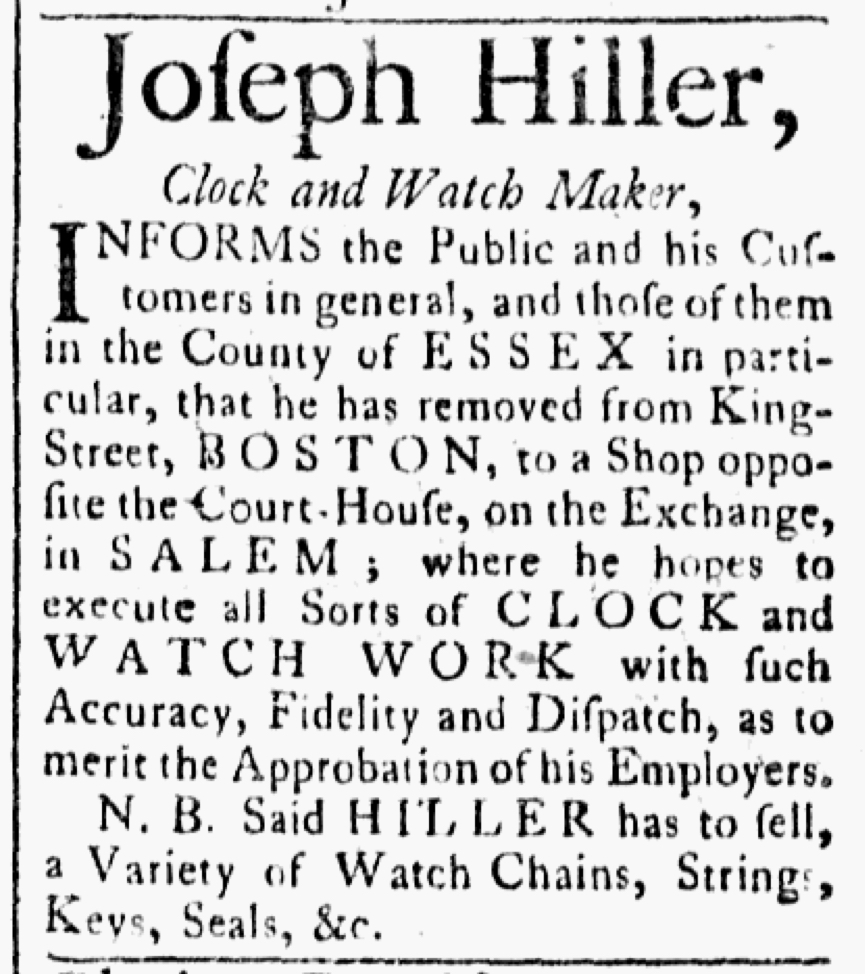
When Joseph Hiller, a clock- and watchmaker, set up shop in a new location, he inserted an advertisement in the Essex Gazette to alert “the Public and his Customers in general, and those of them in the County of ESSEX in particular.”  Hiller had not only moved to a new location, he also moved to a new town.  He explained that he formerly operated a shop on King Street in Boston, but now customers could find him at “a Shop opposite the Court-House, on the Exchange, in SALEM.”  He hoped to retain those customers that he could, especially those who resided close to his new location, but he also aimed to attract new clients in Salem and its environs who may not have been previously inclined to seek out his services in Boston but would now consider his shop a viable option given its proximity.

To that end, he proclaimed that he would “execute all Sorts of CLOCK and WATCH WORK with such Accuracy, Fidelity and Dispatch, as to merit the Approbation of his Employers.”  Previous customers were already familiar with Hiller’s skill and service, so that portion of the advertisement served as an introduction to those who had not previously hired him.  He deployed appeals that artisans commonly incorporated into their advertisements, “Accuracy” testifying to the quality of his work and “Fidelity and Dispatch” applying to the customer service he provided.  While Hiller’s advertisement was not particularly innovative, it did demonstrate that he was competent, at least in how he represented his business in print.  Prospective clients could test those claims for themselves.

In an additional effort to entice customers into his new shop, Hiller appended a nota bene advising that he did more than make and repair clocks and watches.  He also carried a variety of accessories associated with his business: “Watch Chains, Strings, Keys, Seals.”  Selling these items supplemented the revenues that Hiller earned from his primary occupation; purchasing them allowed consumers to express their own tastes in embellishing their clocks and watches.  That Hiller made them available at all may have aroused the curiosity of prospective customers, encouraging them to visit his new shop to examine the accessories even if they did not wish to purchase a clock or watch or arrange for repairs.  As a newcomer in Salem, Hiller offered various reasons for consumers to make a call at his shop.

May 7

What was advertised in a colonial American newspaper 250 years ago today?

May 7 - 5:7:1770 New-York Gazette and Weekly Mercury
New-York Gazette and Weekly Mercury (May 7, 1770).

“Mourning rings cheaper than has ever been done in this city.”

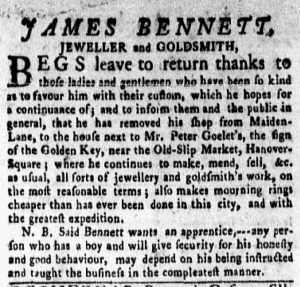
Upon the occasion of moving to a new location, jeweler and goldsmith James Bennet placed an advertisement in the New-York Gazette and Weekly Mercury.  He informed former and prospective customers that he no longer ran a shop on Maiden Lane.  Instead, the “public in general” could find him at his new shop at “the house next to Mr. Peter Goelet’s, the sign of the Golden Key, near the Old-Slip Market, Hanover-Square.”  In an era before standardized street numbers, Bennett provided plenty of landmarks to help customers find his new location.

He opened his advertisement by expressing appreciation for “those ladies and gentlemen who have been so kind as to favour him with their custom.”  He hoped that they would continue as customers.  Acknowledging their prior support for his business also alerted prospective new customers that even though he set up shop at a new location this was not a new endeavor.  Bennett already had experience pursuing his trade in New York.  In thanking former customers, he also sought to demonstrate demand for his services among readers who had not yet visited his shop at any location.

To further capture their interest, he briefly described his services, stating that he continued “to make, mend, [and] sell … all sorts of jewellery and goldsmith’s work.”  He embellished that rather plain overview with a much more enticing offer, claiming that he “makes mourning rings cheaper than has ever been done in this city, and with the greatest expedition.” An advertisement for a jeweler and goldsmith moving from one location to another was pretty standard fare among the notices that ran in colonial newspapers.  A declaration about the lowest prices possible for a popular piece of jewelry, on the other hand, challenged consumers to visit his shop to see for themselves.  If that managed to get customers through the door, it gave Bennett opportunities to secure other sales.  Even if readers were skeptical of his claim, they could not know for certain unless they investigated on their own.  Rather than merely announce that he moved to a new location, Bennett enticed prospective customers with a bold claim intended to grab their attention.