
What was advertised in a revolutionary American newspaper 250 years ago today?
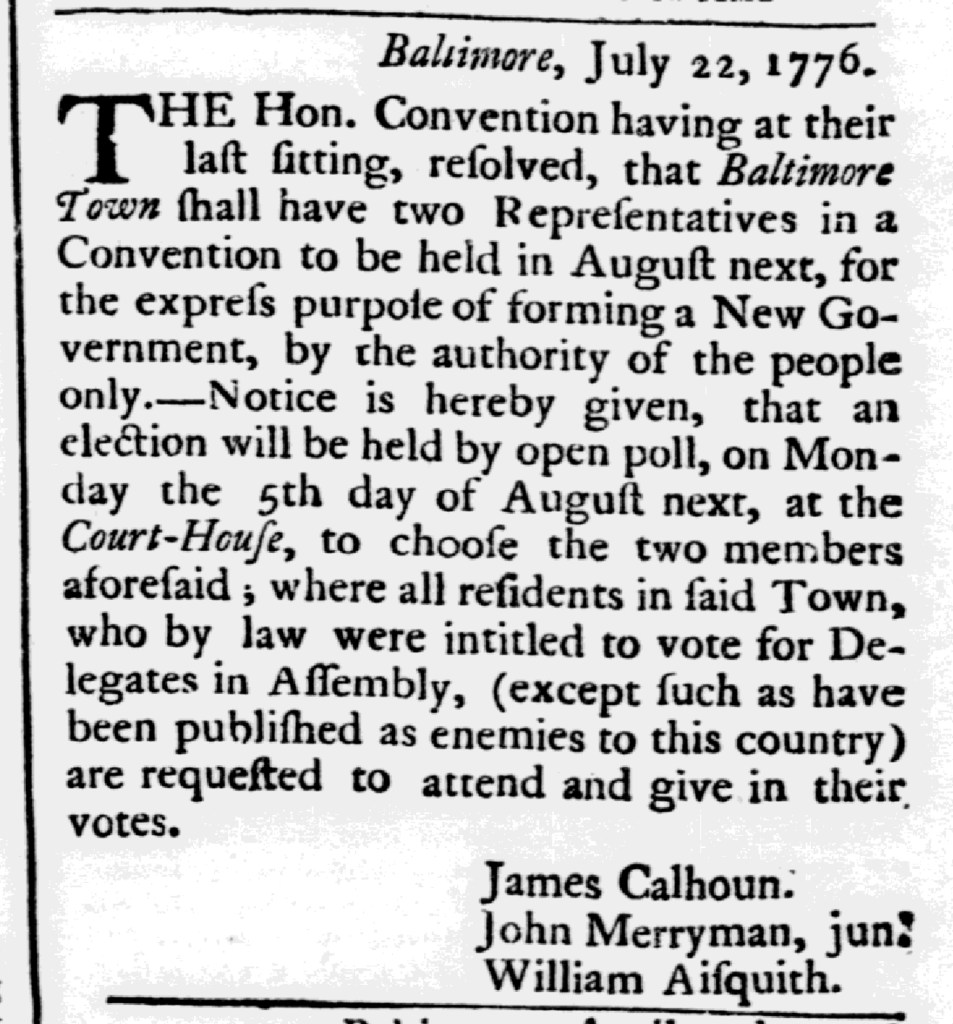
“All residents in said Town … are requested to attend and give in their votes.”
Newspaper advertisements sometimes made important announcements during the era of the American Revolution. An advertisement in the July 23, 1776, edition of Dunlap’s Maryland Gazette, for instance, informed readers that the most recent provincial convention “resolved, that Baltimore Town shall have two Representatives in a Convention to be held in August next, for the express purpose of forming a New Government,” a government established “by the authority of the people only” in the wake of the Continental Congress declaring independence from Great Britain. “Notice is hereby given,” the advertisement continued, “that an election will be held by open poll, on Monday the 5th day of August next, at the Court-House, to choose the two members aforesaid.” Furthermore, “all residents in said Town, who by law were intitled to vote for Delegates in Assembly, (except such as have been published as enemies to this country) are requested to attend and give in their votes.”
That notice appeared among the other advertisements in Dunlap’s Maryland Gazette, alongside employment notices, descriptions of indentured servants who ran away, and an advertisement for “KEYSER’s FAMOUS PILLS” and other patent medicines. The men who signed the notice – James Calhoun, John Merryman, Jr., and William Aisquith – apparently paid to insert it in Dunlap’s Maryland Gazette and in the Maryland Journal as well. The printers of those newspapers could have included such important information with the news that they selected to disseminate to readers. They could have even given the notice a prominent place on the front page, publishing it as a public service as the state created its “New Government, by the authority of the people.” Instead, they treated the notice as an advertisement rather than news, presumably generating revenue each time it appeared in their newspapers. Readers knew that news of various sorts, including legal notices, often ran as advertisements. They realized that the news in any issue of an early American newspaper did not necessarily end when the advertisements began.