January 22

What was advertised in a revolutionary American newspaper 250 years ago today?
New-York Gazette and Weekly Mercury (January 22, 1776).

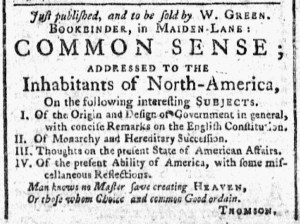
To be sold by W. GREEN … COMMON SENSE.”

Just days after an advertisement for Thomas Paine’s Common Sense made its first appearance in a newspaper beyond those published in Philadelphia, a second advertisement appeared in yet another newspaper.  The Constitutional Gazettecarried that first advertisement on January 20, 1776.  A variation ran in the New-York Gazette and Weekly Mercury on January 22.

Both advertisements included the title of the political pamphlet, “COMMON SENSE,” though the version in the Constitutional Gazette indicated that it was “ADDRESS TO THE INHABITANTS OF AMERICA” while the one in the New-York Gazette and Weekly Mercury instead stated that it was “ADDRESSED TO THE Inhabitants of North-America.”  Both listed the “interesting SUBJECTS” contained within the pamphlet, offering four section headings that included “Of the Origin and Design of Government in general, with concise Remarks on the English Constitution” and “Thoughts on the present State of American Affairs.”  Both concluded with an epigraph from James Thomson’s poem, “Liberty” (1734): “Man knows no Master save creating HEAVEN, / Or those whom Choice and common Good ordain.”  Those lines previewed the arguments readers would encounter in the pamphlet.  These advertisements in newspapers printed in New York replicated those previously published in newspapers in Philadelphia.

The new advertisement in the New-York Gazette and Weekly Mercury did have one significant difference from the earlier advertisements.  It did not include the name of the publisher of the first edition, Robert Bell.  The introduction to the version in the Constitutional Gazette did mention the prominent printer and bookseller, advising readers that “ROBERT BELL, in Third-Street, Philadelphia,” sold the pamphlet and then also listing William Green, a “Bookseller, in Maiden Lane, New-York,” as a local purveyor of Common Sense.  The version in the New-York Gazette and Weekly Mercury, however, eliminated Bell and named Green as the sole vendor of the pamphlet: “Just published, and to be sold by W. GREEN.  BOOKBINDER, in MAIDEN-LANE.”  Eighteenth-century readers knew to separate the phrases “Just published” and “to be sold by.”  Only the latter referred to Green’s role in the production and distribution of the pamphlet.  The phrase “Just published” merely meant “now available.”  Green did not print Common Sense, but when he submitted copy for his advertisement to the New-York Gazette and Weekly Mercury’s printing office he privileged his role in making the incendiary new pamphlet available in that city.  As the pamphlet gained popularity, John Anderson, the printer of the Constitutional Gazette, published and advertised a local edition (and a second local edition), but for a short time Green was the only retailer in New York hawking the pamphlet in the public prints.  His marketing efforts contributed to the stir caused by Paine’s appeal to declare independence rather than continue to seek a redress of grievances within the imperial system.

January 15

What was advertised in a revolutionary American newspaper 250 years ago today?

New-York Gazette and Weekly Mercury (January 15, 1776).

“Dr. Hill’s American Balsam; whose great efficacy is so well known.”

Nine months after his advertisements first appeared in newspapers in New York, shopkeeper Michael Hoffman continued receiving shipments of “DOCTOR HILL’s newly improved great STOMACHIC TINCTURE” and “Dr. Hill’s American Balsam” from an associate in Philadelphia.  His advertisement in the January 15, 1776, edition of the New-York Gazette and Weekly Mercury echoed the one he previously placed in the May 4, 1775, edition of the New-York Journal, though it featured slightly different copy.  Hoffman reminded prospective customers that the tincture was “a very excellent medicine for all weak stomach, as it procures a good healthy appetite, and a sound digestion.”  In addition, it supposedly prevented all sorts of diseases since most, according to the advertisement, “have their origin contracted in a weak stomach.”  The balsam, on the other hand, “is so well known to cure the most inveterate disorder in the breast, as shortness of breath, colds, coughs, and whooping coughs in children.”  Yet that was not all!  Through “a proper use and continuing the same a reasonable time,” the balsam “effectually cured … the most painful rhumatisms, cholic, gravel [kidney stones] and consumption.”

Yet Hoffman did not promote just the efficacy of these patent medicines.  In his effort to attract customers, he assured them that “Doctor Hill’s own directions, printed in London, are wrapt about each bottle” to prevent confusion about the dosage once they took the medicines home.  Those directions, however, included the price in “sterling money,” but Hoffman’s customers could ignore that.  He had worked out a deal for bargain pricing for the benefit of “the poor and indigent” in New York.  In that city, the medicines sold for four shilling and ten pence per bottle.  Even better, those who bought a dozen bottles received a discount, only four shillings and four pence per bottle.  Those customers saved ten percent, a good deal for those who intended to follow Hoffman’s directions to continue taking the medicine for “a reasonable time.”  As had been the case all along, Hoffman had an exclusive appointment to sell Dr. Hill’s tincture and balsam in New York.  He directed customers to his shop “in the Broad-Way, near the Oswego-Market” so they could avoid counterfeits peddled elsewhere.

January 8

What was advertised in a revolutionary American newspaper 250 years ago today?

New-York Gazette and Weekly Mercury (January 8, 1776).

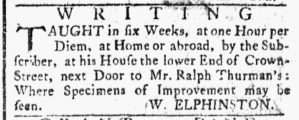
“WRITING TAUGHT in six Weeks … Specimens of Improvement may be seen.”

Among the various advertisements that appeared in the January 8, 1776, edition of the New-York Gazette and Weekly Mercury, W. Elphinston offered his services as a writing tutor.  Although writing and reading are skills often taught simultaneously today, that was not always the case in eighteenth-century America.  For instance, at “Mrs. TAYLOR’s BOARDING SCHOOL” for “young LADIES” in Philadelphia, all students learned “Reading and the Grammar” along with sewing and embroidery, but they had to pay extra for instruction from a “Writing Master,” a “Drawing Master,” a “Dancing Master,” a “Musick Master,” and other tutors.  Some colonizers learned to read without simultaneously learning writing (or arithmetic).  Those who made their mark on documents rather than signing their names did not necessarily lack the skill to read those documents, but they did not benefit from instruction in forming the letters that they knew how to read.

Elphinston offered his assistance.  He did not teach reading; he assumed that his prospective students already possessed that skill at some level.  He expected them to apply what they already knew about reading to learning to write.  Elphinston claimed that his pupils would learn to write in just six weeks, provided that they devoted an hour per day to their lessons.  In addition to novices, he also helped those with rudimentary ability to improve their writing, yet he did not merely ask prospective students to take his word for it.  Instead, he made “Specimens of Improvement” available at the house where he gave lessons.  Anyone who considered engaging his services could examine those specimens themselves to see what kind of progress Elphinston’s former students made because of their lessons with the writing tutor.  He was not the only writing master to make specimens available to the public.  When a “Person from Boston” relocated to Connecticut and advertised that he “will teach in the most elegant and easy Manner, the several Hands now in Practice, both Useful and Ornamental,” he noted that a “Specimen of [his] Performance, in the several hands abovementioned, is left with the Printer … for the Inspection of any Person” who might hire him.  Newspaper advertisements attracted attention, but writing tutors believed that samples could seal the deal.

December 25

What was advertised in a revolutionary American newspaper 250 years ago today?

New-York Gazette and Weekly Mercury (December 25, 1775).

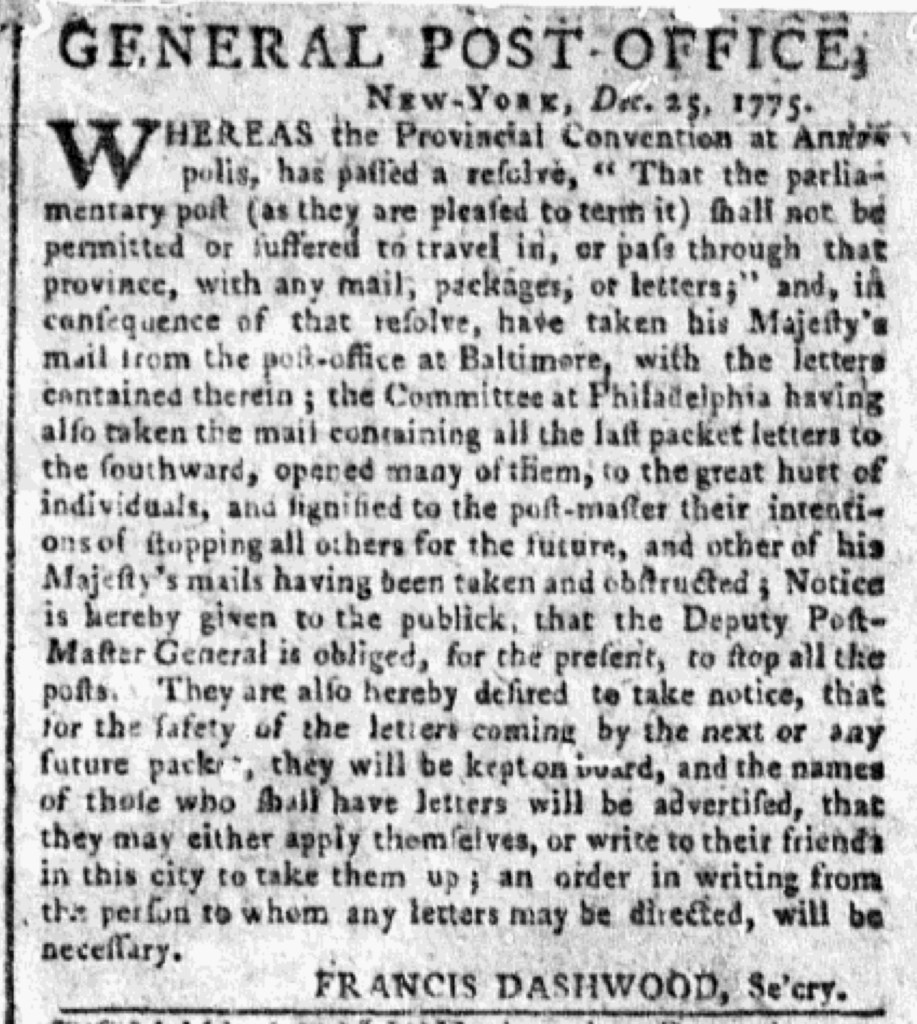
“The Deputy Post-Master General is obliged, for the present, to stop all the posts.”

In the summer and fall of 1775, advertisements for local Constitutional Post Offices, established by the Second Continental Congress as an alternative to the imperial system, appeared in newspapers printed in several colonies.  Postmasters provided schedules.  Post riders offered their services.  As winter arrived, the Deputy Postmaster General of the “parliamentary post (as [supporters of the American cause] are pleased to term it)” published an advertisement announcing that he “is obliged, for the present, to stop all the posts.”  He did not cite competition from the Constitutional Post.  Instead, he blamed the actions of provincial conventions meeting in some of the colonies and abuses by rogues who tampered with private letters.

In Maryland, for instance, one of those conventions passed a resolve that “the parliamentary post … shall not be permitted or suffered to travel in, or pass through, that province, with any mail, packages, or letters.”  In turn, they had confiscated “his Majesty’s mail from the post-office at Baltimore.”  Similarly, a committee in Philadelphia seized “the last packet letters to the southward … and signified to the post-master their intentions of stopping all others for the future.”  That was not all!  That committee also “opened many of [the letters], to the great hurt of individuals,” engaging in some of the same behavior that had caused William Goddard first to envision the Constitutional Post and then advocate that the Second Continental Congress officially endorse it.  The Deputy Postmaster General suggested that it was the Sons of Liberty and their supporters who had infringed on the liberties of others.

Yet this did not end the imperial postal system, though the procedures for delivering letters changed: “for the safety of the letters coming by the next or any future packet,” a ship that carried mail, “they will be kept onboard, and the names of those who shall have letters will be advertised.”  Even if Hugh Gaine, the printer of the New-York Gazette and Weekly Mercury who had recently published a local edition of the Journal of the Proceedings of the Continental Congress, did not care for every British policy, he almost certainly welcomed the advertising revenue for running this notice and the prospects for publishing lists of those who had letters waiting for them aboard packet ships in the harbor.  He was not a staunch patriot like John Holt, printer of the New-York Journal, and John Anderson, printer of the Constitutional Gazette, helping to explain why the advertisement concerning the “GENERAL POST-OFFICE” first appeared in his newspaper.

October 23

What was advertised in a revolutionary American newspaper 250 years ago today?

New-York Gazette and Weekly Mercury (October 23, 1775).

“BEST geneva, made and distilled from rye.”

When John Felthausen wanted the public to know about the “BEST geneva [or genever], made and distilled from rye,” that he produced, he placed an advertisement in the October 23, 1775, edition of the New-York Gazette and Weekly Mercury.  He declared that he distilled his spirits “in the same manner as Holland geneva is made,” assuring prospective customers of the quality and taste.  To entice readers to purchase his genever, Felthausen reported that “some gentlemen have advertised in this paper to encourage that business” because “there is not any person at present, that distills liquor from grain in this government” or colony.  In answer to colonizers who expressed a desire for someone to take responsibility for distilling genever and other spirits in New York, Felthausen suggested that they had a responsibility to support his business now that he accepted their charge to launch such an enterprise.

Yet Felthausen did not address solely those who had written of their desire to see genever produced locally.  Instead, he proclaimed that he “hoped every friend to his country” would buy his genever, “especially at those times when we ought to give a preference to our own manufactures.”  The distiller made a “Buy American” argument, confident that prospective customers knew all about the Continental Association, a nonimportation agreement devised by the First Continental Congress in response to the Coercive Acts.  The Continental Association also called on colonizers to promote “Agriculture, Arts, and the Manufactures of this Country” as alternatives to imported goods.  Throughout the colonies, supporters of the American cause mobilized around the choices that they made in the marketplace.  Many became even more determined to so after the battles at Lexington and Concord.  Entrepreneurs like Felthausen encouraged consumers to practice politics when they made purchases, presenting their decisions as civic duties for “every friend to his country.”

September 25

What was advertised in a revolutionary American newspaper 250 years ago today?

New-York Gazette and Weekly Mercury (September 25, 1775).

“Illustrated with a beautiful Plan of Boston, and the Provincial Camp.”

When fall arrived, it was time to market almanacs for the coming year.  It was an annual ritual in American newspapers from New England to Georgia.  Hugh Gaine, the printer of the New-York Gazette and Weekly Mercury, began advertising “HUTCHIN’s Improv’d: BEING AN ALMANACK … For the Year of our LORD 1776” on September 18, 1775, and then inserted his extensive notice in subsequent issues.  The almanac’s contents included the usual astronomical data, such as “Length of Days and Nights” as well as a schedule of the courts, a description of roads to other cities and towns, and “useful Tables, chronological Observations and entertaining Remarks.”  Gaine enumerated thirty-one of those items, such as a “Very comical, humorous, and entertaining Adventure of a young LADY that used to walk in her sleep,” an essay on the “evil Consequences of Sloth and Idleness,” and a “Method for destroying Caterpillars on Trees.”

If all of that was not enough to entice customers, Gaine made sure that they knew that the almanac was “Illustrated with a beautiful Plan of Boston, and the Provincial Camp.”  That proclamation led the advertisement, appearing immediately above the title of the almanac.  Gaine then devoted the greatest amount of space to describing the map: “13. A very neat Plan of the Town of Boston, shewing at one View, the Provincial Camp, Boston Neck, Fortification, Commons, Battery, Magazines, Charlestown Ferry, Mill Pond, Fort Hill, Corps Hill, Liberty Tree, Windmill Point, South Battery, Long Wharf, Island Wharf, Hancock’s [Wharf], Charlestown, Bunker’s Hill, Winter Hill, Cobble Hill, Forts, Prospect Hill, Provincial Lines, Lower Fort, Upper [Fort], Main Guard, Cambridge College, Charles River, Pierpont’s Mill, Fascine Battery, Roxbury Hill Lines, General Gage’s Lines, Dorchester Hill and Point, and Mystick River.”  As the siege of Boston continued, Daine realized that colonizers in Boston would be interested in supplementing what they read in newspapers and heard from others with a map that would help them envision and better understand recent events.

What was the source for the map?  According to the catalog description for the almanac by PBA Galleries, Auctioneers and Appraisers, the map, “titled a ‘Plan of Boston,’ details Boston’s Shawmut Peninsula and with a smaller inset of the greater Boston area.  Both maps appear to be based on the ‘New and Correct Plan of the Town of Boston and Provincial Camp,’ which appeared in the Pennsylvania Magazine for July, 1775.”  The image that Aitken marketed to spur magazine sales found its way into another periodical publication.  Another printer used it to generate demand for an item produced on his press.

Gaine also listed “11. The whole Process of making SALT PETRE, recommended by the Hon. The Continental Congress, for the making of which there is a Bounty now given both in this and the neighbouring Provinces” and “12. The Method of making Gun-Powder, which at this Juncture may be carried into Execution in a small Way, by almost every Framer in his own Habitation.”  The auction catalog further clarifies that the almanac contains “the Resolution of Congress, July 28, 1775 on the necessity of making gunpowder in the colonies, signed in print by John Hancock, with a recipe for gunpowder on the reverse of the map.”  More than ever, current events played a part in compiling the contents and then marketing almanacs.

“Plan of Boston,” in Hutchins Improved: Being an Almanack and Ephemeris … For the Year of Our Lord 1776 (New York: Hugh Gaine, 1775). Courtesy PBA Galleries, Auctioneers and Appraisers.

July 24

What was advertised in a revolutionary American newspaper 250 years ago today?

New-York Gazette and Weekly Mercury (July 24, 1775).

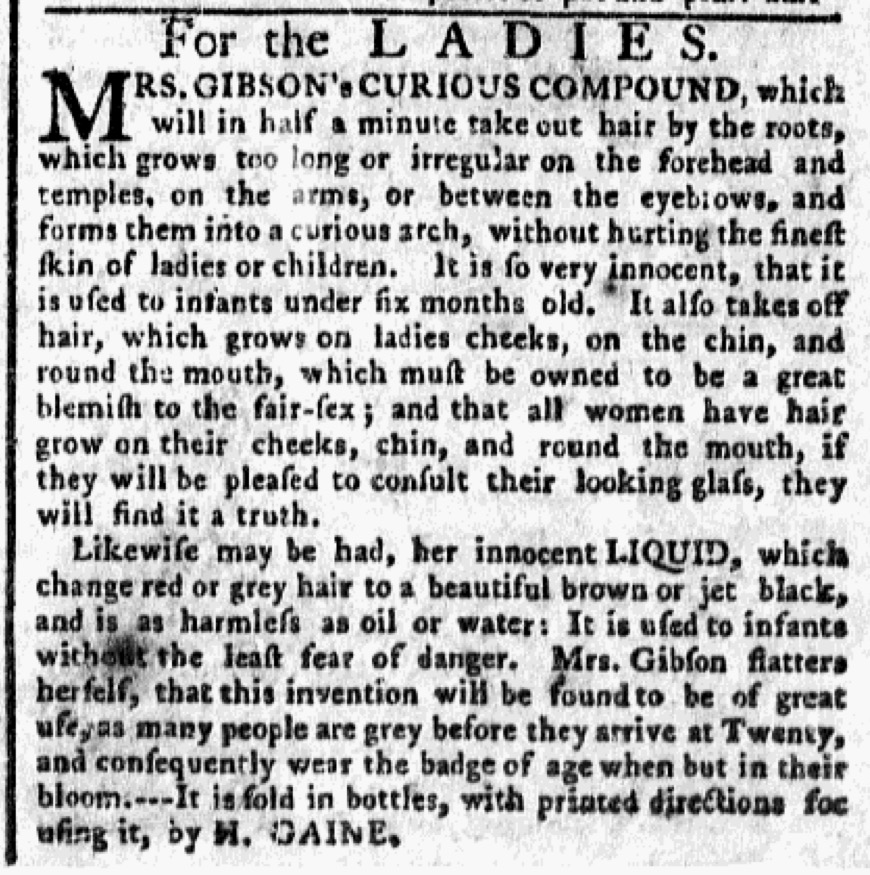
“For the LADIES. MRS. GIBSON’s CURIOUS COMPOUND.”

Cosmetics advertisements occasionally appeared in newspapers during the era of the American Revolution, such as one about “MRS. GIBSON’s CURIOUS COMPOUND” in the July 24, 1775, edition of the New-York Gazette and Weekly Mercury.  The headline, “For the LADIES,” made clear the target audience.  The copy explained that the product “will in half a minute take out hair by the roots, which grows too long or irregular on the forehead and temples, on the arms, or between the eyebrows, and forms them into a curious arch.”  Even more appealing, it did so “without hurting the finest skin of ladies or children.”  Indeed, Mrs. Gibson’s Curious Compound was so gentle and “so very innocent, that it is used [on] infants under six months old.”

Yet the pitch did not end there.  According to the advertisement, the product “also takes off hair, which grows on ladies cheeks, on the chin, and round the mouth, which must be owned to be a great blemish to the fair-sex.”  Lest any female readers to feel too confident about their appearance, the advertisement asserted that “all women have hair grow on their cheeks, chin, and round the mouth.”  That was not a matter of conjecture but something they could prove with their own eyes: “if they will be pleased to consult their looking glass, they will find it a truth.”  The marketing for Mrs. Gibson’s Curious Compound relied on making women feel anxiety about their bodies, not unlike the marketing undertaken by staymakers who addressed “Ladies who are uneasy in their shapes.”

In addition to her hair removal compound, Mrs. Gibson produced an “innocent LIQUID, which change[s] red or grey hair to a beautiful brown or jet black.”  Safety once again played a role in promoting the product.  The advertisement claimed it was “as harmless as oil or water” and could even be “used [on] infants without the least fear of danger.”  The marketing for Mrs. Gibson’s products seemed to have a formula.  After a description of the purpose of Mrs. Gibson’s Liquid and a note about safety, the copy attempted to incite feelings of discomfort and self-consciousness among readers.  “[T]his invention will be found to be of great use,” the advertisement declared, “as many people are grey before they arrive at Twenty, and consequently wear the badge of age when but in their bloom.”  Yet young ladies did not need to appear prematurely old, nor did older ladies need to look their age if they applied Mrs. Gibson’s Liquid to their hair.

Where could women acquire Mrs. Gibson’s Curious Compound and Mrs. Gibson’s Liquid?  Hugh Gaine sold both products, along with “printed directions,” at the printing office where he published the New-York Gazette and Weekly Mercury.  The printer also supplemented his income by marketing Keyser’s Famous Pills once again.  Both advertisements appeared in the final column of the first page of his newspaper.  Printers often stocked, marketed, and sold patent medicines as an additional revenue stream, but they did not promote cosmetics nearly as often.  The printed directions, however, made Mrs. Gibson’s products easy to sell since nobody in the printing office needed to have any direct knowledge of them, just as printed directions made it unnecessary to know much about patent medicines sold in printing offices.

July 17

What was advertised in a revolutionary American newspaper 250 years ago today?

New-York Gazette and Weekly Mercury (July 17, 1775).

“I have not at any time, directly or indirectly, held any correspondence with General Gage.”

Stephen Case of New Marlborough, Massachusetts, needed to set the record straight.  To do so, he placed a notice “To the PUBLIC” in the July 17, 1775, edition of the New-York Gazette and Weekly Mercury.  The stakes were too high to let unsubstantiated rumors go unanswered.

“As no person can secure himself from the slander of malicious tongues, and as inasmuch I am not without my enemies, who have spread a number of falsehoods in order to injure me in my character, and property,” Case asserted, “I have therefore thought it expedient, with the advice of good friends, to undeceive the public.”  Even readers who had never heard of case likely found this introduction intriguing and wanted to learn more.  “It has been reported as a truth,” Case continued, “that I have refused to sign the General Association,” the nonimportation agreement devised by the First Continental Congress in response to the Coercive Acts.  Even worse, gossip spread that Case “held secret correspondence with General Gage, in order to supply the army with flour.”  Gage simultaneously served as governor of Massachusetts and commander of the British regulars involved in the battles at Lexington and Concord, the siege of Boston, and the Battle of Bunker Hill.  Such allegations against Case made him an enemy to the American cause and no doubt unpopular among many of his neighbors and associates.

Case strenuously objected.  He denied the “scandalous falshoods” and was “ready at any time to make oath” about them.  As far as the nonimportation agreement was concerned, he had “long since signed the Association, and [did so] on the first sight thereof, without asking” or prompting from others, “and also have as one of the Committee of Observation advised others to do it.”  When it came to the other accusations, Case proclaimed, “I have not at any time, directly or indirectly, held any correspondence with General Gage, nor none of his agents relating to buying flour, or any provisions whatever.”

To deliver this message “To the PUBLIC,” Case purchased advertising space in a newspaper that circulated in western Massachusetts.  The printer served as editor when it came to news items, letters, and other content, yet provided a forum for advertisers to publish their own news about current events.  Case attempted to take advantage of such access to the public prints to repair the damage to his reputation, but perhaps too much damage had been done.  Four months later he placed another advertisement in the New-York Gazette and Weekly Mercury (and the New-York Journal and Rivington’s New-York Gazetteer) that offered his farm in New Marlborough for sale or exchange “for a House in New-York.”  Case may have remained at odds with other residents of his town, despite the assertions he made in his first advertisement, and decided that he would be better off starting over somewhere else.  If so, it was the damage cause by rumors rather than the danger and destruction of battles that displaced him from his farm during the Revolutionary War.

July 16

What was advertised in a revolutionary American newspaper 250 years ago this week?

New-York Gazette and Weekly Mercury (July 10, 1775).

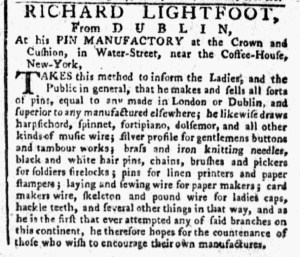
“He therefore hopes for the countenance of those who wish to encourage their own manufactures.”

In the summer of 1775, Richard Lightfoot placed a newspaper advertisement to promote his “PIN MANUFACTORY at the Crown and Cushion” in New York.  In addition to “all sorts of pins,” he also produced a variety of other wirework, including “harpsichord, spinnet, fortepiano, dolsemor, and all other kinds of music wire,” “brass and iron knitting needles,” “pins for linen printers and paper stampers,” and “laying and sewing wire for paper makers.”

Lightfoot addressed “the Ladies,” who presumably constituted a significant portion of his customers, yet also directed his advertisement to “the Public in general.”  After all, he had an interest in the entire community knowing about the work undertaken at his “PIN MANUFACTORY” and his contributions to the American cause through his participation in the marketplace.  Lightfoot proclaimed that “he is the first that ever attempted any of said branches,” the production of the various kinds of wirework, “on this continent.”  He did so at a time that colonizers observed the Continental Association, a nonimportation agreement devised by the First Continental Congress in response to the Coercive Acts.  That pact called for encouraging “Industry” and “the Manufactures of this Country” as alternatives to imported goods.  Under those circumstances, Lightfoot hoped “for the countenance of those who wish to encourage their own manufactures.”  That meant that “the Public in general” should support his enterprise by recommending it to “the Ladies” who purchased and used the pins and other items he made.

When they did so, they could depend on the quality of those products.  Lightfoot asserted that his pins were “equal to any made in London or Dublin, and superior to any manufactured elsewhere.”  He was qualified to make that claim, indicating that he was “From DUBLIN” and likely learned and practiced his trade there before migrating to New York.  Claiming that authority, Lightfoot assured prospective customers that they did not sacrifice quality when they applied their political principles to their decisions about which pins to purchase.  It did not matter that the Continental Association prohibited buying imported pins because Lightfoot made and sold pins that were just as good as (or even better than) pins produced elsewhere!

July 10

What was advertised in a revolutionary American newspaper 250 years ago today?

New-York Gazette and Weekly Mercury (July 10, 1775).

“Children educated … at a distance from probable, sudden danger and confusion.”

In July 1775, Andrew Wilson, a schoolmaster in Morristown, New Jersey, attempted to leverage current events to enroll students in his school “about twenty-seven miles from Powles-Hook, and eighteen miles from Elizabeth-Town.”  In the late spring and early summer, colonizers in New York followed the news about the battles at Lexington and Concord, the siege of Boston, and the Battle of Bunker Hill.  In addition to updates from Massachusetts, they read and discussed actions taken by the Second Continental Congress, meeting in Philadelphia, and provincial congresses throughout the colonies.  While the fighting had been confined to Massachusetts so far, colonizers anticipated that it would spread.

In such an environment, Wilson saw an opportunity to market his school to parents and guardians in New York City and other coastal towns.  “IN these dangerous and alarming times,” he declared, “the inhabitants of large cities, and other places on the sea coast, may wish to have their children educated in the interior parts of the country, at a distance from probably, sudden danger and confusion.”  He acknowledged that they likely weighed tuition and the quality of instruction against the prospects of danger, suggesting that they would send their children to such a school “if the expence was reasonable, and they could depend on the fitness of the teacher.”  Wilson confidently stated that he could alleviate both concerns.  He claimed that he “was recommended by Dr. Witherspoon, of New-Jersey College, and the Rev. Mr. Mason, in New-York.”  Furthermore, he had experience.  When he ran his advertisement in the July 10, 1775, edition of the New-York Gazette and Weekly Mercury, he had “taught [in Morristown] upwards of ten months, to the satisfaction of his employers.”  When it came to expenses, lodging and board amounted to “much less money than is generally given for the same in other places.”  His pupils did not reside at the school; instead, Wilson placed them in the homes of “good families.”  In addition, the schoolmaster described Morristown and a “healthy place” as well as an accessible one.  “[O]n three different days of the week,” he noted, “a stage goes from it to New-York.”

As resistance to imperial overreach became a revolution, the crafty schoolmaster portrayed Morristown, New Jersey, as a relatively safe place to send children to school.  Parents and guardians could remove their charges from danger while still attending to their education and development, alleviating at least some of the worry they experienced during uncertain times.