September 11

What was advertised in a revolutionary American newspaper 250 years ago today?
Newport Mercury (September 11, 1775).

“THE justly celebrated SPEECHES of the Earl of CHATHAM, and Bishop of St. ASAPH.—Also, A MASTER KEY to POPERY.”

To fill the space at the bottom of the last column on the final page of the September 11, 1775, edition of the Newport Mercury, Solomon Southwick, the printer, inserted a short advertisement that listed several books and pamphlet that he sold at his printing office.  Most of them had been featured in longer advertisements, including “the Judgment of whole KINGDOMS and NATIONS, concerning the RIGHTS of Kings, the LIBERTIES of the People, &c.”  Southwick’s edition was one of three printed in the colonies in the past two years.  The printer also stocked the “justly celebrated SPEECHES of the Earl of CHATHAM, and Bishop of St. ASAPH.”  The bishop, a member of Parliament, opposed “altering the Charters of the Colony of Massachusetts Bay,” one of the Coercive Acts enacted by Parliament in retaliation for the Boston Tea Party.  When prevented from delivering his speech during deliberations, he instead published it.  That earned him significant acclaim in the colonies.  William Pitt, the first earl of Chatham, had been “dear to AMERICA” for a decade thanks to his opposition to the Stamp Act.  Southwick’s printing office was clearly a place for Patriots to shop for reading material.

The books on offer included “A MASTER KEY to POPERY.”  Southwick promoted that volume widely even before taking it to press, disseminating subscription proposals in newspapers throughout New England.  They promised an extensive anti-Catholic screed, an exposé of “popery” by a former priest.  Southwick either gained enough subscribers to make the project viable or felt strongly enough about the supposed dangers of Catholicism that he printed the book.  Once he had copies ready for sale, he linked religion and politics in an advertisement that condemned “the infernal machinations of the British ministry, and their vast host of tools, emissaries, &c. &c. sent hither to propagate the principles of popery and slavery, which go hand in hand, as inseparable companions.”  Such prejudices resonated as colonizers expressed dismay over the Quebec Act, yet another of their grievances against Parliament.  That legislation gave several benefits to Catholic settlers in territory gained from the French during the Seven Years War, an insult to Protestants in New England who had sacrificed so much in fighting the British Empire’s Catholic enemies.  For Southwick and many of the readers of the Newport Mercury, support for the American cause and anti-Catholicism went hand in hand during the imperial crisis and the beginning of the Revolutionary War.
May 1

What was advertised in a revolutionary American newspaper 250 years ago today?

Newport Mercury (May 1, 1775).

“English and India GOODS, At the same advance as usual, agreeable to the 9th resolve of the Continental Congress.”

An advertisement that Clarke Brown first placed in the Newport Mercury on January 16, 1775, a little over six weeks after the Continental Association went into effect, ran for several months.  It appeared once again on May 1, just two weeks after the battles at Lexington and Concord.  In it, Browne promoted several commodities, including peas, wine, and snuff, and advised the public that he “continues to sell English and India GOODS.”  He very carefully clarified that he set prices for those imported wares “At the same advance as usual, agreeable to the 9th resolve of the Continental Congress.”

Readers knew that Brown referred to the Continental Association, a nonimportation agreement enacted by the First Continental Congress in response to the Coercive Acts.  To prevent price gouging once merchants and shopkeepers ceased importing new inventory from Britain, the ninth article specified that “Venders of Goods or Merchandise will not take Advantage of the Scarcity of Goods that may be occasioned by this Associacion, but will sell the same at the Rates we have been respectively accustomed to do for twelve Months last past.”  When Brown declared that he set prices “at the same advance as usual,” he meant that he did not increase the markup but instead held prices steady.  He offered assurances to prospective customers.  Just as significantly, he wanted readers, whether they shopped at his store or not, to know that he abided by the ninth article of the Continental Association.  After all, it specified penalties for those who did not: “if any Venders of Goods or Merchandise shall sell any such Goods on higher Terms … no Person ought, nor will any of us deal with any such Person … at any Time thereafter, for any Commodity whatever.”  Brown’s good standing in the community, not just his ability to earn his livelihood, depended on convincing the public that he charged fair prices consistent with the expectations of the Continental Association.

April 3

What was advertised in a colonial American newspaper 250 years ago today?

Newport Mercury (April 3, 1775).

“No TEA – till duty FREE.”

When Thomas Green advertised a variety of grocery items in the April 3, 1775, edition of the Newport Mercury, he listed “SUGAR, FLOUR, COFFEE, … CHOCOLATE, … PEPPER, … NUTMEGS, CLOVES, and MACE.”  Tea, one of the commodities that so often appeared in such lists, was conspicuously absent.  Many shopkeepers had refused to stock, advertise, or sell tea in the aftermath of the Boston Tea Party in December 1773, just as many consumers refrained from purchasing tea.  Abstaining from tea was not universal, however, as some advertisers did continue to include it in their advertisements even after the colonies received word of the Boston Port Act, the Massachusetts Government Act, and the other Coercive Acts that Parliament passed in response to the destruction of the tea by colonizers who masqueraded as Indigenous Americans.  Tea even merited particular notice in the Continental Association, the nonimportation pact devised by the First Continental Congress during its meetings in Philadelphia in September and October 1774, yet Peter Oliver, a noted Loyalist judge in Boston, alleged in his Origin and Progress of the American Rebellion that colonizers, especially women, manufactured all sorts of justifications for continuing to drink tea.

Nathan Beeby, a baker in Newport, took a stand regarding tea in the same issue of the newspaper that carried Green’s advertisement.  He thanked his “kind customers for past favours” and advised the public that “he still continues to carry on the baking business at his house, where he has for sale, crackers, best cabin and ship bread, [and] best superfine and common flour by the barrel, or pound.”  He also peddled “rice, molasses, starch, loaf and brown sugars, best Philadelphia chocolate …, spices of various sorts, and sundry other articles in the retail way.”  As many retailers did at the time, he specified that he did not extended credit, accepting only cash, and then he added: “– But     No TEA – till duty FREE.”  Green left it to readers to realize that tea did not appear in his advertisement, while Beeby made a point of announcing that he did not stock or sell the problematic commodity.  The amount of space that appeared between “But” and “No TEA” amounted to a dramatic pause, further emphasizing Beeby’s commitment and perhaps serving as a reminder to readers of the pledges they made to refuse to consume that beverage.  The baker practiced politics in his advertisement, using the space he purchased in the Newport Mercury to participate in public discourse.

March 27

What was advertised in a colonial American newspaper 250 years ago today?

Newport Mercury (March 27, 1775).

“Worth the Perusal of each TRUE SON OF LIBERTY.”

In the years after British soldiers fired into a crowd of protestors and killed several colonizers on March 5, 1770, the residents of Boston staged an annual commemoration of the “horrid MASSACRE.”  They called on a prominent patriot to give an “ORATION” about what occurred and the dangers of having British soldiers quartered in urban ports during times of peace.  Colonizers did not need to be present for the oration to experience it for themselves.  Each year, printers published and marketed the oration, commodifying an event that played an important role in the imperial crisis becoming a revolution.

New-York Gazette and Weekly Mercury (March 27, 1775).

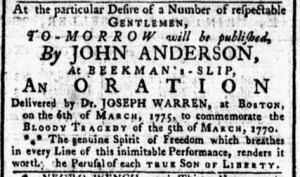
In the first several years, printers in Boston published the oration and newspapers in Massachusetts carried advertisements for it.  In 1775, however, printers in other colonies produced their own editions of Joseph Warren’s oration commemorating the fifth anniversary of the Boston Massacre.  Benjamin Edes and John Gill, the printers of the Boston-Gazette, and Joseph Greenleaf, the publisher of the Royal American Magazine, partnered in printing and advertising a Boston edition.  Not long after, Solomon Southwick, the printer of the Newport Mercury, advertised his own edition, giving the notice a privileged place as the first item in the first column on the first page of the March 27 edition of his newspaper.  On that same day, John Anderson inserted a notice in the New-York Gazette and Weekly Mercury to alert readers of the imminent publication of a local edition undertaken “At the particular Desire of a Number of respectable GENTLEMEN.”  Patriots expressed intertest in obtaining their own copies of Warren’s oration; in turn, printers believed they could generate even greater demand.  To that end, Anderson declared, “The genuine Spirit of Freedom which breathes in every Line of this inimitable Performance, renders it worth the Perusal of each TRUE SON OF LIBERTY.”

The political climate had shifted since printers in Boston disseminated John Hancock’s oration commemorating the fourth anniversary of the Boston Massacre.  Since then, colonizers experienced how Parliament reacted to the destruction of tea during what has become known as the Boston Tea Party.  The Coercive Acts, including the Boston Port Act that closed the harbor until residents paid restitution, prompted delegates from throughout the colonies to gather in Philadelphia for the First Continental Congress in the fall of 1774.  They adopted a nonimportation agreement, the Continental Association, that remained in effect in the spring of 1775.  Given the events that transpired in 1774 and early 1775, it made sense that the anniversary of the “BLOODY TRAGEDY of the 5th of MARCH, 1770” garnered greater attention beyond Massachusetts.

February 6

What was advertised in a colonial American newspaper 250 years ago today?

Newport Mercury (February 6, 1775).

“A METZOTINTO … of that truly staunch Patriot, the Hon. SAMUEL ADAMS.”

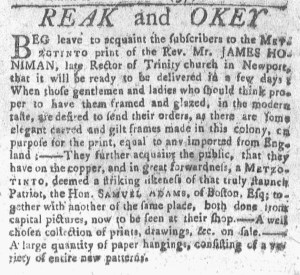
On February 6, 1775, Charles Reak and Samuel Okey took to the pages of the Newport Mercury to advise “subscribers to the METZOTINTO print of the Rev. JAMES HONIMAN … that it will be ready to be delivered in a few days.”  As printers often did for books, Okey, a British printmaker who migrated to Rhode Island, gauged the market by seeking subscribers to his print of James Honyman, the former rector of Trinity Church in Newport, before executing it.  That allowed him to determine whether the project would be viable and how many prints to produce to meet the demand of subscribers who reserved copies.

The print has been dated November 2, 1774, based on a line beneath the title that reads, “Printed by Reak & Okey, Newport Rhode Island, Novr. 2 1774,” yet the newspaper advertisement suggests that even though the engraving may have ready on that day that Reak and Okey printed the portrait in the following months before distributing it in February 1775.  The advertisement gives further evidence that was the case.  The partners informed readers of a forthcoming print depicting “that truly staunch Patriot, the Hon, SAMUEL ADAMS, of Boston.”  Reak and Okey explained that they “have on copper, and in great forwardness” that mezzotint.  The engraving was complete, but printing took time.

When they did deliver copies of the Honyman mezzotint to subscribers, Reak and Okey offered more than just the print to “those gentlemen and ladies who should think proper to have them framed and glazed in the modern taste.”  They promoted “some elegant carved and gilt frames, made in this colony, on purpose for the print, equal to any imported from England.”  With the Continental Association in effect, Reak and Okey gave their customers access to frames without departing from that nonimportation agreement.  The copy in the collections of the Preservation Society of Newport County is “housed in a black painted wood frame with an interior gilt gesso border,” though the description does not give the provenance of the frame.

In their choices about their latest subject, John Adams, and the frames for the James Honyman mezzotint, Reak and Okey courted customers who supported the American cause as the imperial crisis intensified.  They joined other artists and publishers who commemorated the American Revolution even before the war began at Lexington and Concord, doing so with both an image of a “staunch Patriot” and frames imbued with political as well as artistic significance.

November 7

What was advertised in a colonial American newspaper 250 years ago today?

Newport Mercury (November 7, 1774).

“American SNUFF … equal to any imported from Great-Britain.”

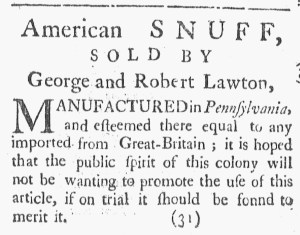
George Lawton and Robert Lawton hoped that their marketing strategy would help them to edge out the competition when they advertised “American SNUFF” in the November 7, 1774, edition of the Newport Mercury.  They explained that the product they sold was “MANUFACTURED in Pennsylvania, and esteemed there equal to any imported from Great-Britain.”  Apparently, it was not yet familiar to consumers in Rhode Island, but the Lawtons hoped that the enthusiasm for the snuff in another colony would convince local customers to give it a try.  Furthermore, they suggested that patriotic consumers had a duty to select this “American SNUFF” and support domestic manufactures over imported alternatives.  “[I]t is hoped,” the Lawtons declared, “that the public spirit of this colony will not be wanting to promote the use of this article, if on trial it should be found to merit it.”  They allowed for some wiggle room, leaving it to consumers to assess the quality of the snuff for themselves, yet proposed that those who did consider it “equal to any imported from Great Britain” should shift their allegiance to the product from the colonies.

Elsewhere on the same page, John Bell a shopkeeper who frequently advertised in the Newport Mercury, hawked “ENGLISH and INDIA GOODS” that he sold “as cheap as can be bought in any shop in AMERICA.”  Following a catalog of some of his inventory, he concluded with a separate entry for “Best Tilloch’s snuff, just imported from Glasgow.”  That city was well known for the quality of the tobacco products made there and then shipped to consumers on both sides of the Atlantic.  Bell expected that customers in Newport recognized “Tilloch’s snuff” as a familiar brand, not an unreasonable supposition considering that other entrepreneurs also advertised that product.  Bell’s effort to market imported snuff did not have the same visual appeal as the advertisement placed by the Lawtons.  Their notice featured “American SNUFF” as a headline in a larger font, calling attention to both the product and the argument about the political principles associated with it at a time that many colonizers advocated for boycotts of British goods as a means of resisting the Coercive Acts passed by Parliament earlier in the year.  They seemingly considered this strategy effective, resorting to it once again after using it several months earlier.

July 25

What was advertised in a colonial American newspaper 250 years ago today?

Newport Mercury (July 25, 1774)

“A MASTER-KEY to POPERY … highly necessary to be kept in every protestant family.”

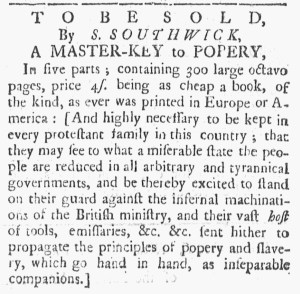
As the imperial crisis intensified in the summer of 1774, Solomon Southwick, printer of the Newport Mercury, peddled an American edition of A Master-Key to Popery.  For many months, Southwick circulated subscription proposals in his own newspaper and several others in New England, seeking to generate sufficient interest to make publishing the book a viable venture.  He took it to press in 1773 and distributed to subscribers the copies they had reserved.  Apparently, he produced surplus copies that he offered for sale at his printing office, perhaps anticipating opportunities to disseminate the assertions made by Antonio Gavin, formerly a “secular Priest in the Church of Rome, and since 1715, Minister of the Church of England.”  Who better than a priest who converted to Protestantism to reveal the true workings of the Catholic Church?

Southwick addressed the subscription proposal to “all Protestants of every Denomination, throughout America, and all other Friends to religious and civil LIBERTY.”  He considered an American edition necessary because “POPERY has lately been greatly encouraged, by the higher Powers in Great-Britain, in some Parts of America, and the West-Indies” and “if successful must prove fatal and destructive to every Liberty, Civil and Religious, which is dear to a rational Being.”  To guard against that, Southwick offered the book as a “more full Account of the wicked and abominable Practices of the Romish Priests, than any Piece ever printed in this Country.”  He echoed those sentiments when he advertised the book once again in the summer of 1774.  He promoted it as “highly necessary to be kept in every protestant family in this country; that they may see to what a miserable state the people are reduced in all arbitrary and tyrannical governments.”  In turn, they would “stand on their guard against the infernal machinations of the British ministry, and their vast host of tools, emissaries, &c. &c. sent hither to propagate the principles of popery and slavery, which go hand in hand, as inseparable companions.”  Puritans in New England and their descendants had long reviled Catholicism.  Within living memory, they had fought against (and defeated) Catholics in New France during the Seven Years War, often suspicious that Catholic agents had infiltrated their colonies.  In publishing and marketing A Master-Key to Popery, Southwick fanned the flames of anti-Catholic sentiment.

His new effort to sell the book occurred as Parliament passed the Coercive Acts in response to the Boston Tea Party.  When his advertisement appeared in the July 25, 1774, edition of the Newport Mercury, Boston’s harbor had already been closed and blockaded for nearly two months since the Boston Port Act went into effect and the colonies were learning of other legislation.  The text of the Massachusetts Government Act filled the first two pages of that issue.  In addition, colonial newspapers had recently published reports that Parliament considered the Quebec Act.  Colonizers anticipated that it would pass; indeed, a few weeks later they received word that the king had given royal assent to both the Quebec Act and the Quartering Act.  Among its various provisions, the Quebec Act allowed for residents to practice Catholicism freely and allowed the Catholic Church to impose tithes.  It also granted land in the Ohio Country to the province of Quebec, frustrating British colonizers who intended to settle there or earn fortunes as land speculators. Crown and Parliament seemed to favor Catholic enemies that colonizers in New England had helped to fight and defeat.

Southwick seemingly saw publishing A Master-Key to Popery as part of the information campaign that he waged against British authorities and their allies, “tools,” and “emissaries.”  Readers had their own responsibility to engage with what he published, both in the book and in his newspaper.  Among the local news in the July 25 edition of the Newport Mercury, Southwick reported that in the previous week he “received a considerable number of new subscribers” who “have stepped forth, at this time, not merely as friends to him, but as friends and supporters of the just and absolute rights of the colonies.”  For Southwick and many other colonizers, anti-Catholicism played a role in interpreting the political landscape and expressing their patriotism.

June 13

What was advertised in a colonial American newspaper 250 years ago today?

Supplement to the Newport Mercury (June 13, 1774).

“American SNUFF … MANUFACTURED in Pennsylvania.”

George Lawton and Robert Lawton advertised “American SNUFF” in the Newport Mercury as colonizers from New England to Georgia discussed how to respond to the Boston Port Act, legislation that closed the harbor as punishment for the destruction of tea in December 1773.  Simultaneously, newspapers covered other abuses perpetrated by Parliament.  The June 13, 1774, edition of the Newport Mercury, for instance, featured “A BILL for better regulating the Government of the Province of the Massachusetts-Bay, in North-America” and “A BILL for the impartial Administration of Justice in the Cases of Persons questioned for any Acts, done by them in the Execution of the law, or for the Suppression of Riots & Tumults in the Province of the Massachusetts-Bay, in New-England.”  Although neither had yet been passed when the ship that carried them departed from Bristol more than five weeks earlier, the printer, Solomon Southwick, noted “there is no doubt of their having passed before this time.”  In colorful commentary, he added that “the — [devil] himself can suggest nothing too horrid to be expected from the present administration.”  Another note followed the second bill: “God save the PEOPLE from such Laws!

It was in that context that the Lawtons marketed “American SNUFF … MANUFACTURED in Pennsylvania” as an alternative to snuff imported from Great Britain.  They asserted that consumers in Pennsylvania “esteemed” this snuff “equal to any imported,” so customers did not have to sacrifice quality in their support of “domestic manufacturers,” goods produced in the colonies.  The Lawtons presented trying this snuff as the patriotic duty of consumers who had concerns about current events.  “[I]t is hoped,” they implored, “that the public spirit of this colony will not be wanting to promote the use of this article, if on trial it should be fo[u]nd to merit it.”  In other words, the Lawtons encouraged prospective customers to try the snuff, taking into account the endorsements from colonizers in Pennsylvania, and see for themselves if they liked it as much as imported snuff.  If they did, their subsequent purchases could serve two purposes: acquiring a product they enjoyed while putting political principles into practice.  In many places, colonizers already discussed another round of nonimportation agreements, drawing on a strategy deployed in response to the Stamp Act and the Townshend Acts.  Immediately above the Lawtons’ advertisement, the resolutions from “a town meeting held at Providence” called for “an universal stoppage of all trade with Great-Britain, Ireland, Africa, and the West-Indies” until Parliament opened Boston Harbor once again.  Colonizers sought to use commerce for political leverage.  Similarly, decisions about which products to consume had political implications.  Even with no boycott currently in place, the Lawtons encouraged consumers to think about how they could support the colonies in their contest against Parliament.

May 23

What was advertised in a colonial American newspaper 250 years ago today?

Newport Mercury (May 23, 1774).

“MATHER is determined to stay but a very short time.”

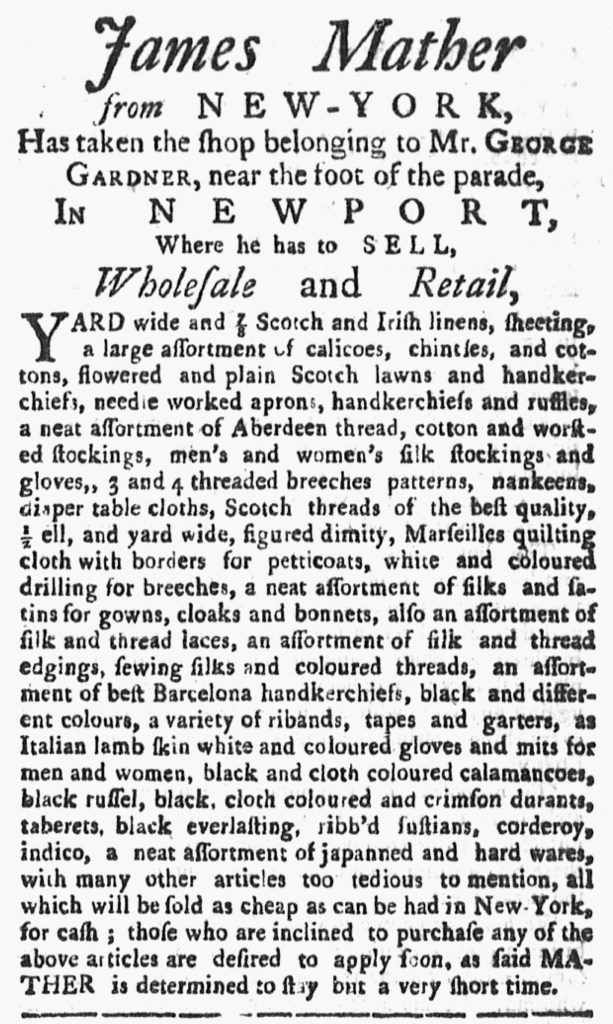
A new purveyor of goods arrived in Newport in the spring of 1774, but he did not have plans to remain in Rhode Island for long, at least not according to the advertisement he placed in the May 23 edition of the Newport Mercury.  James Mather “from NEW-YORK” introduced himself to the public with an announcement that he occupied “the shop belonging to Mr. GEORGE GARDNER, near the foot of the parade.”  Presumably, many readers were familiar with the location and the proprietor if not the entrepreneur who now did business in that space.

Mather offered his wares “Wholesale and Retail,” giving an extensive list of items in stock at his shop.  He carried “a large assortment of calicoes, chintses, and cottons,” “men’s and women’s silk stockings and gloves,” “a neat assortment of silks and satins for gowns, cloaks and bonnets,” and “a neat assortment of japanned and hard wares.”  Yet his newspaper advertisement could not contain the variety of merchandise he had on hand.  Mather exclaimed that he had “many other articles too tedious to mention.”  Prospective customers could depend on an array of choices when they visited the shop “near the foot of the parade.”

They could also expect bargain prices.  Mather declared that he set prices “as cheap as can be had in New-York,” suggesting that competition in the larger port yielded deals for consumers and retailers who bought to sell again.  Being “from NEW-YORK,” Mather had firsthand knowledge of the prices there.  He made them available in Newport, but for a limited time only.  He recommended that “those who are inclined to purchase any of the above articles” should “apply soon” because he “is determined to stay but a very short time.”  Shop soon or miss out, he warned.  It was not the first time that Mather deployed this strategy for moving merchandise.  The previous fall he undertook a similar enterprise in Providence, renting space near a familiar landmark and promoting prices “as cheap as can be bought in New-York.” Mather apparently found it more lucrative to pursue short-term endeavors in smaller ports than maintain a permanent location in New York.

May 16

What was advertised in a colonial American newspaper 250 years ago today?

Newport Mercury (May 16, 1774).

“Fresh Imported … direct from LONDON … English & India GOODS.”

The crisis over tea hit the boiling point as Christopher Champlin inserted a new advertisement in the May 16, 1774, edition of the Newport Mercury.  Relying on standard language that appeared in notices placed by merchants and shopkeepers, he informed readers in Rhode Island that he stocked a “general assortment of English & India GOODS, Suitable for the Season, Which he continues to sell, by WHOLESALE and RETAIL.”  His merchandise was “Fresh Imported” on two ships “direct from LONDON.”  In a final appeal, Champlin asserted that he sold his wares “As low, for cash, as at any store or shop in the colony.”  Considering the news that ran immediately to the left of his advertisement, Champlin’s marketing strategy may not have been resonated differently than he originally intended.

Word of the Boston Port Act had arrived in Newport.  A news update with a headline that proclaimed, “JOIN or DIE!!” described the “act of parliament for blockading the harbour of Boston, in order to reduce its spirited inhabitants to the most servile and mean compliance ever attempted to be imposed on a free people” as leading to a fate “worse than death—SLAVERY.”  The editor had the news from “a gentleman” who recently arrived in Newport from Boston.”  That source stated that “a number of the first merchants in London had wrote the manufacturers in inland towns of England, not to send them any more goods, and had wrote to the merchants in Boston, that the surest way to settle the present difference, between the two countries, is to stop all trade immediately, and advised a strict union between all the colonies in this measure.”  Whether merchants in London had actually done any of that or it was wishful thinking on the part of patriots who sought allies on the other side of the Atlantic, colonizers had experience with nonimportant agreements (or boycotts) as political leverage in response to the Stamp Act and the Townshend Acts.  The update reminded readers “that hydra the Stamp Act … was destroyed by our firmness and union.”

By the end of October, the First Continental Congress adopted the Continental Association, a trade boycott intended to pressure Parliament into repealing the Boston Port Act and the rest of the Coercive Acts passed in retaliation for the Boston Tea Party as well as address other grievances.  For the moment, however, no boycott was in place when Champlin published his advertisement promoting his “Fresh Imported” goods.  The news that accompanied that notice perhaps caused some consumers to reconsider what they might purchase, but it might also have served to encourage sales among colonizers who suspected that it was only a matter of time before another boycott went into effect.  They could buy what they wished with a clear conscience and without others censuring them for doing so.  Whatever they chose to do in May 1774, consumers in Rhode Island made decisions in the context of news arriving from Boston, London, and other places.