March 30

What was advertised in a colonial American newspaper 250 years ago today?
Pennsylvania Gazette (March 30, 1774).

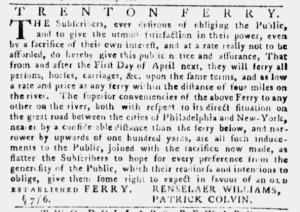
“The superior conveniencies of the above Ferry.”

Rensselaer Williams and Patrick Colvin provided a public service.  At least that was how they wanted prospective clients to think about the “TRENTON FERRY” that they operated.  They opened their advertisement in the March 30, 1774, edition of the Pennsylvania Gazette with a declaration that they were “ever desirous of obliging the Public, and to give the utmost satisfaction in their power.”  To that end, they even set prices (or so they claimed) “by a sacrifice of their own interest, and at a rate really not be afforded.”  Williams and Colvin hoped such proclamations would attract attention in advance of opening for business on “the First Day of April next.”

At that time, they pledged to “ferry all persons, horses, [and] carriages” at “as low a rate and price as any ferry within four miles on the river.”  They certainly had in mind unnamed competitors that they expected were already familiar to prospective clients.  To make their service even more attractive, Williams and Colvin asserted that the “superior conveniencies” of their ferry compared to “any other on the river” included “its direct situation on the great road between the cities of Philadelphia and New-York,” a well-travelled corridor between the two largest cities in British mainland North America.  They emphasized that their location was “nearer by a considerable distance than the ferry below,” once again alluding to the competition.  Prospective clients might even consider passage on Williams and Colvin’s ferry faster and safer since the Delaware River was “narrower by upwards of one hundred yards” at their location.

This advertisement, along with others for ferries and stages, helps in mapping the transportation infrastructure in place in the colonies on the eve of the American Revolution.  Advertisements for almanacs frequently included descriptions of roads among the contents of those annual volumes.  Rather than relying on maps as they traveled from place to place, colonizers instead took into account general knowledge acquired through word of mouth as well as printed sources that included newspaper advertisements and almanacs.  Williams and Colvin certainly anticipated that merchants, travelers, and others would share with others what they read about the “TRENTON FERRY,” what they heard about it, and their own experiences hiring the service.

March 23

What was advertised in a colonial American newspaper 250 years ago today?

Supplement to the Pennsylvania Gazette (March 23, 1774).

“Remarkable old Spirits, West-India Rum, and Brandy.”

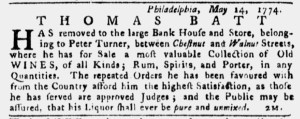
Thomas Batt advertised his “WINE and SPIRIT STORE” in the Pennsylvania Gazette for three months in 1774.  He stocked a “large and valuable Collection” that included “Old genuine Madeira, Lisbon, Mountain and Teneriffe Wines; remarkable old Spirits, [and] excellent Claret.”  He pledged to “sell any Quantity, from a Pipe [a large barrel] to a Gallon” to suit the needs of his customers.

When it ran on March 23, 1774, Batt’s advertisement appeared in the Supplement to the Pennsylvania Gazette rather than in the standard issue for that week.  Colonial newspapers typically consisted of four pages created by printing two pages on each side of a broadsheet and then folding it in half.  On occasion, printers had more news, letters, advertisements, and other content than would fit within four pages.  Sometimes they inserted notices that material which they did not publish that week would appear in the next issue.  Other times, however, they had enough content to justify publishing a supplement, either two or four pages.

In this instance, the printers opted for a four-page supplement, doubling the content they distributed to subscribers and other readers that week.  The revenue generated from advertisements likely made the supplement a viable endeavor since paid notices filled ten of the twelve columns.  Those advertisement had not merely been displaced to the supplement by news that appeared in the standard issue.  News items accounted for slightly less than six of those twelve columns.  Overall, that meant that the standard issue and the supplement carried eight columns of news and sixteen columns of advertising.  More than one hundred paid notices, including Batt’s advertisement for his “WINE and SPIRIT STORE,” occupied two-thirds of the space in that issue of the Pennsylvania Gazette and its supplement.  Quite often, eighteenth-century newspapers served as vehicles for delivering advertising even more so than for disseminating news.

March 16

What was advertised in a colonial American newspaper 250 years ago today?

Pennsylvania Gazette (March 16, 1774).

“THO. PALMER Gun Smith.”

Jack Healy, a student in my Revolutionary America class, selected Thomas Palmer’s advertisement for “a Quantity of well made RIFLES” and “all Sorts of SHOT GUNS” to feature on the Adverts 250 Project, hoping to learn more about firearms in the colonies during the era of the American Revolution and the Early Republic.  The woodcut depicting a gun, which the gunsmith previously used in other advertisements, helped attract Jack’s attention, prompting him to seek more information.

Among other secondary sources, I recommended that Jack peruse Saul Cornell’s A Well-Regulated Militia: The Founding Fathers and the Origins of Gun Control in America.  In the opening chapter, “English Tyranny versus American Liberty,” Cornell describes militia laws “that required each householder to provide himself with a musket to meet his obligation to participate in the militia” for the purposes of keeping order and defending their communities.  “It would be impossible,” Cornell asserts, “to overstate the militia’s centrality to the lives of American colonists.”  In addition to providing defense, the militia “served an important social role” as “one of the central means for organizing citizens” prior to the emergence of modern political parties.  Communities gathered at musters, drilling, celebrating, and forging bonds.[1]

Palmer did not mention any of that in his advertisement.  He did not need to do so since prospective customers were so familiar with the part that militias played in colonial culture.  Instead, he emphasized the quality of the firearms he produced, declaring that he constructed them “in the best and neatest Manner.”  Furthermore, his work “hath gained the Approbation of some of the best Judges within the three Provinces” of Pennsylvania, New Jersey, and Delaware, though he did not identify who gave such endorsements.  For those not in the market to purchase a new firearm, Palmer offered to repair “old Work, in the most careful Manner.”  To fulfill their civic obligations and to participate in communal gatherings, many colonizers may have turned to Palmer to obtain and maintain the firearms they carried as members of their local militia.

**********

[1] Saul Cornell, A Well-Regulated Militia: The Founding Fathers and the Origins of Gun Control in America (New York: Oxford University Press, 2006), 12-13.

March 2

What was advertised in a colonial American newspaper 250 years ago today?

Pennsylvania Gazette (March 2, 1774).

“It is hoped the Public will discourage such unwarrantable Practices by not purchasing the said Pamphlet.”

In the winter of 1774, William Mentz published The Visions of a Certain Tho. Say, of the City of Philadelphia, Which He Saw in a Trance.  That pamphlet did not receive attention in the public prints because Mentz advertised it but instead because Thomas Say ran notices repudiating the work.  On March 2, Say inserted advertisements in the Pennsylvania Gazette and the Pennsylvania Journal.  Five days later, he ran the same notice in Dunlap’s Pennsylvania Packet.  He was so intent on disseminating his message as widely as possible that he invested in advertisements in all three of the English-language newspapers published in Philadelphia at the time.

Mentz did not advertise the pamphlet, so Say’s notices may have generated more attention than anything else.  Did they have the intended effect?  Did colonizers refrain from purchasing the pamphlet because Say reacted so strongly to its publication?  Or did the controversy whet their appetites to see what was contained within its pages?  Say denounced “a certain Mentz [who] has printed and published for Sale, without my Knowledge or Consent, a Pamphlet … which is but an incorrect and imperfect Part of what I propose to make public.”  Furthermore, Say did not know “how or where he got the Copy.”  He excoriated Mentz: “publishing any Thing in any Man’s Name without his Knowledge or Consent is, in my Opinion, very unjustifiable, and often attended with ill Consequences.”  Addressing the public, Say made a plea that they “will discourage such unwarrantable Practices by not purchasing said Pamphlet.”  He also requested that printers neither aid nor assist Mentz “in such wrong Proceedings.”

Did that incite instead of quell demand for the pamphlet?  Mentz issued a second version, The Visions of a Certain Thomas Say, of the City of Philadelphia, Which He Saw in a Trance: To Which Is Added, Another Vision. By the Late Reverend Isaac Watts, D.D.  Perhaps he did so because Say’s unintended marketing of the pamphlet yielded interest in it.  On the other hand, Say may have managed to inhibit sales, prompting Mentz to package the pamphlet with a similar item by a popular author in hopes of rescuing the endeavor from financial failure.  Either way, the visibility that the pamphlet received in Philadelphia’s newspapers came solely from Say’s efforts to constrain sales rather than marketing undertaken by the publisher.

February 16

What was advertised in a colonial American newspaper 250 years ago today?

Pennsylvania Gazette (February 16, 1774).

“Perfectly in the stile of a London tavern.”

In February 1774, Daniel Smith took to the pages of the Pennsylvania Gazette and the Pennsylvania Packet to promote his latest enterprise, the City Tavern in Philadelphia.  Residents of the urban port had witnessed the building and marketing of the tavern.  As Smith explained, the building “was erected at a great expence, by a voluntary subscription of the principal gentlemen of the city.”  He billed it as “the largest and most elegant house in that way,” meaning a tavern and inn, “in America.”  The previous summer, the proprietors ran an advertisement seeking a tavernkeeper with “an active, obliging disposition” to rent the building, still under construction with completion expected by September, and operate it “for the convenience and credit of the city.”  Those “Gentlemen Proprietors” wanted the largest and most cosmopolitan city in the colonies to have a tavern that rivaled any found in London.

Smith asserted that he achieved that goal, doing so “at a very great expence.”  He proclaimed that he furnished the building and stocked the storerooms with every necessity.  He “laid in every article of the first quality, perfectly in the stile of a London tavern,” just as envisioned by the affluent subscribers who made the City Tavern one of their projects for improving the bustling urban port and enhancing the city’s reputation throughout the British Atlantic world.  The amenities included a “genteel Coffee Room” where merchants and others could socialize and conduct business.  He “supplied English and American papers and magazines” for their entertainment, but also so they could track the shipping news, prices current, and current events that had an impact on their businesses.  Perhaps his subscriptions included the new Royal American Magazine, the only magazine published in the colonies at the time, demonstrating to his patrons the efforts he made to provide the latest and most interesting publications.  For “strangers” or visitors to the city, Smith “fitted up several elegant bed rooms, detached from noise,” and the “best livery stables,” located “quite convenient to the house.”  Smith expected that all those features, along with “the goodness of his wines and larder,” would “give the public entire satisfaction.”

The City Tavern quickly became a popular meeting place, especially as the imperial crisis intensified.  In addition to merchants and the local gentry frequenting the establishment as part of their everyday routines, concerned citizens met there to debate and discuss politics.  In May 1774, just three months after Smith ran his advertisement, more than two hundred of them gathered at the City Tavern to determine how to respond to messages from Boston in the wake of the Boston Port Act that closed the port until the colonizers paid for the tea destroyed during the Boston Tea Party.  When the First Continental Congress met in Philadelphia in September and October 1774, many influential leaders from throughout the colonies dined and drank at the City Tavern.  John Adams praised it as “the most genteel [tavern] in America.”[1]

**********

[1] See entry for August 29, 1774, in John Adams diary 21, 15 August – 3 September 1774 [electronic edition]. Adams Family Papers: An Electronic Archive. Massachusetts Historical Society. http://www.masshist.org/digitaladams/

Happy Birthday, Benjamin Franklin!

Today is an important day for specialists in early American print culture, for Benjamin Franklin was born on January 17, 1706 (January 6, 1705, Old Style), in Boston. Among his many other accomplishments, Franklin is known as the “Father of American Advertising.” Although I have argued elsewhere that this title should more accurately be bestowed upon Mathew Carey (in my view more prolific and innovative in the realm of advertising as a printer, publisher, and advocate of marketing), I recognize that Franklin deserves credit as well. Franklin is often known as “The First American,” so it not surprising that others should rank him first among the founders of advertising in America.

benjamin-franklin
Benjamin Franklin (Joseph Siffred Duplessis, ca. 1785).  National Portrait Gallery.

Franklin purchased the Pennsylvania Gazette in 1729. In the wake of becoming printer, he experimented with the visual layout of advertisements that appeared in the weekly newspaper, incorporating significantly more white space and varying font sizes in order to better attract readers’ and potential customers’ attention. Advertising flourished in the Pennsylvania Gazette, which expanded from two to four pages in part to accommodate the greater number of commercial notices.

jan-17-pennsylvania-gazette-19-161736
Advertisements with white space, varying sizes of font, capitals and italics, and a woodcut from Benjamin Franklin’s Pennsylvania Gazette (December 9-16, 1736).

Many historians of the press and print culture in early America have noted that Franklin became wealthy and retired as a printer in favor of a multitude of other pursuits in part because of the revenue he collected from advertising. Others, especially David Waldstreicher, have underscored that this wealth was amassed through participation in the colonial slave trade. The advertisements for goods and services featured in the Pennsylvania Gazette included announcements about buying and selling enslaved men, women, and children as well as notices offering rewards for those who escaped from bondage.

jan-17-pennsylvania-gazette-slave-19-161736
Advertisement for an enslaved woman and an enslaved child from Benjamin Franklin’s Pennsylvania Gazette (December 9-16, 1736).

In 1741 Franklin published one of colonial America’s first magazines, The General Magazine and Historical Chronicle, for all the British Plantations in America (which barely missed out on being the first American magazine, a distinction earned by Franklin’s competitor, Andrew Bradford, with The American Magazine or Monthly View of the Political State of the British Colonies). The magazine lasted only a handful of issues, but that was sufficient for Franklin to become the first American printer to include an advertisement in a magazine (though advertising did not become a standard part of magazine publication until special advertising wrappers were developed later in the century — and Mathew Carey was unarguably the master of that medium).

general-magazine
General Magazine and Historical Chronicle, For all the British Plantations in America (January 1741).  Library of Congress.

In 1744 Franklin published an octavo-sized Catalogue of Choice and Valuable Books, including 445 entries. This is the first known American book catalogue aimed at consumers (though the Library Company of Philadelphia previously published catalogs listing their holdings in 1733, 1735, and 1741). Later that same year, Franklin printed a Catalogue of Books to Be Sold at Auction.

Franklin pursued advertising through many media in eighteenth-century America, earning recognition as one of the founders of American advertising. Happy 318th birthday, Benjamin Franklin!

December 22

What was advertised in a colonial American newspaper 250 years ago today?

Pennsylvania Gazette (December 22, 1773).

“WAS committed … a man, by the name of John Smith, being described in the Gazette as a runaway servant.”

John Anderson, the jailer in Newtown in Bucks County, placed an advertisement in the December 22, 1773, edition of the Pennsylvania Gazette in hopes that it would come to the attention of Thomas Tempel of Pennsbury Township in Chester County, though he likely desired that other readers might supply additional information to help him sort out a situation at his jail.  Anderson reported that on December 13 he detained a man named John Smith,” being described in the Gazette as a runaway servant, his person and cloathing exactly answering the said advertisement.”  At least some colonizers closely read newspaper advertisements that described runaway indentured servants, convict servants, and apprentices or enslaved people who liberated themselves, making it worth the investment for masters and enslavers to place those notices.

Anderson stated that the man he believed was Smith “passed [in Newtown] by the name of Peter Woodford, alias Peter Shanley” and produced “former indentures” when he claimed he had been “a bound apprentice to Richard Plumer” in Lower Makefield Township in Bucks County.  The jailer doubted this story and even the documents that Smith presented because the advertisement that previously ran in the Pennsylvania Gazette “mentions it is likely he would change his name.”  Runaway servants and others often utilized that strategy to increase their chances of making good on their escapes.  Accordingly, Anderson considered it “very likely he is the described person.”  He did not mention any efforts to contact Plumer to determine whether the alleged Smith was actually his former apprentice.  Instead, he advised that if Temple “has any commands upon the said person here described” that he should “come, pay charges, and take him away.”  Otherwise, Anderson would sell Smith (or whoever he was) into a new indenture “in four weeks,” apparently unconvinced by his insistence that he was Peter Woodford or the documents he carried.  A man of low status, unknown to the jailer in Newtown, did not seem to have much recourse to avoid this fate, though perhaps someone that Anderson considered trustworthy would see the advertisement and intervene on the detained man’s behalf.  The prisoner also faced the possibility that Tempel would indeed go the Newtown and positively identify him.  The power of the press had the potential to negate or, perhaps more likely in this instance, to strengthen the authority exercised by the jailer.

December 15

What was advertised in a colonial American newspaper 250 years ago today?

Pennsylvania Journal (December 15, 1773).

“Gentlemen’s natural wigs … and all other fashioned wigs now worn in England.”

In December 1773, “MATHEWS, HAIR-DRESSER, FROM LONDON,” introduced himself to prospective clients in Philadelphia via advertisements in the Pennsylvania Gazette and the Pennsylvania Journal.  He informed “LADIES and GENTLEMEN of this city, that he intends to carry on his business in all its various branches.”  That included “dressing Ladies in the newest and most approved taste,” no doubt drawing on his connections to London to make sure they followed the latest trends, and “making Ladies new invented tupees, in the neatest manner.”  He also made “natural wigs” for gentlemen, “so as not to be discerned from a real head of hair,” as well as “other fashioned wigs now worn in England.”  His clients, Mathews suggested, could depend on looking as sophisticated as their cosmopolitan cousins in the capital of the empire.

Mathews had several choices for disseminating this message.  He opted for two newspapers, increasing the number of readers who would see his advertisement compared to publishing it in just one.  In addition to the Pennsylvania Gazetteand the Pennsylvania Journal, he could have placed it in the Pennsylvania Chronicle and the Pennsylvania Packet.  The cost of advertising may have prevented him from running notices in all four English-language newspapers published in Philadelphia at the time (and he likely considered advertising in the Wöchtenliche Pennsylvanische Staatsboteimpractical, even though the printer translated advertisements gratis).  Yet why did he choose the Pennsylvania Gazetteand the Pennsylvania Journal over the others?  The printers distributed those two newspapers on Wednesdays, while the printers of the Pennsylvania Chronicle and the Pennsylvania Packet distributed their publications on Mondays.  Mathews did not aim to have his advertisements spread out on different days, but that may not have mattered much in the context of weekly rather than daily publication.  Perhaps the cost of advertising influenced his decision, but that may not have been the case.  Although none of the printers included advertising fees in their colophons, they likely offered competitive rates.  All of them except for the Pennsylvania Gazette did include the annual subscription cost in their colophon.  The consistency, ten shilling for each of them, suggests that they set similar fees for advertising.  Perhaps Mathews selected the Pennsylvania Gazette and the Pennsylvania Journal because he believed they had a wider circulation or reached more of the local gentry that he hoped to cultivate as clients.  His example raises a larger question about why any advertiser in cities with multiple newspapers (including Boston, Charleston, New York, and Williamsburg) chose one over another or some over others to run their notices.

December 1

What was advertised in a colonial American newspaper 250 years ago today?

Pennsylvania Gazette (December 1, 1773).

“He continues the Hat-making Business, and hopes those who have already obliged him with their Custom will continue so to do.”

When he moved from Market Street to Water Street in Philadelphia, Samuel Read, “HAT-MAKER,” ran an advertisement in the Pennsylvania Gazette to “inform the Public, and his Friends in particular” of his new location.  He encouraged “those who have already obliged him with their Custom” to visit his new shop, especially since he “intends making it his particular Study to merit their Favour.”  Read also assured “Country Store-keepers, Shallop-men, and others, who have Orders for Hats” that they “may depend on having them at the most reasonable Rate.”

In an effort to draw attention to his advertisement, Read adorned it with a woodcut depicting a tricorne hat, a style so popular at the time that it has become widely associated with late eighteenth-century fashions.  Few advertisements in the December 1, 1773, edition of the Pennsylvania Gazette featured visual images.  The printers supplied woodcuts of vessels at sea for seven advertisements seeking freight and passengers for ships departing for other ports.  Frederick Hubley, a coppersmith in Lancaster, ran the only other advertisement with a woodcut designed for the exclusive use of his business.  Readers of the Pennsylvania Gazette became familiar with his woodcut of a still thanks to repeated insertions over several months.  Even with those advertisements appearing elsewhere in the newspaper, Read’s advertisement was the only one with a woodcut on the first page.

Rivington’s New-York Gazetteer (December 2, 1773).

Read’s woodcut reflected his occupation and distinguished his advertisement from others in the Pennsylvania Gazette, even though it was not as elaborate as a similar image that Nesbitt Deane, a hatmaker in New York, frequently used in his advertisements.  Deane’s woodcut depicted a tricorne hat above a ribbon that stated his name.  Deane also developed marketing appeals beyond those deployed by Read.  For instance, he declared that he devised “a method peculiar to himself, to turn rain, and prevent sweating of the head damaging the crown.”

Read’s advertisement was not as sophisticated as the one that Deane simultaneously ran in Rivington’s New-York Gazetteer, not in terms of the copy nor in terms of the visual image, yet the hatmaker in Philadelphia demonstrated more than a little marketing savvy.  His notice did not merely announce that he moved to a new location.  Read attempted to maintain existing relationships with his customers by promising that their satisfaction remained his primary concern.  He also promised low prices to retailers who would purchase in volume and other customers.  The woodcut, plain as it may seem to modern eyes, also drew attention to his advertisement, distinguishing it from most others in that issue of the Pennsylvania Gazette.

November 24

What was advertised in a colonial American newspaper 250 years ago today?

Pennsylvania Journal (November 24, 1773).

“THE extraordinary quality of this Oil will (he presumes) recommend it to all, who please to make trial of it.”

As November came to an end and the days continued getting shorter, Richard Wells took to the pages of the Pennsylvania Gazette and the Pennsylvania Journal to advertise the “Fine Spermaceti LAMP OIL” that he “MANUFACTURED and SOLD … At his SPERMACETI WORKS” on Arch Street in Philadelphia.  His short advertisement gave his location and declared that the “extraordinary quality of this Oil will (he presumes) recommend it to all, who please to make trial of it.”  Customers who purchased a small quantity, Wells suggested, would be so satisfied that they would buy more.

Pennsylvania Gazette (November 24, 1773).

Wells did not go into great detail about the “extraordinary quality” of his lamp oil, nor did he arrange for any sort of distinctive typography to call attention to his advertisement.  In both newspapers, the format for the copy Wells submitted to the printing office followed the choices often made by the compositors when they set the type for advertisements.  As a result, the version in the Pennsylvania Journal featured more variation in capitalization, font sizes, and white space, but nothing that suggested Wells made any special requests or gave specific instructions.  His advertisement in the Pennsylvania Journal also benefited from appearing at the bottom of the first column on the first page, giving it greater visibility than notices that ran on the third and fourth pages, but most likely that resulted from a choice made by a compositor who needed to complete a column rather than from any arrangements made by Wells.

For the most part, Wells took a conservative approach to advertising.  He did realize that placing notices in two newspapers rather than just one would place his product before the eyes of a greater number of prospective customers.  He did not, however, opt to run his advertisement in every newspaper in other local newspapers, such as the Pennsylvania Chronicle and the Pennsylvania Packet.  Perhaps he found the cost of doing so prohibitive.  Perhaps he wished to see what kind of response these advertisements received before making final determinations about inserting them in other publications.  His advertisements in the Pennsylvania Gazette and Pennsylvania Journal included notations (intended for the compositors) that they should remain until Wells discontinued them rather than for a set period (like “6W” for six weeks).  It could have been Wells’s intention to assess their effectiveness, determining the value his business derived from those notices in order to make further decisions about his marketing efforts.