October 19

What was advertised in a colonial American newspaper 250 years ago today?

Pennsylvania Gazette (October 19, 1774).

“I … am really sorry that my Fellow-Citizens should be so unfriendly to me.”

Tensions rose in the fall of 1774 as the harbor in Boston remained closed and blockaded due to the Boston Port Act and the rest of the Coercive Acts went into effect as punishment for the Boston Tea Party.  Yet that port was not the only place that experienced discord.  John Head’s advertisement, published in both the Pennsylvania Gazette and the Pennsylvania Journal on October 19, revealed his frustration with rumors and accusations that he sought to take advantage of the situation through unscrupulous business practices.

He reported that “a Number of unkind People have industriously propagated through this City, Philadelphia, “I made it my Business to purchase a large Quantity of several Sorts of dry Goods, in order to sell them again at an advanced Price.” Head, like many other colonizers, anticipated that the First Continental Congress, meeting in Philadelphia at the time, would enact some sort of nonimportation agreement in response to the Coercive Acts.  His critics accused him of attempting to sidestep such measures by stocking up on merchandise in advance, thus not having to make the same sacrifices as truly patriotic merchants.  To make matters worse, they insinuated that once goods became scare because of a nonimportation agreement that Head would jack up his prices and gouge consumers who did not have the usual range of choices available to them.

Head vigorously denied those rumors.  That “Report,” he asserted, “I do declare to be false.”  Furthermore, he challenged “any Person to appear to my Face, and prove that I have bought to the Amount of One Shilling’s Worth of Goods from them, since the Arrival of said Ships.”  Continuing to make his case, Head declared that “on a cool Reflection, I cannot recollect that I have bought to the Amount of Fifty Pounds Worth of dry Goods on Speculation since I have been in Trade.”  He did not have a history of acquiring goods in large quantities, nor had he done so recently, despite whatever his adversaries claimed.  Head expressed his disappointment over the gossip that made it necessary to take to the public prints to defend his reputation.  He lamented that “my Fellow-Citizens should be so unfriendly to me, and unjust to themselves, as to propagate a Report of this Sort.”  In so doing, he positioned himself among the ranks of citizens and patriots, confirming his fidelity to their cause.

September 28

What was advertised in a colonial American newspaper 250 years ago today?

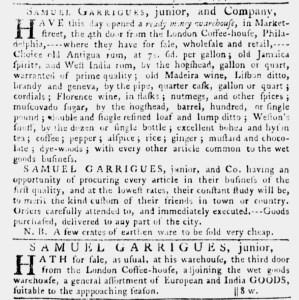
Pennsylvania Gazette (September 28, 1774).

“Goods purchased, delivered to any part of the city.”

As fall arrived in 1774, Samuel Garrigues, Jr., placed a brief advertisement in the Pennsylvania Gazette to remind readers that he sold a variety of imported goods “as usual at his warehouses, the third door from the London Coffee-house” in Philadelphia.  He supplemented that notice with a longer advertisement informing the public that he and his partners, doing business as Samuel Garrigues, Jr., and Company, just opened a “wet goods warehouse” right next door at “the 4th door from the London Coffee-house.”  There they stocked “Choice old Antigua rum,” “old Jamaica spirits, and West India rum,” “old Madeira wine,” “brandy and geneva,” as well as sugar, spices, snuff, coffee, chocolate, and “every other article common to the wet goods business.”  The inventory curiously included “excellent bohea and hyson tea” despite the controversy associated with that commodity.

In addition to listing the merchandise, Garrigues and Company sought to entice prospective customers by explaining that they had “an opportunity of procuring every article in their business of the first quality, and at the lowest prices,” suggesting that they would pass along the savings while also assuring consumers that they did not need to be wary of such bargains meaning inferior goods.  They pledged to make it their “constant study … to merit the kind custom of their friends in town or country” by “carefully attend[ing] to orders” and “immediately execut[ing]” them.  The partnership promised superior customer service.  They also offered a valuable service, delivering purchases “to any part of the city,” whether just a gallon or quart or an entire hogshead or pipe.  They hoped that ancillary service, provided gratis, would sway customers to shop with them to take advantage of both the convenience and the cost.  Eighteenth-century entrepreneurs sometimes experimented with free services as marketing strategies to convince consumers to choose them over their competitors.  For Garrigues and Company, doing so was one aspect of their “constant study” in serving their customers.

August 10

Who was the subject of an advertisement in a colonial American newspaper 250 years ago today?

Pennsylvania Gazette (August 10, 1774).

“SAMUEL PENNOCK … has thought fit … to publish me in the Pennsylvania Gazette.”

Martha Pennock was not having it.  Her husband, Samuel, a hatter, ran a newspaper advertisement that claimed she was not legally his wife because she had previously been married to John Morton of the Royal American Regiment.  Her first husband was still alive for several years after Samuel married Martha, making her a bigamist and invalidating her marriage to the hatter.  That being the case, Samuel advised the public “not to trust her on my account, for I will not pay any debts of her contracting.”  It was quite a twist on the usual “runaway wife” advertisements that appeared so frequently in colonial newspapers.

In another twist, Martha responded in the public prints.  Most women did not have the resources to counter the claims made by their husbands, especially after being cut off from their credit.  That meant that the public had access to only one account, the one from the husband’s perspective, in newspapers, though conversations and gossip likely circulated alternate versions of what occurred.  Martha not only published her rejoinder but did so very quickly.  Samuel inserted his advertisement in the August 3, 1774, edition of the Pennsylvania Gazette.  Martha’s notice ran in the next issue on August 10.  If she became aware of what Samuel had done quickly enough, she could have responded in Dunlap’s Pennsylvania Packet on August 8, but waiting two more days meant that she presented her side of the story to readers in the same publication that carried her husband’s diatribe against her.

Martha’s narrative was quite different.  She blamed the discord on “the instigation of his malicious friends,” asserting that Samuel and his friends “have used me extremely ill, at sundry times.”  She denied “with a safe conscience” that she had another living husband, stating that she had been married to Samuel for eight years and “always behaved as a prudent wife to him.  If necessary, she could provide “a sufficient testimonial of my lawful marriage to the said Pennock” as well as “an authentic power of attorney, under hand and seal, to collect his debts, and enjoy all that is or may be belonging to him hereafter.”  Martha aimed to invalidate any claims that Samuel made, whether about having a first husband or about her rights as Samuel’s “lawful” wife.  In doing so, she joined the ranks of relatively few women who responded in print to husbands who used advertisements to disavow their wives and blame them for discord within their households.

August 3

Who was the subject of an advertisement in a colonial American newspaper 250 years ago today?

Pennsylvania Gazette (August 3, 1774).

“MARTHA MORTON … is not my lawful wife.”

Notices advising merchants, shopkeepers, and others not to extend credit to wives of aggrieved husbands regularly appeared in colonial newspapers.  Termed “runaway wife advertisements” by historians, such notices often followed a familiar format and deployed standardized language.  For instance, consider James Paulhill’s advertisement in the August 3, 1774, edition of the Pennsylvania Gazette: “WHEREAS my wife MARY hath eloped from me, I therefore warn all persons not to trust her on my account, as I will pay no debts of her contracting from the date hereof.”  Many offered more detail, but each established that a wife absconded from her husband and, in turn, he would no longer cover her expenses.  These advertisements revealed marital discord to the community, as well as husbands’ inability to exert masculine authority over their households.

At the same time that Paulhill published his advertisement, Samuel Pennock inserted a much more elaborate notice in which he disavowed his wife, Martha, and accused her of bigamy.  According to Pennock, she was actually Martha Morton, wife of John Morton, who “did live in this city,” Philadelphia, “for several years, and in or about the year 1767 he was listed by Captain George Etherington, in the Royal American Regiment.”  For her part, she “would willingly be called Martha Pennock,” but Samuel adamantly declared that “she is not my wife” because “her husband, John Morton, was alive” for several years after Samuel married her, not realizing that she already had a husband.  Samuel sought to sever his relationship with Martha.  That included making a public announcement that he “will not pay any debts of her contracting” so others should not “trust her on [Samuel’s] account.”  Furthermore, he “forewarn[ed] all persons not to pay her any money that is due to me, or that may become due to me hereafter.”  Samuel aimed to eliminate Martha’s access to any of his financial resources.

As was the case with every runaway wife advertisement, this notice relayed only the perspective of the husband.  Cut off from their sources of support, most wives did not have the means to publish responses to defend themselves and tell their side of the story.  Husbands almost always wielded the power of the press to their advantage.  In this instance, however, Martha inserted a response in the next issue of the Pennsylvania Gazette.  The Adverts 250 Project will feature it next week on the 250th anniversary of its publication.

July 20

What was advertised in a colonial American newspaper 250 years ago today?

Pennsylvania Gazette (July 20, 1774).

“Patterns of the different prints may be seen at the Manufactory.”

John Hewson joined the chorus of entrepreneurs promoting “domestic manufactures” or goods produced in the colonies as an alternative to imported goods when he announced that his “CALICOE PRINTING MANUFACTORY, and BLEACH-YARD, is just opened” on the outskirts of Philadelphia.  As the imperial crisis intensified, it became more important than ever for producers and consumers in the colonies to unite in opposition to the “oppressive and arbitrary yoke” of a “corrupt and designing Ministry.”  That was how an editorial addressed “To the INHABITANTS of the different COLONIES IN AMERICA” described current events.  The following pages of the July 20, 1774, edition of the Pennsylvania Gazette featured a “SUMMARY of Monday’s DEBATES on the BOSTON BILLS” (or the Coercive Acts), “RESOLUTIONS unanimously entered into by the Inhabitants of SOUTH-CAROLINA, at a General Meeting, held at Charles-Town,” and updates from other colonies about how they intended to respond to the Boston Port Act.

That made it an opportune time for Hewson to promote his new enterprise, one that he assured consumers rivaled in quality his competitors on the other side of the Atlantic.  At “considerable expence,” he had “imported prints from London, and completed works for carrying on [his] business to perfection.”  In addition, he possessed valuable experience, having been “brought up regularly to the business, at Bromley-Hall, near London, one of the most considerable Manufactories and Bleach-yards in England.”  Realizing that prospective customers may have been skeptical of his claims, Hewson offered a guarantee: “his work shall be equal in colour, and will stand washing, as well as any imported from London or elsewhere, otherwise will require no pay.”  Customers had nothing to lose if Hewson did not charge for work that they found unsatisfactory.  Furthermore, he charged reasonable prices for textile printing, though the extensive combinations of colors “renders his publishing the prices of printing impossible.”  Hewson had a variety of patterns for customers to order.  They could examine samples “at the Manufactory” or schedule appointments for Hewson to visit them.  They could also place orders “at the Manufactory” or leave them with one of several associates “who have been pleased to encourage the work” and, in turn, endorsed the endeavor by partnering with Hewson in receiving orders.

Hewson did not directly mention the deteriorating relationship between the colonies and Britain nor proposals for new nonimportation agreements intended to harness commerce as political leverage.  That hardly seemed necessary considering that readers almost certainly had current events in mind as they perused newspaper advertisements.  Hewson did not need to belabor the political advantages of supporting his “CALICOE PRINTING MANUFACTORY” when news items and editorials already did that work.

June 22

What was advertised in a colonial American newspaper 250 years ago today?

Pennsylvania Gazette (June 22, 1774).

“ABINGTON MINERAL WATER, SO useful in Chronic Diseases.”

As the first day of summer arrived in 1774, a headline in the Pennsylvania Gazette promoted “ABINGTON MINERAL WATER,” inviting residents of Philadelphia and other towns to visit that “most healthy Part of the Province of Pennsylvania.”  There they could experience the waters “SO useful in Chronic Diseases” and recuperate from a variety of ailments.  William French placed that advertisement, offering “good Accommodations, at a modern Expence.”  Interested in encouraging health tourism in his town, he mentioned that “several other commodious Houses in the Neighbourhood of said Spring” also provided lodging for visitors.

In addition to marketing room and board in proximity to the mineral waters, Rush advised that that he had on hand “Dr. RUSH’S Experiments and Observations on the above Mineral Water, with particular Directions in what Diseases, and in what Manner, it should be used.”  He did not specify whether he sold copies or made them available for consultation by his guests, similar to modern hotels displaying fliers, brochures, and other promotional literature for points of interest in the area.  He also did not invoke the full title of the pamphlet, Experiments and Observations on the Minera Waters of Philadelphia, Abington, and Bristol, in the Province of Pennsylvania.  French conveniently left out other sites that competed for health tourism, though he was not the only advertiser who referred to Rush’s pamphlet, originally a paper delivered to the American Philosophical Society in June 1773, as a means of educating the public about the advantages of taking the waters.  The proprietors of the “BRISTOL BATHS and CHALYBEATE WELLS” did so as well in their own advertisement in the Pennsylvania Gazette a couple of months earlier.  In each instance, those seeking to generate revenue from mineral waters did not simply ask guests to take their word for the supposed benefits to their health; instead, they marshalled evidence from a medical expert as a testimonial on their behalf.  The “commodious Houses” in Abington amounted to pleasant amenities, but it was the healing power of the “MINERAL WATER” that most effectively marketed a stay in that town.

June 8

What was advertised in a colonial American newspaper 250 years ago today?

Pennsylvania Gazette (June 8, 1774).

“There are few or no Inns for the entertainment of travellers, to the southward of Chestnut-street.”

Location!  Location!!  Location!!!  That was the appeal that Joseph Price made when he advertised that he now operated the inn “known by the Sign of the Pennsylvania Farmer” at the corner of Second and Lombard Streets in Philadelphia.  In an advertisement in the June 8, 1774, edition of the Pennsylvania Gazette, he described the location as ideal for colonizers “from the lower counties, both of Pennsylvania and the Jerseys,” heading to market in the bustling city.  Price noted that the business conducted by those visitors “chiefly center[s] at the lower parts of the city,” yet “there are few or no Inns for the entertainment of travellers, to the southward of Chestnut-street.”  The innkeeper insisted that “it must be inconvenient for those, whose business calls them to the lower parts of the city, to be so far from their lodgings.”  Fortunately, they could choose to stay at the Sign of the Pennsylvania Farmer, putting them as close as possible to the market.

Price did not rely on location alone to convince visitors to Philadelphia to lodge there.  He also promoted other amenities that guests could expect, including “a stock of good liquors, bedding, stabling, [and] hay and oats.”  Guests would experience a comfortable stay, whether socializing over drinks or resting in their rooms, while the staff cared for their horses.  In addition to the stables, Price also had a “yard for the reception of market-horses and wagons.”  His guests did not need to go to the trouble of making separate arrangements for their reception at another establishment.  All in all, Price facilitated visits to the city, especially for farmers heading to market from towns to the south.  His marketing strategies anticipated those aimed at modern business travelers, emphasizing the proximity of his inn to the places they conducted business as well as accommodations, such as the yard for parking their wagons, provided specifically to meet their needs.  In addition, a trip to the city did not have to be all business without comforts.  Guests at the Sign of the Pennsylvania Farmer could indulge in the “good liquors” without having to venture elsewhere and then sleep well in the comfortable bedding.  For those who stayed at Price’s inn, a journey undertaken for business also had its pleasures.

May 25

What was advertised in a colonial American newspaper 250 years ago today?

Pennsylvania Gazette (May 25, 1774).

“His Liquor shall ever be pure and unmixed.”

Thomas Batt believed in the power of advertising to yield success for his business.  In 1774, he took to the pages of the Pennsylvania Gazette to announce that he had “opened his WINE and SPIRIT STORE” on Water Street in Philadelphia, pledging “to render the retailing of Liquors as compleat and convenient to the Public, as it is in the Power of Expence and strict Attention to do.”  Not long after that advertisement concluded its run, Batt placed another advertisement, this one dated May 14, to alert the public to his new location at “the large Bank House and Store … between Chestnut and WalnutStreet.”

He took the opportunity to review his inventory with prospective customers, asserting that he stocked “a most valuable Collection of Old WINES, of all Kinds” as well as “Rum, Spirits, and Porter, in any Quantities.”  Batt made a similar appeal about customers purchasing whatever quantity they desired in his previous advertisement, declaring that he was “determined to sell any Quantity, from a Pipe [a large barrel] to a Gallon.”  Perhaps he sought to distinguish himself from local vendors known for selling only large quantities or only small quantities.  Batt emphasized convenience in his initial advertisement; allowing consumers to select the quantity that suited their needs helped him to deliver on that promise.

He also highlighted quality and satisfaction.  He concluded his advertisement with an assurance that “his Liquor shall ever be pure and unmixed.”  Batt did not water down his wine or dilute higher quality spirits with lesser quality ones to increase his profit margins by fooling customers.  The retailer was well on his way to securing a favorable reputation, especially considering the “repeated Orders” he received from “approved Judges” of wines and spirits.  Batt hoped that existing clientele would follow him to his new location as well as new customers seeking him there.  His advertisements suggested a variety of reasons for choosing him over other retailers.

May 18

What was advertised in a colonial American newspaper 250 years ago today?

Pennsylvania Gazette (May 18, 1774).

“At the Sign of the SCYTHE and SICKLE.”

For marking the location of their workshop and for adorning their newspaper advertisements, Goucher and Wylie, cutlers, used an image closely associated with their trade.  In an advertisement that ran in the Pennsylvania Gazette for several weeks in the spring and summer of 1774, they advised prospective customers that they made and sold all kinds of cutlery “at the Sign of the SCYTHE and SICKLE.”  The woodcut that accompanied their notice depicted a scythe and a sickle within a rectangular border, perhaps replicating their shop sign or perhaps merely evoking the same symbols.  Either way, the image made their advertisement more visible to readers while simultaneously prompting them to think of Goucher and Wylie when they glimpsed scythes and sickles.

Yet they were not the only cutlers to operate at the Sign of the Scythe and Sickle in Philadelphia in the early 1770s.  Stephen Paschall and his son, also named Stephen, previously ran advertisements that gave their location as “the Sign of the Scythe and Sickle, in Market-street, between Fourth and Fifth-streets,” the most recent appearing a year before Goucher and Wylie published their notice.  In the longer version of their location, Goucher and Wylie directed customers to “the Sign of the SCYTHE and SICKLE, in Fourth-street, the fourth Door from Market-street.”  In other words, Goucher and Wylie were just around the corner from the Paschalls.  Did both businesses use the same device in such close proximity?  Or had the Paschalls closed shop, leaving the Sign of the Scythe and Sickle up for grabs for any cutlers who wished to appropriate it (and perhaps benefit from the reputation already associated with that image)?  Alternately, the Paschalls might have transferred the Sign of the Scythe and Sickle to Goucher and Wylie.

Let’s examine the evidence for that last possibility.  In June 1770, Samuel Wheeler advertised that he kept shop “at the sign of the Scythe, Sickle and Brand-iron” at the same time that Stephen Paschall ran notices that gave his location as “the sign of the Scythe and Sickle, in Market-street.”  Wheeler carefully added an item to his sign to distinguish his business from Paschall’s.  Had the elder and younger Paschall still been in business around the corner in 1774, Goucher and Wylie may have hesitated to duplicate their sign and, by extension, the name of their business.  In May 1768, Stephen Paschall and Benjamin Humphreys placed a joint advertisement that featured an image of a scythe and sickle enclosed in a rectangular border.  Both items bore the name “HUMPHREYS.”  That woodcut appears identical to the one in Goucher and Wylie’s advertisement that ran six years later, with the exception of “HUMPHREYS” being removed.  Perhaps Paschall had retained the woodcut when his association with Humphreys ended but had not made use of it.  He could have passed along the woodcut to Goucher and Wylie when transferring the Sign of the Scythe and Sickle to them.  If this scenario did occur, it suggests that some artisans carefully curated the names and images associated with their businesses in colonial Philadelphia.

April 13

What was advertised in a colonial American newspaper 250 years ago today?

Pennsylvania Gazette (April 13, 1774).

“Said BENEZET is leaving off Business.”

Daniel Benezet increased the likelihood that prospective customers would see his advertisements by placing them in every newspaper published in Philadelphia the spring of 1774.  Notices with identical copy appeared in Dunlap’s Pennsylvania Packet, the Pennsylvania Gazette, and the Pennsylvania Journal.  Benezet even took advantage of the offer that Henry Miller made in the masthead of each issue of the Wöchentliche Pennsylvanische Staatsbote: “All ADVERTISEMENTS to be inserted in this Paper, or printed single by HENRY MILLER, Publisher hereof, are by him translated gratis.”  That newspaper carried Benezet’s notice to German settlers.  No matter which newspaper colonizers in Pennsylvania read, they would encounter Benezet’s advertisement.

Wöchentliche Pennsylvanische Staatsbote (April 12, 1773).

Like many other entrepreneurs, Benezet listed some of his merchandise in hopes of enticing prospective customers.  He stocked “A VERY large assortment of German SCYTHES,” “a variety of Dutch looking-glasses,” “gold and marble paper,” “best English hammered brass kettles,” “low priced silver watches,” and “a variety of other articles” that consumers would discover when they visited “his STORE, in Arch-street, four doors from the corner of Second-street.”  Yet Benezet did not rely on appeals to choice alone to market his wares.  He also emphasized price and offered a reason for prospective customers to trust that he did indeed offer bargains.  In a nota bene, Benezet advised that since he “is leaving off Business, he is determined to sell the above goods on very low terms.”  In other words, he was holding an eighteenth-century version of a “going out of business” sale.  His desire to liquidate his merchandise justified not only low prices but also investing in advertising in four newspapers to make sure as many prospective customers as possible saw his notice.  Benezet saturated the local media market with his advertisements, signaling that he was serious about the deals at his store as he prepared for “leaving off Business.”