What was advertised in a revolutionary American newspaper 250 years ago today?

“DRUMS … equal to any that have been imported, for sound or beauty.”
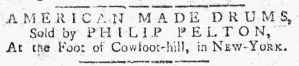
The frequency that advertisements for drums appeared in American newspapers increased significantly after fighting commenced at Lexington and Concord in April 1775. Drums, after all, were essential military equipment. Advertisers who made or sold drums often did not consider it necessary to say much in their newspaper notices. One brief advertisement, for instance, proclaimed, “AMERICAN MADE DRUMS, Sold by PHILIP PELTON, At the Foot of Cowfoot-hill, in NEW-YORK.” Pelton made sure that prospective customers knew that his drums were made in America, but he did not make other appeals in that notice.
In a subsequent advertisement, however, he decided to go into more detail in hopes of convincing readers in the market for drums to choose the ones that he “MADE and sold” and provided to an associate, Daniel Pelton, likely a relation, to sell. In case it was not enough that they were made in America, Pelton asserted that his drums were “equal to any that have been imported, for sound or beauty.” His customers did not have to sacrifice quality when they purchased his drums. They looked as good as imported alternatives and they sounded as good. In addition, the Peltons had a “great variety on hand,” so “any gentlemen may be served at the shortest notice.” Customers did not need to place orders and wait for Pelton to make their drums. Instead, they could select from a wide inventory, making choices according to size and appearance and price. No matter which drums customers chose, the Peltons sold them “on the most reasonable terms” or, in other words, for fair prices. As an ancillary service, the Peltons pledged that “purchasers may depend upon having their Drums tun’d to sound well.” That was yet another marketing appeal intended to resonate with prospective customers. As Pelton had done when mentioning the sound and beauty of his drums earlier in the advertisement, he invited readers to engage their senses by imagining the sounds of drums “tun’d to sound well.” This more elaborate advertisement gave prospective customers more reasons to purchase the drums that Pelton made and sold.