September 27

What was advertised in a revolutionary American newspaper 250 years ago today?
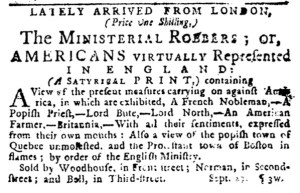
Pennsylvania Journal (September 27, 1775).

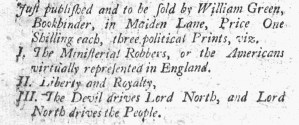
 “AMERICANS VIRTUALLY Represented IN ENGLAND: (A SATYRICAL PRINT.)”

As the imperial crisis intensified and hostilities commenced in Massachusetts in the spring of 1775, American colonizers had supporters in London.  In addition, some artists, engravers, and printers, whatever their own politics may have been, hoped to generate revenue by creating and publishing political cartoons that lambasted the British ministry for the abuses it perpetrated in the colonies.  Some of those prints found their way to eager audiences on the other side of the Atlantic.  In the fall of 1775, William Woodhouse, a bookseller and bookbinder, John Norman, an architect engraver building his reputation, and Robert Bell, the renowned bookseller and publisher, advertised a “SATYRICAL PRINT” that “LATELY ARRIVED FROM LONDON.”

The trio promoted “The MINISTERIAL ROBBERS; or, AMERICANS VIRTUALLY Represented IN ENGLAND,” echoing one of the complaints that colonizers made about being taxed by Parliament without having actual representatives serve in Parliament.  Based on the description of the print in the advertisement, Woodhouse, Norman, and Bell stocked “Virtual Representation, 1775” or a variation of it.  According to the newspaper notice, the image depicted a “View of the present measures carrying on against America, in which are exhibited, A French Nobleman,– A Popish Priest,– Lord Bute,– Lord North,– An American Farmer,– [and] Britannia.”  For each character, “their sentiments, expressed from their own mouths,” appeared as well.

Lord Bute, the former prime minister who inaugurated the plan of regulating American commerce to pay debts incurred during the Seven Years War, appeared at the center of the image, aiming a blunderbuss at two American farmers.  For his “sentiments,” he proclaimed, “Deliver your Property.”  Lord North, the current prime minister, stood next to Bute, pointing at one of the farmers and exclaiming, “I Give you that man’s money for my use.”  In turn, the first farmer stoutly declared, “I will not be Robbed.”  The second expressed solidarity: “I shall be wounded with you.”

The advertisement indicated that the print also showed a “view of the popish town of Quebec unmolested, and the Protestant town of Boston in flames; by order of the English ministry.”  Those parts of the political cartoon unfavorably compared the Quebec Act to the Coercive Acts (including the Boston Port Act and the Massachusetts Government Act), all passed by Parliament in 1774.  The Quebec Act angered colonizers because it extended certain rights to Catholics in territory gained from the French at the end of the Seven Years War.  In the print, the town of Quebec sat high atop its bluff, the flag of Great Britain prominently unfurled, in the upper left with the “French Nobleman” and “Popish Priest” in the foreground.  The legend labeled it as “The French Roman Catholick Town of Quebeck.”  The anti-Catholicism was palpable; the kneeling priest exclaiming “Te Deum” in Latin and holding a cross in one hand and a gallows in the other, playing on Protestant fears of the dangers they faced from their “Popish” enemies.

While Quebec appeared “unmolested” and even favored by Bute, North, and their allies in Parliament, the “English Protestant Town of Boston” appeared in the distance behind the American farmers in the upper right.  The town was indeed on fire, a reference to the battles fought in the vicinity as well as a metaphor for the way Parliament treated the town to punish residents for the Boston Tea Party.  As the advertisement indicated, Britannia, the personification of the empire, made an appearance in the print.  She wore a blindfold and exclaimed, “I am Blinded.”  She looked to be in motion, one foot at the edge of “The Pit Prepared for Others” and her next step surely causing her to fall into it.  There seemed to be no saving Britannia as Bute and North harassed the American farmers and their French and Catholic “Accomplices” watched with satisfaction.

The description of the “SATYRICAL PRINT” in the Pennsylvania Journal merely previewed the levels of meaning contained within the image, yet in likely piqued the curiosity of colonizers who supported the American cause and worried about their own liberties as events continued to unfold in Boston.  Such a powerful piece of propaganda supplemented newspaper reports, maps of the Battle of Bunker Hill, and political treatises circulating in the fall of 1775.

“Virtual Representation, 1775” (London, 1775). Courtesy Boston Public Library.

December 15

What was advertised in a colonial American newspaper 250 years ago today?

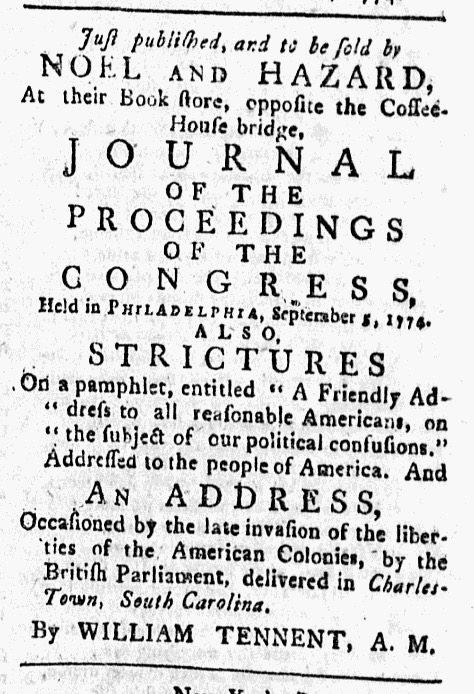
New-York Journal (December 15, 1774).

“JOURNAL OF THE PROCEEDINGS OF THE CONGRESS.”

According to their advertisement in the December 15, 1775, edition of the New-York Journal, Garrat Noel and Ebenezer Hazard stocked the “JOURNAL OF THE PROCEEDINGS OF THE CONGRESS, Held in PHILADELPHIA” at their bookstore.  They also marketed “STRICTURES On a pamphlet, entitled ‘A Friendly Address to all reasonable Americans, on the subject of our political confusions’” by Charles Lee and “AN ADDRESS, Occasioned by the late invasion of the liberties of the American Colonies, by the British Parliament, delivered in Charles-Town, South Carolina” by William Tennent.  The booksellers provided the public access to news and commentary about current events beyond what appeared in the public prints, though they privileged perspectives expressed by Patriots rather than Loyalists.

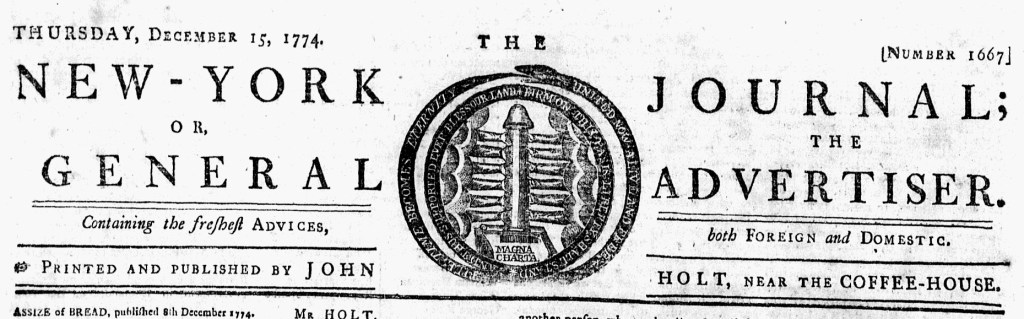
Noel and Hazard may have sold Hugh Gaine’s New York edition of the Proceedings of the First Continental Congress, though the other titles in their advertisement suggest that they could have sold the Philadelphia edition printed by William Bradford and Thomas Bradford.  The Bradfords also published Lee’s Strictures and Tennent’s Address, possibly sending copies of all three titles to Noel and Hazard.  Either  way, the masthead of the newspaper that featured the booksellers’ advertisement suggested that the Bradfords’ edition of the Proceedings made their way to New York.  Six months earlier, John Holt, the printer of the New-York Journal, incorporated a political cartoon depicting a severed snake, each segment representing one of the colonies, with the motto “UNITE OR DIE” into the masthead.  On December 15, he replaced it with a woodcut depicting twelve hands, one for each colony represented at the First Continental Congress, grasping a liberty pole with a liberty cap perched atop it on a pedestal inscribed “MAGNA CHARTA.”  A similar image appeared on the title page of the Bradfords’ edition of the Proceedings, described in Princeton University Library’s online catalog as “the first wood-cut device of the 12 colonies intended to symbolize the need for the true political unity of the colonies.”  Holt enhanced that image, having an ouroboros twice encircle the hands and pillar.  A message on the ouroboros proclaimed, “UNITED NOW – ALIVE AND FREE – AND THUS SUPPORTED EVER – BLESS OUR LAND – FIRM ON THIS BASIS LIBERTY SHALL STAND – TILL TIME BECOMES ETERNITY.”  This addition to his newspaper set the tone for readers to peruse Noel and Hazard’s advertisement, other paid notices, and the news and editorials selected by Holt.

New-York Journal (December 15, 1774).

July 27

What was advertised in a colonial American newspaper 250 years ago today?

Pennsylvania Journal (July 27, 1774).

“Many other articles, which will be sold low for cash, or a short credit.”

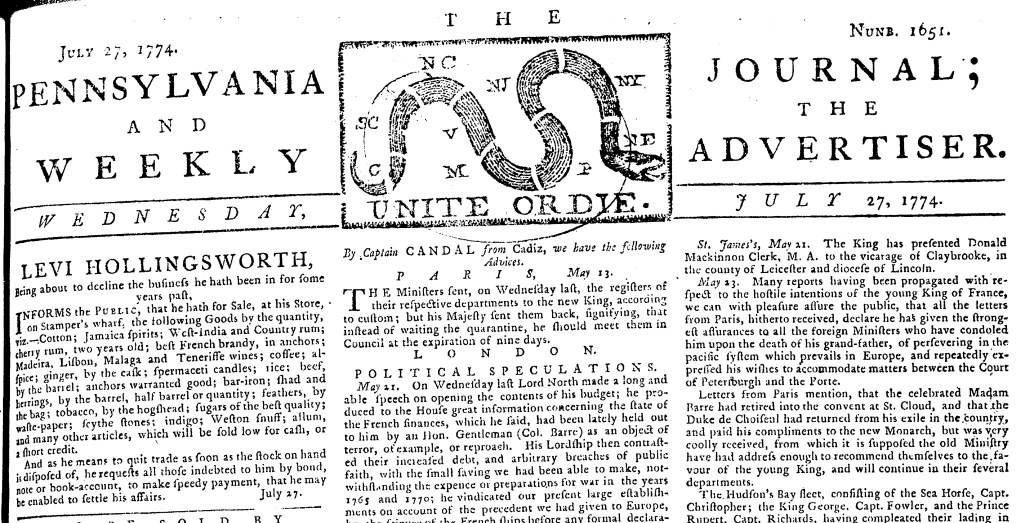
Levi Hollingsworth’s advertisement for a variety of goods available “at his Store, on Stamper’s wharf,” in Philadelphia in the July 27, 1774, edition of the Pennsylvania Journal appeared immediately below a masthead that featured a new image.  Previously, the device had four components.  In the center, a newspaper bearing the title “JOURNAL” sat on a pedestal above a cartouche that showed a ship at sea, those items testifying to information that the newspaper disseminated and the commerce that it facilitated.  An indigenous American on the left and an angel representing Fame on the right flanked the newspaper and ship.  The new device depicted a divided snake, each segment assigned to a colony, with the motto, “UNITE OR DIE.”

In recent weeks, at least two other American newspapers incorporated similar images into their mastheads.  The New-York Journal, printed by John Holt, had done so on June 23.  The images were so similar that William Bradford and Thomas Bradford, printers of the Pennsylvania Journal, likely copied directly from Holt’s newspaper after they received it via exchange networks that linked printers throughout the colonies.  On July 7, Isaiah Thomas adopted an even more elaborate image in the masthead of the Massachusetts Spy, one that showed a divided snake with a pointed tongue and a pointed tail facing off against a dragon that represented Great Britain.  Its admonition demanded that readers “JOIN OR DIE.”  Once the Bradfords updated their masthead, a newspaper published in three of the four largest American port cities circulated the divided snake political cartoon to subscribers and other readers every week.  The Pennsylvania Journalcontinued doing so for fifteen months, returning to its previous device at the end of October 1775.  By that time, the Revolutionary War had started.

In his History of Printing in America (1810), Isaiah Thomas stated that the Pennsylvania Journal “was devoted to the cause of the country.”[1]  Each time that Hollingsworth or other advertisers placed notices in that newspaper they aided in underwriting a partisan press that advocated for the rights of colonizers as British subjects and, eventually, independence from Great Britain.  Each time a reader perused those advertisements, they likely saw the political cartoon in the masthead, forced to engage with its message even if they did not read the news and editorials closely.

**********

[1] Isaiah Thomas, The History of Printing in America: With a Biography of Printers and an Account of Newspapers (1810; New York: Weathervane Books, 1970), 437.

July 7

What was advertised in a colonial American newspaper 250 years ago today?

Massachusetts Spy (July 7, 1774).

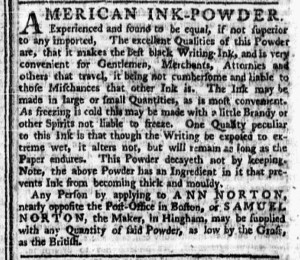
“AMERICAN INK-POWDER.”

In an advertisement in the July 7, 1774, edition of the Massachusetts Gazette, Ann Norton of Boston and Samuel Norton of Hingham heralded “AMERICAN INK-POWDER” made by Samuel.  They encouraged “Gentlemen, Merchants, Attornies and others that travel” to purchase this product “found to be equal, if not superior to any imported.”  Most of the advertisement described the various qualities of the ink powder that made it better than imported alternatives.  As colonizers in Boston and other towns considered enacting nonimportation agreements to protest the Boston Port Act, entrepreneurs like the Nortons seized the opportunity to present “domestic manufactures” or goods produced in the colonies as patriotic choices for consumers.  On the same page as the Nortons’ advertisement for “AMERICAN INK-POWDER,” Philip Freeman once again ran his notice asserting that “we can manufacture enough [gloves] here, to supply the whole Continent” and recommending that “the importation of this article at least will be totally stopped” during such “threatning” times.

Both advertisements ran in a newspaper that featured a new addition to its masthead: a snake in several segments facing a dragon.  The words “JOIN OR DIE” appeared above the snake and abbreviations for New England and other colonies accompanied each segment.  Readers understood that the snake represented the colonies and the dragon represented Great Britain.  As Isiah Thomas, the printer of the Massachusetts Spy, explained in his History of Printing in America(1810), “The head and tail of the snake were supplied with stings, for defence against the dragon, which appeared furious, and as bent on attacking the snake.”[1]  It was a more elaborate version of the “JOIN, OR DIE” emblem that ran in Benjamin Franklin’s Pennsylvania Gazette twenty years earlier and the “UNITE OR DIE” emblem added to the masthead of the New-York Journal just two weeks earlier.  With this image, Thomas made the threat to American liberty explicit with the addition of the dragon.  That “political device,” as Thomas called it, joined a quotation from Joseph Addison’s Cato that had been part of the masthead for many months: “DO THOU Great LIBERTY inspire our Souls – And make our Lives in THY Possession happy – Or, our Deaths glorious in THY just Defence.”  An assertion that the Massachusetts Spy was “Open to ALL Parties, but Influenced by None” disappeared from the masthead.  The combination of the quotation from Cato and the “political device” made the editorial perspective of the newspaper clear.  Thomas ceased publishing the Massachusetts Spy in Boston and left the city in April 1775 and soon after established the Massachusetts Spy; or, American Oracle of Liberty in Worcester.  Throughout the remainder of the newspaper’s publication in Boston, the snake defending itself against the dragon was part of the masthead, setting the tone for all the news, editorials, and advertisements that appeared below.

Massachusetts Spy (July 7, 1774).

**********

[1] Isaiah Thomas, The History of Printing in America: With a Biography of Printers and an Account of Newspapers (1810; New York: Weathervane Books, 1970), 273.

June 23

What was advertised in a colonial American newspaper 250 years ago today?

New-York Journal (June 23, 1774).

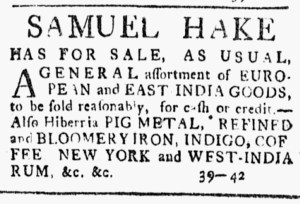
“AS USUAL, A GENERAL assortment of EUROPEAN and EAST INDIA GOODS.”

As readers perused the June 23, 1774, edition of the New-York Journal, they once again encountered Samuel Hake’s advertisements for a “GENERAL assortment of EUROPEAN and EAST INDIA GOODS, to be sold reasonably, for cash or credit.”  It was the fourth consecutive week that it appeared in that newspaper, having originated in the June 2 edition.  It was the first time, however, that the advertisement ran under a new image in the masthead.  The New-York Journal previously included the coat of arms of the United Kingdom, a lion and a unicorn flanking a shield with the words “DIEU ET MON DROIT” (“God and My Right”) on a banner beneath it.  After receiving word of the Boston Port Act that closed and blockaded the harbor until residents of that city paid for the tea destroyed during the Boston Tea Party, John Holt, the printer of the New-York Journal, selected a new image for the masthead, a snake severed into pieces with the words “UNITE OR DIE” beneath it.  Short abbreviations indicated each part of the snake represented New England or one of the other colonies.

Pennsylvania Gazette (May 9, 1754). Courtesy Library of Congress.

Holt drew inspiration from the “JOIN, or DIE” woodcut that appeared in Benjamin Franklin’s Pennsylvania Gazette twenty years earlier on May 9, 1754.  At that time, the American colonies faced a threat from the French and their Indigenous allies on the eve of the Seven Years War.  In an editorial, Franklin encouraged colonizers to support the Albany Plan of Union and recognize their shared identity as Americans.  The “JOIN, or DIE” political cartoon that accompanied that call to a common cause is the earliest known visual representation of such unity, a symbol repurposed during the imperial crisis.  According to public historians at the National Constitution Center, the “emblem appeared in colonial newspapers during the Stamp Act crisis” and again “during the American Revolutionary War, sometimes as part of a masthead.”  Holt was the first printer to deploy it in 1774, though in the coming months variations appeared in the mastheads of other newspapers.  Those newspapers carried editorials and coverage of the Boston Port Act and the rest of the Coercive Acts and the colonial response, including proposals to cease trade with Britain and stop purchasing imported goods.  Over the next several months, the “GENERAL assortment of EUROPEAN and EAST INDIA GOODS” advertised by Hake would take on new political meanings for colonial consumers.

New-York Journal (June 23, 1774).