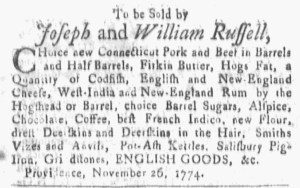
November 26

What was advertised in a colonial American newspaper 250 years ago today?

Providence Gazette (November 26, 1774).

“Names of those Gentlemen who are now indebted to the Library Company should be inserted … in the Providence Gazette.”

The Providence Library Company, a private subscription library, conducted some of its business in the public prints in the eighteenth century.  Early in the fall of 1774, Theodore Foster, the librarian, ran an advertisement in the Providence Gazette, requesting that “All Persons … who have any Books belonging to the Library … return the same immediately” so they could be “examined and numbered.”  In addition to conducting an inventory of the collection, the librarian was “ready to settle with the delinquent Proprietors” who had not paid their subscriptions.

At the end of November, Foster published a new advertisement in the wake of a vote at a recent “Meeting of the Proprietors.”  They had decided that “the Names of those Gentlemen who are now indebted to the Library Company should we inserted three Weeks successively in the Providence Gazette, with the Sums respectively due from each.”  That list consisted of more than two dozen subscribers, most of them with debts going back more than a decade.  The proprietors in good standing determined that the grace period had extended long enough.  Accordingly, the advertisement also informed the delinquent subscribers that if they did not make payment before December 3 then “their Rights should be sold by the Treasurer” at a public auction on December 10.  They took that action “agreeable to the printed and established Rules of the Library.”  The advertisement first ran on November 19 and again on November 26.  It made its final appearance on December 3, the deadline for settling accounts.  Perhaps Foster offered a little more leeway, provided subscribers paid before the auction on December 10, but the advertisement made clear that overdue subscriptions would be addressed, one way or another, “By Order of the Proprietors.”  Their next meeting was scheduled for the day of the auction, an opportunity to assess the outcome of their efforts to get everything in good order.

As was often the case, advertisements like this one relayed local news to the readers of the Providence Gazette.  John Carter, the printer, selected which news and editorials to publish elsewhere in the newspaper, yet purchasing advertising space gave individuals and organizations opportunities to become editors who decided on some of the information presented to the public.

November 19

What kinds of principles were expressed in advertisements in colonial American newspaper 250 years ago today?

Providence Gazette (November 19, 1774).

“VOTES and PROCEEDINGS of the AMERICAN CONTINENTAL CONGRESS.”

“RUN away … a Negro Man, named Prince.”

The press was a powerful engine for promoting freedom and rallying colonizers to resist abuses perpetrated by Parliament and, eventually, declare independence from Britain during the era of the American Revolution, yet it simultaneously aided in perpetuating the enslavement of Black and Indigenous people by publishing advertisements offering enslaved people for sale or offering rewards for the capture and return of those who liberated themselves by running away from their enslavers.  The juxtaposition of liberty and slavery in colonial newspapers was common, as Jordan E. Taylor has demonstrated in “Enquire of the Printer: Newspaper Advertising and the Moral Economy of the North American Slave Trade, 1704-1807.”  Among the most stark examples he identifies, Solomon Southwick, the printer of the Newport Mercury, published the Declaration of Independence and an advertisement for a “NEGRO BOY” on July 18, 1776.[1]

Providence Gazette (November 19, 1774).

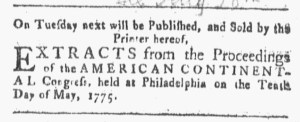
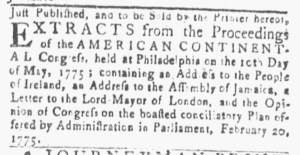
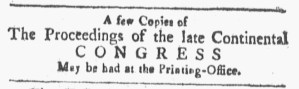
In addition to news and editorials advocating for liberty while advertisements perpetuated slavery, sometimes other advertisements also stood in such contrast.  On November 19, 1774, for instance, John Carter, the printer of the Providence Gazette, inserted advertisements for “EXTRACTS From the VOTES and PROCEEDINGS of the AMERICAN CONTINENTAL CONGRESS” and “ENGLISH LIBERTIES, OR, The free-born Subject’s INHERITANCE” in the same issue that carried an advertisement that described “a Negro Man, named Prince” who had liberated himself by running away from Thomas Wood earlier in the month.  The Adverts 250 Project has noted the publication and dissemination of the Extracts in several towns in the fall of 1774.  The Providence Gazette certainly was not the only newspaper that advertised this important political pamphlet while simultaneously running notices about enslaved people.  On November 2, William Bradford and Thomas Bradford, printers of the Pennsylvania Journal, were the first to announce that they published the Extracts.  In the same issue they ran two advertisements that sought to capture fugitives seeking freedom, one about “a Negro Man named CAESAR” and another an unnamed “NEGRO MAN” who “speaks Low Dutch.”  Almost all the newspapers carrying advertisements for the Extracts that the Adverts 250 Project has featured so far ran them alongside advertisements about enslaved people.  The juxtaposition of liberty and enslavement in revolutionary print culture that Taylor identifies was not merely incidental or occasional.  It occurred consistently, even in newspapers published in New England, New York, and Pennsylvania.

**********

[1] Jordan E. Taylor, “Enquire of the Printer: Newspaper Advertising and the Moral Economy of the North American Slave Trade, 1704-1807,” Early American Studies 18, no. 3 (Summer 2020): 313-4.

November 12

What was advertised in a colonial American newspaper 250 years ago today?

Providence Gazette (November 12, 1774).

“He pretends not to say that no one can sell so cheap, but believes no one will.”

According to his advertisement in the November 12, 1774, edition of the Providence Gazette, Amos Throop stocked a variety of popular patent medicines, including Hooper’s Pills, Stoughton’s Elixir, Bateman’s Drops, Godfrey’s Cordial, James’s Fever Powder, Turlington’s Balsam of Life, and Hill’s Balsam of Honey “for coughs and consumptions.”  He also sold a variety of medical supplies for both physicians, apothecaries, and home use, such as “pocket cases of surgeons instruments,” “a pretty assortment of bell-metal and glass mortars,” and “beautiful smelling bottles of various figures.”

Throop’s advertisement did not list every item that he recently imported from London.  Like other retailers often did, he promised that prospective customers would discover much more merchandise upon visiting his shop.  “Many more articles might be enumerated,” he proclaimed, “but suffice to say, that a more general assortment never was imported.”  Not only did he offer an array of choices, but the selection was supposedly unrivaled in Providence or anywhere else in the colonies.

In case that was not enough to get the attention of prospective customers, Throop also promoted his prices.  He initially referred to them as “very cheap indeed,” but then elaborated on that point.  Readers would not find more choices elsewhere, “nor can any reasonable objection be made to the prices.  He pretends not to say that no one can sell so cheap, but believes no one will.”  In making that declaration, he invited readers to consider the choices made by purveyors of goods when they set prices for their wares.  Throop claimed that he was not in any sort of special position to offer such bargains.  Anyone else in his line of business could have done the same, but he did not suspect that anyone would.  Throop deliberately chose to sell his merchandise “very cheap indeed.”  Physicians, apothecaries, and other consumers, he suggested, should reward that choice by choosing to buy their patent medicines and medical supplies from him rather than any of his competitors.

November 5

What was advertised in a colonial American newspaper 250 years ago today?

Providence Gazette (November 5, 1774).

“The Manual Exercise … the best calculated for Appearance and Defence.”

As was often the case, John Carter, the printer of the Providence Gazette, placed several advertisements in his own newspaper on November 5, 1774, hoping to advance other revenue streams in his printing office.  He placed five notices of varying lengths.

If they perused the contents of that issue from start to finish, readers first encountered an advertisement for books that Carter sold on the third page.  It listed dozens of items, starting with “THE surprising, yet real and true Voyages and Adventures of Monsieur Pierre Viaud, a French Sea Captain, adorned with an elegant engraving of Madam La Couture and her Son, with Capt. Viaud and his Negro, upon a desolate island” that previously had been featured separately in a much more extensive advertisement and concluded with “the Manual Exercise, as ordered by his Majesty in 1764, together with Plans and Explanations of the Method generally practised at Reviews and Field Days,” a publication that had recently received some attention in Boston as well.  Carter added a short note, advising that “this Method of Exercise is now universally taking Placer, and is recommended by the Provincial Congress as the best calculated for Appearance and Defence.”  The printer did not specify the threat that colonizers faced; as the imperial crisis intensified following the passage of the Coercive Acts, readers understood the context for promoting that book.

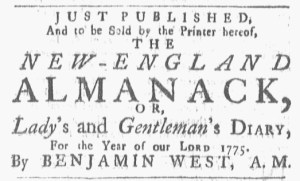
On the fourth page, the second and third columns began and ended with advertisements from Carter.  At the top of the second column, he declared that he had “JUST PUBLISHED” Benjamin West’s “NEW-ENGLAND A[L]MANACK, OR, Lady’s and Gentleman’s DIARY, For the Year of our LORD, 1775.”  Two weeks earlier, he inserted a notice that publication of this annual collaboration with West, an astronomer and mathematician, was imminent.  Carter completed the column with a short advertisement for “BLANKS of various Kinds to be sold by the Printer hereof.”  The fourth column featured an advertisement addressed to the “FRIENDS of LIBERTY and USEFUL KNOWLEDGE,” alerting them that they could acquire copies of “ENGLISH LIBERTIES, OR, The free-born Subject’s INHERITANCE” at Carter’s printing office.  He published that volume by subscription, a project that took quite some time.  Upon publication, this advertisement appeared regularly in the Providence Gazette.  The column ended with a call for “clean Linen Rags … and old Sail-Cloth” to supply the “PAPER MANUFACTORY in Providence.”  Carter offered the “best Prices” to colonizers who supplied these items so essential to the printing trade.

In addition to his own advertisements, the printer inserted a brief note that “Advertisements omitted will be in our next.”  How many advertisements did not appear?  Did Carter’s own notices crowd out paid notices submitted by customers?  Or had some advertisements arrived at the printing office too late to include in the November 5 edition?  Carter had to weigh the advantages and disadvantages of giving too much space to advertisements concerning his own endeavors when others wished to pay for space in his newspaper.

October 29

What was advertised in a colonial American newspaper 250 years ago today?

Providence Gazette (October 29, 1774).

“BRAZIER, from Boston …  has opened a Shop at the North of Providence, near Liberty-Tree.”

When Caleb Allen, a “BRAZIER, from Boston,” opened a shop in Providence in the fall of 1774, he took to the pages of the local newspaper to advise the public of his new endeavor.  He announced that he “makes and mends Brass Kettles, Tea-Kettles, Skillets,” and other items and “mends old Pewter and Tin.”  Like many other artisans, he pledged that his customers “may depend on having their Work done in the neatest Manner, with Care and Dispatch.”  Braziers and other artisans often assured the public about their skill and the quality of their work.

In giving his location, Allen stated that customers could find his shop “at the North End of Providence, near Liberty-Tree.”  In so doing, he may have signaled his political views.  At the very least, he seemingly indicated that he was friendly to the patriot cause rather than holding it in disdain.  After all, he could have chosen from among many ways to give his location, including just “at the North End of Providence” without mentioning the Liberty Tree.  He could have given the name of the street, noted his shop’s proximity to a prominent resident or business, or invoked another familiar landmark.  Yet the newcomer from Boston specifically associated the Liberty Tree with his business.

Allen did not mention how recently he arrived in Providence.  He had not advertised in the Providence Gazette prior to October 29, 1774.  Perhaps he left Boston after the Boston Port Act went into effect, blockading the harbor until the residents of the town paid for the tea destroyed during the Boston Tea Party.  That legislation, along with the other Coercive Acts, disrupted commerce and everyday life in Boston.  The same issue of the Providence Gazette that carried Allen’s advertisement also featured an update from Boston that “transports, with troops, &c. on board, arrived here from New-York.”  Anticipating that things would get even more difficult in that city, the “BRAZIER, from Boston” may have determined to depart and seek his fortunes elsewhere.  In that case, the Liberty Tree in Providence would have had particular significance for him when he set up shop near it.

October 22

What was advertised in a colonial American newspaper 250 years ago today?

Providence Gazette (October 22, 1774).

“On Wednesday next will be published, and sold by the Printer hereof, WEST’s ALMANACK.”

Although he sometimes ran advertisements on the first page of his newspapers, John Carter, the printer of the Providence Gazette, opted to place all of them at the end of the October 22, 1774, edition.  News filled most of the first three pages, with the final third of the last column on the third page given to advertising and then the entire fourth page as well.  As usual, the news concluded with local updates, including accounts of sheep being sent to the “distressed Towns of Boston and Charlestown” to relieve the residents while the Boston Port Act remained in effect and coverage of the capture of a suspected burglar.

As readers finished with the news, they immediately encountered an advertisement for “WEST’s ALMANACK, For the Year of our Lord 1775” before paid notices submitted by Carter’s customers.  That advertisement announced that the printer would publish and sell the almanac on the following Wednesday, the first mention of Benjamin West’s almanac for the coming year in the Providence Gazette.  The public likely anticipated its publication and marketing since West, an astronomer and mathematician, had been collaborating with the printer of the Providence Gazette for more than a decade.  The partnership began before Carter became the proprietor of the newspaper, passing from printer to printer as the Providence Gazette changed hands.  West initially worked with William Goddard, followed by Sarah Goddard, before Carter ran the printing office.

For his part, Carter often gave advertisements for the works that he printed, whether books or West’s almanac, a privileged place.  Sometimes they appeared as the first item on the first page, while other times he positioned them as the first item following the news.  Either way, he increased the chances that readers would see and take note of advertisements that promoted his own endeavors in the printing office.

October 15

What was advertised in a colonial American newspaper 250 years ago today?

Providence Gazette (October 15, 1774).

“At the Printing-Office may likewise be had, Lockyer’s Pills, Turlington’s Balsam of Life.”

Colonial printers devised multiple revenue streams to earn their livelihoods.  John Carter, the printer of the Providence Gazette, was no exception.  In addition to seeking subscribers and advertisers for his newspaper, the colophon in each issue announced that “all Manner of Printing-Work is performed with Care and Expedition” at his printing office.  Carter took orders for job printing, everything from handbills and broadsides to printed blanks and circular letters.  Like other printers, he was also a bookseller, dealing primarily in imported volumes rather than books and pamphlets produced in his own shop.  In the October 15, 1774, edition of the Providence Gazette, Carter inserted an advertisement that listed a couple of dozen titles that he had on hand, including “FORDYCE’s excellent Sermons to young Women, the Family Instructor, Doddridge’s Rise and Progress, Mrs. Rowe’s Letters, likewise he Works compleat, in 4 Vols.”  Each fall, Carter collaborated with Benjamin West, an astronomer and mathematician, in publishing an almanac.  Separate advertisements for that useful work would commence soon, though the printer did not yet promote it in the middle of October.

His advertisement did, however, conclude with a separate list of patent medicines that he stocked at the printing office: “Lockyer’s Pills, Turlington’s Balsam of Life, Stoughton’s Elixir, the Golden Medical Cephalic Snuff, British Tooth-Powder, Tincture for the Gums, and Essence for the Teeth.”  Apothecaries imported and sold these popular remedies, as did merchants and shopkeepers … and printers.  Throughout the colonies, printers frequently advertised patent medicines in addition to goods and services associated with the book trade.  They did not need to possess any specialized medical knowledge to peddle these eighteenth-century versions of over-the-counter medications.  Customers already knew which patent medicines treated which maladies.  In addition, the various pills, powders, and elixirs frequently came with printed instructions that absolved printers and other retailers from having to provide any guidance about their use.  When it came to acquiring patent medicines, consumers may have found it just as convenient to visit the local printing office as any other shop.  For his part, Carter accommodated them, supplementing the revenues he earned from printing and selling books.

October 8

What was advertised in a colonial American newspaper 250 years ago today?

Providence Gazette (October 8, 1774).

“The whole Library may be got together, examined and numbered, as soon as possible.”

Advertisements published in the Providence Gazette reveal some of the work undertaken in administering the Providence Library Company.  In 1753, prominent residents founded this subscription library, believing that “a Collection or Library of Usefull and Edifying Books will most certainly tend to the Benefit and Instruction of the Inhabitants of this Town and County of Providence and the Rising Generation thereto belonging.”  Two decades later, Theodore Foster held the post of librarian.  He took to the pages of the Providence Gazette to address “all the Proprietors” as well as “All Persons, whether Proprietors or not, who have any Books belonging to the Library.”  Foster instructed all of them to return their books “immediately.”

The librarian apparently intended to conduct an inventory of the collection.  He informed the public that “No Books will be delivered out before the next Meeting, but the Librarian will attend at the Library next Saturday, as usual, to receive in the Books.”  Furthermore, he sought to enlist the aid of others in successfully pursuing this project: “All who know of any Books in the Possession of those who are not Proprietors, are desired to inform the Librarian thereof.”  Foster intended to be complete and comprehensive, working with a committee tasked with “examin[ing] and number[ing]” the “whole Library … as soon as possible.”  Gathering the entire collection together was more important than assessing fines for overdue books or investigating where any of the books had been.  “All Fines shall be given up,” Foster declared, “and no Questions asked respecting any of the Books, if they are returned to the Librarian before the next Meeting.”  As an aside, Foster noted that he “is ready to settle with delinquent Proprietors” who had not paid their subscription fees.

The Providence Library Company had compiled and published a Catalogue of All the Books Belonging to the Providence Library as well as Rules for Governing the Proprietors of, and Institutions for Rendering Useful the Books Belonging to the Providence Library in 1768.  The Rules, adopted in 1762, outlined the procedures for borrowing books and the duties of the librarian.  They also specified that that a “Catalogue of all the books belonging to the Library be fairly written in the Register, in alphabetical order, … care being taken to leave Room under each Letter for inserting such Books, as may hereafter be purchased.”  Despite those best intentions, the librarian and the proprietors apparently considered a careful and complete inventory necessary to assess the status of the library’s holdings.  Beyond the annual meeting for the proprietors, Foster resorted to a newspaper advertisement to reach anyone who had information about any books belonging to the library.

October 1

What was advertised in a colonial American newspaper 250 years ago today?

Providence Gazette (October 1, 1774).

SCHEME of a LOTTERY … for rebuilding Holden’s Grist-Mill.”

Regular visitors to the Adverts 250 Project know that I have incorporated both the Adverts 250 Project and the Slavery Adverts 250 Project into my upper-level courses, including Colonial America, Revolutionary America, Slavery and Freedom in America, Public History and Public Debate, and Research Methods.  Students in those courses serve as guest curators for the projects, generating their own miniature archives of digitized copies of eighteenth-century newspapers, selecting advertisements to feature and examine for the Adverts 250 Project, and identifying advertisements about enslaved people and composing posts for the Slavery Adverts 250 Project.  This requires working intensively with early American newspapers.

This semester I decided to experiment with designing an assignment involving those newspapers into my introductory survey of American history that begins with Indigenous America and concludes with Reconstruction.  I gave each student a packet of newspapers published during a single week in 1774 so they could develop their own sense of what was happening in the colonies 250 years ago.  I asked them to craft three short articles, 300 words each, that delivered news in modern English that an average reader today would understand.  Realizing that advertisements contained newsworthy content and that many of them would be more accessible than the articles and editorials in early American newspapers, I encouraged students to examine those and “translate” them for modern audiences, being sure to include the essential who, what, when, where, and how.  In addition, they need to reflect on why, both why something happened in 1774 and why it is important in helping us understand some aspect of the past.  In the past, I’ve found that students often struggle with articulating even basic details from primary sources.  For a survey course, this seemed like a good opportunity to practice that skill while, hopefully, removing some of the pressure of writing a formal essay.  In addition, most students in upper-level courses have been very curious when looking through an entire week’s worth of colonial newspapers, generating all sorts of questions about life in early America.  Their sense of wonder guided classroom discussions, so I hoped to create a similar experience for students in my survey course.

We devoted an entire week, two seventy-five-minute classes, to “history labs” that introduced students to early American newspapers.  On the first day, I presented an overview that included examining a framed original newspaper from May 1787 that usually hangs in my office before giving them time to browse the newspapers on their own and discuss with their peers.  We then convened as an entire class for discussion and questions.  We devoted the entire second day to a workshop intended to prepare students to write their articles about news from early America.  Rather than expect them to complete an unfamiliar assignment on their own away from class, I wanted them to have an opportunity to get started, ask questions, and seek clarifications.  I knew that some students would eventually visit during office hours for assistance, but for many that would be our only chance for one-on-one conversations about how they approached the assignment.  I proved them with worksheets for outlining their articles, including topic, citations to newspapers, and who, what, when, where, how, and why.

During that workshop, I discovered that many students felt uncertain about the expectations for the assignment, including the intended format.  In turn, I decided to provide an example that they could use as a model, one that demonstrated that the project was not as complicated as some of them imagined.  I selected an advertisement that outlined a “SCHEME of a LOTTERY” for the purposes of raising funds “for rebuilding Holden’s Grist-Mill” in East Greenwich, Rhode Island, from the Providence Gazette.  It lent itself well to identifying who, what, when, where, how, and why, allowing me to provide students with an example of how to recognize the important details and organize them in a manner that makes sense to modern readers.  Was that example helpful for students?  I’ll find out later today when the assignment is due.  For now, I’m excited to see what kinds of news my students will report based on what they found interesting among the articles, editorials, and advertisements that ran in newspapers 250 years ago.

September 24

What was advertised in a colonial American newspaper 250 years ago today?

Providence Gazette (September 24, 1774).

“I am determined to prosecute him for the Defamation.”

Defamation!  That was the defense Joseph Aldrich, Jr., made against allegations that appeared in the September 10, 1774, edition of the Providence Gazette.  The original accusation and Aldrich’s response both ran as advertisements.  It started with one that read, “I JOSEPH BROWN, of Gageborough, in the County of Berkshire, and Province of the Massachusetts-Bay, give this public Notice, that Joseph Aldrich, jun. of Gloucester, in the County of Providence, hath forged or counterfeited a Note of Hand against me the said Joseph Brown, for Ninety odd Pounds Lawful Money.”  The notice offered a warning: “All Persons are therefore cautioned against taking any Assignment of said Note, as I am determined to prosecute for the Forgery, instead of paying the Contents.”

Aldrich apparently did not become aware of what Brown charged right away since he did not respond in the next issue of Providence Gazette, but not much time passed before he either read Brown’s advertisement or someone told him about it. That spurred the aggrieved Aldrich into action.  He placed his own advertisement that cited the notice “charging me the Subscriber with forging a Note of Hand against the said Brown” and asserting that “the Charge is absolutely groundless.”  Just as Brown stated that he intended to take the matter to court, so did Aldrich.  “I am determined to prosecute him for the Defamation,” he declared, confident that “I shall be able to make my Innocence appear in a Court of Justice.”

Yet it was not a “Court of Justice” that mattered immediately; it was the court of public opinion that Aldrich sought to sway.  Brown had damaged his reputation, perhaps imperiling his ability to conduct business and support his family.  For Aldrich, the most important news in the September 10 edition of the Providence Gazette appeared among the advertisements, not among the articles and editorials that so animated readers as the imperial crisis intensified.  Paying to run a notice gave Brown access to the public prints to share his version of events involving the supposedly forged and counterfeit note.  In turn, taking out his own notice allowed Aldrich to defend himself against that calumny.  In both instances, advertisements doubled as local news.