October 8

What was advertised in a revolutionary American newspaper 250 years ago this week?

Providence Gazette (October 7, 1775).

“He presumes every Friend to America, both in Town and Country, will encourage him occasionally.”

When Cornelius Cooper, a “BRUSH-MAKER, from Philadelphia,” relocated to Providence, he ran an advertisement in the October 7, 1775, edition of the Providence Gazette to introduce himself to his new neighbors and prospective customers.  The newcomer announced that he “makes and sells, Wholesale and Retail, Sweeping, Hearth, Cloaths, Shoe and Buckle Brushes, and every other Article in the Brush Way.”

Realizing that he was unknown to the residents of Providence, Cooper realized that he might increase sales by giving them sound reasons to purchase his brushes, either to use themselves or to stock in their shops to sell to others.  “As our own Fabrications, of every Kind, hold forth their Utility, in a most conspicuous Manner,” the brushmaker declared, “he presumes every Friend to America, both in Town and Country, will encourage him occasionally.”  Cooper did not need to rehearse current events for readers to understand his meaning.  They knew that the siege of Boston continued, following the battles at Lexington and Concord in April and the Battle of Bunker Hill in June.  They also knew that the Continental Association, a nonimportation agreement devised by the First Continental Congress, went into effect on December 1, 1774, in response to the Coercive Acts.  Colonizers sought to use commerce, especially their choices about consumption, as political leverage to convince Parliament to repeal the Boston Port Bill, the Massachusetts Government Act, and other legislation.  The Continental Association also called on colonizers to encourage domestic manufactures or the production of goods in the colonies as replacements or substitutes for imported ones.  Cooper did his part in making brushes.  Now “every Friend to America” needed to do their part by supporting his enterprise.

Making purchases was not the only way they could do so.  In a nota bene, Cooper requested “that People will be careful to save their Hogs Bristles, for which he will give a good Price in Cash.”  Consuming goods made in the colonies was important, but colonizers could also participate in the production of those goods by collecting materials, delivering them to Cooper, and earning some cash for their efforts.  The brushmaker also noted that he sought an apprentice, “a discreet, active Lad, about 14 Years of Age.”  He would pass along knowledge of his trade and make help the next generation contribute to the local economy.  Readers understood the inspiration and political ramifications without Cooper going into detail in his advertisement.  He presented them with a patriotic obligation and encouraged them to do their civic duty in the marketplace.

September 9

What was advertised in a revolutionary American newspaper 250 years ago today?
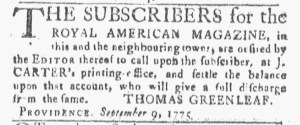
Providence Gazette (September 9, 1775).

“SUBSCRIBERS for the ROYAL AMERICAN MAGAZINE … are desired by the EDITOR thereof to … settle the balance upon that account.”

Joseph Greenleaf acquired the Royal American Magazine in the summer of 1774 and less than a year later suspended publication following the battles at Lexington and Concord.  Some subscribers apparently had not paid for issues already delivered to them, prompting Greenleaf to insert a notice in the June 9, 1775, edition of the Essex Journal.  It called on “Subscribers for the American Magazine at Newbury, Newbury-Port, and the vicinity … to pay their respective ballances to the month of March.”  That corresponded with the final issue of the magazine.

Three months later, Greenleaf’s son, Thomas, ran a similar advertisement in the Providence Gazette.  “THE SUBSCRIBERS for the ROYAL AMERICAN MAGAZINE, in this and the neighbouring towns,” the notice stated, “are desired by the EDITOR thereof,” Joseph, “to call upon the subscriber,” Thomas, “at J. CARTER’S printing-office, and settle the balance upon that account.”  In turn, Thomas “will give a full discharge.”  The younger Greenleaf “learned printing” from Isaiah Thomas, the printer of the Massachusetts Spy and the founder of the Royal American Magazine, and “managed his father’s printing house” in Boston until it closed in 1775.[1]  He left the city and migrated to Rhode Island, where he worked as a journeyman printer for John Carter, the printer of the Providence Gazette, from September 6, 1775, to April 10, 1776.[2]  The advertisement calling on local subscribers to the Royal American Magazine to settle accounts appeared in the first issue of the Providence Gazette published after Greenleaf began working in that printing office.  Even as he set about his new responsibilities, the journeyman renewed the efforts to collect payment from delinquent subscribers who had not paid for the magazines they received.  His advertisement was not as lively as the one placed by his father.  He did not lament “being driven from his house and business by the perfidious [General Thomas] Gage,” the governor and king’s representative in Massachusetts.  Instead, he left it to subscribers to realize why he no longer resided in Boston.  Some may have hoped that they could avoid settling accounts with the Greenleafs while they remained in Massachusetts, but the advertisement in the Providence Gazette reminded them of their obligation.

**********

[1] Isaiah Thomas, The History of Printing in America: With a Biography of Printers and an Account of Newspapers (1810; New York: Weathervane Books, 1970), 175.

[2] Marcus A. McCorison, “The Wages of John Carter’s Journeyman Printers, 1771-1779,” Proceedings of the American Antiquarian Society, 2nd ser., 81 (1971): 273-303.

August 13

What was advertised in a revolutionary American newspaper 250 years ago this week?

“EXTRACTS from the Proceedings of the AMERICAN CONTINENTAL Congress.”

Providence Gazette (August 12, 1775).

In the first advertisement that readers encountered in the August 12, 1775, edition of the Providence Gazette, John Carter announced “On Tuesday next will be Published, and Sold by the Printer hereof, EXTRACTS from the Proceedings of the AMERICAN CONTINENTAL Congress, held at Philadelphia on the Tenth Day of May, 1775.”  In the next issue, he inserted an updated advertisement confirming that he had indeed published the work and had copies available for sale.  Carter also listed some of the contents to entice prospective customers: “An Address to the People of Ireland, an Address to the Assembly of Jamaica, a Letter to the Lord Mayor of London, and the Opinion of Congress on the boasted conciliatory Plan offered by Administration in Parliament, February 20, 1775.”  Once again, the printer placed his notice first among the advertisements.  That was not merely an attempt to increase sales by drawing more attention to it.  In both instances, Carter treated his advertisement for Extracts from the Proceedings of the American Continental Congress as a bridge between news and advertising.  The book he hawked provided more extensive coverage of the news that he published in his weekly newspaper.

Providence Gazette (August 19, 1775).

Carter was the first printer to advertise extracts from the meeting of the Second Continental Congress.  In the fall of 1774, printers throughout the colonies advertised local editions of a similar volume that documented the First Continental Congress’s meetings in September and October.  William Bradford and Thomas Bradford, the printers of the Pennsylvania Journal, ran an advertisement almost as soon as the meetings adjourned.  Newspaper notices radiated out from Philadelphia as printers in other towns acquired copies and produced local editions for their own customers.  The Bradfords eventually published a Journal of the Proceedings of the Congress.  Only one other printer, Hugh Gaine in New York, produced and advertised a local edition.

In this case, Carter was the first printer to publish and advertise extracts from the Second Continental Congress, doing so in faraway Providence rather than in Philadelphia where the delegates met.  He did so during the brief adjournment that lasted from August 2 through September 13, 1775.  His Extracts, a pamphlet of twenty-two pages, included only the items listed in his second advertisement.  The Bradfords did publish a complete Journal of the Proceedings of the Congress that covered May 10 through August 1, but advertisements for that 239-page volume began appearing in December.  The scope of the project meant that it took the Bradfords some time to accomplish it.  The timing of the advertisements demonstrates that Carter did not merely reprint a set of extracts selected by printers in Philadelphia and then reproduced from town to town as local printing offices received copies.  Instead, he acquired the contents of his Extracts through other means, chose which items to include, and marketed the pamphlet to readers in Rhode Island.

June 10

What was advertised in a revolutionary American newspaper 250 years ago today?

Providence Gazette (May 10, 1775).

“A regular Intercourse between the Colonies, at this critical Juncture, is of the utmost Importance.”

As the imperial crisis intensified in the spring of 1775, Isaiah Thomas, the printer of the Massachusetts Spy, left Boston just before the battles at Lexington and Concord.  He had previously planned to establish a printing office in Worcester, setting up a junior partner to publish the town’s first newspaper.  When he left Boston because his political principles and advocacy put him in jeopardy with royal officials, however, he also decided to transfer his newspaper to Worcester and become the local printer.  After revising his plans, he set about expanding the infrastructure for collecting and distributing news in central Massachusetts.

Worcester, previously lacking a printer and a newspaper, became a much more important hub for disseminating information.  Tarent Putnam aimed to be part of that transformation, announcing in the Providence Gazette that he “has began to ride Post from Providence to Worcester, and proposes, on receiving proper Encouragement, to continue his Ride weekly.”  He departed Providence on Saturdays, “immediately after the Publication of the Providence Gazette,” and returned on the following Thursday.  Thomas published the Massachusetts Spy (now branded the Massachusetts Spy, Or, American Oracle of Liberty) on Wednesdays, which meant that Putnam carried newspapers hot off the presses in both directions.  In addition to carrying letters, the postrider accepted subscriptions “for the Providence or Worcester Papers” and promised that he would “faithfully execute any other Business that may be entrusted to him.”

Yet he did not offer these services merely to earn his own livelihood.  Instead, he asked colonizers to consider the impact they could have on current events if they supported his undertaking.  Putnam asserted that “a regular Intercourse between the Colonies, at this critical Juncture, is of the utmost Importance.”  Accordingly, he “flatters himself that the Friends of Liberty and the Rights of Mankind will afford him every Encouragement.”  Putnam did more than move letters and newspapers from one town to another; he made important contributions to the flow of information that kept citizens informed as the siege of Boston continued and the imperial crisis became a war for independence.  The stakes were high … and readers had an opportunity to play their part by supporting Putnam’s “POST from Providence to Worcester.”  In hiring his services, they simultaneously became better informed themselves and aided the American cause by keeping communities in New England and beyond better connected and aware of the latest information regarding current events.

June 3

What was advertised in a revolutionary American newspaper 250 years ago today?

Providence Gazette (June 3, 1775).

“POLLY and LUCY ALLEN, from Boston.”

On June 3, 1775, Polly Allen and Lucy Allen published an advertisement addressed “To the LADIES” in the Providence Gazette.  That notice served as an introduction upon their arrival in the city, informing prospective customers and the community that “all Kinds of Millenary and Mantuamaking are performed by them, at their House on the West Side of the Great Bridge.”  Since the Allens were new to town, they gave further directions that stated their location relative to a resident familiar to readers, stating that they could be found “next door to Amos Atwell’s, Esq.”  New on the scene, they could not rely on their reputation among an established clientele to generate business.  Instead, they assured prospective customers that they made hats and garments “in the neatest and genteelest Manner, and at the cheapest Rates.”  In addition to skillful work on fashionable clothing at the lowest prices, the Allens also pledged exemplary customer service, stating that “all who are pleased to favour them with their Custom may depend on being well used.”

As part of their introduction, the Allens described themselves as “from Boston.”  That made them refugees, of sorts, who had been displaced during the first weeks of the Revolutionary War.  Following the battles at Lexington and Concord on April 19, militias from throughout Massachusetts, joined by companies from other colonies, besieged Boston.  The Massachusetts Provincial Congress, meeting in Watertown, negotiated with General Thomas Gage, the governor, to allow Loyalists who wished to enter the city to do so.  In return, Patriots and other “Inhabitants of the Town of Boston” could leave.  In each case, they could take their effects with them, “excepting their Fire-Arms and Ammunition.”  The Allens apparently took advantage of safe passage out of the city, along with between 12.000 and 13,000 other residents.  When they introduced themselves in the Providence Gazette as “POLLY and LUCY ALLEN, from Boston,” they did not need to say more for readers to piece together why they chose to relocate at that moment.  The Allens may have hoped that their situation would evoke some sympathy among prospective customers or even some curiosity among those who wanted to hear for themselves what conditions had been like since the Boston Port Act closed the harbor a year earlier and, especially, during the siege in recent weeks.  Some clients may have headed to the Allens’ shop in hope of stories as well as new hats and dresses.

March 18

What was advertised in a colonial American newspaper 250 years ago today?

Providence Gazette (March 18, 1775).

“The Proceedings of the late Continental CONGRESS.”

It was a brief yet important notice: “A few Copies of the Proceedings of the late Continental CONGRESS May be had at the Printing-Office.”  It was the first advertisement that appeared in the March 18, 1775, edition of the Providence Gazette, immediately following the local news.  During the era of the American Revolution, printers often gave advertisements they considered significant, often advertisements for political pamphlets and other publications, that privileged place.  Such notices marked a transition between news selected by the printer and other content submitted by advertisers.  Printers may have expected that readers were more likely to give their attention to notices that followed (or even appeared to continue) the news than if they had been interspersed among other advertisements.

John Carter, the printer of the Providence Gazette, stocked a variety of political publications at his printing office “at Shakespear’s Head, in Meeting-Street, near the Court-House.”  He previously advertised “EXTRACTS From the VOTES and PROCEEDINGS of the AMERICAN CONTINENTAL CONGRESS.”  Once the First Continental Congress concluded its meetings in Philadelphia at the end of October 1774, printers in many towns, including Carter, published and advertised local editions of the Extracts to supplement coverage provided in their newspapers.  Not nearly as many printers, however, published the “JOURNAL OF THE PROCEEDINGS OF THE CONGRESS.”  William Bradford and Thomas Bradford, the printers of the Pennsylvania Journal, published a Philadelphia edition.  Hugh Gaine, the printer of the New-York Gazette and Weekly Mercury, published another edition.  Printers and booksellers in other cities and towns apparently acquired copies of the Journal from the Bradfords or from Gaine rather than devoting resources to producing local editions.  They believed that a market existed for that publication, even if local customers demanded only “A few Copies” to read along with the Extracts that provided so much information about the work of the First Continental Congress.  As the imperial crisis intensified in the first months of 1775, Carter suspected that readers of the Providence Gazette might desire their own copies of the Journal.

January 21

What was advertised in a colonial American newspaper 250 years ago today?

Providence Gazette (January 21, 1775).

“TO be Sold, by Order of the Committee of Inspection … sundry Merchandize.”

In December 1774 and January 1775, newspaper advertisements became records of compliance with the provisions of the Continental Association, a nonimportation, nonconsumption, and nonexportation agreement adopted by the First Continental Congress when it met in Philadelphia in September and October 1774.  The tenth article of the Continental Association made provisions for goods that arrived during the months December 1774 and January 1775, items that likely had been shipped before American merchants and shopkeepers could cancel orders previously dispatched across the Atlantic.  The importers could return those goods, turn them over to the local Committee of Inspection to store until the boycott ended, or have the committee sell them, reimburse the importer for costs, and designate any profits for relief of residents of Boston.  For the sake of both transparency and compliance, the tenth article also specified that “a particular Account [be] inserted in the publick Papers.”

Such was the case when James Angell, “Clerk of the Committee,” inserted an advertisement in the January 21, 1775, edition of the Providence Gazette.  That notice announced the upcoming sale of “sundry Merchandize, imported from Great Britain, via New-York.”  That included “6 Tierces [large barrels], 3 Barrels, 5 Bales, 2 Boxes, 1 Hamper, [and] 24 Crates” of unspecified goods as well as “1 Bundle, containing 2 Dozen of Frying Pans” and “8 Bundles, containing 4 Dozen of Iron Shovels.”  As was the case in similar advertisements in other newspapers, the Committee of Inspection did not provide the same extensive catalog of merchandise that merchants and shopkeepers often did to attract the attention of prospective customers when they composed their own newspaper notices.  The committee merely made clear that a notable quantity of items would go up for sale.  The goods “were shipped at Liverpool on board the Ship Daniel, Capt. Casey, the 15th of September, and arrived at New-York since the first Day of December last.”  That accounting made clear that the items had been ordered and shipped before the First Continental Congress agreed on the details of the Continental Association, yet since they arrived after that pact went into effect they fell under its jurisdiction.  On behalf of the Committee of Inspection, Angell decreed that the sale would occur “agreeable to the Association of the Continental Congress.”

December 31

What was advertised in a colonial American newspaper 250 years ago today?

Providence Gazette (December 31, 1774).

For the Support … of the distressed Town of Boston … suffering in the common Cause of North-America.”

As 1774 ended, readers of the Providence Gazette contemplated how they could aid the town of Boston where the harbor had been closed to commerce for seven months.  The Boston Port Act went into effect on June 1, retribution for the Boston Tea Party.  In turn, that inspired a variety of responses, including the meetings of the First Continental Congress in Philadelphia in September and October and the formation of relief efforts for Boston.  Local committees throughout the colonies started subscriptions for collecting food to send to the town, as Bob Ruppert documents in “The Winter of 1774-1775 in Boston.”

An advertisement in the December 31, 1774, edition of the Providence Gazette announced an upcoming sale of a “Quantity of FLOUR, WHEAT, RYE, INDIAN-CORN, and PORK” that would be held “For the Support and Animation of the distressed town of Boston, which is now suffering in the common Cause of North-America.”  Although Parliament aimed the Boston Port Act, the Massachusetts Government Act, and the other Coercive Acts at agitators in Massachusetts, that legislation prompted a unified response, a sense of a “common Cause” as other colonies realized that Parliament could just as easily target them.  The shipment of grains and pork that arrived in Providence came from New Jersey, “a Donation … to the Town of Boston.”  According to the advertisement, the Committee of Correspondence in Boston instructed the Committee of Correspondence in Providence to sell the grains and pork to raise funds rather than attempt to transport them to Boston.

John Carter, the printer of the Providence Gazette, gave that advertisement a privileged place both times that it ran in his newspaper.  The first time that it appeared, he inserted it immediately after local news and before other advertisements.  Readers likely experienced it as a continuation of news related to the imperial crisis, including updates about other “Donations … to the Town of Boston.”  When the advertisement ran a week later, two days before the sale, it was the first item in the first column on the first page, making it nearly impossible for readers to miss.  Through the choices he made about the layout of his newspaper, the printer made his own contribution in support of the “common Cause of North-America.”

December 24

What was advertised in a colonial American newspaper 250 years ago today?

Providence Gazette (December 24, 1774).

“A History of New-England, With particular Reference to the People called BAPTISTS.”

A subscription proposal for “A History of New-England, With particular Reference to the People called BAPTISTS” appeared among the various advertisements in the December 24, 1774, edition of the Providence Gazette.  Dated “BOSTON, December 1,” it described a work in which Isaac Backus, “Pastor of the first Baptist Church in Middleborough,” consulted “ancient Books, and most authentic Records and Papers” to demonstrate the “true Sentiments and Conduct of the original Planters of this Country” and how the “Scheme of compulsive Uniformity in Worship was intruded afterwards.”  The book included a “brief History of the Baptist Churches down to the present time” and “what they have suffered from the opposite Party, with a distinct Consideration of the chief Points of Difference between them and us, from whence it will appear, that those called Standing Churches in Massachusetts and Connecticut Colonies have gone off from the Foundation Principles of the Country.”  As the imperial crisis intensified, Backus offered his own interpretation of the “Difference between Government and Tyranny, and between Liberty and Licentiousness” when it came to how Baptists had comported themselves and been treated in New England.  Positioning Roger Williams as a protagonist in his narrative, the minister expected to attract subscribers in Rhode Island.

Beyond the contents of the volume, Backus promoted the “CONDITIONS” for publication that subscribers could expect.  He anticipated that the book “will contain about 600 Pages in Octavo, which will be delivered handsomely bound.”  Furthermore, they “shall be printed on good Paper” with a “new Type” to enhance legibility.  Each copy cost nine shillings, though Backus offered a free seventh copy “to those who subscribe for six,” whether to gift to friends or retail in shops and bookstores.  Subscribers did not need to make any payments in advance; sometimes subscription proposals called for deposits to help defray the initial costs of printing, but Backus stated that subscribers would “pay the Money when the Books are delivered.”  Rather than raising funds, he intended for the proposals to gauge interest in the project and incite demand.  To that end, he confided that a “considerable Number of Subscribers have already appeared.”  Given the popularity of the book, Backus suggested, prospective subscribers did not want to miss an opportunity to reserve their own copies.  They could submit their names to Backus or an associate in Boston or the printer of the Providence Gazette.  In addition, the minister disseminated “Subscription Papers in Town and Country,” enlisting the aid of local agents in displaying his marketing materials.

Backus called for subscribers “to send in their Names by the 1st Day of February next, that it may be determined what Number to print.”  Distributing subscription proposals did not always result in books going to press.  In this case, Backus apparently found a sufficient number of subscribers to make the project viable, yet he did not publish the book as quickly as intended.  Given the circumstances, an imperial crisis that became a war between the colonies and Britain in the spring of 1775, Backus published the first of three volumes in 1777 and the other two over the course of two decades.  That first volume covered the period through 1690.  The second, published in 1784, extended from 1690 to 1784, including “a concise view of the American war, and of the conduct of the Baptists therein, with the present state of their churches.”  In 1796, Backus published the final volume, a church history that covered the period from 1783 through 1796 that featured a “particular history of the Baptist churches in the five states of New-England.”  The project extended far beyond what he described in the subscription proposals the minister circulated in December 1774.

December 17

What was advertised in a colonial American newspaper 250 years ago today?

Providence Gazette (December 17, 1774).

“The NEW-ENGLAND ALMANACK … By BENJAMIN WEST.”

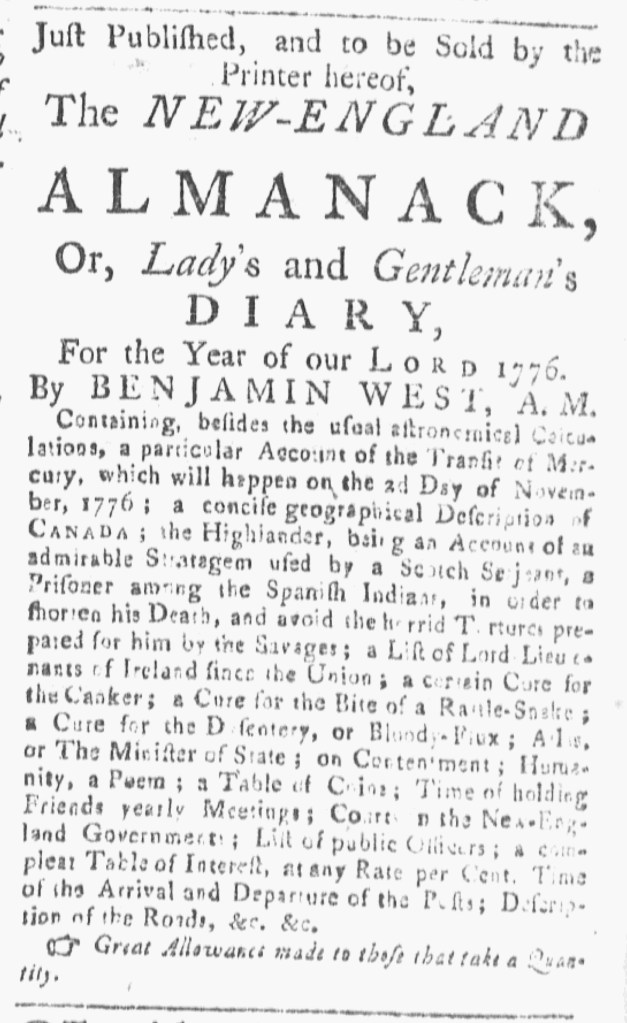
The December 17, 1774, edition of the Providence Gazette carried nearly two dozen advertisements, including one by the printer, John Carter, for “THE NEW-ENGLAND ALMANACK, OR, Lady’s and Gentleman’s DIARY, For the Year of our LORD 1775. By BENJAMIN WEST.”  For a decade, West and the printers of the Providence Gazette had been collaborating on that annual publication, even as proprietorship of the newspaper and the printing office changed hands.  The Adverts 250 Project has documented that partnership, covering West’s almanac perhaps more extensively than any other almanac advertised in early American newspapers.

Some of the “most used” tags for the Adverts 250 Project.

That is a result, in part, of the project’s methodology that calls for examining an advertisement published 250 years ago that day.  Accordingly, I select advertisements from approximately two dozen newspapers that have been digitized and made more widely accessible, yet publication of those newspapers did not occur evenly throughout the week.  Throughout most of the nine years that I have produced the Adverts 250 Project, the Providence Gazette was the only newspaper published in Saturdays.  As a result, that newspaper has been disproportionately featured in the project … and the methodology has encouraged me to have a closer look at the annual publication of West’s New-England Almanack than most other almanacs.

The word cloud generated for the “most used tags” by WordPress reflects this.  “Providence Gazette” appears in a larger font and thicker bold than any other newspaper or other tag, even though it was not the most significant newspaper published in the colonies, neither for news coverage nor for advertising innovation.  Similarly, advertisements from the New-Hampshire Gazette have also been featured regularly due to the methodology because for quite some time that was only newspaper published on Fridays that had been digitized.  While the Providence Gazetteand the New-Hampshire Gazette might not be considered as significant as certain other newspapers published during the era of the American Revolution, this project’s methodology has caused me to approach the contents of those newspapers with greater attention and creativity.

These are the newspapers published 250 years ago this week that have been digitized for greater access:

Monday

  • Boston Evening-Post
  • Boston-Gazette
  • Connecticut Courant (Hartford)
  • Dunlap’s Pennsylvania Packet (Philadelphia)
  • Maryland Journal (Baltimore)
  • Massachusetts Gazette and Boston Post-Boy
  • Newport Mercury
  • New-York Gazette and Weekly Mercury
  • South-Carolina Gazette

Tuesday

  • Essex Gazette (Salem)
  • South-Carolina Gazette and Country Journal (Charleston)

Wednesday

  • Essex Journal (Newburyport)
  • Pennsylvania Gazette (Philadelphia)
  • Pennsylvania Journal (Philadelphia)

Thursday

  • Maryland Gazette (Annapolis)
  • Massachusetts Gazette and Boston Weekly News-Letter
  • Massachusetts Spy
  • New-York Journal
  • Norwich Packet
  • Rivington’s New-York Gazetteer
  • Virginia Gazette [Pinkney] (Williamsburg)
  • Virginia Gazette [Purdie and Dixon] (Williamsburg)

Friday

  • Connecticut Gazette (New London)
  • Connecticut Journal (New Haven)
  • New-Hampshire Gazette (Portsmouth)
  • South-Carolina and American General Gazette (Charleston)

Saturday

  • Providence Gazette