What was advertised in a revolutionary American newspaper 250 years ago today?

“The Second Edition of OBSERVATIONS ON THE Nature of CIVIL LIBERTY.”
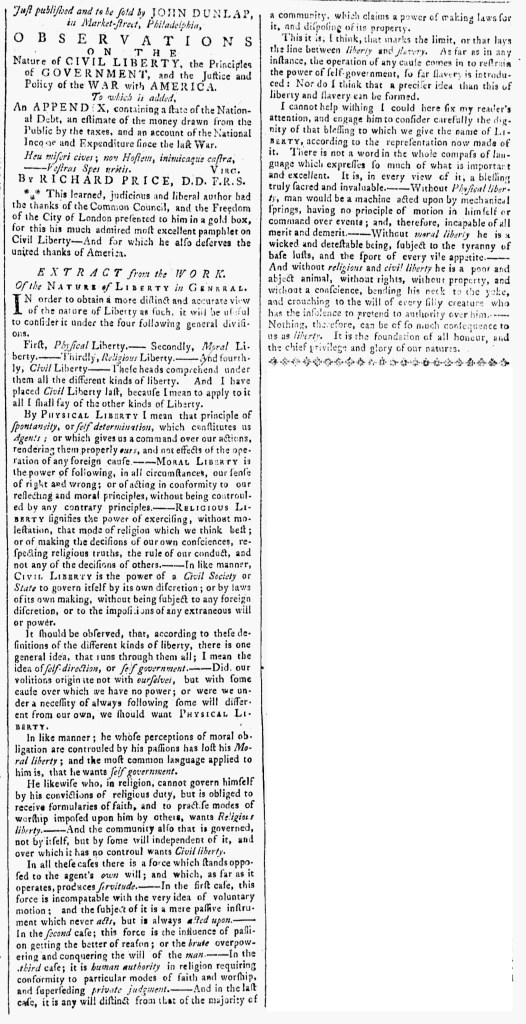
When John Dunlap published a Philadelphia edition of Richard Price’s Observations on the Nature of Civil Liberty, the Principles of Government, and the Justice and Policy of the War with America, the book did well enough that he printed a second edition. He gave an advertisement for the second edition a prime spot in the September 10, 1776, edition of his newspaper, Dunlap’s Pennsylvania Packet, making it the first item in the first column of the first page. Even if readers skipped over the rest of the advertisements on that page, they were more likely to notice that one.
Dunlap reworked an advertisement for the first edition that ran in his newspaper in July. It appears he never broke down the type, perhaps anticipating that he would advertise the first edition again if it did not sell out. Instead, he added a line, “The Second Edition of,” above the title of the book and eliminated the lengthy “EXTRACT from the WORK” that offered a preview in the previous advertisement. A note about the reception that Price and his book received in London remained: “This learned, judicious and liberal author had the thanks of the Common Council, and the Freedom of the City of London presented to him in a gold box, for this much admired most excellent pamphlet on Civil Liberty.” Dunlap added that Price “also deserves the united thanks of America.”
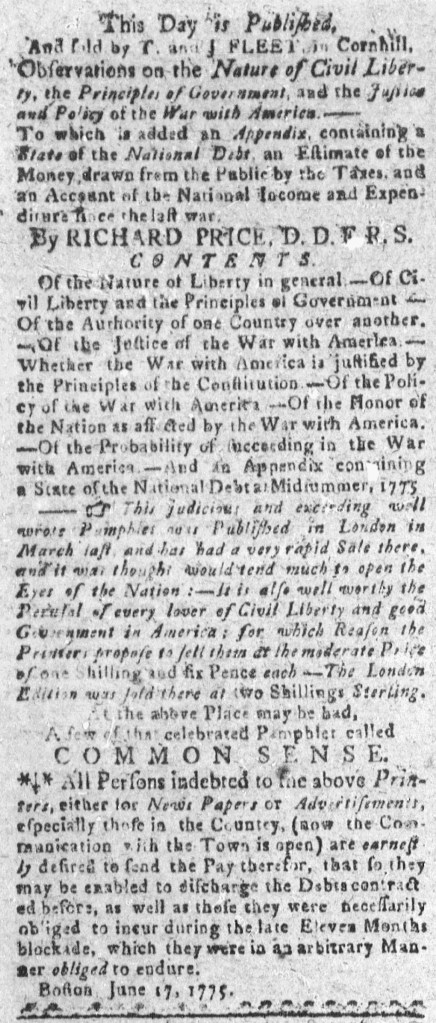
Dunlap and other printers certainly thought that “this much admired most excellent pamphlet” merited distribution in America. Thomas Fleet and John Fleet published a Boston edition, Samuel Loudon published a New York edition, and David Bruce published a Charleston edition. Like Dunlap, the Fleets used the pamphlet’s reception in London in marketing their edition. In their advertisement, they declared, “This judicious and exceeding well wrote Pamphlet was published in London in March last and has had a very rapid Sale there.” In turn, they considered it “well worthy the Perusal of every lover of Civil Liberty and good Government in America.” Such appeals convinced enough consumers that Dunlap printed a second edition. It even convinced retailers. Matthew Anderson of Gloucester, Virginia, listed it as one of the few titles available at his store that primarily sold textiles, housewares, and hardware.