July 22

What was advertised in a revolutionary American newspaper 250 years ago today?

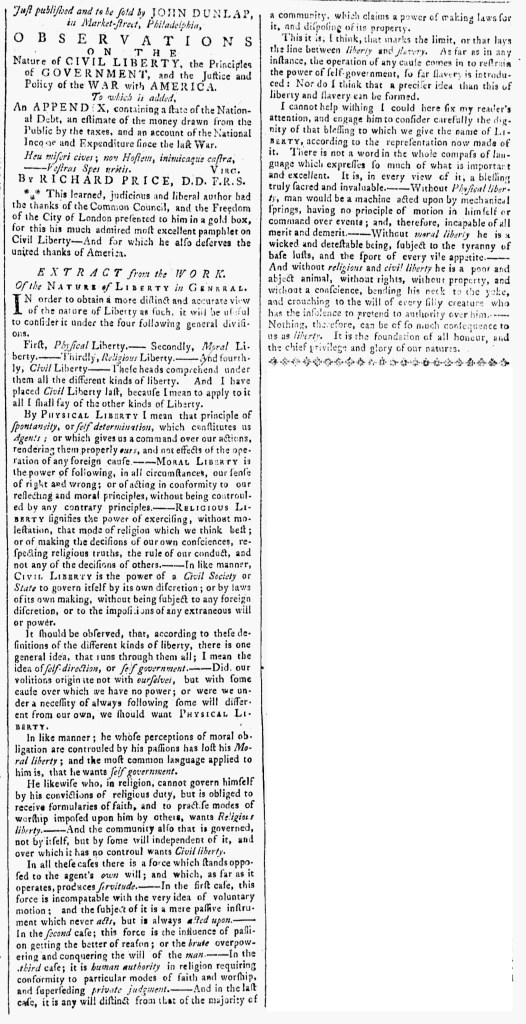
Dunlap’s Pennsylvania Packet (July 22, 1776).

EXTRACT from the WORK.”

John Dunlap devoted nearly half the space on the first page of the July 22, 1776, edition of Dunlap’s Pennsylvania Packet to an advertisement for his Philadelphia edition of Richard Price’s Observations on the Nature of Civil Liberty, the Principles of Government, and the Justice and Policy of the War with America.  A month earlier, Thomas Fleet and John Fleet ran an advertisement for their Boston edition of the popular pamphlet.  Rather than merely use the table of contents as the copy for their advertisement (as printers and booksellers often did), they added their own note that this “judicious and exceeding well wrote Pamphlet was published in London in March last and had had a very rapid Sale there.”  Friends of the American cause “thought [the pamphlet] would tend much to open the Eyes of the Nation.”  Accordingly, the Fleets considered the pamphlet “well worthy the Perusal of every lover of Civil Liberty and good Government in America; for which Reason the Printers propose to sell them at the moderate price of one shilling and six Pence each” compared to two shillings charged in London.

Dunlap inserted different commentary to demonstrate the reception and influence the pamphlet received and, in turn, attempt to incite demand among readers.  “This learned, judicious and liberal author,” the advertisement declared, “had the thanks of the Common Council, and the Freedom of the City of London presented to him in a gold box, for this his much admired most excellent pamphlet on Civil Liberty.”  In addition to that honor, “he also deserves the united thanks of America.”  Yet Dunlap did even more to promote his Philadelphia edition of the pamphlet.  He inserted an “EXTRACT from the WORK” that extended more than a column, giving readers a preview and enticing them to read more.  In so doing, Dunlap reduced the amount of space for news items and paid notices in that issue of the newspaper, apparently considering the length of the advertisement, especially the “EXTRACT,” worth the investment.  He may have also intended that the “EXTRACT” double as a letter to the editor in making the case in support of the American cause.

Dunlap and the Fleets were not alone in publishing local editions of Price’s pamphlet in America.  David Bruce published the pamphlet in Charleston and Samuel Loudon published it in New York.  Printers in the four largest urban ports made local editions of the pamphlet available to readers in their cities.

June 17

What was advertised in a revolutionary American newspaper 250 years ago today?

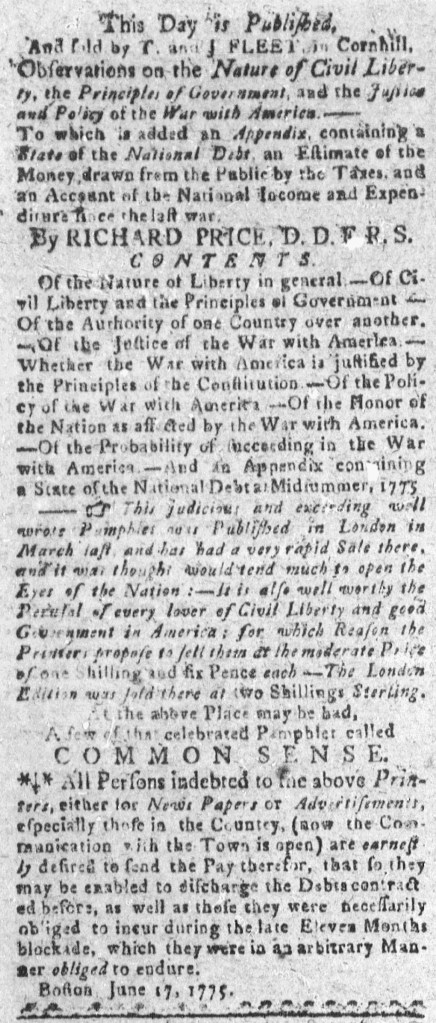
Boston-Gazette (June 17, 1776).

It is also well worthy the Perusal of every lover of Civil Liberty and good Government in America.”

In June 1776, Thomas Fleet and John Fleet announced that they published a Boston edition of Richard Price’s Observations on the Nature of Civil Liberty, the Principle of Government, and the Justice and Policy of the War with America.  Like many other advertisements for books and pamphlets, their notice included an overview of the contents to entice prospective customers with a preview of what they would encounter when they purchased and read the work.  Section headings included “Of the Nature of Liberty in general,” “Whether the War with America is justified by the Principles of the Constitution,” and “Of the Honor of the Nation as affected by the War with America.”

Yet the Fleets did not leave it at that.  They also composed their own address to the public, drawing attention to it with a manicule.  “This judicious and exceeding well wrote Pamphlet,” they reported, “was Published in London in March last and has had a very rapid Sale there.”  The arguments presented combined with the popularity of the pamphlet, the Fleets explained, “was thought would tend much to open the Eyes of the Nation.”  The pamphlet demonstrated that the American cause had supporters on the other side of the Atlantic, though its publication did not have as much impact on policy as the Fleets suggested that it deserved.  Despite that disappointment, the Fleets considered the pamphlet “well worthy the Perusal of every lover of Civil Liberty and good Government in America.”  That being the case, the Fleets sold copies of their Boston edition “at the moderate Price of one Shilling and six Pence each” instead of the “two Shillings Sterling” that printers in London charged for copied printed there.

During the years that they published the Boston Evening-Post before the battles at Lexington and Concord, the Fleets did not gain the same reputation for advocating for the American cause as Benjamin Edes and John Gill, the printers of the Boston-Gazette, and Isaiah Thomas, the printer of the Massachusetts Spy.  The outbreak of the war may have caused them to stake a stronger position, though they may have also aimed to generate revenue in a city that the British had occupied for nearly a year and departed only a few months earlier.  They followed their promotion of Price’s pamphlet with a reminder that they stocked “A few of that celebrated Pamphlet called COMMON SENSE,” another work embraced by the Patriots who remained in Boston after British forces and their Loyalist supporters evacuated from the city.  The Fleets collaborated with the Edes and Gill in publishing and selling Thomas Paine’s influential political pamphlet.  Even though their advertisement did not necessarily reveal their political principles, the Fleets sought to activate the political principles of their prospective customers to sell their Boston edition of Observations on the Nature of Civil Liberty, the Principle of Government, and the Justice and Policy of the War with America.