November 30

What was advertised in a revolutionary American newspaper 250 years ago today?

New-York Journal (November 30, 1775).

“A neat Mezzotinto Print of the Hon. JOHN HANCOCK, Esq.”

Richard Sause, a cutler in New York, became a purveyor of patriotic memorabilia during the Revolutionary War.  In October 1775, he advertised “ROMAN’s MAP OF BOSTON,” billing it as “one of the most correct that has ever been published.”  He described the cartographer, Bernard Romans, as “the most skilful Draughtsman in all America,” noting that he earned credibility because he “was on the spot at the engagements of Lexington and Bunker’s-Hill.”  Nicholas Brooks, a shopkeeper who specialized in prints, and Romans collaborated on the project in Philadelphia.  Sause acted as a local agent for marketing and distributing the map in New York.

That was not the only item commemorating current events that Sause advertised and sold.  At the end of November 1775, he took to the pages of the New-York Journal once again, informing the public that he sold a “neat Mezzotinto Print of the Hon. JOHN HANCOCK, Esq.”  The print depicting the merchant from Boston who served as president of the Second Continental Congress was another one of Brooks’s projects.  In addition, Sause also stocked “a view of the BATTLE at Charlestown” and “an accurate Map of the Present Seat of Civil War, taken by an able Draftsman.”  Sause seemingly worked closely with Brooks in acquiring the various prints and marketing them to patriots in New York, perhaps even providing him with advertising copy to adapt for his own notices.  The prints that Sause offered for sale appeared in the same order in his advertisement in the New-York Journal that they did in Brooks’s advertisement in Pennsylvania Journal.  Brooks may have sent a clipping along with the prints that he dispatched to the cutler in New York.

Although Sause had established himself as a cutler who also sold hardware and jewelry in a series of advertisements in New York’s newspapers, his activities in the marketplace in 1775 emphasized his commitment to the American cause.  Before he began selling prints, he promoted “SMALL SWORDS” to gentlemen who anticipated participating in the defense of their liberties and their city.  Even though he continued to advertise an “assortment of Jewellery, Cutlery, Hardware, and Haberdashery,” he made items related to the conflict with Parliament and British troops quartered in the colonies the focal point of his advertisements.
October 16

What was advertised in a revolutionary American newspaper 250 years ago today?

New-York Journal (October 16, 1775).

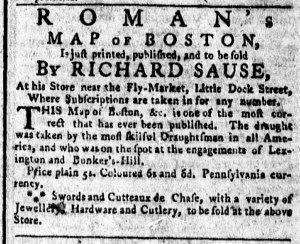
“THIS Map of Boston, &c. is one of the most correct that has ever been published.”

Richard Sause, a cutler in New York, became a local agent in that city when Nicholas Brooks and Bernard Romans collaborated on a map of Boston.  Brooks, a shopkeeper in Philadelphia, described himself as “the printer of said Maps” in newspaper advertisements, though he likely meant that he was the publisher who collaborated with Romans, a noted cartographer.  Sause had not been among the original list of local agents in an advertisement that appeared in Rivington’s New-York Gazetteer in August 1775, nor had he been on the list on a broadside subscription proposal that circulated in the summer and fall.  When Brooks and Romans launched a second project, “An Exact VIEW of the late BATTLE at CHARLESTOWN,” the subscription proposal in the Pennsylvania Ledger included “Mr. Richard Sause in New-York” among the local agents.  Brooks and Romans apparently supplied him with copies of the map as well as the print depicting what is now known as the Battle of Bunker Hill.

Sause, a frequent advertiser, was already familiar to consumers in New York.  A woodcut depicting various kinds of cutlery available at his “Jewlery, Hardware, and Cutlery Store” often adorned his advertisements in newspapers printed in that city.  In the summer and fall of 1775, he emphasized “SMALL SWORDS” in his advertisements.  Following the outbreak of hostilities at Lexington and Concord in April, residents of New York and other towns did not know what to expect.  Many prepared to defend their liberties should the British turn their attention to them.  Sause made sure that Patriots in New York knew that he could supply them with various kinds of small swords.  He even made a pitch for those items at the end of his advertisement for Romans’s map of Boston: “Swords and Cutteaux de Chase [a short sword], with a variety of Jewellery, Hardware and Cutlery, to be sold at the above Store.”

Yet the “MAP OF BOSTON” was the main attraction in that advertisement.  In addition to the headline in capital letters, Sause’s notice billed the map as “one of the most correct that has ever been published.”  To help make sales, he emphasized that the “draught [draft] was taken by the most skilful Draughtsman in all America.”  Buyers could depend on its accuracy because Romans “was on the spot at the engagements of Lexington and Bunker’s-Hill.”  Current events certainly played a role in Sause expanding his business to incorporate a new revenue stream, yet marketing and selling both Brooks and Romans’s map of Boston and prints depicting the Battle of Bunker Hill also gave him an opportunity to participate in politics via the marketplace.

September 14

What was advertised in a revolutionary American newspaper 250 years ago today?

New-York Journal (September 14, 1775).

“SMALL SWORDS … of various sorts.”

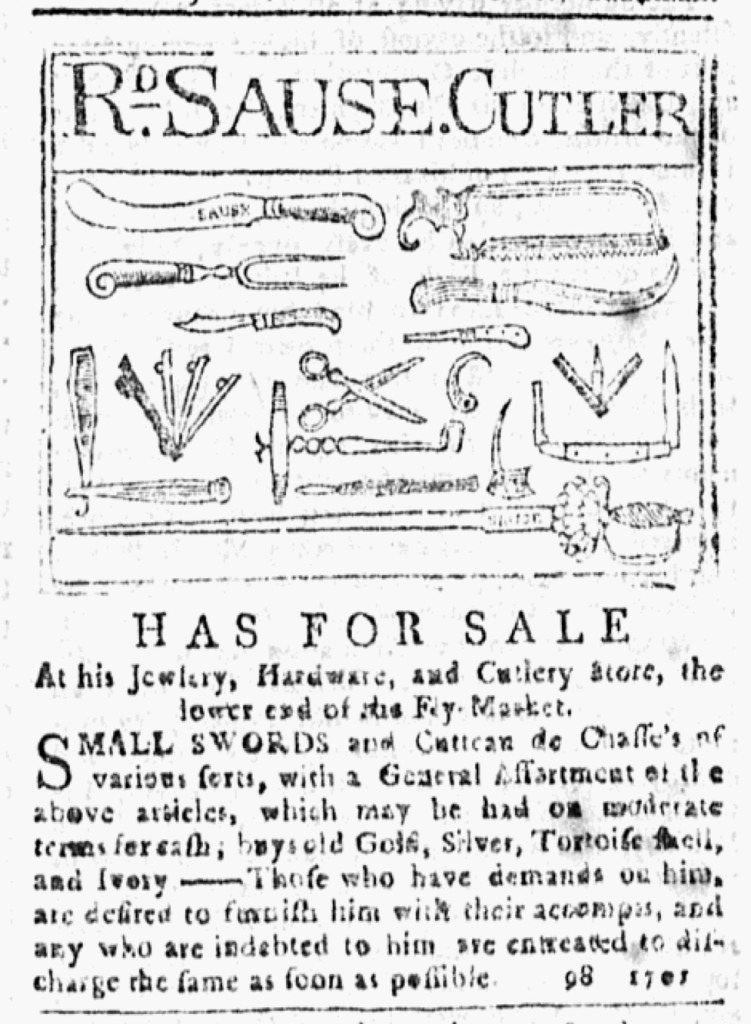
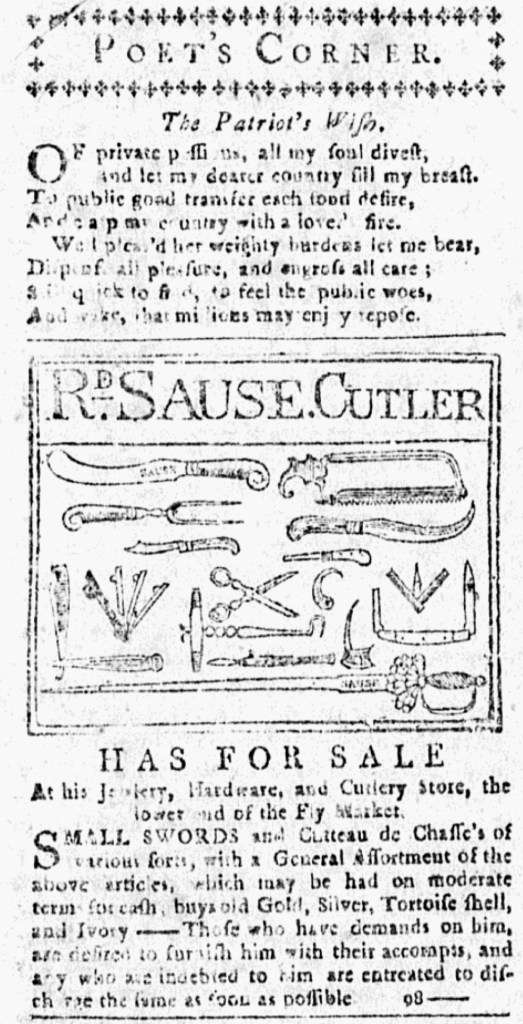
Richard Sause’s advertisement for “SMALL SWORDS” and other items available at his “Jewelery, Hardware, and Cutlery Store” became a familiar sight for readers of the New-York Journal in the summer of 1775.  The woodcut depicting a shop sign with Sause’s name and an array of cutlery, including a sword, made his notice even easier to spot.

On September 14, his notice happened to appear near the top of the left column on the final page of the newspaper, immediately below a regular feature called “POET’S CORNER.”  For that issue, John Holt, the printer, selected a short poem, “The Patriot’s Wish.”

OF private passions, all my soul divest,
and let my dearer country fill my breast,
To public good transfer each fond desire,
And clasp my country with a lover’s fire.
Well pleas’d her weighty burdens let me bear
Dispense all pleasure, and engross all care;
[ ] quick to [ ], to feel the public woes,
And wake, that millions may enjoy repose.

The strained verses were heartfelt even if not especially graceful or elegant.  Perhaps a reader submitted the poem as their way of contributing to the struggle that colonizers endured throughout the imperial crisis and then intensified with the outbreak of hostilities at Lexington and Concord the previous spring.  Sause aimed to make his own contribution by supplying “SMALL SWORDS and Cutteau de Chasse’s,” a type of sword, to the gentlemen of New York who prepared for the possibility that they would have to join the fight.  Although Sause’s advertisement appeared below “The Patriot’s Wish” almost certainly by coincidence, the cutler may have been pleased with the happy accident.  After all, the poem primed readers to think about their duty and to contemplate how to make their own contributions to the cause.  For many, that could have included outfitting themselves with weapons and other military equipment.

July 20

What was advertised in a revolutionary American newspaper 250 years ago today?

New-York Journal (July 20, 1775).

“SMALL SWORDS.”

Richard Sause resorted to a familiar image to adorn his advertisement in the July 20, 1775, edition of the New-York Journal.  It included his name and occupation, “RD. SAUSE. CUTLER,” and depictions of more than a dozen kinds of knives and other blades available at his “Jewlery, Hardware, and Cutlery Store.”  Some of the items, a table knife and a sword, even had his name on the blade, suggesting that Sause marked the items he made.  The image had periodically appeared in various newspapers published in New York since the early 1770s.  Personalized woodcuts, commissioned by advertisers, belonged to those advertisers to submit to printing offices as they saw fit.

In Sause’s previous advertisements, the woodcut accounted for a relatively small amount of space compared to the copy that Sause composed to promote his business.  This time, however, the image and the copy took up the same amount of space.  Sause noted that he sold “a General Assortment of the above articles,” perhaps referring to the “Jewelry, Hardware, and Cutlery” listed in the name of his store or perhaps referring to the many items in the woodcut.  In the copy, he highlighted only one sort of item: “SMALL SWORDS and Cutteau de Chasse’s of various sorts.”  (See Steve Rayner and Jim Mullins’s extensively researched “Cuttoe Knives: A Material Culture Study” for more on “a variety of short swords known as cutteau de Chasse.”  It includes an engraved trade card from 1739 for John Cargill, “Instrument Maker, at ye Saw & Crown in Lombard Street, London,” that featured an image of various blades and other instruments similar to Sause’s woodcut.)  It made sense that Sause emphasized swords in an advertisement placed in the summer of 1775.  Men in New York and other places prepared for the possibility that the fighting that began at Lexington and Concord in April and continued with the siege of Boston and the Battle of Bunkers Hill could occur in their own colonies.  They formed new companies to defend their liberties.  Merchants, shopkeepers, and artisans marketed military equipment while printers and booksellers published and sold military manuals.  Under those circumstances, Sause made a savvy decision to promote “SMALL SWORDS” in his advertisement.

November 4

What was advertised in a colonial American newspaper 250 years ago today?

Rivington’s New-York Gazetteer (November 4, 1773).

“A large assortment of goods.”

In its first six months of publication, Rivington’s New-York Gazetteer developed a signature style for many of its advertisements.  They featured the same copy that appeared in other newspapers published in the city, yet surrounded by borders made of decorative type.  James Rivington and the compositors who worked in his printing office certainly were not the first to devise borders for newspaper notices.  After all, borders enclosed Jolley Allen’s advertisements in several Boston newspapers going back years and the shopkeeper continued to incorporate that design element into his advertisements in the early 1770s (in every newspaper except the Massachusetts Spy, which seemed hesitant to accommodate that request).  Borders occasionally surrounded advertisements in other newspapers as well, but in no newspaper did they appear as frequently as in Rivington’s New-York Gazetteer.

In the fall of 1773, Richard Sause, a cutler “At the CROSS SWORDS,” joined the ranks of advertisers with borders around their advertisements.  Several notices in the November 4 edition had borders, including those places buy John Arthur, a shopkeeper, John Laboyteaux, a tailor, John J. Roosevelt, a merchant, and John Siemon, a furrier.  Borders also enclosed advertisements for “SHIP BREAD” sold by Crommelin and Horsfield and Rivington’s own notice for “Dr. KEYSER’s PILLS.”  The compositor selected different printing ornaments for each advertisement, making them distinctive even though they shared a common feature.

The copy for Sause’s advertisement matched his notice on the front page of the November 1 edition of the New-York Gazette and Weekly Mercury.  An extensive list of merchandise, divided into two columns with one or two items per line, appeared below a headline and brief introduction that promised a “large assortment of goods, which he will sell cheap for cash or short credit.”  Sause’s advertisement filled three-quarters of a column in Rivington’s New-York Gazetteer, making it the longest advertisement with a border in that issue.  Yet Sause did not need to experiment with a border as a means of drawing attention to his advertisement.  Like Siemon, he previously ran advertisements with a woodcut depicting some aspect of his business.  For the furrier, it was a muff.  For Sause, it was a sign that showed many of the items that he made and sold, including a table knife with “SAUSE” at the base of the blade and a sword with “SAUSE” in the same position.”  The sign depicted on the woodcut even included his name and occupation, “RD. SAUSE CUTLER,” making it one of the few woodcuts personalized in such a manner.  That image appeared in Sause’s advertisement in Rivington’s New-York Gazetteer on April 29, only the second issue of that newspaper.  Six months later, however, Rivington opted for the decorative border rather than the woodcut.  The increasingly popular style apparently made an impact on the advertiser, convincing him to give it a try in his own marketing in hopes that it would have a similar effect on prospective customers.

October 3

What was advertised in as colonial American newspaper 250 years ago this week?

Rivington’s New-York Gazetteer (September 30, 1773).

“A GENERAL ASSORTMENT OF CUTLERY.”

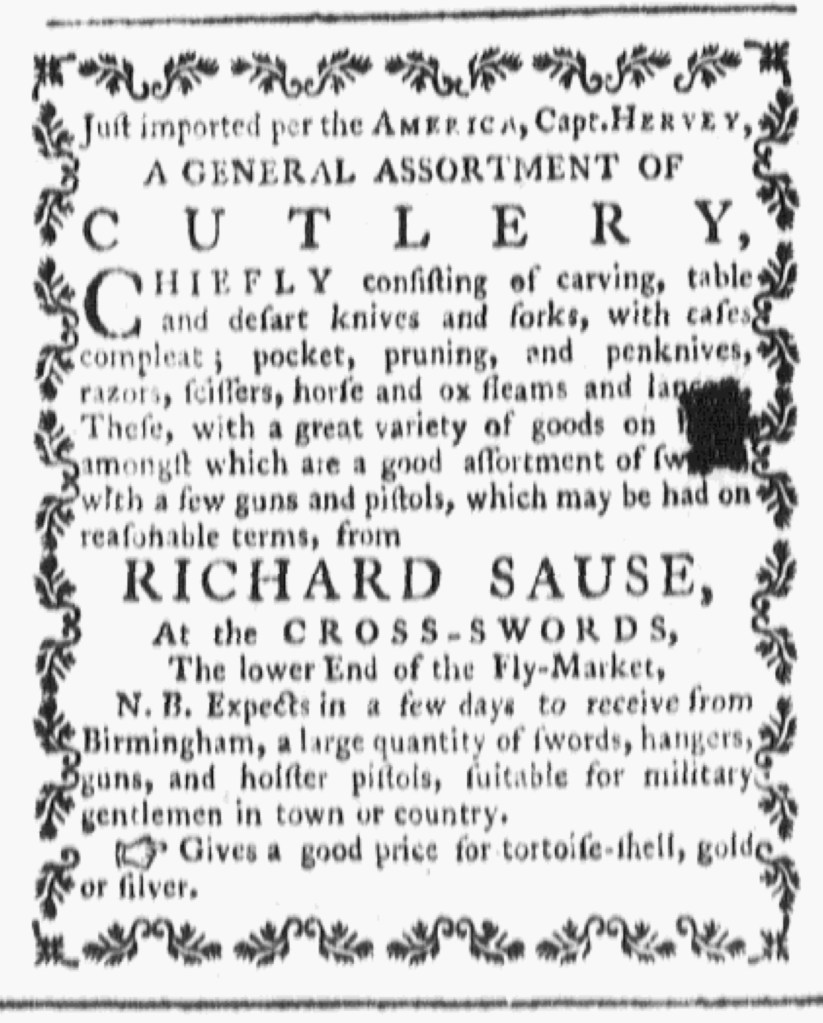
Richard Sause joined other entrepreneurs who experimented with decorative borders enclosing their advertisements when he promoted a “GENERAL ASSORTMENT OF CUTLERY” in Rivington’s New-York Gazetteer.  The cutler had previous experience incorporating visual images into his advertisements in both the New-York Gazette and Weekly Mercury and Rivington’s New-York Gazetteer.  By the fall of 1773, many advertisements in New York’s newest newspaper featured borders, a popular means of enhancing notices.  Similar borders sometimes adorned advertisements in other newspapers, but not in the numbers and frequency that they appeared in Rivington’s New-York Gazetteer.

The September 30, 1773, edition of that newspaper, for instance, included eight advertisements with ornate borders.  Most of those notices were relatively short, a single square of text.  Among them, Dennis McReady, a tobacconist, hawked his wares and Aspinwall and Smith announced that they sold “CHOICE OLD JAMAICA SPIRIT.”  Another of these shorter announcements advised that “the Delaware Lottery for the Sale of Lands, belonging to the Earl of Stirling, will commence on Monday the first Day of November next.”  James Rivington, the printer, also enclosed his advertisement for Keyser’s Pills within a decorative border.  George Webster, “At the THREE SUGAR LOAVES,” listed a couple of items “just received from LONDON” and promised “many other Articles which will be inserted next week.”  That advertisement, however, never materialized.  Given that advertisers paid by the amount of space their notices occupied rather than the number of words, borders made advertisements more expensive.  Rivington may have also charged additional fees for the borders, making them especially attractive to entrepreneurs running shorter advertisements.

Still, some advertisers enclosed longer notices within borders.  Thomas Hazard, one of Sause’s competitors, did so with an advertisement for “Ironmongery and Cutlery,” as did Francis Lewis and Sons in their advertisement that listed dozens of items for sale at their store on Queen Street.  Among these three longer advertisements, Sause’s notice was the shortest.  He apparently appreciated the visual appeal of the border and considered it worth the investment.  Four weeks later he placed a much more extensive advertisement that extended approximately three-quarters of a column.  A decorative border enclosed the lengthy list of merchandise that Sause “JUST IMPORTED.”  Along with several other advertisers, the cutler sought to generate interest in his newspaper notices by making them more visually appealing than text alone.  The printing office seems to have encouraged this innovation.

April 29

What was advertised in a colonial American newspaper 250 years ago today?

Rivington’s New-York Gazetteer (April 29, 1773).

“RD. SAUSE. CUTLER.”

In the second issue of Rivington’s New-York Gazetteer, the printer continued publishing a significant number of advertisements to supplement the revenue earned from subscriptions.  Advertising accounted for six of the twelve columns in the April 29, 1773, edition.  Many of those advertisers also placed notices in other newspapers.

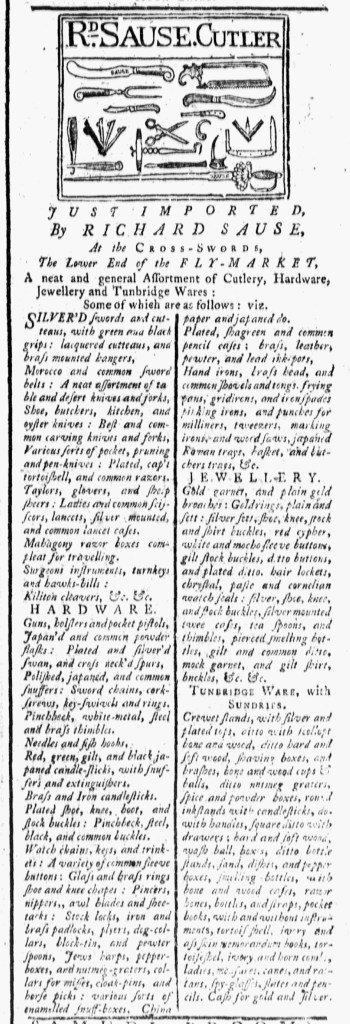
Richard Sause, a cutler, ran an advertisement that filled more than half a column.  He listed a variety of goods from among the “neat and general Assortment of Cutlery, Hardware, Jewellery and Tunbridge Wares” that he recently imported, clustering the various categories of merchandise together with headings to help readers locate items of interest.  A woodcut that depicted more than a dozen forms of cutlery, including knives, scissors, a saw, and a sword, adorned the advertisement.  That image may have replicated the sign that marked the location of Sause’s shop.  It likely looked familiar to readers who regularly perused the New-York Gazette and Weekly Mercury since it had previously accompanied the cutler’s advertisements in that newspaper.

Nesbitt Deane, a hatmaker who frequently advertised in the city’s newspapers, placed a notice that featured a woodcut of a tricorne hat with his name enclosed in a banner beneath it in the first issue of Rivington’s New-York Gazetteer, but it did not appear in the second issue.  Like Sause’s woodcut, that image would have been familiar to readers who regularly read other newspapers since it had been appearing in the New-York Journal for more than a year.  Deane apparently wished to increase the visibility of his business among curious colonizers who examined the first issue of Rivington’s newspaper, but returned to advertising in a publication that he had greater confidence would yield customers.  His advertisement, complete with the woodcut, ran in the New-York Journal rather than Rivington’s New-York Gazetteer on April 29.  Deane either collected the woodcut from one printing office and delivered it to the other or made arrangements for the transfer.

In both instances, the advertisers benefitted from visual images that prominently displayed their names and distinguished their notices from others that consisted solely of text.  To gain those advantages, they made additional investments in commissioning woodcuts and then carefully coordinated when and where they appeared in the public prints.  Like other advertisers who incorporated images into their notices, Deane and Sause each commissioned a single woodcut rather than multiple woodcuts that would have allowed them to enhance their advertisements in more than one newspaper simultaneously.

July 27

What was advertised in a colonial American newspaper 250 years ago today?

New-York Gazette and Weekly Mercury (July 27, 1772).

“J. BAILEY. Cutler. from Sheffield.”

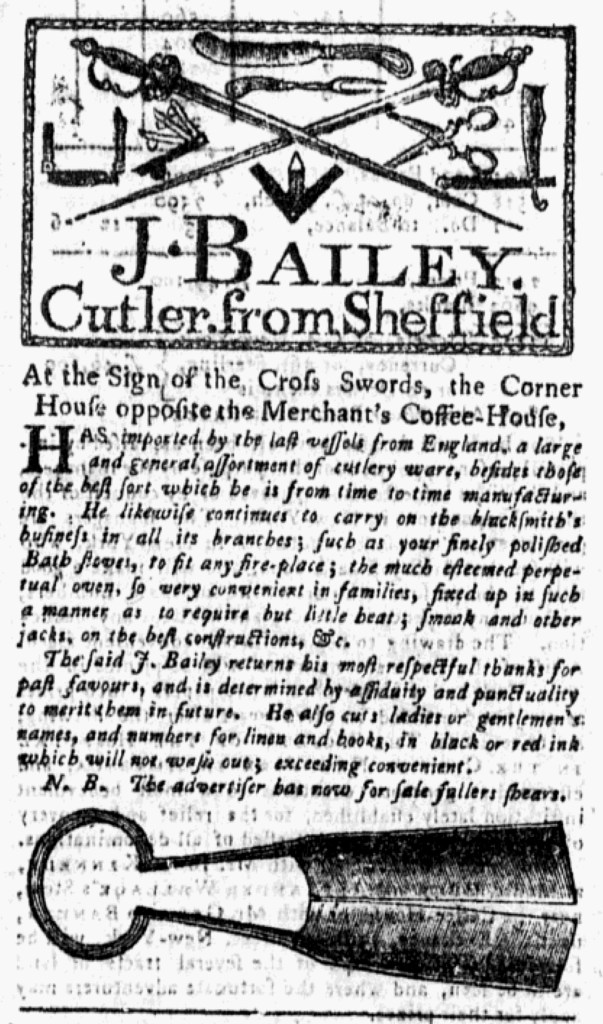
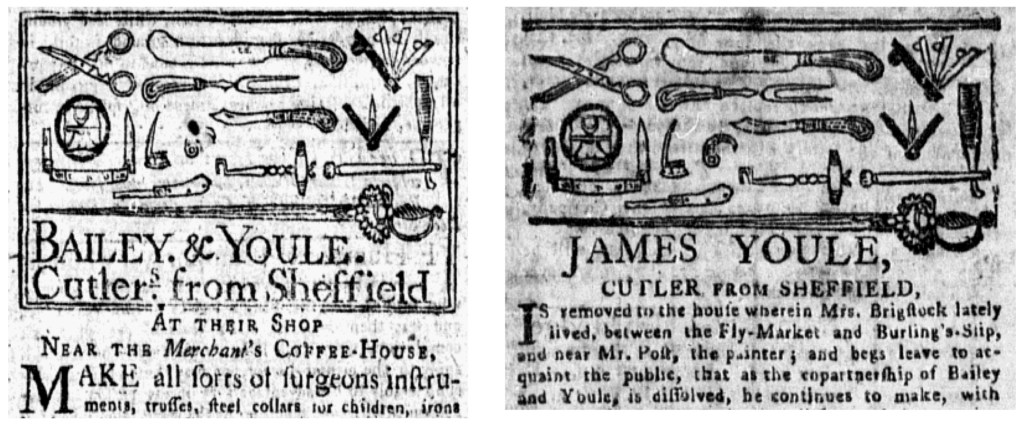
In the early 1770s, cutlers in New York competed with each other not only for customers but also in producing elaborate images to accompany their advertisements in the city’s newspapers.  It began in the spring of 1771 with Bailey and Youle, “Cutlers for Sheffield,” running an advertisement with a woodcut depicting more than a dozen items made and sold at their shop, enhancing their list of “surgeons instruments, … knives, razors, shears, and scissors.”  Not long after, Richard Sause followed their lead with an advertisement featuring a woodcut depicting more than a dozen items available at his shop.  Two items, a knife and a sword, had his name on them, suggesting that he marked his wares so consumers would recall who produced them and, if satisfied with the quality and durability, buy from him again.  In that regard, Sause improved on the image distributed by Bailey and Youle, although his competitors may have also marked their cutlery even if the woodcut in the newspaper did not indicate that was the case.

When Bailey and Youle dissolved their partnership a year later, Youle retained the woodcut and modified it to remove any reference to his former associate.  Not long after Youle disseminated that image in the public prints, Lucas and Shephard, WHITESMITHS and CUTLERS, From BIRMINGHAM and SHEFFIELD,” published their own advertisement with a woodcut showcasing many of the items they made and sold.  Bailey apparently considered that strategy effective for attracting customers (or at least not losing them to his competitors) because he devised his own woodcut that enclosed “J. BAILEY.  Cutler.  from Sheffield” and several cutlery items within a decorative border.  The copy of his advertisement gave his location as “the Sign of the Cross Swords, the Corner House opposite the Merchant’s Coffee-House.”  A pair of crossed swords appeared at the center of the woodcut.  A second woodcut appeared at the end of the advertisement, under a nota bene that advised that Bailey “has now for sale fullers shears.”  The cutler used the additional image to distinguish his notice from those of his competitors.  All three advertisements ran in the July 27, 1772, edition of the New-York Gazette and Weekly Mercury (Bailey’s on the third page, Youle’s on the first page of the supplement, and Lucas and Shephard’s on the second page of the supplement).  Given the prevalence of images in advertisements placed by his competitors, Bailey may have considered it imperative to get his own woodcut depicting his wares into circulation among consumers in New York.

Left: New-York Gazette and Weekly Mercury (March 4, 1771); Right: Supplement to the New-York Gazette and Weekly Mercury (July 27, 1772).

April 3

What was advertised in a colonial American newspaper 250 years ago this week?

New-York Gazette and Weekly Mercury (April 1, 1771).

“RD. SAUSE. CUTLER.”

Imitation is the sincerest form of flattery … or a means of capitalizing on a competitor’s marketing efforts.  On March 4, 1771, Bailey and Youle, cutlers from Sheffield, ran a newspaper advertisement notable for a woodcut that included their names and depictions of more than a dozen items available at their shop.  Four weeks later, another cutler, Richard Sause, inserted a strikingly similar advertisement in the same newspaper, the New-York Gazette and Weekly Mercury.  Like Bailey and Youle, his notice began with a woodcut that included his name and images of various items in his inventory.  He also listed those items and more, including “oyster knives, razors, scissors; pocket, pruning and pen knives; …[and] corkscrews.”  In addition to the assortment of merchandise represented in both image and text, Sause also stocked “sundry other things too tedious to mention.”

Sause further enhanced his woodcut by incorporating his name into the depictions of a table knife and a sword, a modification not present in Bailey and Youle’s image of their wares.  The table knife appeared in the upper left and the sword in the lower right, making it likely that viewers would encounter items branded with Sause’s name first and last as they glanced at the depictions of many kinds of cutlery.  Sause’s woodcut also featured a greater number of items, testifying to the many choices he offered to consumers.  In the copy that accompanied the image, he twice invoked variations of the phrase “other articles too tedious to mention,” deploying language not present in Bailey and Youle’s advertisement.  Using his competitor’s notice as a model, Sause devised improvement for his own.

It seems unlikely that Sause produced this advertisement without having seen the notice that Bailey and Youle placed in the New-York Gazette and Weekly Mercury.  Furthermore, whoever carved the original woodcut probably carved the second, given the similarities between several pieces of cutlery depicted in each.  Bailey and Youle continued running their advertisement when Sause’s notice first appeared, the similarities between the two all the more apparent because they were the only images that appeared anywhere in the April 1, 1771, edition of the New-York Gazette and Weekly Mercury and its supplement, with the exception of the masthead.  When Bailey and Youle published an advertisement that increased their visibility in the marketplace, Sause took notice and shamelessly replicated their efforts.

Detail from Bailey and Youle’s advertisement, Supplement to the New-York Gazette and Weekly Mercury (April 1, 1771).