March 9

What was advertised in a colonial American newspaper 250 years ago today?
Massachusetts Spy (March 9, 1775).

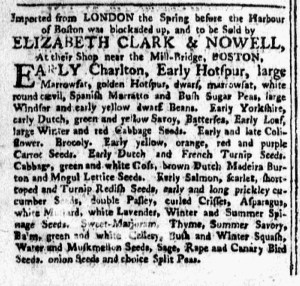
“Imported from LONDON the Spring before the Harbour of Boston was blockade up.”

Although marketing began a little later in the season than in recent years, several retailers placed advertisements for garden seeds in Boston’s newspaper in early March 1775.  The March 9 edition of the Massachusetts Spy, for instance, once again carried Susannah Renken’s advertisement as well notices placed by John Adams, Elizabeth Clark and Elizabeth Nowell, and Ebenezer Oliver.  Each of these purveyors of seeds took to the public prints as spring approached each year, though many familiar names did not yet appear.  More than half a dozen women usually advertised garden seeds that they sold in Boston, but the imperial crisis, especially the closing of the harbor because of the Boston Port Act, disrupted that annual ritual.

Renken, one of the most enterprising of those female seed sellers, apparently acquired her inventory from a ship that landed at Salem.  She identified the captain of the vessel that had transported them across the Atlantic.  Adams and Oliver both declared that they sold seeds “Imported from London,” but did not provide additional details to allow prospective customers in the eighteenth century (or historians in the twenty-first century) to reach conclusions about when and how they came into possession of those seeds.  Clark and Nowell, on the other hand, made clear that their seeds had been “Imported from LONDON the Spring before the Harbour of Boston was blockade up.”  They received their seeds at least nine months earlier, a factor that may or may not have been an advantage.  Adams declared that he “warrants [his seeds] good, and of the last Year’s Growth.”  Similarly, Renken described her seeds as “New and warranted of the last Year’s Growth.”  Clark and Nowell could not make such claims.  Instead, they attempted to leverage the date of delivery as a point in their favor.  Although not “new,” their seeds also were not so old that they would not germinate, especially if Clark and Nowell had stored them carefully.  They asked prospective customers to take into account the challenges that they all faced due to the blockade, hoping that a sense of mutual support would convince consumers to select their seeds over the ones offered by their competitors.
March 5

What was advertised in a colonial American newspaper 250 years ago today?

Providence Gazette (March 5, 1774).

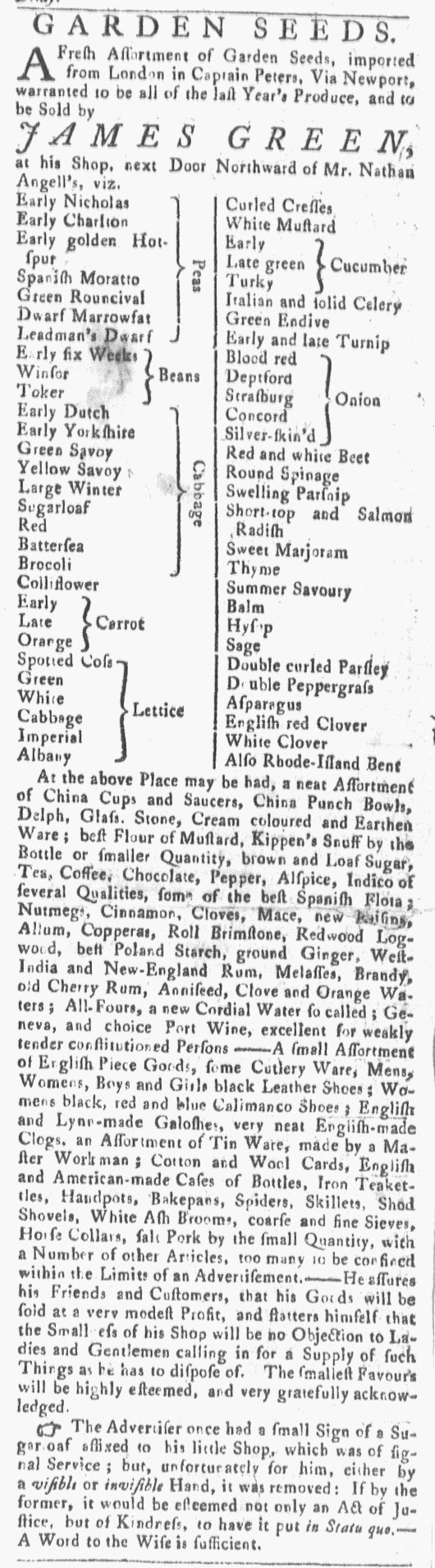
“The Advertiser once had a small Sign of a Sugarloaf affixed to his little Shop.”

As spring approached in 1774, advertisements for “GARDEN SEEDS” appeared in newspapers in New England.  John White was the first to advertise in Boston, soon joined by Susanna Renken, Elizabeth Clark, Elizabeth Greenleaf, Elizabeth Nowell, and other women who annually announced they sold seeds in the city’s newspapers.  As Abel Buell hawked firearms in the Connecticut Journal, Nathan Beers promoted “Garden Seeds, Both of English and American Growth.”  In Rhode Island, James Green placed an extensive advertisement for a “Fresh Assortment of Garden Seeds” in the Providence Gazette, as he had done the previous year.  The format distinguished it from other notices, the various types of peas, beans, cabbage, carrot, lettuce, cucumber, and onion clustered together and labeled by category.

Unlike most other seed sellers, Green also marketed all sorts of housewares, garments, and groceries in his advertisement.  That significantly contributed to the length of a notice that extended more than two-thirds of a column.  Green stocked everything from “a neat Assortment of China Cups and Saucers” and “Womens black, red and blue Calimanco Shoes” to “best Four of Mustard” and “Kippen’s Snuff by the Bottle or smaller Quantity.”  Yet that was not all.  He asserted that his inventory included “a Number of other Articles, too many to be confined within the Limits of an Advertisement.”  A newspaper notice could not contain all the choices Green made available to consumers!  The shopkeeper also made an appeal to price, “assur[ing] his Friends and Customers, that his Goods will be sold at a very modest Profit.”  Conversationally, he confided that he “flatters himself that the Smallness of his Shop will be no Objection to Ladies and Gentlemen calling in for a Supply of such Things he has to dispose of.”

All of that was standard for advertisements in newspapers published throughout the colonies.  A final note, however, discussed unusual circumstances that agitated the shopkeeper.  “The Advertiser once had a small Sign of a Sugarloaf affixed to his little Shop,” Green noted.  In marking his location, it “was of signal Service.”  Yet the sign no longer adorned his shop: “unfortunately for him, either by a visible or invisible Hand, it was removed.”  Perhaps bad weather, an “invisible Hand, had carried it away, but if that was not the case, if some prankster had taken it then Green petitioned for its return: “it would be esteemed not only an Act of Justice, but of Kindness, to have it put in Status quo.”  Using an eighteenth-century version of “no questions asked,” he declared that “A Word to the Wise is sufficient.”  If anyone knew what had happened to the sign, he hoped that they would encourage whoever had it to put it back where it belonged.  Green was not interested in the details of where his sign had been or who took it, only its return to its rightful place as the emblem designating his place of business.  The shopkeeper made an aside in his newspaper advertisement to tend to other forms of marketing associated with his shop in Providence.

February 27

What was advertised in a colonial American newspaper 250 years ago this week?

Massachusetts Spy (February 27, 1774).

“GARDEN SEEDS … SOLD by SUSANNA RENKEN.”

Susanna Renken was not the first entrepreneur to advertise seeds in Boston’s newspapers as the spring of 1774 approached, though she had been on several occasions in the past decade.  That distinction went to John White, “Gardner, and Seeds-Man, in SEVEN-STAR LANE,” with his advertisement in the February 17 edition of the Massachusetts Spy, yet within a week Renken she activated her advertising campaign.  Fittingly, Renken placed an advertisement for “GARDEN SEEDS” in the next issue, serving as a counterpoint to White’s repeated notice.

Unlike the approach White had taken so far, Renken did not confine her marketing efforts to a single newspaper.  When she ran her first advertisement on February 24, she placed it in both the Massachusetts Gazette and Boston Weekly News-Letter and the Massachusetts Spy.  That made her among the first of the sorority of female seed sellers to advertise in 1774.  Her competitors Elizabeth Clark and Elizabeth Nowell also ran a notice in the Massachusetts Gazette and Boston Weekly News-Letter.  It appeared immediately to the left of Renken’s advertisement.

So began the annual contest to woo customers to purchase seeds.  As had been her practice in the past, Renken continued expanding her advertising campaign, seeking to reach more prospective customers by inserting her notice in multiple newspapers.  On February 28, she ran it in the Boston Evening-Post, immediately above Elizabeth Greenleaf’s advertisement for “GARDEN-SEEDS.”  The appropriately named Greenleaf was part of the sisterhood of seed sellers who advertised extensively each spring.  On the same day, her advertisement appeared immediately above Renken’s advertisement in the Boston-Gazette.  Perhaps having noticed that Renken and Clark and Nowell commenced their advertising Greenleaf determined that it was time to invest in her own marketing efforts for 1774.

For whatever reason, none of them or their competitors placed advertisements in the Massachusetts Gazette and Boston Post-Boy on February 28, but the March 3 edition of the Massachusetts Gazette and Boston Weekly News-Letter once again featured advertisements from Renken and Clark and Nowell, joined by Greenleaf.  As had been common in previous years, the compositor arranged them one after the other in a single column.  Printers did not usually arrange advertisements by purpose or category, but they often made an exception for women who sold seeds in Boston.  Renken and White once again placed their notices in the Massachusetts Spy on March 3.

For newspaper readers in and near Boston, this flurry of advertising was an annual ritual.  It signaled that spring was on its way.  Perhaps for modern readers who regularly visit the Adverts 250 Project, these advertisements serve a similar purpose, a sign of the changing seasons as days become longer even if not necessarily warmer.

February 17

What was advertised in a colonial American newspaper 250 years ago today?

Massachusetts Spy (February 17, 1774).

“GARDEN SEEDS.”

It was a sign of the changing seasons for colonizers in Boston.  Each year several female entrepreneurs who sold seeds took to the pages of the several newspapers published in the urban port.  Among them, Lydia Dyar, Elizabeth Greenleaf, and Susanna Renken usually began running notices by the end of February, alerting readers that they sold a variety of seeds.  Renken had been the first to do so in 1768, 1770, and 1773.  On occasion, men joined the women, including John Adams and Ebenezer Oliver, who took up the trade following the death of his mother, Bethiah Oliver.

Renken was not the first to advertise seeds and announce that spring was on its way in 1774.  Instead, that distinction went to John White, “Gardner, and Seeds-Man, in SEVEN-STAR LANE.”  White first advertised in the Massachusetts Spy on February 3 and then again on February 10 and 17.  No other seed sellers, male or female, joined the chorus in the Massachusetts Spy or any of the other newspapers in Boston in that time, not even Renken.  For a few weeks, White was alone in hawking a “large assortment of GARDEN SEEDS” imported from London and an “assortment of AMERICAN SEEDS.”

His female competitors tended to run their advertisements in multiple newspapers, but White confined his initial efforts to the Massachusetts Spy.  He did, however, experiment with a format that differed from the dense paragraphs that listed all sorts of seeds that Renken and her sorority of seed sellers usually inserted in the public prints.  White organized his advertisement as a catalog, dividing it into two columns.  In each column, he included only one type of seed per line and the price for either a bushel or a pound.  That likely made it easier for prospective customers to peruse his notice and spot items of interest.  In addition, Renken and others did not usually include their prices.  White’s method allowed readers to spot bargains without needing to visit his shop.

White was the first to herald the arrival of spring in 1774, making his notices memorable with a format that differed from what Dyar, Greenleaf, Renken, and others published in previous years.  He may have hoped that a head start and providing prices in his advertisement would give him an edge in what would become a very competitive market in the coming months.

April 25

What was advertised in a colonial American newspaper 250 years ago this week?

Massachusetts Gazette and Boston Weekly News-Letter (April 22, 1773).

“Garden Seeds, &c. Are to be Sold by the following Persons, who have advertised the Particular Sorts in this Paper.”

Richard Draper, the printer of the Massachusetts Gazette and Boston Weekly News-Letter, did not have room for all of the news, letters, and advertisements submitted to his printing office for the April 22, 1773, edition.  To remedy the matter, he collected together and abbreviated notices about “Peas, Beans, [and] Garden Seeds” peddled by John Adams, Ebenezer Oliver, Elizabeth Greenleaf, Susanna Renken, Elizabeth Clark and Nowell, and Lydia Dyar.  Draper informed readers that the “following Persons, who have advertised the Particular Sorts in this Paper” continued to sell seeds, but “we have not Room this Week.”  Along with each name, the printer provided the location, but did not elaborate on their merchandise except for a note at the end intended to apply to each advertiser, a single line advising prospective customers that “All the Seeds [were] of the last Year’s Growth.”

Indeed, each of those purveyors of seeds had indeed “advertised the Particular Sorts in this Paper” … and in the four other newspapers published in Boston in the spring of 1773.  For two months readers had encountered advertisements placed by Adams, Oliver, Greenleaf, Renken, Clark and Nowell, and Dyar, an annual herald of the arrival of spring in Boston.  Eighteenth-century printers did not usually classify and categorize advertisements according to purpose and then organize them accordingly in the pages of their newspapers.  Advertisements for seeds, however, proved the exception to the rule. In each of the newspapers printed in the city, the compositors often clustered advertisements for seeds together.  When they did so, those advertisements filled entire columns and, sometimes, more than one column.  In the supplement that accompanied the previous edition of the Massachusetts Gazette and Boston Weekly Mercury, the advertisements by Adams, Oliver, Greenleaf, Renken, Clark and Nowell, and Dyar accounted for half the content on the final page, running one after another in the last two columns.

That practice in place, it made sense for Draper to truncate those advertisements when he did not have sufficient space for all of them in the April 22 edition.  He likely assumed that subscribers and others who regularly read his newspapers had already seen those notices on several occasions.  They could even consult previous editions if they needed more information.  Besides, the season for advertising seeds was coming to an end.  The Massachusetts Gazette and Boston Weekly Mercury did not run any more advertisements for seeds in the following weeks, nor did some of the other newspapers.  Some of the seed sellers discontinued their advertising efforts.  The others began tapering off their notices, placing them in fewer newspapers for the overall effect of seeds having less prominence in the public prints in Boston as April came to a close and May arrived.  The annual ritual completed for 1773, it would begin again the following February.

March 19

What was advertised in a colonial American newspaper 250 years ago today?

New-Hampshire Gazette (March 19, 1773).

“Gentlemen in the Country … may depend upon Care being taken in the Packing of the WARE.”

Half a dozen women and two men advertised garden seeds in newspapers published in Boston in the middle of March 1773.  In the week from the 13th through the 19th, Elizabeth Clark and Nowell, Lydia Dyar, Elizabeth Greenleaf, Anna Johnson, Susanna Renken, Rebeckah Walker, John Adams, and Ebenezer Oliver each placed notices in at least one newspaper.  Greenleaf and Renken ran advertisements in all five newspapers in Boston.  Elsewhere in New England, other entrepreneurs inserted similar notices in other newspapers.  Walter Price Bartlett advised residents of Salem and nearby towns that he sold seeds in an advertisement in the Essex Gazette.  In Connecticut, Nathan Beers promoted garden seeds in Connecticut Journal and New-Haven Post-Boy.  In Rhode Island, Charles Dunbar advertised seeds in the Newport Mercury and James Green did the same in the Providence Gazette.

The New-Hampshire Gazette also carried an advertisement for seeds, but not one placed by a local vendor.  Instead, John Adams extended his advertising campaign beyond the Boston Evening-Post, Boston-Gazette, and Massachusetts Gazette and Boston Weekly News-Letter in an effort to capture the market in the neighboring colony.  His advertisement in the New-Hampshire Gazette included a feature that helped distinguish it from those placed by his female competitors in the public prints in Boston, a headline that proclaimed “GARDEN SEEDS” in capital letters.  For some reason, both Adams and Oliver deployed such headlines, but women who sold seeds in Boston did not.  The headline increased the visibility of Adams’s advertisement in the New-Hampshire Gazette and likely had other benefits since Adams did not enjoy the same name recognition in Portsmouth as in Boston.

His advertisement included another feature that not only distinguished it from those of his female competitors in Boston but also engaged prospective customers beyond the city.  Adams included a note addressed to “Gentlemen in the Country” at the end of his notice, assuring those “that will please to favour him with their Custom” that they “may depend upon Care being taken in the Packing of the WARE.”  In addition, he promised that those customers “shall be supplied as cheap as can be bought in Boston.”  Adams asserted that he would not be undersold by any of his competitors.

In writing the copy, Adams devised an advertisement appropriate for multiple markets.  The headline enhanced its visibility when it appeared alongside notices placed by competitors in Boston’s newspapers.  That same headline provided a quick summary to prospective customers beyond Boston who were less familiar with his business, whether they encountered his advertisement in a newspaper published in Boston or in the New-Hampshire Gazette.  The note about carefully packaging any orders shipped outside the city addressed potential concerns among readers “in the Country” in both Massachusetts and New Hampshire.  Adams thought ambitiously about the markets he could serve and crafted an advertisement with distinguishing features to achieve those ambitions.

March 6

What was advertised in a colonial American newspaper 250 years ago today?

Providence Gazette (March 6, 1773).

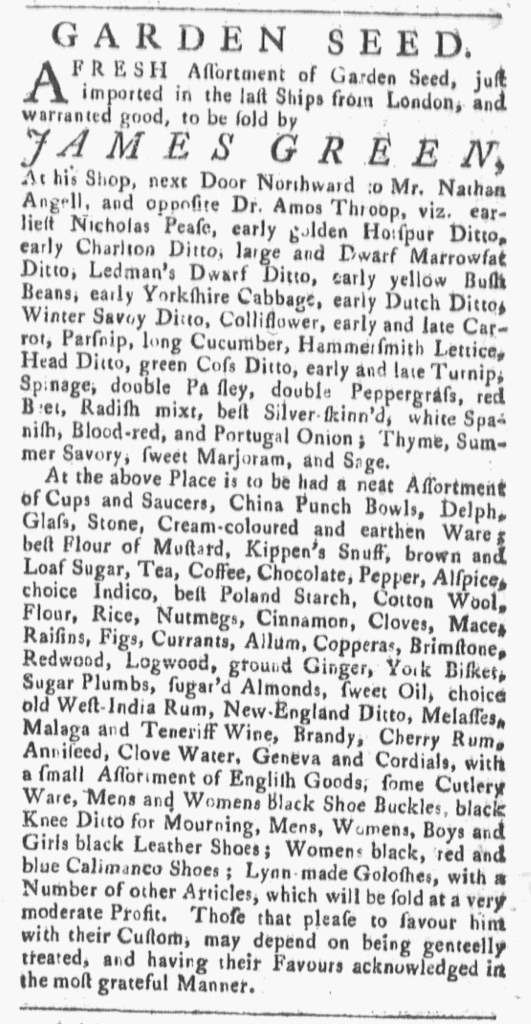
“GARDEN SEED … At the above Place is to be had a neat Assortment of Cups and Saucers.”

In Boston, advertisements for garden seeds continued to fill the pages of newspapers as spring approached in 1773.  On March 1, Elizabeth Greenleaf, Ebenezer Oliver, and Susanna Renken placed notices in the Boston Evening-Post, John Adams, Elizabeth Clark and Nowell, Elizabeth Dyar, Elizabeth Greenleaf, Ebenezer Oliver, and Susanna Renken placed notices in the Boston-Gazette, and Elizabeth Greenleaf and Susanna Renken placed notices in the Massachusetts Gazette and Boston Post-Boy.  On March 4, John Adams, Elizabeth Greenleaf, Ebenezer Oliver, and Susanna Renken ran advertisements in the Massachusetts Gazette and Boston Weekly News-Letter and Lydia Dyar, Elizabeth Greenlead, Anna Johnson, and Susanna Renken ran advertisements in the Massachusetts Spy.

Such advertisements did not saturate newspapers published in other towns in New England to the same extent, but they did appear.  For instance, Nathan Beers informed residents of New Haven that he sold a “Quantity of GARDEN-SEEDS” in a notice in the Connecticut Journal on March 5.  He stated that his seeds were “cultivated according to the rules of the best English Gardiners.”  The following day, James Green ran his own advertisement for a “FRESH Assortment of Garden Seed, just imported in the last Ships from London,” in the Providence Gazette.  Like other seed sellers, he provided an extensive list of his wares.

Unlike most others, however, Green did not focus exclusively on seeds.  He used seasonal merchandise to introduce prospective customers to other goods available at his shop.  Indeed, he devoted just more than half the space in his advertisement to a catalog of housewares, groceries, and garments, including “a neat Assortment of Cups and Saucers,” “best Flour of Mustard,” and “Mens, Womens, Boys and Girls black Leather Shoes.”  He promised “a Number of other Articles.”  To further entice consumers, Green stated that he sold those goods “at a very moderate Profit.”  In other words, he did not mark up the retail prices extravagantly but instead offered good bargains for his customers.

Eighteenth-century advertisers frequently described their merchandise as “suitable for the season.”  Sometimes they used headlines with similar sentiments, such as “WINTER GOODS” in a notice Frazier and Geyer ran in the March 1 edition of the Boston Evening-Post.  In contrast, Green experimented with another marketing strategy.  He focused one particular season item, garden seeds, in the first portion of his advertisement and then directed attention to the rest of his inventory after capturing the attention of prospective customers.

February 21

What was advertised in a colonial American newspaper 250 years ago this week?

Boston Evening-Post (February 15, 1773).

“Early Charlton, early Hotspur, early Golden Hotspur.”

For colonizers in Boston and nearby towns, it was a sign that spring was coming!  The first advertisement for garden seeds appeared in local newspapers on February 15, 1773.  In the late 1760s and the early 1770s, seed sellers, most of them women, took to the pages of the public prints to advertise their wares when they believed that winter passed its halfway point.  Susanna Renken was the first in 1773, just as she had been in 1768 and 1770.  Soon, several other women who advertised seeds each year would join her, as would a smaller number of men.  Indeed, shopkeeper John Adams placed the second advertisement for seeds in newspapers printed in Boston in 1773, but it did not take long for women to outnumber him with their advertisements.

Renken, already familiar to many readers in part due to her annual advertising campaign, had the market to her herself for a few days.  On February 15, she ran notices with identical copy in two of the three newspapers published in Boston that day, the Boston Evening-Post and the Boston-Gazette.  She focused primarily on a long list of seeds, but concluded by mentioning some grocery items, a “Variety of China Bowls and Dishes,” and an “Assortment of India and English Goods.”  Most of her female competitors usually did not promote other items, but Renken recognized an opportunity to encourage other sales, especially if customers were not quite ready to purchase garden seeds in the middle of February.  After all, many of the headlines in other advertisements still hawked “WINTER GOODS.

Massachusetts Gazette and Boston Weekly News-Letter (February 18, 1773).

She had the public prints to herself for only three days.  Adams inserted his advertisement in the Massachusetts Gazette and Boston Weekly News-Letter on February 18.  Renken did not expand her advertising to that newspaper or the Massachusetts Spy.  Her next notices ran once again in the Boston Evening-Post and the Boston-Gazette and, for the first time that year, the Massachusetts Gazette and Boston Post-Boy on February 22.  Other women who participated in the annual ritual joined her on that day, Elizabeth Clark and Nowell, Elizabeth Dyar, and Elizabeth Greenleaf in the Supplement to the Boston-Gazette and Elizabeth Greenleaf in the Massachusetts Gazette and Boston Post-Boy.  Ebenezer Oliver, who inherited the business from his mother, Bethiah Oliver, and invoked her name in his notice, also advertised in the Supplement to the Boston-Gazette, as did John Adams.  A few days later, John Adams, Elizabeth Greenleaf, and Ebenezer Oliver advertised in the Massachusetts Gazette and Boston Weekly News-Letter and Lydia Dyar, Elizabeth Greenleaf, and Anna Johnson advertised in the Massachusetts Spy on February 25.  By then, Renken decided that she would increase the number of newspapers carrying her advertisements, perhaps after noticing that her competitors launched their campaigns.  She also placed a notice in the February 25 edition of the Massachusetts Spy.  For a few days Renken was the sole seed seller promoting her merchandise in Boston’s newspapers, but it soon became a very crowded field.

February 26

What was advertised in a colonial American newspaper 250 years ago this week?

Boston-Gazette (February 24, 1772).

“A fresh Assortment of Garden Seeds.”

It was a sign that spring was approaching.  The first advertisement for a “fresh Assortment of Garden Seeds” than ran in the Boston newspapers in 1772 appeared in the February 24 edition of the Boston-Gazette.  Lydia Dyar informed the public that she stocked seeds for “Collyflower, Cucumber, Onion, Carrot, Turnip, Raddish, and Lettice of all sorts,” an “assortment of Flower Seeds,” and “a Variety of other Seeds not mentioned.”  She pledged that her inventory, obtained “from the Seeds men in LONDON,” consisted of seeds “warranted to be fresh and good, and of the last Year’s Produce.”

Dyar was one of several “Seeds women” in Boston who placed newspaper advertisements in the late 1760s and early 1770s.  More than half a dozen female entrepreneurs annually took the pages of newspapers published in the busy port city to draw attention to the imported seeds they offered for sale.  Most did not advertise at any time of the year except spring, nor did most advertise other sorts of goods.  That does not mean that they did not keep shop throughout the rest of the year, only that they exclusively advertised seeds in the spring.

Although Dyar was the first to insert an advertisement in the public prints in 1772, readers likely expected other “Seeds women” would soon join her.  In past years, compositors tended to cluster advertisements from Dyar and her competitors together, one after another in the lengthy columns in standard issues or occupying an entire page on smaller sheets distributed as supplements.  Compositors rarely resorted to placing advertisements with similar purposes together in eighteenth-century newspapers, making it all the more notable when they seemed to recognize a distinct classification for advertisements for seeds.  The “Seeds women” of Boston comprised a unique cohort of advertisers.  In no other American city or town did so many female entrepreneurs place so many advertisements promoting seeds.  It was indeed a sign that spring was approaching, but one witnessed solely by readers of Boston’s newspapers.

March 7

What was advertised in a colonial American newspaper 250 years ago today?

Massachusetts Gazette and Boston Weekly News-Letter (March 7, 1771).

“New Garden SEEDS, JUST IMPORTED By Elizabeth Greenleaf.”

It was a sign of spring approaching.  Each year in the late 1760s and early 1770s women who sold seeds placed advertisements in the several newspapers published in Boston, starting in early March and continuing for the next couple of months.  Although printers and compositors usually did not arrange advertisements according to any particular classification, they did often place together the notices from these female seed sellers when they made their annual appearances in the public prints.  Most did not advertise other goods at other times of the year.

The appropriately named Elizabeth Greenleaf was the first to advertise in 1771.  On March 7, she placed an advertisement about “New Garden SEEDS,” including “Early Pease, Beans, and Garden Seeds of all Sorts” in the Massachusetts Gazette and Boston Weekly News-Letter.  Her advertisement ran alone, but soon other women would place their own in the Weekly News-Letter and the other newspapers published in Boston.  Their numbers increased as the weather changed and colonists, especially women, anticipated planting gardens.

Two kinds of advertisements in colonial newspapers helped mark the passage of time and the transition from one season to another.  Advertisements placed by female seed sellers harkened the arrival of spring, while advertisements for almanacs signaled the end of one year and the beginning of another.  Advertisements for almanacs ran in newspapers from New Hampshire to Georgia, but notices about seeds sold by a coterie of female retailers were unique to Boston’s newspapers.

This is the sixth year that the Adverts 250 Project traces the appearance of these advertisements.  Each year they have been a welcome herald of spring’s imminent arrival, a harbinger of the end of winter and the beginning of a new season with warmer weather and more hours of sunlight each day.  In that regard, these advertisements certainly resonate in the twenty-first century, as much now as in the eighteenth century when colonial readers in Boston and its hinterlands first encountered them.