March 11

What was advertised in a colonial American newspaper 250 years ago today?
Connecticut Journal (March 11, 1774).

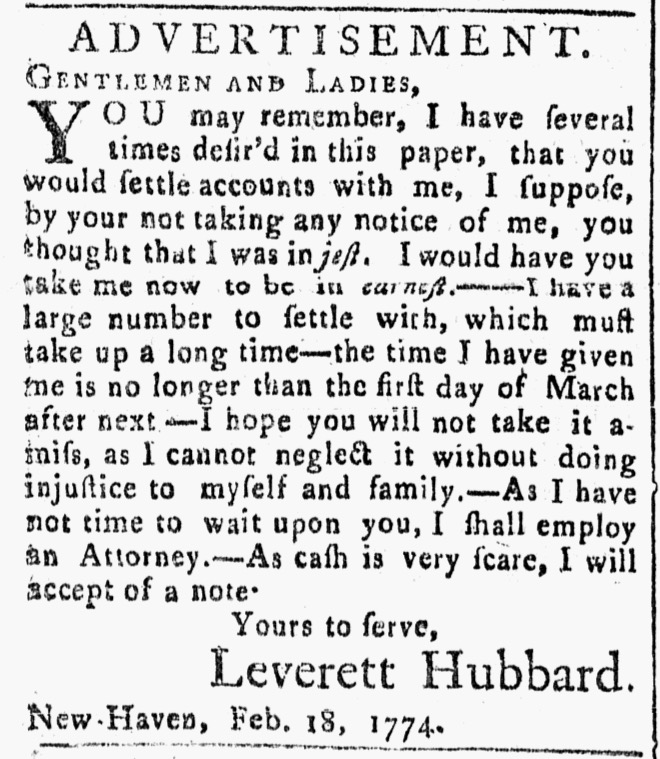
“You thought that I was in jest.  I would have you take me now to be in earnest.”

Leverett Hubbard was not amused.  He made his displeasure known in an advertisement that first appeared in the Connecticut Journal on February 18, 1774, and continued for several weeks.  Perhaps he grew even more frustrated each time that it appeared and those he addressed continued to ignore his call for them to settle accounts.

Hubbard used “ADVERTISEMENT” as a headline for his notice, an unusual opening line.  In this instance, he likely deployed the word according to one of its earliest meanings, one largely obsolete as use of “advertisement” has evolved.  The Oxford English Dictionary gives this definition: “the action or an act of calling the attention of someone; (an) admonition, warning, instruction.”  In a few sentences, Hubbard delivered an admonition, issued a warning, and gave instructions.

“YOU may remember,” he confided to the “GENTLEMEN AND LADIES” he addressed, “I have several times desir’d in this paper, that you would settle accounts with me.”  Such notices regularly appeared in newspapers throughout the colonies, but Hubbard composed lively copy for this “ADVERTISEMENT.”  Sarcastically, he opined, “I suppose by your not taking any of me, you thought that I was in jest.  I would have you take me now to be in earnest.”  Following that admonition, Hubbard gave instructions to settle accounts by “the first day of March.”  He concluded with a warning to his “large number [of colonizers] to settle with,” declaring that since he did not have “time to wait upon you, I shall employ an Attorney.”  Others who placed similar notices sometimes resort to that threat.

Hubbard departed from the formulaic language reiterated from one advertisement to another, perhaps hoping that a more emphatic approach, demonstrating that made his appeal “in earnest” rather than “in jest,” would convince those with open accounts who had ignored his previous notices that it was indeed in their best interests to heed this advertisement with its admonition, instructions, and warning.

February 9

What was advertised in a colonial American newspaper 250 years ago today?

Pennsylvania Journal (February 9, 1774).

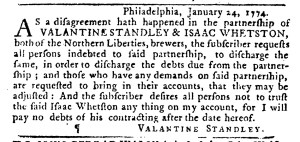
“I will pay no debts of his contracting after the date hereof.”

Valantine Standley and Isaac Whetston had a falling out at the beginning of 1774.  The brewers formed a partnership in the Northern Liberties on the outskirts of Philadelphia, but, as Standley explained in an advertisement in the February 9 edition of the Pennsylvania Journal, “a disagreement hath happened” that caused them to dissolve their partnership and go their separate ways.  Accordingly, Standley sought to separate his finances from Whetston, issuing a call for those who had done business with the brewers to settle accounts.  He requested “all persons indebted to said partnership, to discharge the same, in order to discharge the debts due from the partnership.”  At the same time, he asked that “those who have any demands on said partnership … bring in their accounts, that they may be adjusted.”

Standley could have left it there.  Merchants, shopkeepers, artisans, printers, and other entrepreneurs regularly placed advertisements asking their associates to settle accounts.  Similarly, executors often did so on behalf of the estates they administered.  Standley, however, inserted additional instructions to the partnership’s associates and to the general public, instructions that resembled those given by aggrieved husbands who ran what have become known as “runaway wife” advertisements to warn purveyors of goods and services not to extend credit to wives who had abandoned their husbands and households.  Standley advised “all persons not to trust the said Isaac Whetston any thing on my account, for I will pay no debts of his contracting.”  He replicated language that appeared in advertisements that resulted from marital discord but not usually in notices about business partnerships dissolving.  That Standley did so testified to the “disagreement” between the brewers.  He did not consider it sufficient that an announcement that they were no longer in business together would cause others to refrain from allowing Whetston to make charges on Standley’s account.  Instead, he explicitly forbade such transactions, suggesting that he did not trust his former partner to comport himself appropriately.  Rather than a dry and routine notification that the brewers were no longer in business together, Standley’s advertisement hinted at the acrimony between the two men, perhaps inciting curiosity among their neighbors and associates.  In this instance, an advertisement delivered both news and gossip.

January 14

What was advertised in a colonial American newspaper 250 years ago today?

Connecticut Gazette (January 14, 1774).

“ALL Persons indebted to me / are desired to pay, / Or they will sued be, / and that without delay.”

Advertisements calling on colonizers to pay their debts frequently appeared in newspapers from New England to Georgia, including the Connecticut Gazette.  On January 14, 1774, for instance, that newspaper carried an estate notice directed to “All Persons indebted to the Estate of the Hon. JONATHAN HUNTINGTON,” asking them “to make speedy Payment, to EBENEZER DEVOTION, Executor.”  In addition to that advertisement, another instructed “All Persons indebted toRussell Hubbard, by BOOK or NOTE, whose Debts are of more than one Year’s standing … to settle their respective Accounts and pay off their Notes, without delay, or they may depend on being sued to the next Court.”  Given the circulation of the newspaper in New London and beyond, he asserted that he “expects that this will be as sufficient a Warning as if he wrote to each Person separately.”

Seth Wymund Holmes also took to the pages of the public prints in his efforts to encourage his debtors to make good on what they owed.  He resorted to a different format than Devotion and Hubbard, making his request (and delivering his threats of legal action) in verse.  Holmes composed four stanzas of four lines each.  “ALL Persons indebted to me / are desired for to pay,” his poem began, “Or they will sued by, and that without delay.”  He appealed to the conscience: “So will the Sum amount: / How can you it abide / To add to your Account / Trouble and Cost beside?”  He also lamented how long he carried those debts, incorporating a strategy that appeared in many other advertisements that did not resort to poetry.  “As many Debts now standing be, / for seven Years, to croud my Books,” Holmes declared, “I do protest I hate to see / such dull and heavy looks.”  In case neither asking debtors to do the right thing nor stating how long he had extended credit without receiving payment worked, Holmes circled back to threatening to sue in the final stanza.  “I therefore warn Debtors to come, / and Payment make with speed, / Or they will shortly hear their Doom / in Letters plain to read.”

Holmes certainly did not produce a great work of literature, but that was not his goal.  Instead, he sought to draw the attention of those who owed him money.  He also aimed to make his message memorable.  The format of his advertisement, the amount of white space that remained after setting type for each line, distinguished it from the dense text in so many other notices.  Once that aspect of Holmes’s advertisement prompted readers to take a closer look, they may have considered the poem such a novelty that they read each stilted stanza instead of skimming through the notice like they might have done with the advertisements placed by Devotion and Hubbard.  Holmes presented something different to readers of the Connecticut Gazette.  Whether or not that convinced his debtors to settle accounts, this strategy likely increased the chances that they knew he intended to sue them if they did not.

January 8

What was advertised in a colonial American newspaper 250 years ago today?

Maryland Journal (January 8, 1774).

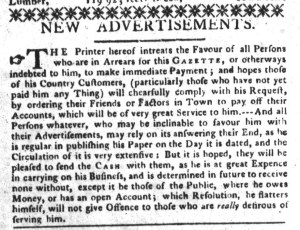
“My Entreaty to a great Majority of the Subscribers … to pay the Entrance Money, (a small Sum!)”

Less than five months after William Goddard commenced publication of the Maryland Journal on August 20, 1773, he found the enterprise in a dire financial position, at least according to the notice that he placed in the January 8, 1774, edition.  It appeared under a heading for “New Advertisements,” the first item following news, letters, and editorials.  With a manicule to help draw attention to his message, the printer lamented, “IT gives me real Pain to find myself under the Necessity of repeating my Entreaty to a great Majority of the Subscribers for the Encouragement of this paper, to pay the Entrance Money, (a small Sum!) agreeable to Contract.”  Indeed, Goddard had specified in his subscription proposals that Baltimore’s first newspaper would cost “the moderate Price of TEN SHILLINGS, … per Annum, one Half to be paid at the Time of subscribing, and the Remainder at the Expiration of the Year.”  He also pledged to begin publication “as soon … as I shall obtain a sufficient Number of Subscribers barely to defray the Expence of this Work.”

Enough subscribers may have submitted payment “barely to defray” the cost of printing those first issues, but Goddard apparently did not insist that more subscribers actually pay the entrance fee before he launched the venture.  Publishing a newspaper was a complex endeavor.  With a large enough subscription base, printers could convince others to subscribe.  The size of that subscription base also testified to the circulation of the newspaper, important for bringing in advertisements.  Many printers considered advertising more lucrative than subscriptions, allowing credit for subscriptions but not advertisements.  Still, that was not the deal that Goddard outlined in the subscription proposals for the Maryland Journal.  He may have figured that subscribers would pay once he distributed the first issue, so he gambled on taking the newspaper to press before most subscribers paid.  Goddard may have also been concerned about the prospects of competition.  The growing port had reached the point that it might support its own newspaper instead of relying on newspapers published in Annapolis and Philadelphia … but could it support two newspapers?  At the same time that Goddard circulated proposals for the Maryland Journal, Robert Hodge and Frederick Shober announced that they “intend shortly to exhibit Proposals for publishing a NEWS-PAPER, which shall be justly entitled to the Attention and Encouragement of this FLOURISHING TOWN.”  In the end, Goddard printed a newspaper in Baltimore, while Hodge and Shober did not.  Perhaps Goddard overextended himself when he faced competition.

If the Maryland Journal failed and Goddard shuttered his printing shop in Baltimore, it would not be his fault.  At least that was what he claimed in his notice, asserting that “[t]hose who neglect complying with this reasonable Request” to pay the entrance fee “may consider themselves individually accessary to the Fall of the Maryland Journal.”   Goddard did not acknowledge that he may have been overzealous in publishing the newspaper before he secured sufficient funding, nor did he acknowledge reasons that some subscribers may have been dissatisfied.  For instance, publication had been sporadic at times in those first months.  From Goddard’s perspective, however, that did not absolve subscribers of their obligation to pay.  After all, publishing a newspaper was an “arduous and very expensive Undertaking” that would not endure without “that Assistance which was expected, according to the Terms of the Proposals.”  Even if Goddard got a little ahead of himself by publishing the newspaper before collecting the entrance fees, subscribers now had a duty to catch up with their payments.  Otherwise, the public would lose a newspaper that disseminated all sorts of advertisements and news, including coverage of the crisis over tea that resulted in colonizers in Boston dumping tea shipped by the East India Company into the harbor.

January 7

What was advertised in a colonial American newspaper 250 years ago today?

New-Hampshire Gazette (January 7, 1774).

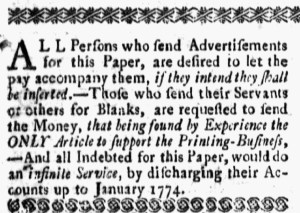
“ALL Persons who send Advertisements for this Paper, are desired to let the pay accompany them, if they intend they shall be inserted.”

Daniel Fowle, the printer of the New-Hampshire Gazette, frequently inserted notices that tended to the business of operating a newspaper.  He had also done so when in partnership with his nephew, Robert Fowle, with most such notices most often calling on subscribers to settle accounts.  Fowle commenced 1774 with an advertisement that addressed several services available at his printing office in Portsmouth.  He exercised his prerogative as proprietor to give that notice a privileged place on the page; it appeared as the first item in the first column on the first page of the first issue of the New-Hampshire Gazette published in the new year.

Fowle presented a variety of instructions to current and prospective customers.  “ALL Persons who send Advertisements for this Paper,” he advised, “are desired to let the pay accompany them, if they intend they shall be inserted.”  In other words, Fowle did not extend credit for advertising.  Most colonial printers likely required advertisers to pay in advance, securing revenues from advertising to balance the credit they allowed for subscriptions, though occasionally some placed notices that called on advertisers to pay overdue bills.  Whatever the policies at the New-Hampshire Gazette had been in the past, Fowle made clear that no advertisements would make it into the pages of his newspaper before receiving payment.  He concluded his notice with a familiar appeal to subscribers to pay what they owed: “all Indebted for this Paper, would do an infinite Service, by discharging their Accounts up to January 1774.”

In addition, Fowle addressed another aspect of his business between his directions about advertisements and subscriptions.  “Those who send their Servants or others for Blanks,” he declared, “are requested to send the Money, that being found by Experience the ONLY  Article to support the Printing-Business.”  Fowle and other printers frequently advertised blanks or printed forms for common commercial and legal transactions.  In the January 7 issue, Fowle ran a short advertisement, “Blanks of most sorts, sold cheap At the Printing Office in Portsmouth,” on the final page.  He suggested that printing and selling blanks represented the only lucrative element of his business, provided that customers paid for them at the time of purchase.  He implied that he only broke even, at best, on advertisements, while the chronic tardiness of subscribers meant that he lost money on subscriptions.  In that case, printing the New-Hampshire Gazetteamounted to a public service rather than a profitable venture for Fowle.  He may have exaggerated whether he made money on anything other than blanks, but Fowle’s exasperation with advertisers and subscribers who did not pay their bills was unmistakable.

November 7

What was advertised in a colonial American newspaper 250 years ago this week?

Providence Gazette (November 6, 1773).

“Those indebted for advertising, or in any other Manner, are likewise requested to pay.”

Like many other colonial printers, John Carter, the printer of the Providence Gazette, published advertisements in his own newspaper.  Many of those notices concerned additional revenue streams.  For instance, in the November 6, 1773, edition, Carter ran an advertisement that promoted “THE NEW-ENGLAND ALMANACK, OR LADY’S and GENTLEMAN’S DIARY, For the Year of our LORD, 1774,” offering to sell the popular pamphlet “in large or small Quantities.”  For many years, Benjamin West, a mathematician and astronomer, collaborated with Carter in publishing and marketing an almanac.  Another advertisement drew attention to a different project undertaken by Carter, a local edition of Daniel Fenning’s Universal Spelling-Book.  The printer proclaimed that he sold this reprint “Cheaper by the Dozen than any imported.”  A third advertisement hawked “BLANKS [or printed forms] of various Kinds,” another common source of revenue for printers.

In addition to notices about other goods and services available in their printing offices, printers also placed advertisements that tended to the business of publishing their newspapers.  In the same issue that carried advertisements for the almanac, the spelling book, and blanks, Carter inserted a notice to inform readers that “THIS DAY’s GAZETTE closes the Year with ALL the old Subscribers.”  That being the case, “the Printer therefore earnestly intreats of every one in Arrear to make immediate Payment.”  He did not, however, address only subscribers.  “Those indebted for advertising, or in any other Manner,” Carter continued, “are likewise requested to pay.”  That notice reveals an important aspect of how Carter ran his business.  Many historians of the early American press have asserted that printers extended to credit to subscribers, sometimes allowing them to fall behind in payments over several years, but insisted that advertisers had to pay for their notices in advance.  The advertising revenue supposedly amounted to more than the overdue subscriptions.  Yet some colonial printers published notices indicating that they did indeed allow credit for advertisements as well as subscriptions.  The Adverts 250 Project compiles such advertisements to demonstrate that practices in printing offices throughout the colonies varied when it came to paying upfront for advertisements.  Even if most printers did insist on payment in advance, a significant minority adopted other policies.

October 4

What was advertised in a colonial American newspaper 250 years ago today?

Pennsylvania Chronicle (October 4, 1773).

“The Printer of this Paper begs the Favour of ALL who are indebted to him for the Pennsylvania Chronicle, Advertisements, &c. to make IMMEDIATE PAYMENT.”

William Goddard exercised his prerogative as printer to place his notice first among the advertisements that appeared in the October 4, 1773, edition of the Pennsylvania Chronicle.  He placed it immediately below the shipping news from the customs house in Philadelphia, a strategy frequently deployed by colonial printers.  Even if readers only skimmed the remainder of the contents of that issue, the advertisements, once they determined that the portion devoted to news came to an end then they might give more attention to the first of the notices they encountered than any of the others.

Goddard participated in a familiar refrain among printers: “The Printer of this Paper begs the Favour of ALL who are indebted to him … to make IMMEDIATE PAYMENT.”  He made a special appeal to “his Customers who live in the Country,” whether in Pennsylvania or other colonies served by the Pennsylvania Chronicle, to “order Payment to be made in this City,” Philadelphia, “or remit the same by the first good Opportunity.”  Goddard pleaded for cooperation because “the Accounts are small and lie so wide of each other, that they cannot be collected without great Trouble and Expence.”  He implied that most overdue accounts were so small that customers would not experience any hardship in settling them, while also encouraging their cooperation in not making the process more onerous than necessary.  Stating that the accounts “lie so wide of each other” also suggested an extensive circulation for the Pennsylvania Chronicle, a factor for prospective advertisers to take into consideration when choosing which of the several newspapers published in Philadelphia should carry their notices.

Notably, Goddard addressed customers “indebted to him for the Pennsylvania Chronicle, Advertisements,” and anything else, such as books or job printing.  Historians have traditionally asserted that colonial printers struck a balance between extending credit to subscribers and requiring advertisers to pay before printing their notices, making advertising the more consistent and more significant source of revenue for printers who published newspapers.  Apparently, not all printers, however, adopted that business model.  Goddard was one of several printers who ran notices that called on both subscribers and advertisers to pay their bills.  Those printers may have been more selective in allowing credit for advertising than for subscriptions, yet their own notices indicated that they did allow credit for advertising for at least some customers. Advertising certainly had the potential to be lucrative, but only if printers required payment in advance or successfully collected payments after extending credit to advertisers.

September 24

What was advertised in a colonial American newspaper 250 years ago today?

New-Hampshire Gazette (September 24, 1773).

“Send or bring the Receipts they have received, that a final Settlement may be made.”

Daniel Fowle, printer of the New-Hampshire Gazette, marked the seventeenth anniversary of the newspaper with a note running across the bottom margin of the first page of the September 23, 1774, edition.  A manicure directed readers to an announcement that “This Paper completes the seventeenth Year since its first Publication.”  In addition, Fowle inserted an advertisement calling on “Customers who are in Arrears for one Year or more” to pay their bills.  Colonial printers often inserted notices in their own newspapers for the purpose of encouraging their customers to pay, especially those who had not done so for several years.  Printers typically extended credit to subscribers, anticipating that increasing their circulation numbers would yield more advertisements and more advertising revenue.  (Some of the notices placed by printers, however, also called on advertisers to settle accounts, though not nearly as often as they singled out subscribers.  Apparently, not all printers required payment for advertisements in advance.)  Like merchants, shopkeepers, and other entrepreneurs who allowed credit for consumers, printers regularly resorted to advertisements requesting payment.  For many newspaper printers, this became part of an annual ritual upon completing another year of publication.

In addition to dealing with him directly, Fowle instructed customers who lived at a distance and “have sent by, or paid any Money to Post-Riders, or others,” to inform him that was the case and submit “the Receipts they have received” in order “that a final Settlement may be made, and the proper Persons charg’d.”  Fowle would consult his ledgers to confirm that post riders who carried the New-Hampshire Gazette to distant towns and received payment for both their services and the newspapers made the proper remittances to the printing office.  To that end, he expressed his desire that “there may be no Misunderstanding.”  That phrase, however, did not apply solely to reconciling accounts with post riders.  Regular readers likely would have recognized the implicit threat of legal action in that phrase.  Fowle was not as assertive as he and his nephew, Robert, had sometimes been when they ran similar advertisements during their partnership.  They explicitly threatened to sue and once even suggested that they would publish the names of subscribers who were delinquent in paying their bills.  Fowle did not resort to those measures this time, but he did make it clear that “Attendance will be given at the Printing-Office” with the expectation that customers would make overdue payments.

September 23

What was advertised in a colonial American newspaper 250 years ago today?

Massachusetts Gazette and Boston Weekly Mercury (September 23, 1773).

“Those who may defer purchasing any of the above GOODS in Expectation of their being put up at Public Auction will be disappointed.”

Ward Nicholas Boylston planned to leave the colonies in the fall of 1773.  Before his departure, he attempted to the liquidate the merchandise at his store on King Street in Boston.  His advertisement in September 23 edition of the Massachusetts Gazette and Boston Weekly News-Letter incorporated several strategies to entice customers to purchase his wares.

The notice commenced with a headline: “At first Cost, for Cash only.”  Like an advertisement that Boylston ran in February, a decorative border enclosed the headline to draw attention to it.  The merchant offered the best prices available, even the prices he paid to acquire his inventory.  Earning profits on the goods mattered less than getting them out of his store, but taking advantage of those bargains required paying in cash.  With his departure quickly approaching, Boylston was not in a position to extend credit.  That also explains why the merchant “repeatedly desires all Persons who have any Demands against him to bring in their Accounts & receive their Ballances, & those who are indebted to him to make immediate Payment.”  Boylston did not want any leftovers in his ledgers when he departed.

He also trumpeted that he provided “an Abatement to those who take large Quantities.”  Merchants who planned to wholesale the goods as well as retailers in town and country looking to supplement their inventories would receive discounts for purchasing in volume.  Boylston cautioned that these deals were the best that buyers should anticipate, warning that “[t]hose who may defer purchasing any of the above GOODS in Expectation of their being put up at Public Auction will be disappointed.”  He declared that “what may remain unsold when he leaves the Country … will be disposed of another Way,” but did not give details.  Once again, this advertisement echoed one that Boylston placed in February.  He addressed “[t]hose who have witheld buying hitherto, on a dependence that the above Goods will be finally exposed to Public Sale” and acknowledged that purchasing at auction often resulted in “better Pennyworths” or bargains. That would not be the case in this instance, the merchant promised, because he would dispose of unsold merchandise “otherwise than at Auction.”  The current sale, “The last Chance” promised in the headline, was “the present and last Opportunity” for the best deals possible for purchasing Boylston’s goods.

With only “Fifteen or Twenty Days” remaining before Boylston left town, those who previously did business with him and those who considered doing business with him had a limited time to settle accounts and to buy an “Assortment of English and India Goods … at the neat Sterling Cost, free of any Charges,” from the merchant.  Realizing that some prospective customers might attempt to wait him out in hopes of purchasing his wares at auction for even lower prices than “the first Cost” and discounts for volume that he already offered, Boylston cautioned them, as he had a habit of doing, not to depend on that strategy because he had other plans for disposing of his merchandise.

June 1

What was advertised in a colonial American newspaper 250 years ago today?

South-Carolina Gazette and Country Journal (June 1, 1773).

“ALL Persons who may favour the Printer of this Gazette with their Advertisements, are requested to send the CASH with them.”

Charles Crouch, the printer of the South-Carolina Gazette and Country Journal, seemed to do good business when it came to advertising.  Dozens of advertisements, including sixteen about enslaved people, filled seven of the twelve columns in the June 1, 1773, edition of his newspaper.  Yet the advertising revenues may not have been as robust as they appeared from merely looking at the contents on the page.

The printer commenced the portion of the issue devoted to advertising with his own notice.  “ALL Persons who may favour the Printer of this Gazette with their Advertisements,” he declared, “are requested to send the CASH with them, except where he owes Money, or has a running Account.”  Crouch suggested that this arrangement “will prevent disagreeable Circumstances, as well as Trouble.”  He apparently experienced some “disagreeable Circumstances” a few months earlier when he ran a notice that called on “ALL Persons indebted to the Printer hereof, for News-Papers, Advertisements, &c. … to make immediate Payment, as he is in REAL Want of his Money.”

Historians have often asserted that colonial printers maintained a balance in their accounts by extending credit to subscribers while requiring advertisers to pay in advance.  Accordingly, advertising became the more important revenue stream.  Notices like those placed by Crouch, however, suggest more complex arrangements, at least in some printing offices.  Both of the notices that Crouch placed in 1773 indicate that he sometimes published advertisements submitted to his office without payment, though he revised that practice as a result of some advertisers becoming as notoriously delinquent in settling accounts as many subscribers.

Crouch and other printers sometimes described such situations in the notices they placed in their own newspapers, though not as frequently as printers placed notices calling on subscribers to make payments.  These instances refine our understanding of the significance of advertising revenue to colonial printers without upending the common narrative.  It appears that some printers exercised a degree of flexibility, even if they eventually adjusted their practices, when it came to submitting the fees along with the advertising copy.