February 14

GUEST CURATOR:  Ashley Schofield

What was advertised in a colonial American newspaper 250 years ago today?

Essex Gazette (February 14, 1775).

“The great Misfortune of losing his House and Store by Fire, with almost every Thing in and about them.”

Peter Frye was a justice of the peace in Salem, Massachusetts, when the town had a fire on October 6, 1774. According to Donna Seger, Frye was a Tory. Tories were also known as Loyalists, colonists who remained loyal to the king and Parliament. In an advertisement that he placed four months after the fire, Frye points out his misfortune of losing his house, store, and belongings due to the fire. “He is now obliged to beg all of those who were then indebted to him by Bond, Note, or on Account” to pay him what they justly owed.

Frye called for sympathy amongst the people of Salem by stating his misfortune of losing his house, store, and belongings. He thought that some readers would hesitate to engage because he was a Tory, either overlooking or disregarding his plea. He knew he was asking a lot of the people to help him recover, so began by noting that he lost everything.

Advertisements calling on readers to settle accounts and debts were common, but most advertisements were due to regular business transactions, not due to fires. Additionally, he not only lost his house and store, but allegedly all that was in them. In this matter, Frye no longer had his ledgers and account books due to the fire, which meant he had no records to confirm who owed him and what amount.

Frye relied on the sympathy and the good consciences of the people of Salem to help him out in this time of tragedy to gain back what he had lost. As Donna Seger explains, “Frye had tried to find his way back to ‘friendship’ with his Salem neighbors, but they had never been able to forget his commercial and judicial dealings contrary to Patriot proclamations.” Due to his position as a Tory on the eve of the American Revolution, townspeople held a grudge against him. Seger notes that Frye left Salem, moving to Ipswich and then Britain.

**********

ADDITIONAL COMMENTARY: Carl Robert Keyes

I enjoyed working with Ashley on this entry for many reasons, including the confluence of primary and secondary sources that went into crafting it.  We began with negotiating whether I would approve Frye’s advertisement as Ashley’s selection for this project.  I encouraged students to choose advertisements about consumer goods and services to build on our readings and discussions about the consumer revolution, but I also told them that I would consider other kinds of advertisements if they made convincing cases for what they hoped to learn from them and why they should be included in the Adverts 250 Project.  Ashley convincingly argued that she did not previously know about the fire in Salem in 1774.   Frye’s advertisement offered an opportunity to learn about that piece of local history and its aftermath.

To fill in the details, she consulted Streets of Salem, a blog produced by Donna Seger, Professor of History at Salem State University.  Seger composes “[s]omewhat random but still timely posts about culture, history, and the material environment, from the perspectives of academia, Salem and beyond.”  In the nine years that I have been producing the Adverts 250 Project, I have consulted and linked to Streets of Salem on many occasions, so I was pleased that Ashley discovered that wonderful and engaging resource when researching Frye’s advertisement.  In the entry that gave so much information about Frye, Seger weaves together various primary sources, informed by Mary Beth Norton’s 1774: The Long Year of Revolution.  Ashley was already familiar with Norton from our discussions about the historiography of the American Revolution.  Seger’s post about “Tea, Fire and a new Congress” vividly illustrated how historians incorporate secondary sources into their research on primary sources, not only for background information but also in presenting an interpretation of what happened, why it mattered then, and why we consider it important now.

During the research, writing, and revision process, Ashley also had an opportunity to learn more about early American print culture and various kinds of advertisements, especially notices that called on colonizers to settle accounts.  As a result, she was able to make a distinction between the familiar and standard notices that so often appeared in the pages of early American newspapers and the appeal that Frye made as he attempted to recover from a fire that had devasted his household and business.  I sometimes select advertisements that deliver local news (including some that ran in the Essex Gazette right after the Salem fire) to feature on the Adverts 250 Project.  Ashley contributed to the project’s examination of those sorts of newspaper advertisements.

November 26

What was advertised in a colonial American newspaper 250 years ago today?

Providence Gazette (November 26, 1774).

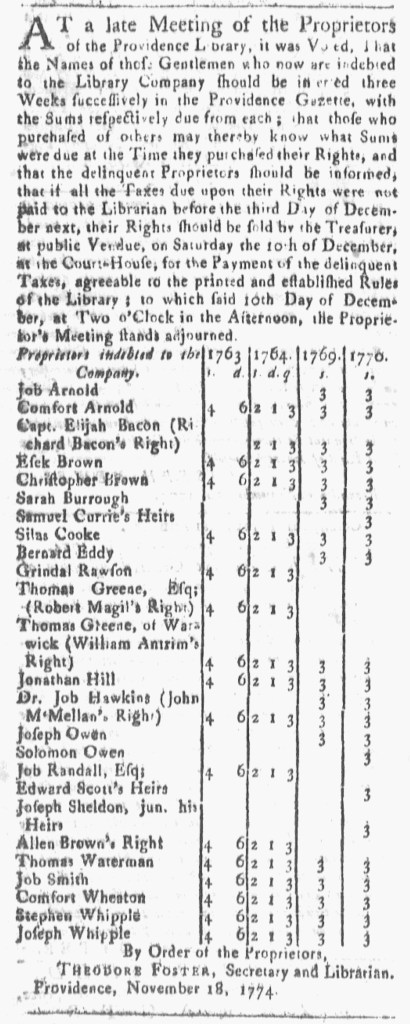
“Names of those Gentlemen who are now indebted to the Library Company should be inserted … in the Providence Gazette.”

The Providence Library Company, a private subscription library, conducted some of its business in the public prints in the eighteenth century.  Early in the fall of 1774, Theodore Foster, the librarian, ran an advertisement in the Providence Gazette, requesting that “All Persons … who have any Books belonging to the Library … return the same immediately” so they could be “examined and numbered.”  In addition to conducting an inventory of the collection, the librarian was “ready to settle with the delinquent Proprietors” who had not paid their subscriptions.

At the end of November, Foster published a new advertisement in the wake of a vote at a recent “Meeting of the Proprietors.”  They had decided that “the Names of those Gentlemen who are now indebted to the Library Company should we inserted three Weeks successively in the Providence Gazette, with the Sums respectively due from each.”  That list consisted of more than two dozen subscribers, most of them with debts going back more than a decade.  The proprietors in good standing determined that the grace period had extended long enough.  Accordingly, the advertisement also informed the delinquent subscribers that if they did not make payment before December 3 then “their Rights should be sold by the Treasurer” at a public auction on December 10.  They took that action “agreeable to the printed and established Rules of the Library.”  The advertisement first ran on November 19 and again on November 26.  It made its final appearance on December 3, the deadline for settling accounts.  Perhaps Foster offered a little more leeway, provided subscribers paid before the auction on December 10, but the advertisement made clear that overdue subscriptions would be addressed, one way or another, “By Order of the Proprietors.”  Their next meeting was scheduled for the day of the auction, an opportunity to assess the outcome of their efforts to get everything in good order.

As was often the case, advertisements like this one relayed local news to the readers of the Providence Gazette.  John Carter, the printer, selected which news and editorials to publish elsewhere in the newspaper, yet purchasing advertising space gave individuals and organizations opportunities to become editors who decided on some of the information presented to the public.

November 15

What was advertised in a colonial American newspaper 250 years ago today?

South-Carolina Gazette and Country Journal (November 15, 1774).

“PUBLIC NOTICE in the three Gazettes of this Province.”

The section for “NEW ADVERTISEMENTS” in the November 15, 1774, edition of the South-Carolina Gazette and Country Journal included a notice from David Deas and John Deas.  “OUR Co-partnership being now expired,” they declared, “we are desirous of brining all our Concerns in Trade to a speedy and final Settlement.”  Like many other merchants, shopkeepers, and other entrepreneurs, the Deases used a newspaper advertisement to call on associates to settle accounts.  Their notice replicated so many others that ran in newspapers throughout the colonies, including a threat of legal action against those who did not respond.  Any “Bonds, Notes, and Book Debts, due to us, which shall not be discharged or settled to our Satisfaction, on or before the 10th Day of March next,” they warned, “will then be put in Suit without Distinction.”  The Deases did not plan to make any exceptions for any reasons, so those with outstanding accounts needed to tend to them by the specified date.

Today, the Deases are best known among historians for their broadside advertising the sale of “A CARGO OF NINETY-FOUR PRIME, HEALTHY NEGROES, CONSISTING OF Thirty-nine MEN, Fifteen BOYS, Twenty-four WOMEN, and Sixteen GIRLS …from SIERRA-LEON” held in Charleston on July 24, 1769.  Yet that was not the only time that they leveraged the power of the press in advancing their business interests.  In this instance, they published their “PUBLIC NOTICE in the three Gazettes of this Province,” submitting it to the South-Carolina and American General Gazette and the South Carolina Gazette as well as the South-Carolina Gazette and Country Journal.  While inserting it in just one of those newspapers would have been sufficient to argue that they gave fair notice, running it in all three increased the likelihood that associates who owed them debts would see their announcement and take heed.  At the same time, placing the advertisement in all three newspapers increased their investment in the endeavor, apparently money the Deases considered well spent if it either had the desired results or gave them a stronger case when they had to resort to going to court.

September 22

What was advertised in a colonial American newspaper 250 years ago today?

Maryland Gazette (September 22, 1774).

“YES, YOU SHALL BE PAID; BUT NOT BEFORE YOU HAVE LEARNED TO BE LESS INSOLENT.”

The saga continued.  Elie Vallette, the clerk of the Prerogative Court in Annapolis and author of the Deputy Commissary’s Guide, did not bow to the public shaming that Charles Willson Peale, the painter, undertook in the pages of the Maryland Gazette in September 1774.  Earlier in the year, Peale had painted a family portrait for Vallette and then attempted through private correspondence to get the clerk to pay what he owed.  When Vallette did not settle accounts, Peale turned to the public prints.  He started with a warning shot in the September 8 edition of the Maryland Gazette: “IF a certain E.V. does not immediately pay for his family picture, his name shall be published at full length in the next paper.”  Peale meant it.  He did not allow for any delay in Vallette taking note of the advertisement and acting on it.  A week later, he followed through on his threat, resorting to all capitals to underscore his point, draw more attention to his advertisement, and embarrass the recalcitrant clerk.  “MR. ELIE VALLETTE,” Peale proclaimed in his advertisement, “PAY ME FOR PAINTING YOUR FAMILY PICTURE.”

That still did not do the trick.  Instead, it made Vallette double down on delaying payment.  He responded to Peale’s advertisement, attempting to put the young painter in his place.  In a notice also in all capitals, he lectured, “MR. CHARLES WILSON PEALE; ALIAS CHARLES PEALE – YES, YOU SHALL BE PAID; BUT NOT BEFORE YOU HAVE LEARNED TO BE LESS INSOLENT.”  Vallette sought to shift attention away from his own debt by critiquing the decorum of an artist he considered of inferior status.  That strategy may have worked, though only for a moment.  Peale’s advertisement did not run in the next issue of the Maryland Gazette.  That could have been because Peale instructed the printer, Anne Catharine Green, to remove his notice and returned to working with Vallette privately.  Even if that was the case, it was only temporary.  “MR. ELIE VALLETTE, PAY ME FOR PAINTING YOUR FAMILY PICTURE” appeared once again in the October 6 edition.  Peale was not finished with his insolence.  He placed the advertisement again on October 13 and 20.  Vallette did not run his notice a second time, perhaps considering it beneath him to continue to engage Peale in the public prints.  He had, after all, made his point, plus advertisements cost money.  That being the case, the painter eventually discontinued his notice.  Martha J. King notes that Vallette “eventually settled his account about a year later.”[1]  For a time, advertisements in the only newspaper printed in Annapolis became the forum for a very public airing of Peale’s private grievances and Vallette’s haughty response.

**********

[1] Martha J. King, “The Printer and the Painter: Portraying Print Culture in an Age of Revolution,” Transactions of the American Philosophical Society 109, no. 5 (2021): 79.

September 16

What was advertised in a colonial American newspaper 250 years ago today?

New-Hampshire Gazette (September 16, 1774).

“There are now the most interesting Matters depending that ever were in this Country.”

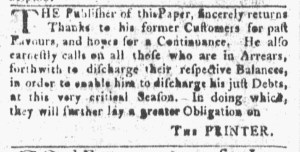
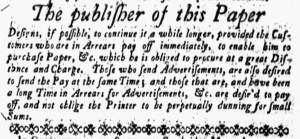
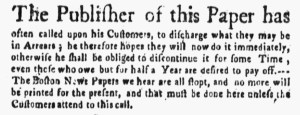
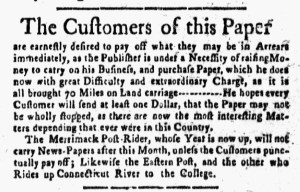
Colonial printers frequently ran advertisements asking customers, especially subscribers, to pay their overdue bills.  Daniel Fowle, the printer of the New-Hampshire Gazette, seemed to do so more often than others.  Such advertisements became a regular feature in his newspaper.  One appeared in the September 16, 1774, edition of the New-Hampshire Gazette.  This time, Fowle pleaded that the “Customers of this Paper” are earnestly desired to pay off what they may be in Arrears immediately, as the Publisher is under a Necessity of raising Money to carry on his Business.”  The fate of the newspaper, Fowle’s ability to continue publishing it, was at stake.  In part, that was because he apparently experienced a disruption in his supply of paper, acquiring it “with Difficulty and extraordinary Charge, as it is all brought 70 Miles on Land carriage.”  The printer did not go into greater detail on that point, though at various times in the past he had suggested that he used only paper produced in the colonies rather than paper imported from England.  The blockade of Boston, one of Parliament’s responses to the Boston Tea Party, may have affected Fowle’s route for receiving paper produced in another colony.

Even if subscribers could not settle accounts, Fowle requested that they “send at least one Dollar, that the Paper may not be wholly stopped, as there are the most interesting Matters depending that ever were in this Country.”  The printer recognized that the imperial crisis had intensified with the Boston Port Act and the rest of the Coercive Acts.  Earlier in the month, the First Continental Congress commenced its meeting in Philadelphia, deliberating about a unified response across the colonies.  Discussion and debates also took place in communities near and far.  That same issue of the New-Hampshire Gazette carried updates from Philadelphia, New London, Hartford, Newport, Boston, Salem, and other towns in Massachusetts.  Local news included coverage of a tea consignee in Portsmouth refusing to accept the shipment, diverting it to Halifax rather than cause a scene.  Yet that article also warned, “In future no such Indulgence will be allowed to the Enemies of America.”  Momentous events were underway.  Fowle did not know what would happen next, but he assured subscribers that they did not want to lose access to the news he supplied if they did not pay what they owed.

September 15

Who was the subject of an advertisement in a colonial American newspaper 250 years ago today?

Maryland Gazette (September 15, 1774).

“MR. ELIE VALLETTE, PAY ME FOR PAINTING YOUR FAMILY PICTURE.”

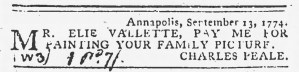
Charles Willson Peale followed through on his threat.  He had placed an advertisement in the September 8, 1774, edition of the Maryland Gazette warning that “IF a certain E.V. does not immediately pay for his family picture, his name shall be published at full length in the next paper.”  The subject of the painter’s notice had not heeded it, perhaps mistakenly believing that Peale would not have the audacity to actually do what he suggested.  If that was the case, he miscalculated because a week later the very first advertisement in the next issue of the Maryland Gazette proclaimed, “MR. ELIE VALLETTE, PAY ME FOR PAINTING YOUR FAMILY PICTURE.”  Using all capital letters signaled the artist’s frustration; it also called greater attention to the advertisement.

Another advertisement involving Vallette appeared on the next page of the newspaper.  That one, which had first appeared four months earlier, promoted the Deputy Commissary’s Guide, a book that Vallette had authored and invested many months in acquiring subscribers before taking it to press.  He had advertised extensively in the Maryland Gazette.  His name did not happen to appear in the most recent advertisement; instead, it gave the title of the book and featured an endorsement by William Fitzhugh, the colony’s commissary general.  Martha J. King suggests that Vallette did not place the advertisement for the Deputy Commissary’s Guide, asserting that Anne Catherine Greene, the printer of both the Maryland Gazette and Vallette’s book, ran that notice.[1]  To whatever extent Vallette was or was not involved in continuing to advertise the Deputy Commissary’s Guide following publication, he was proud enough of his achievement as an author that the book with its engraved title page appeared in the foreground of the family portrait Peale painted.  Peale’s notices may not have been the kind of acclaim that Vallette desired, but the painter had given him public notice after seeking payment in private letters for several months.

Readers of the Maryland Gazette witnessed one side of the feud as it escalated from one week to the next in September 1774.  Some may have found the spectacle entertaining, a good bit of gossip.  Now that he had been named in the public prints, how would Vallette react?  Would the disagreement escalate even more?  Readers had a new reason to peruse the advertisements in the next edition of the Maryland Gazette.

**********

[1] Martha J. King, “The Printer and the Painter: Portraying Print Culture in an Age of Revolution,” Transactions of the American Philosophical Society 109, no. 5 (2021): 79.

September 8

What was advertised in a colonial American newspaper 250 years ago today?

Maryland Gazette (September 8, 1774).

“IF a certain E.V. does not immediately pay for his family picture, his name shall be published at full length in the next paper.”

A private scuffle over paying for a portrait became a public spectacle when Charles Willson Peale resorted to shaming Elie Vallette, author of the Deputy Commissary’s Guide, in a newspaper advertisement.  A notice in the September 8, 1774, edition of the Maryland Gazette advised that “IF a certain E.V. does not immediately pay for his family picture, his name shall be published at full length in the next paper.”  The painter, who signed his name as “CHARLES PEALE,” was near the beginning of his career, though he had already studied with Benjamin West in London for two years and then provided his services in Annapolis for a dozen more.  Still, at the time he sought the overdue payment, he was not yet the prominent figure, one of the most influential America painters and naturalists of his era, that he would become in the decades after the American Revolution.  He gained access to the power of celebrity later in his career, but at the moment he vied with Vallette he sought to leverage public shaming as the most effective tool available.

As Martha J. King notes, Peale “obtained a commission to paint a group portrait of the Vallette family and portrayed the author seated at a table with the engraved title page of the Deputy Commissary’s Guide clearly visible in the foreground.  [His] wife and two children clustered in the picture’s right.”[1]  Vallette had extensively advertised the Deputy Commissary’s Guide in the Maryland Gazette, gaining prominence for himself and his manual for settling estates and writing wills.  Commissioning a family portrait served to further enhance his status, yet the dispute that followed did not necessarily reflect well on Vallette.  On May 28, 1774, Peale sent a letter to Vallette to request payment, explaining that he needed to cover immediate expenses that included rent on the house where his family resided.[2]  The author did not heed that request.  Three months later, Peale decided to escalate his methods for collecting on the debt, placing the advertisement that gave Vallette’s initials and enough information that the author would recognize himself and perhaps enough that some readers could work out his identity, but not so much that readers in Annapolis and throughout the colony knew without a doubt that Peale addressed Vallette.  Was this strategy effective?  Next week the Adverts 250 Project will examine the subsequent issue of the Maryland Gazette to determine whether Peale had to further escalate his demand for payment.

**********

[1] Martha J. King, “The Printer and the Painter: Portraying Print Culture in an Age of Revolution,” Transactions of the American Philosophical Society 109, no. 5 (2021): 78.

[2] King, “Printer and the Painter,” 78.

June 9

What was advertised in a colonial American newspaper 250 years ago today?

Massachusetts Spy (June 9, 1774).

Contains as much news, as many Political Essays, as any in America.”

Printers and other entrepreneurs often published notices calling on customers and associates to settle accounts.  Isaiah Thomas, the printer of the Massachusetts Spy, did so in June 1774, though he confessed that he “is loath to trouble them with a dunning advertisement.”  Still, “his affairs make it necessary.”  Many printers threatened legal action against those who did not submit payment, but Thomas opted for a different strategy.  His “‘dunningadvertisement” focused primarily on the service to the public he provided in publishing the Massachusetts Spy, especially considering the “gloomy prospect of public affairs, at present.”  Readers knew, of course, that he referred to the Boston Port Act that initiated a blockade of the harbor and halted trade at the beginning of the month as well as a series of troubling events over the past decade.

Zechariah Fowle and Thomas commended publishing the Massachusetts Spy in July 1770, four months after the Boston Massacre.  At the age of twenty-one, Thomas became the sole proprietor just a few months later.  In the four years that the newspaper had been published, the young printer sought to establish its reputation in Boston and beyond.  When he asked subscribers to pay what they owed, he underscored that “the MASSACHUSETTS SPY is a third larger than any News-Paper published in this province.”  That distinguished it from the Boston Evening-Post, the Boston-Gazette, the Massachusetts Gazette and Boston Post-Boy, and the Massachusetts Gazette and Boston Weekly News-Letter as well as the Essex Gazette, published in Salem, and the Essex Journal, published in Newburyport.  At the time, no other city or colony had as many newspapers, which meant that Thomas faced significant competition for subscribers and advertisers. Furthermore, Thomas’s newspaper “contains as much News, [and] as many Political Essays, as any in America,” making it a valuable resource for readers far and wide.  Thomas also asserted that the Massachusetts Spyis the cheapest on the globe,” making it a good value that merited support (and payment) from readers.

In return for “the honour of being an hand-servant to the public,” Thomas requested the “kind assistance” of his customers.  He asked that they “take proper notice” of his appeal, warning that “there is no possibility … in carrying on business without regular payments.”  The June 9 edition of his newspaper featured extensive coverage of the “PROCEEDINGS in the HOUSE of COMMONS” from April, including an “Authentic account of Tuesday’s Debate on the Motion for repealing the Tea-Duty in America,” and editorials “To the FREE and BRAVE AMERICANS” from “AN AMERICAN” and “To the ADRESSERS of the late Governor HUTCHINSON” from “A MODERATE MAN.”  Thomas compiled and circulated such news and opinion as a service, but could not afford to continue that endeavor without receiving subscription fees from his customers.  Rather than an explicit threat to take them to court to force them to pay what they owed, Thomas made a much more subtle insinuation about what they would lose if they did not settle accounts.  By his accounting, no other newspaper compared to the Massachusetts Spy.

April 17

What was advertised in a colonial American newspaper 250 years ago this week?

Virginia Gazette [Rind] (April 17, 1774).

“Advertisements, blanks, and many other kinds of printing work, she ardently hopes, may be discharged at the general courts.”

Clementina Rind printed the Virginia Gazette and operated the printing office following the death of her husband in August 1773.  That included keeping the books and calling on customers to settle accounts.  She issued such a notice in the April 14, 1774, edition of her newspaper, at the same time outlining improvements to the publication that payments would help support.  She asserted that she had “lately considerably enlarged her paper,” providing more content to subscribers and other readers.  In addition, she ordered and “expect[ed] shortly an elegant set of types from London, … together with all other materials relative to the printing business.”  Rind expressed pride in “the dignity of her gazette” while simultaneously noting that those who owed money had a role to play in her goal of “keeping it at a fixed standard.”

To that end, she called on subscribers to submit annual payments.  In the eighteenth century, many newspaper subscribers notoriously went for years without settling accounts with printers.  Advertising revenue offset those delinquent payments, yet not all printers demanded that advertisers pay for their notices in advance, contrary to common assumptions about how they ran their businesses.  Rind’s notice suggests that she may have published advertisements on credit but does not definitively demonstrate that was the case.  She requested that customers pay what they owed for “advertisements, blanks, and many other kinds of printing work … at the general courts.”  She may have meant newspaper notices, but “advertisements” could have also referred to handbills, broadsides, and other job printing for the purposes of marketing goods and services or disseminating information to the public.  The masthead listed prices for subscriptions (“12 s. 6 d. a Year”) and advertisements “of a moderate length” (“3 s. the first Week, and 2 s. each Time after”), while also promoting “PRINTING WORK, of every Kind,” which would have included blanks (or forms for legal and commercial transactions), handbills, and broadsides, but that does not clarify what Rind meant by “advertisements” in her notice.  That other printers sometimes allowed credit for newspaper advertisements leaves open the possibility that Rind may have done so as well.  If that was the case, it made it even more imperative that advertisers discharge their debts to “enable her the better to carry on her paper with that spirit which is so necessary to such an undertaking.”

Virginia Gazette [Rind] (April 14, 1774).

March 15

What was advertised in a colonial American newspaper 250 years ago today?

South-Carolina Gazette and Country Journal (March 15, 1774).

“All Persons whatever, who may be inclinable to favour him with their Advertisements, may rely on its answering their End.”

The “NEW ADVERTISEMENTS” in the March 15, 1774, edition of the South-Carolina Gazette and Country Journalbegan with a notice from the printer, Charles Crouch.  Like his counterparts throughout the colonies, Crouch occasionally issued a call for “all Persons who are in Arrear for this GAZETTE, or otherways indebted to him, to make immediate Payment.”  Recognizing that many of his subscribers lived outside Charleston, he requested that “his Country Customers … will cheerfully comply” by directing “their Friends or Factors in Town to pay off their Accounts.”  In particular, he pointedly suggested that “those who have not yet paid him any Thing” would tend to what they owed.  When they ran notices for similar purposes, some printers asserted that certain customers had not made payments for years, taking advantage of credit extended to them.

How did Crouch and other printers manage to stay in business under such circumstances.  Many, but not all, required advertisers to pay in advance, figuring that advertising generated enough revenue to offset shortfalls from subscriptions.  That was the case for Crouch and the South-Carolina Gazette and Country Journal.  He instructed advertisers “send the CASH” when they submitted copy to the printing office.  After all, “he is at great Expence in carrying on his Business.” Accordingly, Crouch was “determined in future to receive none without,” suggesting that perhaps he had accepted advertisements without “the CASH” in the past.  The printer made an exception for those he “owes Money, or has an open Account,” presumably counting new advertisements against his own debts.

In hopes of attracting new advertisers, Crouch commented on the effectiveness of inserting notices in his newspaper.  Advertisers could “rely on its answering their End” or serving their purpose, whether disseminating information or enticing customers or whatever other reason they had for advertising.  He competed against two other newspapers published in Charleston, the South-Carolina Gazette and the South-Carolina and American General Gazette.  Prospective advertisers should choose the South-Carolina Gazette and Country Journal, Crouch stated, because “the Circulation of it is very extensive.”  In other words, the newspaper reached many readers.  In addition, Crouch bragged that he was “regular in publishing his Paper on the Day it is dated,” taking a swipe at other competitors who sometimes delayed printing and distributing their weekly newspapers.  Advertisers could depend on their notices in the South-Carolina Gazette and Country Journal reaching readers in a timely manner.  At the same time, he tended to settling accounts with existing customers, Crouch sought additional customers who had reason to advertise.