April 6

What was advertised in a colonial American newspaper 250 years ago today?
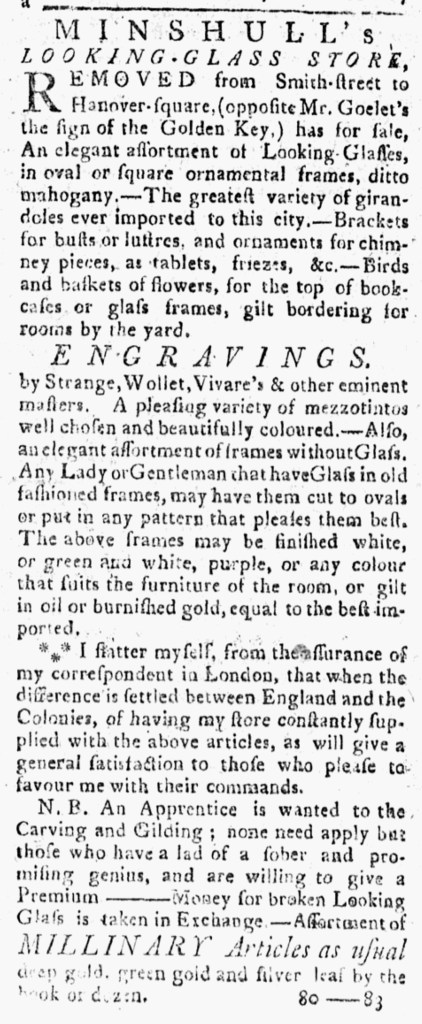
Supplement to the New-York Journal (April 6, 1775).

“Assurance … that when the difference is settled between England and the colonies, of having my store constantly supplied.”

In the spring of 1775, the proprietor of “MINSHULL’s LOOKING-GLASS STORE” ran a newspaper advertisement to announce that he had “REMOVED” from Smith Street to a new location “opposite Mr. Goelet’s [at] the sign of the Golden Key” on Hanover Square in New York.  In addition to an “elegant assortment” of looking glasses, he stocked other items for decorating homes and offices, including brackets for displaying busts, arrangements of flowers and birds “for the top of bookcases,” and the “greatest variety of girandoles” or candleholders “ever imported to the city.”  He also devoted a separate paragraph, with its own headline, to a “pleasing variety” of mezzotint “ENGRAVINGS” and the choices for frames.

John Minshull confided that he had “assurances of my correspondent in London, that when the difference is settled between England and the Colonies, of having my store constantly supplied with the above articles, as will give a general satisfaction” to his customers.  Readers realized that he referred to the imperial crisis and the effects of the Continental Association, the nonimportation agreement devised by the First Continental Congress in response to the Coercive Acts.  Minshull did not state that he imported his inventory before that pact went into effect on December 1, 1774.  Instead, he allowed readers to make that assumption, especially when he noted that he would not receive any new merchandise from England until the colonies and Parliament reached an accord.

That did not happen.  Within weeks of Minshull placing his advertisement, the Revolutionary War began with the Battles of Lexington and Concord in Massachusetts.  A little over a year later, the British occupied New York and remained in the city until 1783.  Yet Minshull persevered, continued operating his shop, and, according to an advertisement in the November 8, 1780, edition of the Royal Gazette, “imported in the Fleet from England, A large Assortment of LOOKING GLASSES, adapted to the present mode of Town and Country.”  He apparently managed to maintain his connections with his correspondents and suppliers in London.

Perhaps Minshull abided by the Continental Association in 1775 as a matter of political principle.  Perhaps he did so merely to stay in the good graces of his customers and the community.  The latter seems more likely since, according to Luke Beckerdite, “a ‘John Michalsal’ was included in a list of Loyalists” in 1775 and “a ‘John Minchull’ subsequently fled to Shelburne, Nova Scotia,” a haven for Loyalists during and immediately after the war.  From August 1782 through February 1783, ran an advertisement in the Royal Gazette for his “remaining Stock” that he sold “Cheap! Cheap! Cheap!”  It appears that Minshull had a going-out-of-business sale before evacuating from New York when the war ended.  Before that, he resumed business as usual when circumstances changed under the British occupation, weathering the storm and attempting to earn his livelihood during uncertain times.  When the “difference [was] settled between England and the Colonies,” he no longer sold looking glasses or anything else in New York.
September 25

What was advertised in a colonial American newspaper 250 years ago this week?

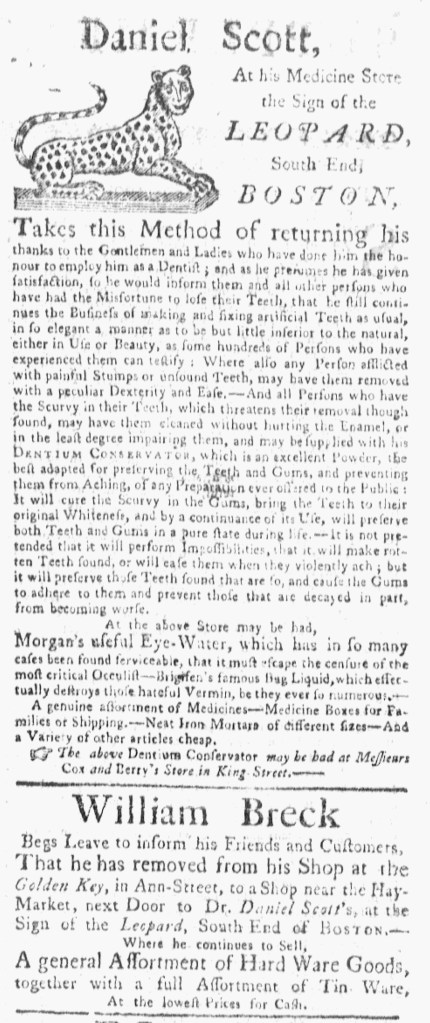
Boston Evening-Post (September 19, 1774).

“Next Door to Dr. Daniel Scott’s, at the Sign of the Leopard.”

In the fall of 1774, William Breck ran an advertisement “to inform his Friends and Customers” that he had moved to a new location.  They would no longer find him at his shop “at the Golden Key, in Ann-street” but instead at a shop “near the Hay-Market, next Door to Dr. Daniel Scott’s at the Sign of the Leopard, South-End of BOSTON.”  Even though he moved, he “continues to sell, as usual, A general Assortment of Hard-Ware GOODS … at the lowest Prices.”

Breck’s advertisement documented some of the visual culture of commerce that residents and visitors encountered as they traversed the streets of the busy port.  Both devices, the Golden Key and the Sign of the Leopard, had also circulated more widely via other media.  Breck distributed an engraved trade card that included an image of an ornate key suspended within a cartouche above a list of the merchandise he stocked “at the Golden Key near the draw-Bridge.”  Paul Revere produced the trade card in the late 1760s, yet Breck might have given out copies well into the 1770s.  (Mary Symonds, a milliner in Philadelphia, commissioned a similar trade card in 1768.  She wrote a receipted bill on the back of one of them in 1770.)  Breck’s advertisement ran on its own in the September 22 edition of the Massachusetts Gazette and Boston Weekly News-Letter, but it just happened to appear immediately below Scott’s advertisement for his “Medicine Store” at “the Sign of the LEOPARD” featuring a woodcut depicting a leopard in the September 19 edition of the Boston Evening-Post.  That image had been circulating in that newspaper for several months, making the Sign of the Leopard an attractive option when Breck decided to include a familiar landmark to help orient customers to his new location.

Breck did not mention whether the Golden Key moved with him or remained as a fixture on Ann Street, marking the location for the next tenant in his former shop.  He had previously made quite an investment in associating the image with his business.  Engraved trade cards, after all, were much more expensive than newspaper advertisements, handbills, and broadsides.  Did he surrender an aspect of the branding associated with his business for many years when he relocated?

September 29

What was advertised in a colonial American newspaper 250 years ago today?

Pennsylvania Journal (September 29, 1773).

“At the Sign of the Golden Key.”

In the fall of 1773, William Ross, a shoemaker, informed readers of the Pennsylvania Journal that he imported a “Very neat assortment of BOOT LEGS and BEN LEATHER SOALS” and “double CALLIMANCOE for ladies shoes.”  He asserted that he stocked “an assortment of the best articles in the business” for the benefit of “his friends and customers.”  The copy for Ross’s advertisement occupied less space than the image that accompanied it.  A woodcut depicting the sign that marked his location on Walnut Street included a shoe and the words “W. ROSS FROM SCOTLAND.”  The shoemaker enhanced his advertisement by investing in a woodcut associated exclusively with his business, unlike the stock images of ships at sea included in some of the other advertisements on the same page.

Pennsylvania Journal (September 29, 1773).

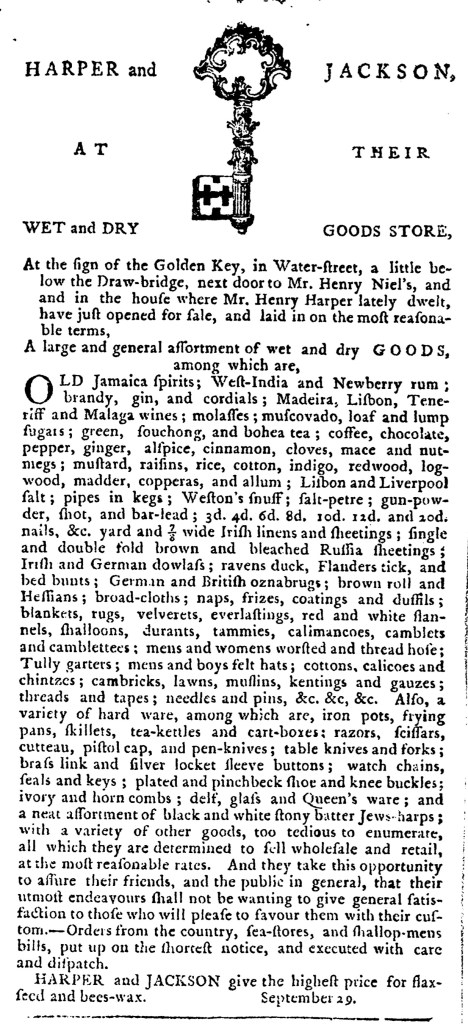
Ross was not the only entrepreneur whose advertisement featured an image of a shop sign in the September 29 edition of the Pennsylvania Journal.  Harper and Jackson adorned their notice for their “WET and DRY GOODS STORE, At the sign of the Golden Key” on Water Street with a woodcut of an ornate key.  Their names flanked the key, further associating the device with their business.  Unlike Ross, Harper and Jackson devoted most of their advertisement to copy, listing dozens of items among their inventory.  In addition, they promised “a variety of other goods, too tedious to mention,” that they sold “at the most reasonable rates.”  The merchants pledged “their utmost endeavours … to give general satisfaction to those who will please to favour them with their custom.”  As much as prospective customers may have appreciated such appeals, it was likely the image of the key that initially attracted their attention to the advertisement and made it memorable.

These two advertisements testify to some of the advertising images that colonizers encountered as they navigated the streets of Philadelphia during the era of the American Revolution.  Many merchants, shopkeepers, artisans, and tavernkeepers adopted, displayed, and promoted devices that became synonymous with their businesses, precursors to logos associated with corporations.  Relatively few included images of their shop signs in their newspaper advertisements, though greater numbers did mention the symbols that marked their locations.  Readers of the Pennsylvania Journal and other newspapers glimpsed truncated scenes of the commercial landscape of the bustling port as they perused the pages of the public prints.

March 24

GUEST CURATOR:  Elizabeth Curley

What was advertised in a colonial newspaper 250 years ago today?

Mar 24 - 3:24:1766 Boston-Gazette
Boston-Gazette (March 24, 1766).

Elizabeth Clark placed this advertisement to sell an assortment of seeds. She got her supplies “per Capt. Freeman” from London. The timing makes perfect sense, because April showers bring May, June, July, and August crops. With it being late March the planting season was right upon colonists in Boston and the rest of Massachusetts.

Anyone who frequently visits the Adverts 250 Project might notice that this advertisement seems repetitive. To be honest I had to review my work from my first week as guest curator in February. The historical impact that woman of the past have on women of the present and future interests me greatly so I try to pick advertisements that feature primarily woman if I am able. On February 17, I featured an advertisement from Lydia Dyar, who also sold garden seeds and had gotten them from Captain Freeman. In his additional commentary Prof. Keyes also pointed out an advertisement from yet another woman, Susanna Renken, who both sold seeds and bought them from Captain Freeman. All three of these woman posted similar advertisements, for mostly the same product, and bought their goods from the same man.

Two of them seem to have had shops in the same vicinity: Mill Creek. Susanna Renken states that her shop is “near the Draw Bridge” and Elizabeth Clark advertised that she was located “near the Mill Bridge,” which was located on Mill Creek. This trade card helped further convince me that these two woman shops were near each other because William Breck had a shop “at the Golden Key near the draw-Bridge Boston.”

Mar 25 - William Breck Trade Card
William Breck’s trade card (Paul Revere, engraver, ca. 1768).  This trade card is part of the American Antiquarian Society’s Paul Revere Collection.
Mar 24 - Nathaniel Abraham - 2:20:1766 Massachusetts Gazette
Massachusetts Gazette (February 20, 1766).

Nathaniel Abraham, who also regularly advertised in the Boston newspapers, listed “Sign of the Golden Key, in Ann-street” as his location too.

This map shows that Ann Street intersected Mill Creek.  The drawbridge crossed Mill Creek.  Elizabeth Clark, Susanna Renken, William Breck, and Nathaniel Abraham had shops located near each other.

Mar 24 - Detail of Map
Detail of A Plan of the Town of Boston.

**********

Mar 24 - Map of Boston.jpg
A Plan of the Town of Boston with the Intrenchments &ca. of His Majesty’s Forces in 1775, from the Observations of Lieut. Page of His Majesty’s Corps of Engineers, and from Those of Other Gentlemen (1777?).  Library of Congress.

**********

ADDITIONAL COMMENTARY:  Carl Robert Keyes

I am impressed with the way that Elizabeth mobilizes several different primary sources –newspaper advertisements, trade cards, maps – in a preliminary attempt to reconstruct neighborhoods and marketplaces in Boston in the 1760s. This is work that historians and scholars in related fields have undertaken on a grander scale.

I appreciate that Elizabeth draws attention to an aspect of eighteenth-century advertisements that has not yet received much attention here: when examined systematically the locations listed in the advertisements help us to understand not only the geography of early American towns and cities but also relationships of various sorts.

More than two decades would pass before publication of the Boston Directory, the city’s first directory that listed the occupations and residences of its inhabitants, in 1789. That and subsequent city directories from Boston and other urban centers in early America have been invaluable to historians, but such sources do not exist for earlier periods.

Elizabeth has discovered on her own – and helps to demonstrate – that newspaper advertisements provide more information than just lists of goods or attempts to convince potential customers to make purchases. They include valuable information about where people worked and where they lived, details that fill in some of the blanks for an era before city directories.