September 11

What was advertised in a revolutionary American newspaper 250 years ago today?
Newport Mercury (September 11, 1775).

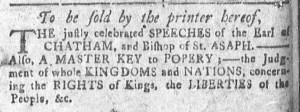
“THE justly celebrated SPEECHES of the Earl of CHATHAM, and Bishop of St. ASAPH.—Also, A MASTER KEY to POPERY.”

To fill the space at the bottom of the last column on the final page of the September 11, 1775, edition of the Newport Mercury, Solomon Southwick, the printer, inserted a short advertisement that listed several books and pamphlet that he sold at his printing office.  Most of them had been featured in longer advertisements, including “the Judgment of whole KINGDOMS and NATIONS, concerning the RIGHTS of Kings, the LIBERTIES of the People, &c.”  Southwick’s edition was one of three printed in the colonies in the past two years.  The printer also stocked the “justly celebrated SPEECHES of the Earl of CHATHAM, and Bishop of St. ASAPH.”  The bishop, a member of Parliament, opposed “altering the Charters of the Colony of Massachusetts Bay,” one of the Coercive Acts enacted by Parliament in retaliation for the Boston Tea Party.  When prevented from delivering his speech during deliberations, he instead published it.  That earned him significant acclaim in the colonies.  William Pitt, the first earl of Chatham, had been “dear to AMERICA” for a decade thanks to his opposition to the Stamp Act.  Southwick’s printing office was clearly a place for Patriots to shop for reading material.

The books on offer included “A MASTER KEY to POPERY.”  Southwick promoted that volume widely even before taking it to press, disseminating subscription proposals in newspapers throughout New England.  They promised an extensive anti-Catholic screed, an exposé of “popery” by a former priest.  Southwick either gained enough subscribers to make the project viable or felt strongly enough about the supposed dangers of Catholicism that he printed the book.  Once he had copies ready for sale, he linked religion and politics in an advertisement that condemned “the infernal machinations of the British ministry, and their vast host of tools, emissaries, &c. &c. sent hither to propagate the principles of popery and slavery, which go hand in hand, as inseparable companions.”  Such prejudices resonated as colonizers expressed dismay over the Quebec Act, yet another of their grievances against Parliament.  That legislation gave several benefits to Catholic settlers in territory gained from the French during the Seven Years War, an insult to Protestants in New England who had sacrificed so much in fighting the British Empire’s Catholic enemies.  For Southwick and many of the readers of the Newport Mercury, support for the American cause and anti-Catholicism went hand in hand during the imperial crisis and the beginning of the Revolutionary War.

March 27

What was advertised in a colonial American newspaper 250 years ago today?

Newport Mercury (March 27, 1775).

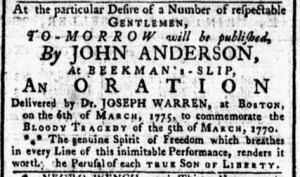
“Worth the Perusal of each TRUE SON OF LIBERTY.”

In the years after British soldiers fired into a crowd of protestors and killed several colonizers on March 5, 1770, the residents of Boston staged an annual commemoration of the “horrid MASSACRE.”  They called on a prominent patriot to give an “ORATION” about what occurred and the dangers of having British soldiers quartered in urban ports during times of peace.  Colonizers did not need to be present for the oration to experience it for themselves.  Each year, printers published and marketed the oration, commodifying an event that played an important role in the imperial crisis becoming a revolution.

New-York Gazette and Weekly Mercury (March 27, 1775).

In the first several years, printers in Boston published the oration and newspapers in Massachusetts carried advertisements for it.  In 1775, however, printers in other colonies produced their own editions of Joseph Warren’s oration commemorating the fifth anniversary of the Boston Massacre.  Benjamin Edes and John Gill, the printers of the Boston-Gazette, and Joseph Greenleaf, the publisher of the Royal American Magazine, partnered in printing and advertising a Boston edition.  Not long after, Solomon Southwick, the printer of the Newport Mercury, advertised his own edition, giving the notice a privileged place as the first item in the first column on the first page of the March 27 edition of his newspaper.  On that same day, John Anderson inserted a notice in the New-York Gazette and Weekly Mercury to alert readers of the imminent publication of a local edition undertaken “At the particular Desire of a Number of respectable GENTLEMEN.”  Patriots expressed intertest in obtaining their own copies of Warren’s oration; in turn, printers believed they could generate even greater demand.  To that end, Anderson declared, “The genuine Spirit of Freedom which breathes in every Line of this inimitable Performance, renders it worth the Perusal of each TRUE SON OF LIBERTY.”

The political climate had shifted since printers in Boston disseminated John Hancock’s oration commemorating the fourth anniversary of the Boston Massacre.  Since then, colonizers experienced how Parliament reacted to the destruction of tea during what has become known as the Boston Tea Party.  The Coercive Acts, including the Boston Port Act that closed the harbor until residents paid restitution, prompted delegates from throughout the colonies to gather in Philadelphia for the First Continental Congress in the fall of 1774.  They adopted a nonimportation agreement, the Continental Association, that remained in effect in the spring of 1775.  Given the events that transpired in 1774 and early 1775, it made sense that the anniversary of the “BLOODY TRAGEDY of the 5th of MARCH, 1770” garnered greater attention beyond Massachusetts.

July 25

What was advertised in a colonial American newspaper 250 years ago today?

Newport Mercury (July 25, 1774)

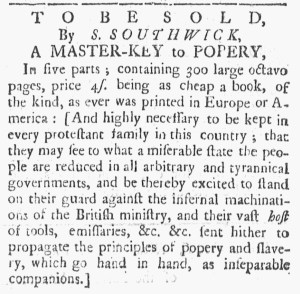
“A MASTER-KEY to POPERY … highly necessary to be kept in every protestant family.”

As the imperial crisis intensified in the summer of 1774, Solomon Southwick, printer of the Newport Mercury, peddled an American edition of A Master-Key to Popery.  For many months, Southwick circulated subscription proposals in his own newspaper and several others in New England, seeking to generate sufficient interest to make publishing the book a viable venture.  He took it to press in 1773 and distributed to subscribers the copies they had reserved.  Apparently, he produced surplus copies that he offered for sale at his printing office, perhaps anticipating opportunities to disseminate the assertions made by Antonio Gavin, formerly a “secular Priest in the Church of Rome, and since 1715, Minister of the Church of England.”  Who better than a priest who converted to Protestantism to reveal the true workings of the Catholic Church?

Southwick addressed the subscription proposal to “all Protestants of every Denomination, throughout America, and all other Friends to religious and civil LIBERTY.”  He considered an American edition necessary because “POPERY has lately been greatly encouraged, by the higher Powers in Great-Britain, in some Parts of America, and the West-Indies” and “if successful must prove fatal and destructive to every Liberty, Civil and Religious, which is dear to a rational Being.”  To guard against that, Southwick offered the book as a “more full Account of the wicked and abominable Practices of the Romish Priests, than any Piece ever printed in this Country.”  He echoed those sentiments when he advertised the book once again in the summer of 1774.  He promoted it as “highly necessary to be kept in every protestant family in this country; that they may see to what a miserable state the people are reduced in all arbitrary and tyrannical governments.”  In turn, they would “stand on their guard against the infernal machinations of the British ministry, and their vast host of tools, emissaries, &c. &c. sent hither to propagate the principles of popery and slavery, which go hand in hand, as inseparable companions.”  Puritans in New England and their descendants had long reviled Catholicism.  Within living memory, they had fought against (and defeated) Catholics in New France during the Seven Years War, often suspicious that Catholic agents had infiltrated their colonies.  In publishing and marketing A Master-Key to Popery, Southwick fanned the flames of anti-Catholic sentiment.

His new effort to sell the book occurred as Parliament passed the Coercive Acts in response to the Boston Tea Party.  When his advertisement appeared in the July 25, 1774, edition of the Newport Mercury, Boston’s harbor had already been closed and blockaded for nearly two months since the Boston Port Act went into effect and the colonies were learning of other legislation.  The text of the Massachusetts Government Act filled the first two pages of that issue.  In addition, colonial newspapers had recently published reports that Parliament considered the Quebec Act.  Colonizers anticipated that it would pass; indeed, a few weeks later they received word that the king had given royal assent to both the Quebec Act and the Quartering Act.  Among its various provisions, the Quebec Act allowed for residents to practice Catholicism freely and allowed the Catholic Church to impose tithes.  It also granted land in the Ohio Country to the province of Quebec, frustrating British colonizers who intended to settle there or earn fortunes as land speculators. Crown and Parliament seemed to favor Catholic enemies that colonizers in New England had helped to fight and defeat.

Southwick seemingly saw publishing A Master-Key to Popery as part of the information campaign that he waged against British authorities and their allies, “tools,” and “emissaries.”  Readers had their own responsibility to engage with what he published, both in the book and in his newspaper.  Among the local news in the July 25 edition of the Newport Mercury, Southwick reported that in the previous week he “received a considerable number of new subscribers” who “have stepped forth, at this time, not merely as friends to him, but as friends and supporters of the just and absolute rights of the colonies.”  For Southwick and many other colonizers, anti-Catholicism played a role in interpreting the political landscape and expressing their patriotism.

May 10

What was advertised in a colonial American newspaper 250 years ago today?

Supplement to the Newport Mercury (May 10, 1773).

“A general and good Assortment Of English and India GOODS.”

Commissioners, to receive the claims against the estate of Mary Malling, deceased.”

“TO BE SOLD … a young NEGRO fellow.”

Advertising accounted for over a third of the content in the May 10, 1773, edition of the Newport Mercury.  Paid notices filled four and a half columns of the twelve columns in the standard issue.  Yet that was not enough space for all of the advertisements submitted to Solomon Southwick’s printing office that week.  Advertising meant revenue, so Southwick opted to print and distribute a supplement that consisted solely of advertisements.

That supplement did not have the same format as the standard issue, something that distinguished it from most other newspaper supplements of the era.  Like other newspapers, the standard issue consisted of four pages created by printing two pages on each side of a broadsheet and then folding it in half.  Most supplements provided two more pages of content, one page on each side of a half sheet.  When printers had enough additional content, they produced four-page supplements on broadsheets of the same size as the standard issue.

Neither happened to be the case for the Supplement to the Newport Mercury, of May 10, 1773.  Southwick resorted to a smaller sheet, one that accommodated only two columns rather than the three columns in the standard issue.  In addition, those columns were not as long as those that ran in the standard issue.  Still, they offered enough space for Southwick to publish nineteen more advertisements, ten on one side and nine on the other.  Most promoted imported goods for sale by merchants and shopkeepers, four concerned settling the estates of deceased colonizers, and two offered enslaved people for sale.  By distributing the supplement, Southwick maintained good relationships with advertisers who expected their notices to appear in the public prints in a timely manner.  Doing so paved the way for generating more revenue through repeat business rather than alienating his current advertisers.

A supplement printed on a smaller sheet raises questions about how many similar supplements Southwick and other printers may have issued that got separated from the standard issues they accompanied and, as a result, have not been preserved by historical societies and research libraries.  How often did Southwick resort to such supplements?  The Supplement to the Newport Mercury, of May 10, 1773 suggests that even more advertising may have circulated in Newport and nearby towns, on sheets the size of handbills rather than newspapers, than extant collections of early American newspapers reveal.

January 6

What was advertised in a colonial American newspaper 250 years ago today?

Newport Mercury (January 6, 1772).

“Subscriptions are taken in by the Priner hereof, and a Number of Gentlemen in different Parts of the Country.”

In December 1771 and continuing into 1772, Solomon Southwick, printer of the Newport Mercury, ran subscription notices for “Col. Church’s HISTORY OF K. Philip’s Indian WAR, Which began in the Month of June, 1675.”  The project did not originate with Southwick; instead, he indicated “A Number of Gentlemen [were] desirous of having Reprinted” an account by Benjamin Church previously published in Boston in 1716.  Neither Southwick nor the “Number of Gentlemen” assumed the risk for publishing this new edition without first gauging broader interest in the book.

Such was the purpose of a subscription notice.  Subscribers reserved copies in advance, giving printers and publishers an idea of how many copies to print.  If they did not acquire a sufficient number of subscribers to make a project viable, they could abandon it rather than lose money on the venture.  In some cases, printers and publishers required subscribers to make payments in advance to help defray the costs of production, but in this instance Southwick specified that subscribers would pay three shilling “on Delivery of the Books.”  To entice prospective subscribers, especially booksellers and other retailers who might purchase multiple copies to sell, Southwick stated, “Those who subscribe for Six Books, to have a Seventh Gratis.”

Southwick accepted subscriptions, but he also relied on a network of associates to assist in the endeavor.  He informed readers that “a Number of Gentlemen in different Parts of the Country, to whom Subscription Papers have been sent,” also accepted orders for the book.  Those subscription papers included the proposal and conditions for subscribing as well as space for subscribers to sign their names and indicate how many copies they wanted.  Subsequent subscribers could peruse the list to see the company they kept, a factor that may have helped convince some potential subscribers that they indeed desired a copy … or at least desired seeing their names listed among those who supported the project.

Not all subscription proposals that ran in early American newspapers generated enough interest to proceed, but in this case Southwick garnered sufficient support to reprint The Entertaining History of King Philip’s WarThis edition included portraits of Benjamin Church and King Philip (Metacom, a Wampanoag leader) engraved by Paul Revere.  Southwick did not mention the images that would accompany the book as a means of promoting interest in the subscription notice.  Other subscription notices highlighted images, but perhaps Southwick had not yet made arrangements for that particular aspect of the publication.  Even without promising portraits of Church and Metacom, the subscription notices helped generate interest in the new edition.

August 5

What was advertised in a colonial American newspaper 250 years ago today?

Newport Mercury (August 5, 1771).

“Where may be gad all kinds of BLANKS commonly used in this Colony.”

Colonial printers often used the colophons on the final pages of their newspapers for more than merely providing the name of the printer and the place of publication.  Many printers treated colophons as spaces for promoting various aspects of their businesses, transforming them into ancillary advertisements.

In a relatively brief example, Solomon Southwick, printer of the Newport Mercury, informed readers that he supplied “all Kinds of BLANKS” (or printed forms for commercial and legal transactions) “commonly used in this Colony.”  Anne Catherine Green included a much more extensive colophon in Maryland Gazette.  Like many other printers, she hawked subscriptions and advertisements, but she also promoted other goods and services available at her printing office in Annapolis.  “At same Place may be had, ready Printed,” she declared, “most kinds of BLANKS, viz. COMMON and BAIL BONDS; TESTAMENTARY LETTERS of several Sorts, with their proper BONDS annexed; BILLS of EXCHANGE; [and] SHIPPING BILLS.”  In addition to blanks, “All Manner of PRINTING-WORK performed in the neatest and most expeditious Manner.”

Isaiah Thomas also used the colophon of his newspaper, the Massachusetts Spy, to solicit job printing in addition to subscriptions and advertisements.  “PRINTING, in its various Branches,” he proclaimed, “performed in a neat Manner, with the greatest Care and Dispatch, on the most reasonable Terms.”  In particular, Thomas produced “Small Hand-Bills at an Hour’s Notice.”  According to the colophon for the New-York Journal, John Holt did “all Sorts of Printing Work … in the neatest Manner, with Care and Expedition.”  Alexander Purdie and John Dixon deployed similar language in the colophon for the Virginia Gazette: “All sorts of PRINTING WORK done at this Office in the neatest Manner, with Care and Expedition.”

Not every newspaper printer transfigured the colophon into an advertisement.  The colophon for the Massachusetts Gazette and Boston News-Letter, for instance, simply stated, “BOSTON: Printed by R. Draper.”  A substantial number of printers, however, did seize the opportunity to do more than merely list their name and location at the bottom of the final page.  Their colophons became advertisements that perpetually appeared in their newspapers, promoting goods and services in a different format than other commercial notices.

March 6

What was advertised in a colonial American newspaper 250 years ago today?

Newport Mercury (March 6, 1771).

“Advertisements, not exceeding 10 or 12 Lines … will be inserted 3 Weeks for 3s9.”

Colonial printers regularly called on their customers to settle accounts.  Solomon Southwick, printer of the Newport Mercury, did so in the March 6, 1771, edition, enclosing his notice in a decorative border to draw attention.  He advised that “ALL Persons indebted to the Printer hereof, either for this Paper, Advertisements, or otherwise, are earnestly requested to make immediate Payment.”  Unlike some of his counterparts who published newspapers in other towns, he did not threaten legal action against those who ignored his notice.

Southwick did take the opportunity to invite others to become subscribers or place advertisements.  Some printers listed their subscription rates, advertising fees, or both in the colophon on the final page, but otherwise most rarely mentioned how much they charged.  Southwick’s notice listed the prices for both subscriptions and advertisements.  He specified that “Any Person may be supplied with this Paper at 6s9 Lawful Money per Year.”  That six shillings and nine pence did not include postage.  Southwick expected subscribers to pay “One Half on subscribing, and the other at the End of the Year.”  Extending credit for a portion of the subscription was standard practice among printers.

Southwick charged advertisers by the amount of space their notices occupied, not the number of words.  “Advertisement, not exceeding 10 or 12 Lines,” he declared, “will be inserted 3 Weeks for 3s9, and be continued, if required, at 1s per week.”  Once again adhering to standard practices in the printing trade, Southwick charged proportionally more for longer advertisements, contingent on their length.  If inserting an advertisement for an additional week cost one shilling, then the initial cost of running an advertisement for three weeks amounted to three shillings for the space in the newspaper and nine pence for setting type, bookkeeping, and other labor undertaken in the printing office.

Running an advertisement for only three weeks cost more than half as much as an annual subscription, demonstrating the significance of advertising revenue for early American printers.  Perhaps because that revenue helped to make publishing the Newport Mercury a viable enterprise, Southwick stated that advertisements should be “accompanied with the Pay” when delivered to his printing office.  He apparently extended credit for advertisements prior to March 1771, but then discouraged that practice in his notice that simultaneously requested that current customers submit payment and outlined the subscription and advertising fees for new customers.

August 14

What was advertised in a colonial American newspaper 250 years ago today?

Aug 14 - 8:14:1769 Newport Mercury
Newport Mercury (August 14, 1769).

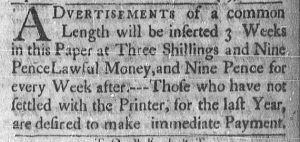
““ADvertisements of a common Length will be inserted 3 Weeks in this Paper at Three Shillings and Nine Pence Lawful Money.”

How much did advertising in colonial newspapers cost? Printers rarely published advertising rates in their newspapers. A few did include this information in the colophon that appeared at the bottom of the final page of each issue, but most did not make their rates so readily available. On occasion, some printers published their plan of publication, including advertising rates, in the first edition as part of launching a newspaper, but did not incorporate that information into subsequent issues. That made Solomon Southwick’s advertisement in the August 14, 1769, edition of the Newport Mercury all the more notable. It did not receive a place of prominence on the first page or in the colophon. Instead, it appeared among other advertisements on the final page, sandwiched between Elizabeth Mumford’s advertisement that John Remmington continued making shoes at her shop following the death of her husband and John Fryer’s notice about a house for rent. The first column of the first page consisted almost entirely of advertising; Southwick could have increased the visibility for his own advertisement about advertising rates (as well as a call for advertisers who had not yet made payment to settle accounts) by inserting it as the first item readers would encounter.

Despite his decision not to exercise his privilege as printer of the Newport Mercury, Southwick did provide important information for prospective advertisers (and for historians of print culture in early America). He informed readers that “ADvertisements of a common Length will be inserted 3 Weeks in this Paper at Three Shillings and Nine Pence Lawful Money, and Nine Pence for every Week after.” His pricing scheme corresponded to those published by other printers. He charged a flat rate for setting the type and inserting an advertisement for three weeks. Some printers ran advertisements for four weeks, but most chose three weeks as the standard for an initial run. At three shillings and nine pence, this cost advertisers nine pence for each insertion and eighteen pence for setting type. This system allowed Southwick to generate revenues based on both labor involved in preparing an advertisement for publication and the space it occupied in the newspaper. His own advertisement, which did not appear the following week, would have cost the printing office twenty-seven pence – eighteen pence for setting the type and nine pence for the space in the August 14 edition – but Southwick likely considered it a good investment if it brought in new advertisers or convinced delinquent customers to make payments on their outstanding accounts.

Although eighteenth-century printers frequently advertised books, stationery, printed blanks, and other goods they sold, they rarely advertised advertising as a service they provided. Many may not have considered it necessary since the pages of their newspapers practically overflowed with advertisements. Those that did reveal advertising rates in the public prints demonstrated a high level of consistency in their business practices, charging an initial fee for setting type and running an advertisement for a specified number of weeks and then another fee for each additional week. According to his own advertisement, Southwick adopted just such a plan.