May 1

What was advertised in a colonial American newspaper 250 years ago today?
May 1 - 5:1:1770 South-Carolina Gazette and Country Journal
South-Carolina Gazette and Country Journal (May 1, 1770).

“NEW ADVERTISEMENTS.”

As usual, the masthead for the May 1, 1770, edition of the South-Carolina Gazette and Country Journal proclaimed that it contained “the freshest Advices, both Foreign and Domestic.”  The front page featured news from Boston, including reports that a committee had been formed to gather testimonies from colonists who witnessed the Boston Massacre.  That issue also included news reprinted from newspapers published in Providence, Newport, Hartford, New York, and Philadelphia, though those items were often themselves republished from English newspapers or letters received from correspondents in faraway places like Gibraltar and Jamaica.  A couple of items of local news as well as the shipping news from the customs house rounded out the “freshest Advices.”

Yet news of the Boston Massacre was not the first item that readers encountered, even though it was on the first page.  Instead, a legal notice filled the upper half of the first two columns.  Assorted advertisements appeared below the legal notice.  News from Boston ran in the third column.  Elsewhere in that issue, news items comprised the entire second page and most of the first column on the fourth, but advertisements filled the third page and two of the three columns on the final page.  The standard issue consisted of five columns of news and seven columns of paid notices … and that was not even the end of the advertising disseminated in the South-Carolina Gazette and Country Journal on May 1.  Charles Crouch, the printer, issued a two-page supplement, another six columns, that consisted entirely of paid notices. Advertising accounted for more than two-thirds of the content delivered to subscribers in the May 1 edition and its supplement.  Like many other printers, Crouch touted the “freshest Advices” that appeared in his newspaper, but the publication was also (and on many occasions primarily) a vehicle for distributing advertising.
April 24

What was advertised in a colonial American newspaper 250 years ago today?

Apr 24 - 4:24:1770 South-Carolina Gazette and Country Journal
South-Carolina Gazette and Country Journal (April 24, 1770).

“A Printed Catalogue will be timely delivered.”

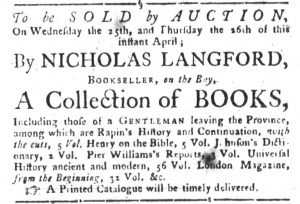
In advance of an auction of a “A Collection of BOOKS,” Nicholas Langford placed an advertisement in the April 24, 1770, edition of the South-Carolina Gazette and Country Journal.  He provided a preview of some of the items for sale, including “Johnson’s Dictionary” in two volumes and thirty-two volumes of the London Magazinefrom the Beginning.”  Langford could have inserted a more extensive account of the “Collection of “BOOKS.”  Instead, he declared that “A Printed Catalogue will be timely delivered.”  He used his newspaper advertisement to promote another form of marketing ephemera that prospective customers could consult and find useful prior to and during the auction.

Indeed, book catalogs and auction catalogs (and catalogs for book auctions) were ephemeral.  Little or no evidence exists concerning the production and distribution of many catalogs except for mentions of them in newspaper advertisements.  Some may never have existed except in those advertisements; bibliographers and historians of print culture suspect that advertisers like Langford sometimes promised catalogs that never went to press.  While some catalogs mentioned in newspaper notices may very well have turned out to be bibliographic ghosts, enough eighteenth-century catalogs have survived to demonstrate that medium did circulate in early America.

It would not have served Langford well to allude to a catalog that would not be “timely delivered” or even delivered at all.  As an entrepreneur seeking to attract as many bidders to his auction as possible, it served his interests to distribute the catalog.  In addition, it would have damaged his reputation if prospective buyers sent for a catalog and he had to confess that he had not managed to follow through on the intention that he had announced to the public in a newspaper advertisement.  Even if something prevented Langford or others from publishing some of the catalogs mentioned in newspaper advertisements, that they were referenced at all suggests that they were a form of marketing media that colonists expected to encounter.

April 17

What was advertised in a colonial American newspaper 250 years ago today?

Apr 17 - 4:17:1770 South-Carolina Gazette and Country Journal Supplement
Supplement to the South-Carolina Gazette and Country Journal (April 17, 1770).

“NEW Bourdeaux RAPPEE.”

In an effort to launch a new product Henry Margue inserted an advertisement in the supplement that accompanied the April 17, 1770, edition of the South-Carolina Gazette and Country Journal.  Margue announced that he sold rappee, a coarse snuff made from dark strong-smelling tobacco leaves, “made by the French Protestants, at New Bourdeaux.”  Since this product was as yet unfamiliar to most consumers, Margue offered assurances of its quality, asserting that the snuff “is allowed, by Connisseurs, to be very good.”  In a nota bene, he suggested that rappee from New Bordeaux could become very popular, “a considerable Manufacture,” if the French Protestants encountered “any Encouragement” in their endeavor.  Margue challenged consumers to find out for themselves if they agreed with the “Connisseurs” and be among the first to demonstrate their good taste.

Even if “NEW Bourdeaux RAPPEE” met with immediate success, it did not last long.  The new settlement, established in 1764, ceased to exist during the American Revolution.  On behalf of the Huguenot Society of South Carolina, Cheves Leland offers a brief history of New Bordeaux as well as six other towns settled by French Protestants who migrated to the colony.  New Bordeaux was the destination of the “last large group of French Protestants to arrive and settle in South Carolina.  Led by the Rev. Jean Louis Gibert and the Rev. Jacques Boutiton, some 371 French, Swiss and German immigrants sailed into Charlestown harbor” on April 12, 1764.  Leland indicates that their efforts to cultivate grapes for wine and silkworms for silk “did well until financial considerations, political intrigues in England and France and the coming American Revolution ended them,” but does not mention the Huguenots cultivating tobacco or producing snuff.  However, Owen Stanwood contends that residents of New Bordeaux “seemed more interested in tobacco” than wine, citing Margue’s advertisement in the April 5, 1770 edition of the South-Carolina Gazette.[1]  On behalf of the French Protestants, Margue promoted snuff from New Bordeaux in more than one newspaper.

Margue and the Huguenots introduced new products to consumers in South Carolina at a time when the “governor had dedicated himself to diversifying the colonial economy, something that he saw as especially important in an era of rising tensions between colonists and Parliament.”[2]  The governor placed far more emphasis on viniculture, but Margue’s advertisement for snuff suggests that some Huguenot settlers had other ideas when it came to which enterprise they wished to develop.

**********

[1] Owen Stanwood, “From the Desert to the Refuge:  The Saga of New Bordeaux,” French Historical Studies 40, no. 1 (February 2017):  26.

[2] Stanwood, “From the Desert to the Refuge,” 26.

April 10

What was advertised in a colonial American newspaper 250 years ago today?

Apr 10 - 4:10:1770 South-Carolina Gazette and Country Journal
South-Carolina Gazette and Country Journal (April 10, 1770).

“He now carries on the Peruke-Making Business in all its Branches.”

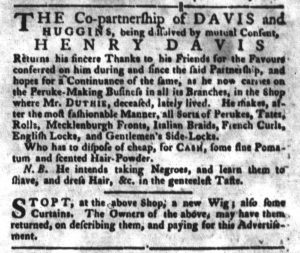
Henry Davis, a wigmaker, hairdresser and barber, did not have only a single purpose for placing an advertisement in the April 10, 1770, edition of the South-Carolina Gazette and Country Journal.  Instead, he pursued several in the course of just a few lines, all of them ultimately promoting his business in one way or another.

He opened by extending “his sincere Thanks” to former customers now that the “Co-partnership of DAVIS and HUGGINS” had been “dissolved by mutual Consent.”  He expressed appreciation for “the Favours conferred on him” and requested “a Continuance of the same” in his new endeavor.  Now that Davis opened his own shop, he hoped to maintain the client base that he had established while in partnership with Huggins.

He also hoped to expand his clientele.  To that end, he addressed former and prospective customers alike when he listed and described the various kinds of wigs he made “after the most fashionable Manner.”  He carried “all Sorts of Perukes, Tates, Rolls, Mecklenburgh Fronts, Italian Braids, French Curls, English Locks, and Gentlemen’s Side-Locks.”  Davis knew that discerning readers could differentiate among the assorted styles.  In addition to the wigs, Davis sold accessories, including “fine Pomatum and scented Hair-Powder.”

As he launched his new business, the wigmaker also intended to expand his staff in order to provide additional services to his clients.  He previewed his plan to acquire enslaved workers and teach them “to shave, and dress Hair, &c. in the genteelest Taste.”  The skill of those assistants would testify to Davis’s own expertise.  Their presence in his shop would contribute to the pampering of clients.  He envisioned that his future success depended in part on the involuntary labor of others.

Finally, Davis advised readers that he had “STOPT” a new wig as well as some curtains.  In other words, someone presented him with items to purchase but he instead confiscated them because he believed they were stolen.  He invited the rightful owner to retrieve them upon offering an accurate description and “paying for this Advertisement.”  This demonstrated his character as he commenced a new enterprise.  It also revealed that some colonists attempted to participate in the consumer revolution and keep up with the latest fashions through unsavory means.

In quick succession, Davis announced the end of his partnership with Huggins, attempted to cement relationships with former clients, provided an overview of the products and services available at his new shop, noted that he intended to acquire additional staff, and invited the victim of a theft to retrieve goods he recovered.  Each of these aspects of his advertisement served to bolster confidence in his abilities as a wigmaker and entrepreneur among prospective customers.

April 7

What was advertised in a colonial American newspaper 250 years ago today?

Apr 7 - 4:7:1770 South-Carolina Gazette and Country Journal Supplement
Supplement to the South-Carolina Gazette and Country Journal (April 7, 1770).

“RUN-AWAY … a NEGRO FELLOW, named MONDAY.”

Newspaper coverage of the Boston Massacre in the weeks after it happened resulted in greater dissemination of advertisements entreating surveillance of Black men in South Carolina.  How did the one cause the other?  Following widespread custom, colonial printers did not write original articles about the Massacre but instead reprinted items from other newspapers.  Thus, the same story about the funeral procession for the victims appeared in both the South-Carolina Gazette and the South-Carolina Gazette and Country Journal within a couple of days of each other, copied either from its original source in the Boston-Gazette or another newspaper that reprinted the story from the Boston-Gazette.  Peter Timothy ran it in the April 5, 1770, edition of the South-Carolina Gazette, exactly one month after the Boston Massacre took place.  The story first appeared in the March 12 edition of the Boston-Gazette.  It took nearly four weeks for it to appear in a newspaper printed in South Carolina.

Charles Crouch, printer of the South-Carolina Gazette and Country Journal, did not allow Timothy, his competitor, to provide the colony’s only coverage of the shocking event.  He had just published his newspaper on April 3.  Given that most colonial newspapers distributed one issue per week, the South-Carolina Gazette and Country Journal was not scheduled for another edition until April 10 … but this news was too momentous to wait that long to take it to press.  Instead, Crouch published a two-page supplement on April 7.  The entire front and much of the back of that broadsheet featured news from Boston, including a woodcut of four coffins that closely replicated the one that accompanied the original article in the Boston-Gazette.  Although other newspapers that reprinted the story included woodcuts, none were as detailed as the one in the Boston-Gazette.  That being the case, Crouch most likely drew his coverage directly from that newspaper rather than another that reprinted it.

The space required for the news from Boston left a column and a half for other content.  Crouch filled that space with advertisements, including two advertisements for enslaved men who escaped from colonists who held them in bondage.  John Marley described “a neg[r]o fellow named GEORGE” who seized his own liberty five months earlier in November.  Humphry Sommers advertised “a NEGRO FELLOW, named MONDAY,” who escaped the day before the Boston Massacre took place hundreds of miles away in Massachusetts.  Both advertisements encouraged readers to engage in careful scrutiny of Black men to determine if they might be George or Monday.  Both Marley and Sommers offered rewards to colonists who helped capture the Black men they claimed as property.  Arguably, these notices received greater attention for having appeared in a supplement devoted to the Boston Massacre than when they ran in the standard issue of the South-Carolina Gazette and Country Journal.  Had it not been for Crouch issuing that supplement, these advertisements encouraging the surveillance of Black men would not have circulated as widely.

Apr 7 - Boston Massacre in South-Carolina Gazette and Country Journal Supplement
Supplement to the South-Carolina Gazette and Country Journal (April 7, 1770).

March 27

What was advertised in a colonial American newspaper 250 years ago today?

Mar 27 - 3:27:1770 South-Carolina Gazette and Country Journal
South-Carolina Gazette and Country Journal (March 27, 1770).

“I shall leave a List of the Subscribers Names, together with their Benefactions.”

In late March 1770 Stephen Hopkins, John Brown, and John Jenckes continued their efforts to raise funds and acquire materials to erect a building for Rhode Island College (now Brown University) in Providence.  On behalf of the “Committee for providing Materials and overseeing the Work,” they placed a notice in the Providence Gazette that thanked the “many Gentlemen [who] have been so generous to this very useful Institution, as to become Benefactors to it” while simultaneously calling on both current supporters and “those whose beneficient Minds may incline them to become such” to send updates about their intended donations.

Yet advocates for the college did not confine their fundraising efforts to the Providence Gazette alone.  Hezekian Smith inserted a similar notice in the March 27, 1770 edition of the South-Carolina Gazette and Country Journal.  He visited the colony to promote the college and the building it needed once its sponsors made a determination to move its location from Warren, Rhode Island, to Providence.  Smith extended his “humble and hearty Thanks to the Benefactors of RHODE-ISLAND COLLEGE, whom he has met since his first Arrival in this Province.”  He also announced that he planned to depart soon, prompting him to encourage “those Gentlemen who were so Kind as to promise to send their Benefactions for the College to him” to do so.

In a nota bene, Smith declared that he would leave behind a “List of the Subscribers Names, together with their Benefactions” that each supporter could consult in order to confirm “that his Donation goes towards making up the Sum I have collected since my Arrival here.”  Smith likely had an additional motive for drawing up such a list for “Subscribers” to consult.  As they perused the list to find their own names and “Benefactions” they would also see who else had donated and how much.  They could congratulate themselves on their civic responsibility and the company they kept, but also compare their donations to those made by others.  Benefactors could judge for themselves whether they appeared generous or miserly in comparison to others on the list.  Did an unexpectedly large donation enhance their status or an unaccountably small donation diminish it?

Today, colleges and nonprofit organizations regularly publish lists of benefactors, often classifying them according to how much they donated and organizing the lists to give preeminence to the most generous.  This is both an expression of appreciation and a challenge to current and prospective donors to secure their positions on subsequent lists of benefactors.  In his efforts to raise funds for Rhode Island College, Hezekiah Smith similarly extended an acknowledgment and a challenge to benefactors in South Carolina.  In promising to leave behind a list of donors and the sums they donated, he encouraged benefactors to increase their pledges.

March 20

What was advertised in a colonial American newspaper 250 years ago today?

Mar 20 - 3:20:1770 South-Carolina Gazette and Country Journal
South-Carolina Gazette and Country Journal (March 20, 1770).

“A faithful Account of the Proceedings of the Subscribers and Non-Subscribers.”

The commodification of the American Revolution began several years before the skirmishes at Lexington and Concord.  As the imperial crisis unfolded, printers marketed a variety of books, pamphlets, and engravings that commemorated current events while simultaneously informing consumers of the rift between the colonies and Britain.

Consider, for instance, an advertisement that appeared in the March 20, 1770, edition of the South-Carolina Gazette and Country Journal.  It announced a “Compilation” of documents related to the colony’s nonimportation agreement was “In the PRESS, and speedily will be published.”  That compilation contained “ALL the LETTERS which have been written FOR and AGAINST the RESOLUTIONS” along with “Copies of the different Resolutions proposed to be signed.”  It also included various lists, including “the Names of the Gentlemen who compose the Committee” that enforced the agreement and “a List of the Non-Subscribers” so readers would know which members of the community worked against the interests of the colony.  To that end, the collection featured “Remarks on the Conduct and Writings” of the “Non-Subscribers.”  The compiler of these documents wished to educate readers about the debates over the boycott, inserting “a Translation of the Latin Verses, Phrases, &c. made Use of in the said Letters.”  Not everyone possessed a classical education, but all colonists could participate in the debates and make decisions about their own conduct.  Nonimportation was not restricted to highbrow households.  In addition to all that, the compilation included “several other interesting Particulars relative to the above Resolutions.”  Through a series of documents and commentaries, it provided a history of recent events, a “faithful Account of the Proceedings of the Subscribers and Non-Subscribers.”

Purchasing this compilation gave colonists another means of participating in protests against the duties on imported goods imposed by Parliament in the Townshend Acts.  Doing so enhanced feelings of connection to others who supported nonimportation agreements in South Carolina and, more generally, throughout the colonies.  Colonists envisioned a time when importation would resume after Parliament relented and repealed the unpopular duties.  When that happened, the compilation would become a memento that reminded those who purchased it of the events they had witnessed, the history they had played a part in shaping.  Owning a copy gave colonists yet another way to express their support for the American cause.

March 18

What was advertised in a colonial American newspaper 250 years ago this week?

Mar 18 - 3:15:1770 South-Carolina Gazette and Country Journal Supplement
Supplement to the South-Carolina Gazette and Country Journal (March 15, 1770).

“His past Offences will be forgiven.”

Charles Crouch, the printer of the South-Carolina Gazette and Country Journal, generated significant revenue from publishing advertisements for “runaways.”  Most of those runaways were actually enslaved men and women who escaped from those who attempted to hold them in bondage.  These included “a negro fellow named LONDON, this country born” and “a negro man named ISAAC” who spoke “tolerable good English” even though he came from “the Guinea country” and survived the Middle Passage.  Both men were subjects of advertisement that ran in the supplement published on March 15, 1770.

Apprentices, indentured servants, convict servants, and even recalcitrant wives were sometimes the subjects of other runaway notices, though not nearly in the same numbers as enslaved people in the South-Carolina Gazette and Country Journal and other newspapers published in Charleston.  In newspapers published in Boston, New York, and Philadelphia, however, the number of runaway notices for apprentices and servants rivaled or often exceeded the advertisements for enslaved men and women who escaped.  Still, notices calling on colonists to help identify and return enslaved people to those who purported to be their masters appeared in every newspaper from Georgia to New England.

Crouch not only published advertisements concerning a variety of runaways but on occasion found himself in the position of placing them.  In the same supplement that carried notices about London and Isaac, Crouch ran a notice directed to his own apprentice, William Way, who “hath absented himself from my Service, for two Months past.”  Addressing Way or anyone who would pass along the message, Crouch pledged that if the wayward apprentice “will return of his own Accord, and behave himself well in future, his past Offences will be forgiven.”  Enslavers occasionally, though rarely, made similar proposals when they attempted to recover people they treated as property.

Crouch’s advertisement told a truncated story about his disobedient apprentice.  It told Crouch’s side of the story.  In the advertisement, Crouch blamed Way for “absent[ing] himself” and accused him of “past Offences” that the printer would generously forgive, but he did not comment on anything that he might have done to exacerbate the situation.  It did not indicate if the master had mistreated or abused the apprentice.  Every runaway notice told only a partial story, one constructed by someone who possessed significantly more power and authority than the subject of the advertisement. Such notices aimed to reassert order in the face of apprentices, servants, and enslaved people exercising agency and seizing power away from those who usually wielded it.  These skirmishes played out in advertisements that appeared in the public prints throughout the colonies.

March 13

What was advertised in a colonial American newspaper 250 years ago today?

Mar 13 - 3:13:1770 South-Carolina Gazette and Country Journal
South-Carolina Gazette and Country Journal (March 13, 1770).

“A CHINA MANUFACTURE.”

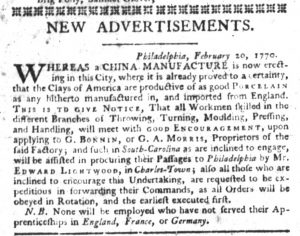
In January 1770 an advertisement for “New China Ware ran in the Pennsylvania Chronicle.  In it, the “CHINA PROPRIETORS in PHILADELPHIA” advised both retailers and consumers that they had set up production of porcelain “as good … as any heretofore manufactured at the famous factory in Bow, near London, and imported into the colonies.”  This enterprise aimed to provide colonists with alternatives to imported merchandise; both imported goods and “domestic manufactures” assumed new political significance when merchants and shopkeepers adopted nonimportation agreements to protest the duties levied on imported paper, glass, paint, lead, and tea in the Townshend Acts.

Two months later an advertisement about the “CHINA MANUFACTURE … now erecting” in Philadelphia appeared in the South-Carolina Gazette and Country Journal.  The proprietors, G. Bonnin and G.A. Morris, had two purposes in placing that notice:  recruiting workers and marketing their wares.  They reiterated the claims they made in the Pennsylvania Chronicle, proclaiming that “the Clays of America are productive of as good PORCELAIN as any hitherto manufactured in, and imported from England.”  Given those resources available to them, the proprietors also needed “Workmen skilled in the different branches of Throwing, Turning, Moulding, Pressing, and Handling.”  In a nota bene at the conclusion of the advertisement they proclaimed that “None will be employed who have not served their Apprenticeships in England, France, or Germany.”  Bonnin and Morris eschewed imported goods, but they still wished to draw on skills that had been learned on the other side of the Atlantic.  The quality of the “Clays of America” alone did not yield finished goods that competed with those produced in England.  To assist in acquiring the skilled workers they needed, the proprietors designated a local agent in Charleston.  They instructed “such in South-Carolina as are inclined to engage” that they would be “assisted in procuring their Passages to Philadelphia by Mr. EDWARD LIGHTFOOT.”

In addition to seeking workers, Bonnin and Morris made an appeal to prospective customers, “those who are inclined to encourage this Undertaking.”  They did not explicitly state that consumers had a duty to purchase goods produced in the colonies, but given the news and commentary that appeared elsewhere in the newspaper the proprietors likely depended on readers making such connections between consumption and politics.  Bonnin and Morris both invoked a sense of urgency and suggested existing demand for their wares, requesting customers “to be expeditious in forwarding their Commands” while also clarifying that “all Orders will be obeyed in Rotation” with “the earliest executed first.”  In so doing, they again repeated marketing strategies incorporated into their earlier advertisement in the Pennsylvania Chronicle.

Bonnin and Morris’s efforts to produce “domestic manufactures” and promote them to consumers were not merely local or even regional endeavors.  They looked far beyond Philadelphia and the Middle Colonies when recruiting workers and customers, further strengthening networks of both print and consumption that increasingly contributed to a sense of an imagined community that stretched from New England to Georgia.

March 6

What was advertised in a colonial American newspaper 250 years ago today?

Mar 6 - 3:6:1770 South-Carolina Gazette and Country Journal
South-Carolina Gazette and Country Journal (March 6, 1770)

“The best French gloves and mits, free from spots, at 12s6. per pair.”

Like many other shopkeepers in Charleston and throughout the colonies, William Stukes stocked “a neat assortment of millenary GOODS, with many other articles.”  To demonstrate the point, he cataloged much of his inventory in a newspaper advertisement.  He carried “PLAIN and flowered sattins,” “stript thread gauze,” “scented and plain hair powder,” and “different coloured silk gloves and mitts,” along with an array of other items.  In addition, he advised prospective customers of “All sorts of millinary ware made in the newest fashion by Mrs. Stukes.”  His partner received second billing even though she provided an important service that undoubtedly supported his enterprise and supplemented the household income.

Stukes sought to incite demand for his wares by emphasizing both consumer choice and fashion.  In addition, he made appeals to price, proclaiming that he would sell these goods “extraordinary cheap.”  When eighteenth-century advertisers made such claims, they usually did not elaborate.  Stukes, however, listed his prices for several items:

  • “black sattin hats at 30s.”
  • “the newest fashion broad ribbons at 5s. per yard”
  • “the best French gloves and mits, free from spots, at 12s6. per pair”
  • “Hose’s callimanco shoes at 31s. per pair”
  • “fine bohea tea at 20s. per pound”
  • “black pepper at 15s. per pound”
  • “table knives and forks at 20s. per set”
  • “best Oronoko tobacco at 12s6 per pound”

Prospective customers did not have to take Stukes at his word that he offered low prices, only to be disappointed when they visited his shop.  Unlike most other advertisers, he published prices for several items.  That allowed consumers to assess for themselves whether Stukes actually offered bargains.  It also facilitated comparison shopping.  Prospective customers might examine the merchandise in other shops, Stukes may have reasoned, and then decide to give their business to him upon learning that his competitors did not match his prices.

Today, consumers are accustomed to prices being advertised with products.  Indeed, naming a price is a common marketing strategy, an effort to entice customers with bargains.  Most eighteenth-century advertisers did not deploy that method for attracting customers, though a few, like Stukes, did experiment with attaching prices to some of their goods when they promoted their businesses in the public prints.