February 27

What was advertised in a colonial American newspaper 250 years ago today?
Feb 27 - 2:27:1770 South-Carolina Gazette and Country Journal
South-Carolina Gazette and Country Journal (February 27, 1770).

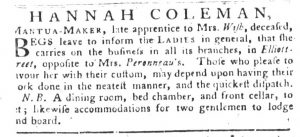
“HANNAH COLEMAN, … late apprentice to Mrs. Wish.”

Hannah Coleman made mantuas.  These loose gowns worn by women first came into popularity in the late seventeenth century.  In February 1770, Coleman placed an advertisement in the South-Carolina Gazette and Country Journal to “inform the LADIES in general” that she carried on the business of a “MANTUA-MAKER … in all its branches.”  She used a phrase commonly deployed by artisans to indicate that there was no part of her trade beyond her abilities.  Accordingly, she pledged that customers would have their garments made “in the neatest manner.”  To bolster that claim, Coleman relied on another strategy that often appeared in advertisements placed by artisans, though one usually invoked by men rather than women.  She listed her credentials when she named her occupation.  Rather than “HANNAH COLEMAN, MANTUA-MAKER,” she was “HANNAH COLEMAN, MANTUA-MAKER, late apprentice to Mrs. Wish, deceased.”  She assumed that prospective clients would be familiar with the reputation of the departed Mrs. Wish or at least feel reassured that Coleman had completed an apprenticeship.

Although Coleman adopted a strategy usually reserved for men, her efforts to market mantuas fashioned a world in which women participated in commercial transactions without reference to men.  She addressed “the LADIES in general.”  She established her connection to her mentor, Mrs. Wish.  She even listed her location in relation to another woman, stating that she did business “in Elliott-Street, opposite to Mrs. Peronneau’s” rather than naming male neighbors or using other landmarks.  In a nota bene, Coleman did note that she sought “two gentlemen to lodge and board,” but the portion of the advertisement about her activities as a mantua maker depicted a world of women who created their own networks, taught each other, and traded with each other.  Women in business tended to publish newspaper advertisements less often than their male counterparts in eighteenth-century America, perhaps because they relied on gendered networks as an alternate means of attracting customers.  They participated in the marketplace, but chose means of promoting their enterprises that yielded less visibility among the general public even while generating familiarity among female consumers.

February 20

What was advertised in a colonial American newspaper 250 years ago today?

Feb 20 - 2:20:1770 South-Carolina Gazette and Country Journal
South-Carolina Gazette and Country Journal (February 20, 1770).

“The said Wines are still in the Possession of Captain Livingston.”

The “NEW ANNOUNCEMENTS” in the February 20, 1770, edition of the South-Carolina Gazette and Country Journalcommenced with a notice placed by the “GENERAL COMMITTEE” responsible for overseeing adherence to the nonimportation agreement adopted in protest of duties that Parliament levied on certain imported goods via the Townshend Acts.  The committee noted that Patrick Muir had imported some goods from Scotland and “refused to store or re-ship” them.  The bulk of the advertisement, however, concerned a “Parcel of Wines” from Tenerife on the Hope, captained by Alexander Livingston.

That was a much more convoluted story.  The committee became aware of an “industriously spread” rumor that John Tuke ordered the wine at the behest of Wilson, Coram, Wayne, and Company despite the fact that those merchants were “Subscribers to the Resolutions” who had pledged to support the nonimportation agreement.  In response, Tuke made a statement in which he declared “the above Report is absolutely false, having never made use of those Gentlemen’s Names.”  He did acknowledge, however, that “the Wines were bought on my own Account” even though he was also “a Subscriber to the General Resolutions.”  Tuke assumed responsibility and expressed his “utmost Concern” that the wine had been shipped to Charleston.  A nota bene inserted by the committee reported that the wine was “still in the Possession of Captain Livingston.”  Tuke had not taken possession of it or attempted to sell it.

Did Tuke profess “utmost Concern” because a misunderstanding resulted in the wine being delivered by mistake or because he had been caught and now realized the error of his ways?  His statement did not make that clear, but it did attempt to unequivocally clear Wilson, Coram, Wayne, and Company.  As Tuke worked to ameliorate any damage done to his own standing in the community, he also sought to restore the reputations of prominent merchants who had been pulled into the controversy.  It was bad enough to find his dealings under so much scrutiny; he did not need to alienate himself from Wilson, Coram, Wayne, and Company by continuing to call unwarranted attention to them.  Instead, he did what he could to exonerate those merchants and shift the focus solely to himself.

Relatively little local news appeared in colonial newspapers, in part because most were published once a week so anything of consequence spread via word of mouth before it could appear in print.  In some instances, however, advertisements carried news and supplemented coverage that ran elsewhere in the newspaper.

January 30

What was advertised in a colonial American newspaper 250 years ago today?

Jan 30 - 1:30:1770 South-Carolina Gazette and Country Journal
South-Carolina Gazette and Country Journal (January 30, 1770).

“Valuable PLANTATION … THIRTY VALUABLE NEGROES.”

John Rose and Alexander Rose, administrators of the estate “of the deceased Dr. WILLIAM ROSE,” turned to the newspapers published in Charleston, South Carolina, to announce the sale of the late doctor’s “valuable PLANTATION” as well as “About THIRTY VALUABLE NEGROES,” livestock, furniture, and tools. The Roses included visual images in their advertisements to help draw the attention of prospective buyers. Indeed, they included two woodcuts, one depicting a house and another an enslaved man, in their advertisement in the January 30, 1770, edition of the South-Carolina Gazette and Country Journal. If they included a visual image at all, most advertisements featured only one, even in similar advertisements that offered both real estate and enslaved men, women, and children for sale.

The inclusion of two woodcuts seems not to have been a choice made by the compositor working independently at the South-Carolina Gazette and Country Journal. The following day an advertisement with identical copy ran in the South-Carolina and American General Gazette. It also included two woodcuts, one of a house and fields and another of several enslaved people. It was not a coincidence that the two advertisements each had more than one visual image. A notice with the same copy also ran in the February 1, 1770, edition of the South-Carolina Gazette. It also had two woodcuts, one depicting a house and the other several enslaved people, both adults and children. The typography (fonts, fonts size, capitalization, italics) varied among the advertisements, but the copy was consistent, as was the inclusion of two visual images that set these advertisements apart from others. It seems clear that the Roses instructed each printing office that their notice must include both. Although the compositors made most of the decisions about the format of these advertisements, the Roses did exert some influence over the graphic design. They were certainly not the first or only advertisers to adopt this strategy for drawing attention to their notices, but they did experiment with an uncommon approach to visual images when they submitted the copy and specified that their advertisements must include two woodcuts rather than one or none.

January 23

What was advertised in a colonial American newspaper 250 years ago today?

Jan 23 - 1:23:1770 South-Carolina Gazette and Country Journal
South-Carolina Gazette and Country Journal (January 23, 1770).

“SUBSCRIPTIONS are taken in by the Printer of this Paper.”

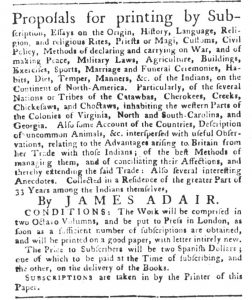
The many and various advertisements for consumer goods and services in the January 23, 1770, edition of the South-Carolina Gazette and Country Journal included a subscription notice for “Essays on … the Indians, on the Continent of North-America” by James Adair, who had resided “the greater Part of 33 Years among the Indians themselves.” Those essays focused “Particularly” on the Catawbas, Cherokees, Creeks, Chickasaws, and Choctaws “inhabiting the western Parts of the Colonies of Virginia, North and South-Carolina, and Georgia.” Given their proximity, the author or publisher expected that the proposed book would resonate with prospective subscribers in South Carolina … and in Georgia. The same subscription notice ran on several occasions in the Georgia Gazette in late 1769 and early 1770.

Charles Crouch, printer of the South-Carolina Gazette and Country Journal, and James Johnston, printer of the Georgia Gazette, acted as local agents on behalf of the author or publisher. The book would not go to press until enough “subscribers” expressed interest and confirmed their intention to buy it by putting down a deposit in advance. By enlisting local agents and seeking subscribers in South Carolina, Georgia, and likely other places as well, the author or publisher aimed to enlarge the market and make the proposed book a viable endeavor.

The advertisements in the two newspapers contained exactly the same copy (except for the final word, “Paper” instead of “Gazette”). The author or publisher may have written out the advertisement once and then carefully copied it into letters directed to multiple printing offices. Alternately, the subscription notice may have appeared once in one newspaper and then the author or publisher forwarded clippings along with requests to insert the notice in other newspapers when soliciting the cooperation of additional local agents. Depending on the sophistication of the marketing efforts, the author or publisher may even have distributed broadside subscription notices with space for subscribers to sign their names. The copy for newspaper advertisements could have been drawn directly from such broadsides.

Regardless of how the South-Carolina Gazette and Country Journal and the Georgia Gazette ended up publishing advertisements with identical copy, readers in the two colonies encountered the same subscription notice within a single week. This contributed to the creation of an imagined community among colonists, a common identity as readers and consumers, as the press presented the same news items, reprinted from one newspaper to another to yet another, and, sometimes, the same advertisements as well.

January 2

What was advertised in a colonial American newspaper 250 years ago today?

Jan 2 1770 - 1:2:1770 South-Carolina Gazette and Country Journal
South-Carolina Gazette and Country Journal (January 2, 1770).

“NEW ADVERTISEMENTS.”

It has been more than a year since any “NEW ADVERTISEMENTS” from Charles Crouch’s South-Carolina Gazette and Country Journal have been featured on the Adverts 250 Project. Why? The project relies on eighteenth-century newspapers that have been digitized and made available via Accessible Archives’s collection of South Carolina Newspapers, Colonial Williamsburg’s Digital Library, and Readex’s America’s Historical Newspapers. These sources provide extensive access to newspapers published in the colonies in the late 1760s and early 1770s, but they are not comprehensive and complete.

Consider the newspapers printed in Charleston, South Carolina, on the eve of the American Revolution. For nearly a decade before the outbreak of military hostilities, three newspapers circulated in that busy urban port. In addition to Crouch’s South-Carolina Gazette and Country Journal, Peter Timothy published the South-Carolina Gazette and Robert Wells published the South-Carolina and American General Gazette.

Today, all three are available, to varying degrees, via Accessible Archives. That database includes transcriptions of those newspapers as well as digitized images of most issues. However, it does not include such images of issues of the South-Carolina Gazette and Country Journal published in 1769. The transcriptions for that year are certainly valuable, giving scholars and others greater access to the past, but that form of remediation and the methods for navigating that kind of database do not lend themselves well to the Adverts 250 Project. As a result, the South-Carolina Gazette and Country Journal temporarily dropped from both the Adverts 250 Project and, even more significantly, the Slavery Adverts 250 Project. The projects both had good coverage, but not complete coverage, of South Carolina, incorporating two of the three newspapers published in the colony in 1769.

In 2020, the South-Carolina Gazette and Country Journal returns to those projects. The Slavery Adverts 250 Project identifies fourteen advertisements concerning enslaved men, women, and children published in the January 2, 1770, edition of the South-Carolina Gazette and Country Journal. The Adverts 250 Project will examine advertisements for consumer goods and services as well as other kinds of paid notices in the coming months. For the past year, the project has relied on the Essex Gazette, the only newspaper published on Tuesdays in 1769 (with dates that correspond to Thursdays in 2019) available via these databases. As a result, that newspaper has been disproportionately featured in the project.

Having access once again to digitized images of the South-Carolina Gazette and Country Journal will shift the scope of the Adverts 250 Project and the Slavery Adverts 250 Project. This will clearly benefit the Slavery Adverts 250 Project by generating a more complete archive that demonstrates the ubiquity of advertisements concerning enslaved men, women, and children in early America. This also has the potential to benefit the Adverts 250 Project by reducing coverage of the Essex Gazette. On the other hand, having no choice but to feature advertisements from that newspaper guaranteed that a less prominent publication from a smaller town regularly found its ways into the Adverts 250 Project. That is a goal that must continue to be observed, even while featuring the Essex Gazette less often thanks to restored access to the South-Carolina Gazette and Country Journal.

February 21

What was advertised in a colonial American newspaper 250 years ago today?

Essex Gazette (February 21, 1769).

“ADVERTISEMENTS, &c. are received for this Paper.”

Regular visitors to the Adverts 250 Project and the Slavery Adverts 250 Project may have noticed that the content presented on Thursdays changed significantly in January of this year. Thursdays previously featured an advertisement from the South-Carolina Gazette and Country Journal on the Adverts 250 Project and a dozen or more advertisements concerning enslaved men, women, and children on the Slavery Adverts 250 Project. For the last eight weeks, however, the advertisements examined on Thursdays have been drawn from the Essex Gazette. During that time, no advertisements about enslaved people published in the South-Carolina Gazette and Country Journal have been added to the Slavery Adverts 250 Project. Why? Digital images of issues of that newspaper from 1769 are not readily available. Accessible Archives, the source of all three newspapers from South Carolina that have been included in these projects, includes transcriptions of the South-Carolina Gazette and Country Journal for 1769, but not images of the pages of that newspaper. Such images recommence with issues published in 1770.

What effect has this had on the Adverts 250 Project and the Slavery Adverts 250 Project? It has certainly shifted the content of both. With the South-Carolina Gazette and Country Journal no longer available for inclusion on Thursdays, only one English-language newspaper for that day remains. The Essex Gazette had been in circulation for less than six months at the beginning of 1769. It had not yet cultivated a substantial clientele of advertisers, whereas the South-Carolina Gazette and Country Journal regularly featured dozens of advertisements in each issue and sometimes issued supplements for notices that overflowed from the standard issue. In addition to having far fewer advertisements to choose among for the Adverts 250 Project, this has resulted in the Essex Gazette being overrepresented in the project. It is certainly not the only one. On Mondays, the Providence Gazette is the only option. The same goes for the Georgia Gazette on Fridays. In contrast, half a dozen or more newspapers come under consideration when selecting advertisements for both Wednesdays and Saturdays, including some of the most significant newspapers with the greatest number of advertisements. As a result, newspapers from the largest urban centers – Boston, Charleston, New York, and Philadelphia – are underrepresented. This has been part of the project from the beginning due to the methodology that calls for examining an advertisement published 250 years ago to the day whenever possible. With the South-Carolina Gazette and Country Journal having been the only option on Thursdays for some time and the most significant option after the Essex Gazette commenced publication, Charleston had avoided that underrepresentation. Now, advertisements from Charleston compete with those from other major urban ports as those from Providence, Salem, and Savannah find their way into the project every week.

The Slavery Adverts 250 Project has been affected as well. The South-Carolina Gazette and Country Journal regularly published a dozen or more advertisements concerning enslaved men, women, and children in each issue. Those advertisements were among the many that overflowed into supplements. Since digital images are not available for issues from 1769, the total number of advertisements incorporated into the project each week has declined. The Slavery Adverts 250 Project aims to demonstrate the ubiquity of such advertisements in colonial newspapers, arguing that they testify to the constant presence of slavery in everyday life throughout the colonies. The absence of advertisements from the South-Carolina Gazette and Country Journal makes that argument less effective and less powerful. With the exception of an occasional advertisement from the Essex Gazette, the Slavery Adverts 250 Project now goes silent on Thursdays, giving the mistaken impression that advertisements concerning enslaved men, women, and children were not published in colonial America on that day. This is more significant than the overrepresentation and underrepresentation of certain newspapers in the Adverts 250 Project. The availability of digitized primary sources have made the Adverts 250 Project and the Slavery Adverts 250 Project possible, but both researchers and readers must remain aware that these projects draw on original sources made unevenly available. Even as the Slavery Adverts 250 Project strives to tell a more complete story about the lives of enslaved people in the era of the American Revolution as well as illustrate the connections between the press and perpetuation of slavery as an institution, the project also unintentionally obscures part of that story. Digitization has made the past much more readily accessible to scholars and general audiences alike, but it is a partial past shaped by which sources have been included and excluded in the digitization efforts that have been completed to this point.

December 27

What was advertised in a colonial American newspaper 250 years ago today?

South-Carolina Gazette and Country Journal (December 27, 1768).

“Certificates of which, she can produce from the Gentleman whose Lectures she attended.”

When Mrs. Grant arrived in South Carolina in late 1768, she placed an advertisement in the South-Carolina Gazette and Country Journal to inform colonists in her new home that “she proposed to practise MIDWIFERY.” In introducing herself to the public, she deployed many of the same strategies as her male counterparts, though she also expanded on some of them.

As a newcomer, Grant did not benefit from having a reputation gained from building a clientele over the years. Instead, she needed to offer assurances that she was indeed capable of providing the services she claimed. To that end, she first emphasized her credentials, formal training, and experience. She was qualified to practice midwifery, “having studied that Art regularly, and practised it afterwards with success at EDINBURGH.” When men who provided medical services moved to a new town or city in the colonies and placed advertisements, they usually provided a similar overview. Grant, however, did not expect her prospective clients to trust the word of a stranger when it came to such an important service. In addition to noting her training and experience, she stated that she could produce “Certificates … from the Gentleman whose Lectures she attended, and likewise from the Professors of Anatomy and Practice of Physic” in Edinburgh. Male practitioners rarely offered documentation to confirm their narratives. In an era during which medicine increasingly became professionalized (and, as part of that process, masculine), Grant may have believed that she need to do more in order to level the playing field when competing with male counterparts for clients.

To help establish her reputation, Grant also indicated in a nota bene that she would “assist the Poor, gratis.” Doing so allowed her to demonstrate her skills while simultaneously testifying to her good character and commitment to her new community. She was not alone in offering free services to the poor as a means of introducing herself. Men sometimes did so as well. Still, Grant may have considered it especially imperative as a way of breaking into the market upon arriving as a stranger in Charleston.

December 13

What was advertised in a colonial American newspaper 250 years ago today?

South-Carolina Gazette and Country Journal (December 13, 1768).

“Be early in sending their Advertisements for Insertion, and not to exceed Monday Noon.”

Just as Mein and Fleeming marked the first anniversary of publishing the Boston Chronicle by placing a notice in their own newspaper, a day later Charles Crouch celebrated three years of publishing the South-Carolina Gazette and Country Journal with his own advertisement. Like his counterparts in Boston, Crouch addressed advertisers as well as subscribers, encouraging them to place notices in his publication. In the process, he provided details about the mechanism for publishing advertisements that did not often appear in the pages of eighteenth-century newspapers.

To entice advertisers, Crouch first underscored the popularity of the South-Carolina Gazette and Country, a necessary step considering that it competed with Peter Timothy’s South-Carolina Gazette and Robert Wells’s South-Carolina and American General Gazette. Crouch did not mention either by name, but when he addressed “the Friends to this Gazette” he did note that their “Number are as great as any other in the Place.” In other words, his newspaper had as many subscribers and advertisers as the others. Advertisers could not go wrong by placing notices in his South-Carolina Gazette and Country Journal “as the Circulation of his Papers are very numerous.”

Crouch distributed the South-Carolina Gazette and Country Journal on Tuesdays. To keep to that schedule, he requested that advertisers “be early in sending their Advertisements for Insertion, and not to exceed Monday Noon.” Despite the time required to set type and print the newspaper on a hand-operated press, advertisers could submit their notices as late as a day prior to publication, though Crouch probably limited the number of last-minute submissions out of practicality. He aimed to keep to his schedule for the benefit of his readers, but also to adhere to what seems to have been an informal agreement among Charleston’s printers to stagger publication throughout the week. Until recently, the South-Carolina Gazette appeared on Mondays, the South-Carolina Gazette and Country Journal on Tuesdays, and the South-Carolina and American General Gazette on Thursday. Crouch asserted that he was “fully determined to CONTINUE always punctual to his Day,” perhaps rebuking other printers in the city for recently deviating from the usual schedule and potentially infringing on his circulation and sales as a result.

Crouch did not offer much commentary on the other contents of his newspaper, other than noting that “Letters of Intelligence, Speculative Pieces, &c. are kindly received” and considered for publication. In promoting the South-Carolina Gazette and Country Journal as it “begins the fourth Year of its Publication,” he called on subscribers to pay their bills and assured prospective advertisers that he could place their notices before the eyes of numerous readers. He asserted that his circulation was as large as that of any other newspaper printed in South Carolina, making it the ideal venue for advertising.

December 6

What was advertised in a colonial American newspaper 250 years ago today?

Dec 6 - 12:6:1768 South-Carolina Gazette and Country Journal
South-Carolina Gazette and Country Journal (December 6, 1768).

“A List of the Person’s Names may be seen affixed to the Directions.”

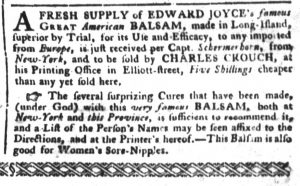
According to their advertisements, eighteenth-century printers and booksellers often carried at least some merchandise not related to the book trades. Throughout much of 1768 Charles Crouch, the printer of the South-Carolina Gazette and Country Journal, attempted to supplement the revenues gained from subscriptions, advertisements, and job printing by also selling a patent medicine he imported from Long Island, New York, “EDWARD JOYCE’s famous GREAT American BALSAM.” He placed lengthy advertisements about this patent medicine in the summer; as winter arrived, he inserted shorter notices to remind readers that they could purchase this elixir “at his Printing Office in Elliott-street.”

In case prospective customers suspected that Crouch sought to clear out leftovers that had been sitting on the shelves for several months, he proclaimed that he had “A FRESH SUPPLY.” That was only the first of several appeals he made in the abbreviated version of his advertisement. He also offered a bargain, pledging that customers could acquire the nostrum for “Five Shillings cheaper than any yet sold here.”

The price did not matter, however, if the patent medicine was not effective. Crouch assured consumers that “EDWARD JOYCE’s famous GREAT American BALSAM” was “superior by Trial, for its Use and Efficacy, to any imported from Europe.” Readers did not even need to consider any of those more familiar remedies produced in London and other places on the far side of the Atlantic, not when they had access to a product produced in the colonies that was even better. Crouch did not expect prospective customers to simply take his word that others had found the potion “superior by Trial.” Instead, he reported on “surprising Cures” in both New York and South Carolina, stating that “a List of the Person’s Names may be seen affixed to the Directions.” Even if local customers did not recognize the names of any of the patients cured in New York, they were likely to be familiar with colonists from South Carolina who had benefited from “this very famous BALSAM.” In providing directions that also listed satisfied customers, Crouch deployed printed materials beyond newspaper advertising to market this patent medicine to consumers.

November 29

What was advertised in a colonial American newspaper 250 years ago today?

Nov 29 - 11:29:1768 South-Carolina Gazette and Country Journal
South-Carolina Gazette and Country Journal (November 29, 1768).

“WEBB & DOUGHTY, HAVE JUST IMPORTED A LARGE AND COMPLEAT ASSORTMENT OF EUROPEAN GOODS.”

As a result of its length and, especially, its graphic design, Webb and Doughty’s advertisement for a “LARGE AND COMPLEAT ASSORTMENT OF EUROPEAN GOODS” dominated the front page of the November 29, 1768, edition of the South-Carolina Gazette and Country Journal. No other item in that issue, neither news nor other paid notices, rivaled Webb and Doughty’s call to prospective customers to purchase the array of goods they had “JUST IMPORTED” from London and Liverpool.

Their advertisement occupied a privileged place, appearing immediately below the masthead. That alone would have drawn the eyes of readers, but the unique format increased the likelihood that subscribers and others would take note. Webb and Doughty’s advertisement extended across two of the three columns, unusual for any sort of content in the South-Carolina Gazette and Country Journal and other colonial newspapers. This advertisement would have otherwise filled an entire column, but that long-and-narrow format would have been much more familiar to readers. Due to that familiarity, it would not have been as visually striking as the lengthy list of goods that seemed to overflow the boundaries of its column. Overall, this advertisement accounted for one-quarter of the content on the first page.

Spanning two columns also allowed Webb and Doughty to mobilize a headline that would not have been possible in a single column. The additional space allowed them to increase the size of the font for both their names and “EUROPEAN GOODS.” Indeed, “WEBB & DOUGHTY” appeared in a larger font than “SOUTH-CAROLINA JOURNAL,” shifting attention away from the masthead in favor of the advertisement or, at the very least, setting the two in competition. The masthead proclaimed that the newspaper “Contain[ed] the freshest Advices, both Foreign and Domestic,” but readers had to turn to the second page to encounter any news. Webb and Doughty’s oversized advertisement made it clear that advertising was the order of business in this issue of the South-Carolina Gazette and Country Journal. In addition to Webb and Doughty’s advertisement, other paid notices filled three of four pages in the November 29 edition.

Webb and Doughty’s merchandise did not much differ from what competitors offered in their own advertisements, but the graphic design significantly deviated from the appearance of other advertisements for consumer goods and services in colonial newspapers. Webb and Doughty did not rely on copy alone to market their goods. Instead, they incorporated typographical innovation into their marketing strategy.