September 6

What was advertised in a colonial American newspaper 250 years ago today?

Sep 6 - 9:6:1768 South-Carolina Gazette and Country Journal Page 3
South-Carolina Gazette and Country Journal (September 6, 1768).

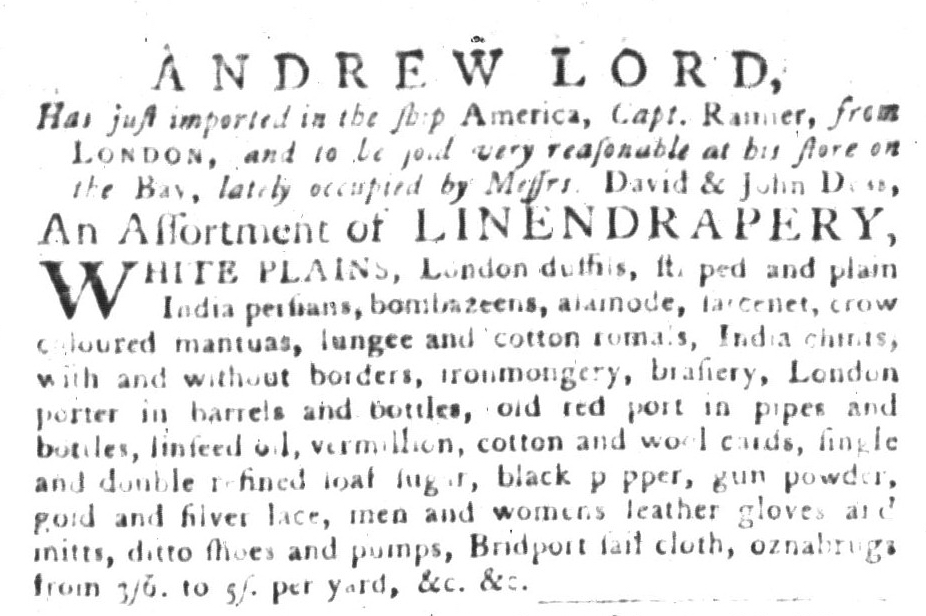
“ANDREW LORD, Has just imported …”

In September 1768 Andrew Lord experimented with a marketing strategy deployed by relatively few merchants and shopkeepers prior to the American Revolution. He placed multiple advertisements in a single issue of the South-Carolina Gazette and Country Journal, improving the likelihood that readers would notice at least one of them. For readers and prospective customers who happened to notice both, this further increased Lord’s visibility in the Charleston marketplace, making it difficult to overlook his significance in the local commercial landscape. Publishing multiple advertisements enhanced his name recognition.

Printers frequently crowded newspapers with advertisements for their own goods and services, exercising one of the privileges of operating the press, but merchants, shopkeepers, artisans, and others were slow to follow their lead. Financial considerations certainly played a role. Advertisers not affiliated with the newspaper did, after all, have to pay to have their notices inserted, but that alone does not sufficiently explain their failure to appreciate how to better take advantage of the power of the press in presenting their goods and services to prospective customers. After all, many advertisers made significant investments when they inserted lengthy notices that listed vast arrays of merchandise.
Sep 6 - 9:6:1768 South-Carolina Gazette and Country Journal Page 4
South-Carolina Gazette and Country Journal (September 6, 1768).

Lord could have done the same. He could have combined his two advertisements into a single advertisement. Doing so would have had the advantage of making his assortment of merchandise seem even more expansive by taking up more space on a single page. Yet he opted for two distinct advertisements instead. Since most printers charged by the length, Lord incurred the same costs whether he published one longer advertisement or two shorter ones. Given the choice, he determined that two shorter notices better suited his purposes. One appeared on the third page of the September 6 edition of the South-Carolina Gazette and Country Journal, the other on the fourth page. This bolstered his presence in the newspaper, further solidifying his reputation as a merchant of note in the bustling port of Charleston. The appeals Lord made in his advertisements did not distinguish him from his competitors, but the reiteration of his name in a single issue did.

August 30

What was advertised in a colonial American newspaper 250 years ago today?

Aug 30 - 8:30:1768 South-Carolina Gazette and Country Journal
South-Carolina Gazette and Country Journal (August 30, 1768).

“REBECCA WRIGHT, SOLE-DEALER, MILLINER, from LONDON.”

Late in the summer of 1768, Rebecca Wright, a “MILLINER, from LONDON,” took to the pages of the South-Carolina Gazette and Country Journal to announce that she intended to open her own shop on King Street in Charleston. She informed prospective customers that she pursued “the MILLINARY BUSINESS in all its branches, in the genteelest taste.” In just a few words, Wright commented on her abilities to pursue her trade and her attention to current fashions. In those regards the appeals in her advertisement paralleled some of the most common appeals deployed by artisans throughout the eighteenth century. Her notice, however, deviated from those placed by other artisans in once significant manner: the headline.

For most artisans, their name alone served as the headline for their advertisements. Their occupation or trade appeared as a secondary headline. Such was the case in other advertisements that ran in the same column as Wright’s notice. These included “JAMES OLIPHANT, JEWELLER, in Broad-street, next door to the Post-office,” “JOHN LORD, CARVER and GILDER,” and “THOMAS COLEMAN, UPHOLSTERER and PAPER-HANGER.” The headline for Wright’s advertisement had an additional element, identifying her as a “SOLE-DEALER” before listing her occupation as a secondary headline. What did this designation mean?

Laws replicating the English practice of coverture were in place throughout the colonies. Such laws negated the separate legal identity of married women. This certainly had ramifications for women in business. As the Elizabeth Murray Project explains, “Most legal arrangements, such as contracts, were considered to be the husband’s sole right and responsibility. … If [a wife] were able to enter into contracts on her own, she could ultimately be held liable in ways that might deprive a husband of services to which he had first claim.” Wives who ran their own businesses did so under the authority of their husbands, who were legally responsible for the debts incurred and other commercial activities of their entrepreneurial wives. Only Pennsylvania and South Carolina passed feme sole trader statutes that enabled married women to participate in the marketplace on their own behalf, separating their legal identity from husbands when it came to business.

Wright proclaimed that this was case with her millinery shop. The headline of her advertisement announced that she operated her business on her own, that she (not her husband) was ultimately responsible for making contracts, paying debts, suing for payment, and any other legal actions necessary for its operation. This advertisement – along with one placed by “FRANCES SWALLOW, SOLE DEALER,” on the same page – testifies to the commercial independence that some married women managed to achieve even in an age when coverture was the common practice.

August 23

What was advertised in a colonial American newspaper 250 years ago today?

Aug 23 - 8:23:1768 South-Carolina Gazette and Country Journal
South-Carolina Gazette and Country Journal (August 23, 1768).

“GOOD CUSTOMERS may depend on being constantly supplied with FRESH GOODS.”

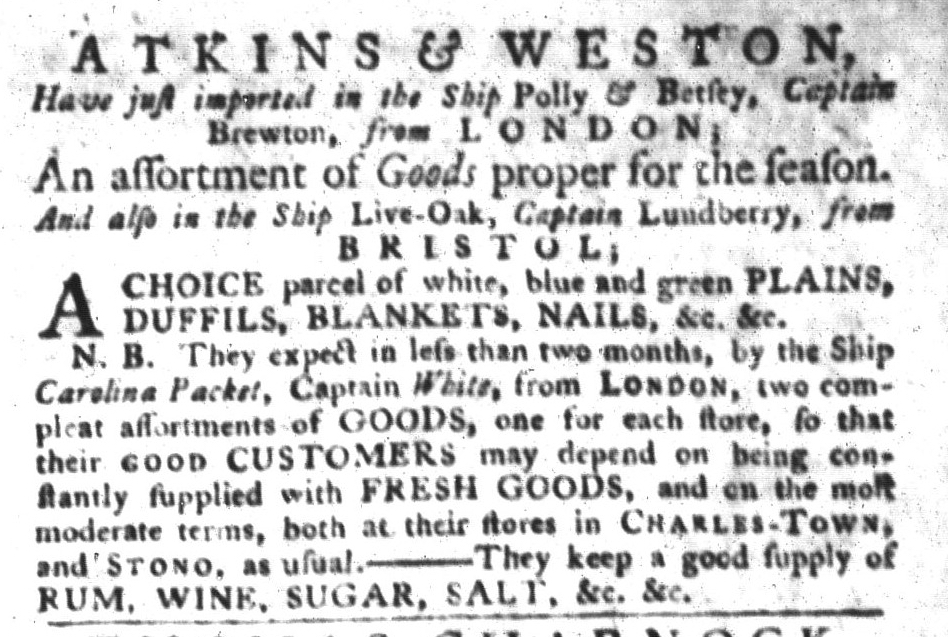
According to their advertisement in the August 23, 1768, edition of the South-Carolina Gazette and Country Journal, the partnership of Atkins and Weston operated two shores in the colony, one in the port of Charleston and the other about five miles to the south in Stono on James Island. They stocked “An assortment of Goods proper for the season” recently imported from London and Bristol. They also advised prospective customers that they had on hand “a good supply of RUM, WINE, SUGAR, SALT,” and other staples.

Yet a significant portion of their advertisement did not focus on goods they already offered for sale but instead anticipated merchandise that they planned to make available to consumers in the near future. Atkins and Weston announced that they expected to receive a new shipment of goods from London via the Carolina Packet within two months. This shipment consisted of “two compleat assortments of GOODS, one for each store.”

The partners underscored their commitment to serving their customers. They did not place their advertisement merely out of self-interest, hoping to generate revenues by reducing their current inventory. They also wanted their “GOOD CUSTOMERS” to know that they “may depend on being constantly supplied with FRESH GOODS” rather than being forced to choose from among whatever wares lingered on the shelves. Furthermore, this was the case at both stores. The shop in Charleston did not make room for new goods by transporting remainders to the shop in the smaller settlement at Stono. Instead, each store received its own shipment of goods. Those residing in the country did not need to worry that they were presented with different options than the colonists who resided in the bustling urban port. Atkins and Weston did not attempt to pass off to customers in Stono what had been passed over in Charleston.

By promoting a shipment of goods that had not yet arrived, Atkins and Weston sought to create a sense of anticipation among consumers in both locations. They currently stocked “Goods proper for the season,” but the season would soon change and the partners attempted to incite desire for other goods. They encouraged potential customers to imagine consumption as an ongoing process, one of acquiring goods now and planning to acquire “FRESH GOODS” later. Providing details about a shipment they expected to receive “in less than two months” prompted consumers to keep their eyes on Atkins and Weston’s stores when they contemplated purchases in the future.

August 16

What was advertised in a colonial American newspaper 250 years ago today?

Aug 16 - 8:16:1768 South-Carolina Gazette and Country Journal
South-Carolina Gazette and Country Journal (August 16, 1768).

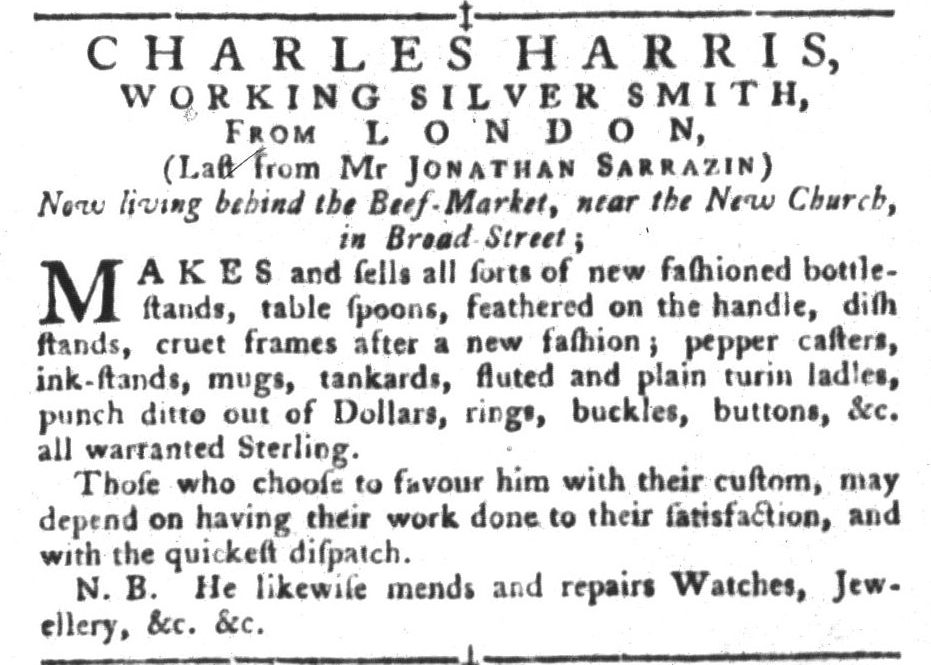
“CHARLES HARRIS, WORKING SILVERSMITH, FROM LONDON, (Last from Mr. JONATHAN SARRAZIN.”

Like many other artisans who advertised in colonial newspapers, Charles Harris, a silversmith, provided his some of his credentials in the notice he inserted in the August 16, 1768, edition of the South-Carolina Gazette and Country Journal. He first asserted his connections to London, the cosmopolitan center of the empire, as a means of assuring prospective customers that he was indeed aware of the current tastes and styles. Invoking his London origins gave the silversmith cachet while simultaneously suggesting his familiarity with “all sorts of new fashioned bottle-stands” and “cruet frames after a new fashion.” He paid attention to the smallest details, even when making “table spoons, feathered on the handle.”

Yet Harris had not just arrived in Charleston directly from London. His advertisement indicated that he had already spent some time in the colony, employed in another workshop before establishing his own. Even though he had migrated “FROM LONDON,” Harris informed readers that he was also “(Last from Mr JONATHAN SARRAZIN),” a jeweler who ran a shop at the corner of Broad Street and Church Street. Harris’s former employer, who had recently published a series of advertisements in all three newspapers published in Charleston, was now one of his competitors. Harris took advantage of their former affiliation to market his own wares. Prospective customers who had previously secured Sarrazin’s services had likely acquired items that Harris took a hand in producing. Rather than his work being completely unknown in the local marketplace, as was the case for artisans newly arrived from London, some of his wares had already found their way into the hands of local consumers. This allowed Harris to piggyback on the reputation that Sarrazin had cultivated among residents of Charleston.

Harris deployed his advertisement as his résumé. He included vital work history that allowed prospective customers to determine if they wished to consider availing themselves of his services. Establishing that he had already made contributions to his trade in the local marketplace gave Harris additional credibility in his pledge to potential clients that they “may depend on having their work done to their satisfaction, and with the quickest dispatch.”

August 9

What was advertised in a colonial American newspaper 250 years ago today?

Aug 9 - 8:9:1768 South-Carolina Gazette and Country Journal
South-Carolina Gazette and Country Journal (August 9, 1768).

“For the inspection of the CURIOUS … one of Mr. Benjamin Martin’s ROYAL PATENT PUMPS.”

Like many other colonial booksellers, Nicholas Langford stocked an array of other sorts of goods at his “BOOK and PRINT STORE” in Charleston. In an advertisement in the August 9, 1768 edition of the South-Carolina Gazette and Country Journal, Langford listed several titles from among the “Very neat and choice collection of BOOKS in polite literature, approved history and useful sciences” that he had recently imported, but he supplemented those wares with other sorts of merchandise, including “Woodstock wash leather gloves” and “neatest London made gentlemens shoes.” Langford’s inventory of clothing and housewares was not particularly extensive when compared to the items listed by many shopkeepers. However, the bookseller did stock sufficient additional goods to garner attention from prospective customers interested in more than just books, stationery, and prints.

That part of Langford’s advertisement was not all that unusual. Eighteenth-century booksellers frequently attempted to supplement the revenues generated by their primary occupation by selling other items on the side. A lengthy paragraph about “Mr. Benjamin Martin’s ROYAL PATENT PUMPS,” however, did distinguish Langford’s advertisement from others placed by booksellers. Langford announced that he displayed one of the pumps, which had never before been seen in South Carolina, “For the inspection of the CURIOUS.” He invited readers to examine the display model for themselves to see “its much superior effect produced by a continual stream” and observe how it “work[ed] without friction,” eliminating the “wear” and “choak” commonly associated with other pumps. Langford promoted several uses for this new brand of pumps, asserting that “they will be found to be extremely useful to this province, particularly for the draining of swamps, and filling the indico vats.” Interested parties could place their orders at the “BOOK and PRINT STORE” for Langford to transmit “to the manufactory in London.”

The final paragraph of Langford’s advertisement deviated significantly from the standard marketing efforts deployed by eighteenth-century booksellers. He offered readers a curiosity that they were invited to contemplate in the moment as well as examine on their own during a visit to his shop. In making “Mr. Benjamin Martin’s ROYAL PATENT PUMPS” available for purchase, he enhanced his reputation as an entrepreneur who tended to the improvement of the entire colony rather than merely advancing his own business. Yet he did stand to reap benefits of his own if displaying the pump and taking orders also happened to create additional foot traffic in his shop and if curious onlookers also happened to buy books or other wares. Langford hoped to transform the “CURIOUS” into consumers.

July 26

What was advertised in a colonial American newspaper 250 years ago today?

Jul 26 - 7:26:1768 South-Carolina Gazette and Country Journal
South-Carolina Gazette and Country Journal (July 26, 1768).

“Mrs. Crane continues to make … the Brunswick dresses, so much esteemed in England.”

In the summer of 1768, John and Sarah Crane placed an advertisement in the South-Carolina Gazette and Country Journal to inform residents of Charleston and the surrounding area that they had “removed from the house” where they formerly kept their workshop to a new location. The tailor and mantuamaker considered it “their duty, not only to acquaint the gentlemen and ladies of this town” that they had moved but also to express “their sincere acknowledgments for the many favours they have received.” The Cranes wanted their existing clientele to follow them to their new location. They anticipated the “pleasing prospect” of the “continuance” of their business, but acknowledging their customers in the public prints served as more than a means of maintaining those relationships. It also communicated to prospective clients that other consumers in the busy port had already sought out their services.

The Cranes may have considered this especially important since they had only recently arrived in Charleston. They described themselves as “Very Lately arrived from LONDON,” though they had been in town for at least five months. They had previously advertised in February, yet they still considered themselves new to the community. Despite the disadvantages of being newcomers, depicting themselves in this manner worked to their advantage in certain ways. It established a direct connection to the cosmopolitan center of the empire, suggesting that they relied on their own knowledge when they pledged to make garments “in the newest taste.” To further make their case, they noted that “Mrs. Crane continues to make … the Brunswick dresses, so much esteemed in England.” The glossary of “Colonial Lady’s Clothing” compiled by historians at Colonial Williamsburg describes the Brunswick as a “three-quarter length jacket worn with a petticoat” that was worn as “an informal gown or a traveling gown. It had a high neck, unstiffened bodice that buttoned, long sleeves, and frequently had a sack back (loose pleats) and a hood.” The Brunswick reached the height of its popularity in the 1760s, indicating that the Cranes were right on message when they chose it as an example to demonstrate their awareness of the “newest taste” in London.

When it came to stating how long they had been in Charleston, the Cranes tried to have it both ways. They had been in the city just long enough to faithfully serve some of its residents, but not so long that their personal observations of popular styles in London had become outdated. They expected both of these factors to appeal to prospective clients.

July 19

What was advertised in a colonial American newspaper 250 years ago today?

Jul 19 - 7:19:1768 South-Carolina Gazette and Country Journal
South-Carolina Gazette and Country Journal (July 19, 1768).

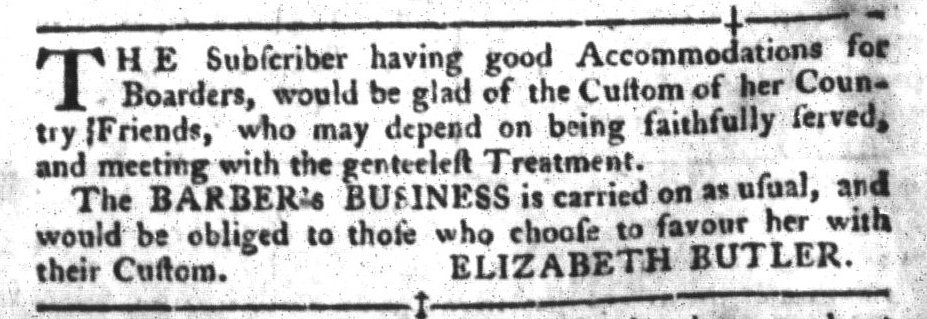
“The BARBER’s BUSINESS is carried on as usual.”

Elizabeth Butler’s advertisement in the July 19, 1768, edition of the South-Carolina Gazette and Country Journal demonstrates that women pursued a wide range of occupations in colonial America. Divided into two parts, Butler’s advertisement promoted two different services she provided. In the first portion, she announced that she had “good Accommodations for Boarders” who could “depend on being faithfully served, and meeting with the genteelest Treatment.” Women throughout the colonies provided such services. In that regard, Butler did not describe anything out of the ordinary. In the second portion of her advertisement, however, Butler indicated that she practiced an occupation usually reserved for men: shaving and trimming beards as well as cutting and dressing hair. “The BARBER’s BUSINESS is carried on as usual,” Butler informed prospective clients, apparently reminding many readers of the services that she apparently had already provided for some time.

When women placed newspaper advertisements for the services they provided they also indicated what was probable and what was possible for members of their sex in the marketplace. Most advertisements fell in the category of what was probable, such as those placed by milliners, schoolmistresses, and women who took in boarders. A significantly smaller number of advertisements, on the other hand, belonged to the category of what was possible. Women sometimes practiced trades considered the domain of men, such as barbering. Butler’s advertisement testifies to the flexibility sometimes exhibited in the gendering of occupations in colonial America. While women did not enter most trades in large numbers, a few did manage to carve out space for themselves without being too disruptive of social norms. They did so by remaining exceptions to expectations rather than seeking to transform generally accepted ideas about who should work in particular occupations. That Butler simultaneously pursued an occupation considered appropriate for women – operating a boardinghouse – may have reassured residents of Charleston that she sought only to stretch rather than shatter the gendered boundaries associated with barbering.

July 12

What was advertised in a colonial American newspaper 250 years ago today?

Jul 12 - 7:12:1768 South-Carolina Gazette and Country Journal
South-Carolina Gazette and Country Journal (July 12, 1768).

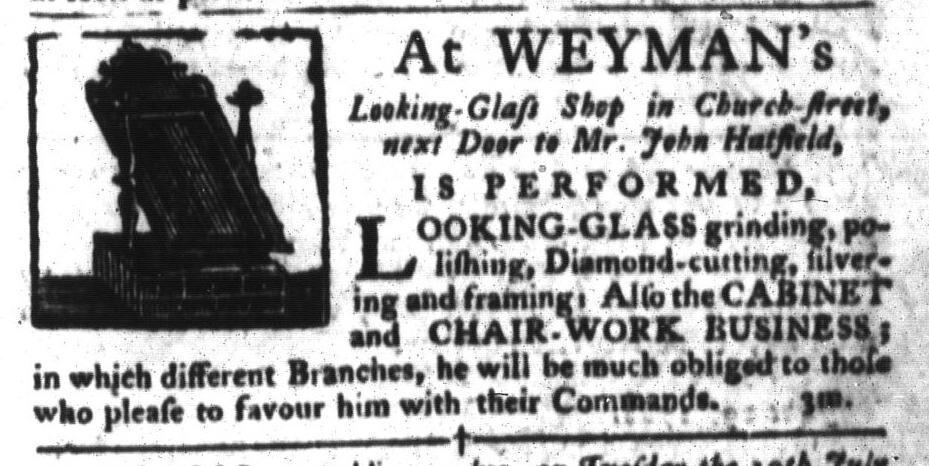
“At WEYMAN’s Looking-Glass Shop.”

Edward Weyman’s advertisements for his “Looking-Glass Shop in Church-street” in Charleston were easily recognizable when they appeared in the South-Carolina Gazette and Country Journal. In addition to using to his surname as a headline, Weyman included an image of a looking glass mounted in an elaborately carved frame. While Weyman’s woodcut certainly was not a sophisticated engraving, the processes of remediating the image over the years – photography and digitization – likely make it appear more crude than it looked to colonists who read the newspaper when it was first published or even to modern researchers who consult original copies in libraries and archives rather than the digital surrogates more widely accessible in the twenty-first century. This process is compounded when printing images from the digital ones, a process that tends to create even darker and denser images. In other words, Weyman’s woodcut may look like a dark mass to modern eyes, but that is contingent in part on the format in which it is presented for our consumption. Eighteenth-century viewers would have seen a crisper image. They would have more easily noticed the lines and details that do not translate well via subsequent remediation. It remains important not to overstate the quality of this and other woodcuts, but at the same time we should avoid denigrating them as excessively crude unnecessarily.

Besides, Weyman’s woodcut served its purpose. Other than the masthead, only three images appeared in the July 12, 1768, edition of the South-Carolina Gazette and Country Journal. Two of them were stock images that belonged to the printer: a woodcut of a house that accompanied a real estate advertisement and a woodcut of a slave that accompanied a fugitive advertisement. Weyman’s woodcut of a looking glass was the only one commissioned by the advertiser, the only one used exclusively by a particular advertiser rather than interchangeably in advertisements of the corresponding genre. Weyman advertised frequently, making his woodcut a familiar image to regular readers of the South-Carolina Gazette and Country Journal. In effect, it created a logo or a brand that readers could immediately identify. Its mere repetition over weeks and months, especially as an especially distinctive visual element, likely secured a place for Weyman in the minds of readers. Even if they did not need or want looking glasses when they glimpsed his advertisements, they were likely to remember his workshop when they were in the market to make such purchases.

July 5

What was advertised in a colonial American newspaper 250 years ago today?

Jul 5 - 7:5:1768 South-Carolina Gazette and Country Journal
South-Carolina Gazette and Country Journal (July 5, 1768).

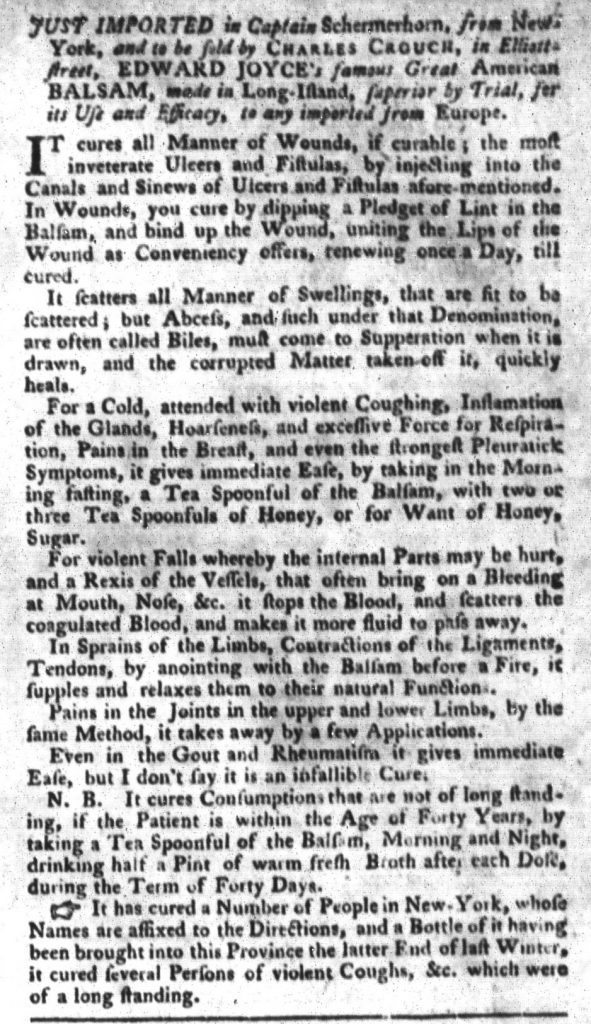
“EDWARD JOYCE’s famous Great American BALSAM.”

Like many other colonial American printers, Charles Crouch sold patent medicines to supplement his income from newspaper publishing and job printing. The featured advertisement from just a few days ago, for instance, listed a variety of popular patent medicines – Anderson’s Pills, Bateman’s Drops, Godfrey’s Cordial, among them – that Timothy Green, printer of the New-London Gazette, sold. Given that each of these remedies represented a brand familiar to colonists, Green devoted little space to describing their use or the symptoms they cured. Crouch, on the other hand, stocked a patent medicine that was not nearly as well known among his prospective customers: “EDWARD JOYCE’s famous Great American BALSAM.” Placing it in the hands of readers required more promotion than usually accompanied the most established patent medicines.

Crouch first acknowledged the origins of Joyce’s Balsam, but stressed that should not cause concern. Even though it was “made in Long-Island” and shipped from New York, this remedy was “superior by Trial, for its Use and Efficacy, to any imported from Europe.” Wary readers did not have to trust solely in Crouch’s word on that count. He concluded his advertisement by stating that Joyce’s Balsam had “cured a Number of People in New-York, whose Names are affixed to the Directions.” Skeptics could examine that evidence for themselves. Furthermore, Crouch reported that a bottle had been “brougth into this Province the latter End of last Winter” and “it cured several Persons of violent Coughs, &c. which were of a long standing.” The printer suggested that potential customers could receive local confirmation of the claims transmitted from afar.

Colonists already knew the uses for patent medicines imported from England, which ones supposedly alleviated which symptoms. Since Joyce’s Balsam was much less familiar, Crouch needed to educate readers about which maladies it relieved. To that end, he devoted the vast majority of the advertisement to describing how to take Joyce’s Balsam for colds, swelling, wounds, sprains, and an assortment of other concerns. According to Crouch’s account, Joyce’s Balsam was a cure-all that could replace any variety of imported patent medicines, though he did offer a warning that it had its limits: “I don’t say that it is an infallible cure.”

Given the number of apothecaries, shopkeepers, and printers who regularly advertised patent medicines, a market for familiar imported brands already existed. Crouch, however, wanted to create a local market for a remedy produced in the American colonies. That required more extensive copy than usually accompanied the most popular patent medicines. This included not only reviewing the uses of Joyce’s Balsam but also asserting its effectiveness as a legitimate competitor “to any imported from Europe.”

June 28

What was advertised in a colonial American newspaper 250 years ago today?

Jun 28 - 6:28:1768 South-Carolina Gazette and Country Journal
South-Carolina Gazette and Country Journal (June 28, 1768).

“TO BE SOLD, EXCEEDING good Rhenish WINE, in BOTTLES.”

The proportion of news to advertising varied among eighteenth-century newspapers. Some carried relatively few advertisements, but others, especially those published in the largest port cities, often devoted significant portions of each issue to advertising. Many of those seemed to strike a balance between the two types of content, designating two of the four pages of a standard issue to each. Some, however, received so much advertising that they regularly issued two-page supplements comprised solely of advertising. Such was the case for the Pennsylvania Gazette in the late 1760s. In such instances, advertising accounted for two-thirds of the content delivered to readers, which helps to explain why many printers considered advertisements rather than subscriptions better for generating revenues. Some printers acknowledged this by including “Advertiser” in the title of the newspaper. The masthead of the Boston Post-Boy, for instance, read “The Boston Post-Boy & Advertiser.”

Charles Crouch’s South-Carolina Gazette and Country Journal ran more advertising than most other American newspapers in the late 1760s. Indeed, advertising sometimes seemed to crowd out other content, especially news. For instance, consider the four-page standard issue and the two-page supplement distributed on June 28, 1768. Not surprisingly, the supplement consisted entirely of advertisements, except for the masthead. With twelve woodcuts of horses, houses, slaves, and even a mirror on a stand for “WEYMAN’s Looking-Glass Shop” distributed across two pages, this advertising supplement featured far more images to break up the otherwise dense text than appeared in the vast majority of newspaper during the period.

Advertising also comprised most of the standard issue. Except for a proclamation by the lieutenant governor that filled one-third of a column on the third page, the final two pages consisted entirely of advertising. Advertisements filled the entire first column on the first page. In other words, seven of twelve columns in the regular issue (in addition to all six columns in the supplement) delivered advertising to readers. The remainder of the issue was rather short on news. After eliminating poetry and amusing anecdotes, just a little more than two columns featured news and editorials, including “DEFENCE of the AMERICANS,” reprinted “From the Gentleman’s Magazine, for January 1768.”

In this case, Crouch’s publication operated as an advertiser rather than as a newspaper. While it is extremely difficult to determine what readers thought about the advertisements delivered to them in newspapers of all sorts, this balance of news and advertising suggests that at least some readers expected and desired to read advertisements. Perhaps more significantly, the collective decision of advertisers to continue placing notices in publications that provided as much (if not more) advertising as news suggests that advertisers felt confident that readers would indeed peruse their notices. Although they did not engage in market research as we understand it today, anecdotal evidence likely suggested that newspaper advertising achieved some positive return on their investment.