June 21

What was advertised in a colonial American newspaper 250 years ago today?

Jun 21 - 6:21:1768 South-Carolina Gazette and Country Journal
South-Carolina Gazette and Country Journal (June 21, 1768).

Just published in Pamphlets, and to be sold by CHARLES CROUCH.”

In an advertisement that appeared in the June 14, 1768, edition of the South-Carolina Gazette and Country Journal, Charles Crouch announced an auction of “A COLLECTION of LAW BOOKS” scheduled to occur in just over a week. He offered a brief description of the books, arguing that they were “valuable” and “rarely to be found.” He also pledged to insert a catalog in the next issue of the newspaper, a promise that he fulfilled in the June 21 edition. The catalog provided an additional description of the books up for bid: “the best Editions, well bound, and in good Condition.”

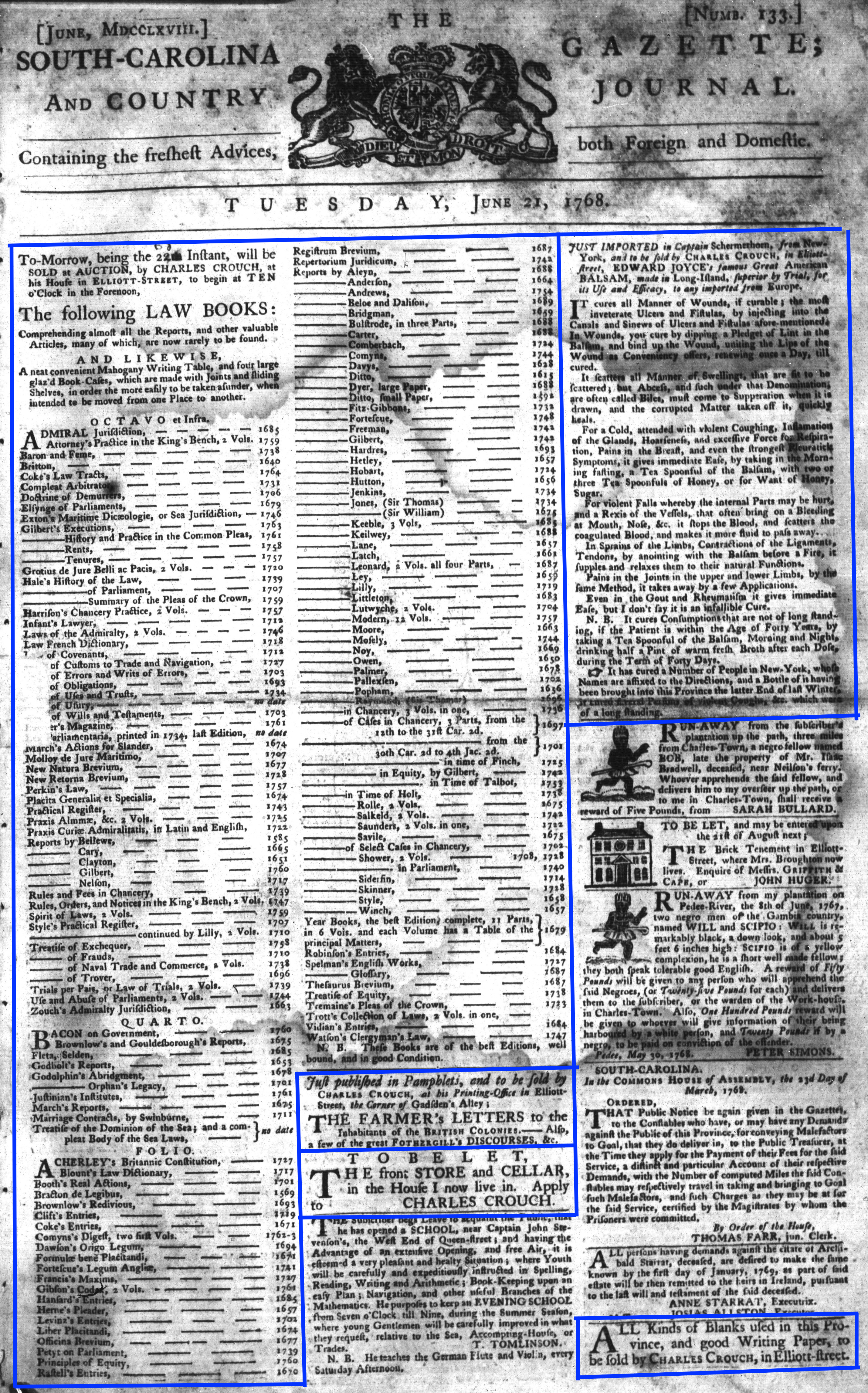
As the printer of the South-Carolina Gazette and Country Journal, Crouch exercised considerable discretion when it came to the placement of his advertisements in that publication. The original announcement about the auction appeared first among the paid notices, immediately under a header that marked “New Advertisements.” The catalog occupied an even more privileged place in the next edition. Except for the masthead, it was the first item on the first page. The catalog comprised more than half the page, filling the entire first column as well as more than two-thirds of the second. Other advertisements for Crouch’s interests also appeared on the front page, including one seeking a tenant for “THE front STORE and CELLAR, in the House I now live in.” In another short notice, he announced that he sold “THE FARMER’s LETTERS to the Inhabitants of the BRITISH COLONIES,” a pamphlet that collected and reprinted John Dickinson’s series of essays that appeared in newspapers throughout the colonies. In yet another advertisement, Crouch alerted readers that he had just received a shipment of “EDWARD JOYCE’s famous Great American BALSAM,” a patent medicine made in New York. A lengthy description of the remedy and its uses extended nearly half a column. Finally, Crouch inserted a short advertisement for printed blanks and stationery, the last item on the first page.

Advertising accounted for three of the four pages of the June 21, 1768, edition of the South-Carolina Gazette and Country Journal. Paid notices generated significant revenue for Crouch, making it possible to distribute the newspaper as well as give over space to his own advertisements. It hardly seems a coincidence that so many of his advertisements were clustered on the first page of the June 21 issue. As the proprietor of the newspaper, he likely instructed the compositor to give his advertisements prominence of place, thereby increasing the number of readers likely to examine them.
Jun 21 - 6:21:1768 South-Carolina Gazette and Country Journal Page 1
Charles Crouch placed five of his own advertisements on the front page of the newspaper he published. (South-Carolina Gazette and Country Journal, June 21, 1768).

June 15

What was advertised in a colonial American newspaper 250 years ago this week?

Jun 15 - 6:14:1768 South-Carolina Gazette and Country Journal
Supplement to the South-Carolina Gazette and Country Journal (June 14, 1768).

“ALL Person who are anywise indebted to the Estate of JOHN DUTARQUE, deceased, are desired to make payment.”

The “missing” Georgia Gazette from June 15, 1768, presents an opportunity to discuss methodology. Each day the Adverts 250 Project republishes an advertisement originally published in an American newspaper exactly 250 years ago that day, along with a short essay that provides historical context and analysis of the contents of the advertisement. These advertisements are drawn from databases of eighteenth-century newspapers that have been digitized: the Virginia Gazette from Colonial Williamsburg’s Digital Library, newspapers published in Charleston from Accessible Archives’s South Carolina Newspapers, and an extensive array of newspapers from throughout the colonies from Readex’s America’s Historical Newspapers.

If no newspaper was published on a particular day (or if no newspaper published on a particular day has been digitized as part of one of those databases), the Adverts 250 Project instead features an advertisement printed sometime during the previous week. Although colonial printers clustered newspaper publications on Mondays and Thursdays in the late 1760s, at least one newspaper was published somewhere in the colonies on every day of the week except Sundays. This means that usually there is only one day of the week that the Adverts 250 Project needs to feature an advertisement not published exactly 250 years to the day.

The clustering of publications on Mondays and Thursdays means that some days offer many more choices for both newspapers and advertisements. During most weeks, the South-Carolina Gazette and Country Journal was the only [extant and digitized] newspaper printed on Tuesdays, the Georgia Gazette was the only newspaper printed on Wednesdays, and the Providence Gazette was the only newspaper printed on Saturdays. As a result, the Adverts 250 Project features an advertisement from each of these publications once a week. During the rest of the week the project draws from among more than a dozen other newspapers, attempting an informal rotation to feature as many as possible.

This methodology causes some newspapers to be featured much more often than others. Even though it carried relatively little advertising compared to some of its counterparts published in the largest port cities, the Georgia Gazette contributes an advertisement to the Adverts 250 Project once a week because it was only newspaper published in the colonies on Wednesdays in the late 1760s. (Dates that fell on Wednesdays in 1768 fall on Fridays in 2018.)

Jun 15 - Georgia Gazette Calendar
This calendar indicates which issues of the Georgia Gazette from 1768 have been digitized for Readex’s America’s Historical Newspapers database.

Today’s advertisement should have come from the Georgia Gazette, but the issue for June 15, 1768, is “missing.” Note the availability of other issues summarized in the calendar provided via Readex’s America’s Historical Newspapers. On closer investigation of some of those other issues it turns out that the June 15 edition is not missing after all. The June 8 edition is numbered 246. June 22 is numbered 247. June 29 is numbered 248, indicating that the June 22 edition is indeed numbered correctly and not the result of the printer or compositor neglecting to advance the number if there had been a June 15 edition (that would have been 247). For whatever reason, printer James Johnston did not issue the Georgia Gazette on June 15, 1768. Despite the noticeable gap in the calendar depicting publication in 1768, complete runs of the Georgia Gazette for that year have been preserved in archives and reproduced via America’s Historical Newspapers.

Rather than examine an advertisement published sometime during the previous week, the not-missing-after-all issue of the Georgia Gazette presents an opportunity to discuss the Advert 250 Project’s methodology in greater detail as well as describe the schedule of publication throughout the colonies in the late 1760s. This should give readers a better sense of why advertisements from some newspapers appear so frequently and advertisements from other newspapers are featured much less often.

June 14

What was advertised in a colonial American newspaper 250 years ago today?

Jun 14 - South-Carolina Gazette and Country Journal
South-Carolina Gazette and Country Journal (June 14, 1768).

A Catalogue of which will be in our next.”

In advance of an auction of “A COLLECTION of LAW BOOKS” to be held on June 22, 1768, Charles Crouch placed an advertisement in the June 14 edition of the South-Carolina Gazette and Country Journal. He attempted to incite enthusiasm by informing potential bidders that the collection included several “valuable Articles; many of which, are now rarely to be found.” Anyone potentially interested would not want to miss this sale since auctions often yielded bargain prices, even for rare items that might otherwise cost significantly more when they exchanged hands through other sorts of transactions.

Crouch did not expect prospective buyers simply to trust his assertions about the value and rarity of the books up for auction in just over a week. Instead, he advised them that “A Catalogue … will be in our next” edition, a promise that Crouch could confidently make since he was the printer of the South-Carolina Gazette and Country Journal. Publishing a catalog, whether in a newspaper or as a separate pamphlet or broadside, provided a preview of the auction. It allowed interested parties to contemplate the merchandise in advance; as they anticipated the auction they likely imagined themselves bidding and acquiring some of the items, perhaps increasing the chances they would do so once they found themselves at the auction.

Yet Crouch did not yet direct readers to such visualizations: the list of rare and valuable books would not appear in the newspaper until the following week. He mentioned the catalog, however, as an invitation to potential bidders to peruse the next issue of the South-Carolina Gazette and Country Journal, perhaps assuming that their eagerness would make them more inclined to select items that they did indeed wish to buy at the auction. Alternately, he ran the risk that the catalog would merely disappoint some readers if its contents did not include books they considered interesting or particularly valuable or rare. Crouch gambled that mentioning the catalog in advance would make readers more disposed to examining it and attending the auction.

May 31

Who was the subject of an advertisement in a colonial American newspaper 250 years ago today?

May 31 - 5:31:1768 South-Carolina Gazette and Country Journal Supplement
Supplement to the South-Carolina Gazette and Country Journal (May 31, 1768).

“Will sell two or three Negro Shoemakers.”

John Matthews, a cobbler, placed a variation of the same advertisement in all three newspapers published in Charleston, South Carolina, for several weeks in the spring of 1768. In each, he announced that because he was “intending to decline Shoemaking” he wished to sell “two or three Negro Shoemakers.” These enslaved artisans already had significant experience. Matthews explained that “they have done all my business for nine Years past.” Apparently the cobbler took on the role of manager of the workshop while the “Negro Shoemakers” labored on his behalf. To further enhance their value for potential buyers, Matthews boasted that in terms of skill they “are at least equal to any Negroes of the Trade in this Province.” In so doing, he implicitly made an unfavorable comparison to white shoemakers even as he credited the abilities of the enslaved artisans who had “done all [his] business” for nearly a decade. Matthews indicated that the “eldest of them” was only twenty-two, suggesting that they had been working in his shop since their early teens.

Slaveholders in South Carolina and beyond frequently associated particular skills with the enslaved men and women they advertised for sale. Another advertisement that ran in the South-Carolina Gazette and Country Journal in the spring of 1768, for instance, listed “sawyers, mowers, a very good caulker, a tanner, a compleat tight cooper, [and] a sawyer, squarer and rough carpenter” among “A PARCEL of valuable SLAVES.” In addition, that advertisement included an enslaved woman who was “a washer, ironer and spinner.” Beyond agricultural labor, enslaved men and women possessed a variety of specialized skills. Many of them were artisans whose skills rivaled their white counterparts (even if slaveholders could not quite acknowledge such expertise). In urban centers and on plantations, slaves practiced a variety of trades. As a result, they contributed far more to colonial economies than just their labor. Slaveholders benefited from the knowledge and skill possessed the “Negro Shoemakers” and other artisans they held in bondage.

May 24

What was advertised in a colonial American newspaper 250 years ago today?

May 24 - 5:24:1768 South-Carolina Gazette and Country Journal
South-Carolina Gazette and Country Journal (May 24, 1768).

“A CARGO of DRY GOODS … never yet exposed to SALE.”

In the spring of 1768 Samuel Prioleau, Jr., and Company placed an advertisement in the South-Carolina Gazette and Country Journal that announced their plans to auction “A CARGO of DRY GOODS” just imported from Liverpool. They provided a short list highlighting some of the merchandise, including “cotton and silk hollands,” “Scotch osnaburgs,” and “Drogheda linen,” but also promised “sundry other articles” too numerous to name in their notice.

Prioleau and Company proclaimed that their wares had “never yet been exposed to SALE.” In so doing, they assured potential buyers – retailers and end-use consumers alike – that this was not merely a cargo of castoffs that merchants and shopkeepers on the other side of the Atlantic had been unable to sell and then attempted to pawn off on distant colonists who did not have easy access to the newest and most fashionable goods. Colonial consumers sometimes complained that they were expected to be content with just such merchandise, which explains why so many eighteenth-century advertisers made a point of stressing that they stocked the newest fashions. This was not necessary for the “Irish linen” or “Scotch osnaburgs,” a coarse fabric often used to clothe slaves, but likely made a difference for “men and boys hats” and some of the higher end textiles that Prioleau and Company listed. They also indicated that this cargo had been “Just imported in the Ship Nanny, David Perry, Master, from Liverpool,” signaling to prospective customers that the textiles had not first been offered for sale in local warehouses or shops. According to the shipping news in the South-Carolina Gazette published the previous day, the Nanny was still in port. To underscore that these goods had “never yet been exposed to SALE,” the advertisers concluded by stating that they were “all bought at the manufactory.” Coming directly from the place of production, these items had not previously sat on shelves where they had been pawed and passed over by other prospective customers. Instead, colonists in Charleston had first shot at acquiring this assortment of fabrics.

May 17

What was advertised in a colonial American newspaper 250 years ago today?

May 3 - 5:3:1768 South-Carolina Gazette and Country Journal
Supplement to the South-Carolina Gazette and Country Journal (May 17, 1768).

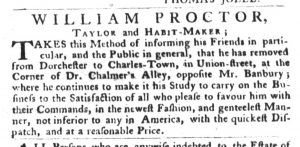
“He has removed from Dorchester to Charles-Town.”

William Proctor, a tailor, placed an advertisement in the South-Carolina Gazette and Country Journal when he relocated from the small town of Dorchester on the Ashley River to the bustling urban port of Charleston. He addressed his notice to both “his Friends in particular, and the Public in general,” a strategy intended to maintain any clients who wished to patronize him at his new location as well as introduce him to the residents of Charleston.

Given that Dorchester, a town already in decline and abandoned after the American Revolution, was eighteen miles from Charleston, Proctor probably had few existing customers in his new city. After all, residents could choose from among many tailors and others who worked in the garments trades in one of the largest ports in the American colonies. Still, acknowledging “his Friends in particular” in his advertisement served an important purpose. It signaled to prospective clients that he had experience pursuing his trade, that he had previously cultivated a clientele in Dorchester and thus deserved their consideration now that he set up shop in Charleston.

He enhanced that appeal by underscoring that “he continues to make it his Study to carry on the Business to the Satisfaction of all who please to favour him with their Commands.” Proctor provided his own testimonial about the quality of the garments he made and the level of customer satisfaction he previously achieved, promising that new clients would not be disappointed if they engaged his services. In case some prospective customers remained skeptical about the clothing he produced, the tailor proclaimed that he constructed garments “in the newest Fashion, and genteelest Manner, not inferior to any in America.” In so doing, he cautioned readers not to dismiss him as a backwoods amateur merely because he had lived and worked outside the colony’s largest city. Instead, he pledged that he was as familiar with current trends – and capable of replicating them – as tailors from Charleston as well as Philadelphia and New York. That he made such a claim at all suggested that he was prepared for prospective clients to assess his efforts and reach their own conclusions, realizing that word of his ineptitude would spread if he did not manage to achieve “the Satisfaction of all who please to favour him with their Commands.” Proctor’s advertisement established a narrative about his skills and the types of garments he created, but consumers possessed the power to verify or discredit the reputation he attempted to construct.

May 3

What was advertised in a colonial American newspaper 250 years ago today?

May 3 - 5:3:1768 South-Carolina Gazette and Country Journal
Supplement to the South-Carolina Gazette and Country Journal (May 3, 1768).

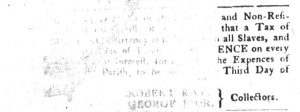
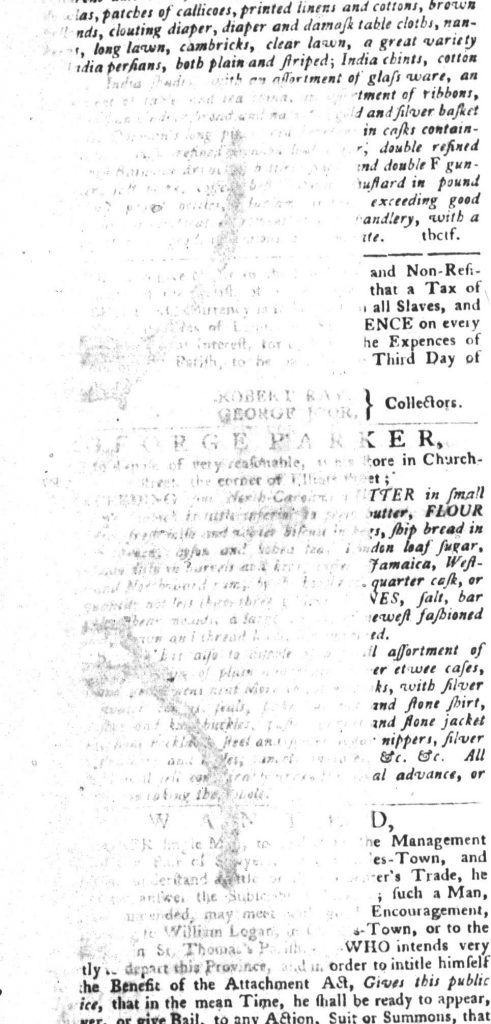
“… that a Tax of … all Slaves, and … ENCE on every … he Expences of … Third Day of …”

This advertisement presented a conundrum when I set about compiling the advertisements from the May 3, 1768, edition of the South-Carolina Gazette and Country Journal for inclusion in the Slavery Adverts 250 Project. It includes a reference to slaves, seemingly in connection to taxes to be collected, but the majority of the advertisement has been obscured. Working with a digital surrogate available in Accessible Archives‘s database of newspapers published in South Carolina rather than an original copy, it is difficult to determine exactly why a large portion of the advertisement is not visible. It does not seem to be the result of poor photography or digitization but rather a faithful rendition of the state of the original issue as the result of the treatment it received in the quarter millennium since it was published.

May 3 - Left Side South-Carolina Gazette and Country Journal Page 7As I have worked my way through the digitized copies of the South-Carolina Gazette and Country Journal from 1768 I have discovered that many issues include portions that are similarly illegible. It appears that at some point someone attempted to repair rips and tears in those issues with tape. (See the image of today’s advertisement and others to the left.) Most often the concealed portion appears at the edge of the page, the place most easily ripped. In the case of this advertisement, the items printed on the opposite side of the page do indeed display evidence of two tears. (See the image below. Note the mirrored tears that appear to have happened when the page was folded in half.) Taping one side preserved the contents on the other. Whether the tape remains on the page is not clear. It appears that it may have been removed, damaging the newspaper in the process. If this is indeed the case, examining the original may not reveal anything that cannot be viewed in the digital surrogate. If the tape remains on the page, however, it may be possible to examine the original from other angles that reveal more than the single image of the page yields.
May 3 - Right Side South-Carolina Gazette and Country Journal Page 8Historical documents are fragile things that sometimes present a variety of problems when working with them. Digital surrogates sometimes compound those problems. Although photography and digitization have been performed to aid in the preservation of eighteenth-century newspapers and other sources, to prevent them from sustaining further damage as a result of continued use, sometimes the surrogates do not sufficiently replicate the originals. Digital surrogates are not replacements for original documents. Instead, they are complements that allow greater numbers of people to gain access to historical sources. In this case, unfortunately, the complement does not tell the complete story … and it is difficult to tell from the surrogate if examining the original would reveal more. As much as we celebrate the advantages of digitization in this technological age, we must also acknowledge the various shortcomings and challenges of working with digitized sources.

April 26

What was advertised in a colonial American newspaper 250 years ago today?

Apr 26 - 4:26:1768 South-Carolina Gazette and Country Journal
South-Carolina Gazette and Country Journal (April 26, 1768).

“He entreats a Continuation of Messrs. DAVID and JOHN DEAS’s Customers.”

Andrew Lord launched a new enterprise in the spring of 1768, at least an enterprise that was new to him. He took to the pages of the South-Carolina Gazette and Country Journalto announce that he had “bought out Messrs. DAVID and JOHN DEAS, and taken the Stores and house lately occupied by them.”  He planned to sell all of the merchandise already on hand, pledging to part with it “very low.”  Prospective customers enjoyed bargain prices as the new proprietor attempted to clear out the existing inventory.

In addition to inviting new patrons to his store, Lord hoped to invoke loyalty among customers who already shopped there when it still belonged to the previous owners:  “He entreats a Continuation of Messrs. DAVID and JOHN DEAS’s Customers.”  This was not loyalty to the purveyors of goods but rather loyalty to the goods themselves.  Lord implied that since the Deas’s former customers appreciated the wares they had previously purchased that they would continue to be satisfied as they selected among the inventory he had obtained.  He much more explicitly, however, invited the Deas’s customers to give him a chance to demonstrate that he could serve them just as well as the former proprietors had done.  He stressed that “he expects a compleat Assortment of GOODS by the first Vessels from London and Bristol,” an assortment that he believed maintained the standards that customers had come to anticipate when making purchases in the store he now operated.

The existing clientele may have factored into Lord’s decision to acquire a shop and inventory owned by two of Charleston’s most prominent merchants and slave traders.  According to his advertisement, he certainly hoped that familiarity with the location and merchandise would convince previous patrons to continue making purchases at the same store, especially since he offered low prices and an extensive selection.  The proprietor had changed, but other aspects of the business remained the same.  Accordingly, there was no need to seek out other vendors, at least not without first giving Lord the opportunity to demonstrate that customers would not experience any disruption in the experience they had come to expect when shopping at that store.

April 19

GUEST CURATOR:  Anna MacLean

Who was the subject of an advertisement in a colonial American newspaper 250 years ago today?

Apr 19 - 4:19:1768 South-Carolina Gazette and Country Journal
South-Carolina Gazette and Country Journal (April 19, 1768).

TO BE SOLD … A PARCEL of valuable SLAVES.”

In this advertisement from the South-Carolina Gazette and Country Journal Edward Oats announced that he intended to sell “A PARCEL of valuable SLAVES.” The slaves originally belonged to the estate of Mary Frost. This advertisement shocked me with how this group of enslaved men and women were characterized as merchandise to be purchased. In addition, the details associated with the process astounded me. Edward Oats wrote that “Twelve months credit will be given, paying interest, and giving approved security, the property not to be altered till the conditions are complied with.” This set of terms and conditions sounds comparable to buying furniture or appliances in the twenty-first century.

Furthermore, I was intrigued with the advertisement because the author chose to incorporate the many skills held by individuals among this group of slaves. They included “sawyers, mowers, a very good caulker, a tanner, a compleat tight cooper, a sawyer, squarer and rough carpenter.” In the midst of my research I observed that slaves tended to be sold in parcels, or large groups, in the southern colonies more frequently than in the northern colonies. Often, the skills and talents of slaves were highlighted by newspaper advertisements as a method of attracting buyers, especially plantation owners. According to Daniel C. Littlefield in “The Varieties of Slave Labor,” eighteenth-century plantation owners “tried to maintain self-sufficiency based on the varied skills of their slaves.” Although the vast majority of African slaves were purchased specifically for agricultural work, enslaved peoples also found themselves performing a number of skilled functions to guarantee overall efficiency on plantations.

**********

ADDITIONAL COMMENTARY:  Carl Robert Keyes

Although Edward Oats and the readers of the South-Carolina Gazette and Country Journal had no way of knowing it, within a decade April 19 would become one of the most important days in American history. Seven years after the publication of this advertisement armed hostilities broke out between colonists and Britain at Concord and Lexington in Massachusetts, initiating a new phase in the imperial crisis and eventually resulting in the Declaration of Independence and a war that lasted the better part of a decade.

Americans continue to commemorate April 19 today.  In Massachusetts it is known as Patriots’ Day, a state holiday observed on the Monday that falls closest to April 19.  The Boston Marathon takes place on Patriots’ Day.  This year residents of Massachusetts received an extension on filing their taxes until Tuesday, April 17 because the traditional tax day, April 15, fell on a Sunday, followed by Patriots’ Day on Monday. Beyond Massachusetts, Americans have been celebrating the 243rd anniversary of Paul Revere’s ride and the battles at Concord and Lexington, though historians have turned to social media and other public history platforms to offer more complete and nuanced portraits of events than Henry Wadsworth Longfellow etched in popular memory in the poem he composed about the “midnight message of Paul Revere” in 1860.

In the midst of these commemorations of liberty and resistance to British oppression, Anna has chosen an advertisement that reminds us that freedom had varied meanings to different people in early America.  Edward Oats had seen the Stamp Act enacted and repealed, only to be replaced by the Declaratory Act and the Townshend Act.  If he read the newspaper in which he advertised “A PARCEL of valuable SLAVES,” he had been exposed to news from throughout the colonies about efforts to resist Parliament by consuming goods produced in the colonies rather than imported from England.  He would have also encountered the series of “Letters from a Farmer in Pennsylvania” outlining the limits of Parliament’s authority.

Even as white Americans grappled with these political issues, they bought and sold enslaved men, women, and children, often acknowledging the skills they possessed yet obstinately refusing to acknowledge their humanity.  These “SLAVES” and “wenches,” however, had their own ideas about liberty.  As other advertisements in newspapers throughout the colonies indicate, many slaves seized their freedom by running away from the masters who held them in bondage.  As we once again celebrate the milestones of April 19, this advertisement for “A PARCEL of valuable SLAVES” reminds us to take a broad view of the revolutionary era in order to tell a more complete story of the American past.

April 5

What was advertised in a colonial American newspaper 250 years ago today?

Apr 5 - 4:5:1768 South-Carolina Gazette and Country Journal
South-Carolina Gazette and Country Journal (April 5, 1768).

“BALL’s ALMANACKS for the Year 1768, to be sold by the Printer.”

Published in the lower right corner of the first page of the April 5 issue, this advertisement for “BALL’s ALMANACKS for the Year 1768” made an unseasonably late appearance in the South-Carolina Gazette and Country Journal.  Readers throughout the colonies were accustomed to a certain rhythm when it came to printers advertising almanacs in newspapers. Some commenced as early as September, seeking to gain an advantage over competitors by announcing that their almanacs would soon go to press.  They peddled the promise of a product that did not yet exist, but primed consumers to contemplate the version they offered before encountering any others.  The number and frequency of advertisements for almanacs increased throughout the fall as the new year approached.  The advertisements usually continued for the first few weeks of January but then tapered off by the time February arrived. After all, more and more of the contents became outdated every week.  Yet Charles Crouch still opted to publish an advertisement for almanacs in his newspaper in early April 1768.  More than a quarter of the year had passed, but Crouch tested whether he could create a market for leftover copies that he had not managed to sell.

Many eighteenth-century printers sought to generate revenues beyond job printing, newspaper subscriptions, and advertising fees by publishing and selling almanacs.  Doing so was a savvy investment of their time and resources since colonists from the most humble households to the most grand acquired these popular periodicals each year … but only if printers accurately estimated the market for almanacs.  Not printing a sufficient number meant turning customers away. Even worse, it could mean losing their business in future years if they purchased another almanac and developed loyalty toward its contents, author, or printer.  On the other hand, printing too many almanacs could undermine any profits if a printer ended up with a significant surplus.  That Crouch was still advertising “BALL’s ALMANACKS for the Year 1768” in April suggests that he did indeed have an unacceptable surplus crowding the shelves or storage space at his printing shop.  Indirectly, it also testifies to the utility of almanacs in the eighteenth century.  Prospective customers may not have dismissed the almanacs simply because a portion of the calendar and astronomical calculations had already passed. Instead, some may have instead focused on the other information contained within the pages of almanacs, information that remained useful throughout the year.  Among their many contents, almanacs typically contained lists of colonial officials, dates for holding courts ands fairs, cures and remedies for various maladies, and amusing anecdotes.  That being the case, Crouch took a chance that he might find buyers for some of his remaining almanacs even if readers did not expect to see them advertised at that time of the year.