October 22

What was advertised in a revolutionary American newspaper 250 years ago this week?
Providence Gazette (October 21, 1775).

“THOSE Gentlemen … who have been entrusted with Subscription-Papers … are requested to return them.”

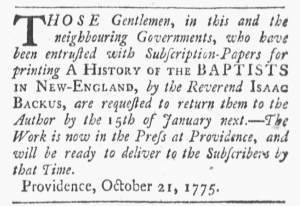
Among the various advertisements in the October 21, 1775, edition of the Providence Gazette, one requested that “THOSE Gentlemen, in this and the neighbouring Governments [or colonies], who have been entrusted with Subscription-Papers for printing A HISTORY OF THE BAPTISTS IN NEW-ENGLAND … return them to the Author,” Isaac Backus, “by the 15th of January next.”  Backus, a Baptist minister, advocate for religious liberty, and one of the founders of Rhode Island College (now Brown University), previously announced this project in an advertisement in the Providence Gazette ten months earlier in December 1774.  At that time, he indicated that “Subscriptions are taken in by the Author, by Mr. Philip Freeman, in Union-street, Boston; by the Printer of this Paper, and by others who are furnished with Subscription Papers in Town and Country.”

Like many other authors and printers, neither Backus nor John Carter, the “Printer of this Paper” who apparently planned to publish the History, went to press without first having an idea how many copies to produce to make the venture viable.  They disseminated subscription proposals to garner interest, asking those who wished to reserve copies to sign the subscription papers entrusted to local agents in their towns.  The combination of subscription proposals and subscription papers served two important functions, inciting demand and gauging the market.  Despite that level of sophistication, Backus did not write directly to the local agents who oversaw the subscription papers “in Town and Country” but instead ran a newspaper advertisement and expected local agents to see it and respond according to the directions in the notice.

Backus originally instructed that prospective subscribers should “send in their Names” by February 1, 1775, “that it may be determined what Number to print,” but the project had stalled as the imperial crisis intensified.  His new advertisement extended the deadline by nearly a year, though this time he reported that the “Work is now in the Press at Providence, and will be ready to deliver to the Subscribers by that Time.”  That seems to have been another miscalculation since the first of three volumes did not appear until 1777, printed by Edward Draper in Boston rather than by Carter in Providence.  The book had a circuitous path to publication.  Backus attempted to use newspaper advertisements to keep subscribers informed, but factors beyond his control intervened.

January 17

What was advertised in a colonial American newspaper 250 years ago today?

Essex Gazette (January 17, 1774).

“ALL Persons who have … Subscription Papers … are desired immediately to return the same.”

Samuel Hall and Ebenezer Hall, the printers of the Essex Gazette, inserted a brief notice in the January 17, 1775, edition to request that “ALL Persons who have in their Hands any Subscription Papers for printing the Independent Whig … to return the same to the Printers hereof.”  They referred to a project that they had first announced more than fifteen months earlier on September 23, 1773, with another advertisement in their newspaper.  On that occasion, they confided that “A Number of the principal Gentlemen in this Town … encouraged the Publication” of the work that Thomas Gordon and John Trenchard first distributed as a weekly magazine in London in 1720.  For those not as familiar with that “celebrated Performance,” the printers gave the full title: “THE Independent Whig, Or, A Defence of primitive Christianity, and of our Ecclesiastical Establishment, against the extravagant Claims of fanatical and disaffected Clergymen.”

The Halls informed the public that they could subscribe to the work at their printing office in Salem.  Those not yet certain that they wished to reserve copies could examine the “Proposals.”  The printers eventually published subscription notices in the Massachusetts Spy in February 1774, hoping to reach even more prospective customers in Boston and other towns throughout the colony.  Yet the Halls apparently did not limit their marketing efforts to newspaper advertisements, choosing to circulate “Subscription Papers” that likely described the purpose of the book and the conditions for ordering copies.  They may have requested that friends and associates post the subscription proposals in their shops and offices, recruiting the assistance of local agents in other towns.  Such items often featured space for subscribers to sign their names, making their support of the project visible to others, though local agents sometimes compiled separate lists.  No copies of the “Subscription Papers” that the Halls mention in their newspaper advertisement survive, at least not any that have been identified and cataloged yet.  Their newspaper notice testifies to a more extensive culture of marketing media in early America than the collections in research libraries, historical societies, and private collections reveal.  How much advertising ephemera circulated that has been lost without any mention in the public prints?

December 24

What was advertised in a colonial American newspaper 250 years ago today?

Providence Gazette (December 24, 1774).

“A History of New-England, With particular Reference to the People called BAPTISTS.”

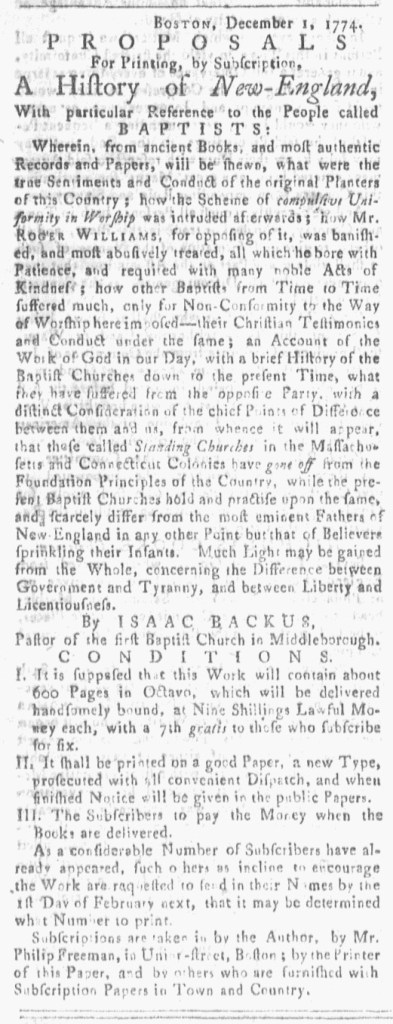
A subscription proposal for “A History of New-England, With particular Reference to the People called BAPTISTS” appeared among the various advertisements in the December 24, 1774, edition of the Providence Gazette.  Dated “BOSTON, December 1,” it described a work in which Isaac Backus, “Pastor of the first Baptist Church in Middleborough,” consulted “ancient Books, and most authentic Records and Papers” to demonstrate the “true Sentiments and Conduct of the original Planters of this Country” and how the “Scheme of compulsive Uniformity in Worship was intruded afterwards.”  The book included a “brief History of the Baptist Churches down to the present time” and “what they have suffered from the opposite Party, with a distinct Consideration of the chief Points of Difference between them and us, from whence it will appear, that those called Standing Churches in Massachusetts and Connecticut Colonies have gone off from the Foundation Principles of the Country.”  As the imperial crisis intensified, Backus offered his own interpretation of the “Difference between Government and Tyranny, and between Liberty and Licentiousness” when it came to how Baptists had comported themselves and been treated in New England.  Positioning Roger Williams as a protagonist in his narrative, the minister expected to attract subscribers in Rhode Island.

Beyond the contents of the volume, Backus promoted the “CONDITIONS” for publication that subscribers could expect.  He anticipated that the book “will contain about 600 Pages in Octavo, which will be delivered handsomely bound.”  Furthermore, they “shall be printed on good Paper” with a “new Type” to enhance legibility.  Each copy cost nine shillings, though Backus offered a free seventh copy “to those who subscribe for six,” whether to gift to friends or retail in shops and bookstores.  Subscribers did not need to make any payments in advance; sometimes subscription proposals called for deposits to help defray the initial costs of printing, but Backus stated that subscribers would “pay the Money when the Books are delivered.”  Rather than raising funds, he intended for the proposals to gauge interest in the project and incite demand.  To that end, he confided that a “considerable Number of Subscribers have already appeared.”  Given the popularity of the book, Backus suggested, prospective subscribers did not want to miss an opportunity to reserve their own copies.  They could submit their names to Backus or an associate in Boston or the printer of the Providence Gazette.  In addition, the minister disseminated “Subscription Papers in Town and Country,” enlisting the aid of local agents in displaying his marketing materials.

Backus called for subscribers “to send in their Names by the 1st Day of February next, that it may be determined what Number to print.”  Distributing subscription proposals did not always result in books going to press.  In this case, Backus apparently found a sufficient number of subscribers to make the project viable, yet he did not publish the book as quickly as intended.  Given the circumstances, an imperial crisis that became a war between the colonies and Britain in the spring of 1775, Backus published the first of three volumes in 1777 and the other two over the course of two decades.  That first volume covered the period through 1690.  The second, published in 1784, extended from 1690 to 1784, including “a concise view of the American war, and of the conduct of the Baptists therein, with the present state of their churches.”  In 1796, Backus published the final volume, a church history that covered the period from 1783 through 1796 that featured a “particular history of the Baptist churches in the five states of New-England.”  The project extended far beyond what he described in the subscription proposals the minister circulated in December 1774.

December 1

What was advertised in a colonial American newspaper 250 years ago today?

Virginia Gazette [Purdie and Dixon] (December 1, 1774).

“I have sent Subscription Papers into all publick Places of the Country.”

Two advertisements that led the front page of the December 1, 1774, edition of Alexander Purdie and John Dixon’s Virginia Gazette provided important updates from the printers.  In the first, Purdie reported that he planned to “resign the Conduct of this Gazette” and wished to express his “sincere and most grateful Acknowledgments to all our Customers, and to the Publick in general,” for years of support.  In addition, he announced that he “shall begin doing Business for myself, and intend to print a GAZETTE as soon as I am furnished with a moderate Number of Customers.”  To entice them, he unveiled the proposed newspaper’s motto: “ALWAYS FOR LIBERTY AND THE PUBLICK GOOD.”  To acquire content, Purdie asked “the Favour of my BROTHER PRINTERS to the Northward to furnish me with their Newspapers, and they shall be sure to have mine, as soon as I begin to print.”  No doubt he and Dixon already participated in such exchanges.

Purdie planned to launch that enterprise “Immediately after Christmas,” but there was no guarantee that he would attract enough subscribers and advertisers to make a go of it.  After all, his newspaper would compete with the Virginia Gazettethat Dixon continued to publish and another Virginia Gazette printed by John Pinkney.  Was Williamsburg and the rest of the colony ready to support three newspapers?  To get a better sense of the market, Purdie “sent Subscription Papers into all publick Places of the Country” and instructed prospective customers that they could also contact him by letter or visit his printing office.  He eventually gained the “moderate Number of Customers” that he needed, though it took a couple of months before he distributed the first issue of his Virginia Gazette on February 3, 1775.  In that time, he also operated a shop where he sold books, sheet music, and stationery, pledging to circulate “a Catalogue of all my Books, &c. as soon as I possibly can.”  Purdie resorted to a variety of marketing media: newspaper advertisements, subscription papers, book catalogs.

In the second advertisement, Dixon revealed William Hunter, “Son of the late Mr. WM. HUNTER of this City, Printer,” would become his new partner in printing the Virginia Gazette and running a book and stationery shop.  He suggested that customers would experience a seamless transition, expressing his “most grateful Thanks for their many Favours” in the past, reminding them that “my Conduct, while in Company with Mr. PURDIE, met with general Approbation,” and pledging that “my future Endeavours to serve the Publick … will render me an Object worthy of their Encouragement.”  Aas Purdie sought subscribers and advertisers for his proposed newspaper, Dixon hoped to maintain the clientele they had cultivated over nearly a decade of working together.

Before perusing news articles or essays in the December 1 edition of Purdie and Dixon’s Virginia Gazette, readers first encountered two advertisements that delivered important news about the future of that newspaper and the possibility that another newspaper might soon be published in Williamsburg.  As was so often the case, printers used advertising space in their own publication to promote their enterprises, framing their work as service to the public.

April 23

What was advertised in a colonial American newspaper 250 years ago today?

Providence Gazette (April 23, 1774).

“Subscribers Names may be annexed to the Work.”

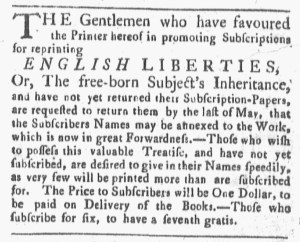
When John Carter, the printer of the Providence Gazette, set about publishing a new edition of English Liberties, Or the Free-Born Subject’s Inheritance: Containing Magna Charta, Charta de Foresta, the Statute de Tallagio non Concedendo, the Habeas Corpus Act, and Several Other Statutes, with Comments on Each of Them, he started with subscription proposals.  Early American printers often did not take books directly to press.  Instead, they disseminated proposals that described their intended projects, simultaneously seeking to gauge the market and to incite demand.  In requesting that subscribers reserve their copies in advance, sometimes asking them to pay a deposit, printers determined whether publishing proposed books would be viable ventures and, if so, how many copies to print to avoid producing surplus copies that cut into profits.  Subscription proposals ran as advertisements in newspapers and, for some proposed works, “Subscription-Papers” circulated separately as handbills, broadsides, and pamphlets.

Many printers recruited local agents to assist them in collecting the names of subscribers and how many copies each wished to reserve.  Carter did so with English Liberties.  In an update in the April 23, 1774, edition of the Providence Gazette, he advised that the book “is now in great Forwardness.”  Most likely much of the type had been set and supplies, such as paper, acquired by the printing office.  Carter instructed the “Gentlemen who have favoured the Printer hereof in promoting Subscriptions … to return [their subscription papers] by the last of May.”  He needed to receive them by that time so “the Subscribers Names may be annexed to the Work.”  That was a popular strategy for inciting demand among prospective customers, promising that their names would appear along with others who also subscribed.  They became part of a community of readers, even if they never met, and, in this instance, a community of citizens committed to those “ENGLISH LIBERTIES” that had been “The free-born Subject’s Inheritance” for generations.  Printers suggested to those who had not yet subscribed that they needed to do so if they wished to be recognized alongside their friends and acquaintances and the most prominent members of their communities who already made a statement about the causes that they supported by subscribing for one or more copies.

Carter deployed other marketing strategies to encourage subscriptions for English Liberties.  He warned that “very few will be printed more than are subscribed for,” so anyone who even had an inkling that they might want a copy should not depend on waiting to purchase the book after it went to press.  In addition, Carter offered a premium: “Those who subscribe for six, to have a seventh gratis.”  Subscribers who purchased multiple copies would receive a free one as a reward.

Carter did indeed insert a list of “SUBSCRIBERS NAMES” at the end of the book.  They appeared in somewhat alphabetical order, with last names starting with “A” coming first, followed by “B,” and so on.  Carter indicated the town for subscribers who did not reside in Providence and, within each letter, clustered subscribers from the same town together.  That made it easier for subscribers to determine which of their neighbors had joined them in supporting the enterprise.  Most were from towns in Rhode Island, Massachusetts, and Connecticut, but some subscribed from greater distances, including Robert Johnston of Chester County in Pennsylvania and Thomas Tillyer in Philadelphia.  The roster of subscribers included nearly five hundred names, mostly men, but also Mrs. Elizabeth Belvher of Wrentham, Massachusetts, several lawyers and ministers, and even Darius Sessions, the deputy governor of Rhode Island.  For those who subscribed for multiple copies, Carter listed how many.  A few purchased two or three copies, but more commonly subscribers purchased six, a sign of the effectiveness of the printer’s marketing strategy.

Not all subscription proposals resulted in publishing books.  Printers sometimes learned that they could not generate sufficient demand.  In this case, however, the combination of the subject matter’s relationship to the political climate, widespread distribution of subscription papers to local agents, publishing the names of subscribers, and free copies for those who purchased at least six contributed to the success of the venture, though it had taken more than a year.

February 19

What was advertised in a colonial American newspaper 250 years ago today?

Connecticut Journal (February 19, 1773).

“Those who may have subscription papers are desired to return them to the printers.”

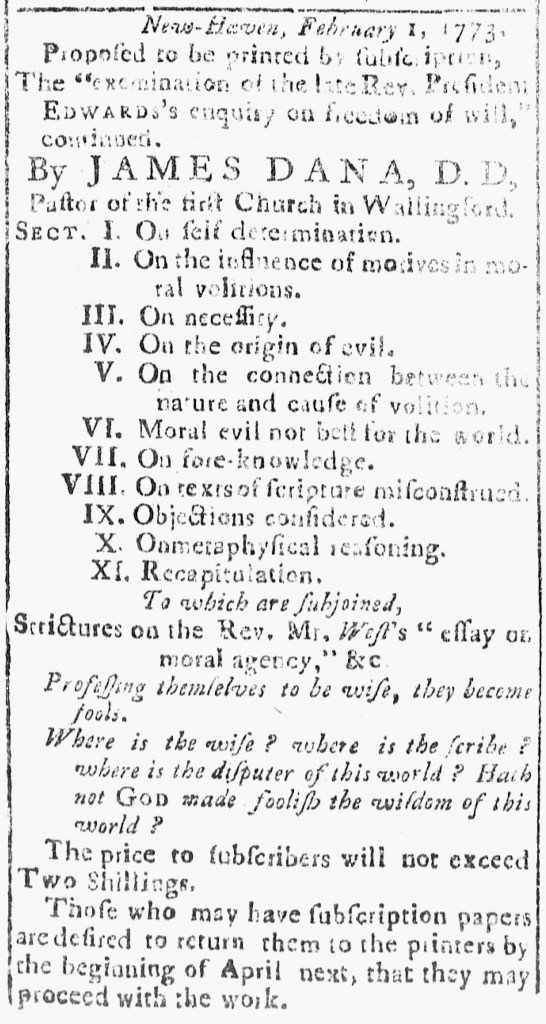
In February 1773, Thomas Green and Samuel Green, printers of the Connecticut Journal and New-Haven Post-Boy, inserted subscription proposals for a book by James Dana, “Pastor of the first Church in Wallingford,” into their own newspaper.  Eighteenth-century printers often placed advertisements promoting their other projects in their newspapers, whether publishing books and pamphlets or peddling books, stationery, patent medicines, and other merchandise.  In this instance, the Greens sought to publish a continuation of An Examination of the Late Reverend President Edwards’s “Enquiry on Freedom of Will” (1770), supplementing the new volume with “Strictures on the Rev. Mr. West’s ‘essay on moral agency.’”  To entice prospective customer to reserve copies by subscribing in advance, the Greens listed the contents of the book and promised that the price “will not exceed Two Shillings.”

Subscription proposals served as a rudimentary form of market research.  Printers and authors did not want to take books to press without knowing if they made a sound investment.  To assess demand for proposed works, they distributed subscription notices that described the contents, the paper and type, and the costs.  Customers interested in the proposed work reserved copies in advance, sometimes paying a deposit.  Collecting the names of subscribers provided guidance about how many copies to print.  In some instances, they discontinued projects after determining that they had not generated sufficient interest to make them viable.  Sometimes, but not always, printers gave credit to those who supported the project by inserting a list of subscribers, an additional incentive for customers to reserve copies.

The Greens began promoting this book before their advertisement appeared in the Connecticut Journal in February 1773. In that advertisement they requested that “Those who may have subscription papers are desired to return them to the printers by the beginning of April next, that they may proceed with the work.”  The Greens apparently provided separate advertisements, perhaps as handbills, broadsides, or pamphlets, to associates who took responsibility for distributing them and collecting the names of subscribers and how many copies they ordered.  Those associates may have kept lists of their own.  Alternately, they may have posted broadsides in their shops, allowing subscribers to sign their own names … and peruse the list of other subscribers to get a sense of the company they kept.  Eighteenth-century newspaper advertisements make frequent reference to subscription papers, suggesting that this form of advertising circulated more widely than surviving copies in research libraries and historical societies suggest.  Many printers and authors, including the Greens, deployed multipronged approaches to marketing, disseminating advertisements in formats other than the newspaper advertisements so familiar to historians of early America.

May 24

What was advertised in a colonial American newspaper 250 years ago this week?

Supplement to the South-Carolina Gazette (May 21, 1772).

“Send their names to the Printers of this Paper.”

The supplement that accompanied the May 21, 1772, edition of the South-Carolina Gazette included “PROPOSALS FOR PUBLISHING BY SUBSCRIPTION, A MAP of the INTERIOR PARTS OF NORTH-AMERICA.  By THOMAS HUTCHINS, Lieutenant in His Majesty’s Royal American Regiment, and Engineer.”  Hutchins explained that the map depicted a region “which must soon become a most important and very interesting part of the British empire in America.”  It included “the great rivers of Missisippi and Ohio, with the newest smaller streams which empty into them” as well as “Lakes Erie, Huron, and Michigan.”  Hutchins asserted that the map “accurately delineated” the region, “a great part of the country and most of the rivers and lakes … laid down from surveys, corrected by the observation of latitudes, carefully executed by himself” during the Seven Years War and “since the final treaty with the western and northern Indians in 1764.”  The map also incorporated “every considerable town of the various Indian Nations, who inhabit these regions.”  The “extent of their respective claims,” Hutchins noted, “are also particularly pointed out.”  Land speculators and settler colonizers certainly had their eyes on those “respective claims,” despite the Proclamation Line of 1763 that reserved that territory for indigenous peoples.

Hutchins declared that he would publish and deliver the map “as soon as the Subscribers amount to a number adequate to defray the unavoidable expence of the publication.”  Like so many others who wished to publish books and maps, he did not intend to assume the financial risk without assurances that the project would meet with success.  To that end, he invited “those in SOUTH-CAROLINA who may think proper to encourage” publishing the map to “as soon as possible, send their names to the Printers of this Paper.”  Powell, Hughes and Company acted as local agents for subscribers.  Hutching did not, however, restrict his marketing efforts to newspaper notices.  He also distributed broadside subscription proposals that featured almost identical text.  Measuring approximately thirteen inches by eight inches, a copy at the Historical Society of Pennsylvania includes blank space to insert the name of a local agent who could have posted the subscription notice in a retail shop or printing office.  That accounts for the first variation in the text compared to the advertisement in the South-Carolina Gazette, an invitation for subscribers to “send their names to [blank]” rather than “send their names to the Printers of this Paper.”  A short paragraph unique to the broadside notice followed that blank: “WE the Subscribers do agree to pay Lieutenant THOMAS HUTCHINS, or Order, for the above-mentioned Map and Analysis, ONE PISTOLE, on the receipt thereof, according to the Number affixed to our respective Names.”  Additional blank space provided room for subscribers to add their names and indicate how many copies they wished to order.  The Historical Society of Pennsylvania’s copy does not have any manuscript additions; no subscribers signed it to reserve their maps.

Newspaper advertisements provided the best opportunity to circulate subscription notices to the greatest number of prospective customers, but they were not the only means of inciting interest in books and maps.  Hutchins and other entrepreneurs also distributed broadsides to local agents to facilitate recording the names of subscribers.  I suspect that a greater number of those broadsides circulated in early America than survive today, increasing the frequency that colonizers encountered advertising media.

Broadside Subscription Proposal with Space for Subscribers to Add Names. Courtesy Historical Society of Pennsylvania.

March 26

What was advertised in a colonial American newspaper 250 years ago today?

South-Carolina and American General Gazette (March 26, 1771).

“The Publisher will give two Copies gratis to such as shall collect One Dozen of Subscribers.”

When John Fleeming of Boston set about publishing what he billed as “The first Bible ever printed in America” he advertised widely in the colonial press.  He launched his marketing efforts in newspapers published in Boston and other towns in New England, but over time his subscription notices also ran in newspapers in far distant cities.  One version appeared in the March 26, 1771, edition of the South-Carolina and American General Gazette.  Though lengthy, it was not as extensive as some variants of the advertisement.  It did not include a testimonial from George Whitefield concerning an earlier English edition that incorporated “Annotations and Parallel Scriptures, By the late Rev. SAMUEL CLARKE.”  Fleeming intended to include the same supplementary material in his American edition.

In order to make this enterprise viable, Fleeming sought subscribers who reserved copies in advance.  To that end, he cultivated networks of local agents.  The publisher started with newspaper printers who ran his advertisement, but he also encouraged others to join his efforts.  He offered premiums to those who accepted his invitation.  “In order to encourage Booksellers, Country Traders, &c. to promote Subscriptions for this grand and useful Work,” Fleeming declared, “the Publisher will give two Copies gratis to such as shall collect One Dozen of Subscribers.”  Fleeming also expected these local agents to distribute copies to their subscribers and collect payment.

In addition to placing newspaper advertisements that laid out the terms of subscribing, he also printed separately subscription papers for local agents.  Those “Proposal” likely included the same conditions as appeared in newspaper advertisements and Whitefield’s endorsement as well as space for subscribers to add their names.  In turn, subscribers and prospective subscribers could examine the list to see the company they kept or could keep by supporting the project.  Some local agents may have posted subscription papers in their shops, putting them on display before the community.  The proposals also specified that “Subscribers Names will be printed.”  Fleeming asked booksellers, country traders, and others interested in becoming local agents to contact him for copies of the proposals.  In the version of the advertisement that ran in the South-Carolina and American General Gazette, he named Robert Wells, printer of that newspaper, in Charleston and James Johnston, printer of the Georgia Gazette, in Savannah as local agents who collected subscriptions.

Fleeming promoted this annotated “FAMILY BIBLE” as a “laudable Undertaking.”  It was certainly an undertaking that required coordination with others before going to press.  The publisher advertised widely and established networks of local agents.  To increase the number of subscribers, he offered premiums to local agents who met the threshold of getting commitments from at least a dozen subscribers.  Fleeming did not envision this endeavor as a Boston edition for residents of Boston but instead as an American edition for readers and consumers throughout the colonies.

August 24

What was advertised in a colonial American newspaper 250 years ago today?

Aug 24 - 8:24:1770 Connecticut Journal
Connecticut Journal (August 24, 1770).

Send the Subscription Papers, to the Printing Office.”

An advertisement for A Treatise on Regeneration by Peter Van Mastricht ran in the August 24, 1770, edition of the Connecticut Journal.  Thomas Green and Samuel Green announced that the book was “In the Press, and a few Days will be published.”  The Greens had multiple audiences in mind when they composed their advertisement.  They hoped to attract new customers, but they also addressed existing customers as well as associates who collected subscriptions on their behalf.  A manicule drew attention to a short note at the conclusion of the advertisement: “Those Gentlemen that took in Subscriptions for printing the above Piece, are desired to send the Subscription Papers, to the Printing Office, in New Haven, the first Opportunity.”

Publishing by subscription, a popular practice prior to the American Revolution, meant taking orders in advance of printing a proposed book.  This allowed printers to gauge interest so they could determine if sufficient demand existed to merit moving forward with the project.  If so, this also gave them a good sense of how many copies to print in order to meet demand and have a small surplus for additional customers, but not so many that any that did not sell caused the venture to be a financial failure rather than success.  Printers did not always take advance orders themselves.  Instead, they distributed subscription papers to networks of associates who collected names on their behalf.  Those subscription papers included an overview of the proposed book, the conditions, an enumerated list of what subscribers could expect in terms of the material qualities of the publication, and space for subscribers to sign their names.  Prospective subscribers could also see which of their friends and neighbors had already subscribed.

When the Greens called on the “Gentlemen that took in Subscriptions” to return their subscription papers, they did so because they needed to determine a complete count of how many customers had already committed to purchasing Van Mastricht’s Treatise on Regeneration.  They could then print an appropriate number of copies to fulfill the subscriptions and still have a reasonable number for new customers.

May 16

What was advertised in a colonial newspaper 250 years ago today?

May 16 - Subscription 5:16:1766 Rind's Virginia Gazette
Rind’s Virginia Gazette (May 16, 1766).

“THE Publisher of the GAZETTE, will esteem it as a Favour.”

Special circumstances prompt me to deviate from the usual “featured advertisement” format today. On this day 250 years ago William Rind published the first issue of Rind’s Virginia Gazette, as promised in an advertisement featured last week. This presents an opportunity to look at advertising as it appeared from the very start of a publication. Considering that colonial newspapers tended to make any profit from advertising, not from subscriptions, I was curious to examine to what extent advertising appeared in the first issue of Rind’s Virginia Gazette.

May 16 - Advert Extra 5:16:1766 Rind's Virginia Gazette
Rind’s Virginia Gazette (May 16, 1766).

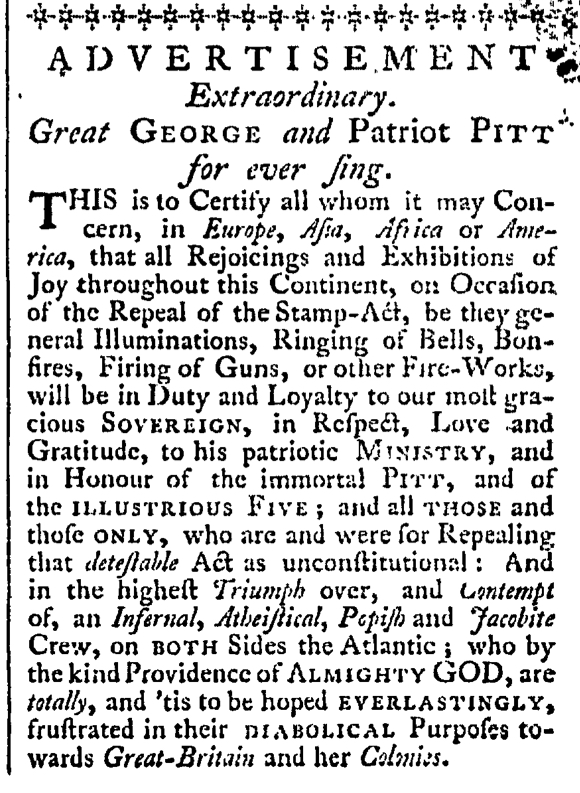
Rind inserted an “ADVERTISEMENT Extraordinary” originally published in the Boston Gazette (April 21, 1766); the Adverts 250 Project previously featured this “ADVERTISEMENT Extraordinaryreprinted in the New-Hampshire Gazette (April 25, 1766) and noted when it also appeared in the Newport Mercury (April 28, 1766). It quite likely appeared in many other newspapers in April and May 1766. The original and the reprints in the New-Hampshire Gazette and the Newport Mercury all included this final line: “P.S. All Printers throughout this Continent are desired to publish this Advertisement.” Although this “ADVERTISEMENT Extraordinary” did not generate any revenue for Rind, it was valuable content that demonstrated to readers that they could depend on the printer’s connections to deliver news of interest from throughout the colonies.

May 16 - Lee 5:16:1766 Rind's Virginia Gazette
Rind’s Virginia Gazette (May 16, 1766).

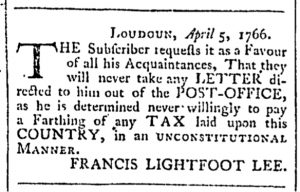
The next two advertisements that appeared in the first issue of Rind’s Virginia Gazette took a distinctly partisan tone, making them appropriate complements to the “Advertisement Extraordinary.” In one, Francis Lightfoot Lee, member of the Virginia House of Burgesses and future signer of the Declaration of Independence, warned friends and acquaintances against picking up letters addressed to him at the post office because “he is determined never willingly to pay a Farthing of any TAX laid upon this COUNTRY, in an UNCONSTITUTIONAL MANNER.”

May 16 - 5:16:1766 Rind's Virginia Gazette
Rind’s Virginia Gazette (May 16, 1766).

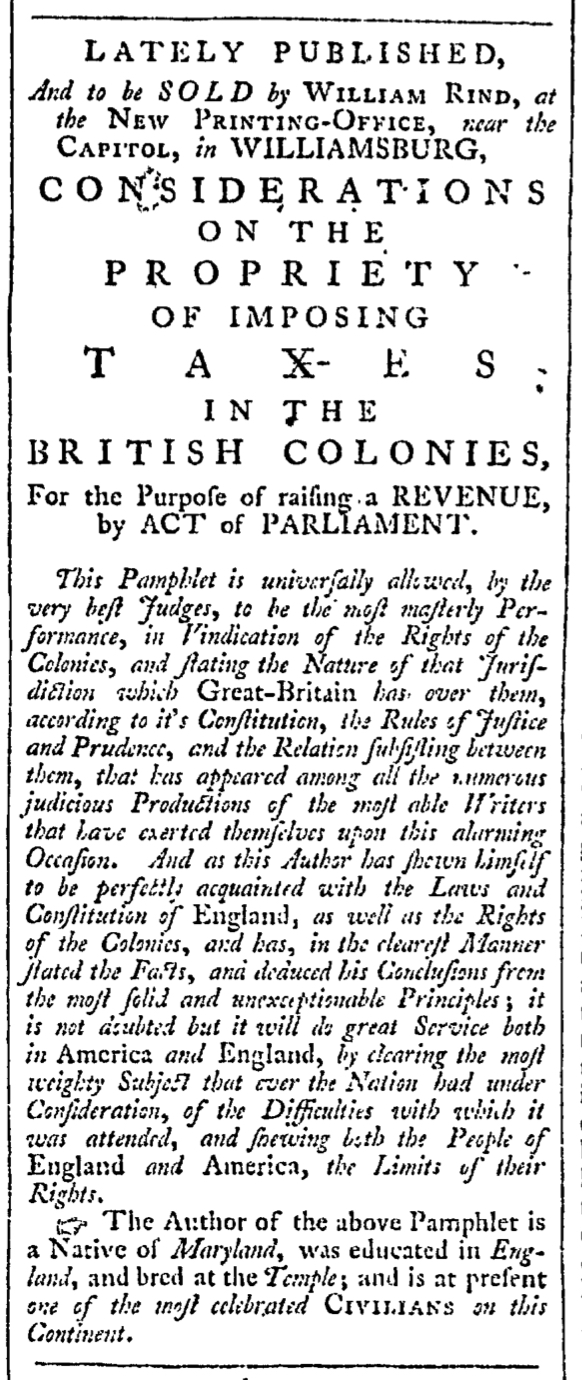
The other advertisement with a partisan valence marketed a pamphlet that examined ‘THE PROPRIETY OF IMPOSING TAXES IN THE BRITISH COLONIES, For the Purpose of raising a REVENUE, by ACT of PARLIAMENT.” Although “LATELY PUBLISHED, And to be SOLD by WILLIAM RIND,” these two descriptions need to be separated from each other. Rind likely sold a pamphlet that had recently been published by another printer. This same advertisement, except for the information about where it was sold, previously appeared in a variety of newspapers in New England and the Middle Atlantic. Either the pamphlet’s printer provided printers and booksellers with copy to place their own advertisements or Rind borrowed the copy from other newspapers (just as he had done with the “ADVERTISEMENT Extraordinary.” Either way, the newspaper did not generate any revenue from this advertisement; Rind inserted it to advance his other branches of his printing and bookselling business. (This calls into question whether Lee paid to insert his advertisement, dated a month earlier, into Rind’s Virginia Gazette or if Rind reprinted it from another publication.)

May 16 - Stray Horse 5:16:1766 Rind's Virginia Gazette
Rind’s Virginia Gazette (May 16, 1766).

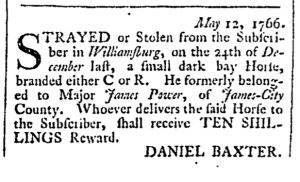
Daniel Baxter’s notice (dated May 12) about a stray or stolen horse was certainly a new advertisement. Similar advertisements appeared frequently in newspapers throughout the colonies. The misfortune of the advertisers financially benefited the printers who published their advertisements.

Rind inserted one more advertisement of his own, an abbreviated version of his request for “Gentlemen who have obliged him by taking in Subscriptions” to return the lists to him as soon as possible. A more extensive version appeared a week earlier in the competing Virginia Gazette.

May 16 - Subscription 5:16:1766 Rind's Virginia Gazette
Rind’s Virginia Gazette (May 16, 1766).

Finally, the colophon encouraged readers to become subscribers and presented the terms for advertising in Rind’s Virginia Gazette. “ADVERTISEMENTS of a moderate Length are inserted for 3 s. the First Week, and 2 s. each Time after: And long Ones in Proportion.” Rind adopted a price structure that exactly replicated that of the Virginia Gazette. He didn’t seek to undercut the competition (doing so might not have allowed for any profit), but he also attempted to make advertising in his newspaper as attractive as possible.

May 16 - Colophon 5:16:1766 Rind's Virginia Gazette
Rind’s Virginia Gazette (May 16, 1766).

Even though Rind had previously advertised in the Virginia Gazette that he intended to begin publishing his own newspaper, very little advertising appeared in the first issue. That makes sense since not even Rind seemed certain of how many people had signed up as subscribers. Potential advertisers likely waited to see how successful Rind’s Virginia Gazette would be, delaying decisions to purchase advertising space until they had a better sense that doing so would likely produce a satisfactory return on their investment. For his part, Rind inserted enough advertising to assure others that their marketing efforts would not stand alone in his newspaper.