October 18

What was advertised in a revolutionary American newspaper 250 years ago today?

Pennsylvania Journal (October 18, 1775).

“An Elegy to the memory of the American Volunteers who fell … April 19, 1775.”

During the era of the American Revolution, advertisements for almanacs frequently appeared in newspapers from New England to Georgia each fall.  Such was the case in the Pennsylvania Journal in 1775.  James Adams, a printer in Delaware, inserted a notice that announced that he “JUST PUBLISHED … The WILMINGTON and PENNSYLVANIA ALMANACKS, For the year of our LORD, 1776.”

Adams followed a familiar format for advertising almanacs.  He indicated that both editions included “the usual astronomical calculations” that readers would find in any almanac as well as a variety of other enticing contents.  The Pennsylvania edition included “Pithy Sayings” for entertainment and “Tables of Interest at six and seven per cent” for reference as well as the “Continuation of William Penn’s Advice to his Children” and the “Conclusion of Wisdom’s Call to the young of both sexes.”  Adams published a portion of those pieces in the almanac for the previous year, anticipating that readers would purchase the subsequent edition for access to the essays in their entirety.  The almanac for 1776 also suggested “Substitutes for Tea,” certainly timely considering that the Continental Association remained in effect. Colonizers sought alternatives while they boycotted imported tea.

Current events played an even more prominent role in the Wilmington Almanack.  It featured an “Elegy to the memory of the American Volunteers, who fell in the engagement between the Massachusetts-Bay Militia and the British Troops, April 19, 1775.”  Six months after the battles at Lexington and Concord, Adams memorialized the minutemen who had died for the American cause during the first battles of the Revolutionary War.  In addition, the almanac featured “The Irishman’s Epistle to the Officers and troops at Boston,” “Liberty-Tree,” and “A droll Dialogue between a fisherman of Poole, in England, and a countryman, relative to the trade of America, and proposed victory over the Americans.”  Adams did not elaborate on those items, perhaps intentionally.  Presenting the titles of the pieces without further elaboration was standard practice in advertisements for almanacs, but in this case the printer may have intended to stoke curiosity that would lead to more sales.  For both almanacs, a concern for current events and a burst of patriotism influenced the contents and their marketing.
August 16

What was advertised in a revolutionary American newspaper 250 years ago today?

Massachusetts Spy (August 16, 1775).

“An unwearied Pedlar of that baneful herb TEA.”

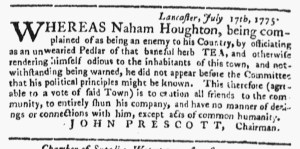
Naham Houghton of Lancaster, Massachusetts, went too far and there had to be consequences.  An advertisement in the August 16, 1775, edition of the Massachusetts Spy gave an abbreviated account of what occurred.  According to John Prescott, chairman of the local Committee of Inspection, there had been complaints that Houghton behaved as “enemy to his Country, by officiating as an unwearied Pedlar of that baneful herb TEA, and otherwise rendering himself odious to the inhabitants of this town.”  Prescott did not elaborate on the other infractions.  Selling tea was enough to get Houghton into hot water.

That violated the Continental Association, a nonimportation agreement devised by the First Continental Congress in response to the Coercive Acts imposed by Parliament in retribution for the Boston Tea Party.  The eleventh article outlined an enforcement mechanism, stating that a “Committee be chosen in every County, City, and Town” to monitor compliance with the pact.  When a majority determined that someone committed a violation, they would “cause the truth of the case to be published in the Gazette, to the End that all such foes to the rights of British America may be publickly known and universally condemned as Enemies.”  In turn, the rest of the community would “break off all Dealings with him, or her.”

The committee in Lancaster apparently sought to work with Houghton in seeking an explanation for his actions, but to no avail.  Prescott reported that Houghton refused to “appear before the Committee that his political principles might be known” even though he had been warned.  Neither the committee nor the town tolerated such defiance.  The town voted “to caution all friends to the community, to entirely shun his company,” as the Continental Association instructed, “and have no manner of dealings or connections with him, except acts of common humanity.”  Selling tea continued to resonate as a political act, yet it was only one of many offenses that made Houghton “odious” to his neighbors.  At the same time that others suspected of Tory sympathies confessed their errors and used newspaper advertisements to rehabilitate their reputations, Houghton steadfastly refused to bow to such pressure exerted by the Committee of Inspection.  He instead became the subject of an advertisement that made clear, far and wide, that he was not in good standing in his community.

August 6

What was advertised in a revolutionary American newspaper 250 years ago this week?

New-York Journal (August 3, 1775).

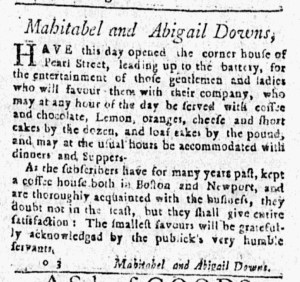
“The subscribers have for many years past, kept a coffeehouse both in Boston and Newport.”

In the summer of 1775, Mahitabel Downs and Abigail Downs published an advertisement that advised residents of New York that they had opened a “house … for the entertainment for those gentlemen and ladies who will favour them with their company.”  They offered hospitality to their guests “at any hour of the day,” serving “coffee and chocolate, Lemon, oranges, cheese and short cakes by the dozen, and loaf cakes by the pound.”  Among the beverages listed in their advertisement, the Downses notably did not include tea.  Although a favorite of many colonizers, tea was at the center of political controversies during the imperial crisis.  In not serving tea to their patrons, the Downses indicated that they supported the American cause or at least abided by the boycott currently in effect.  Guests could gather at their house of entertainment with confidence that they upheld the Continental Association’s prohibition on drinking “East India Tea.”

Apparently the Downses were newcomers in New York.  Accordingly, they believed that they needed to do more to entice guests to dine and socialize at their house of entertainment on Pearl Street than merely list the refreshments that they could enjoy there.  Although new to the city, they were not new to the business, as they explained in their advertisement.  The hostesses shared that they “have for many years past, kept a coffee house both in Boston and Newport, and are thoroughly acquainted with the business.”  As a result, “they doubt not in the least, but they shall give entire satisfaction” to their guests.  Even though readers did not know them by reputation, the Downses hoped that their prior experience operating similar establishments in bustling port cities in New England would convince prospective patrons of the quality of the experience – the food, the beverages, the furnishings, the atmosphere – they could expect at this new house of entertainment.  If the Downses succeeded in persuading guests to visit them once then they anticipated that the food, drink, and service would serve as sufficient recommendation to return.

May 24

What was advertised in a revolutionary American newspaper 250 years ago today?

Pennsylvania Journal (May 24, 1775).

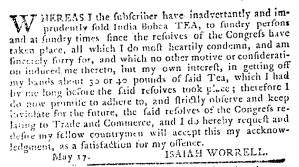
“I … have inadvertently and imprudently sold India Bohea TEA, to sundry persons and at sundry times.”

Isaac Worrell needed to do some damage control when others discovered that he had been selling tea in violation of the third article of the Continental Association in the spring of 1775.  That nonimportation agreement, devised by the First Continental Congress the previous fall, stated “we will not purchase or use any Tea imported on Account of the East India Company, or any on which a Duty hath been or shall be paid; and, from and after the first Dat of March next, we will not purchase or use any East India Tea whatever.”  Yet Worrell had not abided by those terms.

In an advertisement that first appeared in the May 17, 1775, edition of the Pennsylvania Journal and ran again the following week, Worrell confessed that he “imprudently sold India Bohea TEA, to sundry persons and at sundry times since the resolves of the Congress have taken place,” though he claimed that he had done so “inadvertently.”  Readers may have been skeptical that a prohibited act that occurred repeatedly happened “inadvertently.”  All the same, Worrell hoped that they would take note of his explanation for the infractions and accept his apology.  He asserted that he had “no other motive or consideration … but my own interest, in getting off my hands about 30 or 40 pounds of said Tea.”  He also contended that he acquired the tea “long before the said resolves took place,” hoping that would make his offense seem less serious.  At least he had not actively ordered or received new shipments.

Worrell assured his community that he had reformed.  “I do now promise to adhere to, and strictly observe and keep inviolate for the future,” he proclaimed, “the said resolves of the Congress relating to Trade and Commerce.”  He hoped that would be sufficient that “my fellow countrymen will accept this my accknowledgment, as a satisfaction for my offence.”  The Continental Association called for breaking off all ties, commercial and social, with those who violated it, yet Worrell hoped that his apology would outweigh his flimsy excuses to restore him to the good graces of the public. That he managed to sell “30 or 40 pounds of said Tea,” however, suggests that many others did not obey the terms of the Continental Association.  Loyalists accused Patriots of cheating, especially when it came to tea.  Worrell’s notice seems to support such allegations.

May 15

What was advertised in a revolutionary American newspaper 250 years ago today?

Connecticut Courant (May 15, 1775).

“TEA! (I ask pardon) [&] COFFEE kettles.”

In the spring of 1775, Frederick Bull advertised a variety of items available at his store in Hartford.  In addition to “earthen and delph WARE” and an assortment of liquors and groceries, he emphasized that he stocked the “most universal assortment of iron HOLLOW WARE perhaps ever brought into any one store in this town, such as large kettles and coolers, large, middle sized and small pots, spiders, bake pans, basons, [and] skillets.”  The list concluded with two items that likely drew attention because they appeared in capital letters: “TEA! [&] COFFEE kettles.”

The tea kettles may have caused some concern among readers.  After all, the third article of the Continental Association specified that “after the first Day of March [1775], we will not purchase or use any East India Tea whatever.”  If colonizers were abiding by the nonimportation and nonconsumption agreement devised by the First Continental Congress and not drinking tea then they should not have needed to purchase new tea kettles, yet Bull marketed them in the Connecticut Courant.  The first time his advertisement appeared, it ran one column over from an update about Samuel Adams and John Hancock from Massachusetts and Silas Deane and Roger Sherman from Connecticut making their way to Philadelphia to attend the Second Continental Congress following the battles at Lexington and Concord.  Their arrival in New York “was announced by the ringing of bells, and other demonstrations of joy.”

All the same, Bull advertised tea kettles for sale in Hartford.  He had the good graces to insert a brief note of apology.  The entire phrase read: “TEA! (I ask pardon) [&] COFFEE kettles.”  Most likely the tea kettles had been part of a larger shipment; perhaps he presented them to consumers as an option, leaving it to them to decide whether they could purchase them in good conscience.  That he included them in his advertisement at all indicated that there were limits to the amount of shame that Bull felt in hawking them.  Although he proclaimed, “I ask pardon,” that may have been an eighteenth-century version of “Sorry (not sorry),” a wink and a nod to prospective customers who continued to drink tea on the sly.  Bull acknowledged that he engaged in suspect behavior by selling tea kettles, yet he hoped that his apology combined with demand for those kettles would absolve him of any consequences.

April 27

What was advertised in a revolutionary American newspaper 250 years ago today?

Norwich Packet (April 27, 1775).

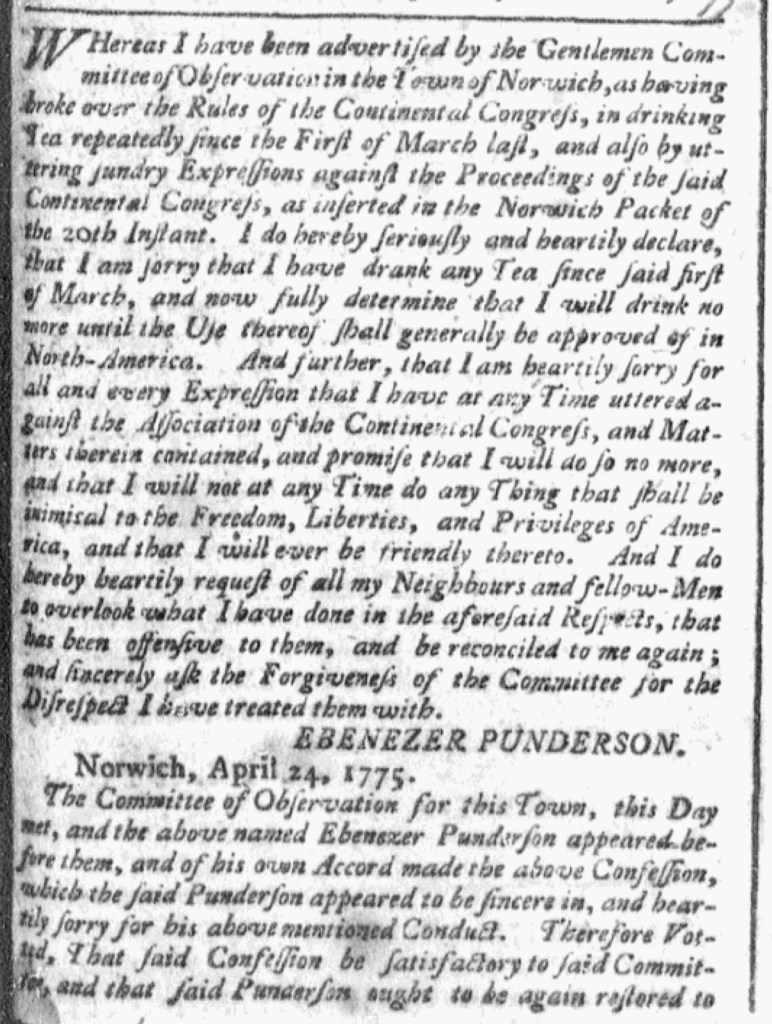
I am sorry that I have drank any Tea.”

Ebenezer Punderson had the misfortune of appearing in an advertisement placed in the Norwich Packet by the local Committee of Inspection in the issue that carried the first newspaper coverage of the battles of Lexington and Concord.  The committee accused him of drinking tea in violation of the Continental Association, disparaging the First Continental Congress, and refusing to meet with the committee to discuss his conduct.  In turn, the committee advised the public not to carry on any “Trade, Commerce, Dealings or Intercourse” with Punderson.

Perhaps Punderson would have weathered that sort of public shaming under other circumstances, but news of events at Lexington and Concord made his politics even more unpalatable and his situation more dire.  From what ran in the newspaper, it did not take him long to change his tune, meet with the committee, and publish an apology for his behavior.  In a missive dated four days after the committee’s advertisement, Punderson reiterated the charges against him and “seriously and heartily” declared the he was “sorry I have drank any Tea since the first of March” and “will drink no more until the Use thereof shall generally be approved in North-America.”  In addition, he apologized for “all and every Expression that I have at any Time uttered against the Association of the Continental Congress.”  Furthermore, Punderson pledged that he “will not at any Time do any Thing that shall be inimical to the Freedom, Liberties, and Privileges of America, and that I will ever be friendly thereto.”  He requested that his “Neighbours and fellow-Men to overlook” his transgression and “sincerely ask[ed] the Forgiveness of the Committee for the Disrespect I have treated them with.”

Norwich Packet (April 27, 1775).

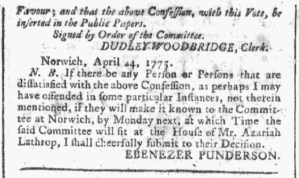
Punderson apparently convinced the committee to give him another chance.  Dudley Woodbridge, the clerk, reported that Punderson “appeared before them, and of his own Accord made the above Confession” and seemed “heartily sorry for his … conduct.”  In turn, the committee voted to find Punderson’s confession “satisfactory” and recommended that he “be again restored to Favour” in the community.  The committee also determined that “the above Confession, with this Vote, be inserted in the Public Papers,” perhaps less concerned with restoring Punderson’s good name than the example his recantation set for other Tories.  When the notice appeared in the Norwich Packet, Punderson inserted an additional note that extended an offer to meet with anyone “dissatisfied with the above Confession” and asserted that he would “cheerfully submit” to any further decisions the Committee of Inspection made in response.

Yet what appeared in the Norwich Packet did not tell the whole story.  According to Steve Fithian, Punderson “attempted to flee to New York but was captured and returned to Norwich where he spent eight days in jail and only released after signing a confession admitting to his loyalist sympathies.”  He did not stay in Norwich long after that.  “Several weeks later he fled to Newport, Rhode Island and boarded a ship which took him to England where he remained for the entire Revolutionary War.”  Apparently, he convincly feigned the sincerity he expressed, well enough that the committee accepted it.  While imprisoned, Punderson wrote a letter to his wife about his ordeal.  After arriving in England, he published an account with a subtitle that summarized what he had endured: The Narrative of Mr. Ebenezer Punderson, Merchant; Who Was Drove Away by the Rebels in America from His Family and a Very Considerable Fortune in Norwich, in Connecticut.  Just as the Committee of Inspection used print to advance a version of events that privileged the patriot cause, Punderson disseminated his own rendering once he arrived in a place where he could safely do so.

**********

The Committee of Inspection’s notice appeared with the advertisements in the April 20, 1775, edition of the Norwich Packet.  Punderson’s confession, however, ran interspersed with news items in the April 27 edition.  It may or may not have been a paid notice, but it was certainly an “advertisement” in the eighteenth-century meaning of the word.  At the time, according to the Oxford English Dictionary, an advertisement was a “(written) statement calling attention to anything” and “an act of informing or notifying.”  Advertisements often delivered local news in early American newspapers.  Punderson definitely made news as the imperial crisis became a war.

April 20

What was advertised in colonial American newspaper 250 years ago today?

Norwich Packet (April 20, 1775).

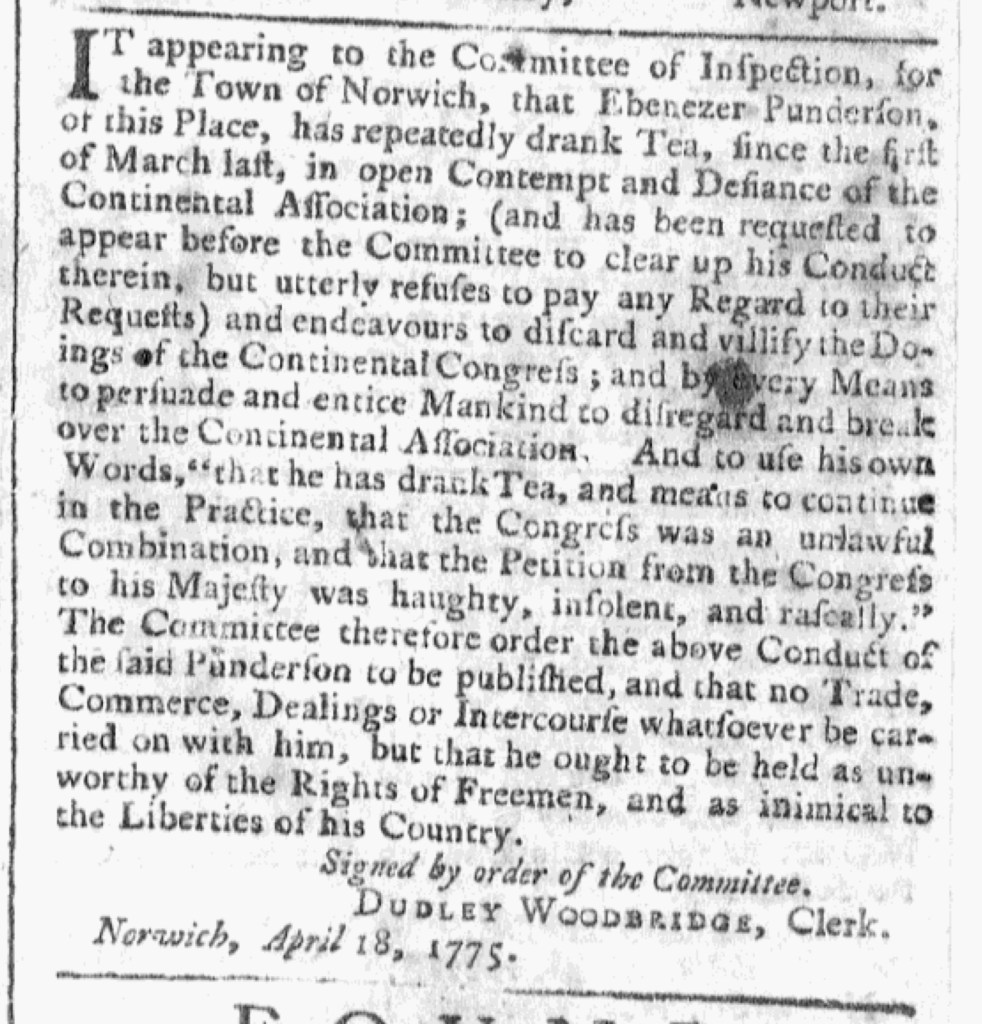
“Ebenezer Punderson … has repeatedly drank Tea … in open Contempt and Defiance of the Continental Association.”

Ebenezer Punderson went too far and now it was time for consequences.  He brazenly and repeatedly violated the Continental Association, the nonimportation and nonconsumption agreement enacted by the Continental Congress in response to the Coercive Acts.  As a result of his actions, the Committee of Inspection in Norwich, Connecticut, placed an advertisement in the April 20, 1775, edition of the Norwich Packet to document his behavior and advise the community to shun Punderson.

The committee reported that Punderson “has repeatedly drank Tea … in open Contempt and Defiance of the Continental Association.”  When the committee sought to investigate the matter, he “utterly refuse[d] to pay any Regard to their Requests” to appear before it.  Even worse, he “endeavours to discard and vilify the Doings of the Continental Congress; and by every Means to persuade and entice Mankind to disregard and break over the Continental Association.”  His refusal to abide by the Continental Association damaged the movement and had the potential to do even more harm by inspiring others to ignore it as well.  In addition, he stridently declared that he had no intention of adhering to the agreement, insulting the Continental Congress in the process:  “to use his own words, ‘that he has drank Tea, and means to continue in that Practice, that the Congress was an unlawful Combination, and that the Petition from the Congress to his Majesty was haughty, insolent, and rascally.’”

The Committee of Inspection, in turn, determined that it was Punderson who was haughty, insolent, and rascally.  It ordered that the “Conduct of the said Punderson be published, and that no Trade, Commerce, Dealings or Intercourse whatsoever be carried on with him.”  Furthermore, the committee declared that “he ought to be held as unworthy of the Rights of Freemen, and as inimical to the Liberties of his Country.”  Punderson acted in opposition to the patriot cause.  The Committee of Inspection intended to see him pay for his transgressions.

Norwich Packet (April 20, 1775).

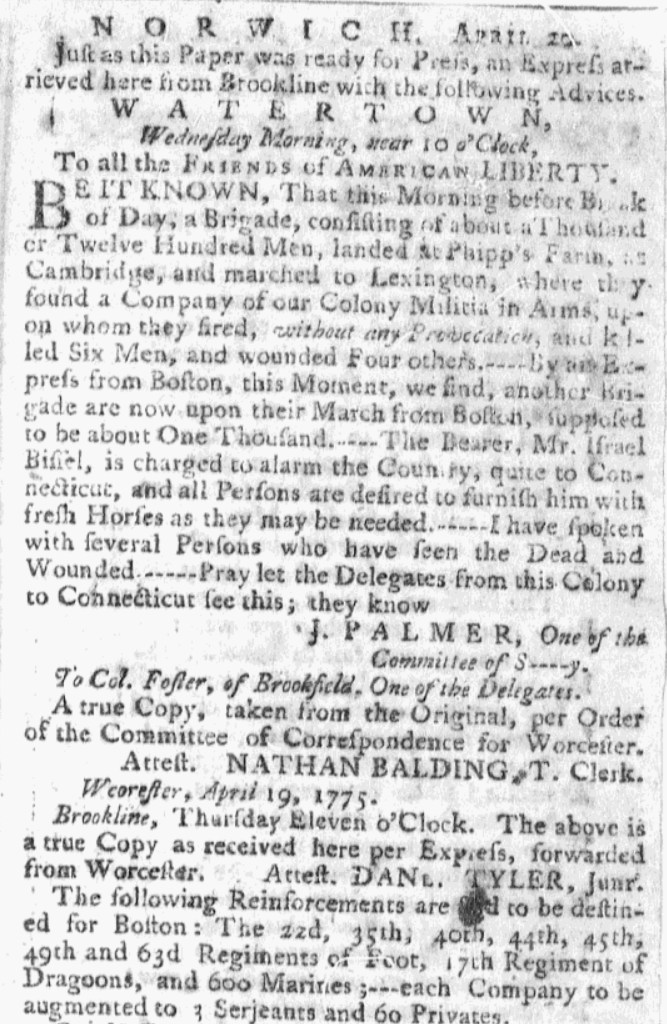
Punderson chose the wrong time to draw attention to himself.  Some of the first coverage of the battle at Lexington to appear in American newspapers ran at the top of the column that featured the advertisement about his offenses.  “Just as this Paper was ready for Press,” the printers declared, “an Express arrived here from Brookline with the following Advices” from J. Palmer, “One of the Committee of S[afet]y,” and dispatched to “Col. Foster, of Brookfield.”  The missive reported that before dawn on the morning of April 19 “a Brigade [of British troops] … marched to Lexington, where they found a Company of our Colony Militia in Arms, upon whom they fired, without any Provocation, and killed Six Men, and wounded Four others.”  Palmer stated that he had “spoken with several Persons who have seen the Dead and Wounded.”  He also relayed news that another Brigade “are now on their March from Boston.”  Israel Bissell carried the message, “charged to alarm the Country” in western Massachusetts all the way to Connecticut.  The printers published this account from a “true Copy, taken from the Original, per Order of the Committee of Correspondence for Worcester.”  The details were sparse, yet the “FRIENDS of AMERICAN LIBERTY” reading the Norwich Packet now knew that fighting had commenced near Boston.  That news quite likely had an impact on their attitude when they read about Punderson’s offenses further down the column.

April 3

What was advertised in a colonial American newspaper 250 years ago today?

Newport Mercury (April 3, 1775).

“No TEA – till duty FREE.”

When Thomas Green advertised a variety of grocery items in the April 3, 1775, edition of the Newport Mercury, he listed “SUGAR, FLOUR, COFFEE, … CHOCOLATE, … PEPPER, … NUTMEGS, CLOVES, and MACE.”  Tea, one of the commodities that so often appeared in such lists, was conspicuously absent.  Many shopkeepers had refused to stock, advertise, or sell tea in the aftermath of the Boston Tea Party in December 1773, just as many consumers refrained from purchasing tea.  Abstaining from tea was not universal, however, as some advertisers did continue to include it in their advertisements even after the colonies received word of the Boston Port Act, the Massachusetts Government Act, and the other Coercive Acts that Parliament passed in response to the destruction of the tea by colonizers who masqueraded as Indigenous Americans.  Tea even merited particular notice in the Continental Association, the nonimportation pact devised by the First Continental Congress during its meetings in Philadelphia in September and October 1774, yet Peter Oliver, a noted Loyalist judge in Boston, alleged in his Origin and Progress of the American Rebellion that colonizers, especially women, manufactured all sorts of justifications for continuing to drink tea.

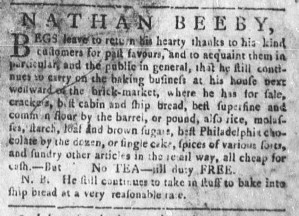
Nathan Beeby, a baker in Newport, took a stand regarding tea in the same issue of the newspaper that carried Green’s advertisement.  He thanked his “kind customers for past favours” and advised the public that “he still continues to carry on the baking business at his house, where he has for sale, crackers, best cabin and ship bread, [and] best superfine and common flour by the barrel, or pound.”  He also peddled “rice, molasses, starch, loaf and brown sugars, best Philadelphia chocolate …, spices of various sorts, and sundry other articles in the retail way.”  As many retailers did at the time, he specified that he did not extended credit, accepting only cash, and then he added: “– But     No TEA – till duty FREE.”  Green left it to readers to realize that tea did not appear in his advertisement, while Beeby made a point of announcing that he did not stock or sell the problematic commodity.  The amount of space that appeared between “But” and “No TEA” amounted to a dramatic pause, further emphasizing Beeby’s commitment and perhaps serving as a reminder to readers of the pledges they made to refuse to consume that beverage.  The baker practiced politics in his advertisement, using the space he purchased in the Newport Mercury to participate in public discourse.

December 14

What was advertised in a colonial American newspaper 250 years ago today?

Pennsylvania Journal (December 14, 1774).

“GREEN and SOUCHONG TEAS.”

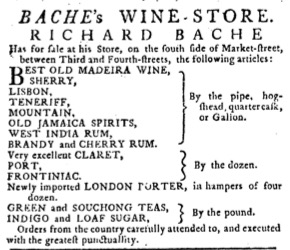
A year after the Boston Tea Party, advertisements for tea continued to appear in newspapers throughout the colonies.  They even continued to run after the Continental Association, a nonimportation agreement adopted by the First Continental Congress, went into effect on December 1, 1774.  The December 14, 1774, edition of the Pennsylvania Journal, for instance, carried two advertisements, side by side at the top of the final page, that included tea among the commodities offered for sale.  “BACHE’s WINE-STORE” stocked more than just wine and spirits.  Richard Bache also promoted “GREEN and SOUCHONG TEAS … By the pound.”  Similarly, “JOHN MITCHELL’s Wine, Spirit, Rum and Sugar STORES” provided consumers with “Bohea Tea, warranted good, by the chest, half chest or dozen” and “Best Green and Hyson Tea, by the dozen or pound.”  These advertisements apparently did not meet with the sort of ire that resulted in Bache or Mitchell quickly discontinuing them.  Instead, James R. Fichter documents in Tea: Consumption, Politics, and Revolution, 1773-1776, that “between May 1774 and March 1775 their ads appeared most weeks.”[1]

That seems incongruous considering the editorial position of the Pennsylvania Journal and the actions of William Bradford, one of its printers.  Fichter explains that Bradford “hosted in his home the meeting which decided how to oppose the East India Company’s shipment to Philadelphia in 1773.  Furthermore, he published “John Dickinson’s denunciation of the 1773 tea scheme, the broadsides from ‘Committee on Tarring and Feathering,’ which threatened pilots” who brought ships carrying tea up the Delaware River, and the “JOURNAL OF THE PROCEEDINGS” of the First Continental Congress.  On July 27, 1774, the Pennsylvania Journal altered its masthead to include a woodcut depicting a severed snake, each segment labeled to represent one of the colonies, and the motto, “UNITE OR DIE.”  How did advertisements that offered tea for sale find their way into such a newspaper so regularly?  Fichter explains that Bradford “was also a business” as well as a Patriot.  Like other newspaper printers who shared his political principles, he “did not censor tea ads” but instead “ran these ads as long as they were politically permissible.”  Even so late in 1774, “discourse and consumption were only partially politicized,” Fichter asserts, “and advertisements remained separate from but parallel to political debate.”[2]  While that was the case for advertisements about tea, other advertisements did take positions, either implicitly or explicitly, about the politics of consumption, yet Fichter demonstrates the complexity and nuance in how printers, advertisers, and the public approached such issues.  Neither the Boston Tea Party nor the Continental Association resulted in colonizers immediately giving up tea or other imported goods.

**********

[1] James R. Fichter, Tea: Consumption Politics, and Revolution, 1773-1776 (Ithaca: Cornell University Press, 2023), 143.

[2] Fichter, Tea, 143.

November 6

What was advertised in a colonial American newspaper 250 years ago this week?

Postscript to the Virginia Gazette [Purdie and Dixon] (November 3, 1774).

“It has been thought necessary, for the publick Good, to enter into several particular Resolves.”

As the imperial crisis intensified in the fall of 1774, the distinction between news items and advertisements in colonial newspapers became blurry with greater frequency.  Such was the case with letter-advertisements expressing regret for signing “an Address to the late Governor Hutchinson, on his leaving this Province” in several newspapers in Massachusetts.  Another instance appeared in the Virginia Gazette, published by Alexander Purdie and John Dixon in Williamsburg.  On November 3, they distributed a two-page Postscript to accompany the standard four-page issue.  That supplement included nothing but advertising except, perhaps, the first item in the first column on the first page.  With a dateline that read, “EDENTON, NORTH CAROLINA, October 25, 1774,” it featured the petition signed by fifty-one women at the Edenton Tea Party and listed their names in two columns.

Those women expressed their support for resolutions protesting the Tea Act of 1773 passed by the North Carolina Provincial Congress in August.  They proclaimed, “AS we cannot be indifferent on any Occasion that appears nearly to affect the Peace and Happiness of our Country, and as it has been thought necessary, for the publick Good, to enter into several particular Resolves, by a Meeting of Members deputed from the whole Province, it is a Duty which we owe, not only to our near and dear Connections, who have concurred in them, but to ourselves, who are essentially interested in their Welfare, to do every Thing as far as lines in our Power to testify our sincere Adherence to the same; and we do therefore accordingly subscribe this Paper, as a Witness of our fixed Intention and solemn Determination to do so.” In a single sentence, the women of Edenton declared their position on current events and pledged to participate in politics through the decisions they made about consumption.  They added their voices to those who adopted nonimportation agreements.

Why did their petition appear in an advertising supplement?  Had the women involved in the Edenton Tea Party sent their petition to Purdie and Dixon to feature in the Virginia Gazette?  Probably not, but they may have submitted it to the printer of the North-Carolina Gazette in New Bern.  The few extant issues of that newspaper have not been digitized for greater accessibility, making it difficult to determine if the petition appeared in that newspaper and then Purdie and Dixon reprinted it.  After all, colonial printers constantly reprinted items from other newspapers.  The printers in Williamsburg could have received an issue of the North-Carolina Gazette with the petition from the Edenton Tea Party after they printed the November 3 edition of the Virginia Gazette but did not wish to wait a week to disseminate it in the next issue.  Take into consideration as well that news, especially “Extracts from the Votes and Proceedings of the AMERICAN CONTINENTAL CONGRESS,” filled much of the newspaper, crowding out advertisements.  The printers had reason to produce an advertising supplement, yet they may have also wished to highlight the petition signed by patriotic women in Edenton.  The “Extracts” started with an overview of the Continental Association, a nonimportation agreement, as the first news item.  The women’s petition ran as the first item in the Postscript, mirroring the placement of the Continental Association and demonstrating the commitment already expressed for such measures even before the First Continental Congress formally adopted them.  At a glance, it looked like another advertisement among those in the Postscript, yet it delivered important news to readers.