January 17

What was advertised in a revolutionary American newspaper 250 years ago today?
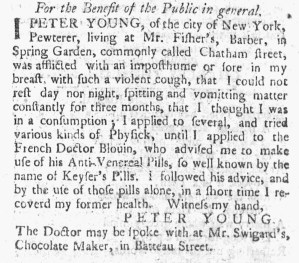
Constitutional Gazette (January 17, 1776).

“I applied to the French Doctor Blouin, who advised me to make use of his Anti-Venereal Pills.”

Peter Young, a pewterer in New York, went through quite an ordeal.  According to the advertisement he placed in the January 17, 1776, edition of the Constitutional Gazette, he “was afflicted with an imposthume or sore in my breast, with such a violent cough, that I could not rest day or night.”  In addition, he was “spitting and vomitting matter constantly for three months,” so much so that he thought he “was in a consumption.”  Young sought out medical assistance from several providers and “tried various kinds of Physick,” but none of them could alleviate the disorder that he suffered … at least not until he “applied to the French Doctor Blouin.”  That doctor advised Young “to make use of his Anti-Venereal Pills, so well known by the name of Keyser’s Pills.”  The pewterer followed Blouin’s advice and “by the use of those pills alone, in a short time [he] recovered [his] former health.”

According to the advertisement’s header, Young inserted his testimonial in the Constitutional GazetteFor the Benefit of the Public in general.”  Beneath his signature, a note advised, “The Doctor may be spoke with at Mr. Swigard’s, Chocolate Maker, in Batteau Street.”  The advertisement gave no indication about who added that note.  It could have been Young or it could have been John Anderson, the printer of the Constitutional Gazette, out of his own desire to assist the public.  Most likely, Blouin added that detail and engineered publishing the testimonial while seeking to make it appear that Young published it independently.  After all, if Young pursued that course on his own, solely “For the Benefit of the Public in general,” that made the recommendation even more noteworthy for readers who hoped for relief from similar symptoms.  Blouin previously placed advertisements in the Constitutional Gazette, introducing himself and his pills “TO THE PUBLIC.”  Young’s testimonial supplemented his previous marketing efforts.

November 29

What was advertised in a revolutionary American newspaper 250 years ago today?

Pennsylvania Gazette (November 29, 1775).

“We, the subscribers, do recommend the above named John Spering as a Rider.”

In the fall of 1775, John Spering, a resident of Easton, took to the pages of the Pennsylvania Gazette to announce that he “proposes to ride POST” between Philadelphia and Northampton.  Along the way he would make stops in “Germantown, Bussel-town [now Bustleton], Four-lane-end [now Langhorne], Newtown, Durham, Easton, Bethlehem, and Northampton.”  Until January 1, he would depart Philadelphia each Wednesday evening.  In January, February, and March, he planned to scale back service to “once every fortnight,” presumably due to the weather, and then resume weekly service on April 1.  He assured “All Gentlemen and ladies who are pleased to encourage this undertaking” that they “may depend upon being punctually served, and that the greatest care will be taken of such letters, or other things,” such as small parcels, entrusted to him.  Given that the Pennsylvania Gazette circulated widely beyond Philadelphia, Spering hoped that his advertisement would attract patrons in the many towns along his route.

He also realized that most prospective customers did not know him and thus might be cautious about handing over letters and packages.  To address such concerns, he included a character reference signed by nine residents of Easton.  “We, the subscribers,” they declared, “do recommend the above named John Spering as a Rider, as we believe he will perform his duty therein faithfully and honestly.”  They noted that Spering had been “a resident in Easton for upwards of thirteen years, where he has, during that time, behaved himself very well.”  Prospective clients could have confidence that he would faithfully deliver their letters without tampering with them.  The signatories would have been as unknown to most readers as Spering, but the titles that accompanied some of their names testified to their trustworthiness and standing in their community: “Lewis Gordon, Esq; Henry Fullert, Esq; Dr. Andrew Ledlie, [and] Jacob Orndt, Esq.”  That so many of his neighbors endorsed Spering at the risk of their own reputations may have helped to convince the “Gentlemen and Ladies” that Spering addressed to avail themselves of his services when they had letters to post.

April 4

What was advertised in a colonial American newspaper 250 years ago today?

Pennsylvania Evening Post (April 4, 1775).

“Restored to as good a state of health as ever he had in his life.”

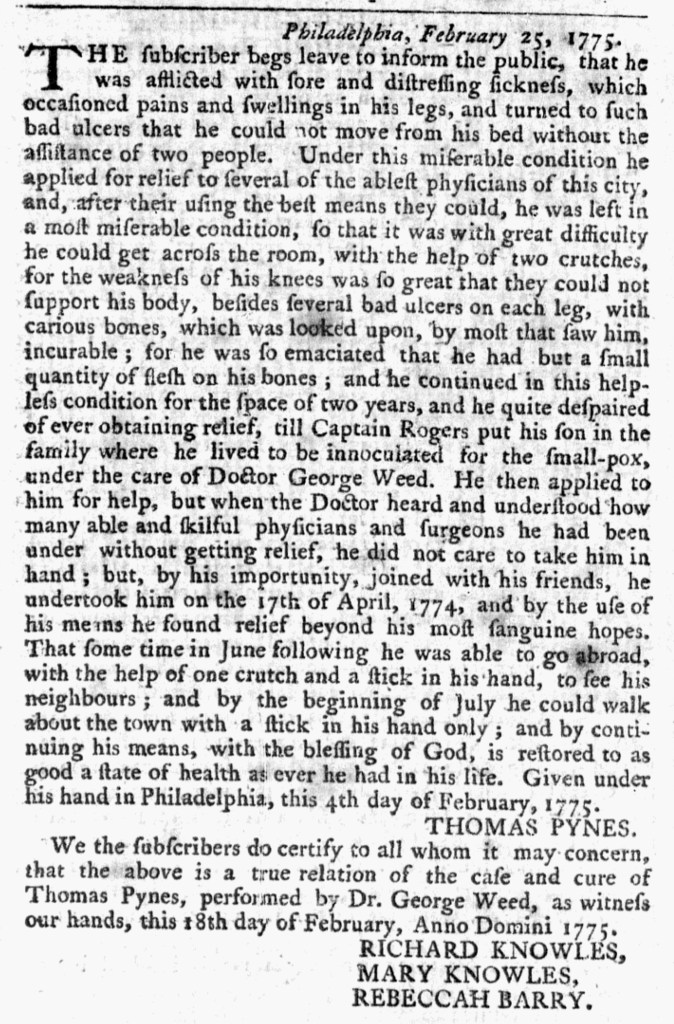
The final page of the April 4, 1775, edition of the Pennsylvania Evening Post consisted entirely of advertisements (and the colophon running across both columns at the bottom of the page).  The final notice filled about two-thirds of the column, making it longer than many of the news items that ran elsewhere in that issue.  It took the form of an open letter in which Thomas Pynes described how he was formerly “afflicted with sore and distressing sickness, which occasioned pains and swellings in his legs, and turned to such bad ulcers that he could not move from his bed without the assistance of two people.”  In that “miserable condition,” he “applied for relief” and consulted “several of the ablest physicians” in Philadelphia, but he did not experience any relief even after they provided “the best means they could.”  Most of those doctors considered him “incurable.”

Pynes endured that condition for two years, “despair[ing] of ever obtaining relief.”  He eventually learned of patients “under the care of Doctor George Weed” and felt renewed hope, yet when Weed “heard and understood how many able and skilful physicians and surgeons [Pynes] had been under without getting relief, he did not care to take him in hand.”  Weed overcame those misgivings when Pynes enlisted the aid of friends in petitioning the doctor.  Pynes entered his care on April 17, 1774, about a year before his letter appeared in the Pennsylvania Evening Post.  He reported that “found relief beyond his most sanguine hopes.”  Furthermore, that relief arrived very quickly, especially considering how long he had been ill.  In June, just two months after Weed commenced treatment, Pynes was able to leave his house and visit his neighbors “with the help of one crutch and a stick in his hand.”  By July, he “could walk about the town with a stick in his hand only.”  Under Weed’s care, “with the blessing of God,” Pynes was “restored to as good a state of health as ever he had in his life.”

A short confirmation of Pynes’s account appeared at the end of the advertisement.  Richard Knowles, Mary Knowles, and Rebeccah Barry “certif[ied] … that the above is a true relation of the case and cure of Thomas Pynes, performed by Dr. George Weed.”  Pynes and his friends likely did not insert this letter in the Pennsylvania Evening Post on their own, just as Joseph Wellahway and Samuel Hallo probably did not submit their testimonials to that newspaper about six weeks earlier without guidance from the doctor.  Weed adopted a clever strategy in not adding anything else to these testimonials, not even giving his location, hawking the patent medicines he produced, or making other sorts of appeals.  Instead, he depended on the story told by Pynes and its authenticity as affirmed by three witnesses as all the marketing necessary to draw the attention of prospective patients.  Rather than an advertisement devised by the doctor, Pynes’s story looked like a narrative written and published for the benefit of the public, especially those who despaired of finding relief for the maladies that incapacitated them.

February 28

What was advertised in a colonial American newspaper 250 years ago today?

Pennsylvania Evening Post (February 28, 1775).

“By taking one bottle of Doctor GEORGE WEED’s Royal Balsam, recovered his health.”

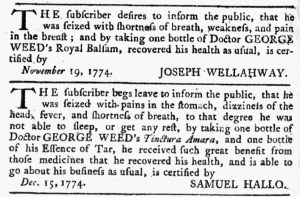
A notice signed by Joseph Wellahway appeared in the February 28, 1774, edition of the Pennsylvania Ledger for the purpose of “inform[ing] the public, that he was seized with shortness of breath, weakness, and pain in the breast; and by taking one bottle of Doctor GEORGE WEED’s Royal Balsam, recovered his health as usual.”  Wellahway “certified” that testimonial on November 19, 1774.  Immediately below, Samuel Hallo offered a more elaborate endorsement, signed on December 15, 1774.  He recounted that he “was seized with pains in the stomach, dizziness of the head, fever, and shortness of breath, to that degree he was not able to sleep, or get any rest.”  He finally found relief “by taking one bottle of Doctor GEORGE WEED’s Tinctura Amara, and one bottle of his Essence of Tar.”  When he did that, “he received such great benefit from those medicines that,” like Wellahway, “he recovered his health, and is able to go about his business as usual.”

Weed, who regularly placed advertisements in Philadelphia’s newspapers, did not supplement these testimonials with a notice of his own, not even to direct prospective patients to his shop.  He likely believed that he had established such a reputation in the city that he did not need to do so.  It was not the first time he adopted that strategy.  An advertisement in the Pennsylvania Chronicle five years earlier featured testimonials from Jacob Burroughs, Margaret Lee, Tabitha Wayne, and Elizabeth Beach.  Each of those names may have seemed more plausible to skeptical readers than Joseph Wellahway and Samuel Hallo.  In December 1772, Weed concluded an advertisement with a note from a minister to certify that he “was under the Instructions and Directions of a judicious Practitioner of Physic, in New-England, from some Years,” though that missive was dated almost two decades earlier.  Some or all these endorsements may have been genuine, yet Weed might have manufactured some of them to market his remedies.  Prospective patients, then as now, likely embraced the veneer of authenticity in hopes that the medicines would indeed deliver the promised results.

July 2

What was advertised in a colonial American newspaper 250 years ago today?

Maryland Journal (July 2, 1774).

“IN Gratitude to Doctor GILBERT, I … make this public acknowledgment.”

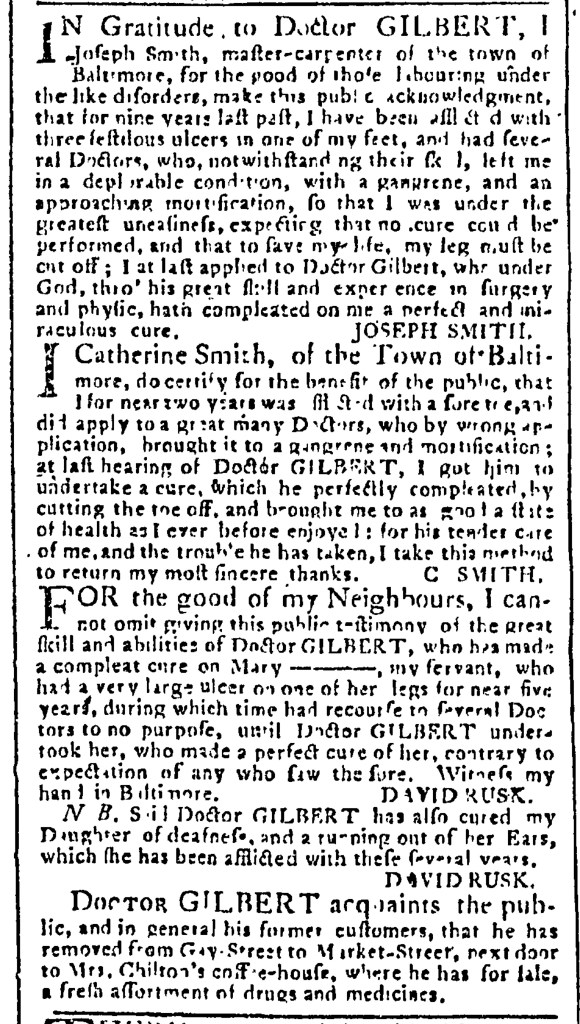
When Doctor Gilbert moved to a new location on Market Street from Gay Street in Baltimore in 1774, he alerted “the public, and in general his former customers” in an advertisement in the Maryland Journal.  Yet that information appeared at the end of a lengthy advertisement devoted primarily to testimonials from some of the patients he served.  The advertisement began with Joseph Smith, “master-carpenter of the town of Baltimore,” expressing his gratitude to the doctor and doing so in the public prints “for the good of those labouring under the like disorders.”  He then explained that for nine years he had suffered from ulcers that would not heal on one of his feet, despite the skill of other doctors he consulted.  His condition reached such a “deplorable condition” that he feared that his leg would need to be amputated “to save my life.”  Fortunately, he “applied to Doctor Gilbert” who “thro’ his great skill and experience in surgery and physic, hath completed on me a perfect and miraculous cure.”

Similarly, Catherine Smith offered an account of her experience with a “sore toe” that would not heal.  She saw several doctors, but they unsuccessfully treated her and instead “brought it to a gangrene and mortification.”  She turned to Gilbert.  Although he could not save her toe, after he amputated it he “brought me to as good a state of health as I ever before enjoyed.”  Smith offered her “most sincere thanks” for “his tender care of me,” making a statement in an advertisement “for the benefit of the public.”  David Rusk felt a similar duty to report on how Gilbert aided members of his household.  “FOR the good of my Neighbours,” he explained, “I cannot omit giving this public testimony of Doctor GILBERT.”  His servant, Mary, had “a very large ulcer on one of her legs for near five years.”  She had also seen many doctors “to no purpose,” but then Gilbert “made a perfect cure of her, contrary to expectation of any who saw the sore.”  In addition, Gilbert cured Rusk’s daughter of deafness through treating “a running out of her Ears, which she has been afflicted with these several years.”

For his part, Gilbert did not describe his services or his training.  He merely informed readers of his new location and mentioned that he sold “a fresh assortment of drugs and medicines.”  He apparently believed that he did not need to expound on his credentials or his experience like others who provided medical services often did in their advertisements, figuring that testimonials from his former patients told a more compelling and more convincing story than anything he could say about himself.  Those stories of successful treatments offered hope to prospective patients, a powerful motivation to seek Gilbert’s services.

May 12

What was advertised in a colonial American newspaper 250 years ago today?

Maryland Gazette (May 12, 1774).

“I do hereby recommend [this guide] to the several deputy commissaries within this province.”

Publishing the Deputy Commissary’s Guide took more than a year.  The first advertisement, Elie Vallette’s lengthy subscription proposal, ran in the February 25, 1773, edition of the Maryland Gazette.  It featured an excerpt and notable image depicting how each copy would be personalized for the subscriber.  The original version ran for several weeks before an abbreviated version appeared; it eliminated the excerpt but retained the image.  Such visual distinctiveness made even the shorter advertisement the focal point among other newspaper notices.  In the summer of 1773, Vallette ran a new advertisement, this one featuring an endorsement from several prominent “gentlemen of the law” who testified to the “general utility” of the volume.  At that time, Vallette stated that the work “Is now in the Press, and will be speedily published.”

Yet subscribers still had to wait for their copies.  In May 1774, Vallette ran a notice to announce that The Deputy Commissary’s Guide was “JUST PUBLISHED, And ready to be delivered to the subscribers, neatly bound, at the respective places where they were subscribed for.”  Local agents in towns throughout the colony had collected subscriptions on behalf of Vallette.  He now set about sending copies to each of them to distribute, including additional copies or “a few remaining books” for “non-subscribers” who decided that they did indeed wish to purchase this helpful guide.  To aid in selling those surplus copies, Vallette included a recommendation for The Deputy Commissary’s Guide from William Fitzhugh, the colony’s commissary general.  Fitzhugh declared that he had “perused” the work and “approving of the regulations therein made … I do hereby recommend [the book] to the several deputy commissaries within this province” to aid them in a variety of their duties.  What better endorsement could Vallette and his reference guide have received?!

Vallette had no guarantee of success when he first distributed subscription proposals for The Deputy Commissary’s Guide.  Many proposed books did not gain sufficient numbers of subscribers to make them viable ventures for authors and printers.  Even after taking the book to press, Vallette still hustled to sell leftover copies.  His latest advertisement was not as lengthy or flashy as previous ones, but he likely figured that a key testimonial provided the best incentive to acquire the book once it hit the market.

April 1

What was advertised in a colonial American newspaper 250 years ago today?

Connecticut Gazette (April 1, 1774).

“We the Subscribers have received such unexpected and unheard of Relief, and final Cures.”

It looked like a letter to the editor, but actually it was a testimonial advertising “Trusses or Bandages” for treating hernias.  The notice opened with a salutation, “Mr. GREEN, Please to insert the following in your next Paper,” addressing Timothy Green, the printer of the Connecticut Gazette.  Had it appeared only once on March 25, 1774, it might have been intended as an interesting news item selected by Green or it might have been an advertisement quickly discontinued.  That it ran in three consecutive issues, however, confirms that it was a paid notice that took an unusual format compared to most other advertisements for goods and services.  Testimonials about medicines and medical services appeared occasionally, though not regularly, in colonial newspapers in the 1760s and 1770s.

Eight “Subscribers [who] have received such unexpected and unheard of Relief, and final Cures, of the Difficulty of the Burst” (or hernia) extolled the efficacy of treatment provided by Stephen Johnson of Ashford.  They proclaimed that “by so many infallible Proofs, he hath the greatest Skill in that Business of any Man we ever heard of.”  Johnson had been so successful in alleviating their discomfort that those he assisted stated that they “Do think it our Duty, for the Benefit of Mankind, to publish” their endorsement of the “Trusses or Bandages, made and applied” by Johnson.  Furthermore, they encouraged “Any Person needing his Help” to contact Johnson, promising that if they sent “an exact Measure of their Body or Waist, with the Side in which the Breach is made, [they] may be as exactly fitted as present.”  Johnson possessed such great skill, the eight “Subscribers” insisted, that he could provide effective treatment even without consulting with patients in person.  He offered a precursor to mail order home health care supplies and equipment.

No doubt Daniel Holt, Samson Keyes, Amos Babcock, and five other “Subscribers” would testify to their experiences with Johnson and his trusses if asked by friends and neighbors who saw the notice in the Connecticut Gazette, but most likely they did not decide on their own to collaborate in writing and publishing that testimonial.  Instead, Johnson probably coordinated the effort, composed the copy himself, polled satisfied clients for permission to include their names, and paid top insert the advertisement in the newspaper.  Perhaps one or more of those clients enthusiastically thanked him for his assistance, planting the idea for the testimonial.  Inspired by their gratitude, Johnson may have seen an opportunity to leverage his prior experience into a marketing effort that would garner new clients.

October 24

What was advertised in a colonial American newspaper 250 years ago this week?

Rivington’s New-York Gazette (October 21, 1773).

“In a short time JAMES RIVINGTON will publish some other particulars of the efficacy of Dr. KEYSER’s PILLS.”

Like many other colonial printers, James Rivington supplemented revenues from the usual operations of his printing office by peddling patent medicines.  In particular, Rivington hawked Dr. Keyser’s Pills, one of the most popular treatments for venereal disease in eighteenth-century America.  This remedy was so popular that often name recognition alone marketed the pills to prospective customers.  For many weeks in the fall of 1773, Rivington ran a short advertisement that proclaimed, “EVERY ONE THEIR OWN PHYSICIAN, BY THE USE OF Dr, KEYSER’s PILLS.”  A border comprised of decorative type enclosed the bold headline and a promise that the medicine would “infallibly cure a DISEASE, not to be mentioned in a News-Paper, without the Knowledge of the most intimate Friends.”  For those still too embarrassed to purchase the pills, Rivington noted that they “are also wonderfully efficacious in curing the RHEUMATISM,” providing a cover story for prospective customers who wished to make use of it.

On occasion, Rivington enhanced that candid advertisement with descriptions of “CURES Performed by KEYSER’s PILLS,” giving examples to readers who still needed more convincing about whether they should invest in the medicine.  In the October 24 edition of Rivington’s New-York Gazetteer, for instance, the printer included three stories of patients who had been cured of “a fashionable disease.”  The most remarkable concerned a pregnant woman whose child “was born with the distemper.”  When the mother’s symptoms “grew very alarming,” she took the pills and recovered.  The infant’s wet nurse also took the pills and “the child, from the effect of the pills taken by the nurse, was perfectly restored to health.”  According to this story, Dr. Keyser’s Pills were so effective that they even cured a baby breastfeeding from a woman directed to take them!  The other two stories told of patients who had long suffered “with the same disease” and the “severest courses prescribed” by physicians, yet “restored” or “relieved” when they resorted to Dr. Keyser’s Pills.  Once again, Rivington avoided associating the pills exclusively with venereal disease.  To that end, he inserted other examples: “In the RHEUMATISM,” “In APOPLEXIES,” “In the ASTHMA,” and “A WHITE SWELLING.”  That swelling almost resulted in “the amputation of an arm,” but the patient experienced “a radical cure” upon taking Dr. Keyser’s Pills.”

That did not exhaust the stories of successful treatments, just the amount of space that Rivington devoted to advertising the pills in that issue of his newspaper.  He concluded his advertisement with a note that “In a short time [he] will publish some other particulars of the efficacy of Dr. KEYSER’s PILLS,” though he did not indicate if he intended to do so with newspaper advertisements, handbills, broadsides, or pamphlets.  The media mattered less than alerting prospective customers that the printer had access to similar stories.  They could wait to examine those or consider that sufficient enough justification to acquire the pills to start down their own road to recovery.

January 27

What was advertised in a colonial American newspaper 250 years ago today?

Pennsylvania Gazette (January 27, 1773).

“We find them very advantageous … and certainly is preferable to any method ever before invented.”

When Samuel Reynolds invented a machine “for raising Mill-stones, and turning them on their back, fit for dressing or washing in five minutes or less,” he took to the pages of the Pennsylvania Gazette to promote his product.  In an advertisement addressed “TO THE MILLERS IN GENERAL” in the January 27, 1773, edition, Reynolds described how millers could safely use his invention with “one hand only” to maneuver millstones for cleaning “without hurting the plaister on burr stones.”  He invited millers who wished to order the machine to contact him in Wilmington, Delaware, or any of three millers “at Brandywine mills,” Daniel Byrnes, Joseph Tatnall, and William Starr.

Rather than ask prospective customers to rely solely on the inventor’s own proclamations about his product, Reynolds included a testimonial from Byrnes, Tatnall, and Starr.  The experienced millers asserted that Reynolds “made each of [us] one of the said Machines, and we find them very advantageous, as the Mill-stone is taken up by them, with great ease and safety.”  In so doing, they reiterated the most important claims made by the inventor.  In addition, they declared that using Reynold’s new machine “certainly is preferable to any method ever before invented.”  Such an assessment bolstered the pitch made by Reynolds.

The inventor also suggested that he received advance orders or at least interest from other millers, though that may have been a marketing ploy rather than fact.  “As there has been a number made for people at a considerable distance, whose names an approbation are difficult to be collected,” he stated, “said Reynolds will be obliged to those that join in sentiment with the above, to favour him with a line for that purpose.”  In other words, he invited millers interested in the new machine to join with many others in showing their support by placing orders to acquire their own.  The savvy Reynolds sought to incite demand by demonstrating that demand already existed among experienced millers familiar with his product.

January 4

What was advertised in a colonial American newspaper 250 years ago today?

Massachusetts Gazette and Boston Post-Boy (January 4, 1773).

“More certificates may be seen, and any other particulars concerning them fully explained.”

Michael B. Goldthwait placed an advertisement for “Dr. KEYSER’S celebrated PILLS” in the January 4, 1773, edition of the Massachusetts Gazette and Boston Post-Boy, yet he had little to do with generating the copy.  Instead, he republished an advertisement that previously ran in the New-York Gazette and Weekly Mercury.  James Rivington, a printer and bookseller in New York, hawked the patent medicine to generate additional revenue.  He placed an advertisement that made a patient’s “certificate” or testimonial about the efficacy of Keyser’s pills its main focus.  Goldthwait may have worked with Rivington when he decided to reprint the advertisement in one of Boston’s newspapers.  Given the wide circulation of colonial newspapers, however, he Goldthwait may have seen Rivington’s advertisement in a copy of the New-York Gazette and Weekly Mercury that made its way to Boston and decided to appropriate it for his own use.

Goldthwait made only a few revisions to the notice before submitting it to a local printing office.  He altered the headline from “KEYSER’s PILLS” to “Dr. KEYSER’S celebrated PILLS” and streamlined the introductory paragraph that gave context for William Shipman’s testimonial, softening some of the language about the “purchase money” necessary to acquire the medicine.  The entire testimonial appeared, including Shipman’s assertion that it “is a faithful relation of my Case, and I can with an honest confidence recommend the Medicine to those who are afflicted with any Rheumatic complaints.”  Goldthwait did devise one significant embellishment.  Rivington concluded the original advertisement with an offer to provide “very satisfactory information” to anyone “desirous of enquiring further to the efficacy of this medicine,” but Goldthwait claimed that he had “more certificates” or testimonials at his shop near the Mill Bridge.  Those certificates likely included testimonials he published in an advertisement in August 1772.  Furthermore, Goldthwait could supply “other particulars” that “fully explained” those certificates.

When it came to advertisements appearing in multiple newspapers published in a town or city, merchants, shopkeepers, artisans, and other purveyors of goods and services often placed the same notice in more than one publication.  In terms of advertisements for consumer goods appearing in multiple newspapers published in different cities, that most often occurred with subscription notices for books, pamphlets, newspapers, and other printed materials as printers attempted to generate sufficient demand to make those ventures viable.  Apothecaries, shopkeepers, printers, and others throughout the colonies advertised Keyser’s pills, but they did not coordinate their marketing messages.  Shipman’s testimonial running in newspapers in Boston and New York was a rare instance of entrepreneurs in two towns exposing consumers to the same marketing campaign.