April 3

What was advertised in a revolutionary American newspaper 250 years ago today?

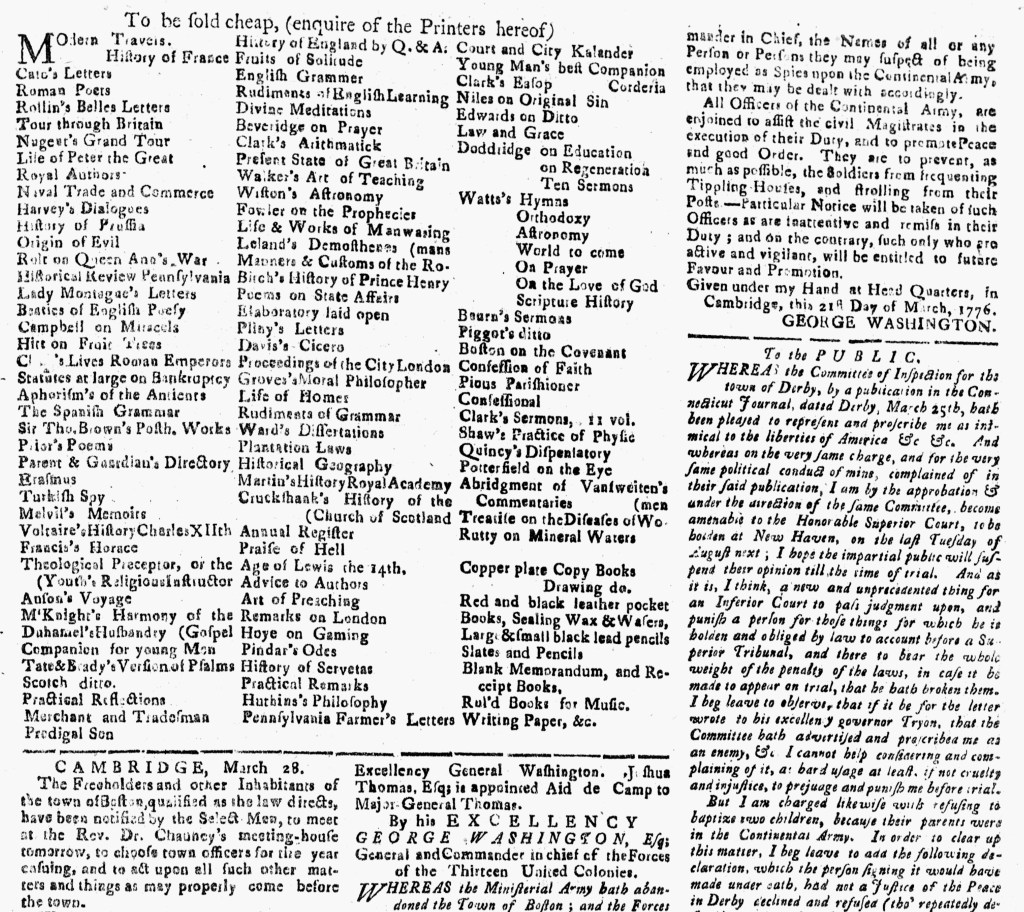
“M‘Knight’s Harmony of the
Duhamel’s Husbandry     (Gospel.”
Connecticut Journal (April 3, 1776).

Like other printers throughout the colonies, Thomas Green and Samuel Green, the printers of the Connecticut Journal, stocked and sold an array of imported books, pamphlets, and other merchandise.  Beyond newspaper subscriptions and advertisements and job printing, they cultivated other revenue streams.  As newspaper printers, the Greens had ready access for promoting their wares, doing so, for instance, with an oversized advertisement in the April 3, 1776, edition of the Connecticut Journal.
Connecticut Journal (April 3, 1776).

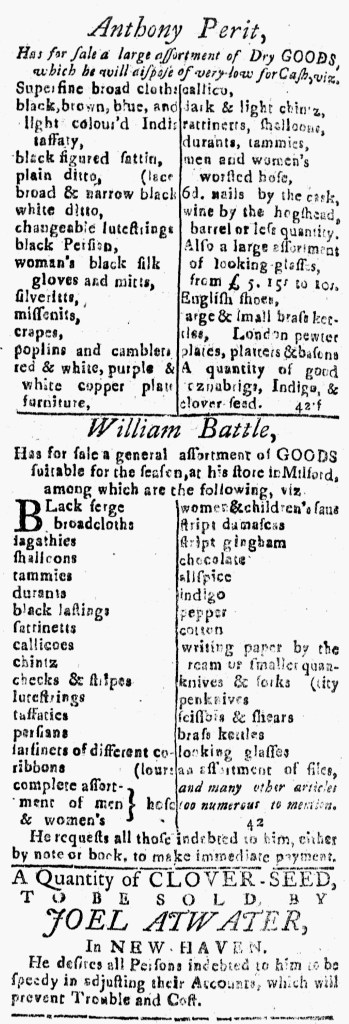
Listing dozens of titles, that advertisement dominated the third page.  The format distinguished it from any other, extending across two columns in the upper left corner, yet the columns within the advertisement did not align with the rest of the columns in the newspaper.  Rather than the standard width, the Greens used three narrow columns.  They listed one title per line, leaving white space that made it easier for readers to navigate their notice than if they had resorted to a paragraph of dense text.  A couple of advertisements on the facing page received similar treatment.  Anthony Perit’s advertisement for a “large assortment of Dry GOODS” and William Battle’s advertisement for a “general assortment of GOODS suitable for the season” each had their inventory arranged in two columns with a line running down the center, but those notices did not exceed the standard width for the newspaper.  On the other hand, either the Greens or a compositor who set the type realized that one title per line in the catalog of books and pamphlets available at their printing office in New Haven would leave too much white space.  As a matter of both efficiency and design, their advertisement thus featured a format that distinguished it from others.

That efficiency included limiting the number of lines and the overall space required for the advertisement.  Near the bottom of the first column, an incomplete entry for “M‘Knight’s Harmony of the” concluded at the end of the next entry for “Duhamel’s Husbandry” with “(Gospel.”  The complete entry listed M‘Knight’s Harmony of the Gospel.”  The “(” signaled to readers that “Gospel” belonged with either the previous or the following entry.  Similarly, about one third of the way down the second column, an incomplete entry for “Manners & Customs of the Ro-” concluded with “(mans” on the line above and an incomplete entry for “Treatise on the Diseases of Wo-” near the bottom of the final column concluded with “(men” at the end of the previous line.  While not always elegant, the format enhanced the visibility of the advertisement the printers ran to promote book sales.

March 13

What was advertised in a revolutionary American newspaper 250 years ago tiday?

Connecticut Journal (March 13, 1776).

“That much esteemed Pamphlet, intitled, COMMON SENSE.”

Two months after Robert Bell published the first edition of Thomas Paine’s Common Sense in Philadelphia, printers in other cities and towns in New York and New England published local editions that increased the circulation of the popular political pamphlet.  Advertisements for Common Sense proliferated as those printers marketed their editions and other printers and booksellers acquired copies that they sold in their communities.  On March 13, 1776, an advertisement for Common Sense appeared in the Connecticut Journal, published in New Haven, for the first time.

Just published & to be sold by the Printers hereof,” Thomas Green and Samuel Green announced, “That much esteemed Pamphlet, intitled, COMMON SENSE; ADDRESSED To the INHABITANTS of AMERICA.”  The Greens, however, had not published their own local edition.  As was the case with so many other advertisements for books and pamphlets, eighteenth-century readers knew to separate the phrases “Just published” and “sold by the Printers hereof.”  The latter did not mean that the printers had published the pamphlet themselves; instead, it meant that the pamphlet was “now available” rather than “forthcoming” or “in the press.”

The Greens stocked an edition that included “an APPENDIX to Common Sense, and an Address to the Representatives of the People called Quakers.”  Paine included that additional material in his approved new edition published by William Bradford and Thomas Bradford, the printers of the Pennsylvania Journal, after he parted ways with Bell.  It did not take long for Bell to pirate those items and incorporate them into a supplementary pamphlet of essays he marketed as related to Common Sense.  On the same day that the Greens first advertised Common Sense in the Connecticut Journal, the Bradfords once again cautioned the public that the “Pamphlet advertised by Robert Bell, entitled Additions to Common Sense … consists of pieces taken out of the News-papers, and not written by the author of Common Sense.”  That the Greens did not mention any additional material except the “APPENDIX, and an Address to the Representatives of the People called QUAKERS” suggests that they stocked copies published by the Bradfords rather than by Bell.  The advertisement does not definitively demonstrate that was the case, but it does show that more and more printers made some version of the political pamphlet available to readers.  The Greens simultaneously advertised “EXTRACTS from the VOTES and PROCEEDINGS of the American CONTINENTAL CONGRESS,” supplying customers with other products to keep informed beyond what they read in the newspaper.

November 11

What was advertised in a colonial American newspaper 250 years ago today?

Connecticut Journal (November 11, 1774).

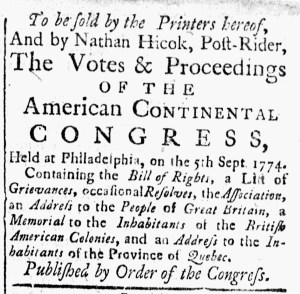
“To be sold by the Printers hereof, And by Nathan Hicok, Post-Rider.”

Throughout the colonies, printers provided updates from the First Continental Congress during its meeting in September and October 1774.  After the delegates adjourned and traveled home, printers quickly set about publishing, advertising, distributing, and selling a pamphlet that included an overview of the “Votes & Proceedings” as well as “the Bill of Rights, a List of Grievances, occasional Resolves, the Association, an Address to the People of Great Britain, a Memorial to the Inhabitants of the British American Colonies, and an Address to the Inhabitants of the Province of Quebec.”  William Bradford and Thomas Bradford, printers of the Pennsylvania Journal, first made the pamphlet available in Philadelphia just a week after the meeting ended.  Other printers soon joined them, producing their own local editions.

That included Thomas Green and Samuel Green, the printers of the Connecticut Journal and New-Haven Post-Boy.  On November 4, they alerted readers that the “Proceedings of the Continental Congress will shortly be ready for sale at the Printing Office.”  A week later, they ran a new advertisement, this time announcing that they sold the pamphlet.  Yet customers did not have to visit the printing office or send an order to acquire copies because the Greens enlisted Nathan Hicok, a post rider, in selling as well as delivering the “Votes & Proceedings” to colonizers seeking to keep informed beyond the coverage in newspapers.  It was not the first time that the Greens designated Hicok as one of their agents for disseminating printed items that supported the patriot cause.  On September 30, 1774, they advertised “The celebrated SPEECH, of the Bishop of St. Asaph, on the Bill for altering the Charter of the Colony of Massachusetts-Bay.  To be sold by the Printers, and Nathan Hicok, jun.”  Advertisements in several newspapers demonstrate that several post riders became partners with printers in marketing and selling political pamphlets as the imperial crisis intensified.  Even more post riders, though not named in newspaper advertisements, may have assumed similar responsibilities, actively promoting sales of such items rather than merely delivering them at the behest of printers and their customers.

November 4

What was advertised in a colonial American newspaper 250 years ago today?

Connecticut Journal (November 4, 1774).

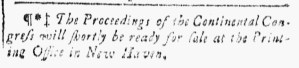
The Proceedings of the Continental Congress will shortly be ready for sale at the Printing Office in New Haven.”

William Bradford and Thomas Bradford, the printers of the Pennsylvania Journal in Philadelphia were the first to advertise the Extracts from the Votes and Proceedings of the American Continental Congress after the First Continental Congress adjourned its meeting in the fall of 1774, but other printers in other towns soon hawked their own editions.  A multiplication of copies produced and disseminated throughout the colonies aided in keeping colonizers informed beyond what they read in newspapers or heard from their friends and neighbors.

The Bradfords announced publication of the Extracts on November 2, a week after the First Continental Congress concluded its meeting.  On November 3, John Holt, the printer of the New-York Journal, ran a shorter advertisement to the same effect: “THE PROCEEEDINGS OF THE CONTINENTAL CONGRESS, With their Letter to the People of QUEBEC, To be sold by the Printer.”  He may have been so occupied with taking the Extracts to press as quickly as possible that he did not focus on crafting an advertisement.  On the other hand, considering the level of interest in the decisions of the delegates, Holt may not have considered an elaborate advertisement necessary to market the pamphlet.  Anne Catharine Green and Son, the printers of the Maryland Gazette in Annapolis, ran their own advertisement that day, though they did not have their edition ready for sale.  Still, they wanted readers to know that it would soon be available: “Now in the press, and speedily will be published, EXTRACTS FROM THE VOTES AND PROCEEDINGS OF THE AMERICAN CONTINETNAL CONGRESS.”  They placed their notice immediately after the news, testifying to its consequence.

Thomas Green and Samuel Green, the printers of the Connecticut Journal and New-Haven Post-Boy, also moved quickly to publish an edition of the Extracts.  They inserted a note in the November 4 edition of their newspaper: “The Proceedings of the Continental Congress will shortly be ready for sale at the Printing Office in New Haven.”  It appeared at the bottom of the final column on the third page of that issue.  Printers usually printed the first and fourth pages on one side of a broadsheet and let them dry while they set type for the second and third pages to print on the other side.  That meant that the Greens’ notice about the Extracts would have been the last item added to that edition.  Perhaps they had hoped to have the pamphlet ready for sale by the time the second and third pages of the newspaper went to press, but settled for alerting readers that they could acquire copies soon.  As quickly as they could, the Greens joined other printers in disseminating the political pamphlet far and wide.

April 23

Who was the subject of advertisements in colonial American newspapers 250 years ago today?

Connecticut Journal (April 23, 1773).

“TO BE SOLD … A likely Negro Man … Enquire of the Printers.”

TO BE SOLD, A Negro Boy … Enquire of the Printers.”

Timothy Green ran a busy printing office in the early 1770s.  In addition to publishing the New-London Gazette, he sold books, some that he printed but most of them imported.  In the April 23, 1773, edition of his newspaper, Green advertised one of his own imprints, informing readers that “A Faithful HISTORY OF REMARKABLE OCCURRENCES, IN THE Captivity and Deliverances OF Mr. JOHN WILLIAMS, Minister of the Gospel in DEEERFIELD” was “Just Published, and to be Sold.”  Green also did job printing, including broadsides, handbills, and blanks (or forms).  Similarly, Thomas Green and Samuel Green oversaw a bustling printing office where they published the Connecticut Journal and New-Haven Post-Boy.  In the spring of 1773, they distributed subscription proposals for a new edition of “A Discourse on Justification by Faith alone. BY THE REVEREND JONATHAN EDWARDS.”  Those proposals also appeared in the April 23 edition of the New-London Gazette, part of a network of printers and others who cooperated in collecting the names of subscribers who reserved copies.

New-London Gazette (April 23, 1773).

Among their many other responsibilities, all three printers also served as slave brokers.  The same day that they promoted important historical and theological works, they also advised readers to “Enquire of the Printers” to learn more about enslaved people advertised for sale in their newspapers.  In the Connecticut Journal, a brief advertisement announced, “TO BE SOLD, (for no Fault, but for want of Employ,) A likely Negro Man, about 26 Years old, fit for Town or Country. Enquire of the Printers.”  An even shorter, but equally insidious, advertisement in the New-London Gazette stated, “TO BE SOLD, A Negro Boy, about 13 Years old, lately brought into the Country.  Enquire of the Printer.”  In both cases, the advertisers declined to identify themselves, instead instructing interested parties to contact the printers for more information.  In turn, the printers facilitated the sales of enslaved people twice over and generated revenue from the advertisements in the process.  First, they disseminated the notices, undertaking the labor required to print and distribute the advertisements and the rest of the newspapers.  Then, they actively participated in the sale of the “likely Negro Man” and the “Negro Boy, about 13 Years old,” responding to messages they received in the printing office and colonizers who visited to learn more.  As these advertisements demonstrate, printers in New England participated in perpetuating slavery during the era of the American Revolution, alongside their counterparts in Maryland, Virginia, South Carolina, and other colonies with greater numbers of enslaved people.  Such advertisements underwrote the production and dissemination of the news, while those that required readers to “Enquire of the Printers” further enmeshed printers in the slave trade as brokers for sales.

For an extended consideration of such advertisements, see Jordan E. Taylor, “Enquire of the Printer: Newspaper Advertising and the Moral Economy of the North American Slave Trade, 1704-1807,” Early American Studies 18, no. 3 (Summer 2020): 287-323, and the companion website.

April 2

What was advertised in a colonial American newspaper 250 years ago today?

Connecticut Journal (April 2, 1773).

They shall be under the necessity of reducing it to its original size and price, unless the Subscribers for it, are more punctual in their payments.”

On April 17, 1772, Thomas Green and Samuel Green began printing the Connecticut Journal on larger sheets.  That allowed them to deliver more content to their subscribers, meeting the demand of “many of our Customers, and others, … desirous of having [the newspaper] enlarged.”  When they did so, they also noted that the previous edition “completed Four Years and an Half since the first Publication” of the newspaper, yet many of the subscribers “paid not a single Farthing” during that time and others were “indebted for Two or Three Year’s Papers.”  The printers called on anyone who owed for newspapers, advertisements, printed blanks, or anything else “to make speedy Payment.”

Almost a year later, the Greens made similar pleas.  On April 2, 1773, they declared, “The Printers are sorry, they can with truth inform the Public, That they have not for this year past, received from all the Customers for this Journal, so much money as they have expended for the blank paper, on which it has been printed.”  Colonial printers often lamented that subscribers and others did not pay their bills, but few did so in such stark terms.  The Greens noted that the “next week’s paper … completes one year since its enlargement,” a benefit to subscribers that accrued even greater expenses for the printers.  That benefit would not continue, the Greens warned, if subscribers did not settle accounts.  They proclaimed that “they shall be under the necessity of reducing it to its original size and price, unless the Subscribers for it, are more punctual in their payments.”  Other printers often threatened to take legal action against recalcitrant subscribers to force them to pay what they owed.  The Greens, on the other hand, threatened other consequences that would have an impact on all readers, not just those taken to court.

Whether it involved suing subscribers or publishing the names of those who refused to pay, printers usually did not follow through on their threats.  Whether or not the Greens’ notice prompted some subscribers to submit payment, the printers did not opt to revert to the original size of the newspaper.  Through experience, many readers likely believed that they could ignore such notices from the printers without suffering any consequences.  Printers wished to maintain robust circulations so they could sell advertising, a factor that played a role in their decisions about how to handle difficult subscribers.

February 19

What was advertised in a colonial American newspaper 250 years ago today?

Connecticut Journal (February 19, 1773).

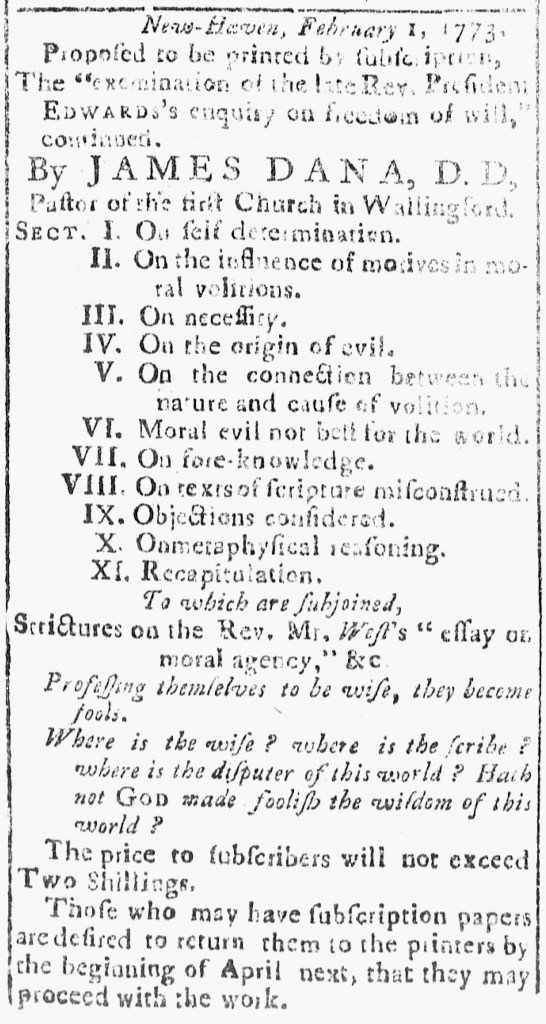
“Those who may have subscription papers are desired to return them to the printers.”

In February 1773, Thomas Green and Samuel Green, printers of the Connecticut Journal and New-Haven Post-Boy, inserted subscription proposals for a book by James Dana, “Pastor of the first Church in Wallingford,” into their own newspaper.  Eighteenth-century printers often placed advertisements promoting their other projects in their newspapers, whether publishing books and pamphlets or peddling books, stationery, patent medicines, and other merchandise.  In this instance, the Greens sought to publish a continuation of An Examination of the Late Reverend President Edwards’s “Enquiry on Freedom of Will” (1770), supplementing the new volume with “Strictures on the Rev. Mr. West’s ‘essay on moral agency.’”  To entice prospective customer to reserve copies by subscribing in advance, the Greens listed the contents of the book and promised that the price “will not exceed Two Shillings.”

Subscription proposals served as a rudimentary form of market research.  Printers and authors did not want to take books to press without knowing if they made a sound investment.  To assess demand for proposed works, they distributed subscription notices that described the contents, the paper and type, and the costs.  Customers interested in the proposed work reserved copies in advance, sometimes paying a deposit.  Collecting the names of subscribers provided guidance about how many copies to print.  In some instances, they discontinued projects after determining that they had not generated sufficient interest to make them viable.  Sometimes, but not always, printers gave credit to those who supported the project by inserting a list of subscribers, an additional incentive for customers to reserve copies.

The Greens began promoting this book before their advertisement appeared in the Connecticut Journal in February 1773. In that advertisement they requested that “Those who may have subscription papers are desired to return them to the printers by the beginning of April next, that they may proceed with the work.”  The Greens apparently provided separate advertisements, perhaps as handbills, broadsides, or pamphlets, to associates who took responsibility for distributing them and collecting the names of subscribers and how many copies they ordered.  Those associates may have kept lists of their own.  Alternately, they may have posted broadsides in their shops, allowing subscribers to sign their own names … and peruse the list of other subscribers to get a sense of the company they kept.  Eighteenth-century newspaper advertisements make frequent reference to subscription papers, suggesting that this form of advertising circulated more widely than surviving copies in research libraries and historical societies suggest.  Many printers and authors, including the Greens, deployed multipronged approaches to marketing, disseminating advertisements in formats other than the newspaper advertisements so familiar to historians of early America.

April 10

What was advertised in a colonial American newspaper 250 years ago today?

Connecticut Journal (April 10, 1772).

“The Printers hereof earnestly request all those who are indebted to them for Newspapers, Advertisements, Blanks, or in any other Way … to make speedy Payment.”

Colonial printers regularly called on customers to settle accounts, placing notices in their own newspapers for that purpose.  The appearance of those notices often coincided with an anniversary; as printers completed one year of publication and commenced another, they requested that customers make payments.  Thomas Green and Samuel Green, however, did so halfway through their fifth year of publishing the Connecticut Journal.  They inserted a notice in the April 10, 1772, edition to inform readers that “THIS Day’s Paper (No. 234) completes Four Years and an Half since the first Publication of the CONNECTICUT JOURNAL, and NEW-HAVEN POST-BOY.”  They then lamented that “many of the Subscribers for it, have not paid a single Farthing, and others are indebted for Two or Three Year’s Papers.”

The Greens focused most of their attention on subscribers who had fallen behind or never paid, but they did not limit their efforts to collecting from those customers.  Instead, they “earnestly request all those who are indebted to them for News Papers, Advertisements, Blanks, or in any other Way, (whose Accounts are of more than a Year’s standing) to make speedy Payment.”  They continued to allow credit for those whose accounts did not extend more than a year, but they wanted others to pay their bills because “Printing a Weekly News-Paper, and carrying on the other Branches of the Printing-Business is attended with great Expence.”  While some printers may have considered advertising the more significant source of revenue and required that advertisers pay for notices in advance while extending credit to subscribers, that was not always the case.  For a time in the early 1770s, the colophon for the Providence Gazette, printed by John Carter, stated that “ADVERTISEMENTS of a moderate Length (accompanied with the Pay) are inserted in this Paper three weeks.”  Ebenezer Watson, printer of the Connecticut Courant in Hartford, apparently updated his policy about paying for advertisements in advance of publication.  On February 25, 1772, he informed readers that “No Advertisements will for the future be published in this paper, without the money is first paid, unless it be for such persons as have open accounts with The Printer.”  Watson continued to accept advertisements without payment from existing customers in good standing, but no longer did so for new advertisers.  The Greens did not change their policy, but their notice did indicate that they extended credit for advertisements as well as subscriptions.  Payment in advance was not always required for publishing advertisements in early American newspapers.

March 15

What was advertised in a colonial American newspaper 250 years ago today?

New-London Gazette (March 15, 1771).

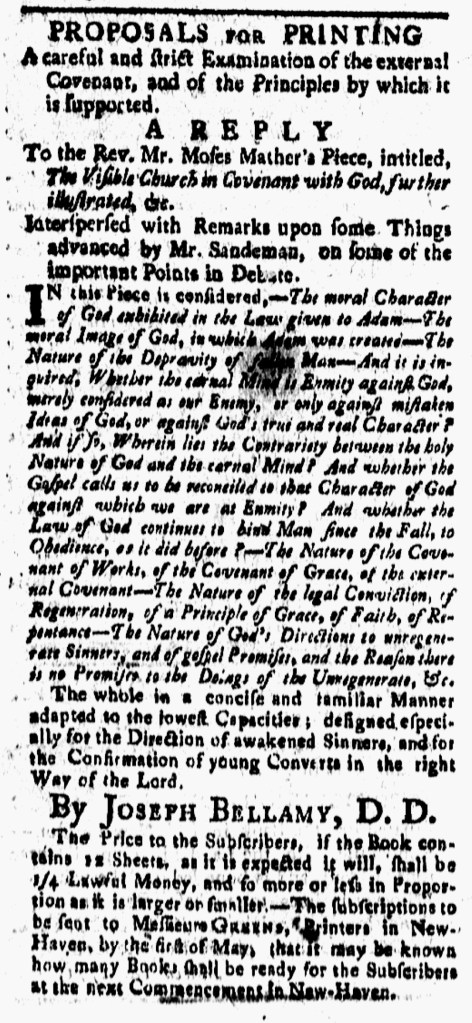
“PROPOSALS FOR PRINTING.”

Thomas Green and Samuel Green, printers of the Connecticut Journal in New Haven, planned to publish “A careful and strict Examination of the external Covenant, and of the Principles by which it is supported.  A REPLY To the Rev. Mr. Moses Mather’s Piece, intitled, The Visible Church on Covenant with God, further illustrated” in the spring of 1771.  Before taking the book to press, however, they sought to gauge demand in order to determine how many copies to print.  To that end, they distributed subscription notices, including “PROPOSALS FOR PRINTING” in the March 15, 1771, edition of the New-London Gazette.  The Greens requested that those interested in reserving copies become “Subscribers” by submitting their names by May 1.  In turn, the Greens guaranteed the price of the book to those who ordered copies in advance.  Other customers who purchased surplus copies risked paying higher prices.

In addition to seeking subscribers in New Haven, the Greens attempted to incite demand in other towns.  Timothy Green, printer of the New-London Gazette, not only inserted the “PROPOSALS FOR PRINTING” in his newspaper but likely also served as a local agent who collected subscriptions and sent the list to the printing office in New Haven.  The Greens devoted most of subscription notice to the lengthy title of the book and a list of its contents, demonstrating to prospective subscribers the various theological arguments presented by Joseph Bellamy.  They also listed the price, one shilling and four pence, contingent on how many pages were in the book.  They anticipated printing on twelve sheets, but would adjust the price higher or lower if they used more or less paper.  The Greens also established a timeline for receiving subscriptions and printing the book, stating that subscribers and local agents should contact them by May 1 so “it may be known how many Books shall be ready for the Subscribers at the next Commencement in New-Haven.”  The Greens planned to distribute the book at the same time as graduates of Yale College gathered.

Colonial printers often relied on networks of booksellers, local agents, and fellow printers in the marketing and distribution of books they printed.  Two other notices in the same edition of the New-London Gazette concluded with such lists.  One, another subscription notice, listed seven local agents in seven towns in Connecticut.  The other, an advertisement for a book already published, named eleven local agents in seven towns as well as a postrider who served several of those places.  Subscription notices and local agents played a vital role in determining the viability of proposed books in eighteenth-century America.

December 26

What was advertised in a colonial American newspaper 250 years ago this week?

Connecticut Courant (December 25, 1770).

“ADVERTISEMENTS of not more than ten Lines, are taken in and inserted for THREE SHILLINGS three weeks.”

On November 13, 1770, Thomas Green and Ebenezer Watson, printers of the Connecticut Courant in Hartford, announced that they planned to enlarge the newspaper and make other improvements before the end of the year.  The November 13 edition served as a specimen copy for current and prospective subscribers, though it did not feature a new colophon on the final page.  Green and Watson inaugurated that aspect of the newspaper on December 25 when the new size became official.  Compared to the previous colophon, “HARTFORD: Printed by GREEN & WATSON,” the new colophon was much more extensive, befitting a publication that sought to join the ranks of those from Boston and New York.

The new colophon included information about the costs of subscriptions and advertisements that not all printers made readily available to readers.  If subscription fees or advertising rates did appear in print, they were usually part of a colophon.  Some colophons incorporated one or the other, but usually not both.  When they enlarged and enhanced the Connecticut Courant, Green and Watson provided both in the colophon.  They set two prices for subscriptions, “NINE SHILLINGS, Lawful Money per Year, if sent by the special Post, or SEVEN SHILLINGS without Postage.”  That provided important insight into Green and Watson’s business practices, especially their means of circulating the Connecticut Courant to distant subscribers.  In the late 1760s and early 1770s, other printers who listed their subscription rates, most of them in busy and crowded urban ports, did not take the fees for post riders into consideration.  Separate advertisements sometimes tended to those concerns, though they typically offered services without specifying prices.  The colophon for the enlarged Connecticut Courant made the total costs for subscribing visible to customers.

In terms of advertising rates, Green and Watson charged three shillings to publish notices of ten lines or less for three weeks.  Prices increased “in Proportion” for longer advertisements.  As was typical, the initial fee included setting type, bookkeeping, and multiple insertions.  Some printers allowed for four insertions, but most opted for three, then charged additional fees for subsequent insertions.  Advertisers could continue running their notices in the Connecticut Courant for an additional six pence per week.  That meant that half of the initial fee, three shillings or thirty-six pence, covered setting type and bookkeeping because three weeks of inserting a notice amounted to eighteen pence.  Most newspaper printers derived greater revenues from advertising than subscriptions.  In the case of the Connecticut Courant, three advertisements cost the same as an annual subscription that included “the special Post.”

Subscription rates and advertising fees were an aspect of early American printers’ business practices that did not regularly find their way into print in eighteenth-century newspapers.  For many years Green and Watson did not incorporate this information into the Connecticut Courant, but when they enlarged the newspaper at the end of 1770, they added a new colophon as one of the improvements.  In so doing, they provided important information about the production of their newspaper.