What was advertised in a revolutionary American newspaper 250 years ago this week?
Pennsylvania Ledger (September 14, 1776).
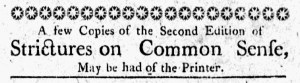
“A few Copies of the Second Edition of Strictures on Common Sense.”
Like many other printers in Philadelphia, James Humphreys, Jr., advertised and sold military manuals in the fall of 1776. In the September 14 edition of his newspaper, the Pennsylvania Ledger, he announced, “A few Copies of the Military Guide FOR YOUNG OFFICERS, By THOMAS SIMES … May be had of the PRINTER hereof.” Humphreys collaborated with fellow printers Robert Bell and Robert Aitken in publishing that “large and valuable Compilation from the most celebrated MILITARY WRITERS.” In the same issue, he noted that “A few Copies of the Second Edition of Strictures on Common Sense, May be had of the Printer.” He used a shortened title for The True Interest of America Impartially Stated, in Certain Strictures on a Pamphlet Intitled Common Sense, one of only two pamphlets that directly responded to Thomas Paine’s popular pamphlet. Humphreys had published the first edition in late May and found a large enough market, even with the colonies declaring independence, that he undertook a second edition.
The advertisements for those two works – a military manual primarily intended for officers and soldiers fighting for the American cause and a political pamphlet arguing against independence – demonstrated the editorial perspective that Humphreys took in publishing the Pennsylvania Ledger. In the colophon, he stated that “Essays, Articles of News, Advertisements, &c. are gratefully received and impartially inserted.” That meant that he welcomed letters, editorials, and news updates that expressed an array of views about current events, unlike many other printers. Rather than place the colophon at the bottom of the final page, where it appeared in most newspapers, Humphreys positioned it immediately below the masthead so it alerted readers before they perused any of the “Essays, Articles of News, [and] Advertisements” that they should expect to encounter items that took different positions and did not necessarily reflect their own views, whatever those happened to be. More than most printers at the time, Humphreys did strive to “impartially” deliver news to readers, but that did not earn him the admiration of the public. Concerned about his safety, he ceased publishing the Pennsylvania Ledger and left Philadelphia by the end of 1776.
What was advertised in a revolutionary American newspaper 250 years ago today?
Pennsylvania Ledger (July 13, 1776).
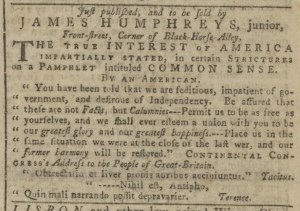
“The True Interest of America Impartially Stated.”
A week after the Pennsylvania Evening Post became the first newspaper to publish the Declaration of Independence, the Pennsylvania Ledger became the last newspaper printed in Philadelphia to carry that momentous document. The news had certainly reached readers by word of mouth long before July 13. Some may have attended the public reading of the Declaration of Independence at the Pennsylvania State House (now known as Independence Hall) on July 8. They could have also read the document in the Pennsylvania Ledger (July 6), Dunlap’s Pennsylvania Packet (July 8), Henrich Millers Pennsylvanischer Staatsbote (in German, July 9), the Pennsylvania Gazette (July 10), or the Pennsylvania Journal (July 10). The text may not have been readily available to James Humphreys, Jr., in time for the July 6 edition of the Pennsylvania Ledger, though he may not have invested the same effort in acquiring it as did Benjamin Towne, the printer of the Pennsylvania Evening Post. Like the printers of the other newspapers published in Philadelphia, Humphreys did not move forward his weekly publication schedule to disseminate the Declaration of Independence, nor did he print a supplement or extraordinary issue.
Still, Humphreys may have published the Declaration of Independence with less enthusiasm than his fellow printers in Philadelphia. Humphreys was widely suspected of being a Loyalist, though Isaiah Thomas, a printer who did not shy away from condemning other printers who did not support the American cause, had a more nuanced view of Humphreys and “his intention to conduct his paper with political impartiality.” Thomas noted “perhaps, in times more tranquil than those in which it appeared, he might have succeeded in his plan.” Humphreys stood by his “oath of allegiance to the king of England … and refused to bear arms against the British government; in consequence of which, he was deemed a tory, and his paper denounced as being under corrupt influence.”[1] In the end, the “impartiality of the Ledger did not comport with the temper of the times” and Humphreys left Philadelphia for his safety by the end of 1776. He eventually returned during the British occupation of the city, accompanied the army to New York, and, following the war, established a newspaper, the Nova Scotia Packet, in Shelburne, a town founded by Loyalists who went into exile.[2]
That “impartiality” described by Thomas found expression in other items that came off Humphreys’s press and appeared in advertisements in the Pennsylvania Ledger. Without comment on the contents of the pamphlet, Thomas reported that Humphreys printed “Strictures on Paine’s Common Sense. Two editions …, consisting of several thousand copies each, were sold in a few months.”[3]The True Interest of America Impartially Stated, as the pamphlet was also known, offered a response to Common Sense. Humphreys placed an advertisement for the second edition of The True Interest of America Impartially Stated on the first page of the issue of the Pennsylvania Ledger that carried the Declaration of Independence. That document appeared on the second page, though probably not the result of Humphreys inserting news only when it arrived. He almost certainly had access to a copy of the Declaration of Independence with sufficient time to place it on the front page of the Pennsylvania Ledger if he wished. After all, the printers of the Pennsylvania Gazette and the Pennsylvania Journal made room for the Declaration of Independence on the front page of their newspapers three days earlier.
The advertisement for The True Interest of America Impartially Stated even carried a quotation from the Continental Congress’s “Address to the People of Great-Britain” in October 1774 that contradicted the action they took in declaring independence less than two years later: “You have been told that we are seditious, impatient of government, and desirous of Independency. Be assured that these are not Facts, but Calumnies – Permit us to be as free as yourselves, and we shall ever esteem a union with you to be our greatest glory and our greatest happiness. – Place us in the same situation we were at the close of the last war, and our former harmony will be restored.” Even as Humphreys published the Declaration of Independence in the Pennsylvania Ledger, not all readers celebrated or agreed with the action taken by the Continental Congress. The Revolutionary War became a civil war among colonizers as much as a contest between a nation seeking independence and Great Britain.
**********
[1] Isaiah Thomas, The History of Printing in America: With a Biography of Printers and an Account of Newspapers (1810; New York: Weathervane Books, 1970), 439-440.
“THE TRUE INTERSEST OF AMERICA IMPARITALLY STATED.”
An advertisement for a new political pamphlet, The True Interest of America Impartially Stated, in Certain Strictures on a Pamphlet Intitled Common Sense, ran on the first page of the May 29, 1776, edition of the Pennsylvania Gazette. According to Thomas R. Adams, “only two pamphlet-answers to Common Sense appeared” after the publication of Thomas Paine’s influential pamphlet on January 9, 1776.[1] In March, Robert Bell, the printer of the first edition of Common Sense and subsequent unauthorized editions in Philadelphia, printed, advertised, and sold “PLAIN TRUTH; addressed to the INHABITANTS of America, containing Remarks on a late Pamphlet intituled COMMON SENSE.” At the same time, Samuel Loudon, a printer in New York, advertised the imminent publication of “The Deceiver unmasked, or Loyalty and Interest united; In answer to a Pamphlet, entitled, COMMON SENSE.” However, Loudon never sold that pamphlet because Patriots destroyed almost all the copies. That made True Interest the second pamphlet directly responding to Common Sense available to the public.
Charles Inglis, a minister at Trinity Church in New York and a Loyalist who later became the first Anglican Bishop of Nova Scotia, published the pamphlet anonymously, just as Common Sense and Plain Truth had been published anonymously. Inglis presented a stronger rebuttal than the arguments in Plain Truth, but he did so too late to have much impact on the debate over declaring independence. Adams notes that “True Interest (traditionally regarded by historians as a much more effectual reply to Common Sense [than Plain Truth]) did not appear until nine days before Richard Henry Lee actually introduced his resolution for independence in the Congress. Clearly, Inglis’s pamphlet came too late to play any part in shaping opinion.”[2] That was not for lack of effort on the part of James Humphreys, Jr., the printer of True Interest, in marketing the pamphlet. In addition to the advertisement in the May 29 edition of the Pennsylvania Gazette, he inserted an advertisement in his own Pennsylvania Ledger on June 1, giving it a privileged place as the first item in the first column on the first page. That might have helped in finding a market for the pamphlet among Loyalists and perhaps others curious about the pamphlet’s contents or eager to refute it. It did well enough that Humphreys printed a second edition, but True Interest still did not have the influence that Inglis hoped as the Second Continental Congress considered declaring independence.
**********
[1] Thomas R. Adams, “The Authorship and Printing of Plain Truth by ‘Candidus,” Papers of the Bibliographical Society of America 49, no. 3 (1955): 230.
[2] Adams, “Authorship and Printing of Plain Truth,” 234.