May 29

What was advertised in a revolutionary American newspaper 250 years ago today?
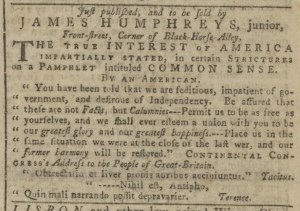
Pennsylvania Gazette (May 29, 1776).

“THE TRUE INTERSEST OF AMERICA IMPARITALLY STATED.”

An advertisement for a new political pamphlet, The True Interest of America Impartially Stated, in Certain Strictures on a Pamphlet Intitled Common Sense, ran on the first page of the May 29, 1776, edition of the Pennsylvania Gazette. According to Thomas R. Adams, “only two pamphlet-answers to Common Sense appeared” after the publication of Thomas Paine’s influential pamphlet on January 9, 1776.[1]  In March, Robert Bell, the printer of the first edition of Common Sense and subsequent unauthorized editions in Philadelphia, printed, advertised, and sold “PLAIN TRUTH; addressed to the INHABITANTS of America, containing Remarks on a late Pamphlet intituled COMMON SENSE.”  At the same time, Samuel Loudon, a printer in New York, advertised the imminent publication of “The Deceiver unmasked, or Loyalty and Interest united; In answer to a Pamphlet, entitled, COMMON SENSE.”  However, Loudon never sold that pamphlet because Patriots destroyed almost all the copies.  That made True Interest the second pamphlet directly responding to Common Sense available to the public.

Charles Inglis, a minister at Trinity Church in New York and a Loyalist who later became the first Anglican Bishop of Nova Scotia, published the pamphlet anonymously, just as Common Sense and Plain Truth had been published anonymously.  Inglis presented a stronger rebuttal than the arguments in Plain Truth, but he did so too late to have much impact on the debate over declaring independence.  Adams notes that “True Interest (traditionally regarded by historians as a much more effectual reply to Common Sense [than Plain Truth]) did not appear until nine days before Richard Henry Lee actually introduced his resolution for independence in the Congress.  Clearly, Inglis’s pamphlet came too late to play any part in shaping opinion.”[2]  That was not for lack of effort on the part of James Humphreys, Jr., the printer of True Interest, in marketing the pamphlet.  In addition to the advertisement in the May 29 edition of the Pennsylvania Gazette, he inserted an advertisement in his own Pennsylvania Ledger on June 1, giving it a privileged place as the first item in the first column on the first page.  That might have helped in finding a market for the pamphlet among Loyalists and perhaps others curious about the pamphlet’s contents or eager to refute it.  It did well enough that Humphreys printed a second edition, but True Interest still did not have the influence that Inglis hoped as the Second Continental Congress considered declaring independence.

**********

[1] Thomas R. Adams, “The Authorship and Printing of Plain Truth by ‘Candidus,” Papers of the Bibliographical Society of America 49, no. 3 (1955): 230.

[2] Adams, “Authorship and Printing of Plain Truth,” 234.
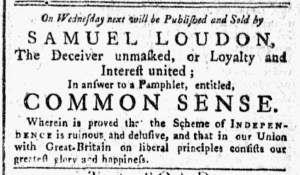
March 18

What was advertised in a revolutionary American newspaper 250 years ago today?

New-York Gazette and Weekly Mercury (March 18, 1776).

“The Deceiver unmasked … In answer to a Pamphlet, entitled, COMMON SENSE.”

As Robert Bell advertised Plain Truth, a response to Thomas Paine’s Common Sense, in Philadelphia in March 1776, Samuel Loudon, a printer and bookseller in New York, prepared to publish and sell “The Deceiver unmasked, or Loyalty and Interest united; in answer to a Pamphlet, entitled COMMON SENSE.”  On Monday, March 18, he announced that two days later he would make available a new pamphlet “Wherein is proved that the Scheme of INDEPENDENCE is ruinous and delusive, and that in our Union with Great-Britain on liberal principles consists our greatest glory and happiness.”  By the time Loudon placed this advertisement, he may have seen an advertisement for Plain Truth in a newspaper printed in Philadelphia, borrowing the words “ruinous” and “delusive” for his own advertisement.

At first glance, this advertisement seems to contradict Thomas R. Adams’s assertion that only two pamphlets directly responding Common Sense appeared in the colonies in the six months between its publication in January and the Continental Congress declaring independence in July.  Bell published Plain Truth in the middle of March and James Humphreys, Jr., published The True Interest of America Impartially Stated in Certain Strictures on a Pamphlet Intitled Common Sense at the end of May.[1]  What about Loudon’s Deceiver Unmasked?  In a footnote, Adams explains that a “third pamphlet … was printed by Samuel Loudon in New York, but it was never sold because a Committee of Mechanics under Christopher Duyckinck destroyed almost all of the 1,500 copies.”[2]  One of the notes in the American Antiquarian Society’s catalog entry for Deceiver Unmasked provides more information: “The New-York Historical Society copy bears the [manuscript] note: General Duykinck’s Committee went to the House of Mr. Loudon’s and destroyed all these pamphlets just as they were ready to be published. — this Copy was saved.”  That delayed rather than prevented dissemination of Deceiver Unmasked.  The pamphlet eventually came off Humphreys’s press in Philadelphia as The True Interest of America.  Readers intrigued by Loudon’s advertisement for Deceiver Unmasked had to wait months for its publication, not knowing during that time whether Loudon or any other printer would even attempt it.  The first edition met with sufficient success that Humphreys issued a second edition.  While neither Plain Truth nor Deceiver Unmasked/True Interest of America had much impact, the publication and marketing of these responses to Common Sense demonstrates that printers believed a market existed for Loyalist tracts.

**********

[1] Thomas R. Adams, “The Authorship and Printing of Plain Truth by ‘Candidus,’” Papers of the Bibliographical Society of America 49, no. 3 (1955): 230-231.

[2] Adams, “Authorship and Printing,” 230.