
GUEST CURATOR: Kathryn J. Severance

What was advertised in a colonial newspaper 250 years ago today?
“Will be Sold by PUBLIC VENDUE … A variety of genteel House Furniture, belonging to a Gentleman going out of the Province, viz. Mohogony Desk and Book-Case.”
This advertisement features a series of household goods for sale, listing both the type of items and how many of the items are available. This particular advertisement was placed by an individual who was leaving the ‘province,’ which, for all intents and purposes, meant the same thing as the colony. Today, we might look at this ad as an eighteenth-century version of an advertisement for a yard sale of a homeowner who was leaving the state. It is always interesting to look at something from history and see it through a modern lens. When a person moves, they sometimes sell their possessions to make some funds for the move and get rid of possessions that will not be needed or wanted for their journey elsewhere.
One item featured in the advertisement that I find intriguing is the mahogany desk. Desks of the Colonial period were sometimes ornate, featuring far more details and far more lavish woods than what is utilized in today’s desks. To a large extent, furniture helped to designate a family or individual’s social class. Wealthier families would have the most ornate woods and intricately-carved pieces in their homes, while middling individuals would have pieces that were far more basic.
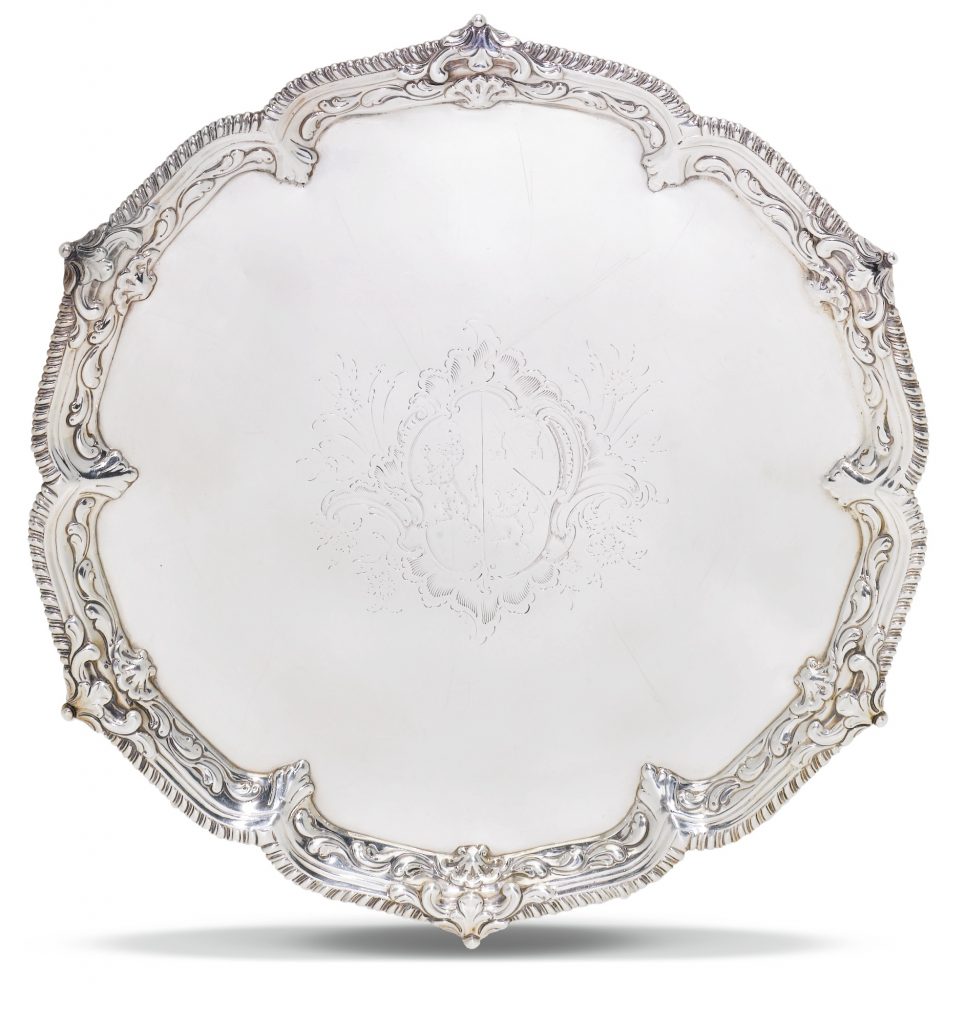
Other items also caught my attention: the “porringers” and “salver.” A porringer was a special type of bowl that featured one or two decorated handles and were often made out of silver or pewter. They were often used for serving soup or porridge. (Check out this modern recipe for perfect porridge from BBC Good Food magazine.) Once again, the more ornate the dishes were, the more wealth that a family had. Silver was a sign of elite status, while pewter was a sign of the middling and lower sorts. A salver, on the other hand, was an eighteenth-century tray. These also could be made of silver or pewter, with the same connotations for their worth. Check out this silver salver crafted by Ebenezer Coker of London.
**********
ADDITIONAL COMMENTARY: Carl Robert Keyes
One of the reasons I founded the Adverts 250 Project was to use advertisements to open up the daily lives of colonists. I anticipated that some advertisements would be featured because they were simply mundane, what colonists expected to see, rather than exceptional or extraordinary in some way.
Kathryn has chosen an advertisement and offered commentary that illuminates the daily lives of colonists in several ways, some of them demonstrating a continuity with our modern lives and others demonstrating how much has changed. I confess that I never thought of this kind of “Public Vendue” notice as an eighteenth-century “garage sale” advertisement, but Kathryn makes a valid comparison that I will incorporate into my own classroom explanations in the future.
I also appreciate the way she worked through some of the language in the advertisement. Porringers? Salvers? Those would have been housewares encountered by many early Americans on a daily basis. The words they used to describe them would have been part of their everyday lexicon. Yet the words sound strange to most of us today. The uses, to some extent, seem archaic. Who needs a porringer to serve soup or porridge when there’s a bowl in the cupboard?!
The household goods this gentleman sought to sell included one more item much less common today. His “Case containing 12 Knives and Forks, [and] 12 Spoons” also included a spoon “for Marrow.” That’s not a standard piece of many silverware sets sold today, reflecting a change in dining habits since the colonial era.
