January 3

What was advertised in a revolutionary American newspaper 250 years ago today?
Pennsylvania Journal (January 3, 1776).

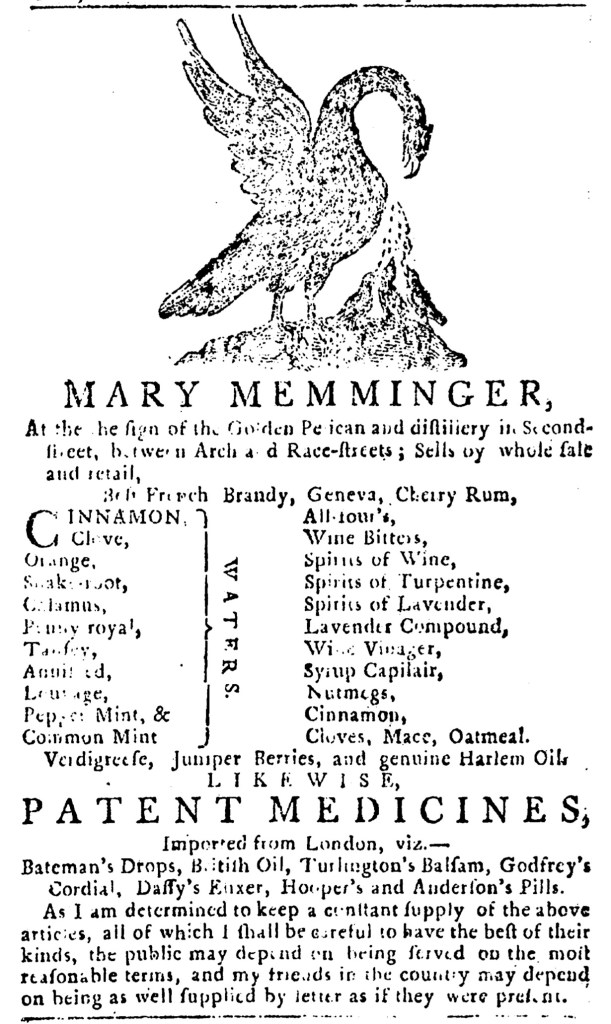
“MARY MEMMINGER, At the sign of the Golden Pelican.”

In the final issue of the Pennsylvania Journal published in 1775 and continuing in January 1776, Mary Memminger advertised the remedies available at her apothecary shop “At the sign of the Golden Pelican” on Second Street in Philadelphia.  Memminger described her shop as a “distillery,” suggesting that she may have produced some of the “WATERS” (including cinnamon, clove, orange, peppermint, and “Common Mint”) and “Spirits of Wine,” “Spirits of Turpentine,” and “Spirits of Lavender.”  She also stocked popular “PATENT MEDICINES, Imported from London,” listing “Bateman’s Drops, British Oil, Turlington’s Balsam, Godfrey’s Cordial, Daffy’s Elixer, [and] Hooper’s and Anderson’s Pills.”  Memminger apparently tended closely to her advertising.  The first time her notice appeared, it featured an error, truncating “Godrey’s Cordial, Daffy’s Elixer” to “Godfrey’s Elixer.”  The compositor fixed the mistake, a rare instance of an updated version of a newspaper advertisement for consumer goods and services after the type had been set.

Memminger did not indicate when she received the patent medicines “Imported from London,” whether they arrived in the colonies before the Continental Association went into effect on December 1, 1774.  Apothecaries and others who sold patent medicines often gave assurances that they were “fresh,” recent arrivals that had not lingered on shelves or in storerooms for months, yet Memminger left it to readers to draw their own conclusions.  She did assert that she was “determined to keep a constant supply of the above articles, all of which I shall be careful to have the best of their kinds,” perhaps indicating a willingness to make exceptions when it came to certain imported items.  Memminger made the health of her clients her priority, promising that “the public may depend on being served on the most reasonable terms, and my friends in the country may depend on being as well supplied by letter as if they were present.”  As a symbol of the care she provided, a woodcut dominated her advertisement (and the entire final page of the January 3, 1776, edition of the Pennsylvania Journal).  As William H. Helfand explains, it depicted “a pelican piercing her breast to nourish her young.”  Perhaps it replicated the “sign of the Golden Pelican” that marked Memminger’s location.  While other apothecaries, like Philip Godfrid Kast and Oliver Smith, deployed images that incorporated mortars and pestles, Memminger declined to include a tool of the trade in favor of emphasizing a symbol of motherly care and sacrifice tending to the welfare of others.

September 1

What was advertised in a revolutionary American newspaper 250 years ago today?

Story and Humphreys’s Pennsylvania Mercury (September 1, 1775).

“ALL sorts of PLANES, suitable for carpenters.”

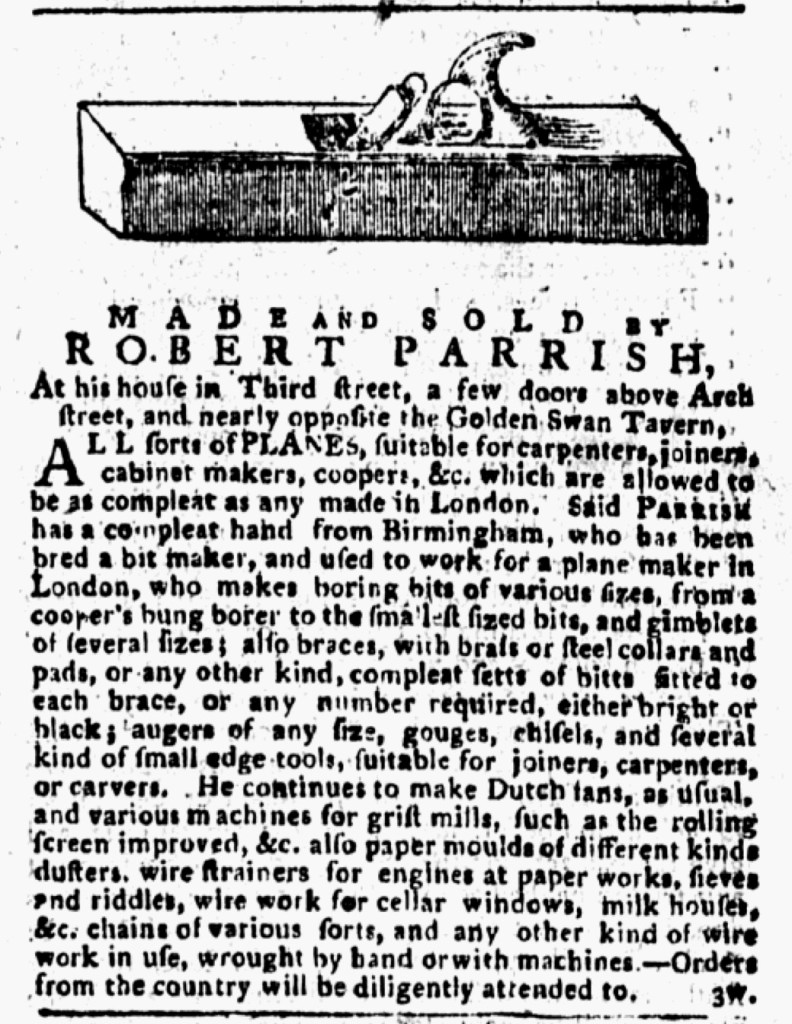
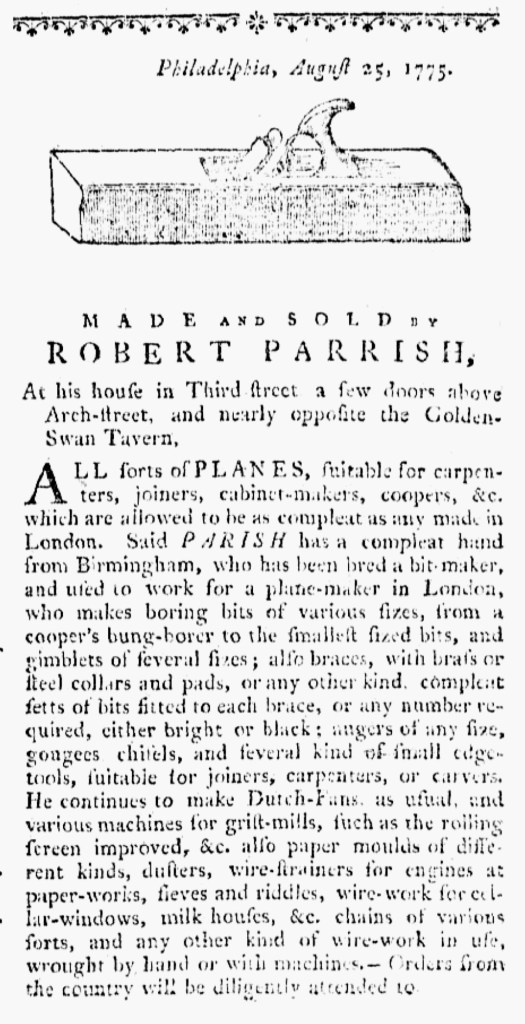
When Robert Parrish published an advertisement adorned with a woodcut depicting a carpenter’s plane in the August 26, 1775, edition of the Pennsylvania Ledger, it was the first of several appearances that image would make in newspapers printed in Philadelphia over the course of eight weeks.  It next appeared in Story and Humphreys’s Pennsylvania Mercuryon September 1 as part of an advertisement with identical copy.  Perhaps Parrish had clipped his advertisement from the Pennsylvania Ledger and delivered it to Story and Humphreys’s printing office along with the woodcut that he retrieved from the Pennsylvania Ledger.

Having commissioned only one woodcut constrained Parrish’s schedule for publishing his advertisements.  Story and Humphreys’s Pennsylvania Mercury came out on Fridays and the Pennsylvania Mercury on Saturdays.  That did not leave enough time to transfer the woodcut back and forth between the two printing offices and have the compositors in each include them in the new issues when they set the type and laid them out.  Compositors, after all, sought to streamline that process as much as possible.  To that end, the initial insertion of Parrish’s advertisement in the Pennsylvania Ledgerincluded a dateline, “Philadelphia, August 25, 1775,” above the woodcut, but the compositor did not include it with subsequent insertions (even though advertisements often ran with their original dates for weeks or months).  It was much easier to retain the copy for the main body of the advertisement without worrying about a header that ran above the woodcut.

Parrish’s advertisement first ran in the Pennsylvania Ledger on a Saturday (in the first week of his advertising campaign) and then in Story and Humphreys’s Pennsylvania Mercury the following Friday (in the second week of his advertising campaign).  It did not appear in the Pennsylvania Ledger the next day.  Instead, it ran in that newspaper a week later (in the third week of his advertising campaign).  In the fourth week, the woodcut returned to Story and Humphreys’s printing office and Parrish’s advertisement appeared in their newspaper once again on September 15.  It did not run in either newspaper the following week but instead found its way to yet another newspaper, the Pennsylvania Journal published on Wednesday, September 27.  That allowed enough time to get the woodcut back to the Pennsylvania Ledger for its September 30 edition (during the sixth week of Parrish’s advertising campaign).  Parrish returned to alternating between the two original newspapers during the next two weeks.  His advertisement with the woodcut went back to Story and Humphreys’s Pennsylvania Mercury for the October 6 issue and then ran in the Pennsylvania Ledger on October 14.

Investing in a woodcut increased the chances that prospective customers would take note of an advertisement, but Parrish and other advertisers had limits to how much they would spend.  He apparently considered it worth it to commission a single woodcut but not more than one.  Instead, he arranged to transfer that woodcut from printing office to printing office to printing office over the course of many weeks.

August 27

What was advertised in a revolutionary American newspaper 250 years ago this week?

Pennsylvania Ledger (August 26, 1775).

“ALL sorts of PLANES … as compleat as any made in London.”

Robert Parrish inserted an advertisement in the August 26, 1775, edition of the Pennsylvania Ledger to advise the public that he made and sold “ALL sorts of PLANES, suitable for carpenters, joiners, cabinet-makers, coopers,” and other artisans at “his house in Third-street, a few doors above Arch-street, and nearly opposite the Golden-Swan Tavern” in Philadelphia.  Parrish was no stranger to advertising in the public prints.  He previously ran an advertisement for “DUTCH FANS” and “ROLLING SCREENS,” both used for separating wheat from chaff, in the Pennsylvania Chronicle.

That notice featured two images, one of each kind of equipment that Parrish made and sold.  A woodcut also accompanied his new advertisement, this one depicting a carpentry plane.  It almost certainly drew attention to his advertisement since it was the only image of any sort, except for the coat of arms of Great Britain that always appeared in the masthead, in that issue of the Pennsylvania Ledger.  Parrish stated that “continues to make Dutch-Fans, as usual, and various machines for grist-mills, such as the rolling screen improved,” yet he did not include either of the images that accompanied his previous advertisement.  Perhaps he never reclaimed them from the printing office when William Goddard ceased publishing the Pennsylvania Chronicle in 1774 … or maybe he considered it too expensive to purchase the necessary space to feature two images.  His copy, after all, was significantly longer than in that earlier advertisement.

Parrish insisted that the planes made and sold at his shop were “as compleat as any made in London,” an assurance that the quality of construction matched imported tools.  American artisans frequently made such claims, though such promises had even greater significance with the Continental Association in effect.  The First Continental Congress devised that nonimportation and nonconsumption agreement in response to the Coercive Acts.  It also called for producers and consumers to support domestic manufactures, goods produced in the colonies, as alternatives to imported items.  Parrish signaled that he did his part to support the American cause by supplying carpenters, joiners, cabinetmakers, and coopers with the tools they needed to earn their livelihoods.

August 26

What was advertised in a revolutionary American newspaper 250 years ago today?

Constitutional Gazette (August 26, 1775).

“He proposes to continue his business of pickling oysters and lobsters.”

John Anderson’s effort to solicit advertisements in the August 23, 1775, edition of the Constitutional Gazette yielded results.  When he published the next issue three days later, the final page carried four advertisements.  The printer was responsible for two of them, one for a pamphlet, “Defensive War in a Just Cause Sinless,” and the other for “All sorts of Blanks used in this Province,” children’s books, and “New Pamphlets.”  Another advertisement hawked “JOYCE’s Grand American Balsam,” a patent medicine sometimes advertised in other newspapers.  Customers could acquire the medicine and directions from “Mrs. Joyce, at Brookland Ferry” and from “Messrs. Anderson, Gaine, and Rivington, Printers in New-York.”  Although Edward Joyce’s widow or the other two printers may have played a role in placing the advertisement, Anderson certainly had a hand in publishing it.

One advertisement, however, had not connection to the printer of the Constitutional Gazette.  Abraham Delanoy placed a notice “to inform his customers, and the public in general, THAT … he proposes to continue his business of pickling oysters and lobsters; and also puts up fired oysters so as to keep a long time even in a hot climate.”  His advertisement featured a woodcut depicting a lobster trap and an oyster cage, accounting for half the space and attracting attention in a newspaper that did not have any other visual images.  That woodcut previously accompanied Delanoy’s advertisement in Rivington’s New-York Gazetteer.  He either retrieved it from another printing office to deliver to Anderson or carefully stored it in anticipation of using it again.  Delanoy also replicated much of the copy from that previous advertisement. The similarities suggest that he either copied directly from it, making minor revisions as he went, or indicated changes directly on a clipping of the advertisement.  Some readers likely recognized Delanoy’s advertisement, but this time it generated revenue for John Anderson and the Constitutional Gazette.  The printer must have been pleased that Delanoy set an example for others to advertise in this new publication.

March 19

What was advertised in a colonial American newspaper 250 years ago this week?

New-York Journal (March 16, 1775).

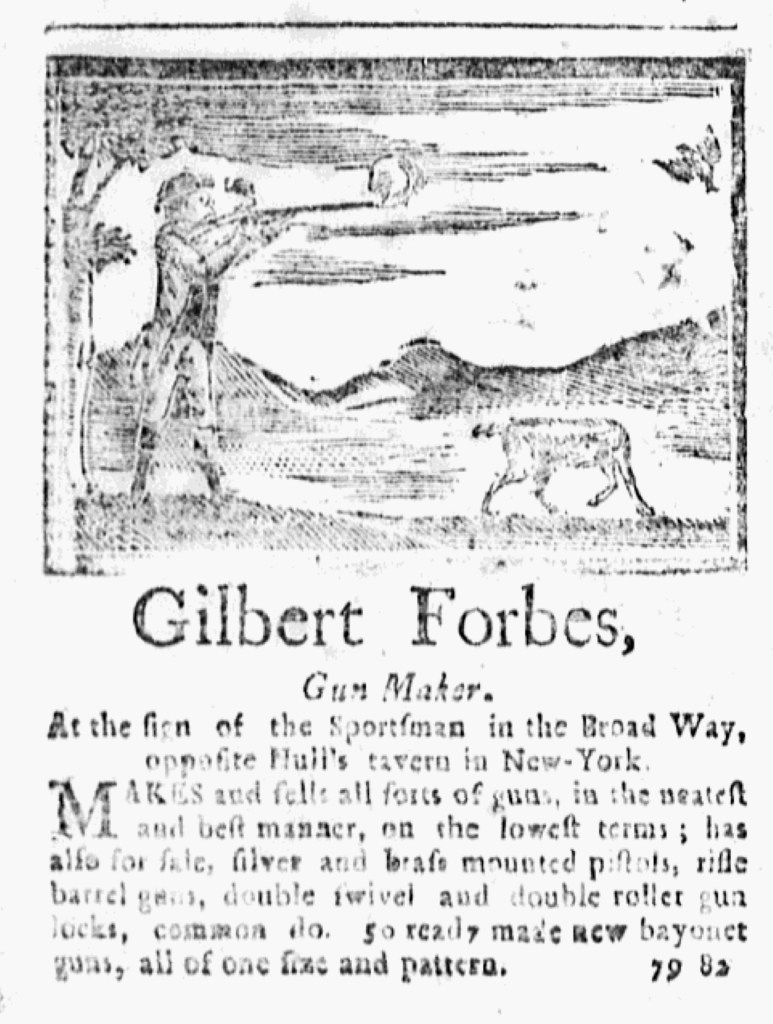
“Gilbert Forbes, Gun Maker, At the sign of the Sportsman.”

Gilbert Forbes, “Gun Maker, At the sign of the Sportsman in the Broad Way,” took to the pages of the New-York Journal to advertise “all sorts of guns” that he made “in the neatest and best manner “and sold “on the lowest terms” as spring approached in 1775.  He made some of the standard appeals deployed by artisans – quality and price – yet those were not the focal point of his advertisement.  A woodcut dominated his notice, accounting for more than half the space he purchased in the newspaper.

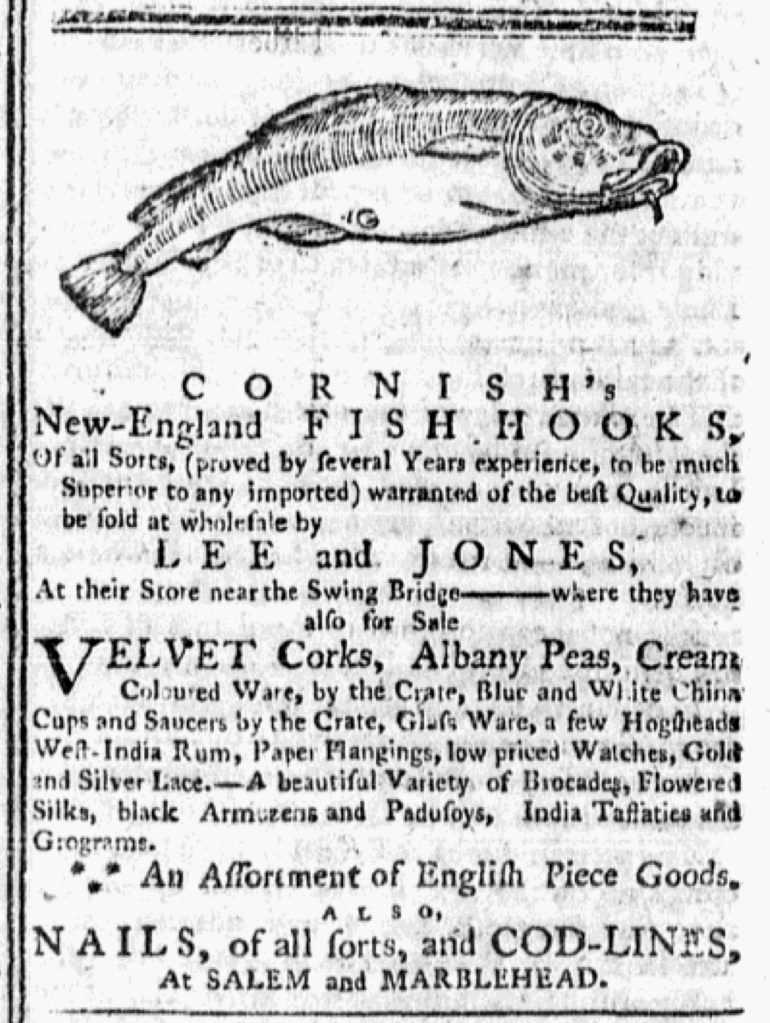
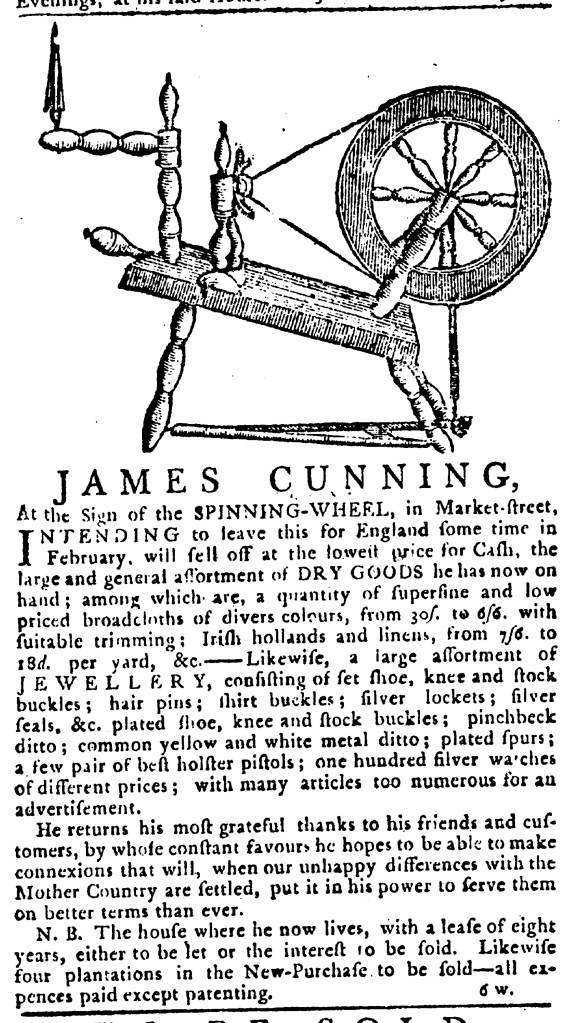
Commissioning the woodcut may very well have been worth the investment.  It almost certainly attracted the attention of readers, not only because it appeared on the first page of the March 16 edition.  The image depicted a scene of a well-dressed gentleman firing a gun, a bird plummeting out of the sky, and a hunting dog waiting below.  A puff of smoke wafted out of the barrel of the gun, capturing the moment just after the gentleman pulled the trigger.  Such a scene differed dramatically from other images that appeared in newspaper advertisements during the era of the American Revolution.  When advertisers commissioned woodcuts, they usually requested static images that corresponded to some aspect of their business, most often replicating their shop sign or showing an item that they made or sold at their shop.  For instance, an image of a fish adorned an advertisement for “CORNISH’s New-England FISH HOOKS” in the Massachusetts Spy and an image of a spinning wheel appeared in James Cunning’s advertisement for dry goods he sold “At the Sign of the SPINNING-WHEEL” in the Pennsylvania Journal.  In contrast, Forbes provided a scene in motion, distinguishing his advertisement from others.

Relatively few advertisements featured images at all.  Those that did most often incorporated stock images of ships at sea, houses, horses, or enslaved people, each of them provided by the printer.  Occasionally, advertisers commissioned woodcuts intended exclusively for their own use.  Among that small number, an image of a scene, one that invited viewers to imagine events in motion, was exceptionally rare.  As such, it demanded attention.

February 12

What was advertised in a colonial American newspaper 250 years ago this week?

Massachusetts Spy (February 9, 1775).

“CORNISH’s New-England FISH HOOKS.”

Lee and Jones stocked a variety of merchandise at “their Store near the Swing Bridge” in Boston in February 1775, but they made “CORNISH’s New-England FISH HOOKS” the centerpiece of their advertisement in the February 9 edition of the Massachusetts Spy.  Not only did they list that product first and devote the most space to describing it, but they also adorned their advertisement with a woodcut depicting a fish.  That image previously appeared in advertisements that Abraham Cornish placed in the Massachusetts Spy in March 1772 and March 1773.  Either Lee and Jones acquired the woodcut from Cornish when they composed the copy for their notice or Isaiah Thomas, the printer of the Massachusetts Spy, held the woodcut for Cornish and determined that advertisers promoting his product could use it in their notices.  It was not the first time that Lee and Jones distributed “CORNISH’s New-England Cod-Fish HOOKS.”

By the time that Lee and Jones ran their advertisement, Cornish had established a familiar brand.  In addition to advertising in the Massachusetts Spy, he also advertised in the Massachusetts Gazette and Boston Weekly News-Letter and Salem’s Essex Gazette.  His marketing efforts regularly touted the approval he received when “Fishermen … made trial of his Hooks” and found them “much superior to those imported from England.”  Lee and Jones deployed similar appeals when they proclaimed that the hooks had been “Proved by several Years experience, to be much Superior to any imported.”  Such assertions held even greater significance with the Continental Association, a nonimportation pact, in effect and the imperial crisis becoming even more dire.  In protest of the Coercive Acts passed in response to the Boston Tea Party, colonizers vowed not to import good from Britain.  The Continental Association called for encouraging domestic manufactures or goods produced in the colonies as alternatives to imported items.  Cornish has been making that case for his product for several years, as many readers likely remembered when they saw Lee and Jones’s advertisement for “CORNISH’s New-England FISH HOOKS.”

January 12

What was advertised in a colonial American newspaper 250 years ago today?

Supplement to the New-York Journal (January 12, 1775).

“A GENERAL and complete assortment of MUFFS and TIPPETS.”

Lyon Jonas, a “FURRIER, from LONDON,” was consistent in his advertising in two newspapers published in New York on the eve of the American Revolution.  He ran notices with identical copy in the New-York Gazette and Weekly Mercury in November 1774 and the New-York Journal in January 1775.  As was often the case when advertisers purchased space in more than one publication, the notices featured variations in format at the discretion of the compositor, including line breaks and capitalization.  Otherwise, the copy in Jonas’s advertisement was identical.  Rather than writing it out twice, the furrier may very well have clipped his advertisement from one newspaper to submit to the printing office of the other.

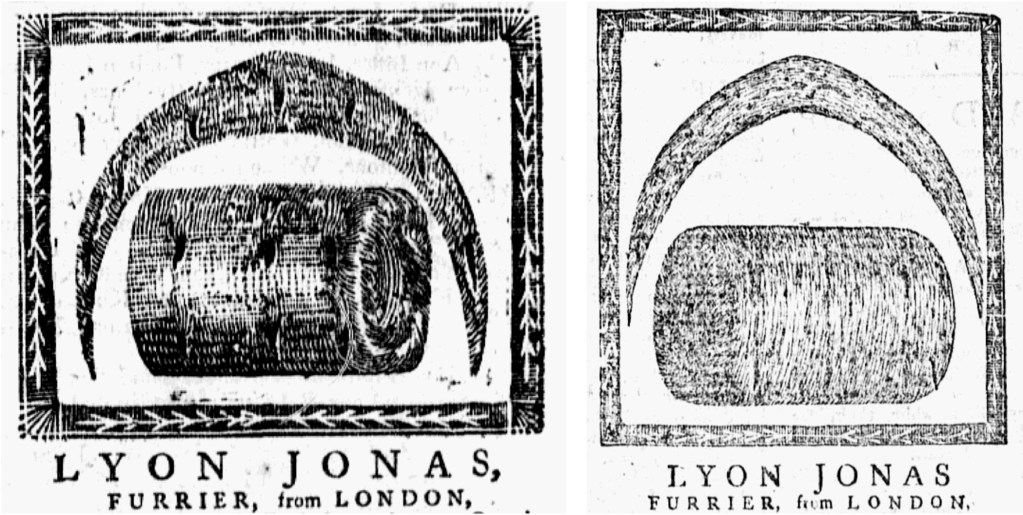
The two notices featured another striking similarity.  Both were adorned with a woodcut depicting a muff and a tippet enclosed within a decorative border, the size of the image accounting for approximately half of the space of the advertisement and certainly drawing attention.  Advertisers commissioned such distinctive woodcuts to promote their businesses, making additional investments in their marketing efforts.  In most instances that they incorporated images into advertisements in more than one newspaper, they collected their woodcut from one printing office and delivered it to another.

Jonas, however, commissioned a second woodcut.  Though similar at a glance, enough so that consumers would recognize the devise that represented Jonas’s business, the woodcuts had several variations.  The one in the New-York Gazette and Weekly Mercury was rectangular while the one in the New-York Journal was nearly a square.  The borders had different decorative elements, especially the corners.  The muffs faced opposite directions.  The ends of the tipped almost touched the border in the woodcut in the New-York Journal, but much more space appeared between the ends and the border in the version in the New-York Gazette and Weekly Mercury.

Most advertisers who adorned their newspaper notices with custom images limited their investment to one woodcut, transferring it from printing office to printing office when they wished to include those images in more than one publication.  Jonas, however, opted for a second woodcut.  Doing so allowed him, if he wished, to circulate advertisements with identical copy accompanied by distinctive images in two newspapers simultaneously without having to worry about the logistics of the printing offices sharing a single woodcut.

Left: New-York Gazette and Weekly Mercury (November 21, 1774); Right: Supplement to the New-York Journal (January 12, 1775).

November 30

What was advertised in a colonial American newspaper 250 years ago today?

Pennsylvania Journal (November 30, 1774).

“The Sign of the SPINNING-WHEEL.”

James Cunning ran a shop “At the Sign of the SPINNING-WHEEL” in Philadelphia in the early 1770s, occasionally advertising in the local newspapers.  In the fall of 1774, he made plans to depart for England the following February.  His preparations included running a new notice and selling his remaining merchandise “at the lowest price for Cash.”  He did not indicate why he planned to leave Philadelphia or how long he would be away, but he did state that during his time on the other side of the Atlantic that he “hopes to be able to make connexions that will, when our unhappy differences with the Mother Country are settled, put it in his power to serve [his customers] on better terms than ever.”  Neither Cunning nor readers knew that armed conflict between the colonies and Britain would erupt in Massachusetts in April 1775 or that the “unhappy differences” would be settled with a war for independence that would last eight years.

They did know, however, that the imperial crisis had intensified to the point that delegates from twelve colonies convened the First Continental Congress in Philadelphia in September and October 1774.  They also knew that meeting resulted in the Continental Association, a nonimportation agreement intended to unify the colonies.  That pact was scheduled to go into effect on December 1, the day after Cunning’s advertisement made its first appearance in the Pennsylvania Journal. Envisioning the difficulty ahead, the shopkeeper may have decided to make the best of the situation by liquidating his inventory and making plans for what he hoped would be a better future.

Given the stakes, Cunning sought to increase the chances that readers would take note of his advertisement.  To that end, he included a woodcut that depicted a spinning wheel, the same device that marked the location of his shop.  He had incorporated that image into advertisements he placed in October 1771 and December 1772.  More recently, including in an advertisement in the December 6, 1773, edition of Dunlap’s Pennsylvania Packet, he did not feature a visual image.  When he decided to visit England, Cunning either remembered where he had stored the woodcut or managed to find it after some searching, determined to use it to his advantage during difficult times.  A nick in the spindle reveals that it was the same woodcut from his earlier advertisements, collected from the printing office where John Dunlap published the Pennsylvania Packet and later delivered to the printing office where William Bradford and Thomas Bradford published the Pennsylvania Journal.  The shopkeeper intended, at least one more time, to get a return on the investment he made when he commissioned the woodcut.

November 28

What was advertised in a colonial American newspaper 250 years ago today?

Supplement to the New-York Gazette and Weekly Mercury (November 28, 1774).

“All sorts of organs, harpsichords, spinnets and Fortepianoes.”

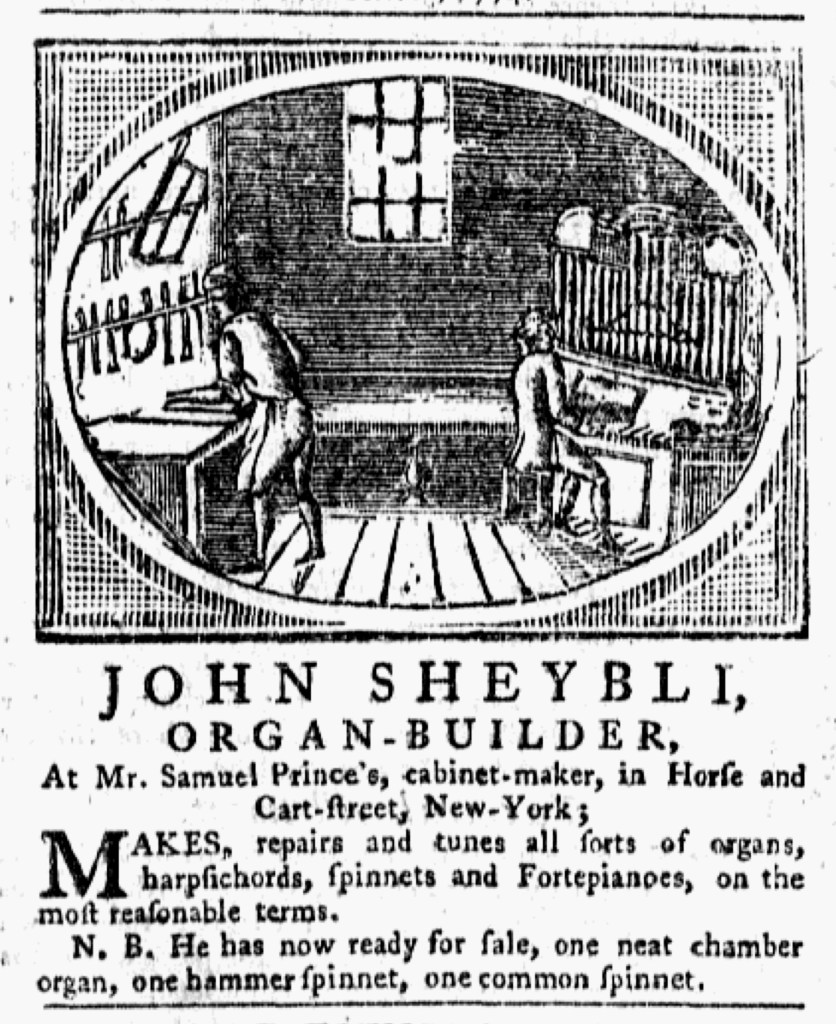
In the fall of 1774, John Sheybli, an “ORGAN-BUILDER,” took to the pages of the New-York Gazette and Weekly Mercury to advise the public that he “MAKES, repairs and tunes all sorts of organs, harpsichords, spinnets and Fortepianoes, on the most reasonable terms.”  In addition, he “has now ready for sale, one neat chamber organ, one hammer spinnet, [and] one common spinnet” at the workshop he shared with Samuel Prince, a cabinetmaker.

Readers of the New-York Gazette and Weekly Mercury likely perused the copy in Sheybli’s advertisement only after noticing the visual image that accompanied it.  A woodcut featured a scene with two men within an oval frame.  The man on the left stood at a workbench with an array of tools hanging on the wall over it and the man on the right was seated at an organ, maybe tuning it or maybe playing it.  Perhaps it was a depiction of the workshop where Sheybli built organs and other instruments on Horse and Cart Street, though it may have been an idealized portrait of the artisan at work and a customer enjoying the product of those labors.  Readers could determine for themselves how they wished to interpret it.

No matter which narrative they imagined, Sheybli treated them to a visual image unlike others they encountered in the New-York Gazette and Weekly Mercury and other newspapers.  Advertisers sometimes included woodcuts that represented some aspect of their business, but they focused on specific goods or replicated their shop signs.  They almost never showed people, neither at work producing the items offered for sale nor at leisure enjoying their purchases.  The November 28, 1774, edition of the New-York Gazette and Weekly Mercury and its supplement had three advertisements with woodcuts commissioned by the advertisers.  Lyon Jonas, a furrier, once again ran his notice with an image of some of the goods he produced, a muff and a tippet, while Nicholas Cox, a hatter, incorporated what may have been a variation of the sign that marked his location.  His woodcut showed a crown above a tricorne hat.  Readers were accustomed to those kinds of images, but much less often saw the sort of scene that Sheybli presented in his advertisement.  That almost certainly helped in making it memorable.

November 21

What was advertised in a colonial American newspaper 250 years ago today?

New-York Gazette and Weekly Mercury (November 21, 1774)

“A General and compleat assortment of muffs and tippets in the newest taste.”

As winter approached in 1774, Lyon Jonas, a “FURRIER, from LONDON,” took to the pages of the New-York Gazette and Weekly Mercury to advertise the “General and compleat assortment of muffs and tippets in the newest taste” available at his shop on Little Dock Street.  He also “manufactures and sells gentlemens caps and gloves lined with furr, very useful for travelling,” “trims ladies robes and riding dresses,” and “faces and lappels gentlemens coats and vests.”  In addition to those services, Jonas “buys and sells all sorts of furrs, wholesale and retail.”

To attract attention to his advertisement, the furrier adorned it with a woodcut that depicted a muff and a tippet (or scarf) above it with both enclosed within a decorative border.  It resembled, but did not replicate, the woodcut that John Siemon included in his advertisements in the New-York Journal, the Pennsylvania Chronicle, and the Pennsylvania Journal three years earlier.  That image did not include a border, but perhaps whoever carved Jonas’s woodcut recollected it when the furrier commissioned an image to accompany his notice.

Whatever the inspiration may have been, Jonas’s woodcut represented an additional investment in his marketing efforts.  First, he paid for the creation of the image.  Then, he paid for the space it occupied each time it appeared in the newspaper.  Advertisers paid by the amount of space rather than the number of words.  The woodcut doubled the amount of space that Jonas required in the New-York Gazette and Weekly Mercury, incurring additional expense.  Jonas presumably considered it worth the cost since the woodcut distinguished his notice from others.  In the November 21 edition and its supplement, five other advertisements featured stock images of ships and Hugh Gaine, the printer, once again ran an advertisement for Keyser’s “Famous Pills” with a border composed of ornamental type.  Beyond that Jonas’s notice was the only one with an image as well as the only one with an image depicting an aspect of his business and intended for his exclusive use.  Readers could hardly have missed it when they perused the pages of the New-York Gazette and Weekly Mercury.