March 6

What was advertised in a colonial American newspaper 250 years ago this week?

Supplement to Rivington’s New-York Gazetteer (March 3, 1774).

“All kinds of Windsor Chairs.”

On and off for several months, Thomas Ash, a “WINDSOR CHAIR MAKER, At the Corner below St. Paul’s Church, In the Broad Way,” adorned his advertisement in Rivington’s New-York Gazetteer with a woodcut depicting the item that he made and sold.  In contrast to Abel Buell’s advertisement featuring an image of a gun in the Connecticut Journal, Ash’s woodcut was not the only woodcut commissioned by an advertiser to appear in the March 3, 1774, edition of Rivington’s newspaper.  Elsewhere in that issue, Nesbitt Deane once again ran an advertisement featuring a tricorne hat with his name on a banner unfurled beneath it.  George Webster, “GROCER, AT THE SIGN OF THE Three Sugar Loaves & Scales,” included an image of three sugar loaves, two shorter ones flanking a taller one, enclosed within a simple border.

Those were not the only visual flourishes intended to draw attention to some of the advertisements in Rivington’s New-York Gazetteer.  Decorative borders became a trademark of that newspaper.  In the March 3 edition, five advertisements had such borders, including those placed by Richard Sause for merchandise at his “Hardware, Jewellery and Cutlery Store, John Siemon, a furrier, for muffs and tippets, John Simnet for cleaning and repairing watches, and S. Sp. Skinner for rum distilled in New York.  Except for Simnet, all those advertisers had experience running other notices with decorative borders, as the links indicate.  Simnet previously placed an identical advertisement, including the border. Sause and Siemon also sometimes ran advertisements with woodcuts tied to their businesses.  Indeed, Siemon did so in the New-York Journal published the same day, choosing one method of adding visual interest in one newspaper and another method in the other.  Webster was the fifth advertiser to use a border of decorative type, taking advantage of both methods in a single newspaper notice.

All the woodcuts and borders in Rivington’s New-York Gazetteer made its pages more vibrant than those in the Connecticut Journal.  Advertisements with woodcuts and borders still stood out from others since most did not have either of those features, yet they collectively contributed to a cohesive look that distinguished newspapers published in busy ports from those printed in smaller towns.

January 20

What was advertised in a colonial American newspaper 250 years ago today?

Rivington’s New-York Gazetteer (January 20, 1774).

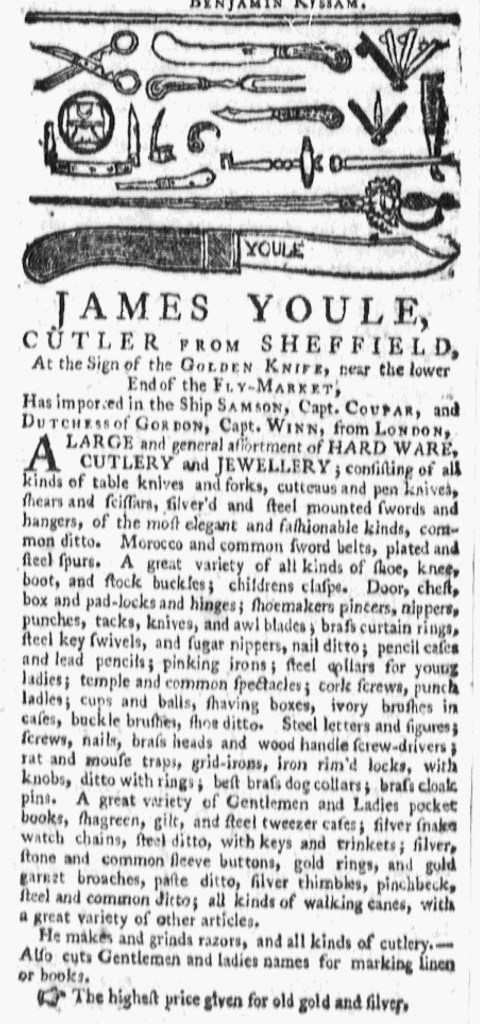
“JAMES YOULE, CUTLER FROM SHEFFIELD, At the Sign of the GOLDEN KNIFE.”

James Youle, a “CUTLER FROM SHEFFIELD,” ran a shop “At the Sign of the GOLDEN KNIFE” in New York in the 1770s.  He advertised a “LARGE and general assortment of HARDWARE, CUTLERY and JEWELLERY” in the January 20, 1774, edition of Rivington’s New-York Gazetteer.  In addition to the dozens of items he listed in that notice, Youle declared that he “makes and grinds razors, and all kinds of cutlery.”  Even given the length of Youle’s advertisement, many readers likely considered the woodcut that adorned it the most significant feature.  It depicted more than a dozen items that the cutler made or sold at his shop, including shears, a fork, a table knife, a pocketknife, and a sword.  The image rivaled the decorative borders that enclosed other advertisements in the same issue.

Youle had some experience incorporating similar woodcuts into his advertisements.  Nearly three years earlier, the partnership of Bailey and Youle included a similar image in their advertisements in the New-York Gazette and Weekly Mercury in March 1771.  In the summer of 1772, Youle updated the image to feature his name alone.  The partnership having dissolved, Bailey ran advertisements for his own shop “At the Sign of the Cross Swords.”  The woodcut that accompanied his advertisement showed several items arrayed around two crossed swords.  In the early 1770s, other cutlers in New York, including Richard Sause and Lucas and Shephard, devised similar images for their advertisements, apparently deciding that remaining competitive in their trade required visual images in their notices as well as skill in their shops.

When he returned to pairing advertising copy with a woodcut in 1774, Youle revived the image that he first used when partnered with Bailey and later on his own, though he made one significant alteration.  The cutler added a large knife, perhaps a machete, below the sword.  The blade bore the name “YOULE,” just as Richard Sause previously included his last name on the blades of both a knife and a sword in his woodcut.  Perhaps this new addition was the “GOLDEN KNIFE” from Youle’s sign, a new means of identifying his shop since his earlier advertisements with woodcuts.  The cutler may have crafted the woodcut himself.  Near the end of his advertisement, he noted that he “cuts Gentlemen and ladies names for marking linen or books.  He may have applied the same skill to enhancing his own newspaper advertisements.

December 1

What was advertised in a colonial American newspaper 250 years ago today?

Pennsylvania Gazette (December 1, 1773).

“He continues the Hat-making Business, and hopes those who have already obliged him with their Custom will continue so to do.”

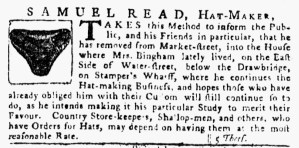
When he moved from Market Street to Water Street in Philadelphia, Samuel Read, “HAT-MAKER,” ran an advertisement in the Pennsylvania Gazette to “inform the Public, and his Friends in particular” of his new location.  He encouraged “those who have already obliged him with their Custom” to visit his new shop, especially since he “intends making it his particular Study to merit their Favour.”  Read also assured “Country Store-keepers, Shallop-men, and others, who have Orders for Hats” that they “may depend on having them at the most reasonable Rate.”

In an effort to draw attention to his advertisement, Read adorned it with a woodcut depicting a tricorne hat, a style so popular at the time that it has become widely associated with late eighteenth-century fashions.  Few advertisements in the December 1, 1773, edition of the Pennsylvania Gazette featured visual images.  The printers supplied woodcuts of vessels at sea for seven advertisements seeking freight and passengers for ships departing for other ports.  Frederick Hubley, a coppersmith in Lancaster, ran the only other advertisement with a woodcut designed for the exclusive use of his business.  Readers of the Pennsylvania Gazette became familiar with his woodcut of a still thanks to repeated insertions over several months.  Even with those advertisements appearing elsewhere in the newspaper, Read’s advertisement was the only one with a woodcut on the first page.

Rivington’s New-York Gazetteer (December 2, 1773).

Read’s woodcut reflected his occupation and distinguished his advertisement from others in the Pennsylvania Gazette, even though it was not as elaborate as a similar image that Nesbitt Deane, a hatmaker in New York, frequently used in his advertisements.  Deane’s woodcut depicted a tricorne hat above a ribbon that stated his name.  Deane also developed marketing appeals beyond those deployed by Read.  For instance, he declared that he devised “a method peculiar to himself, to turn rain, and prevent sweating of the head damaging the crown.”

Read’s advertisement was not as sophisticated as the one that Deane simultaneously ran in Rivington’s New-York Gazetteer, not in terms of the copy nor in terms of the visual image, yet the hatmaker in Philadelphia demonstrated more than a little marketing savvy.  His notice did not merely announce that he moved to a new location.  Read attempted to maintain existing relationships with his customers by promising that their satisfaction remained his primary concern.  He also promised low prices to retailers who would purchase in volume and other customers.  The woodcut, plain as it may seem to modern eyes, also drew attention to his advertisement, distinguishing it from most others in that issue of the Pennsylvania Gazette.

October 28

What was advertised in a colonial American newspaper 250 years ago today?

New-York Journal (October 28, 1773).

“Gentlemen’s caps, and gloves, lined with fur, very useful for travelling, and sleighing.”

During the final week of October 1773, John Siemon, a furrier, inserted advertisements in three newspapers published in New York, placing his notices before the eyes of as many readers in and near the city as possible.  He hawked a “General and complete assortment, of new fashion’d muffs & tippets, ermine, cloak linings, … gentlemen’s caps, and gloves, lined with fur,” and other items.  In addition, he “trims Ladies robes and riding dresses” and “faces and lapels Gentlemen’s waistcoats.”  As an ancillary service, Siemon provided directions “to rub the furs in summer” to keep them in good condition when not being worn.

Although Siemon submitted nearly identical copy to the three printing offices, his advertisements had very different formats when they appeared in the newspapers.  Arguably the one that best represented Siemon’s brand, the notice in the New-York Journal featured a woodcut depicting a muff, an image that regularly accompanied the furrier’s advertisements.  Siemon apparently considered it worth the investment to commission a single woodcut for the exclusive use of his business, but did not realize the potential of purchasing multiple woodcuts with the same image in order to achieve visual consistency and product recognition across several publications.

Rivington’s New-York Gazetteer (October 28, 1773).

Siemon’s advertisement in Rivington’s New-York Gazetteer had a different kind of visual appeal.  The furrier joined the ranks of advertisers who enclosed their notices within borders comprised of decorative type, including Crommelin and Horsfield, bakers, John J. Roosevelt, a merchant, Richard Sause, a cutler.  James Rivington and the compositors in his printing office made such borders a regular part of advertisements for consumer goods and services.  Those borders helped to draw attention to certain advertisements while also giving the pages of Rivington’s newspaper a distinctive look.  In contrast, no images or decorative type adorned Siemon’s advertisement in the New-York Gazette and Weekly Mercury.  It consisted solely of text with the typography determined by the compositor to match other advertisements in that publication.

New-York Gazette and Weekly Mercury (October 25, 1773).

In most instances, advertisers submitted copy to printing offices and then compositors determined the format of the advertisements.  Siemon’s advertisements suggest that was indeed the case when advertising in the New-York Gazette and Weekly Mercury, yet he offered specific directions, in the form of the familiar woodcut, for his advertisement in the New-York Journal.  His advertisement in Rivington’s New-York Gazetteer demonstrates the greatest level of collaboration between advertiser and compositor.  Siemon either requested or agreed to include a distinctive visual element associated with notices in that newspaper.  The furrier took graphic design into account to varying degrees in his efforts to disseminate his advertisements in multiple newspapers.

September 29

What was advertised in a colonial American newspaper 250 years ago today?

Pennsylvania Journal (September 29, 1773).

“At the Sign of the Golden Key.”

In the fall of 1773, William Ross, a shoemaker, informed readers of the Pennsylvania Journal that he imported a “Very neat assortment of BOOT LEGS and BEN LEATHER SOALS” and “double CALLIMANCOE for ladies shoes.”  He asserted that he stocked “an assortment of the best articles in the business” for the benefit of “his friends and customers.”  The copy for Ross’s advertisement occupied less space than the image that accompanied it.  A woodcut depicting the sign that marked his location on Walnut Street included a shoe and the words “W. ROSS FROM SCOTLAND.”  The shoemaker enhanced his advertisement by investing in a woodcut associated exclusively with his business, unlike the stock images of ships at sea included in some of the other advertisements on the same page.

Pennsylvania Journal (September 29, 1773).

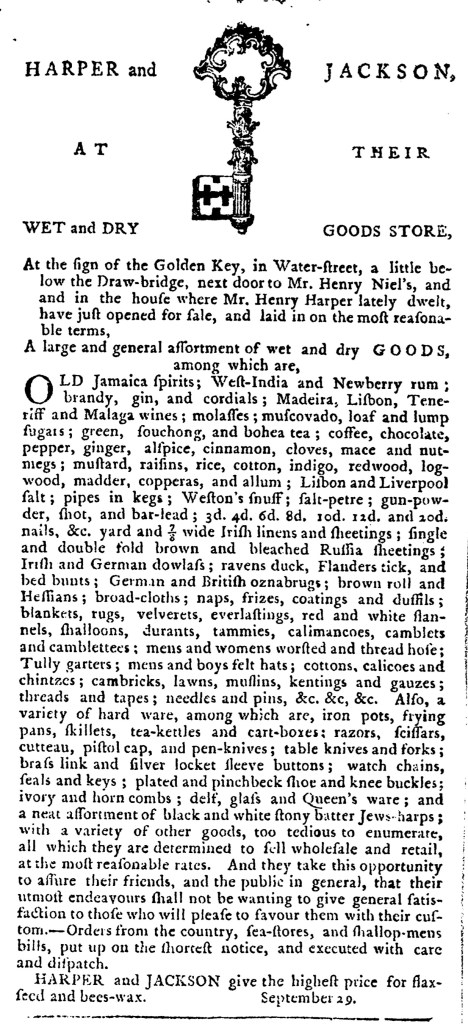
Ross was not the only entrepreneur whose advertisement featured an image of a shop sign in the September 29 edition of the Pennsylvania Journal.  Harper and Jackson adorned their notice for their “WET and DRY GOODS STORE, At the sign of the Golden Key” on Water Street with a woodcut of an ornate key.  Their names flanked the key, further associating the device with their business.  Unlike Ross, Harper and Jackson devoted most of their advertisement to copy, listing dozens of items among their inventory.  In addition, they promised “a variety of other goods, too tedious to mention,” that they sold “at the most reasonable rates.”  The merchants pledged “their utmost endeavours … to give general satisfaction to those who will please to favour them with their custom.”  As much as prospective customers may have appreciated such appeals, it was likely the image of the key that initially attracted their attention to the advertisement and made it memorable.

These two advertisements testify to some of the advertising images that colonizers encountered as they navigated the streets of Philadelphia during the era of the American Revolution.  Many merchants, shopkeepers, artisans, and tavernkeepers adopted, displayed, and promoted devices that became synonymous with their businesses, precursors to logos associated with corporations.  Relatively few included images of their shop signs in their newspaper advertisements, though greater numbers did mention the symbols that marked their locations.  Readers of the Pennsylvania Journal and other newspapers glimpsed truncated scenes of the commercial landscape of the bustling port as they perused the pages of the public prints.

August 11

What was advertised in a colonial American newspaper 250 years ago today?

Pennsylvania Gazette (August 11, 1773).

“Weaver’s Reeds or Shuttles.”

Eighteenth-century readers would have recognized the image that adorned George Lechler’s advertisement in the August 11, 1773, edition of the Pennsylvania Gazette, even though it does not possess the same familiarity for modern readers.  Lechler described himself as a “WEAVER AND REED-MAKER.”  The image that ran across the top of the notice, a long narrow rectangle divided by vertical lines at close intervals, depicted a reed.  As described by the Oxford English Dictionary, a reed is “part of a loom consisting of a set of evenly spaced wires known as dents (originally slender pieces of reed or cane) fastened between two parallel horizontal bars used for separating, or determining the spacing between, the warp threads, and for beating the weft into place.”  A reed also aids in guiding a shuttle across the loom.  Though the woodcut likely looks like a geometric design to most readers today, colonizers easily recognized a piece of equipment used when weaving.

That image helped draw attention to the lively copy that constituted the remainder of the advertisement.  Lechler expressed some exasperation that he “F[OU]ND myself once more under the necessity to acquaint the Public where in Philadelphia I live, since there are persons who say that I am removed.”  Such stories, he asserted, were “entirely false, as I live in the same house where I have lived these 12 years past, and shall continue in it till I move into eternity.”  Lechler had no intention, now or ever, of moving to another location.  Furthermore, following his death, “there will be another Lechler, who will continue to live there, as the house is my own, and he will make work as good as his father.”  The weaver demonstrated pride in owning his house and workshop, as sign of success, as well as pride in his own abilities and pride in the skills of his son who would continue the family business.  Yet he did not consider it necessary to go into greater detail about the “Weaver’s Reeds or Shuttles” that he made, stating that “it is not necessary for me to praise my work, for the work itself will praise the master.”  Customers who needed reeds and shuttles, Lechler declared, “may depend on getting them as good of me, as in any part of the world,” whether imported or made in the colonies.

The weaver had “a parcel of good Reeds ready made …for sale” at his house on Market Street, “the third door above the sign of the Three Kings.”  He intended for the image of the reed and the slightly cantankerous advertisement to entice weavers to acquire equipment from him at the usual place rather than trust in idle gossip (or perhaps even deliberate attempts to undermine his share of the market) that he had moved to another location.  He also encouraged the public to think of his workshop as a family business that would continue after his death, promoting customer loyalty among those satisfied with the reeds they purchased from him.

August 1

What was advertised in a colonial American newspaper 250 years ago this week?

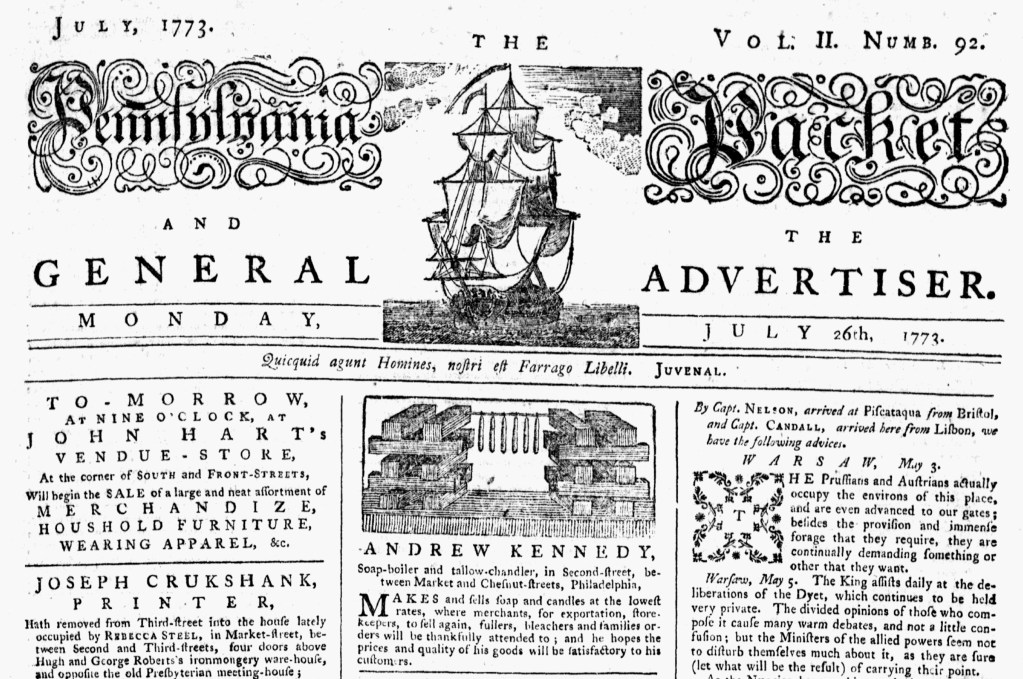
Pennsylvania Packet (July 26, 1773).

“MAKES and sells soap and candles … for exportation.”

The front page of the July 26, 1773, edition of the Pennsylvania Packet and General Advertiser featured two images.  As usual, a woodcut depicting a ship at sea appeared in the masthead.  The newspaper took its name from the packet ships that crisscrossed the Atlantic, transporting passengers and freight.  Significantly, packet ships also carried information, whether written in letters, printed in newspapers, or shared by captains, other officers, and crew.  The Pennsylvania Packet, like a packet ship, disseminated news to every destination it reached.  Whether accounts of current events, rosters of vessels arriving and departing from customs houses, prices current for commodities, or advertisements, the contents of the Pennsylvania Packet facilitated commerce in Philadelphia, its figurative home port, and readers wherever they happened to peruse the newspaper.

Andrew Kennedy certainly hoped that the Pennsylvania Packet and General Advertiser would facilitate his own commercial interests.  The “soap-boiler and tallow-chandler” ran a shop in Philadelphia, though he aimed to serve consumers far beyond that bustling port.  Like packet ships and newspapers, he envisioned the soap and candles that he made and sold “at the lowest rates” reaching faraway places.  He offered them to “merchants, for exportation,” and to “storekeepers, to sell again,” presenting those options for buying by volume first before mentioning “families orders.”  Like many other artisans and shopkeepers who advertised in colonial newspapers, he promoted the “prices and quality of his goods” and concluded with overtures about customer satisfaction.  Kennedy commenced his advertisement with an image that readers immediately recognized, stacks of blocks on the right and left to support a string dangling six freshly-dipped candles.  Without even skimming the rest of the advertisement, readers knew that Kennedy sold candles.

Only two other images appeared in that issue of the Pennsylvania Packet, both of them woodcuts of indentured servants who ran away from their masters.  John Dunlap, the printer, provided those stock images to the advertisers, but Kennedy commissioned a woodcut for his own exclusive use.  That image likely helped attract attention to the appeals to price and quality that he intended to resonate with merchants, shopkeepers, and other prospective customers.

July 21

What was advertised in a colonial American newspaper 250 years ago today?

Pennsylvania Gazette (July 21, 1773).

“At the Hunting Side Saddle.”

Elias Botner, “Sadler and Harness-maker,” ran a workshop “at the Hunting Side Saddle, next door to the London Coffee-house” in Philadelphia in the early 1770s.  In an advertisement in the July 21, 1773, edition of the Pennsylvania Gazette, he informed prospective customers that he made and sold various kinds of saddles for gentlemen and ladies as well as saddlebags, “jockey caps, of all sizes,” holsters, and fire buckets.  He declared that he made his saddles and “saddle-furniture” (or equipment) “in the newest and neatest fashion” to match the tastes of his discerning customers.  In addition, he marketed his fire buckets as the “strongest perhaps made in this city.”  He offered discounts to customers who purchased “a quantity” of fire buckets, while also promising “the lowest terms” for his other merchandise.

To draw attention to these various appeals, Botner adorned his advertisement with a woodcut that depicted a saddle.  That image distinguished his advertisement from the other paid notices in the same issue.  Four of them featured stock images of ships at sea, supplied by the printers, but all of the other advertisements relied solely on text without images.  Botner’s advertisement was the only one with an image commissioned for the exclusive use of that business.  It was not the first time, however, that the saddler deployed the image, though it had been a while since it appeared in the pages of the Pennsylvania Gazette.  More than three years earlier, Botner ran an advertisement in the Postscript Extraordinary to the Pennsylvania Gazette on May 3, 1770, adorning his notice with the woodcut and invoking the sign that marked the location of his shop.  That sign remained a constantly visible marker for residents and visitors who traversed the streets of Philadelphia in the intervening years, even though the woodcut disappeared from the public prints during that time.  Like many other entrepreneurs, Botner utilized visual images to promote his business, but used some, like his shop sign, consistently and others, like his woodcut in his newspaper advertisements, sporadically.  Botner and others experimented with the power of images in their marketing efforts, sometimes assuming additional costs for the advertisements they placed in colonial newspapers.

May 23

What was advertised in a colonial American newspaper 250 years ago this week?

Rivington’s New-York Gazetteer (May 20, 1773).

“The Sign of the Tea-Cannister and two Sugar Loaves.”

When James Rivington launched Rivington’s New-York Gazetteer in the spring of 1773, he had a significant number of advertisers lined up for the first several issues.  Those advertisers included entrepreneurs who previously invested in woodcuts that depicted some aspect of their business.  Such visual images distinguished their advertisements from others that consisted entirely of text.  Nesbitt Deane, a hatmaker, ran an advertisement featuring the familiar image of a tricorne hat with his name in a ribbon below it in the first issue.  Richard Sause, a cutler, included his woodcut depicting items made and sold at his shop in the second issue of Rivington’s New-York Gazetteer.

A couple of weeks later, Smith Richards, a “GROCER and CONFECTIONER, At the Sign of the Tea-Cannister and two Sugar Loaves,” ran an advertisement with an image that replicated his shop sign.  Within a thick border, sugar loaves flanked a tea canister embellished with the names of popular varieties of tea, “HYSON,” “SOUCHONG,” and “CONGO.”  Unlike the woodcuts that adorned advertisements placed by Deane and Sause, this one had not previously appeared in the New-York Gazette and Weekly Mercury or the New-York Journal.  (It may have run in the New-York Gazette or Weekly Post-Boy.  Issues from January 1771 through the last known issue of July 12, 1773, have not yet been digitized for greater accessibility.)  The image of the “Sign of the Tea-Cannister and two Sugar Loaves” very well may have been the first woodcut commissioned for an advertisement in Rivington’s New-York Gazetteer.

Richards had not previously advertised in the New-York Gazette and Weekly Mercury or the New-York Journal, but he apparently believed that the new Rivington’s New-York Gazetteer offered a good opportunity and a sound investment when it came to advertising his wares.  Even though most advertisers did not commission woodcuts to accompany their notices, many other entrepreneurs, some who previously advertised in other newspapers and some who had not, shared Richards’s confidence in the effectiveness of disseminating their advertisements via New York’s newest newspaper. Rivington had successfully convinced prospective advertisers that his newspaper enjoyed a wide circulation for even its earliest issues.

May 12

What was advertised in a colonial American newspaper 250 years ago today?

Supplement to the Pennsylvania Gazette (May 12, 1773).

“A MUSICIAN.”

When an anonymous musician offered “to teach the art of playing on the Guittar, in the best and newest taste” and “likewise teaches the German flute,” he adorned his advertisement in the May 12, 1773, edition of the Pennsylvania Gazette with an image of a guitar, a flute, and a sheet of music.  The woodcut accounted for half of the space occupied by the advertisement.  The combination of visual image and advertising copy likely drew the attention of readers, especially since most advertisements did not feature any sort of image.

Some did have a stock image in the upper left corner.  For instance, four advertisements that sought passengers and freight for ships preparing to depart for other ports incorporated woodcuts of vessels at sea, perhaps the most common image that appeared in a newspaper published in the bustling urban port of Philadelphia.  In contrast, images depicting enslaved people appeared about as often as images of ships in advertisements in newspapers published in Charleston.  The May 12 edition of the Pennsylvania Gazette did not have any images of enslaved people, even though it included advertisements about enslaved men, women, and children for sale as well as notices describing enslaved people who liberated themselves and offering rewards for their capture and return.  That issue did feature one advertisement with a woodcut depicting an indentured servant who absconded.  Two advertisements for stallions “to cover” (or breed with) mares had woodcuts of horses.

Pennsylvania Gazette (May 12, 1773).

In addition to those stock images supplied by the printers, three images commissioned by advertisers to correspond to the goods and services they marketed adorned advertisements in that issue.  A woodcut depicting a stagecoach drawn by two horses enhanced the notice for the route that connected Philadelphia and New York, operated by Charles Bessonett and Company.  An image of a sickle accompanied the advertising copy in Jacob Eckfelt’s notice.  Finally, the woodcut depicting the guitar, flute, and sheet music distinguished the anonymous musician’s advertisement from others that consisted solely of text.

To varying degrees, eighteenth-century advertisers experimented with images in their newspaper notices, sometimes opting for stock images provided by the printers and other times commissioning woodcuts for their sole use.  Although the majority of advertisers did not incorporate images into their notices, enough did so to demonstrate both curiosity about the practice and a suspicion or even a belief that images were worth the additional investment.  While these images may seem quaint or rudimentary when viewed through modern eyes, they likely resonated with eighteenth-century readers who usually encountered images in advertisements and nowhere else in newspapers, with the exception of the image that appeared in the masthead on the first page of each issue.