May 12

What was advertised in a colonial American newspaper 250 years ago today?

Supplement to the Pennsylvania Gazette (May 12, 1773).

“A MUSICIAN.”

When an anonymous musician offered “to teach the art of playing on the Guittar, in the best and newest taste” and “likewise teaches the German flute,” he adorned his advertisement in the May 12, 1773, edition of the Pennsylvania Gazette with an image of a guitar, a flute, and a sheet of music.  The woodcut accounted for half of the space occupied by the advertisement.  The combination of visual image and advertising copy likely drew the attention of readers, especially since most advertisements did not feature any sort of image.

Some did have a stock image in the upper left corner.  For instance, four advertisements that sought passengers and freight for ships preparing to depart for other ports incorporated woodcuts of vessels at sea, perhaps the most common image that appeared in a newspaper published in the bustling urban port of Philadelphia.  In contrast, images depicting enslaved people appeared about as often as images of ships in advertisements in newspapers published in Charleston.  The May 12 edition of the Pennsylvania Gazette did not have any images of enslaved people, even though it included advertisements about enslaved men, women, and children for sale as well as notices describing enslaved people who liberated themselves and offering rewards for their capture and return.  That issue did feature one advertisement with a woodcut depicting an indentured servant who absconded.  Two advertisements for stallions “to cover” (or breed with) mares had woodcuts of horses.

Pennsylvania Gazette (May 12, 1773).

In addition to those stock images supplied by the printers, three images commissioned by advertisers to correspond to the goods and services they marketed adorned advertisements in that issue.  A woodcut depicting a stagecoach drawn by two horses enhanced the notice for the route that connected Philadelphia and New York, operated by Charles Bessonett and Company.  An image of a sickle accompanied the advertising copy in Jacob Eckfelt’s notice.  Finally, the woodcut depicting the guitar, flute, and sheet music distinguished the anonymous musician’s advertisement from others that consisted solely of text.

To varying degrees, eighteenth-century advertisers experimented with images in their newspaper notices, sometimes opting for stock images provided by the printers and other times commissioning woodcuts for their sole use.  Although the majority of advertisers did not incorporate images into their notices, enough did so to demonstrate both curiosity about the practice and a suspicion or even a belief that images were worth the additional investment.  While these images may seem quaint or rudimentary when viewed through modern eyes, they likely resonated with eighteenth-century readers who usually encountered images in advertisements and nowhere else in newspapers, with the exception of the image that appeared in the masthead on the first page of each issue.
May 5

What was advertised in a colonial American newspaper 250 years ago today?

Pennsylvania Gazette (May 5, 1773).

“Chymist and Druggist … at the Sign of the Unicorn’s Head.”

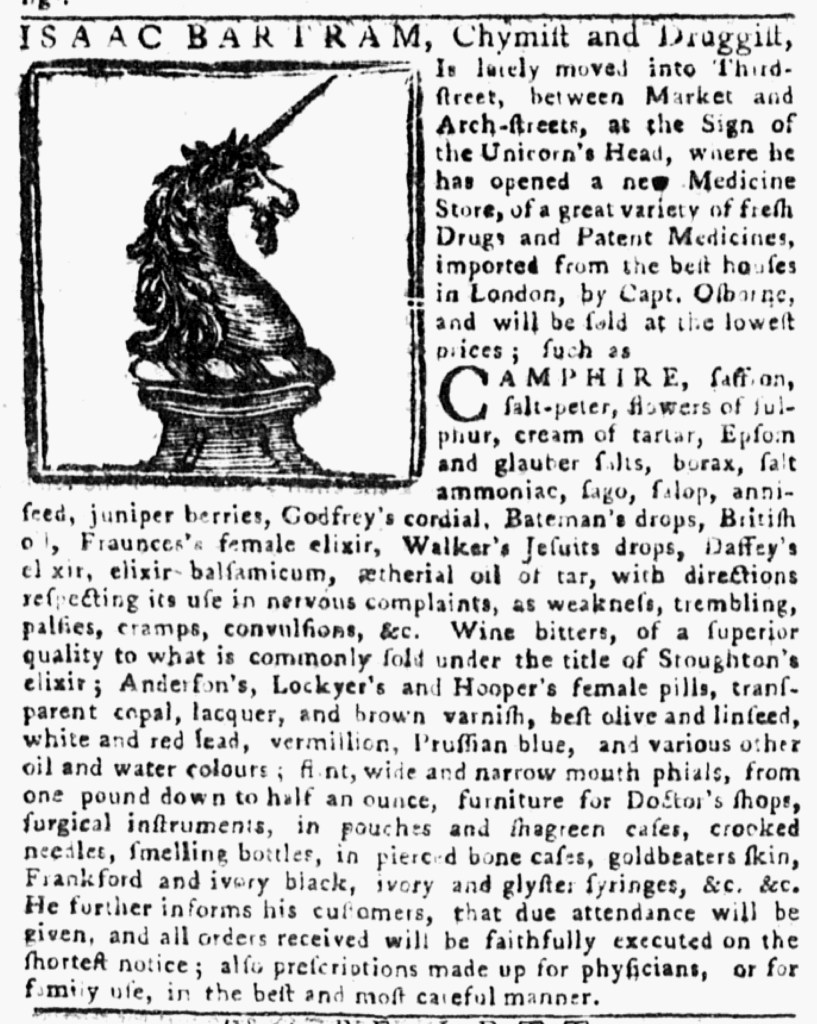
Isaac Bartram, “Chymist and Druggist,” offered a variety of goods and services at his “new Medicine Store” in Philadelphia in the spring of 1773.  According to his advertisement in the May 5 edition of the Pennsylvania Gazette, he sold a “great variety of fresh Drugs and Patent Medicines, imported from the best houses in London.”  Prospective customers would have been familiar with the patent medicines that Bartram listed in his notice, just as modern consumers recognize various brands of over-the-counter medications.  Among other nostrums, the apothecary carried “Godfrey’s cordial, Bateman’s drops, … Walker’s Jesuits drops, Daffey’s elixir, [and] Anderson’s Lockyer’s and Hooper’s female pills.”  For those willing to try equivalent products, like modern consumers who purchase generics, Bartram marketed “Wine bitters, of a superior quality to what is commonly sold under the title of Stoughton’s elixir.”  He also stocked medical equipment, including syringes, vials, and surgical instruments, and prepared prescriptions “for physicians, or for family use.”

In addition to the copy, Bartram deployed an image to draw more attention to his advertisement.  He indicated that he kept shop “at the Sign of the Unicorn’s Head.”  Appropriately, a woodcut depicting a unicorn’s head enclosed within a border adorned the upper left corner of his notice, accounting for nearly one-quarter of the space occupied by his advertisement.  This certainly increased Bartram’s advertising costs since he had to commission the unique image associated with his business and then pay for the additional space.  Most advertisers did not invest in images for their notices, though a growing number adopted the practice in the early 1770s.  Elsewhere in the same issue of the Pennsylvania Gazette, Stephen Paschall and son Stephen Paschall, as they styled themselves, included an image of a scythe, a sickle, and other sort of iron work available at their workshop “at the Sign of the Scythe and Sickle.”  The initials “SP” marked one of the items.  The Paschalls first published the image a year earlier.  These images may have replicated the signs displayed by Bartram and the Paschalls, the only surviving visual representations of signs that colonizers glimpsed as they traversed the streets of Philadelphia.

Most advertisers relied solely on the text of their notices to encourage readers to visit their shops.  Such was the case for Robert Bass, an apothecary whose advertisement for a “new and fresh Assortment of DRUGS and PATENT MEDICINES” appeared on the same page as Bartram’s advertisement.  The woodcut depicting the Sign of the Unicorn’s Head certainly made Bartram’s notice much more visible to readers, prompting them to read about his wares and, in the process, quite possibly justifying the investment.

March 31

What was advertised in a colonial American newspaper 250 years ago today?

Pennsylvania Gazette (March 31, 1773).

“A Quantity of well made RIFLES.”

Thomas Palmer, a gunsmith, made several appeals to prospective customers in Philadelphia in the advertisement he placed in the March 31, 1773, edition of the Pennsylvania Gazette.  He declared that his inventory included a wide selection, a “Quantity of well made RIFLES, of different Lengths and Sizes of Bores.”  Palmer was so confident of the quality of those guns that he proclaimed that he “will insure to the Purchasers” that they were “as good and as handsomely fitted up as any made in America.”  Consumers would not find better in Philadelphia or anywhere else in the colonies.  In addition, the gunsmith “makes Fowling Pieces, of different Sizes, such as have been approved of by Gentlemen of this City.”  Short of publishing testimonials from his clients, Palmer suggested that men with good reputations endorsed the guns produced in his workshop.  In addition to making rifles and fowling pieces, he also “repairs old Guns in the most careful Manner.”

Palmer did not rely on advertising copy alone to market his services.  Instead, he incorporated a visual image into his notice.  A woodcut that may have replicated a sign that marked the gunsmith’s location adorned the advertisement, though the copy did not make reference to any sign at Palmer’s shop on “the North Side of Market-street, between Fourth and Fifth-streets.”  On the other hand, Palmer may have considered it unnecessary to mention a sign in copy that appeared immediately below an image of a rifle and the words “THO: PALMER Gun Smith” enclosed within a double border.  Residents of Philadelphia may have already been familiar with the sign and readers from beyond the city would have easily recognized it if they decided to visit Palmer’s shop.  Whether or not Palmer displayed a sign at his shop on Market Street, the woodcut helped distinguish his advertisement from other content in the Pennsylvania Gazette, likely making it worth the investment.  With the exception of the seal in the masthead, only one other image appeared in that issue.  A stock image of a house ran with a real estate notice, but that lacked the same level of customization as the woodcut in Palmer’s advertisement.  The gunsmith deployed text and image simultaneously in his efforts to engage prospective customers.

November 21

What was advertised in a colonial American newspaper 250 years ago today?

Providence Gazette (November 21, 1772).

“At the Sign of the Greyhound.”

Nathaniel Wheaton sold a “new Assortment of English and India GOODS, of almost every Kind,” as well as “West-India Goods” at his shop on Williams Street in Providence.  In an advertisement that ran in the Providence Gazette for several weeks in November 1772, he thanked his current customers and invited new ones to examine his merchandise, pledging that all of “their Favours will be gratefully acknowledged.”

To help readers find his shop, Wheaton noted that “the Sign of the Greyhound” marked his location.  A woodcut depicting a greyhound, sitting on its haunches and its town hanging out, adorned the advertisement.  The image may have replicated the shop sign.  Even if Wheaton had not been that precise, he still resorted to some sort of depiction of a greyhound to encourage consumers to associate that emblem with his shop.  Like other eighteenth-century newspaper advertisers who published images that correlated to their shop signs, Wheaton devised a marketing strategy that could be considered a precursor to branding his business.  The woodcut encouraged readers to associate the greyhound with Wheaton’s shop, especially when considered in combination with the sign displayed on Williams Street.

The image also directed attention to Wheaton’s advertisement.  Except for the image of a lion and a unicorn flanking a crown and shield in the masthead, the greyhound was the only image in the November 21 edition of the Providence Gazette.  Readers could not have missed it!  Wheaton incurred additional expense to achieve that.  He paid for the woodcut and he paid for the space it occupied.  Newspaper advertisers paid for the amount of space required to publish their notices, not by the number of words, so both larger fonts and images increased the costs of running advertisements.  Wheaton devoted as much space to the image of the greyhound as he did to advertising copy, doubling the price of his notice compared to what he would have paid if he published solely text.  He likely considered the additional expense a good investment to distinguish his advertisement from those of his competitors.  After all, it was not the first time he incorporated the image into his newspaper advertisements.

An imperfection in the copy of the November 21 edition available in the database of digitized images of eighteenth-century newspapers mars the image of the greyhound in Wheaton’s advertisement. This image shows the woodcut without flaws. (Providence Gazette, November 14, 1772).

September 19

What was advertised in a colonial American newspaper 250 years ago today?

Pennsylvania Chronicle (September 19, 1772).

“John White Stay-Maker”

Most advertisements in colonial newspapers did not feature visual images.  Those that did usually used a stock image provided by the printer, such as a ship at sea, a house, a horse, or an enslaved person liberating him- or herself by “running away.”  Never elaborate in the scenes depicted, such woodcuts could be used interchangeably in advertisements from the appropriate genre.  Some advertisers, however, commissioned images that corresponded to the shop signs that marked their locations or illustrated one or more items available among their merchandise.

Two such images appeared in the September 19, 1772, edition of the Pennsylvania Chronicle.  Robert Parrish once again included the woodcut depicting a “ROLLING SCREEN for cleaning wheat and flaxseed,” though he did not use a woodcut showing a Dutch fan or winnowing fan that previously appeared with it.  Perhaps he did not wish to incur the additional cost for the space required to publish two images.

Another entrepreneur, John White, adorned his advertisement with an image of a stay (or corset), the body and holes for the laces on the left and the laces on the right.  Readers would have easily recognized the garment and understood how it wrapped around and confined a woman’s body.  The words “John White” and “Stay-Maker” flanked the woodcut.  The image accounted for half of the space for the advertisement, an additional investment beyond commissioning the woodcut.

White announced that he moved to a new location where “he continues to carry on the Staymaking business as usual.”  He pledged “to give satisfaction to all who are pleased to employ him.”  He also solicited “orders from any part of the country” and provided mail order service, making it unnecessary for clients to visit his shop in Philadelphia.  Instead, they could send measurements “in respect to length and width of the Stays, both at top and bottom exactly, in the front and back parts.”  The staymaker warned that customers who opted for that convenience needed to pay postage for such orders rather than expect him to take responsibility for those charges.

The woodcut depicting a stay, its body and laces unfurled, almost certainly helped attract attention to White’s advertisement, his promises of customer satisfaction, and the option for submitting orders “by the post” rather than visiting his shop.  Most newspaper advertisements consisted solely of text, so any sort of visual enhancement, whether an image or decorative type, distinguished those advertisements from others.

June 18

What was advertised in a colonial American newspaper 250 years ago today?

Massachusetts Spy (June 18, 1772).

“HATS manufactured and sold by the advertiser.”

Of the five newspapers published in Boston in the summer of 1772, the Massachusetts Spy had the most elaborate masthead, but it also had featured the fewest innovations in design for the rest of the contents, including advertisements.  For instance, a decorative border enclosed Jolley Allen’s advertisement when it appeared in each of the other newspapers, but that distinctive format was not incorporated into Allen’s notice when he submitted identical copy to the Massachusetts Spy.

That did not prevent Martin Bicker from attempting to draw more attention to his advertisement with an image of his merchandise in the upper left corner.  Bicker advertised that he “manufactured and sold” hats.  A woodcut depicting a tricorne hat, a popular style at the time, alerted readers to the contents of the advertisement before they read it.  Bicker did not provide many details about his hats, but he did declare that he “hopes he has given such satisfaction to his customers as will induce them to continue their favours.”  In other words, he invited repeat business and recommendations via word of mouth.

New-York Journal (June 18, 1772).

The same day that Bicker’s advertisement ran in the Massachusetts Spy, Nesbitt Deane once again inserted his advertisement for hats in the New-York Journal.  Both the appeals he made to customers and the image that accompanied the notice were more sophisticated.  Deane trumpeted that he made hats “to exceed in Fineness, Cut, Colour and Cock.”  In addition, he devised a means “to turn rain, and prevent the Sweat of the Head damaging the crown.”  Prospective customers would not find that feature in other hats, Deane asserted, because he invented “a Method peculiar to himself. He also gave a discount to retailers who bought in volume, offering “Encouragement to those who buy to sell again.”  Like Bicker, Deane acknowledged his existing customers and asked them to promote his hats.  “Such Gentry and others, who have experienced his Ability, ’tis hoped will recommend.”  The image at the top of Deane’s advertisement included both a tricorne hat and a banner with his name.  Rococo flourishes further enhanced that image.

Bicker did not deploy as many appeals as Deane in his effort to entice consumers to purchase his hats, but including an image in his advertisement distinguished it from most others in the Massachusetts Spy.  Relatively few advertisements published in the eighteenth-century newspapers featured images of any sort.  Did including images give advertisers an advantage?  Deane apparently thought so.  By the time Bicker placed his notice, Deane had been running his advertisement for nearly a year.  He likely would not have inserted it in the New-York Journal so many times if he did not believe he received a return on his investment.

April 6

What was advertised in a colonial American newspaper 250 years ago today?

Boston Evening-Post (April 6, 1772).

“At the GOLDEN MORTAR … A compleat and fresh Assortment of Drugs & Medicines.”

Very few images appeared in the April 6, 1772, edition of the Boston Evening-Post.  The masthead ran on the first page, as usual, featuring a cartouche with an ornate border enclosing an image of a crown suspended over a heart.  Immediately below, the colophon stated that the newspaper was “Printed by THOMAS and JOHN FLEET, at the HEART and CROWN in Cornhill.”  Readers encountered only two other images in that issue, both of them adorning advertisements on the second page.  A woodcut depicting a ship at sea embellished a notice that announced the London would soon sail for London.  It helped draw attention to instructions for anyone interested in “Freight or Passage [to] apply to the Captain on board, or to Nath. Wheatley’s Store in King-Street.”

That woodcut belonged to the printers, Thomas Fleet and John Fleet.  The woodcut that accompanied Oliver Smith’s advertisement, however, did not.  It depicted a mortar and pestle, replicating Smith’s shop sign, “the GOLDEN MORTAR,” in the same way the image in the masthead represented the sign that marked the Fleets’ printing office.  The Fleets and other printers supplied a small number of woodcuts – ships at sea, houses, horses, enslaved people – for eighteenth-century advertisers to include in their newspaper notices.  If advertisers wished for specialized images associated exclusively with their businesses, they commissioned the woodcuts and provided them to the printers.  That also meant they could retrieve their woodcuts from one printing office and submit them to another.

Smith did so in the early 1770s.  His woodcut depicting a mortar and pestle enhanced an advertisement in the Massachusetts Gazette and Boston Weekly News-Letter in the fall of 1771.  More than half a year later, the same woodcut appeared in an advertisement in the Boston Evening-Post.  Not only did Smith attempt to widen his share of the market for “Drugs & Medicines” in Boston by advertising in multiple newspapers, he also sought to increase the visibility of the device associated with his shop.  The “GOLDEN MORTAR” served as a rudimentary trademark or brand that made his advertisements and his shop easy for consumers to identify.

December 22

What was advertised in a colonial American newspaper 250 years ago this week?

New-York Journal (December 19, 1771).

“MUFFS, TIPPETS, ERMINE and lining for CLOAKS.”

In the fall of 1771, furriers Fromberger and Siemon placed a series of advertisements in the Pennsylvania Chronicle and the Pennsylvania Journal.  On several occasions, an image of a muff and tippet adorned their notices, helping to draw attention to the various appeals they made concerning fashion, quality, and price.  The partners even offered ancillary services to entice prospective customers, including caring for furs “gratis for the summer season.”

The furriers apparently considered the image of the muff and tippet so effective in promoting their enterprise that when Siemon traveled to New York to conduct business there he took the woodcut with him in order to enhance advertisements he placed in newspapers published in that busy port.  He placed a notice in the December 19, 1771, edition of the New-York Journal that included both the image and copy, effectively doubling the cost.  According to the newspaper’s colophon, John Holt charged five shillings to insert “Advertisements of no more Length than Breadth” for four weeks and “larger Advertisements in the same Proportion.”  The woodcut doubled the length of Siemon’s advertisement, but very well may have been worth the additional expense if it aided in cultivating a clientele previously unfamiliar with the furrier.

Familiar appeals accompanied the visual image.  Siemon informed “the LADIES and others” that he brought with him “a general assortment of the newest fashion’d MUFFS, TIPPETS, ERMINE and lining for CLOAKS … now worn by the LADIES at the Court of Great-Britain,” echoing appeals to fashion, taste, and gentility advanced in advertisements that ran in newspapers in Philadelphia.  He also encouraged prospective customers to make their purchases soon because he would be in New York for a limited time.  Siemon had plans to return to Philadelphia, so would stay “a month only in this city.”  Milliners and shopkeepers who missed that window of opportunity, however, could direct orders to Fromberger and Siemon in Philadelphia.

Although printers provided stock images of ships, houses, horses, indentured servants, and enslaved men and women, woodcuts with images that represented specific businesses belonged to the advertisers to transfer from newspaper to newspaper as they saw fit.  Some advertisers did indeed deploy the same woodcut in multiple newspapers printed in a city, but it was much more unusual for advertisers to transport an image to newspapers published in other cities. Fromberger and Siemon did so, their advertisement running in the Pennsylvania Journal without an image on the same day that Siemon’s advertisement first appeared in the New-York Journal with an image.  Having gained some visibility in Philadelphia over the course of several months, the furriers likely aimed to achieve maximum effectiveness through using the woodcut to call attention to their advertisements in another city when one of the partners visited and temporarily conducted business there.

November 3

What was advertised in a colonial American newspaper 250 years ago this week?

Pennsylvania Gazette (October 31, 1771).

“THOMAS SHIELDS … at the Golden Cup and Crown.”

When Thomas Shields, a goldsmith, advertised his services in the October 31, 1771, edition of the Pennsylvania Gazette, he adorned his notice with a depiction of a crown suspended above a cup.  That image corresponded to the sign that marked his location on Front Street in Philadelphia.  It also helped to distinguish his advertisement from others in the same issue.  Ten other notices incorporated images, but all of them featured woodcuts of vessels at sea.  Each of those advertisements sought passengers and freight for ships preparing to leave the busy port.

The images of the ships belonged to David Hall and William Sellers, the printers of the Pennsylvania Gazette.  Along with stock images of houses, horses, enslaved people, and indentured servants, colonial printers provided images of ships to advertisers.  Those who desired more specialized images, on the other hand, commissioned them and retained ownership.  That being the case, some advertisers used their woodcuts in one newspaper for a while before transferring them to another newspaper.  At about the same time that Shields ran his advertisement in the Pennsylvania Gazette, James Cunning, a shopkeeper “At the sign of the SPINNING WHEEL,” supplied his woodcut of a spinning wheel to two other newspapers, first the Pennsylvania Journal and then the Pennsylvania Packet.  The notation at the end of Shields’s advertisement, “5 W,” indicated that he arranged for it to run for five weeks.  After that, he could collect his woodcut from Hall and Sellers and transfer it to another printing office.

I regularly choose these unique images that adorned newspaper advertisements when I select notices to feature on the Adverts 250 Project.  Relative to their numbers and frequency in the early American press, such images are overrepresented on this project, meriting a disclaimer that Shields’s advertisement and others with such images were not typical.  They do, however, testify to what was possible in eighteenth-century advertising and the choices that advertisers made when it came to format, incurring additional expenses, and placing notices in multiple newspapers.  In addition, the Adverts 250 Project has compiled an informal census of woodcuts that advertisers commissioned in the late 1760s and early 1770s.  After nearly six years producing the Adverts 250 Project, I get the impression (though this needs to be tested against a more systematic accounting) that the frequency of such images accelerated in the early 1770s, a sign that greater numbers of advertisers embraced the additional expense if those woodcuts garnered greater attention for their newspaper notices.

August 29

What was advertised in a colonial American newspaper 250 years ago today?

New-York Journal (August 29, 1771).

“HATS MANUFACTURED by … NESBITT DEANE.”

For many weeks in the summer of 1771, Nesbitt Deane took to the pages of the New-York Journal to advertise hats he made and sold “Aside the Coffee-House Bridge.”  His hats had several qualities he expected consumers would appreciate, including exceptional “Fineness, Cut, Colour and Cock.”  These were not ordinary hats that prospective customers could acquire in just any shop, Deane confided, but instead “MANUFACTURED … by a Method peculiar to himself, to turn rain, and prevent the Sweat of the Head damaging the crown.”  Such promises may have enticed some readers to visit his shop to examine his hats for themselves to see what distinguished them from others available in the bustling port city.  Deane also called on “Such Gentry and others, who have experienced his Ability” by purchasing and donning his hats to recommend them to others.

Eventually, the hatter determined that he might attract more attention and incite greater demand if an image accompanied his advertisement.  Without revising the copy, he doubled the length of his notice, beginning on August 29, with a woodcut depicting a tricorne hat.  A banner bearing Deane’s name, adorned with rococo flourishes completed the image.  Such finery likely prompted the “Gentry and others” among readers of the New-York Journal of the engraved images on trade cards and billheads that circulated in London and, to a lesser extent, the largest cities in the colonies.  Another advertiser, Gerardus Duyckinck, had been enclosing the copy of his advertisements within a baroque cartouche for several years.  His most recent advertisement, perhaps an inspiration for Deane, appeared once again in the August 29 edition.

The sophistication inherent in Deane’s image testified to the “Fineness” of his hats, but it also meant that he invested more in his marketing efforts.  In addition to commissioning a woodcut unique to his business, he also paid for twice as much space in the New-York Journal each time his advertisement appeared.  The compositor’s notation at the end, “95 –,” indicated that the notice with the woodcut first appeared in issue 1495 but Deane had not selected an end date.  Neither had he done so for his first advertisement composed entirely of text.  In both instances, the hatter committed to more than the standard four weeks that the printer set as a minimum.  Between the indefinite duration of his notices and enhancing them with a striking image, Deane demonstrated his belief that more and better advertising would produce results.