July 3

What was advertised in a colonial American newspaper 250 years ago today?

Providence Gazette (July 3, 1773).

“Watch and Clockmaker, from Paris, but late from New-Orleans.”

Advertisements in colonial newspapers testified to the migration of artisans from place to place in the Atlantic World in the eighteenth century.  As they sought to earn their livelihoods in new locations, some artisans introduced themselves to prospective customers with newspaper notices.  These newcomers had not yet established their reputations in the cities and towns where they settled, so they used advertising as a means of assuring consumers of the quality of their work if given a chance.  As part of those efforts, they listed their origins in hopes that prospective customers would associate some sort of cachet with London, Paris, and other European cities.  Some even continued to make reference to their origins long after they set up shop in the colonies.

Consider two advertisements that appeared in the July 3, 1773, edition of the Providence Gazette.  In the first, Lambert Lescoiet pledged that he made and repaired watches and clocks “in the best Manner, and doubts not of giving entire Satisfaction to such as may please to employ him.”  Having recently arrived in Providence, he had not yet established a reputation or cultivated a clientele.  In the absence of the community’s familiarity with him and his work, he hoped that introducing himself as a “Watch and Clockmaker, from Paris, but late from New-Orleans,” would suggest to readers that he did indeed possess the skills to “giv[e] entire Satisfaction” to his customers.  He also attempted to excite some curiosity and even bragging rights among colonizers who availed themselves of the services of the clockmaker “from Paris, but late from New-Orleans.”

In the other advertisement, John Sebring continued promoting himself as a “Saddler, Chaise and Harness-Maker, from London” who made saddles and accessories “in the newest Fashion, and in the neatest Manner.”  He likely hoped that prominently displaying his origins suggested that he maintained connections to London and possessed special insight into the latest fashions in the most cosmopolitan city in the empire, even though he had been working in Providence for eight months.  In that time, his previous advertisement in which he declared that he “has had the Advantage of several Years Experience in some of the principal Shops in London” may have helped in attracting clients.  In his latest advertisement, he expressed “his Thanks to all those who have obliged him with their Custom, and hopes for a Continuance of their Favours.”  In so doing, he signaled to prospective clients that their peers already trusted him to supply their saddles and accessories.

Like many other artisans who advertised in colonial newspapers, both Lescoiet and Sebring hoped that invoking their origins from metropolitan places, like Paris and London, would serve as recommendations to prospective customers.  As newcomers who had not yet established their reputations in Providence, they made reference to their origins as one means of inciting interest among local consumers.

July 1

What was advertised in a colonial American newspaper 250 years ago today?

Supplement to the New-York Journal (July 1, 1773).

“Advice to the cautious, who are about to buy, swop, and little jobs to the wise for nothing.”

On July 1, 1773, watchmaker John Simnet placed a new advertisement in Rivington’s New-York Gazetteer.  On that day, another of his advertisements appeared in the New-York Journal for the tenth time.  While not uncommon for merchants, shopkeepers, and artisans to advertise in more than one newspaper simultaneously, they usually submitted identical notices to each printing office.  Prospective customers usually encountered the same advertisement no matter which publication they happened to read.

Simnet’s advertisements in the two newspapers were not that much different.  In each, he informed the public that he recently “removed” to a new location.  He also proclaimed that he charged “half the price” of his competitors when it came to cleaning and repairing watches, in addition to offering a service plan in which he would “keep them in order at his own trouble, without expence (except abused).”  In other words, as long as clients treated their watches well, Simnet provided small repairs free of charge.  The watchmaker, a frequent advertiser, had been promoting these aspects of his business for quite some time, even before one of his current advertisements first ran in the New-York Journal on April 29.

Rivington’s New-York Gazetteer (July 1, 1773).

He made additional appeals in his new advertisement in Rivington’s New-York Gazetteer.  In particular, he offered “advice to the cautious, who are about to buy, swop, and little jobs to the wise for nothing.”  With the exception of small jobs undertaken gratis, these services had not previously been part of Simnet’s marketing efforts in the public prints.  The description he deployed closely replicated the language that Thomas Hilldrup, a watchmaker in Hartford, used in advertisements that ran in all three newspapers published in Connecticut.  In those notices, Hilldrup declared that he offered “advice to those who are about to buy, sell or exchange, and any other jobbs that take up but little time gratis.” Simnet almost certainly saw those advertisements, especially considering that he advertised in the Connecticut Courant for the first time in January 1773.  He had been active in the greater New York market for more than two years, after relocating from Portsmouth, New Hampshire, but had not considered it necessary to advertise in any of the newspapers published in Connecticut until Hilldrup arrived in the colony in the fall of 1772 and then devised an extensive advertising campaign over the next several months.

One other aspect of Simnet’s new notice merits attention, especially considering that he placed it in a newspaper that served Connecticut, New Jersey, the Hudson River, and Quebec.  Simnet asserted that he was the “ONLY regular Watchmaker here, of the London Company,” a claim that he frequently made in other advertisements as a means of denigrating his competitors.  In addition, he had a long history of picking fights and engaging in public feuds in his newspaper advertisements, first in Portsmouth and then in New York.  It comes as little surprise that he would appropriate the marketing strategies of a competitor while simultaneously contending that he possessed superior skill and training, especially in a newspaper that he anticipated that competitor was likely to read.  The cantankerous watchmaker often seemed as interested in taunting his competitors as attracting clients to his shop.

April 27

What was advertised in a colonial American newspaper 250 years ago today?

Connecticut Courant (April 27, 1773).

WATCHES! only.”

Having established himself in Hartford, watchmaker Thomas Hilldrup continued his advertising campaign with a new notice in the April 27, 1773, edition of the Connecticut Courant.  He stated that his “motive was to merit the approbation of the public from his first commencing business here” in the fall of 1772, while also providing an update that he had been successful in that endeavor as measured by “the many repeated favours already confer’d” by customers in the area.  Hilldrup also reminded prospective clients of the services and incentives he offered, including repairing watches “in a perfect and durable manner,” giving a warrantee that they would “perform well, free of any expence for one year,” and providing “advice gratis.”

Connecticut Courant (April 27, 1773).

Those appeals echoed Hilldrup’s earlier advertisements, but other aspects of his notice seemed to comment on a notice that a competitor, Enos Doolittle, placed in the previous issue of the Connecticut Courant.  Doolittle used a headline that read, “Clocks & Watches,” and informed the public that he had been trained in “the business of Clock Making and repairing all kinds of Watches.”  In turn, Hilldrup emphasized that he specialized in watches with a headline that proclaimed, “WATCHES! only.”  Doolittle also noted that he “employed a journeyman who has serv’d a regular Apprenticeship to the Watchmaking business in London.”  Hilldrup implied that this indicated some sort of shortcoming in the way that Doolittle managed his business.  In a nota bene, marked with a manicule to draw attention, Hilldrup declared, “The public are desired to take notice that I am capable of going through the business myself without any assistance.”  Hilldrup suggested that hiring a journeyman to handle some of the business that came into the shop meant that Doolittle lacked the skill necessary to do the work on his own.  Doolittle, like other artisans who mentioned employees, presented the journeyman’s presence as evidence of a thriving business.

Artisans rarely made direct comparisons between themselves and their competitors when they placed newspaper advertisements during the era of the American Revolution.  Hilldrup was an exception, though he did not explicitly name Doolittle in his notice.  Still, readers of the Connecticut Courant likely noticed that Hilldrup’s advertisement commented on the one placed by his competitor.

March 2

What was advertised in a colonial American newspaper 250 years ago today?

South-Carolina Gazette and Country Journal (March 2, 1773).

“She carries on the MILLINARY BUSINESS in all its branches, and will be much obliged to her FRIENDS for a continuance of their favours.”

The Bowers continued their advertising efforts in the South-Carolina Gazette and Country Journal in March 1773. William gave directions to the new location for his shop and advised readers that he “continues to carry on the CLOCK and WATCH-MAKING BUSINESS in all its branches.”  Katharine, a milliner and shopkeeper, promoted the “very neat ASSORTMENT of MILLINARY GOODS” she recently imported and sold at the same location that William made and repaired clocks and watches.

The two previously placed a joint advertisement with the primary purpose of informing current customers and the general public of their new location.  William’s portion of the original notice was a little longer than Katharine’s portion, mostly as a result of providing more extensive directions to the new shop at “the fourth corner of Tradd-street and the Bay, lately possessed by Messrs. Mackenzie & Tunno, and next door to The Great Stationary and Book Store.”  In terms of describing the goods and services they provided, William and Katharine occupied similar amounts of space in that earlier notice.

Such was not the case with the new notice.  William’s portion of the advertisement repeated, the type still set from the previous iteration, but Katharine submitted entirely new copy that required twice as much space as William’s portion.  That made her business the focal point of the shared advertisement, especially since her headline for “MILLINARY GOODS,” in a larger font than anything else in the notice (including their names), appeared in the center of the advertisement.  In addition, Katharine adopted a strategy deployed by many merchants and shopkeepers.  She listed a “Neat assortment of fashionable CAPS, … a great variety of sash and other RIBBONS, fashionable FANS, women and girls white and coloured GLOVES,” and various other items.  In a nota bene, Katharine declared that she “carries on the MILLINARY BUSINESS in all its branches, and will be much obliged to her FRIENDS for a continuance of their favours.”  In other words, she hoped the clientele she cultivated would follow her to her new location.

Although William and his endeavors had a privileged place at the beginning of the shared advertisement, the length and format of their respective sections made Katharine’s business more prominent in this variation.  That may have been an indication that she contributed as much to the household income through her entrepreneurial activities as he did. William’s name appeared first, but not in a way that overshadowed Mary’s business.

January 29

What was advertised in a colonial American newspaper 250 years ago today?

New-London Gazette (January 29, 1773).

Difficult jobbs performed for those who pretend to the business.”

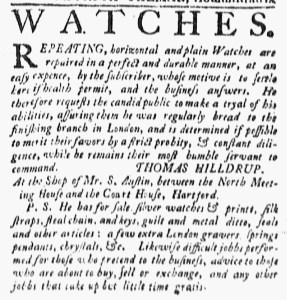
At the end of January 1773, watchmaker Thomas Hilldrup continued expanding his advertising campaign.  When he arrived in Hartford in the fall of 1772, he inserted notices in the local newspaper, the Connecticut Courant, starting on September 15.  His advertisement ran almost every week throughout the remainder of the year and continued into the new year.  Early in 1773, he decided to increase the reach of his marketing by placing the same advertisement in the Connecticut Journal and New-Haven Post-Boy.  Not much time passed before he ran that notice in the New-London Gazette as well.  With that publication, Hilldrup advertised in all of the newspapers printed in the colony at the time, making his efforts a regional campaign.

Hilldrup made a variety of appeals intended to attract attention from prospective clients who may not have otherwise considered seeking the services of a watchmaker in Hartford rather than one in their own town.  When he asked “the candid public to make a tryal of his abilities” in repairing several different kinds of watches, he emphasized his training and experience in the cosmopolitan center of the empire.  The watchmaker declared that he “was regularly bread to the finishing business in London,” implying that, as a result, he possessed greater skill than watchmakers who learned the trade in the colonies.  To underscore that point, he proclaimed that he did “difficult jobbs … for those who pretend to the business.”  In other words, he informed fellow watchmakers who did not possess the same level of skill that they could bring repairs beyond their abilities to him to complete.  Such an offer planted a seed of doubt about his competitors and prompted readers to question their capabilities.  Hilldrup also attempted to cultivate a clientele by offering free services, pledging “any other jobbs that take up but little time [done] gratis.”  That allowed him to meet new clients while also creating a sense of obligation that they would eventually purchase accessories, like chains and keys, at his shop or hire him when their watches needed more extensive repairs.

The newcomer made his presence known in the colony, first by advertising repeatedly in the Connecticut Courant and then by advertising widely in the other newspapers published in the colony.  He promoted credentials that he believed eclipsed many of his competitors and offered services intended to incite interest among prospective clients near and far.

January 26

What was advertised in a colonial American newspaper 250 years ago today?

Connecticut Courant (January 26, 1773).

“WATCHES … every Particular in repairing at HALF PRICE.”

For the past four years the Adverts 250 Project has traced newspaper advertisements placed by watchmaker John Simnet, first in Portsmouth in the New-Hampshire Gazette for a year and a half in 1769 and early 1770 and then in newspapers published in New York.  In both locations, the cantankerous artisan engaged in public feuds with his competitors and sometimes ran notices that mocked and denigrated them.

At the end of January 1773, Simnet decided to insert an advertisement for his shop in New York in the Connecticut Courant, published in Hartford.  That put him in competition with Thomas Hilldrup, who had been advertising in the Connecticut Courant for months, Enos Doolittle, who had been advertising in that newspaper for six weeks, and other watchmakers in Hartford and other towns in Connecticut.  It was an unusual choice for an artisan in New York to extend their advertising efforts to newspapers in neighboring colonies, especially when they had the option to run notices in multiple newspapers in New York.  Did Simnet believe that he would gain clients in Hartford?  Perhaps he thought his promotions – “every Particular in repairing at HALF PRICE” and “no future Expence, either for cleaning or mending” – would indeed convince faraway readers to send their watches to him when they needed maintenance.

New-York Journal (January 21, 1773).

Even if those offers caught the attention of prospective customers in Connecticut, the final lines of Simnet’s advertisement likely confused them.  The advertisement previously ran in the New-York Journal for eight weeks, starting on December 3, 1772.  In the most recent edition, published on January 21, 1773, Simnet added a short poem that addressed “Rhyming Pivot, of York, / With Head, light as Cork.”  The “Rhyming Pivot” may have been Isaac Heron, a nearby neighbor and competitor, who included short verses in his advertisement that ran in the New-York Journal for several weeks, starting on December 24.  At the conclusion of Heron’s notice, he asked “brethren of the Pivot,” fellow watchmakers, to confiscate certain watches that had gone missing from his shop if clients brought them to their shops “for repair or sale.”  Simnet, easily agitated, apparently did not like that another watchmaker dared to try to generate business via notices in the public prints.  He responded with his own poem that described his competitor’s merit as “a Joke or a Song” and declared that he belonged on Grub Street in London, known for authors who often lacked talent and the printers and booksellers who peddled works of dubious quality.

The poem may have resonated with readers of the New-York Journal who were familiar with Heron’s advertisement (and may have also witnessed Simnet’s feud with James Yeoman several months earlier), but readers of the Connecticut Courant had no context for understanding it.  Why did Simnet choose to have his updated advertisement reproduced in its entirety rather than the original version, without the poem, that ran for so many weeks in New York.  The ornery watchmaker was usually very calculated in his decisions about marketing.  What made him decide that advertising in the Connecticut Courant was a good investment?  Even if he considered it worth the costs, why did he include a poem that would have confounded prospective clients?

January 19

What was advertised in a colonial American newspaper 250 years ago today?

South-Carolina Gazette and Country Journal (January 19, 1773).

“WILLIAM BOWER … continues to carry on the CLOCK and WATCH-MAKING BUSINESS.”

“KATHARINE BOWER … carries on the MILLINARY BUSINESS.”

When clock- and watch-maker William Bower moved to a new location, he placed an advertisement in the January 19, 1773, edition of the South-Carolina Gazette and Country Journal to inform current and prospective customers.  Now located “next door to The Great Stationary and Book Store,” he continued to offer the same services “as cheap and expeditiously done, as by any [other clock- and watchmaker] in the province.”  Katharine Bower, a milliner, also advised the public that she moved to a new location “where she carries on the MILLINARY BUSINESS in all its branches, and will be much obliged to her friends for a continuance of their favours.”  William and Katharine, presumably husband and wife, but possibly otherwise related, now ran businesses from the same location at “the store the fourth corner of Tradd-street and the Bay, lately possessed by Messrs. Mackenzie & Tunno.”  Previously, William had a workshop on Broad Street, while Katharine kept shop on Church Street.

In addition to sharing a store at the corner of Tradd Street and the Bay, William and Katharine also advertised together, purchasing a “square” of space in one of the local newspapers.  Husbands and wives (and other male and female relatives) who pursued separate occupations sometimes did so, especially in newspapers published in Charleston.  Those advertisements tended to adhere to certain patterns.  The husband or other male relative usually appeared first, followed by his wife or other female relative.  In some instances, the female entrepreneur appeared only in a brief note at the end of the advertisement.  In this case, however, both William and Katharine had headlines in larger fonts that made their names visible to readers.  William had a secondary headline that gave his occupation, “CLOCK and WATCH MAKER,” while Katharine did not.  Even when female entrepreneurs were not relegated to a short note, the amount of space devoted to promoting the husband’s business usually exceeded that amount of space for the wife’s business.  At a glance, that looked like the case in the Bowers’ advertisement.  However, much of the additional space in William’s portion of the notice gave extensive directions to the new shop, directions that Katharine did not need to repeat.  Katharine did not make as elaborate appeals about price and customer service as William, but she did encourage existing customers to visit her at her new location.

The Bowers pooled their resources to insert an advertisement in the South-Carolina Gazette and Country Journal.  Their notice gave preference to William by listing his business first and including a secondary headline that listed his occupation, but this did not overshadow Katharine’s enterprise as much as some other advertisements placed jointly by men and women.  Katharine’s name appeared as a headline in the same size font as William’s name and, aside from the directions to the new location, the details about her business occupied a similar amount of space.  In general, the notice communicated that both William and Katharine were competent entrepreneurs responsible for their own participation in the marketplace.

January 8

What was advertised in a colonial American newspaper 250 years ago today?

Connecticut Journal (January 8, 1773).

“Whose motive is to settle here if health permit[s], and the business answers.”

When Thomas Hilldrup arrived in Hartford in the fall of 1772, he commenced an advertising campaign to advise prospective customers that he repaired watches “in a perfect and durable manner, at an easy expence.”  Throughout late September and into October, November, and December, he consistently ran his advertisement in the Connecticut Courant, alerting readers that he planned “to settle here if health permit[s], and the business answers.”  That being the case, he invited the public “to make a trial of his abilities.”  In addition to repairing watches, Hilldrup also sold watches and accessories and provided ancillary services, including consultations with “those who are about to buy, sell or exchange.”

Hilldrup continued placing his advertisement in the Connecticut Courant in the new year.  He also decided to expand his advertising campaign to another newspaper, the Connecticut Journal and New-Haven Post-Boy.  Doing so extended the reach of his advertising and gave him access to a new market.  Why did the watchmaker decide to advertise in another publication?  Did he believe that the notice in the Connecticut Courant had been sufficiently successful to merit advertising in a newspaper in another town?  Among colonizers who perused multiple newspapers as they circulated far and wide in Connecticut and beyond, that certainly likely enhanced Hilldrup’s visibility and name recognition.  That he continued to invest in advertisements in the Connecticut Courant also suggests that he considered the outcomes so far worth the expense.

On the other hand, those advertisements may not have been as successful as Hilldrup hoped.  Perhaps placing the same notice in the Connecticut Journal and attempting to capture a portion of an adjacent market was an attempt to generate enough business to make remaining in Hartford a viable option.  Whatever his reasons for choosing to run his advertisement in an additional newspaper in January 1773, Hilldrup eventually determined that he cultivated a large enough clientele to remain in Hartford.  He continued advertising watches and repairs in newspapers published in that town for nearly two decades.  In the coming months, the Adverts 250 Project will examine some of his subsequent newspaper notices.

January 7

Who was the subject of an advertisement in a colonial American newspaper 250 years ago today?

Massachusetts Gazette and Boston Weekly News-Letter (January 7, 1773).

“A Negro Man whose extraordinary Genius has been assisted by one of the best Masters in London.”

An advertisement in the January 7, 1773, edition of the Massachusetts Gazette and Boston Weekly News-Letter informed readers of a novelty that they could see for themselves.  “At Mr. M’Lean’s, Watch-Maker near the Town-House,” it read, “is a Negro Man whose extraordinary Genius has been assisted by one of the best Masters in London; he takes Faces at the lowest Rates.”  For anyone intrigued by this notice, “Specimens of his Performances may be seen at said Place.”  According to J.L. Bell, this “portrait artist was probably Prince Demah, enslaved to Henry Barnes of Marlborough. Barnes had recently taken the young man to London and arranged for lessons from the artist Robert Edge Pine. In February, Demah painted a portrait William Duguid,” now at the Metropolitan Museum of Art.

Although the advertiser depicted the Black man as possessing “extraordinary Genius,” recognized and cultivated by a white artisan, free and enslaved Black men and women possessed a variety of skills and contributed to colonial commerce in many ways.  They did far more than perform agricultural labor.  From New England to Georgia, they worked alongside white artisans who often received credit for the items they produced or otherwise profited from their industry.  In Boston, for instance, an enslaved family of printers, Peter Fleet and his sons Pompey and Caesar, worked in the printing office where Thomas Fleet published the Boston Evening-Post in the middle of the eighteenth century.

On the same day that the notice in the Massachusetts Gazette and Boston Weekly News-Letter described the “extraordinary Genius” of a Black man at a local watchmaker’s workshop, an advertisement in the South-Carolina Gazette reported that Abraham, an enslaved man who liberated himself by running away from his enslaver on Christmas Day, was a “Cabinet-Maker by Trade.”  In the same issue, William Wayne sought to hire out “Four Negro Painters … Who are capable of finishing a Piece of Work in any Manner their Employers may think proper to have it.”  Other advertisements that offered enslaved men and women for sale or promised rewards for the capture and return of enslaved men and women who liberated themselves regularly indicated that they pursued skilled trades, including carpenters, coopers, blacksmiths, and seamstresses.

A watchmaker in Boston treated the “extraordinary Genius” of a Black man as a marketing ploy to draw prospective customers to his shop, yet readers may not have been easily convinced that this announcement merited their attention.  Through everyday experience, they knew that Black men and women worked at any number of skilled trades.

December 27

What was advertised in a colonial American newspaper 250 years ago this week?

New-York Journal (December 24, 1772).

“Sprigs, which more beauteous makes the fair; / And lockets, various, for the hair.”

Isaac Heron, a watchmaker, operated a shop at the Sign of the Arched Dial in New York in the 1760s and 1770s.  When he decided to promote his services in the public prints in the early 1770s, he published a lively advertisement, one that interspersed commentary and poetry, in the December 24, 1772, edition of the New-York Journal.  Heron may have taken note of the notices placed by his competitors, especially John Simnet and James Yeoman, over the past six months or so.  Often creative beyond the standard appeals that appeared in many other advertisements and sometimes descending into rancorous feuds with each other, Simnet and Yeoman made their newspaper notices memorable for readers.  After observing how those rival watchmakers described their services and characterized their competitors, Heron likely determined that he needed to write copy that did not pale in comparison.  He composed more innovative copy than appeared in one of his earlier advertisements.

For instance, he offered low prices and a guarantee when it came to repairing watches.  Heron declared that he “charges as low … as his neighbors,” other watchmakers, by setting his rates “as near the London prices as possible.”  In what might have been a rebuke to Simnet and Yeoman, Heron stated, “To say more, would neither be prudent nor honest.”  In terms of a guarantee, he pledged that “As usual, he warrants their performance” for a year.  Like other watchmakers who offered similar guarantees, he clarified “accidents and mismanagement of [watches he repaired] excepted.”  Unlike other watchmakers, he elaborated in verse: “Should the all-sustaining hand, him drop, / His movements all, springs, wheels, hands must stop! / Then, like the tale of ‘a bear and fiddle,’ / This bargain—‘breaks off in the middle.’”

In addition to selling and repairing watches, Heron also sold jewelry.  He inserted a rhyming couplet to conclude the list of merchandise he lighted to prospective customers.  A paragraph that included “Ladies elegant steel watch-chains, mens [chains,] seals, trinkets, glasses, strings, and keys by the dozen, … Elegant broach-jewels for their honest breasts; sword-knots, sundries, &c.” concluded with “Sprigs, which more beauteous makes the fair; / And lockets, various, for the hair.”  Neither Simnet nor Yeoman advertised these additional items.  They focused exclusively on their skill and experience as watchmakers.  In terms of both goods and presentation, Heron devised an advertisement that distinguished his services from his competitors.