April 23

What was advertised in a colonial American newspaper 250 years ago today?

New-York Journal (April 23, 1772).

“‘Tis our sole Wish, that the Gent who advertises in Astronomy will favour us with a Specimen.”

John Simnet, “WATCH-FINISHER, and Manufacturer, of London,” seemed to relish nothing more than sparring with an adversary in the public prints.  For eighteenth months in 1769 and 1770, he participated in a feud with rival watchmaker Nathaniel Sheaff Griffith in the pages of the New-Hampshire Gazette.  After relocating to New York, he initially published advertisements that did not denigrate his competitors, but eventually found himself embroiled in a war of words with James Yeoman.

As part of that altercation, Simnet updated an advertisement that first ran in the March 19, 1772, edition of the New-York Journal.  On April 23, he removed a lengthy paragraph that cast aspersion on Yeoman in favor of a shorter paragraph meant to do the same.  In both, he addressed insults that Yeoman delivered in his advertisements, insults that the rival watchmaker was so committed to circulating that he resubmitted the copy to run for additional weeks.  (The April 9 edition of the New-York Journal included a new version of Yeoman’s advertisement, the type reset with new line breaks and the addition of the issue number in which that iteration first appeared.)  Yeoman listed his credentials for repairing “CLOCKS, ASTRONOMICAL, Musical or Plain” before concluding his advertisement with an assertion that “it is the sole Wish of the said James Yeoman, to obtain Favours only proportioned to the Knowledge he has, and the Satisfaction he affords in his Business.”

In the updated version of his advertisement, Simnet mocked Yeoman by paraphrasing his rival’s words.  “‘Tis our sole Wish,” he declared, “that the Gent who advertises in Astronomy will favour us with a Specimen of his Qualifications in that Science, for if he can cause the Planets, Eclipses, Comets, &c. to move on the Table, ‘twill save the Charge of Telescopes.”  Simnet questioned Yeoman’s ability to repair astronomical clocks, challenging him to provide examples of his work for others to examine.  Earlier in the advertisement, he mentioned the harm done to clocks and watches by “Persons not qualified to practice in this Business.”  The new paragraph more explicitly leveled that accusation at Yeoman.  Simnet seemed to hit his stride in his advertisements when he treated competitors with condescension, a tactic rarely adopted in eighteenth-century advertising.
April 15

What was advertised in a colonial American newspaper 250 years ago this week?

New-York Gazette and Weekly Mercury (April 13, 1772).

“Such Alterations which don’t engage much Time, GRATIS.”

John Simnet, a watchmaker, placed rather colorful newspaper advertisements over the course of several years in the late 1760s and 1770s, first in the New-Hampshire Gazette and later in newspapers published in New York.  During the time that he resided in New Hampshire, he engaged in nasty feud with a fellow watchmaker, Nathaniel Sheaff Griffith.  Having trained and worked in London, Simnet accused Griffith of not possessing the same level of skill and suggested that Griffith actually damaged the watches he attempted to repair.  In a series of advertisements, Simnet denigrated Griffith’s character, intellect, and skill.

That rivalry may have played a part in Simnet’s decision to relocate to New York.  He once again turned to the public prints to promote his business.  For a time, he focused primarily on his own credentials and expertise, but old habits died hard.  Simnet eventually found himself embroiled in another feud with a fellow watchmaker, though James Yeoman appears to have been the first to pursue their disagreement in print with an advertisement that seemed to critique Simnet’s credentials without naming him.  Given his personality, Simnet may have initiated the insults in person before the dispute moved into advertisements in the newspapers.  Regardless of who started it, Simnet had extensive experience demeaning a competitor in print.  In March 1772, he deployed some of the same strategies that he used against Griffith a few years earlier.

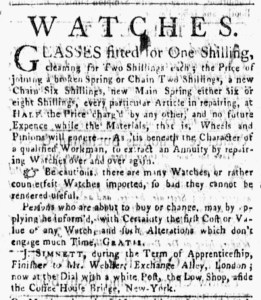
Even though he could not resist placing negative advertisements about Yeoman, Simnet may have learned from his experience in New Hampshire that consumers did not respond well to marketing campaigns that revolved entirely around disparaging others.  In his next advertisement, published in the April 13, 1772, edition of the New-York Gazette and Weekly Mercury, he returned to the kinds of appeals that he incorporated into his notices when he first arrived in New York.  He gave prospective customers a careful accounting of how much they could expect to pay for various goods and services, such as “a new Chain Six Shillings” and “the Price of joining a broken Spring or Chain Two Shillings.”  He also promoted his prices while offering a guarantee, stating that he set rates for “every particular Article in repairing, at HALF the Price charg’d by any other, and no future Expence while the Materials, that is, Wheels and Pinions will endure.”  Simnet declared that it was “beneath the Character of a qualified Workman, to extract an Annuity by repairing Watches over and over again.”  That may have been a subtle critique of his many competitors, but not a targeted attack on Yeoman or any other watchmaker in New York.  To draw customers to his shop, Simnet also offered “such Alterations which don’t engage much Time, GRATIS.”

Simnet has been a fascinating character to track over the past three years, in large part because he deviated so significantly from one of the standard advertising practices of the period.  He sometimes placed advertisements that vilified his rivals rather than focusing on his expertise and experience.  Yet Simnet did not always go negative.  He also published advertisements that incorporated the tone and appeals usually found in newspaper notices by artisans.  In some cases, he also crafted innovative appeals, including free services to entice prospective customers into his shop in hopes of establishing relationships with them.  As an advertiser, he covered a greater range of appeals, positive and negative, than just about anyone else marketing their goods and services in the colonies in the decade before the American Revolution.

March 19

What was advertised in a colonial American newspaper 250 years ago today?

New-York Journal (March 19, 1772).

“The manufacture he governs is 100 miles from real.”

It was probably only a matter of time before John Simnet, “WATCH-FINISHER, and Manufacturer, of London,” engaged in a war of words with a competitor in New York.  In late 1768, he migrated to New Hampshire and began placing advertisements in the New-Hampshire Gazette.  Over the next eighteen months, Simnet developed a rivalry with Nathaniel Sheaff Griffith, a watchmaker who already resided there.  The two waged a feud in their advertisements in the public prints, though Simnet was often more aggressive.  In a series of newspaper notices, the newcomer ridiculed his rival’s skill and intelligence before deciding to relocate to New York in the summer of 1770.  He occasionally published advertisements in his new city, but focused on promoting his own business rather than denigrating competitors.

That changed in March 1772.  In fairness to Simnet, another watchmaker, James Yeoman, seemed to start the dispute when he published an advertisement that seemed to critique the “WATCH-FINISHER, and Manufacturer, of London.”  In an advertisement that first ran in the March 12 edition of the New-York Journal, Yeoman listed his credentials, stating that he “received his Instructions in the Business from the ingenious Mr. Neale, (whose great Knowledge in Mechanics was well known),” and declared that he “can with Propriety declare himself a real Manufacturer, having had the Government of a large Manufactory from its Infancy to its Maturity, one Hundred Miles from London.”  Yeoman cast doubt on Simnet’s description of his occupation and work in London.  As a further insult, he declared, “The above is not the Result of Vanity or Parade, for, should it be doubted, proper Testimonial shall be produced to prove the Assertion.”  Yeoman suggested that Simnet’s advertisements consisted of nothing more than puffery.

Perhaps the argument started before anything appeared in print.  Simnet and Yeoman may have exchanged words in person before Yeoman took to the pages of the New-York Journal.  Once Yeoman published his advertisement, Simnet responded in the next issue, updating a notice that previously ran for four weeks.  He doubled the length of his notice, starting with an introduction that instructed that “Persons who write in public on this art, where faith is be reposed, should consult their ability, and have strict regard to – not pull down truth.”  Sinnet did not mention Yeoman by name, but it was clear that his description of “Hocus Pocus” addressed the content of Yeoman’s advertisement.  In ridiculing an unnamed rival, Simnet remarked that the “manufacture he governs is 100 miles from real,” alluding to Yeoman’s claim that he managed “a large Manufactory … one Hundred Miles from London.”  Simnet also quoted Yeoman’s proclamation that he repaired clocks and watches “as cheap as by any Person in this City” in his own notice.  “As cheap as any person in this city,–can we save the value of a bowl of punch, or a turkey by reading that? –alas–No.”  He further underscored that “words are wind, and declare the expresser full of emptiness” before concluding with a poem that cast aspersions on Neale, Yeoman’s mentor.

No matter who started the dispute, Simnet and Yeoman took their argument to the public prints.  Simnet once again had a rival to denigrate in his advertisements.  Purveyors of goods and services rarely resorted to negative advertising, usually preferring to promote their own businesses and largely ignoring their competitors.  They often stated that they possessed the greatest skill or offered the lowest prices, but rarely did they directly critique or even address others who provided the same goods and services.  That made Simnet and Yeoman’s advertisements all the more notable and perhaps even entertaining for readers.

March 16

What was advertised in a colonial American newspaper 250 years ago today?

Pennsylvania Packet (March 16, 1772).

“Proposes to engage his performance for one year, provided the owners do not abuse the same.”

When Thomas Morgan, a watch- and clockmaker, relocated from Philadelphia to a shop on Gay Street in Baltimore in the early 1770s, he placed an advertisement in the Pennsylvania Packet, published in Philadelphia.  Why did he advertise in a newspaper published in the town he left rather than one published in his new town?  Baltimore did not yet have its own newspaper.  Colonizers in Baltimore and the surrounding area depended on the Maryland Gazette, published in Annapolis, and several newspapers published in Philadelphia, including the Pennsylvania Packet, as regional newspapers.  When he placed an advertisement in the Pennsylvania Packet, Morgan anticipated that prospective customers in Baltimore would see it.

In addition, he deployed other marketing strategies.  He marked his new location in Baltimore with “THE SIGN OF THE ARCH DIAL,” a visual statement to all passersby about what kind of business he operated.  He also offered a guarantee for repairing and cleaning watches and clocks, stating that he would “engage his performance for one year, provided the owners do not abuse the same.”  In other words, the guarantee remained in effect only if customers treated their clocks and watches well.  That included not subjecting their timepieces to “unskilful hands” who did more harm than good.  Morgan lamented that “many good watches are greatly abused for want of experience” by artisans who purported to possess skills that they did not.  In so doing, Morgan made appeals similar to those that John Simnet, a watchmaker in New York, included in his newspaper advertisements.  He also offered guarantees of his work, contingent on how customers treated their clocks and watches, and warned against trusting inexperienced watch- and clockmakers who damaged the timepieces entrusted to them.

Morgan invited “Any Gentleman” to visit his new location in Baltimore, promising that they may “have new Watches and Clocks made after the neat and best construction.”  To encourage those previously unfamiliar with his work, he indicated that he already attracted new clients and “most gratefully acknowledges the many favours received from the Public, and hopes for the continuance of them.”  Morgan hoped that advertising in the Pennsylvania Packet would further ease the transition after setting up shop in a new town.

February 23

What was advertised in a colonial American newspaper 250 years ago today?

New-York Journal (February 20, 1772).

“Watches regulated, and such alterations which don’t require much time; gratis.”

For the past three years, the Adverts 250 Project has tracked newspaper advertisements placed by John Simnet, a “WATCH-FINISHER, and Manufacturer, of London,” first in the New-Hampshire Gazette during the period that he lived and worked in Portsmouth in 1769 and 1770 and then in newspapers published in New York after he migrated to that city.  Simnet often promoted his years of experience working in London in his advertisements in the New-Hampshire Gazette, but he also pursued a nasty public feud with one of his competitors.  That may have contributed to his decision to leave Portsmouth in favor of New York.

In a new city, Simnet adopted a much less aggressive approach in his advertising.  He deployed a variety of marketing strategies that did not focus on denigrating other watchmakers, though he did suggest that he possessed greater skill than any of his rivals.  In an advertisement that ran for the first time in the February 20, 1772, edition of the New-York Journal, for instance, he trumpeted that he “had more practice, and general knowledge on new work [the mechanisms in watches] than any yet in this country could have.”  Drawing on his long experience and superior expertise, he provided a service to anyone considering buying, selling, or repairing watches.  Simnet offered to examine watches and inform the owners or prospective buyers of “the first cost, or value of any new, or old watch.”  Once they knew the value of watches “with certainty,” they could make informed decisions about buying, selling, or repairing watches.

To generate business and enhance his reputation, Simnet also declared that he made “such alterations which don’t require much time; gratis.”  For those jobs that did involve more time and attention, he stated that he “will clean them, fit glasses, springs, inside chains; and perform every particular article in repairing, at half the price, charg’d by any other.”  Perhaps Simnet discovered that bargain prices brought more customers to his shop “At the Dial … beside the Coffee-House Bridge” than cantankerous diatribes that insulted his competitors.  In this advertisement, he focused on his own skill, asserting that customers could depend on his work keeping their watches in good order for quite some time instead of having them become “an annual or continual expence.”  Simnet attempted to leverage his skill and experience “To the Advantage of those who wear WATCHES” as well as his own benefit in earning a livelihood through providing various services.

December 27

What was advertised in a colonial American newspaper 250 years ago today?

New-Hampshire Gazette (December 27, 1771).

“WATCHES and CLOCKS are clean’d and kept in Repair.”

As 1771 came to an end and a new year loomed, Nathaniel Sheaff Griffith took to the pages of the New-Hampshire Gazette to remind residents of Portsmouth and nearby towns that he “clean’d and kept in Repair” both clocks and watches.  He also sold “all Sorts of Watch Materials lately imported” and “performs gilding Work, either with Gold or Silver.”  He pledged that he performed all of these services “in the cheapest and best Manner.”

Regular readers of the New-Hampshire Gazette may have remembered that not so long ago another clock- and watchmaker, John Simnet, frequently placed advertisements that accused Griffith of damaging watches rather than cleaning and repairing them.  Sometimes Simnet identified Griffith by name, but other times he merely made insinuations.  For his part, Griffith expressed less interest in fueling a feud in the public prints, preferring instead to bolster his own business rather than denigrate a competitor.  That did not prevent him, however, from suggesting that Simnet, who had recently relocated to Portsmouth from London, was an itinerant as likely to steal watches as repair them.  In a series of advertisements, Simnet trumpeted his decades of experience in some of the best workshops in London, proclaiming his superior skill.  In addition to pointing out that Griffith lacked formal training, he also implied that his competitor possessed a defective intellect.

Griffith and, especially, Simnet staged quite a performance in the pages of the New-Hampshire Gazette before the newcomer decided that Portsmouth was not the place for him.  After a year and a half of sparring with Griffith, Simnet moved to New York.  He once again touted the skill and experience he gained on the other side of the Atlantic, but he did select any local competitors to target for abuse.  Perhaps he learned in Portsmouth that some consumers did not appreciate marketing strategies that pivoted on abusing others.  Free of the cantankerous Simnet, Griffith continued placing occasional advertisements that conformed to the standards of the period.  He made positive appeals, such as asserting that he did his work “in the cheapest and best Manner,” but did not make any direct comparisons to other artisans.

December 5

What was advertised in a colonial American newspaper 250 years ago today?

New-York Journal (December 5, 1771).

“JOHN SIMNET, of London, WATCH-FINISHER.”

Nearly six months had passed since John Simnet last placed an advertisement in the New-York Journal, but he concluded the year by placing his notice in every issue published in December 1771.  Simnet, a veteran watchmaker with decades of experience working in shops in London, did not advertise in any of the newspapers published in New York nearly as often as he had advertised in the New-Hampshire Gazette when he ran a shop in Portsmouth for about eighteen months in 1769 and 1770.  A rivalry with another watchmaker, Nathaniel Sheaff Griffith, played an important part in Simnet aggressively taking to the public prints, frequently denigrating his competitor.  Readers may have been amused by the feud between Griffith and Simnet that played out before their eyes in the New-Hampshire Gazette, though Simnet may have alienated as many prospective customers as he gained since his advertisements were often significantly more mean-spirited than those placed by Griffith.

Simnet did not even mention his time in Portsmouth after he relocated from the smaller town to the bustling port of New York.  He presented himself as “JOHN SIMNET, of London, WATCH-FINISHER,” choosing not to acknowledge that he passed through New Hampshire.  He adopted a more evenhanded tone in his advertisements in the New-York Journal, though he could not resist the temptation to make a blanket statement about “Watch-Butchers” who further damaged rather than repaired watches customers entrusted to their care when he advertised in the summer of 1771.  He eschewed such attacks when he once again ran notices in December.  He trumpeted, however, that he was the “only general Manufacturer in this Country,” dismissing the training, skill, and experience of his competitors.  Despite that interlude near the end of his advertisement, Simnet focused most of his effort on positive appeals.  He emphasized price, addressing his notice “to “those who desire to preserve their Money and their WATCHES, And avoid unnecessary Expence.”  He listed prices for some of his services, reporting that he performed “All other Repairs in Proportion, at half what is usually charged.”  The watchmaker also declared that he completed difficult jobs quickly.  Simnet may have learned that such strategies served him better than the antagonistic approach he took to marketing during the time he resided in New Hampshire.

November 14

What was advertised in a colonial American newspaper 250 years ago today?

Pennsylvania Journal (November 14, 1771).

“WATCHES made in Philadelphia.”

When Parliament imposed duties on certain imported goods – glass, lead, paint, paper, and tea – in the Townshend Acts in 1767, colonists responded by adopting nonimportation agreements.  In so doing, they resumed a strategy that helped win repeal of the Stamp Act, using economic leverage in the service of political goals.  At the same time that merchants vowed not to import and sell a wide assortment of items, many colonists also advocated that consumers support “domestic manufactures” by purchasing goods produced in the colonies as alternatives to their imported counterparts.  When Parliament eventually relented and repealed all of the duties except the one on tea, colonial merchants and others resumed trade with Britain.  Imported goods flooded American markets.

Even as consumers eagerly embraced imported goods once again, some American entrepreneurs continued to promote domestic manufactures.  John Sprogell, Jr., for instance, marketed “WATCHES made in Philadelphia” in an advertisement in the November 14, 1771, edition of the Pennsylvania Journal.  Like others who advertised goods made in the colonies, Sprogrell promised prospective customers that they would not sacrifice quality.  To that end, he declared that he had “employed journeymen from London” so his shop would produce “the best of WATCHES.”  He offered a guarantee, proclaiming that he would “insure [the watches] for one, two, or three years.”  They would not need any maintenance that would incur “expense to the purchaser,” with the exception of routine cleaning.

As the proprietor of the shop, Sprogell understood that his reputation was on the line.  “The public may be assured,” he asserted, “that he will use his utmost endeavour to give general satisfaction” because “the character of the maker lays at stake.”  Even though the journeymen who labored in the shop did much or all of the work, ultimately the watches were Sprogell’s products.  Inferior work would have an effect on his standing in the marketplace, so even as he arranged a means of providing the same quality as found in London he provided additional security for customers who chose his “WATCHES made in Philadelphia” in hopes that his various pledges and promises would entice them into his shop.

August 9

What was advertised in a colonial American newspaper 250 years ago today?

New-Hampshire Gazette (August 9, 1771).

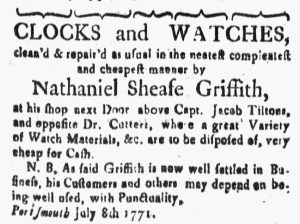
“Griffith is now well settled in Business.”

Nathaniel Sheaff Griffith frequently advertised his services as clock- and watchmaker in the New-Hampshire Gazette in the late 1760s and early 1770s.  For eighteen months in 1769 and 1770, he placed many of his notices in response to advertisements inserted by John Simnet, a rival who migrated to Portsmouth after gaining decades of experience as a clock- and watchmaker in London.  Simnet repeatedly denigrated colonial clock- and watchmakers in general and Griffith in particular, claiming that those who did not receive their training in England did more harm than good when they attempted to fix broken clocks and watches.  For his part, Griffith sometimes refused to take the bait, but on other occasions published pointed responses to the Simnet, accusing him of being an itinerant just as likely to steal watches as repair them.  Readers of the New-Hampshire Gazette observed their feud for months.  When Simnet departed for New York, Griffith continued advertising, but returned to positive messages.

Such was the case in an advertisement that ran in the August 9, 1771, edition of the New-Hampshire Gazette (though the notice was most likely misdated July 8).  Griffith announced “CLOCK and WATCHES, clean’d & repair’d as usual in the neatest compleatest and cheapest manner.”  Like other artisans, he emphasized quality, skill, and price.  He also made a nod toward customer service, stating that “his Customers and others may depend on being well used, with Punctuality.”  Griffith also mentioned that he was “now well settled in Business,” testifying to his experience without having to draw comparisons to a competitor with decades of experience who formerly mocked him in the public prints.  A year after Simnet removed to New York, many readers likely still remembered the war of words between the watchmakers that regularly played out in the newspaper.  Griffith likely experienced some relief at no longer being at the receiving end of Simnet’s harangues.  No longer debating whether he needed to respond to Simnet or how vociferously, Griffith ran advertisements that promoted his business without launching attacks on his competitors.  That may have suited him just fine, but readers lost out on one source of entertainment that formerly appeared in the New-Hampshire Gazette.

July 14

What was advertised in a colonial American newspaper 250 years ago this week?

Maryland Gazette (July 11, 1771).

“He further proposes to engage his Performance for One Year.”

In the summer of 1771, Thomas Morgan announced to “the Publick” that he “has opened a Shop” in Annapolis, “WHERE he intends to carry on the Business of Watch and Clock-making, in all its various Branches.”  In an advertisement that ran in the Maryland Gazette for five weeks, he assured “Gentlemen that will please to favour him with their Custom” that they would receive attentive and efficient service when they visited his shop.  Most artisans, as well as many other purveyors of goods and services, made similar promises about customer service in their newspaper advertisements.

In addition to making clocks and watches, Morgan also cleaned and repaired them.  To entice prospective patrons to give him a chance to demonstrate his skill, he proclaimed that he performed those services “in the best Manner.”  Furthermore, he offered a guarantee, a marketing strategy commonly adopted by watch- and clockmakers.  John Simnet, a watchmaker who set up shop in New Hampshire, in the late 1760s and migrated to New York in the early 1770s, declared in one of his advertisements that “Such Watches as have been repaired by me, if become foul, or require Alteration, may be clean’d, &c. gratis.”  Similarly, Morgan asserted that he would “engage his Performance for One Year, provided the Owner don’t abuse the same.”  Patrons who experienced difficulty could return their timepieces to his shop for additional repairs and cleaning free of charge, though Morgan assessed whether the problems originated with any sort of misuse on the part of owners.

While such guarantees protected the interests of clients, they also testified to the confidence watch- and clockmakers had in their abilities.  Artisans like Morgan and Simnet would not have offered guarantees if they anticipated that they would have to expend significant time and resources in fulfilling them.  Guarantees also communicated to customers that even though Morgan and Simnet would address any problems that arose, they strove to do the job right the first time.