What was advertised in a colonial newspaper 250 years ago today?
Pennsylvania Gazette (April 24, 1766).
“The Stage Wagon … intends to perform the Journey from Philadelphia to New-York in two Days.”
Today it takes only a couple of hours or less to travel between Philadelphia and New York by planes, trains, or automobiles, but in the eighteenth century going from one of these urban ports to the other required much more time. John Barnhill and John Masherew offered a service intended to transport colonists between the two cities as quickly and efficiently as possible (and as comfortably as well: note that “the Waggon-Seats [were] to be set on Springs”).
This journey could be completed in the impressively short span of two days between April and November, but required three days in the winter months. To make this possible, Barnhill and Masherew pooled their resources. Each offered a service that extended into the hinterland around their respective cities, but neither sent their “Stage Waggon” between the two destinations. Instead, Barnhill operated between Philadelphia and Prince Town (now Princeton, New Jersey) and Masherew offered service from New York to Prince Town. At Prince Town, passengers switched from one “Stage Waggon” to the other. Each leg of the journey took a day (or a day and a half in the winter).
The advertisement indicates Barnhill and Masherew began advertising this service before it appeared in the April 24, 1766, issue of the Pennsylvania Gazette: “commencing the 14th Day of April next.” The notation on the final line – “* 6 W.” – was likely a reminder to the printer to insert the advertisement in six consecutive issues over the course of six weeks.
What was advertised in a colonial newspaper 250 years ago this week?
Final Page of Pennsylvania Gazette (February 6, 1766).
“This is to inform the PUBLIC …”
In first taking a look at this particular set of advertisements from the Pennsylvania Gazette, I believed that it was a single advertisement, but came to learn that instead it was multiple advertisements that were not separated from one another as was customarily done. It is believable that an advertisement might take up an entire page during the twenty first century in America, as many magazines feature full-page advertisements for different products, but this was not done in Colonial times. Instead, the fact that this was featured without separations between each advertisement was an indicator of some sort of issue or malfunction with technologies. The fact that the advertisement was not properly sectioned into different advertisements posed tremendous difficulty for me in trying to discern what the advertisement was for and what it focused upon. Analysis of this is best done while zoomed in closely upon the featured text, as the quality of the modern photography of the Pennsylvania Gazette is not high and this poses a difficulty in providing a historical understanding of its structure and content.
The Pennsylvania Gazette, a newspaper printed by Benjamin Franklin for many decades, was esteemed and often did not feature advertisements on its front page, as some others did, but instead, seems to have kept these advertisements, for the most part, separate from the rest of the newspaper, putting them within the last few pages all together beside one another.
Pennsylvania Gazette (February 6, 1766).
This particular advertisement is unique in its construct, as the majority of eighteenth-century advertising did not feature visuals of any kind.
**********
ADDITIONAL COMMENTARY: Carl Robert Keyes
As Kathryn indicates, this issue of the Pennsylvania Gazette illustrates some of the difficulties working with digitized sources, especially for those who have not had opportunities previously to work with the sources in their original format.
Kathryn notes that at first she thought the entire page might be one extensive advertisement. To better understand her initial confusion, it would be helpful to describe how the Early American Newspapers database visualizes the pages of eighteenth-century newspapers. In most instances they have been indexed in such a manner that each item has a separate index entry on a menu at the left of the screen. Upon selecting the index entry or clicking on the text itself, that item appears separately, enlarged for easier viewing. In some cases, however, the multiple items on the page have not been disambiguated by the software and/or the people who prepared the index. This can lead to frustration for researchers and confusion for novice users. It suggests some of the limits of using digitized sources: sometimes flawed metadata affects how users interpret the sources. In the case, Early American Newspapers classified the entire page as one “Advertisement.”
Note in this screen shot from Early American Newspapers that the index at the left classifies this entire page of the February 6, 1766, issue of the Pennsylvania Gazette as a single advertisement.
**********
Note in this screen shot from Early American Newspapers that the index at the left includes a separate entry for each advertisement from this page of the February 10, 1766, issue of the Boston-Gazette. Individual advertisements are also disambiguated by highlighting each in yellow when positioning the cursor over them.
Kathryn also notes that many of the advertisements for this issue have been grouped together at the end of the newspaper. She is correct in making this observation, but it also opens the door for a bit of printing history. As we saw with yesterday’s featured advertisement and issue of the New-Hampshire Gazette, most eighteenth-century newspapers were broadsheets folded in half to create a four-page issue. The extremely successful Pennsylvania Gazette, printed in the largest urban center in the colonies, often had more advertising than it could include in just four pages. As a result, it often issued an additional half sheet with advertisements printed on both sides. That explains the fifth and sixth pages of this particular issue of the Pennsylvania Gazette. The extra half sheet would have been tucked in the fold, between the traditional second and third pages. Other newspapers sometimes issued half sheet “supplements” (with news and/or advertising) and “extras” (usually just news).
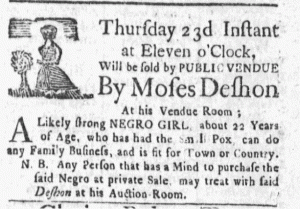
Who was the subject of an advertisement in a colonial newspaper 250 years ago today?
Massachusetts-Gazette (January 16, 1766)
“Will be sold … A Likely strong NEGRO GIRL.”
Many, many different kinds of merchandise were bought and sold via the advertisements in eighteenth-century newspapers — certainly more than an assortment of textiles, housewares, and foodstuffs imported from London and other ports throughout the Atlantic world. People could also be commodities in eighteenth-century America, as this advertisement demonstrates.
Advertisements for buying and selling slaves — and for runaways who sought to escape their captivity — were not uncommon in newspapers printed in New England and the Middle Atlantic and an even more familiar feature in the Chesapeake and Lower South. This advertisement, however, is rather unique: unlike most others peddling slaves, it includes an image, a woodcut intended to depict “A Likely strong NEGRO GIRL.” This would have been a stock piece owned by the printer. It could have been inserted in any number of advertisements for female slaves or even runaway wives since its features did not depict any particular woman or girl. The “Likely strong NEGRO GIRL” remained nameless in this advertisement, just as interchangeable with other slaves, other pieces of property that could be bought and sold, as a piece of type that could be inserted in any number of advertisements.