July 27

What was advertised in a colonial American newspaper 250 years ago today?
Jul 27 - 7:27:1767 Pennsylvania Chronicle
Pennsylvania Chronicle (July 27, 1767).

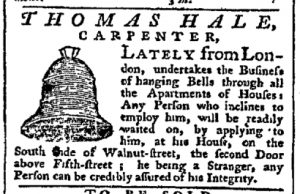
“THOMAS HALE … undertakes the Business of hanging Bells through all the Apartments of Houses.”

Thomas Hale, a carpenter, turned to the advertising pages of the Pennsylvania Chronicle to announce that he “undertakes the Business of hanging Bells through all the Apartments of Houses.” Appropriately, he adorned his notice with a woodcut depicting a bell. Somewhat crude compared to other woodcuts that sometimes appeared in eighteenth-century newspapers, Hale’s bell served its purpose of drawing attention to his advertisement. It was the only visual image on the page, as well as the only woodcut that accompanied any advertisement in the July 27, 1767, edition of the Pennsylvania Chronicle, making Hale’s notice difficult to overlook.

When woodcuts did accompany advertisements in eighteenth-century newspapers, they often replicated familiar shop signs and promoted businesses operated by colonists already well known to many readers and potential customers. That was not the case, however, for Thomas Hale. He noted that he was “LATELY from London” and so recently arrived in Philadelphia as to be considered a “Stranger” (for which he offered assurances of his integrity to anyone who contemplated hiring him). As a newcomer to the city, as someone attempting to find his footing and establish his business, Hale needed to increase the likelihood that possible patrons would notice his advertisement among the dozens of others published in the Pennsylvania Chronicle. Including an image offered one way to distinguish his notice from so many others that consisted exclusively of text on a densely formatted page.

This woodcut did not confirm Hale’s “Integrity” or the quality of his work, but it did demonstrate to potential customers that the carpenter was conscientious and thoughtful. Placing the advertisement was one of the first steps in establishing a clientele that could also yield further business via word-of-mouth recommendations. Accordingly, readers willing to take a chance on Hale could reasonably expect that he would exert the same care in hanging bells and other tasks that he devoted to designing his newspapers notices, his first introduction to the residents of Philadelphia.

Hale advertised that he installed “Bells through all the Apartments of Houses,” bells intended to alert residents when someone desired their attention. His own woodcut of a bell figuratively rang loudly, announcing his presence and demanding the attention of potential customers.
July 7

What was advertised in a colonial American newspaper 250 years ago today?

Jul 7 - 7:7:1767 South-Carolina Gazette and Country Journal
South-Carolina Gazette and Country Journal (July 7, 1767).

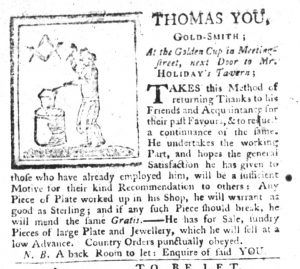
“If any such Piece should break, he will mend the same Gratis.”

For many eighteenth-century artisans, making a living depended in part on establishing a creditable reputation, both for fair dealing and for skilled craftsmanship. Thomas You, a goldsmith in Charleston, devoted most of his advertisement in the South-Carolina Gazette and Country Journal to cultivating and maintaining his reputation, hoping to gain new clients as well as repeat business from previous patrons.

He reminded those who had employed him in the past of their “general Satisfaction” with his work, but he also suggested that this merited passing along “their kind Recommendation to others.” You did not believe that he could rely on word of mouth alone to promote his services to new clients; he apparently supposed that newspaper advertising could provoke word-of-mouth endorsements that would supplement notices in the public prints.

You also pursued another means of cultivating his reputation: he was so confident in the quality of his work that he offered a guarantee. “Any Piece of Plate worked up in his Shop,” the goldsmith pledged, “he will warrant as good as Sterling; and if any such Piece should break, he will mend the same Gratis.” In making this promise to fix defective work for free, You offered a blanket guarantee that covered not only the work done by his own hand but also any tasks undertaken by others who labored in his shop, whether journeymen, apprentices, or enslaved artisans.

You incorporated other appeals into his advertisement, including low prices and punctual service on orders sent by mail, but he saved those for after his endeavors to secure his reputation. He revealed what he thought was most important to his customers. Low prices or quick responses hardly mattered if they accompanied inferior work. The goldsmith first needed to establish the quality of his work, reflected in both his existing reputation and a guarantee on future jobs, in order to convince potential customers of the value of the other appeals he advanced.

May 17

What was advertised in a colonial American newspaper 250 years ago this week?

May 17 - 5:14:1767 Pennsylvania Gazette
Supplement to the Pennsylvania Gazette (May 14, 1767).

“Imported … by MAGDALEN DEVINE … the following goods.”

Compared to their male counterparts, female shopkeepers placed relatively few advertisements in eighteenth-century newspapers (and turned to other forms of marketing media, such as magazine wrappers, trade cards, and broadsides, even less often). Women’s participation in the marketplace as retailers rather than consumers was disproportionately underrepresented among advertisements in colonial and Revolutionary-era newspapers.

Magdalen Devine’s lengthy list-style advertisement was notable, however, not only because she was a female entrepreneur who turned to the public prints to promote her business. To draw attention to her notice, Devine included a woodcut that depicted the sorts of textiles she imported and sold at her shop on Second Street near the Quaker Meetinghouse. A border surrounded two rolls of cloth positioned next to two swatches, all of them arrayed to demonstrate four different patterns. This visual image reinforced the work done in Devine’s dense list of merchandise: customers could expect to make choices among the assortment of dry goods she stocked.

Given that few male advertisers, whether shopkeepers, artisans, or others, commissioned woodcuts to include in their marketing efforts, Devine’s advertisement was quite extraordinary. To paraphrase Laurel Thatcher Ulrich’s analysis of gendered women’s activities in colonial New England, Devine’s advertisement demonstrates what was possible rather than what was probable when women took on some of the same tasks and responsibilities most often reserved for or associated with men.

Three other women played a role in advertisements that appeared in the same issue of the Pennsylvania Gazette. A notice placed by “JOHN HOLLIDAY, TAYLOR,” included a final paragraph about “Mrs. Holliday’s new-invented curious Compound” for removing hair. Unlike her husband, Mrs. Holliday’s name did appear in all capitals. “WILLIAM SYMONDS” and “MARY SYMONDS, Millener,” cooperated in placing an advertisement, though Mary seems to have been the driving force. The advertisement briefly noted that William “has just imported in the last vessels, a neat assortment of merchandize.” Mary, on the other hand, provided a list of her “neat assortment of millenery goods” that exceeded Devine’s in length. (Symonds was one of the few female entrepreneurs who distributed her own trade card in eighteenth-century America, though she would not do so for another decade.) Finally, “ANN PEARSON, MILLENER,” also inserted a list-style advertisement, seemingly of her own accord. It did not mention any male relatives who might have overseen her participation in the marketplace.

The woodcut that accompanied Devine’s advertisement made her marketing memorable. The May 14 issue of the Pennsylvania Gazette consisted of eight pages (the four-page standard issue as well as a four-page supplement) with nearly seven of them devoted to advertising. Only two other advertisements included woodcuts, a generic ship with Alexander Lunan’s notice about freight and passage on a ship about to sail for South Carolina and an extended hand with dyer Joseph Allardyce’s advertisement for his shop “at the Sign of the Blue Hand.” Although men most actively advertised consumer goods and services in early America, women also adopted marketing innovations and experimented with various methods for marketing their wares.

May 7

What was advertised in a colonial American newspaper 250 years ago today?

May 7 - 5:7:1767 Pennsylvania Gazette
Supplement to the Pennsylvania Gazette (May 7, 1767).

“SUPPLEMENT to the PENNSYLVANIA GAZETTE.”

The masthead of the Pennsylvania Gazette declared that it “Contain[ed] the Freshest Advices, Foreign and Domestic.” Readers expected a variety of news updates from Europe, especially England, the Caribbean and other locales in the Atlantic world, and neighboring colonies. The Pennsylvania Gazette also carried some local news, but when it came to local affairs word of mouth often scooped newspapers published only once a week.

Readers also expected to encounter a variety of advertising. The Pennsylvania Gazette, like its counterparts in the largest colonial port cities, attracted so much advertising that the printers frequently issued a half sheet supplement devoted exclusively to paid notices of various sorts. Doing so shifted the relative balance of news items and advertising, though sometimes the supplement resulted from the regular issue including more news than usual.

Such was not the case with the May 7, 1767, edition of the Pennsylvania Gazette and the accompanying Supplement. News items appeared on only two of the four pages of the standard issue. Instead of two pages, a half sheet, Hall and Sellers created a four-page supplement, an entire broadsheet filled entirely with advertising. This doubled the number of pages in the May 7 issue. It also underscored the newspaper’s roles as a delivery mechanism for advertising. Paid notices covered three-quarters – six out of eight – pages.

Even with the supplement, space was at a premium. The paid notices were composed primarily of text with little variation in font size. Hall and Sellers incorporated few woodcuts into the advertisement: none of the houses or fleeing figures that accompanied real estate and runaway slave advertisements, respectively, and only one ship in a brief notice about “Accommodations for Passengers” aboard a ship departing “For KINGSTON, in JAMAICA,” in three weeks. Four advertisers drew attention to their notices by including woodcuts specific to their businesses that they commissioned. William Dawson, cutler, presumably replicated his shop sign, “the Scythe and Sickle,” as did dyers Joseph Allardyce and Company “at the Sign of the Blue Hand.” John Young, Sr., a saddler, and Richard Truman, who made “Dutch FANS and SCREENS,” each included images of the products they constructed.

Rather than examine a single advertisement published 250 years ago today, consider the entire issue of the Pennsylvania Gazette. Doing so underscores the importance of advertising in the dissemination of some of the most successful and widely circulated early American newspapers. It also demonstrates the extensive culture of consumption in port cities, practices of purchasing and display that filtered out to the provinces as merchants and shopkeepers distributed goods from their point of entry to customers throughout the colonies.

February 9

What was advertised in a colonial American newspaper 250 years ago today?

feb-9-291767-pennsylvania-chronicle
Pennsylvania Chronicle (February 9, 1767).

“A neat Assortment of DRY GOODS, which he will sell cheap.”

Today the Adverts 250 Project features its first advertisement from the Pennsylvania Chronicle, and Universal Advertiser. Likewise, the Slavery Adverts 250 Project includes its first advertisement from that newspaper. William Goddard had been publishing proposals for the Pennsylvania Chronicle in Philadelphia’s newspapers (and even the Providence Gazette) for weeks before it commenced publication on January 26, 1767. The third issue, published February 9, 1767, is the first included in Readex’s America’s Historical Newspapers database, though copies of the first two issues are extant in the collections of the American Antiquarian Society.(*)

Goddard’s proposal included a call for advertisers to submit notices they wished to appear in the Pennsylvania Chronicle. In addition, the colophon advised readers that Goddard “gratefully received” all sorts of submissions for his newspaper, including advertisements, articles, and letters of intelligence. He achieved early successes attracting advertisers, devoting nearly half (seven of sixteen columns) of the third issue to thirty-five paid notices of varying lengths. Most promoted consumer goods and services, but some offered real estate for sale or called on debtors to settle accounts. One even offered a reward upon the return of “a young DOG of the Spaniel Breed” that had strayed from its master.

Compared to newspapers published in some smaller towns, the new Pennsylvania Chronicle overflowed with advertising, especially advertisements for consumer goods and services. The third issue even included advertisements from two entrepreneurs who branded their businesses with woodcuts that presumably replicated the shop signs that marked their locations: saddler John Young, Jr., “At the sign of the ENGLISH HUNTING SADDLE” and druggist Nathaniel Tweedy “At the GOLDEN-EAGLE.”

feb-9-291767-tweedy-detail-pennsylvania-chronicle
Detail of Nathaniel Tweedy’s advertisement in the Pennsylvania Chronicle (February 9, 1767).

This stands in stark contrast to other newspapers, such as the Providence Gazette that seemed to struggle to attract advertisers in late 1766 and early 1767. Goddard appears to have experienced no difficulty generating advertising from entrepreneurs in the busy urban port of Philadelphia. The third issue of the Pennsylvania Chronicle offered dozens of advertisements to its readers. A quarter of a millennium later, I am simultaneously excited by the range of advertisements that could potentially be incorporated into the Adverts 250 Project and disappointed to choose only one at a time.

I am also frustrated to skip over so many interesting and significant advertisements, though I continue to affirm the methodology that requires doing so. Part of this disappointment stems from the dearth of advertisements available at other times during the week. For instance, since the Providence Gazette was the only newspaper published on Saturdays in 1767 and no newspapers were published on Sundays, each week the Adverts 250 Project gives disproportionate attention to advertisements from the Providence Gazette in the process of featuring advertisements published exactly 250 years ago that day or as close to that day as possible. As a result, the Providence Gazette is overrepresented and other newspapers with much more advertising remain underrepresented. On the other hand, this means that marketing efforts in at least one smaller city are subject to examination alongside the copious newspaper advertisements published in Boston, Charleston, New York, and Philadelphia.

Again, I stand by the project’s methodology, but recognize that both researchers and readers must take into account both its strengths and limitations.

**********

(*) Although this project relies primarily on digitized primary sources, I also examined original copies of the first two issues of the Pennsylvania Chronicle. From the very first issue William Goddard managed to attract advertisers.  A total of twenty-two advertisements spread over five (out of sixteen) columns appeared in the first issue (January 26, 1767), including an advertisement by Nathaniel Tweedy (without the woodcut).  The second issue (February 2, 1767) included thirty-three advertisements amounting to nearly seven columns, including advertisements by John Young, Jr., and Nathaniel Tweedy (both with woodcuts).

January 29

What was advertised in a colonial American newspaper 250 years ago today?

jan-29-1291767-new-york-journal-supplement
Supplement to the New-York Journal (January 29, 1767).

“WILLIAM HAWXHURST, HAS lately erected a Finer and great hammer, for refining the Sterling pig iron, into bar.”

By the end of January 1767 William Hawxhurst had been placing this advertisement – with its detailed woodcut – in the New-York Journal for several weeks. The woodcut depicts a furnace “for refining he Sterling pig iron, into bar” surrounded by five workers undertaking several tasks. To the right, three pack animals seems to be loaded with supplies to deliver to Hawxhurst. With the exception of the stock images in notices for slave auctions or runaway slaves and indentured servants, few woodcuts in eighteenth-century advertisements depicted people. Andrew Gautier’s advertisement in the same issue of the New-York Journal, for instance, included a woodcut of a Windsor chair, giving potential customers a glimpse of the product offered for sale rather than the artisan who produced it. Hawxhurst testified to the industriousness of American colonists by showing men at work.

Hawxhurst also offered assurances about his domestically produced iron and the array of products made from it. He promised “reasonable terms” and a “considerable abatement … to those that purchase quantities.” He also offered a guarantee, pledging that his hammers and anvils were “warranted for three months (or any reasonable time).” In addition, “the castings will also be warranted to stand the fire any reasonable time.” He even compared his iron goods he produced favorably to any “imported … from Europe,” stating customers could purchase from him “at a lower rate.” Hawxhurst combined an image of American industriousness with guarantees about the quality of his merchandise and comparisons to the prices of European imports as he encouraged potential customers to purchase items manufactured locally. Although he did not make any explicitly political comments in his advertisement, these attributes fit within marketing discourses developed by the first generation of advertisers who adopted “Buy American” campaigns during the imperial crisis that preceded the American Revolution.

As an aside, I am pleased to finally share this advertisement with readers of the Adverts 250 Project. The woodcut has drawn my attention, as it must have drawn the attention of eighteenth-century readers, every time it appeared in the New-York Journal. However, no previous iterations of this advertisement included an image of the woodcut clear enough to merit inclusion in the project. For the 1760s, it was an exceptionally detailed image, one executed by an artist of modest abilities. Between the original printing and poor photography much later, the woodcut often appears as a dark square in the digitized surrogates available to modern historians. I made a deliberate decision not to examine this advertisement until it featured an image that did justice to the original woodcut.

For more on William Hawxhurst’s advertising efforts, see his public dispute with competitor Daniel Offley in Philadelphia.

January 24

What was advertised in a colonial American newspaper 250 years ago today?

jan-24-1241767-providence-gazette
Providence Gazette (January 24, 1767).

“JUST PUBLISHED …. The true and original NEW-ENGLAND Almanack.”

Despite the proclamation in the first line of this advertisement, the “true and original NEW-ENGLAND Almanack” had not been “JUST PUBLISHED” by Sarah Goddard and Company. Even if readers of the Providence Gazette had not seen the original advertisement, published seven weeks earlier, that announced the almanac was slated for publication just a few days later, they would have realized that no printers waited more than three weeks into the new year to print almanacs. Goddard and Company ran this advertisement – yet again – in an attempt to move surplus inventory that was quickly becoming outdated. With every day that passed, this almanac, like the “NEW-YORK Pocket Almanacks” advertised on the previous page, had less value to potential customers.

Printing and selling almanacs could be a lucrative business for members of the book trades in early America, but it could also be a tricky business. Starting as early as September, printers and booksellers advertised almanacs for the coming year, seeking to incite demand among potential customers. They aimed to print or stock just enough to meet that demand, not wishing to turn away customers (especially given that disappointed prospective customers might then patronize competitors who still had almanacs available), but also not producing so many that leftover copies diminished profits.

Goddard and Company apparently overestimated how many almanacs they needed to print for 1767. Perhaps their earlier complaints about dishonorable dealings by competitors in nearby Boston and corresponding appeals to customers’ sense of justice and fairness to convince them to purchase the “true and original” version of Benjamin West’s New-England Almanack had not gone over as successfully as they had anticipated or hoped. As a result, they found themselves in a position of devoting space in the Providence Gazette to advertisements intended to clear out their inventory, even as Joseph and William Russell continued to note, in their advertisement on the same page, that their assortment of imported goods was “too large” to print the sort of enumerated list that had been part of their marketing strategy over the past several months. Having too many almanacs on hand as the end of January approached may have prompted Goddard and Company to forego potential advertising revenue that they would have obtained from selling more space to the Russells.

December 12

Who was the subject of an advertisement in a colonial American newspaper 250 years ago today?

dec-12-12121766-south-carolina-and-american-general-gazette
South-Carolina and American General Gazette (December 12, 1766).

“RAN AWAY … NERO … many scars about his head.”

Woodcuts frequently accompanied advertisements offering slaves for sale or warning about runaway slaves. As a result, images of Africans and African Americans appeared in newspapers regularly, in contrast to white colonists who were rarely illustrated with visual images. These woodcuts did not depict particular enslaved men, women, or children. Instead, they were stock devices used interchangeably, erasing the individuality of any of the slaves they purported to represent. Significantly, images of black bodies appeared in eighteenth-century newspapers at all because Africans and African Americans were marketed as commodities, just as the multitude of woodcuts depicting ships represented imported goods.

Last week I discovered that I have access to digitized copies of the South-Carolina and American General Gazette, a newspaper not previously incorporated into the Adverts 250 Project. As a result, today I chose to feature an advertisement from that newspaper rather than one either of the other two published 250 years ago today. Both the New-London Gazette and, especially, the New-Hampshire Gazette have contributed a good number of advertisements to this project over the past year. Featuring an advertisement from the South-Carolina and American General Gazette not only increases the number of newspaper included in this project, it also further augments the geographic scope of the project, bringing the number of newspapers printed in Charleston, South Carolina, in 1766 that have since been digitized to three. This rivals Boston with four, New York with three, and Philadelphia with two.

As I perused the December 12, 1766, edition of the South-Carolina and American General Gazette to make my selection for today, I was drawn to this runaway slave advertisement because of the woodcut. This is not the first time that I have examined a woodcut depicting a slave, but this one had an interesting aspect that was not part of similar woodcuts in other newspapers. The torso of the escaped slave was emblazoned with a capital “R,” presumably for “runaway.” The imaginary slave’s body was marked, almost as if it had been branded, while the actual slave – Nero, a sawyer and woodcutter – was also marked with “many scars about his head.” Advertisements for runaway slaves usually included some sort of physical description that allowed readers to scrutinize the black bodies they encountered beyond the pages of the newspaper. Those descriptions often included marks that had been inflicted upon them by masters and overseers. Nero’s scars may have derived from African cultural traditions or they may have been the result of his labors as a sawyer and woodcutter, but it was just as likely that they were indications of punishment and mistreatment. The real Nero was not marked with a capital “R,” but his body may have born other evidence of his enslavement.

December 6

What was advertised in a colonial American newspaper 250 years ago today?

dec-6-1261766-providence-gazette
Providence Gazette (December 6, 1766).

“This Almanack is embellished with the above Cut of the Four Seasons of the Year.”

In colonial America, December was the time for marketing and selling almanacs. Yesterday the Adverts 250 Project featured an advertisement for the New-Hampshire Almanack from the New-Hampshire Gazette. Today’s advertisement for the “true and original” New-England Almanack, printed by Mary Goddard and Company, appeared in the Providence Gazette.

To spruce up their advertisement, Goddard and Company included a “Cut of the Four Seasons of the Year.” As the only image that appeared in that issue of the Providence Gazette (except for the lion and union that always appeared in the masthead), the woodcut certainly distinguished this advertisement from the others. It did more, however, than entice potential customers by merely previewing the almanac’s contents. It also served as a means of distinguishing the almanac printed by Goddard and Company “from an Almanack under the same Title, published at Boston” that did not incorporate the woodcut.

“The PRINTERS” devoted nearly half of their advertisement to a dispute with printers in Boston, claiming that a copy of Benjamin West’s calculations and other contents of the New-England Almanack had been “insidiously obtained, and unhappily sold, after the SOLE PROPERTY justly became ours, by a fair and honorable Purchase.” Goddard and Company stated that they possessed exclusive rights to print and distribute this particular almanac. When they read the newspapers from Boston they were dismayed to discover that competitors also printed it and distributed it to booksellers to sell. To their chagrin, they had supported West’s almanac “at our own Risque, ever since it had a Name, and ay a considerable Expence before it had Credit,” yet other printers now undermined their investment.

Potential customers might purchase the edition printed by Goddard and Company because the woodcut of the seasons was an attractive bonus or because the calculations were accurate and the contents “correctly printed.” If this was not enough to convince prospective readers to choose Goddard and Company’s edition over the other, then purchasers were encouraged to think of their choice in terms of justice. Unlike their competitors, Goddard and Company printed their edition “without the Prostitution of Virtue and Honor.” They encouraged potential customers to simultaneously reward them and deprive the Boston printers of their patronage.

December 4

What was advertised in a colonial American newspaper 250 years ago today?

dec-4-1241766-pennsylvania-gazette-supplement
Supplement to the Pennsylvania Gazette (December 4, 1766).

“THOMAS HEWES, UPHOLSTERER … Easy Chairs.”

I first began studying advertising in eighteenth-century America shortly after I finished my comprehensive exams in graduate school. During the very early stages of the project I discussed my work with a senior colleague at a reception held during a conference. “Don’t get too enamored of the advertisements with the pictures,” this professor counseled. “Those are certainly quaint, but make sure that you look at other advertisements as well.” In hindsight, I recognize both good and poor advice bound together in that conversation. The professor was certainly correct that the world of eighteenth-century advertising was much more extensive than the relatively few newspaper advertisements that included woodcuts. However, he dismissed those woodcuts too quickly when he implied that they were only of antiquarian, rather than scholarly, interest. Because I wanted to be a serious scholar and I wanted others to take my work seriously, I did not give woodcuts in newspaper advertisements as much attention as they merit.

In recent years, however, my interest in the production of advertising in early America has shifted to encompass visual culture and innovative graphic design much more extensively, partly as a result of my exposure to the conferences and other programs sponsored by the Center for Historic American Visual Culture at the American Antiquarian Society. I have come to realize that woodcuts, like the one depicting a wingback chair in upholsterer Thomas Hewes’s advertisement, have real significance beyond merely being “quaint.”

Hewes’ advertisement appeared in the two-page supplement that accompanied the December 4, 1766, issue of the Pennsylvania Gazette. The contents of the supplement consisted exclusively of advertising, without other sorts of content. This more than doubled the space devoted to advertising for the December 4 edition. Amid all those advertisements, only six included any sort of visual image. The other five all featured a ship, the image produced by a woodcut that would have belonged to the printer. Most printers had a few stock images – ships, houses, slaves – that could be inserted interchangeably into advertisements. Other sorts of images, like Hewes’ chair, were commissioned by particular advertisers and used only in their advertisements. Compared to most other advertisers, Hewes invested additional creativity and expense in creating his advertisement.

The five advertisements with woodcuts of ships all promoted ships departing for Europe and encouraged colonists to book passage. That made Hewes’ advertisement unique in that issue of the Pennsylvania Gazette. It was the only advertisement for consumer goods that mobilized any sort of visual image to attract the attention of readers and make the advertisement more memorable. For anybody glancing through the six pages of the regular issue and its supplement, Hewes’ advertisement would have stood out. While the illustration may appear primitive to modern eyes (and perhaps even relatively crude to colonists familiar with engraved trade cards), that Hewes’ included an image at all amounted to an innovation intended to distinguish his business from others.

The Adverts 250 Project regularly documents the significance of the seemingly innumerable newspaper advertisements that lacked any sort of visual image. However, it’s also necessary to acknowledge the significance of those that di have some sort of “quaint” woodcut, an important aspect of the evolution of advertising in early America.