November 21

What was advertised in a colonial American newspaper 250 years ago today?

New-York Gazette and Weekly Mercury (November 21, 1774)

“A General and compleat assortment of muffs and tippets in the newest taste.”

As winter approached in 1774, Lyon Jonas, a “FURRIER, from LONDON,” took to the pages of the New-York Gazette and Weekly Mercury to advertise the “General and compleat assortment of muffs and tippets in the newest taste” available at his shop on Little Dock Street.  He also “manufactures and sells gentlemens caps and gloves lined with furr, very useful for travelling,” “trims ladies robes and riding dresses,” and “faces and lappels gentlemens coats and vests.”  In addition to those services, Jonas “buys and sells all sorts of furrs, wholesale and retail.”

To attract attention to his advertisement, the furrier adorned it with a woodcut that depicted a muff and a tippet (or scarf) above it with both enclosed within a decorative border.  It resembled, but did not replicate, the woodcut that John Siemon included in his advertisements in the New-York Journal, the Pennsylvania Chronicle, and the Pennsylvania Journal three years earlier.  That image did not include a border, but perhaps whoever carved Jonas’s woodcut recollected it when the furrier commissioned an image to accompany his notice.

Whatever the inspiration may have been, Jonas’s woodcut represented an additional investment in his marketing efforts.  First, he paid for the creation of the image.  Then, he paid for the space it occupied each time it appeared in the newspaper.  Advertisers paid by the amount of space rather than the number of words.  The woodcut doubled the amount of space that Jonas required in the New-York Gazette and Weekly Mercury, incurring additional expense.  Jonas presumably considered it worth the cost since the woodcut distinguished his notice from others.  In the November 21 edition and its supplement, five other advertisements featured stock images of ships and Hugh Gaine, the printer, once again ran an advertisement for Keyser’s “Famous Pills” with a border composed of ornamental type.  Beyond that Jonas’s notice was the only one with an image as well as the only one with an image depicting an aspect of his business and intended for his exclusive use.  Readers could hardly have missed it when they perused the pages of the New-York Gazette and Weekly Mercury.
September 1

What was advertised in a colonial America newspaper 250 years ago today?

Rivington’s New-York Gazetteer (September 1, 1774).

“Cabinet and Chair-Maker, At the Sign of the Chair.”

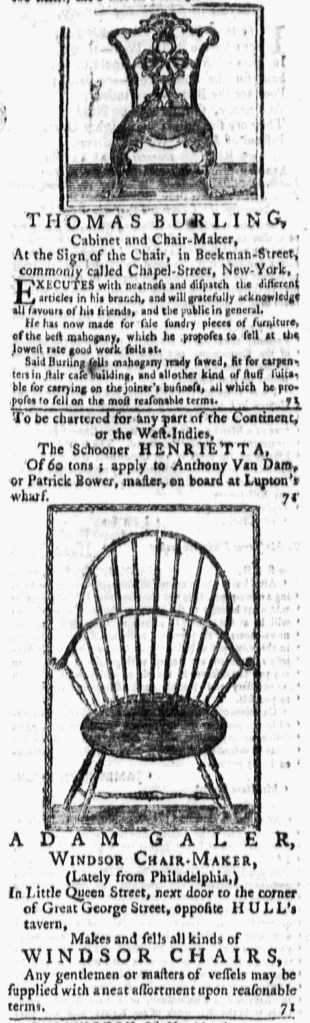
A week ago, the Adverts 250 Project examined advertisements placed by Adam Galer, “WINDSOR CHAIR-MAKER,” and Thomas Burling, “Cabinet and Chair-Maker,” that happened to appear one after the other in the August 25, 1774, edition of Rivington’s New-York Gazetteer.  Galer adorned his advertisement with an image of a Windsor chair within a decorative border, the focal point of his notice, while Burling relied exclusively on copy in making his pitch to prospective customers.

Burling apparently did not like being outdone by Galer.  In the next issue of Rivington’s New-York Gazetteer his advertisement also featured a woodcut of a chair within a border.  Though the image was not as large as Galer’s image, the chair depicted in it was much more elaborate.  That represented the sorts of furniture, the “different articles in his branch,” that Burling produced in his shop, compared to Galer specializing in Windsor chairs.  The woodcut may have also replicated the “Sign of the Chair” that marked Burling’s location “in Beekman-Street, commonly called Chapel-Street.”  Once again, the two advertisements appeared in proximity to each other, though this time Burling’s came first and a short advertisement for chartering the schooner Henrietta separated them since colonial printers did not classify or organize advertisements by purpose or genre.

That Burling first published his advertisement without an image and then so quickly added one suggests that he consulted the newspaper to see his advertisement in print, perhaps to confirm its conclusion or perhaps out of pride to see his name and a description of his “neatness and dispatch” and “good work” in print.  He might have been quite surprised to discover that Galer upstaged him with an image and, adding to his frustration, that the two advertisements appeared together.  While the image drew attention to that portion of the page, increasing the chances that readers noticed Burling’s advertisement immediately below Galer’s, Burling might have felt that it reflected poorly on him that a chairmaker who made only Windsor chairs circulated the more striking notice.  To make his advertisement just as memorable, he added an image of a much more ornate chair at the first opportunity.

August 25

What was advertised in a colonial American newspaper 250 years ago today?

Rivington’s New-York Gazetteer (August 25, 1774).

“Sundry pieces of furniture, of the best mahogany.”

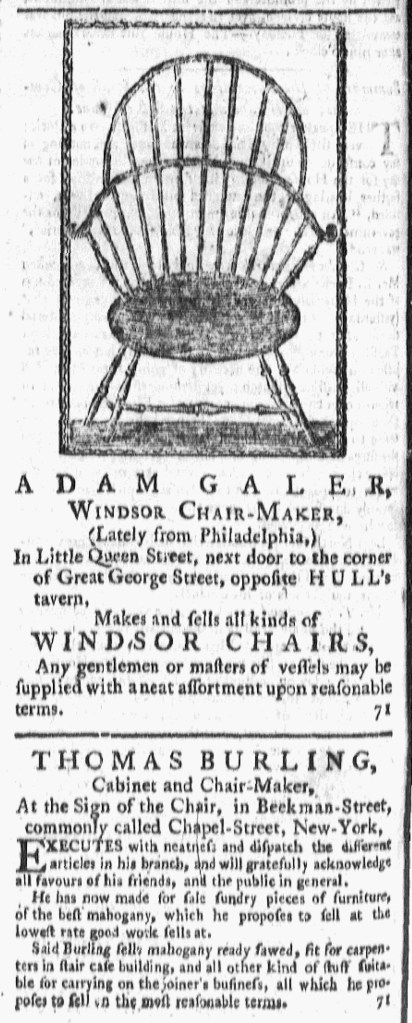
Both Adam Galer and Thomas Burling made and sold furniture in New York in the mid 1770s, yet they took different approaches when they advertised in Rivington’s New-York Gazetteer.  Their advertisements appeared one after the other in the August 25, 1774, edition, not by design but rather by coincidence since printers and compositors did not classify or organize paid notices by genre or purpose.  The proximity of the advertisements made the differences in their marketing efforts even more stark.

For his part, Galer, a “WINDSOR CHAIR-MAKER,” made an image of a Windsor chair within a decorative border the focal point of his advertisement.  That device filled about two-thirds of the space, immediately drawing attention.  Having recently arrived in New York from Philadelphia, Galer may have considered it worth the extra expense of commissioning the woodcut to enhance his visibility in the public prints.  In the copy, he gave his location and advised “gentlemen” and “masters of vessels” that they could acquire Windsor chairs “upon reasonable terms.”

Thomas Burling, on the other hand, relied exclusively on advertising copy without any images.  In that regard, his notice resembled the vast majority of newspapers advertisements.  He informed readers that they could find him “At the Sign of the Chair, in Beekman-Street, commonly called Chapel-Street,” indicating that he deployed visual images in other formats to promote his nosiness.  Burling, a “Cabinet and Chair-Maker,” produced a wider array of furniture than Galer, declaring that he “EXECUTES with neatness and dispatch the different articles in his branch.”  He reinforced his appeal to quality when he described the material, “the best mahogany,” and his own skill as an artisan.  He linked the latter to the price: “he proposes to sell at the lowest rate good work sells at.”

Burling may have benefited from the proximity of the two advertisements if readers took note of the image in Galer’s notice and then happened to continue reading the notice that followed.  Still, both artisans likely felt that they were in a better position than if they had not advertised at all.  Their direct competition in the public prints gave them an advantage over other competitors who did not advertise at all.

July 21

What was advertised in a colonial American newspaper 250 years ago today?

Supplement to Rivington’s New-York Gazetteer (July 21, 1774).

“He proposes to continue his business of pickling oysters and lobsters.”

James Rivington had sufficient content to include in the July 21, 1774, edition of Rivington’s New-York Gazetteer that he distributed a two-page supplement with the standard four-page issue.  The items in that supplement consisted entirely of paid notices, dozens of them.  In addition, advertising accounted for several columns alongside the news in the standard issue.  Only a few of those advertisements, however, featured visual images to aid in drawing the attention of readers.  Three had stock images of ships at sea, one for a sloop for sale, one seeking passengers and freight for a voyage to South Carolina, and one that “WANTS A FREIGHT, To any part of EUROPE.”  The printer supplied stock images for those notices.

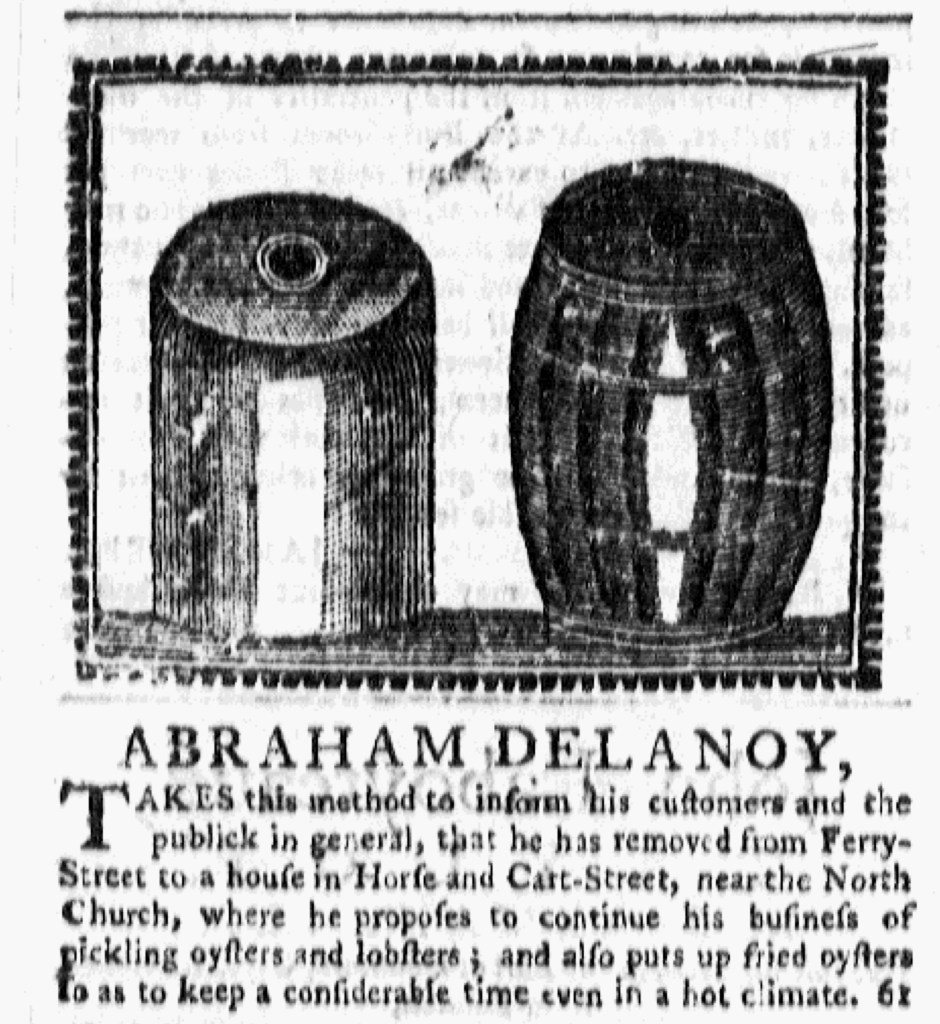
Three other advertisements sported woodcuts commissioned by the advertisers for their exclusive use, each of them providing a visual representation of some aspect of their business.  Thomas Ash, “WINDSOR CHAIR-MAKER,” once again incorporated the image of a chair that had accompanied his advertisements for several months.  Abraham Delanoy and James Webb also deployed images that had become familiar sights to readers over several weeks.  Delanoy advised readers that he moved to a new location where he “continue[d] his business of pickling oysters and lobsters” and “puts up fried oysters so as to keep a considerable time even in a hot climate.”  A woodcut depicting a lobster trap and an oyster cage appeared above his message to consumers.  Like Ash, Delanoy devoted as much space to his image as his copy, apparently believing that a picture was indeed worth a thousand words.  He trusted that the woodcut would as effectively market his wares as anything he might write.  He may have also figured that he had already established his reputation in the local marketplace so his primary purpose for the image could have been increasing the likelihood that customers saw his announcement that he had moved “from Ferry-Street to a house in Horse and Cart-Street.”

Supplement to Rivington’s New-York Gazetteer (July 21, 1774).

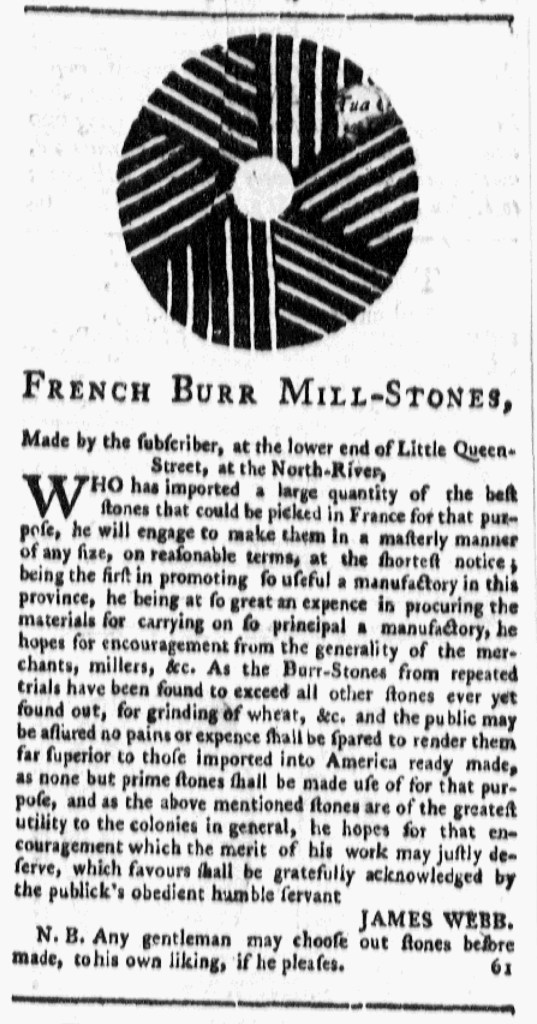
James Webb, on the other hand, used his woodcut of a millstone to advance a new endeavor unfamiliar to readers of Rivington’s New-York Gazetteer.  Accordingly, he devised significantly more copy to sell the “FRENCH BURR MILL-STONES” that he made from “the best stones that could be picked in France for that purpose.”  Webb claimed that he was “the first in promoting [or undertaking] so useful a manufactory in this province,” making it even more necessary that he provide an overview of his enterprise.  He asserted that he made millstones “in a masterly manner of any size, on reasonable terms, at the shortest notice,” succinctly incorporating appeals to quality, price, and convenience.  He suggested that millers, merchants, and others were already familiar with such millstones and knew that “from repeated trials [they] have been found to exceed all other stones ever yet found out.”  His millstones had the added advantage of being made in the colonies at a time that colonizers discussed the prospects of boycotting goods imported from Britain in response to the Coercive Acts passed by Parliament following the destruction of tea now known as the Boston Tea Party.  Webb pledged that “no pains or expence shall be spared to render [his millstones] far superior to those imported into America ready made,” while simultaneously reminding readers that they had a duty to support domestic manufactures.  To that end, his millstones “are of the greatest utility to the colonies in general.”  Just in case all of that did not convince prospective customers, Webb added a nota bene advising that “Any gentleman may choose out stones before made, to his own liking, if he pleases.”  In the end, that would yield even greater satisfaction with the finished product.

In each instance, the woodcuts that Ash, Delanoy, and Webb included in their advertisements happened to be the only visual images that appeared on that page of the July 21 edition of Rivington’s New-York Gazetteer.  Most likely that was by coincidence rather than design, yet it still helped in distinguishing their notices from others.  (The three images of ships appeared in a cluster, one after the other, on another page.)  Ash, Delanoy, and Webb had to pay additional fees to commission their woodcuts, but they very well may have determined that doing so was worth the investment.

July 11

What was advertised in a colonial American newspaper 250 years ago today?

Boston Evening-Post (July 11, 1774).

“The Sign of the LEOPARD.”

When Daniel Scott advertised his “Medicine Store [at] the Sign of the LEOPARD, South End” in the July 11, 1774, edition of the Boston Evening-Post, he adorned his notice with a woodcut depicting that exotic animal.  The device that he chose to represent his store gave colonizers greater access to faraway places that were part of global networks of trade and (often involuntary) migration.  Residents of the busy port spotted the leopard when they passed by Scott’s store.  His advertisement disseminated an image of an animal native to Africa and Asia even more widely, reaching readers who encountered such creatures mainly through descriptions rather than images.  Something similar occurred with the “Sign of the ELEPHANT” that marked the location of “HILL’s ready Money Variety Store” in Providence and the woodcut of an elephant in Hill’s advertisements in the Providence Gazette in the spring and summer of 1774.  That these entrepreneurs used these animals as their emblems suggests that colonizers were familiar enough with their descriptions to recognize them when they saw them, yet the signs and woodcuts helped clarify their visualizations.

Colonizers did have some opportunities to view exotic animals transported to British North America.  In August 1768, for instance, Abraham Van Dyck advertised that he had on display “one of the most beautiful Animals, call’d, The LEOPARD” that had “JUST ARRIVED” in New York.  Assuming readers had limited familiarity with this large cat, Van Dyck provided a description: “adorned all over with very neat and different spots, black and white [and] much in Shape, Nature, and Colour, like unto a Panther.”  To further entice prospective audiences, he included a woodcut depicting the creature.  He also stated that he had “several other Animals” on display “in the Broad-Way,” but did not indicate which species.  Although colonizers in New York could pay one shilling for a “full View of the Leopard,” most did not have chances to observe this animal very often.  Their most regular access to visual images of leopards, elephants, and other exotic animals would have been shop signs and, occasionally, advertising media, such as trade cards and newspaper notices, that incorporated woodcuts.  Scott offered lengthy descriptions of some of the medicines he sold, but many readers may have considered the image of the leopard the most engaging part of his advertisement.

June 6

What was advertised in a colonial American newspaper 250 years ago today?

New-York Gazette and Weekly Mercury (June 6, 1774).

Stove Grate Warehouse, in Beaver-street, (late Parker’s printing-office).”

William Bayley hawked a variety of merchandise to decorate a home according to the latest styles at his “Stove Grate Warehouse” in New York, far more than the name of his shop suggested.  In an advertisement in the June 6, 1774, edition of the New-York Gazette and Weekly Mercury, he listed an array of items recently imported from London, including a “New and general assortment of hard-ware, toys and trinkets; plated, japan’d and brown tea urns and coffee pots of the newest fashions; [and] a large assortment of paper hangings [or wallpaper] of the newest patterns.”  Bayley also stocked a “small assortment of china” and “a number of other articles too tedious to mention.”  He catered to taste while giving consumers choices for outfitting their homes for their own comfort and to impress visitors.

To give prospective customers a glimpse of what they might encounter at his “Warehouse” of decorative arts, Bayley adorned his advertisement with a woodcut depicting an ornate mantel with a stove grate.  Perhaps a similar image appeared on a sign that marked the location of his shop.  The border that enclosed it suggested that might have been the case. Incorporating such an image into his advertisement represented a significant investment for Bayley.  He had to commission the woodcut plus pay for twice as much space in the newspaper, yet he must have considered it worth the expense to increase the chances that customers would come to his new store in the space previously occupied by Samuel F. Parker’s printing office.  Given that the “Stove Grate Warehouse” was a new endeavor, Bayley may have considered even more necessary to make an impression in the public prints, strategically choosing a visual image over the lengthy lists of their inventories that other entrepreneurs, including James Morton and Richard Sause, published in the June 6 edition of the New-York Gazette and Weekly Mercury.  In the early twentieth century advertising executives coined the phrase “a picture is worth a thousand words,” but Bayley and other advertisers already deployed that concept during the era of the American Revolution.
May 18

What was advertised in a colonial American newspaper 250 years ago today?

Pennsylvania Gazette (May 18, 1774).

“At the Sign of the SCYTHE and SICKLE.”

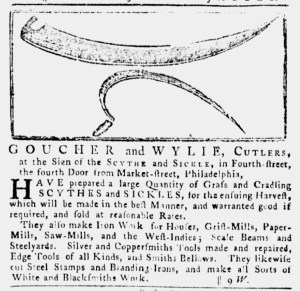
For marking the location of their workshop and for adorning their newspaper advertisements, Goucher and Wylie, cutlers, used an image closely associated with their trade.  In an advertisement that ran in the Pennsylvania Gazette for several weeks in the spring and summer of 1774, they advised prospective customers that they made and sold all kinds of cutlery “at the Sign of the SCYTHE and SICKLE.”  The woodcut that accompanied their notice depicted a scythe and a sickle within a rectangular border, perhaps replicating their shop sign or perhaps merely evoking the same symbols.  Either way, the image made their advertisement more visible to readers while simultaneously prompting them to think of Goucher and Wylie when they glimpsed scythes and sickles.

Yet they were not the only cutlers to operate at the Sign of the Scythe and Sickle in Philadelphia in the early 1770s.  Stephen Paschall and his son, also named Stephen, previously ran advertisements that gave their location as “the Sign of the Scythe and Sickle, in Market-street, between Fourth and Fifth-streets,” the most recent appearing a year before Goucher and Wylie published their notice.  In the longer version of their location, Goucher and Wylie directed customers to “the Sign of the SCYTHE and SICKLE, in Fourth-street, the fourth Door from Market-street.”  In other words, Goucher and Wylie were just around the corner from the Paschalls.  Did both businesses use the same device in such close proximity?  Or had the Paschalls closed shop, leaving the Sign of the Scythe and Sickle up for grabs for any cutlers who wished to appropriate it (and perhaps benefit from the reputation already associated with that image)?  Alternately, the Paschalls might have transferred the Sign of the Scythe and Sickle to Goucher and Wylie.

Let’s examine the evidence for that last possibility.  In June 1770, Samuel Wheeler advertised that he kept shop “at the sign of the Scythe, Sickle and Brand-iron” at the same time that Stephen Paschall ran notices that gave his location as “the sign of the Scythe and Sickle, in Market-street.”  Wheeler carefully added an item to his sign to distinguish his business from Paschall’s.  Had the elder and younger Paschall still been in business around the corner in 1774, Goucher and Wylie may have hesitated to duplicate their sign and, by extension, the name of their business.  In May 1768, Stephen Paschall and Benjamin Humphreys placed a joint advertisement that featured an image of a scythe and sickle enclosed in a rectangular border.  Both items bore the name “HUMPHREYS.”  That woodcut appears identical to the one in Goucher and Wylie’s advertisement that ran six years later, with the exception of “HUMPHREYS” being removed.  Perhaps Paschall had retained the woodcut when his association with Humphreys ended but had not made use of it.  He could have passed along the woodcut to Goucher and Wylie when transferring the Sign of the Scythe and Sickle to them.  If this scenario did occur, it suggests that some artisans carefully curated the names and images associated with their businesses in colonial Philadelphia.

May 1

What was advertised in a colonial American newspaper 250 years ago this week?

Massachusetts Spy (May 28, 1774).

“Medicine Boxes … are put up in the neatest Manner.”

The woodcut that adorned John Joy’s advertisement in the April 28, 1774, edition of the Massachusetts Spy alerted readers to the type of merchandise that the apothecary sold before they even read the copy.  It depicted a lion wearing a crown and working a mortar and pestle atop a column.  The woodcut ran the entire length of the advertisement, as if Joy or the compositor or perhaps the two working together intentionally designed the image and copy to fit together that way.  A sign with a similar image may or may not have marked Joy’s location at “the North-Corner of William’s Court, BOSTON,” but he did not make specific mention of a sign.  Other advertisers who commissioned woodcuts for their newspaper notices often did so when the image matched the device customers saw at their shop.  Whatever the case, the image made Joy’s advertisement much more visible to prospective customers than M.B. Goldthwait’s notice about a “fresh supply of DRUGS and MEDICINES” and “SURGEONS INSTRUMENTS, Of all Kinds.”

Massachusetts Spy (April 28, 1774).

The copy declared that Joy “Has just received from LONDON, A large and compleat Assortment of Drugs and Medicines, Of the best Quality.”  The lion with the crown asserted both those imperial connections and the quality of the remedies that Joy sold.  In addition, he stocked “Surgeons Instruments, of every Kind, finished in the neatest Manner” as well as “a full Assortment of Groceries and Dye Stuffs.”  Not unlike modern retail pharmacies, Joy diversified his enterprise to cultivate multiple revenue streams, including medicines, medical equipment, home health care supplies, and groceries.  To that end, he also prepared “Medicine Boxes of various Prices, for Ships or private Families,” pledging that they “are put up in the neatest Manner.”  Goldthwait also prepared “Doctor’s Boxes … for Masters of Vessels and private Families” and included “every necessary direction” for using the contents.  These first aid kits included both medicine and supplies.  Selling them allowed apothecaries to enhance their revenues since buyers acquired a variety of items that they did not yet need and might never use but purchased against the chance of injury or illness.  After all, it was better to have them on hand than not at all.  Joy also operated a precursor to the mail order pharmacy, alerting “Prac[ti]tioners and others” that they may be supplied with large or small Quantities, by Letter or otherwise [such as sending a servant enslaved messenger], as well as though they were present.”  Joy and other apothecaries frequently promoted such convenience as part of their marketing efforts.  Like the image of the crowned lion working a mortar and pestle, that appeal distinguished Joy’s advertisement from the notice placed by his competitor.

April 10

What was advertised in a colonial American newspaper 250 years ago this week?

Rivington’s New-York Gazetteer (April 7, 1774).

“ETHAN SICKELS, Leather-Dresser and Breeches-Maker.”

Even if imitation is the sincerest form of flattery, Cornelius Ryan, “LEATHER DRESSER and BREECHES MAKER,” probably did not feel particularly flattered when Ethan Sickels, “Leather-Dresser and Breeches-Maker,” ran an advertisement that imitated Ryan’s advertisement a little too much.  Compare the copy from Ryan’s notice, which first appeared in the New-York Gazette and Weekly Mercury on March 21, 1774, and Sickels’s notice, which first appeared in Rivington’s New-York Gazetteer on March 31.

Ryan: “MAKES and sells best Buck and Doe Skin Breeches, find ground Lamb do, best Buck and Doe Skin Gloves, also the very best Kind of Caraboo Skin Breeches and Gloves.”

Sickels: “MAKES and sells the best buck and doe skin breeches, fine ground lamb best buck and doe skin gloves; Also the very best Caraboo skin breeches, and gloves.”

Ryan: “He likewise has a great Variety of Buck Skin Breeches for Traders or Country Stores … all which he will sell on as low Terms as they can be had from Philadelphia, or any Part of the Continent.”

Sickels: “he likewise has a great quantity of buckskin breeches for traders, or country stores … all which he will sell on as low terms as they can be had from Philadelphia, or any part of the continent.

This was not an instance of using standardized or formulaic language as was often the case in eighteenth-century advertisements for consumer goods and services.  Instead, Sickels quite clearly borrowed Ryan’s advertising copy … but that was not the only undeniable similarity between the two newspaper notices.  Each of them included a woodcut depicting a pair of breeches and the initials of the advertiser that accounted for approximately half of the space occupied by the advertisements.  Ryan’s image also included a sun, replicating his “Sign of the SUN and BREECHES,” while Sickels’s image had a border around it instead.

Sickels apparently admired Ryan’s advertisement or feared that it gave his competitor too much of an advantage or recognized a means of drawing more attention to his own business.  All those factors may have been at play when he saw Ryan’s notice in the New-York Gazette and Weekly Mercury and decided to cross the street from his workshop “Opposite Mr. RIVINGTON’S PRINTING-OFFICE” to arrange for such a similar advertisement to run in Rivington’s New-York Gazetteer.  This suggests that entrepreneurs did not place newspaper advertisements as mere announcements in the eighteenth century but instead some of them monitored the public prints to devise their own marketing efforts or at least keep up with their competitors.

March 28

What was advertised in a colonial American newspaper 250 years ago today?

Supplement to the New-York Gazette and Weekly Mercury (March 28, 1774).

“The Sign of the SUN and BREECHES.”

Cornelius Ryan, “LEATHER DRESSER and BREECHES MAKER,” pursued his trade at “the Sign of the SUN and BREECHES, IN THE BROADWAY” in New York.  Residents and visitors to the busy port likely glimpsed his sign as they traversed the streets of the city.  Readers of the New-York Gazette and Weekly Mercury almost certainly noticed the woodcut that adorned the advertisements he ran in that newspaper.  It included the same elements as the sign that marked his location, a sun above a pair of breeches.  The sun had a face that stared directly at readers as well as eight rays enclosed within a corona.  In addition, the initials “CR,” for Cornelius Ryan, appeared between the legs of the breeches.  The woodcut may or may not have replicated Ryan’s sign; at the very least, it strengthened the association that the leather dresser and breeches maker wanted consumers to have with his business and visual representations of it.

To achieve that, Ryan invested in commissioning a woodcut stylized for his exclusive use.  Most entrepreneurs did not go to such lengths when they advertised in colonial newspapers, though Smith Richards, who kept shop “At the Tea canister and two sugar loaves,” once again included a woodcut depicting those items in his notice in the same supplement that carried Ryan’s advertisement.  Nesbitt Deane advertised hats he “Manufactured,” but did not adorn his notice with the image of a tricorne hat and his name within a banner that he had included in other notices on several occasions over the years.  Since advertisers paid by the amount of space their notices occupied rather than the number of words, woodcuts amounted to significant additional expense beyond the costs of producing them.  For Ryan, the woodcut accounted for nearly half of his advertisement, doubling the cost of running it in the New-York Gazette and Weekly Mercury.  He may very well have considered it worth the investment if the striking image prompted prospective customers to read the copy more closely.  The visual image served as a gateway for the appeals to skill, quality, price, consumer choice, and customer satisfaction that followed.