Are you looking for the advertisement by an eighteenth-century tailor from Portsmouth, New Hampshire, recently featured by the Two Nerdy History Girls in their “Breakfast Links“ for this week? That was the featured advertisement for March 13. You can skip to it directly via this link.
However, you’re also welcome to explore the rest of the Adverts 250 Project and examine many other eighteenth-century advertisements. Thank you for visiting!
What was advertised in a colonial American newspaper 250 years ago today?
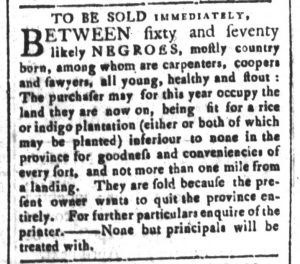
South-Carolina and American General Gazette (March 20, 1767).
“BETWEEN sixty and seventy likely NEGROES … among whom are carpenters, coopers and sawyers.”
This advertisement said the slaves for sale included “carpenters, coopers and sawyers.” I had never heard of coopers or sawyers before so I decided to find out more about them. The job of a cooper was to make casks, buckets and other containers to store things. The sawyer worked in a saw mill. Daniel C. Littlefield states that in the 1700s plantation owners in South Carolina “expected enslaved people to perform a wide range of jobs that included carpenter, cooper, boatman, cook, seamstress, and blacksmith, to mention only a few of the skilled function required around plantations.”
This made me question, what other jobs could be found on South Carolina plantations. Since the majority of the plantations in South Carolina were rice plantations, the major jobs on the plantation were creating dikes or levees and sluices and to maintain them. Slaves also had to keep animals away from the area. Other jobs included planting, weeding, and harvesting the rice.
**********
ADDITIONAL COMMENTARY: Carl Robert Keyes
Each eighteenth-century slavery advertisement tells an important story that demonstrates the scope of enslaved people’s experiences in early America, but some of them tell stories less familiar to my students (and the general public) than others. When Ceara selected today’s advertisement, I encouraged her to focus on the “carpenters, coopers and sawyers” prominently listed among the slaves offered for sale.
That enslaved men, women, and children were exploited for their labor comes as no surprise, but most students do not realize that slaveholders benefited from far more than just the labor of their labors. Instead, slaves contributed valuable expertise to plantations and the colonial economy more generally. Many learned specialized skills. Enslaved artisans plied their crafts on plantations in the Chesapeake and the Lower South, but they also worked in urban centers throughout the colonies, north and south.
Advertisers often made special note of the skills their human property possessed, such as the “carpenters, coopers and sawyers” from today’s advertisement or the “FOUR very valuable NEGROES” advertised in the Supplement to the South-Carolina Gazette and Country Journal on March 17, 1767. Three of the four were considered particularly valuable because two were “good workmen at the cabinet-maker’s business” and one was “a good sawyer, and handles his tools so well in the coarser branches of that trade as to be capable of making a tolerable country carpenter.”
In some instances enslaved artisans were “hired out” for limited amounts of time, such as a “Negro Man, by Trade a Shoemaker” also advertised in the March 17 supplement. This practice granted slaveholders an even greater return on their investment by occupying the time of skilled laborers who might otherwise experience lulls in demand for their services on their own plantations.
I anticipate that Ceara will approach her responsibilities as curator of the Slavery Adverts 250 Project with a more nuanced appreciation of the different kinds of labor and expertise described in the advertisements now that she has a better understanding that slaves contributed knowledge and expertise as well as physical labor to the cultivation of crops and the production of commodities in colonial and Revolutionary America.
The Slavery Adverts 250 Project chronicles the role of newspaper advertising in perpetuating slavery in the era of the American Revolution. The project seeks to reveal the ubiquity of slavery in eighteenth-century life from New England to Georgia by republishing advertisements about enslaved people – for sale as individuals or in groups, wanted to purchase or for hire for short periods, runaways who liberated themselves, and those who were subsequently captured and confined in jails and workhouses – in daily digests on this site as well as in real time via the @SlaveAdverts250 Twitter feed, utilizing twenty-first-century media to stand in for the print media of the eighteenth century.
The project aims to provide modern audiences with a sense of just how often colonizers encountered these advertisements in their daily lives. Enslaved men, women, and children appeared in print somewhere in the colonies almost every single day. Those advertisements served as a constant backdrop for social, cultural, economic, and political life in colonial and revolutionary America. Colonizers who did not purport to own enslaved people were still confronted with slavery as well as invited to maintain the system by purchasing enslaved men, women, and children or assisting in the capture of so-called “runaways” who sought to free themselves from bondage. The frequency of these newspaper advertisements suggests just how embedded slavery was in colonial and revolutionary American culture in everyday interactions beyond the printed page.
These advertisements also testify to the experiences of enslaved men, women, and children, though readers must consider that those experiences have been remediated through descriptions offered by enslavers rather than enslaved people themselves. Often unnamed in the advertisements, enslaved men, women, and children were not invisible or unimportant in early America.
These advertisements appeared in colonial American newspapers 250 years ago today.
South-Carolina and American General Gazette (March 20, 1767).
**********
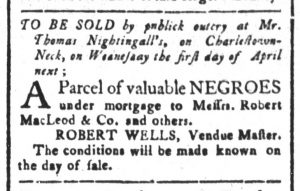
South-Carolina Gazette and Country Journal (March 20, 1767).
**********
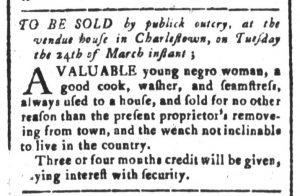
South-Carolina and American General Gazette (March 20, 1767).
**********
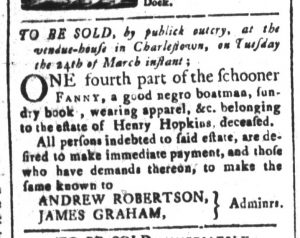
South-Carolina and American General Gazette (March 20, 1767).
**********
South-Carolina and American General Gazette (March 20, 1767).
**********
South-Carolina and American General Gazette (March 20, 1767).
**********
South-Carolina and American General Gazette (March 20, 1767).
**********
South-Carolina and American General Gazette (March 20, 1767).
What was advertised in a colonial American newspaper 250 years ago today?
Massachusetts Gazette (March 19, 1767).
“To be sold by WILLIAM JACKSON, at his Shop at the Brazen Head.”
This advertisement made me curious about William Jackson and the Brazen Head since I am from a town close to Boston. These curiosities led me to the Massachusetts Historical Society’s article on William Jackson.
Jackson was born in 1731. Mary Jackson, his widowed mother kept the Brazen Head Tavern next to the Town House (which is now known as the Old State House) in Boston. In 1758, William went into business with his mother, starting a “variety store” selling an assortment of goods in the same location,.
William Jackson was a Loyalist who adamantly supported the king throughout the imperial crisis and the Revolution. The Massachusetts Historical Society notes that in a Boston newspaper Jackson was named along with others for being “those who audaciously continue to counteract the unitedSentiments of the Body of Merchants throughout NORTH AMERICA, by importing British goods contrary to the agreement.” He was such a loyalist to the king, that when the British abandoned Boston in March of 1776, he tried to leave as well, only to be caught and imprisoned for a year. In the end, William Jackson returned to England, where he resided until his death in 1810.
**********
ADDITIONAL COMMENTARY: Carl Robert Keyes
At a glance, William Jackson’s advertisement does not appear to explicitly reveal much about women’s roles in the eighteenth-century marketplace, either as consumers or producers/sellers. However, Ceara and I did not need to do much research to discover that William Jackson’s story cannot be told without acknowledging women’s participation in commerce and consumer culture. As Ceara has already outlined, one of Jackson’s first forays into the world of business involved a partnership with his mother, already an experienced businesswoman who operated a tavern. Although widows may have been more likely to operate businesses than their married sisters, in the century before the Revolution wives stepped forward to act as what Laurel Thatcher Ulrich has described as “deputy husbands” who attended to matters of business in the temporary absence of their husbands. Many eighteenth-century advertisements make reference to wives or other female relations who worked in shops owned by their husbands, but historians have demonstrated that even if women’s contributions were not acknowledged in the marketing materials that they were indeed present and assisting in the operation of the family business.
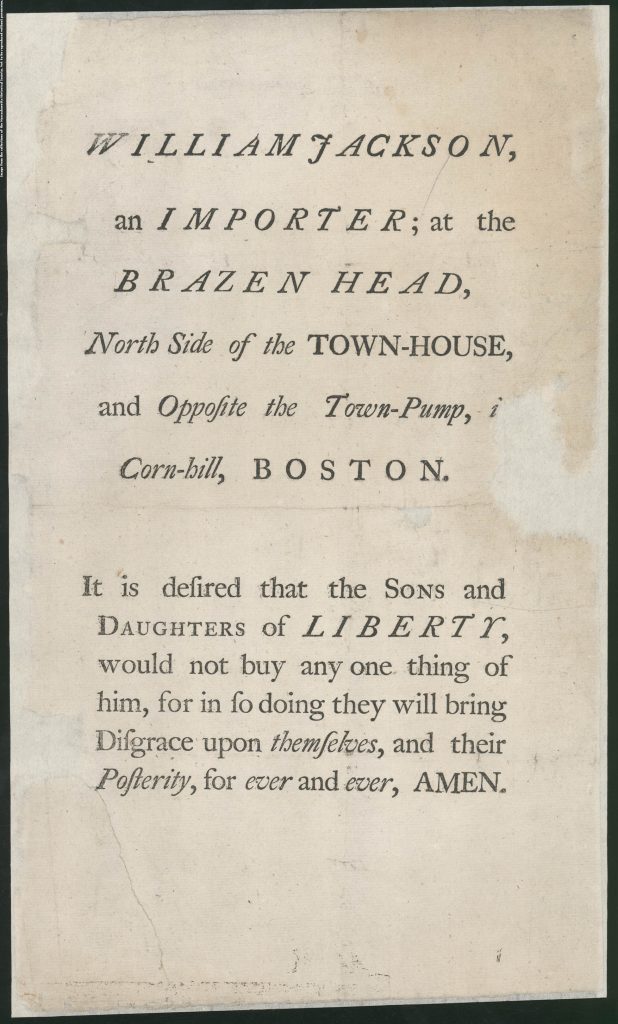
Anonymous broadside accusing William Jackson of not abiding by nonimportation agreements (Boston: ca. 1769-1770). Courtesy Massachusetts Historical Society.
To learn more about William Jackson, Ceara consulted the online collections of the Massachusetts Historical Society. In addition to a short biography of the prominent Loyalist shopkeeper, the MHS has made available an image of an anonymous broadside (ca. 1769-1770) warning “SONS and DAUGHTERS of LIBERTY” against purchasing goods from Jackson, “an IMPORTER,” who operated in violation of a non-importation agreement that most merchants and shopkeepers had signed in 1768 in response to the Townshend Acts. Note that the broadside addressed both “SONS” and “DAUGHTERS,” imbuing decisions that both men and women made about consumption with political meaning. Barred from formal mechanisms of political participation – voting and holding office – women engaged in political debates and civic discourse through other means, including the politicization of consumer culture. Nonimportation and nonconsumption agreements, what we would call boycotts today, were effective only if they had widespread approval and adherence. Women’s role in managing their household economy took on political significance as each personal choice whether to buy certain goods made a statement about their views. As acts of consumption increasingly had political valence, neutrality became impossible. During the imperial crisis, women were political actors in the overlapping marketplace of goods and marketplace of ideas.
William Jackson’s advertisement is an especially fine choice to examine during Women’s History Month. It reminds us that much of women’s history has been obscured but not hidden beyond recovery. A willingness to conduct a little more research, to ask new questions, and to approach sources from new perspectives allows us to tell a much more complete story of the American past.
Ceara Morse is a sophomore majoring in History and Secondary Education at Assumption College. From a young age she found history interesting because history is being made every day, not just in the distant past. She is fascinated by many historical periods and places, but wants to focus on U.S. History. She will be guest curator of the Adverts 250 Project during the week of March 19 to 25, as well as curator of the Slavery Adverts 250 Project for the week of April 2 to 8. She has previously served as guest curator of the Adverts 250 Project during the week of October 30 to November 5, 2016, as well as curator of the Slavery Adverts 250 Project during the week of October 9 to 15, 2016.
The Slavery Adverts 250 Project chronicles the role of newspaper advertising in perpetuating slavery in the era of the American Revolution. The project seeks to reveal the ubiquity of slavery in eighteenth-century life from New England to Georgia by republishing advertisements about enslaved people – for sale as individuals or in groups, wanted to purchase or for hire for short periods, runaways who liberated themselves, and those who were subsequently captured and confined in jails and workhouses – in daily digests on this site as well as in real time via the @SlaveAdverts250 Twitter feed, utilizing twenty-first-century media to stand in for the print media of the eighteenth century.
The project aims to provide modern audiences with a sense of just how often colonizers encountered these advertisements in their daily lives. Enslaved men, women, and children appeared in print somewhere in the colonies almost every single day. Those advertisements served as a constant backdrop for social, cultural, economic, and political life in colonial and revolutionary America. Colonizers who did not purport to own enslaved people were still confronted with slavery as well as invited to maintain the system by purchasing enslaved men, women, and children or assisting in the capture of so-called “runaways” who sought to free themselves from bondage. The frequency of these newspaper advertisements suggests just how embedded slavery was in colonial and revolutionary American culture in everyday interactions beyond the printed page.
These advertisements also testify to the experiences of enslaved men, women, and children, though readers must consider that those experiences have been remediated through descriptions offered by enslavers rather than enslaved people themselves. Often unnamed in the advertisements, enslaved men, women, and children were not invisible or unimportant in early America.
These advertisements appeared in colonial American newspapers 250 years ago today.
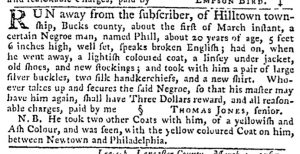
Supplement to the New-York Journal (March 19, 1767).
**********
Pennsylvania Gazette (March 19, 1767).
**********
Pennsylvania Gazette (March 19, 1767).
**********
Pennsylvania Gazette (March 19, 1767).
**********
Pennsylvania Gazette (March 19, 1767).
**********
Pennsylvania Gazette (March 19, 1767).
**********
Supplement to the Pennsylvania Gazette (March 19, 1767).
**********
Supplement to the Pennsylvania Gazette (March 19, 1767).
**********
Supplement to the Pennsylvania Gazette (March 19, 1767).
I have previous experience in public history and historical interpretation as a Park Ranger for the National Park Service, and I have looked at and interpreted primary sources for other history classes and for tours, so heading into this project I felt comfortable and within my element. The project did still push me to further my interpretation skills and ability to analyze primary sources, all within a public history setting. I especially was pushed to find my scholarly voice as well. I feel I learned a lot about the purpose of the project and about digital humanities projects, which I find to be an importation means of linking the academic world to the public through digital platforms. I came across unexpected challenges, such creating the content to reflect the audience of the project. Researching specific sources and documents for the posts was also a welcomed challenge.
The research topic and general theme of the project allowed me to really dive into learning about everyday live in colonial and Revolutionary America. A lot of my work and writing allowed me to compare our current everyday life and find similarities and differences to eighteenth-century life. Newspapers were a particularly fascinating primary source, a means of cultural communication that is still in place today, in paper or digital. Understanding the primary sources and taking on the viewpoint of a colonist helped me develop different perspectives. It pushed me to become the audience and ask myself questions. Then being able to step outside of that perspective and write about it in present terms to make it available for the public to use and learn was engaging. I tried to focus my work on an array of topics to allow readers to see that colonial life was just as complex as today. See, specifically, my post on the different textiles, baize and tammy. I realized they seemed like unfamiliar goods, but today when I see an advertisement, I automatically know what each product is. I asked myself if readers of the newspaper would read the advertisement and automatically know everything as well. I began researching the two I personally found interesting and it eventually led to me finding Abigail Adams mentioning baize in a letter to her husband John. I wanted to make clear comparisons to today as well; I hoped this would interest readers.
As for my long-term academic plans, I feel this project will help me in different aspects. It gave me a taste of being an actual historian, doing work that I might experience when I plan to continue the study of history in graduate school. Interpretation of primary sources and researching historical topics for public history use will help develop my interpretation skills as a Park Ranger. I hope to continue linking scholarship to the public through different means, especially through digital humanities which gives it easier access to people. For doing public history in an academic setting, I thought I learned a lot of the behind the scenes work it takes, and embraced the challenges not usually found in a typical classroom setting.
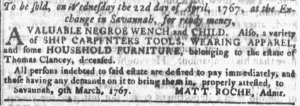
Who was the subject of an advertisement in a colonial American newspaper 250 years ago today?
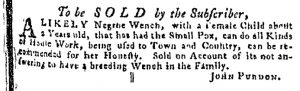
Georgia Gazette (March 18, 1767).
“A VALUABLE NEGROE WENCH and CHILD.”
Scanning through a colonial American newspaper, especially one from Georgia, it is not uncommon to see advertisements selling slaves with other goods. It is appalling to see a woman and her child being sold as property along with carpentry tools and household furniture. Ironically, in the 1730s the Georgia Trustees envisioned their colony as a free settlement. Unfortunately, the economic temptations were too strong and by 1751 slavery was legalized. In contrast, by 1784, the northern states, Pennsylvania, Massachusetts, New Hampshire, Connecticut, and Rhode Island, had all abolished slavery. But Georgia remained a slave state after the Revolution.
Two crops dominated the Georgia economy, rice in the eighteenth century and cotton in the nineteenth century. Rice and cotton plantations required an adequate slave labor force, so as Georgia’s plantations grew so did the demand for slaves. A state law passed in 1793 prohibited the importation of slaves, but the law went into effect in 1798. During the 1790s the number of slaves in Georgia nearly doubled. In 1790 Georgia had 29,264 slaves, but then 54,699 slaves in 1800.
What did it really mean to see a slave advertisement in the colonial American newspaper? It means viewing human beings as property that could contribute to the owner’s own economic growth. They were seen just as equal as household furniture and other common goods that could be sold and advertised in a newspaper.
**********
ADDITIONAL COMMENTARY: Carl Robert Keyes
Today is the 251st anniversary of the repeal of the Stamp Act. Such an odd number merits little notice in a culture that usually prefers to celebrate landmark numbers of years measured in decades. For the purposes of the Adverts 250 Project, however, March 18, 1767, was the first anniversary of the repeal of the Stamp Act. Colonists did not allow that important anniversary to pass unnoticed. Instead, they engaged in commemorations noted in newspapers published throughout the colonies during the week before and several weeks after March 18.
Against that backdrop, today’s advertisement for “A VALUABLE NEGROE WENCH and CHILD” seems especially jarring. The juxtaposition did not go unnoticed during the years prior to the American Revolution. In Taxation No Tyranny, published in 1775, Samuel Johnson famously asked, “How is it that we hear the loudest yelps for liberty among the drivers of negroes?” The British author and lexicographer identified a glaring inconsistency in the rhetoric of colonists who claimed they were being enslaved by Parliament.
Although patriots in northern colonies (later states) did not level the same sort of acerbic observations against their southern counterparts, many increasingly applied the rhetoric of liberty to the circumstances of their own slaves. As Daniel notes, several northern states abolished slavery by the end of the eighteenth century. Others adopted gradual emancipation plans. As a result, advertisements offering slaves for sale tapered off in northern newspapers.
For the past six months, the Slavery Adverts 250 Project has demonstrated, however, that advertisements for slaves were common in newspapers printed in New England and the Middle Atlantic, regions not associated with slavery to the same extent as the Chesapeake and the Lower South (in part because the northern regions abolished or phased out slavery after the Revolution). Today’s advertisement lumping together “A VALUABLE NEGROE WENCH and CHILD” with tools, clothing, and furniture appeared in some variation in newspapers printed in Boston, New York, and Philadelphia during its week of initial publication.
As Daniel and his peers in my Revolutionary America class work on the Adverts 250 Project and the Slavery Adverts 250 Project, I am encouraging them to contemplate the tensions between liberty and enslavement in eighteenth-century America, as well as the uneven application of the rhetoric of the Revolution when it came to slavery. While it is important to realize that approximately half a million slaves resided in the colonies at the time of the Revolution, the micro-histories embedded in slavery advertisements tell the stories of individuals. They provide further insight into the daily lives and lived experiences of enslaved men, women, and children in early America.
These tables indicate how many advertisements for slaves appeared in colonial American newspapers during the week of March 12-18, 1767.
Note: These tables are as comprehensive as currently digitized sources permit, but they may not be an exhaustive account. They includes all newspapers that have been digitized and made available via Accessible Archives, Colonial Williamsburg’s Digital Library, and Readex’s America’s Historical Newspapers. There are several reasons some newspapers may not have been consulted:
Issues that are no longer extant;
Issues that are extant but have not yet been digitized (including the Pennsylvania Journal); and
Newspapers published in a language other than English (including the Wochentliche Philadelphische Staatsbote).
**********
Slavery Advertisements Published March 12-18, 1767: By Date
**********
Slavery Advertisements Published March 12-18, 1767: By Region
The Slavery Adverts 250 Project chronicles the role of newspaper advertising in perpetuating slavery in the era of the American Revolution. The project seeks to reveal the ubiquity of slavery in eighteenth-century life from New England to Georgia by republishing advertisements about enslaved people – for sale as individuals or in groups, wanted to purchase or for hire for short periods, runaways who liberated themselves, and those who were subsequently captured and confined in jails and workhouses – in daily digests on this site as well as in real time via the @SlaveAdverts250 Twitter feed, utilizing twenty-first-century media to stand in for the print media of the eighteenth century.
The project aims to provide modern audiences with a sense of just how often colonizers encountered these advertisements in their daily lives. Enslaved men, women, and children appeared in print somewhere in the colonies almost every single day. Those advertisements served as a constant backdrop for social, cultural, economic, and political life in colonial and revolutionary America. Colonizers who did not purport to own enslaved people were still confronted with slavery as well as invited to maintain the system by purchasing enslaved men, women, and children or assisting in the capture of so-called “runaways” who sought to free themselves from bondage. The frequency of these newspaper advertisements suggests just how embedded slavery was in colonial and revolutionary American culture in everyday interactions beyond the printed page.
These advertisements also testify to the experiences of enslaved men, women, and children, though readers must consider that those experiences have been remediated through descriptions offered by enslavers rather than enslaved people themselves. Often unnamed in the advertisements, enslaved men, women, and children were not invisible or unimportant in early America.
These advertisements appeared in colonial American newspapers 250 years ago today.