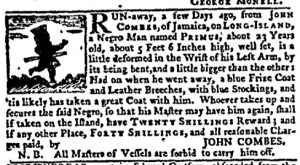
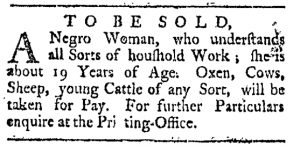
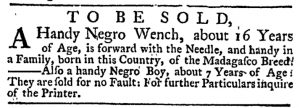
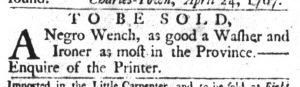
Slavery Advertisements Published May 21, 1767

The Slavery Adverts 250 Project chronicles the role of newspaper advertising in perpetuating slavery in the era of the American Revolution. The project seeks to reveal the ubiquity of slavery in eighteenth-century life from New England to Georgia by republishing advertisements about enslaved people – for sale as individuals or in groups, wanted to purchase or for hire for short periods, runaways who liberated themselves, and those who were subsequently captured and confined in jails and workhouses – in daily digests on this site as well as in real time via the @SlaveAdverts250 Twitter feed, utilizing twenty-first-century media to stand in for the print media of the eighteenth century.

The project aims to provide modern audiences with a sense of just how often colonizers encountered these advertisements in their daily lives. Enslaved men, women, and children appeared in print somewhere in the colonies almost every single day. Those advertisements served as a constant backdrop for social, cultural, economic, and political life in colonial and revolutionary America. Colonizers who did not purport to own enslaved people were still confronted with slavery as well as invited to maintain the system by purchasing enslaved men, women, and children or assisting in the capture of so-called “runaways” who sought to free themselves from bondage. The frequency of these newspaper advertisements suggests just how embedded slavery was in colonial and revolutionary American culture in everyday interactions beyond the printed page.

These advertisements also testify to the experiences of enslaved men, women, and children, though readers must consider that those experiences have been remediated through descriptions offered by enslavers rather than enslaved people themselves. Often unnamed in the advertisements, enslaved men, women, and children were not invisible or unimportant in early America.

These advertisements appeared in colonial American newspapers 250 years ago today.
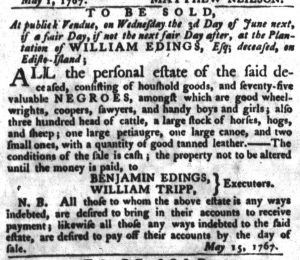
May 21 - New-York Gazette Weekly Post-Boy Slavery 1
New-York Gazette: Or, the Weekly Post-Boy (May 21, 1767).

**********

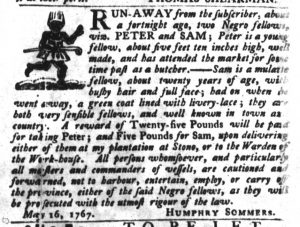
May 21 - New-York Gazette Weekly Post-Boy Slavery 2
New-York Gazette: Or, the Weekly Post-Boy (May 21, 1767).

**********

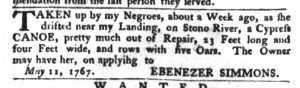
May 21 - Pennsylvania Gazette Slavery 1
Pennsylvania Gazette (May 21, 1767).

**********

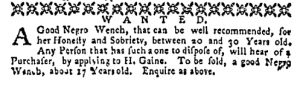
May 21 - Pennsylvania Gazette Slavery 2
Pennsylvania Gazette (May 21, 1767).

**********
May 21 - Pennsylvania Gazette Slavery 3
Pennsylvania Gazette (May 21, 1767).

**********

May 21 - Pennsylvania Gazette Slavery 4
Pennsylvania Gazette (May 21, 1767).

**********

May 21 - Pennsylvania Gazette Supplement Slavery 1
Supplement to the Pennsylvania Gazette (May 21, 1767).

**********
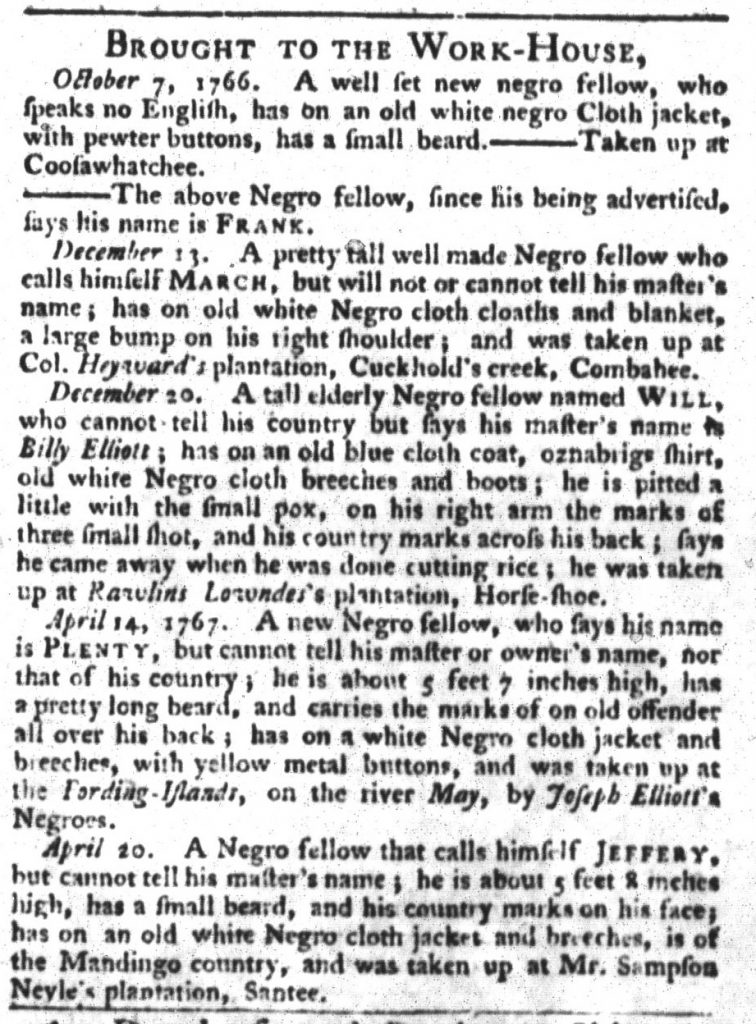
May 21 - Pennsylvania Gazette Supplement Slavery 2
Supplement to the Pennsylvania Gazette (May 21, 1767).

**********

May 21 - Pennsylvania Gazette Supplement Slavery 3
Supplement to the Pennsylvania Gazette (May 21, 1767).

**********

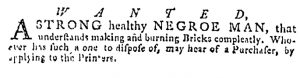
May 21 - Virginia Gazette Slavery 1
Virginia Gazette (May 21, 1767).

**********
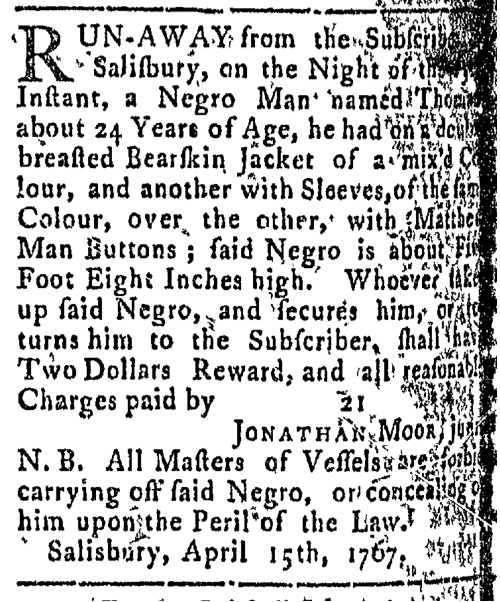
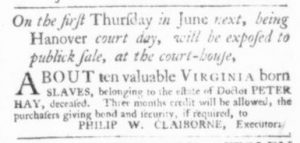
May 21 - Virginia Gazette Slavery 2
Virginia Gazette (May 21, 1767).

**********

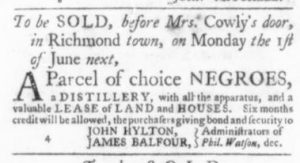
May 21 - Virginia Gazette Slavery 3
Virginia Gazette (May 21, 1767).

**********

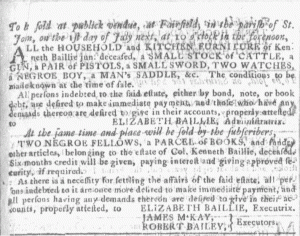
May 21 - Virginia Gazette Slavery 4
Virginia Gazette (May 21, 1767).

**********

May 21 - Virginia Gazette Slavery 5
Virginia Gazette (May 21, 1767).

May 20

Who was the subject of an advertisement in a colonial American newspaper 250 years ago today?

May 20 - 5:20:1767 Georgia Gazette
Georgia Gazette (May 20, 1767).

“RUN AWAY … a MUSTEE WENCH.”

Jenny, an enslaved woman, made her escape, prompting Archibald Bulloch to place an advertisement in the Georgia Gazette. He offered a reward to “Whoever apprehends and delivers the said wench to me in Savannah.” To help readers identify Jenny, Bulloch described her as a “MUSTEE WENCH,” mobilizing one of the many categories for describing both the physical appearance and heritage of mixed race men, women, and children in the early modern Atlantic world.

Mustee, now chiefly an historical term according to the Oxford English Dictionary, specifically means “a person with one white-skinned parent and the other one-quarter black.” In other words, Jenny may have been one-eighth black, presumably fairly light-skinned, as the result of having one African great-grandparent. However, the OED also indicates that mustee sometimes also referred to “a person of mixed European and African descent” and, even more generally, “a person of mixed racial descent” (including indigenous Americans as well as Africans). Mustee was likely a shortened form of mestizo arising from non-standardized spellings. That being the case, Bulloch may not have intended to be any more descriptive than simply indicating that Jenny had a mixed racial heritage.

Whatever the case, Bulloch mobilized print culture to put black bodies on display. By advertising Jenny and describing her as a “MUSTEE WENCH,” he encouraged readers to engage in surveillance of all black women they encountered, to carefully examine their physical characteristics to assess whether they might be the runaway. This advertisement called attention not only to Jenny; it cast suspicion on all black women, the reward offering added incentive to take note of their bodies.

May 20 - 11:4:1732 South Carolina Gazette
South Carolina Gazette (November 4, 1732).

Research note: I consulted the Oxford English Dictionary for an authoritative definition and etymology of mustee. Among its historical sources, the OED included a runaway slave advertisement published in the South Carolina Gazette in 1732.

Summary of Slavery Advertisements Published May 14-20, 1767

These tables indicate how many advertisements for slaves appeared in colonial American newspapers during the week of May 14-20, 1767.

Note:  These tables are as comprehensive as currently digitized sources permit, but they may not be an exhaustive account.  They includes all newspapers that have been digitized and made available via Accessible Archives, Colonial Williamsburg’s Digital Library, and Readex’s America’s Historical Newspapers.  There are several reasons some newspapers may not have been consulted:

  • Issues that are no longer extant;
  • Issues that are extant but have not yet been digitized (including the Pennsylvania Journal); and
  • Newspapers published in a language other than English (including the Wochentliche Philadelphische Staatsbote).

**********

Slavery Advertisements Published May 14-20, 1767:  By Date

Slavery Adverts Tables 1767 By Date May 14

**********

Slavery Advertisements Published May 14-20, 1767:  By Region

Slavery Adverts Tables 1767 By Region May 14

Slavery Advertisements Published May 20, 1767

The Slavery Adverts 250 Project chronicles the role of newspaper advertising in perpetuating slavery in the era of the American Revolution. The project seeks to reveal the ubiquity of slavery in eighteenth-century life from New England to Georgia by republishing advertisements about enslaved people – for sale as individuals or in groups, wanted to purchase or for hire for short periods, runaways who liberated themselves, and those who were subsequently captured and confined in jails and workhouses – in daily digests on this site as well as in real time via the @SlaveAdverts250 Twitter feed, utilizing twenty-first-century media to stand in for the print media of the eighteenth century.

The project aims to provide modern audiences with a sense of just how often colonizers encountered these advertisements in their daily lives. Enslaved men, women, and children appeared in print somewhere in the colonies almost every single day. Those advertisements served as a constant backdrop for social, cultural, economic, and political life in colonial and revolutionary America. Colonizers who did not purport to own enslaved people were still confronted with slavery as well as invited to maintain the system by purchasing enslaved men, women, and children or assisting in the capture of so-called “runaways” who sought to free themselves from bondage. The frequency of these newspaper advertisements suggests just how embedded slavery was in colonial and revolutionary American culture in everyday interactions beyond the printed page.

These advertisements also testify to the experiences of enslaved men, women, and children, though readers must consider that those experiences have been remediated through descriptions offered by enslavers rather than enslaved people themselves. Often unnamed in the advertisements, enslaved men, women, and children were not invisible or unimportant in early America.

These advertisements appeared in colonial American newspapers 250 years ago today.

May 20 - Georgia Gazette Slavery 1
Georgia Gazette (May 20, 1767).

**********

May 20 - Georgia Gazette Slavery 2
Georgia Gazette (May 20, 1767).

**********

May 20 - Georgia Gazette Slavery 3
Georgia Gazette (May 20, 1767).

**********

May 20 - Georgia Gazette Slavery 4
Georgia Gazette (May 20, 1767).

**********

May 20 - Georgia Gazette Slavery 5
Georgia Gazette (May 20, 1767).

**********

May 20 - Georgia Gazette Slavery 6
Georgia Gazette (May 20, 1767).

**********

May 20 - Georgia Gazette Slavery 7
Georgia Gazette (May 20, 1767).

**********

May 20 - Georgia Gazette Slavery 8
Georgia Gazette (May 20, 1767).

May 19

What was advertised in a colonial American newspaper 250 years ago today?

May 19 - 5:19:1767 South-Carolina Gazette and Country Journal
South-Carolina Gazette and Country Journal (May 19, 1767).

“He served his apprenticeship in London, of which city he is a freeman.”

As a standard part of their advertisements, merchants and shopkeepers noted that they sold goods imported from faraway places, especially London. In so doing, they established themselves as conduits who connected their customers to both the quality and fashions associated with goods produced and popularly consumed in the largest city in the British empire. Artisans who made the items they sold in local workshops, however, could not make quite the same claim. Instead, those who had migrated across the Atlantic proudly proclaimed their origins, announcing that they were “FROM LONDON,” as Whiting the saddler did in today’s advertisement.

On occasion, artisans elaborated on the training they had received in workshops in London, demonstrating to potential customers why they should take notice of their origins. Whiting asserted that he was capable of “execut[ing] all the branches of that business in the compleatest manner” precisely because “he served his apprenticeship in London, of which city he is a freeman.” This meant that Whiting belonged to the Worshipful Company of Saddlers, one of the city’s livery companies that originated as trade guilds. These companies oversaw members who practiced their trade; they kept standards high, an early modern version of quality control. To become a member, known as a freeman, an artisan had to serve an apprenticeship under a master of the trade who was already a freeman. Alternately, some joined by patrimony if a parent ad been a freeman or by redemption upon paying a fee. Working within the walls of the City of London required achieving freeman status. This conferred some level of prestige on the artisans, a certain cachet that Whiting suggested could be transferred to those who hired him. Whiting wanted prospective customers to know that he had earned the rank of freeman via servitude rather than patrimony or redemption, that he had honed his skills through an apprenticeship to a master saddler.

Although he was an ocean away from the livery companies that oversaw artisans in the City of London, Whiting called on their privileged position and his membership in their order to advance his own workshop in Charleston. He expected that this would resonate with local residents.

Slavery Advertisements Published May 19, 1767

The Slavery Adverts 250 Project chronicles the role of newspaper advertising in perpetuating slavery in the era of the American Revolution. The project seeks to reveal the ubiquity of slavery in eighteenth-century life from New England to Georgia by republishing advertisements about enslaved people – for sale as individuals or in groups, wanted to purchase or for hire for short periods, runaways who liberated themselves, and those who were subsequently captured and confined in jails and workhouses – in daily digests on this site as well as in real time via the @SlaveAdverts250 Twitter feed, utilizing twenty-first-century media to stand in for the print media of the eighteenth century.

The project aims to provide modern audiences with a sense of just how often colonizers encountered these advertisements in their daily lives. Enslaved men, women, and children appeared in print somewhere in the colonies almost every single day. Those advertisements served as a constant backdrop for social, cultural, economic, and political life in colonial and revolutionary America. Colonizers who did not purport to own enslaved people were still confronted with slavery as well as invited to maintain the system by purchasing enslaved men, women, and children or assisting in the capture of so-called “runaways” who sought to free themselves from bondage. The frequency of these newspaper advertisements suggests just how embedded slavery was in colonial and revolutionary American culture in everyday interactions beyond the printed page.

These advertisements also testify to the experiences of enslaved men, women, and children, though readers must consider that those experiences have been remediated through descriptions offered by enslavers rather than enslaved people themselves. Often unnamed in the advertisements, enslaved men, women, and children were not invisible or unimportant in early America.

These advertisements appeared in colonial American newspapers 250 years ago today.

May 19 - South-Carolina Gazette and Country Journal Slavery 1
South-Carolina Gazette and Country Journal (May 19, 1767).

**********

May 19 - South-Carolina Gazette and Country Journal Slavery 2
South-Carolina Gazette and Country Journal (May 19, 1767).

**********

May 19 - South-Carolina Gazette and Country Journal Slavery 3
South-Carolina Gazette and Country Journal (May 19, 1767).

**********

May 19 - South-Carolina Gazette and Country Journal Slavery 4
South-Carolina Gazette and Country Journal (May 19, 1767).

**********

May 19 - South-Carolina Gazette and Country Journal Slavery 5
South-Carolina Gazette and Country Journal (May 19, 1767).

**********

May 19 - South-Carolina Gazette and Country Journal Slavery 6
South-Carolina Gazette and Country Journal (May 19, 1767).

**********

May 19 - South-Carolina Gazette and Country Journal Slavery 7
South-Carolina Gazette and Country Journal (May 19, 1767).

**********

May 19 - South-Carolina Gazette and Country Journal Slavery 8
South-Carolina Gazette and Country Journal (May 19, 1767).

**********

May 19 - South-Carolina Gazette and Country Journal Slavery 9
South-Carolina Gazette and Country Journal (May 19, 1767).

**********

May 19 - South-Carolina Gazette and Country Journal Slavery 10
South-Carolina Gazette and Country Journal (May 19, 1767).

**********

May 19 - South-Carolina Gazette and Country Journal Slavery 11
South-Carolina Gazette and Country Journal (May 19, 1767).

**********

May 19 - South-Carolina Gazette and Country Journal Slavery 12
South-Carolina Gazette and Country Journal (May 19, 1767).

**********

May 19 - South-Carolina Gazette and Country Journal Slavery 13
South-Carolina Gazette and Country Journal (May 19, 1767).

**********

May 19 - South-Carolina Gazette and Country Journal Slavery 14
South-Carolina Gazette and Country Journal (May 19, 1767).

**********

May 19 - South-Carolina Gazette and Country Journal Slavery 15
South-Carolina Gazette and Country Journal (May 19, 1767).

**********

May 19 - South-Carolina Gazette and Country Journal Slavery 16
South-Carolina Gazette and Country Journal (May 19, 1767).

**********

May 19 - South-Carolina Gazette and Country Journal Supplement Slavery 1
Supplement to the South-Carolina Gazette and Country Journal (May 19, 1767).

**********

May 19 - South-Carolina Gazette and Country Journal Supplement Slavery 2
Supplement to the South-Carolina Gazette and Country Journal (May 19, 1767).

**********

May 19 - South-Carolina Gazette and Country Journal Supplement Slavery 3
Supplement to the South-Carolina Gazette and Country Journal (May 19, 1767).

**********

May 19 - South-Carolina Gazette and Country Journal Supplement Slavery 4
Supplement to the South-Carolina Gazette and Country Journal (May 19, 1767).

May 18

What was advertised in a colonial American newspaper 250 years ago today?

May 18 - 5:18:1767 New-York Gazette
New-York Gazette (May 18, 1767).

“Cloaths, after the newest and genteelest Taste, as is now worn in London.”

George Senneff adopted a marketing strategy commonly deployed by tailors and other artisans. To imbue his services with extra cachet, he included his origins in his introduction: “George Senneff, Taylor, from LONDON.” Colonists were preoccupied with the latest trends in England, especially London, when it came to both dress and adorning private and public spaces. They experienced anxiety that they might appear pretenders in provincial backwaters as they participated in transatlantic consumer culture that changed increasingly rapidly as the eighteenth century progressed. Tailors and others in the clothing trades, as well as hairdressers and cabinetmakers, offered reassurances that their goods and services were à la mode when they asserted their connections to the cosmopolitan center of the empire.

Many considered announcing that they were “from LONDON” sufficient for the purpose, but Senneff treated that merely as an opening salvo in his bid to win clients concerned about wearing the latest fashions and demonstrating their awareness of the most current trends. Not only was he “from LONDON,” Senneff proclaimed that he made men’s garments of “plain and lac’d Cloaths, after the newest and genteelest Taste, as is now worn in London.” He reiterated this claim when he described the riding habits he made for women: “after the newest Fashions now worn in London.” Senneff had his finger on the pulse of changing tastes in the metropole. In turn, his clients in New York would exhibit that insider’s knowledge in their attire as they attended to business and socialized in the colonial outpost.

Senneff’s decision to repeatedly state that his garments conformed to “the newest Fashions now worn in London” may not have merely reassured customers. Instead, such intensive focus on the latest styles in that faraway city could have stoked anxiety among local consumers. Repetitively invoking current tastes in London may have prompted some potential customers to dwell on this aspect of their own apparel, encouraging them to seek out Senneff’s services since he seemed to be in the know and could provide appropriate guidance in outfitting them “after the newest and genteelest Taste.” Senneff craftily induced such uneasiness and simultaneously offered his services as an especially effective way to experience relief. His notice was no mere announcement but rather a clever attempt to manipulate potential customers into visiting his shop.

Slavery Advertisements Published May 18, 1767

The Slavery Adverts 250 Project chronicles the role of newspaper advertising in perpetuating slavery in the era of the American Revolution. The project seeks to reveal the ubiquity of slavery in eighteenth-century life from New England to Georgia by republishing advertisements about enslaved people – for sale as individuals or in groups, wanted to purchase or for hire for short periods, runaways who liberated themselves, and those who were subsequently captured and confined in jails and workhouses – in daily digests on this site as well as in real time via the @SlaveAdverts250 Twitter feed, utilizing twenty-first-century media to stand in for the print media of the eighteenth century.

The project aims to provide modern audiences with a sense of just how often colonizers encountered these advertisements in their daily lives. Enslaved men, women, and children appeared in print somewhere in the colonies almost every single day. Those advertisements served as a constant backdrop for social, cultural, economic, and political life in colonial and revolutionary America. Colonizers who did not purport to own enslaved people were still confronted with slavery as well as invited to maintain the system by purchasing enslaved men, women, and children or assisting in the capture of so-called “runaways” who sought to free themselves from bondage. The frequency of these newspaper advertisements suggests just how embedded slavery was in colonial and revolutionary American culture in everyday interactions beyond the printed page.

These advertisements also testify to the experiences of enslaved men, women, and children, though readers must consider that those experiences have been remediated through descriptions offered by enslavers rather than enslaved people themselves. Often unnamed in the advertisements, enslaved men, women, and children were not invisible or unimportant in early America.

These advertisements appeared in colonial American newspapers 250 years ago today.

May 18 - Boston-Gazette Slavery 1
Boston-Gazette (May 18, 1767).

**********

May 18 - Connecticut Courant Slavery 1
Connecticut Courant (May 18, 1767).

**********

May 18 - New-York Gazette Slavery 1
New-York Gazette (May 18, 1767).

**********

May 18 - New-York Mercury Slavery 1
New-York Mercury (May 18, 1767).

**********

May 18 - New-York Mercury Slavery 2
New-York Mercury (May 18, 1767).

**********

May 18 - New-York Mercury Slavery 3
New-York Mercury (May 18, 1767).

**********

May 18 - New-York Mercury Slavery 4
New-York Mercury (May 18, 1767).

**********

May 18 - New-York Mercury Slavery 5
New-York Mercury (May 18, 1767).

**********

May 18 - Newport Mercury Slavery 1
Newport Mercury (May 18, 1767).

May 17

What was advertised in a colonial American newspaper 250 years ago this week?

May 17 - 5:14:1767 Pennsylvania Gazette
Supplement to the Pennsylvania Gazette (May 14, 1767).

“Imported … by MAGDALEN DEVINE … the following goods.”

Compared to their male counterparts, female shopkeepers placed relatively few advertisements in eighteenth-century newspapers (and turned to other forms of marketing media, such as magazine wrappers, trade cards, and broadsides, even less often). Women’s participation in the marketplace as retailers rather than consumers was disproportionately underrepresented among advertisements in colonial and Revolutionary-era newspapers.

Magdalen Devine’s lengthy list-style advertisement was notable, however, not only because she was a female entrepreneur who turned to the public prints to promote her business. To draw attention to her notice, Devine included a woodcut that depicted the sorts of textiles she imported and sold at her shop on Second Street near the Quaker Meetinghouse. A border surrounded two rolls of cloth positioned next to two swatches, all of them arrayed to demonstrate four different patterns. This visual image reinforced the work done in Devine’s dense list of merchandise: customers could expect to make choices among the assortment of dry goods she stocked.

Given that few male advertisers, whether shopkeepers, artisans, or others, commissioned woodcuts to include in their marketing efforts, Devine’s advertisement was quite extraordinary. To paraphrase Laurel Thatcher Ulrich’s analysis of gendered women’s activities in colonial New England, Devine’s advertisement demonstrates what was possible rather than what was probable when women took on some of the same tasks and responsibilities most often reserved for or associated with men.

Three other women played a role in advertisements that appeared in the same issue of the Pennsylvania Gazette. A notice placed by “JOHN HOLLIDAY, TAYLOR,” included a final paragraph about “Mrs. Holliday’s new-invented curious Compound” for removing hair. Unlike her husband, Mrs. Holliday’s name did appear in all capitals. “WILLIAM SYMONDS” and “MARY SYMONDS, Millener,” cooperated in placing an advertisement, though Mary seems to have been the driving force. The advertisement briefly noted that William “has just imported in the last vessels, a neat assortment of merchandize.” Mary, on the other hand, provided a list of her “neat assortment of millenery goods” that exceeded Devine’s in length. (Symonds was one of the few female entrepreneurs who distributed her own trade card in eighteenth-century America, though she would not do so for another decade.) Finally, “ANN PEARSON, MILLENER,” also inserted a list-style advertisement, seemingly of her own accord. It did not mention any male relatives who might have overseen her participation in the marketplace.

The woodcut that accompanied Devine’s advertisement made her marketing memorable. The May 14 issue of the Pennsylvania Gazette consisted of eight pages (the four-page standard issue as well as a four-page supplement) with nearly seven of them devoted to advertising. Only two other advertisements included woodcuts, a generic ship with Alexander Lunan’s notice about freight and passage on a ship about to sail for South Carolina and an extended hand with dyer Joseph Allardyce’s advertisement for his shop “at the Sign of the Blue Hand.” Although men most actively advertised consumer goods and services in early America, women also adopted marketing innovations and experimented with various methods for marketing their wares.

Slavery Advertisements Published May 16, 1767

The Slavery Adverts 250 Project chronicles the role of newspaper advertising in perpetuating slavery in the era of the American Revolution. The project seeks to reveal the ubiquity of slavery in eighteenth-century life from New England to Georgia by republishing advertisements about enslaved people – for sale as individuals or in groups, wanted to purchase or for hire for short periods, runaways who liberated themselves, and those who were subsequently captured and confined in jails and workhouses – in daily digests on this site as well as in real time via the @SlaveAdverts250 Twitter feed, utilizing twenty-first-century media to stand in for the print media of the eighteenth century.

The project aims to provide modern audiences with a sense of just how often colonizers encountered these advertisements in their daily lives. Enslaved men, women, and children appeared in print somewhere in the colonies almost every single day. Those advertisements served as a constant backdrop for social, cultural, economic, and political life in colonial and revolutionary America. Colonizers who did not purport to own enslaved people were still confronted with slavery as well as invited to maintain the system by purchasing enslaved men, women, and children or assisting in the capture of so-called “runaways” who sought to free themselves from bondage. The frequency of these newspaper advertisements suggests just how embedded slavery was in colonial and revolutionary American culture in everyday interactions beyond the printed page.

These advertisements also testify to the experiences of enslaved men, women, and children, though readers must consider that those experiences have been remediated through descriptions offered by enslavers rather than enslaved people themselves. Often unnamed in the advertisements, enslaved men, women, and children were not invisible or unimportant in early America.

These advertisements appeared in colonial American newspapers 250 years ago today.

May 16 - Providence Gazette Slavery 1
Providence Gazette (May 16, 1767).

**********

May 16 - Providence Gazette Slavery 2
Providence Gazette (May 16, 1767).

**********

May 16 - Providence Gazette Slavery 3
Providence Gazette (May 16, 1767).