Slavery Advertisements Published June 10, 1767

The Slavery Adverts 250 Project chronicles the role of newspaper advertising in perpetuating slavery in the era of the American Revolution. The project seeks to reveal the ubiquity of slavery in eighteenth-century life from New England to Georgia by republishing advertisements about enslaved people – for sale as individuals or in groups, wanted to purchase or for hire for short periods, runaways who liberated themselves, and those who were subsequently captured and confined in jails and workhouses – in daily digests on this site as well as in real time via the @SlaveAdverts250 Twitter feed, utilizing twenty-first-century media to stand in for the print media of the eighteenth century.

The project aims to provide modern audiences with a sense of just how often colonizers encountered these advertisements in their daily lives. Enslaved men, women, and children appeared in print somewhere in the colonies almost every single day. Those advertisements served as a constant backdrop for social, cultural, economic, and political life in colonial and revolutionary America. Colonizers who did not purport to own enslaved people were still confronted with slavery as well as invited to maintain the system by purchasing enslaved men, women, and children or assisting in the capture of so-called “runaways” who sought to free themselves from bondage. The frequency of these newspaper advertisements suggests just how embedded slavery was in colonial and revolutionary American culture in everyday interactions beyond the printed page.

These advertisements also testify to the experiences of enslaved men, women, and children, though readers must consider that those experiences have been remediated through descriptions offered by enslavers rather than enslaved people themselves. Often unnamed in the advertisements, enslaved men, women, and children were not invisible or unimportant in early America.

These advertisements appeared in colonial American newspapers 250 years ago today.

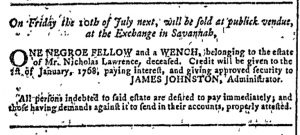
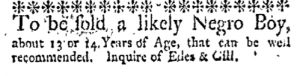
Jun 10 - Georgia Gazette Slavery 1
Georgia Gazette (June 10, 1767).

**********
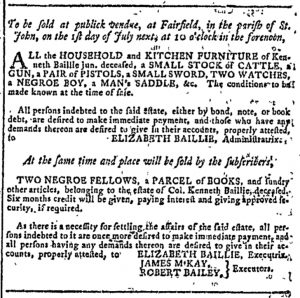
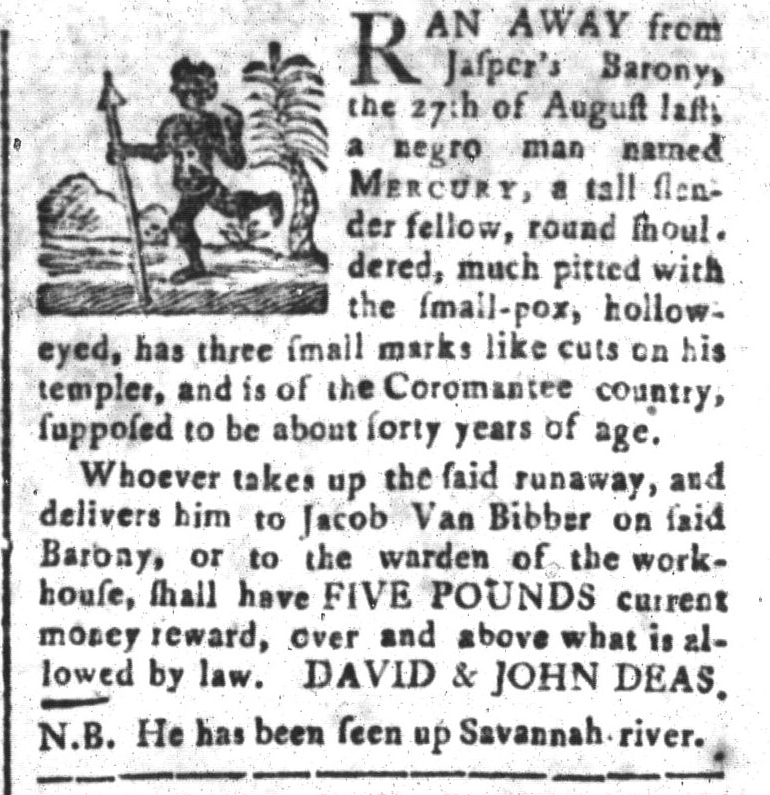
Jun 10 - Georgia Gazette Slavery 2
Georgia Gazette (June 10, 1767).

**********

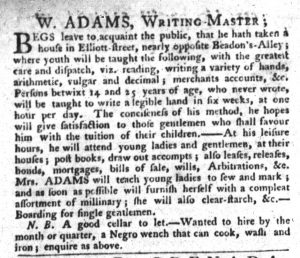
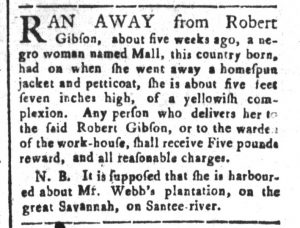
Jun 10 - Georgia Gazette Slavery 3
Georgia Gazette (June 10, 1767).

**********
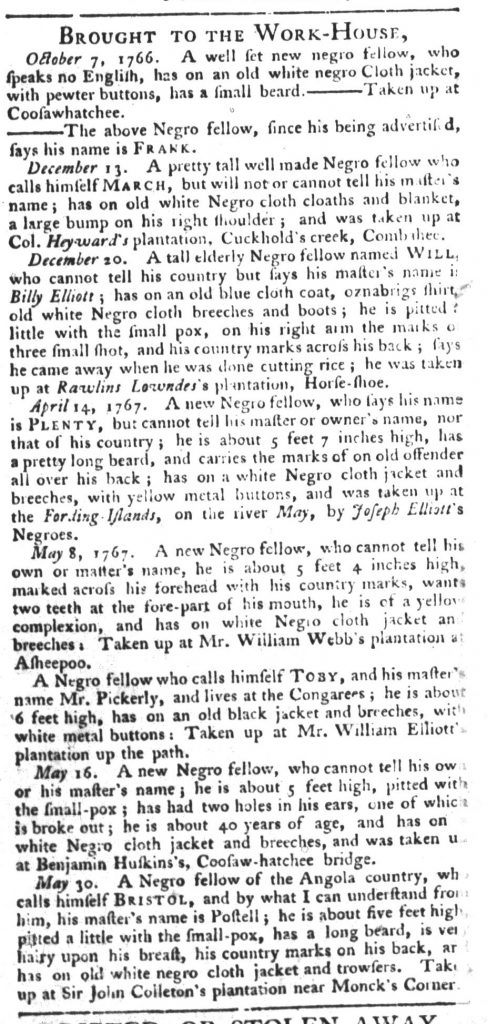
Jun 10 - Georgia Gazette Slavery 4
Georgia Gazette (June 10, 1767).

**********

Jun 10 - Georgia Gazette Slavery 5
Georgia Gazette (June 10, 1767).

June 9

What was advertised in a colonial American newspaper 250 years ago today?

Jun 9 - 6:9:1767 South-Carolina Gazette and Country Journal Page 2
South-Carolina Gazette and Country Journal (June 9, 1767).

“He first introduced into this Province the most expeditious Method of teaching Writing.”

Osborne Straton was not the only schoolmaster who advertised his services in the newspapers printed in Charleston, South Carolina, in 1767. He needed to distinguish his instruction from that provided by W. Adams and William Johnson, both of whom inserted much more extensive notices in the public prints. Rather than going into as much detail about his curriculum and teaching methods, Straton advanced two other reasons “Parents and Guardians” should enroll their children in “the British Academy on the Green, at the West End of BROAD-STREET.”

First, he underscored his experience, implying that the parents of prospective students should choose his academy because his competitors were newcomers who had not yet gained the public trust. Straton had been teaching in Charleston for half a decade; he considered it “his Duty to remind the Public, That A.D. 1762, he first introduced into this Province the most expeditious Method of teaching Writing, Drawing, &c. &c. in all their Branches.” His methods were particularly designed “to qualify Youth for Business in general,” a goal that Straton identified in an advertisement published several months earlier. He noted his long experience in that notice as well, stating that he had “forty years experience as head book-keeper in some of the first counting-houses in Europe” before migrating to South Carolina and becoming a schoolmaster. According to Straton, his experience, both in business and in teaching local youth, should cause parents to give him precedence over other schoolmasters.

Straton also argued that he served the public good in addition to earning a living by charging tuition of students who could afford it. He pledged to “Instruct six poor Children Gratis, every Thursday and Saturday in the Afternoon.” This was not the first time he made such an offer. Several weeks earlier he announced that “one youth may be qualified for business gratis, on a private benevolence,” an eighteenth-century scholarship of sorts. In making a new commitment to teach several poor children, Straton again played on his ties to the community established over the course of several years. He set a philanthropic example to make his academy more appealing to prospective students and their parents, suggesting that service rather than revenues motivated his instruction.

Compared to his competitors, Straton’s advertisement was relatively short. Despite its length, he included two appeals that made his academy both distinctive and attractive to residents of Charleston as they considered several options. Other schoolmasters might have offered effective instruction, but for Straton the work seemed to be a vocation rather than a mere occupation.

Slavery Advertisements Published June 9, 1767

The Slavery Adverts 250 Project chronicles the role of newspaper advertising in perpetuating slavery in the era of the American Revolution. The project seeks to reveal the ubiquity of slavery in eighteenth-century life from New England to Georgia by republishing advertisements about enslaved people – for sale as individuals or in groups, wanted to purchase or for hire for short periods, runaways who liberated themselves, and those who were subsequently captured and confined in jails and workhouses – in daily digests on this site as well as in real time via the @SlaveAdverts250 Twitter feed, utilizing twenty-first-century media to stand in for the print media of the eighteenth century.

The project aims to provide modern audiences with a sense of just how often colonizers encountered these advertisements in their daily lives. Enslaved men, women, and children appeared in print somewhere in the colonies almost every single day. Those advertisements served as a constant backdrop for social, cultural, economic, and political life in colonial and revolutionary America. Colonizers who did not purport to own enslaved people were still confronted with slavery as well as invited to maintain the system by purchasing enslaved men, women, and children or assisting in the capture of so-called “runaways” who sought to free themselves from bondage. The frequency of these newspaper advertisements suggests just how embedded slavery was in colonial and revolutionary American culture in everyday interactions beyond the printed page.

These advertisements also testify to the experiences of enslaved men, women, and children, though readers must consider that those experiences have been remediated through descriptions offered by enslavers rather than enslaved people themselves. Often unnamed in the advertisements, enslaved men, women, and children were not invisible or unimportant in early America.

These advertisements appeared in colonial American newspapers 250 years ago today.

Jun 9 - South-Carolina Gazette and Country Journal Slavery 1
South-Carolina Gazette and Country Journal (June 9, 1767).

**********
Jun 9 - South-Carolina Gazette and Country Journal Slavery 2
South-Carolina Gazette and Country Journal (June 9, 1767).

**********
Jun 9 - South-Carolina Gazette and Country Journal Slavery 3
South-Carolina Gazette and Country Journal (June 9, 1767).

**********

Jun 9 - South-Carolina Gazette and Country Journal Slavery 4
South-Carolina Gazette and Country Journal (June 9, 1767).

**********
Jun 9 - South-Carolina Gazette and Country Journal Supplement Slavery 1
Supplement to the South-Carolina Gazette and Country Journal (June 9, 1767).

**********

Jun 9 - South-Carolina Gazette and Country Journal Supplement Slavery 2
Supplement to the South-Carolina Gazette and Country Journal (June 9, 1767).

**********

Jun 9 - South-Carolina Gazette and Country Journal Supplement Slavery 3
Supplement to the South-Carolina Gazette and Country Journal (June 9, 1767).

**********

Jun 9 - South-Carolina Gazette and Country Journal Supplement Slavery 4
Supplement to the South-Carolina Gazette and Country Journal (June 9, 1767).

**********
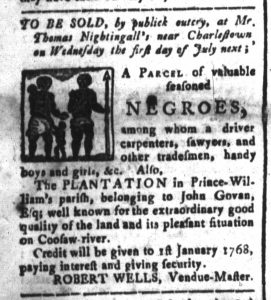
Jun 9 - South-Carolina Gazette and Country Journal Supplement Slavery 5
Supplement to the South-Carolina Gazette and Country Journal (June 9, 1767).

**********

Jun 9 - South-Carolina Gazette and Country Journal Supplement Slavery 6
Supplement to the South-Carolina Gazette and Country Journal (June 9, 1767).

**********

Jun 9 - South-Carolina Gazette and Country Journal Supplement Slavery 7
Supplement to the South-Carolina Gazette and Country Journal (June 9, 1767).

**********

Jun 9 - South-Carolina Gazette and Country Journal Supplement Slavery 8
Supplement to the South-Carolina Gazette and Country Journal (June 9, 1767).

**********

Jun 9 - South-Carolina Gazette and Country Journal Supplement Slavery 12
Supplement to the South-Carolina Gazette and Country Journal (June 9, 1767).

**********

Jun 9 - South-Carolina Gazette and Country Journal Supplement Slavery 9
Supplement to the South-Carolina Gazette and Country Journal (June 9, 1767).

**********

Jun 9 - South-Carolina Gazette and Country Journal Supplement Slavery 10
Supplement to the South-Carolina Gazette and Country Journal (June 9, 1767).

**********

Jun 9 - South-Carolina Gazette and Country Journal Supplement Slavery 11
Supplement to the South-Carolina Gazette and Country Journal (June 9, 1767).

June 8

What was advertised in a colonial American newspaper 250 years ago today?

Jun 8 - 6:8:1767 Newport Mercury
Newport Mercury (June 8, 1767).

“At as low a Rate for Cash as can be bought at any Shop in Newport.”

In the June 8, 1767, edition of the Newport Mercury, Josias Lyndon advertised that he sold an assortment of imported goods “Very cheap for Cash, or short Credit.” Invoking low prices was one of the most common marketing appeals of the eighteenth century. Lyndon chose a standard method: promoting his own prices without making reference to those of his competitors. In that regard, he advertisement differed from most placed by shopkeepers in that issue. Others went into greater detail about the nature of their prices.

Samuel Lyndon, Jr., for instance, offered his wares “at as low a Rate as can be bought in any Shop in the Town of NEWPORT.” Similarly, David Moore sold dry goods and groceries “AS CHEAP FOR CASH as at any Shop in Newport.” Issachar Polock boldly proclaimed that he parted with his merchandise “at a LOWER PRICE than any advertised before him.” Each of these shopkeepers adapted the standard appeal to price in ways that more directly positioned their shops as preferable to local competitors.

Other advertisers expanded on this trend. Napthaly Hart, Jr., stated that was “determined to sell at as low Rate as any of the Shops in NEWPORT or PROVIDENCE.” In an advertisement that also appeared in the Providence Gazette, William Rogers promised that customers purchased his inventory “as cheap as can be bough at any Shop in Providence.” Both of these shopkeepers seemed as concerned (or, in Rogers’ case, more concerned) with losing business to counterparts in Providence than others in Newport.

Christopher Champlin’s advertisement suggested why Newport’s shopkeepers provided more elaborate appeals to price than usual in the late spring of 1767. “FINDING many of his Brother Shopkeepers,” Champlin declared, “to prevent most of the circulating Cash from being sent to Providence, have greatly lowered the Price of their Goods; therefore … said CHAMPLIN … has to sell … a neat Assortment of GOODS … at as low a Rate for Cash as can be bought at any Shop in Newport.”

Cash was scarce in colonial America. By charging low prices, Newport’s shopkeepers not only competed with each other but also pursued the public interest on behalf of their entire community by not allowing scarce resources to seep away to another port city. Champlin annunciated this as “so laudable a Motive,” one that was “worthy of Imitation.” He was late to the game in lowering his own prices, but managed to position himself, along with his “Brother Shopkeepers” in Newport, as doing something noble when setting his prices.

Slavery Advertisements Published June 8, 1767

The Slavery Adverts 250 Project chronicles the role of newspaper advertising in perpetuating slavery in the era of the American Revolution. The project seeks to reveal the ubiquity of slavery in eighteenth-century life from New England to Georgia by republishing advertisements about enslaved people – for sale as individuals or in groups, wanted to purchase or for hire for short periods, runaways who liberated themselves, and those who were subsequently captured and confined in jails and workhouses – in daily digests on this site as well as in real time via the @SlaveAdverts250 Twitter feed, utilizing twenty-first-century media to stand in for the print media of the eighteenth century.

The project aims to provide modern audiences with a sense of just how often colonizers encountered these advertisements in their daily lives. Enslaved men, women, and children appeared in print somewhere in the colonies almost every single day. Those advertisements served as a constant backdrop for social, cultural, economic, and political life in colonial and revolutionary America. Colonizers who did not purport to own enslaved people were still confronted with slavery as well as invited to maintain the system by purchasing enslaved men, women, and children or assisting in the capture of so-called “runaways” who sought to free themselves from bondage. The frequency of these newspaper advertisements suggests just how embedded slavery was in colonial and revolutionary American culture in everyday interactions beyond the printed page.

These advertisements also testify to the experiences of enslaved men, women, and children, though readers must consider that those experiences have been remediated through descriptions offered by enslavers rather than enslaved people themselves. Often unnamed in the advertisements, enslaved men, women, and children were not invisible or unimportant in early America.

These advertisements appeared in colonial American newspapers 250 years ago today.

Jun 8 - Boston-Gazette Slavery 1
Boston-Gazette (June 8, 1767).

**********

Jun 8 - Boston-Gazette Slavery 2
Boston-Gazette (June 8, 1767).

**********

Jun 8 - New-York Gazette Slavery 1
New-York Gazette (June 8, 1767).

**********

Jun 8 - New-York Mercury Slavery 1
New-York Mercury (June 8, 1767).

**********

Jun 8 - New-York Mercury Slavery 2
New-York Mercury (June 8, 1767).

**********

Jun 8 - New-York Mercury Slavery 3
New-York Mercury (June 8, 1767).

**********

Jun 8 - New-York Mercury Slavery 4
New-York Mercury (June 8, 1767).

**********

Jun 8 - New-York Mercury Slavery 5
New-York Mercury (June 8, 1767).

**********

Jun 8 - New-York Mercury Slavery 6
New-York Mercury (June 8, 1767).

**********

Jun 8 - Newport Mercury Slavery 1
Newport Mercury (June 8, 1767).

June 7

What was advertised in a colonial American newspaper 250 years ago this week?

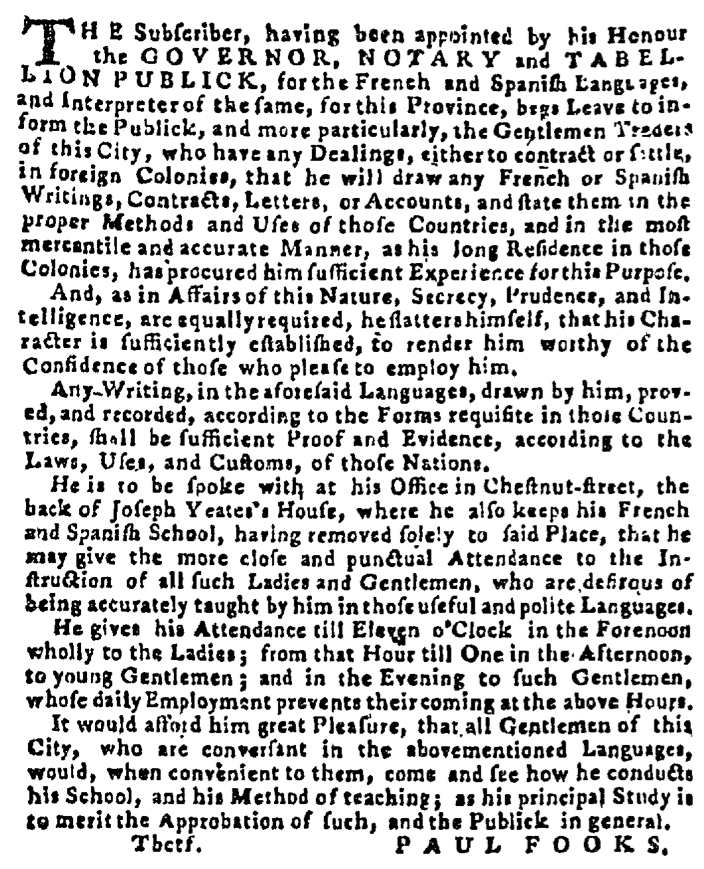
Jun 7 - 6:4:1767 Pennsylvania Gazette
Supplement to the Pennsylvania Gazette (June 4, 1767).

“He will draw any French or Spanish Writing, Contracts, Letters, or Accounts.”

William Fooks of Philadelphia was quite chatty in an advertisement offering his services as “NOTARY and TABELLION PUBLICK, for the French and Spanish Languages” to the “Gentleman Traders of this City.” To counter the effusiveness of his advertisement, he assured potential clients that of the “Secrecy, Prudence, and Intelligence” that defined his character and how he pursued his occupation. Those qualities, he asserted, “render him worthy of the Confidence of those who please to employ him.”

Although the term “tabellion” has declined in use today, residents of England and its colonies in the seventeenth and eighteenth centuries would have readily recognized this description of the scrivener’s vocation, an occupation closely associated with (and sometimes overlapping) the duties performed by notaries. In taking on both titles – “NOTARY and TABELLION PUBLICK” – to describe his work Fooks underscored the level of expertise he possessed. This was particularly important given both his line of work and, especially, the differences in language and legal customs inherent in doing business in French and Spanish colonies. That may explain why he composed such an extensive advertisement. Special circumstances required that he underscore and reiterate his skill and experience as a means of convincing potential clients, those “Gentleman Traders,” that they could trust and depend on his work.

To that end, Fooks stated that “he will draw any French or Spanish Writing, Contracts, Letters, or Accounts, and state them in the most proper Methods and Uses of those Countries, and in the most mercantile and accurate Manner.” He repeated this promise later in the advertisement, again noting that he drew up documents “according to the Laws, Uses, and Customs, of those Nations.” He was particularly qualified to do so as a result of the experience gained through “his long Residence in those Colonies” (though the otherwise verbose Fooks did not elaborate on which colonies or the length of his residence).

Fooks provided very specialized services that could have had significant ramifications in the lives and fortunes of his clients. He may have believed that his turgid prose was necessary to convince prospective clients to entrust him with sensitive and substantial matters. They may not have viewed his notice as chatty but instead as reassuring about the professionalism Fooks brought to his occupation.

June 6

What was advertised in a colonial American newspaper 250 years ago today?

Jun 6 - 6:6:1767 Providence Gazette
Providence Gazette (June 6, 1767).

Books, Pamphlets, and Blanks of all Sorts, &c. &c.”

For several weeks in the winter and early spring of 1767 advertising was sparse in the Providence Gazette. Many of the advertisements that did appear were placed by Sarah Goddard and Company, the printers of the newspaper, for goods and services they sold. Others came from associates in the printing trades, including extensive proposals for the Pennsylvania Chronicle, a new publication that William Goddard, Sarah’s son, launched in Philadelphia in January 1767. It seemed as though Goddard and Company struggled to fill the pages of the Providence Gazette, sometimes inserting many of their own advertisements as means of generating sufficient content to fill the pages of each weekly issue.

That changed as summer approached. New advertisers placed commercial notices. Previous advertisers returned to the pages of the Providence Gazette. Advertising comprised about one-third of the contents of the June 6 edition, just as it had the previous week and would again the following week. Goddard and Company did not place any advertisements among those that appeared in the June 6 issue, yet the partnership still managed to inform readers about the services they offered.[1] Indeed, Goddard and Company’s promotional efforts accounted for the first and last items printed in that issue.

On the first page, below a masthead that proclaimed the newspaper carried “the freshest Advices, both Foreign and Domestic,” an announcement from the printers appeared at the top of the first column, preceding foreign “advices” from London. In addition to informing readers that the printing office had moved to a new location, the announcement concluded with a list of printed materials Goddard and Company offered for sale: “where may be had Books, Pamphlets, and Blanks of all Sorts, &c. &c.” On the final page, the colophon appeared across the bottom as usual. In addition to providing publication information, it also solicited business for the printers. Goddard and Company accepted subscriptions and advertisements directly associated with the Providence Gazette, but they also did job printing (“all Manner of PRINTING WORK”) to the specifications of clients.

Even as the Providence Gazette gained advertisers in the spring of 1767, the printers controlled the layout of the newspaper. More advertising meant less space for their own notices, which may have been a welcome relief if advertisers paid in a timely manner, yet Goddard and Company continued to devise ways to promote their own goods and services. Their privileged position as operators of the press allowed them to begin and end the June 6 edition with brief marketing messages.

**********

[1] The masthead lists “SATURDAY, JUNE 7, 1767” as the date for the issue, but that was not possible. In 1767, it could have been published on Saturday, June 6 or Sunday, June 7. Considering that the Providence Gazette was published on Saturdays throughout the rest of the year (and that no newspapers were printed on Sundays anywhere in the colonies), I consider it more likely that June 6 was the correct date. In addition, the printers did not offer any sort of apology for the late appearance of the issue. Goddard and Company regularly inserted notes explaining that the late arrival of the post affected which news appeared, making it likely that they would have also acknowledged publishing an issue a day later than usual. That being said, moving the printing office could have caused a one-day delay in publication, but most of the circumstances suggest that this edition appeared on Saturday, June 6, 1767.

Slavery Advertisements Published June 6, 1767

The Slavery Adverts 250 Project chronicles the role of newspaper advertising in perpetuating slavery in the era of the American Revolution. The project seeks to reveal the ubiquity of slavery in eighteenth-century life from New England to Georgia by republishing advertisements about enslaved people – for sale as individuals or in groups, wanted to purchase or for hire for short periods, runaways who liberated themselves, and those who were subsequently captured and confined in jails and workhouses – in daily digests on this site as well as in real time via the @SlaveAdverts250 Twitter feed, utilizing twenty-first-century media to stand in for the print media of the eighteenth century.

The project aims to provide modern audiences with a sense of just how often colonizers encountered these advertisements in their daily lives. Enslaved men, women, and children appeared in print somewhere in the colonies almost every single day. Those advertisements served as a constant backdrop for social, cultural, economic, and political life in colonial and revolutionary America. Colonizers who did not purport to own enslaved people were still confronted with slavery as well as invited to maintain the system by purchasing enslaved men, women, and children or assisting in the capture of so-called “runaways” who sought to free themselves from bondage. The frequency of these newspaper advertisements suggests just how embedded slavery was in colonial and revolutionary American culture in everyday interactions beyond the printed page.

These advertisements also testify to the experiences of enslaved men, women, and children, though readers must consider that those experiences have been remediated through descriptions offered by enslavers rather than enslaved people themselves. Often unnamed in the advertisements, enslaved men, women, and children were not invisible or unimportant in early America.

These advertisements appeared in colonial American newspapers 250 years ago today.

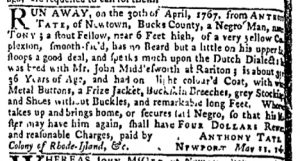
Jun 6 - Providence Gazette Slavery 1
Providence Gazette (June 6, 1767).

June 5

What was advertised in a colonial American newspaper 250 years ago today?

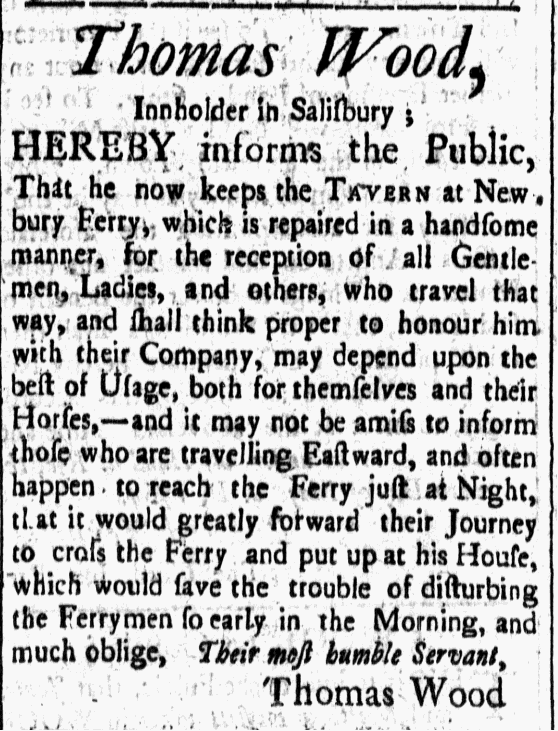
Jun 5 - 6:5:1767 New-Hampshire Gazette
New-Hampshire Gazette (June 5, 1767).

“He now keeps the TAVERN at Newbury Ferry.”

Thomas Wood, “Innholder in Salisbury,” offered some helpful advice to travelers in New Hampshire when he announced that he “now keeps the TAVERN at Newbury Ferry.” Not surprisingly, that advice also served to increase the number of patrons, especially overnight guests, at the tavern. Travelers heading east faced a choice when they arrived in his area at the end of the day. Continuing their journey required passage via ferry. Realizing that some might be tempted to call it a day, especially if they had traveled any distance or experienced any difficulties, and wait until the next morning to embark on the ferry, Wood recommended that it actually would be more efficient to make the crossing as the final leg of the journey for the day and then have the liberty to move along at their own convenience at a time that suited the following morning, perhaps saving the trouble of waking the ferry operators. Not only would this arrangement save time, travelers would also benefit from the accommodations that Wood offered at a tavern “repaired in a handsome manner, for the reception of all Gentlemen, Ladies, and others, who travel that way.” Wood assured potential guests they could “depend upon the best of Usage, both for themselves and their Horses.”

Wood made a nod toward what this “best of Usage” entailed in making his recommendation that “it would greatly forward their Journey to cross the Ferry and put up at his House, which would save the trouble of disturbing the Ferrymen so early in the Morning.” Even before interacting with patrons in person, he stepped into the role of concierge to facilitate their travels and create the best possible experience. Many eighteenth-century advertisements indicate that shopkeepers, artisans, and others who provided goods and services practiced what is now commonly known as customer service, though many did not go into detail beyond phrases indicating customers received “the best of Usage.” In his advertisement, Wood included an example to entice potential guests and demonstrate that he did indeed have their best interests at heart, even as he stood to increase his own business at the same time.

Slavery Advertisements Published June 5, 1767

The Slavery Adverts 250 Project chronicles the role of newspaper advertising in perpetuating slavery in the era of the American Revolution. The project seeks to reveal the ubiquity of slavery in eighteenth-century life from New England to Georgia by republishing advertisements about enslaved people – for sale as individuals or in groups, wanted to purchase or for hire for short periods, runaways who liberated themselves, and those who were subsequently captured and confined in jails and workhouses – in daily digests on this site as well as in real time via the @SlaveAdverts250 Twitter feed, utilizing twenty-first-century media to stand in for the print media of the eighteenth century.

The project aims to provide modern audiences with a sense of just how often colonizers encountered these advertisements in their daily lives. Enslaved men, women, and children appeared in print somewhere in the colonies almost every single day. Those advertisements served as a constant backdrop for social, cultural, economic, and political life in colonial and revolutionary America. Colonizers who did not purport to own enslaved people were still confronted with slavery as well as invited to maintain the system by purchasing enslaved men, women, and children or assisting in the capture of so-called “runaways” who sought to free themselves from bondage. The frequency of these newspaper advertisements suggests just how embedded slavery was in colonial and revolutionary American culture in everyday interactions beyond the printed page.

These advertisements also testify to the experiences of enslaved men, women, and children, though readers must consider that those experiences have been remediated through descriptions offered by enslavers rather than enslaved people themselves. Often unnamed in the advertisements, enslaved men, women, and children were not invisible or unimportant in early America.

These advertisements appeared in colonial American newspapers 250 years ago today.

Jun 5 - New-Hampshire Gazette Slavery 1
New-Hampshire Gazette (June 5, 1767).

**********

Jun 5 - New-London Gazette Slavery 1
New-London Gazette (June 5, 1767).

**********

Jun 5 - South-Carolina and American General Gazette Slavery 1
South-Carolina and American General Gazette (June 5, 1767).

**********

Jun 5 - South-Carolina and American General Gazette Slavery 2
South-Carolina and American General Gazette (June 5, 1767).

**********

Jun 5 - South-Carolina and American General Gazette Slavery 3
South-Carolina and American General Gazette (June 5, 1767).

**********

Jun 5 - South-Carolina and American General Gazette Slavery 4
South-Carolina and American General Gazette (June 5, 1767).

**********

Jun 5 - South-Carolina and American General Gazette Slavery 5
South-Carolina and American General Gazette (June 5, 1767).

**********

Jun 5 - South-Carolina and American General Gazette Slavery 6
South-Carolina and American General Gazette (June 5, 1767).

**********

Jun 5 - South-Carolina and American General Gazette Slavery 7
South-Carolina and American General Gazette (June 5, 1767).

**********

Jun 5 - South-Carolina and American General Gazette Slavery 8
South-Carolina and American General Gazette (June 5, 1767).

**********

Jun 5 - South-Carolina and American General Gazette Slavery 9
South-Carolina and American General Gazette (June 5, 1767).

**********

Jun 5 - South-Carolina and American General Gazette Slavery 10
South-Carolina and American General Gazette (June 5, 1767).

**********

Jun 5 - South-Carolina and American General Gazette Slavery 11
South-Carolina and American General Gazette (June 5, 1767).

**********

Jun 5 - South-Carolina and American General Gazette Slavery 12
South-Carolina and American General Gazette (June 5, 1767).