June 4

What was advertised in a colonial American newspaper 250 years ago today?
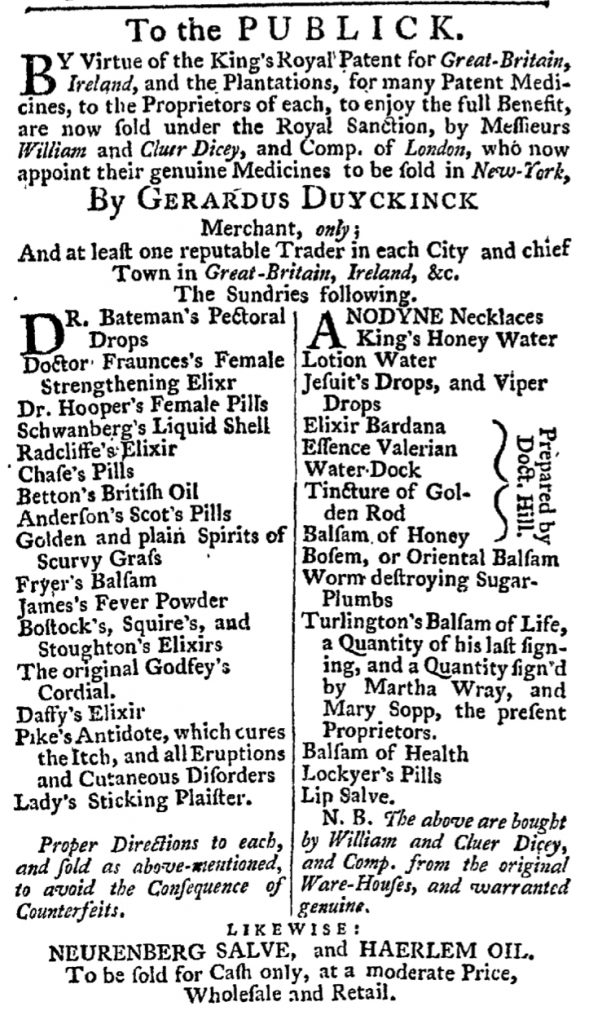
Jun 4 - 6:4:1767 New-York Gazette Weekly Post-Boy
New-York Gazette: Or, the Weekly Post-Boy (June 4, 1767).

“Genuine Medicines to be sold in New-York, by GERARDUS DUYCKINCK Merchant, only.”

Several apothecaries operated shops in New York and advertised in the local newspapers in the spring of 1767, but they were not the only residents who sold medicines in the city. Gerardus Duyckinck, a merchant who ran the “UNIVERSAL STORE, Or the MEDLEY of GOODS … At the Sign of the Looking-Glass, and Druggist Pot,” also peddled remedies.[1] As he was not an apothecary himself, he dressed up his advertisements with several sorts of puffery in order to compete with others who specialized in compounding drugs and selling patent medicines.

For instance, Duyckinck opened his advertisement with what appeared to be some sort of official proclamation that bestowed some degree of exclusivity on the merchant: “To the PUBLICK. By Virtue of the King’s Royal Patent for Great-Britain, Ireland, and the Plantations, for many Patent Medicines, to the Proprietors of each, to enjoy the full Benefit, are now sold under the Royal Sanction, by Messieurs William and Cluer Dicey, and Comp. of London, who now appoint their genuine Medicines to be sold in New-York, By GERARDUS DUYCKINCK Merchant, only.” Although the advertisement listed many tinctures and nostrums advertised and sold by several druggists and apothecaries in New York, the grandiloquent language implied that Duyckinck alone possessed the right to peddle those cures. Anyone else did so without official sanction.

This also allowed Duyckinck to warn readers against counterfeits and assure potential customers that he sold only authentic medicines. He did so in two ways. In a nota bene, he announced that all the drugs on his list had been “bought by William and Cluer Dicey, and Comp. from the original Ware-Houses, and warranted genuine.” In addition, he provided “Proper Directions to each … to avoid the Consequence of Counterfeits.” Duyckinck did not outright accuse his competitors of selling counterfeits, but the several aspects of his advertisement worked together to create doubts about the efficacy and authenticity of any medicines purchased from other vendors. Patent medicines were advertised far and wide in colonial newspapers. By inserting these enhancements to what otherwise would have been a standard list-style advertisement, Duyckinck devised a marketing strategy that distinguished him from his competitors.

**********

[1] For this description of his store, see the other advertisement Duyckinck placed on June 4, 1767, a list-style notice of an assortment of imported goods in the New-York Journal. It briefly mentioned “Drugs and Medicines” near the end.

Slavery Advertisements Published June 4, 1767

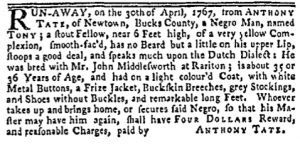
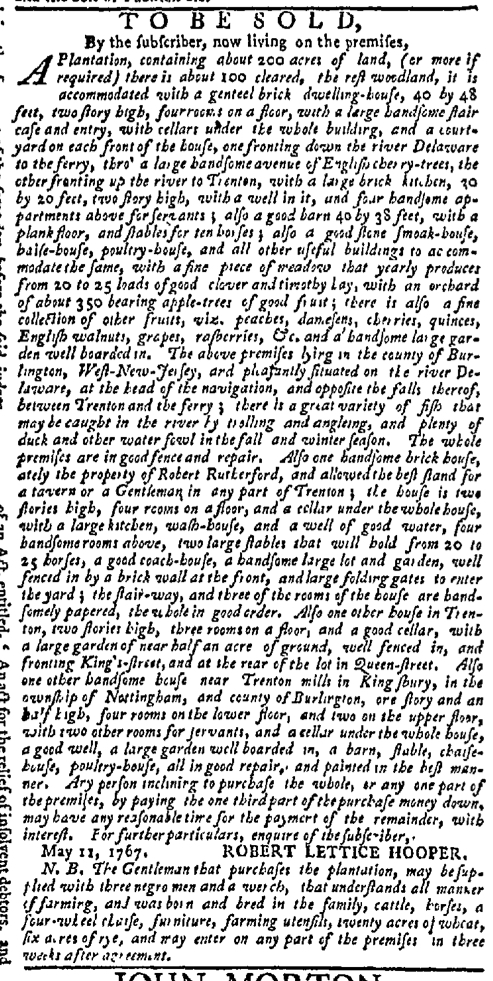
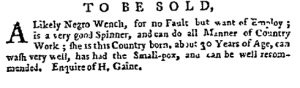
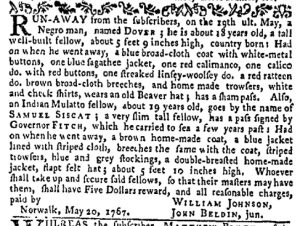
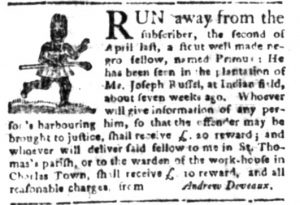
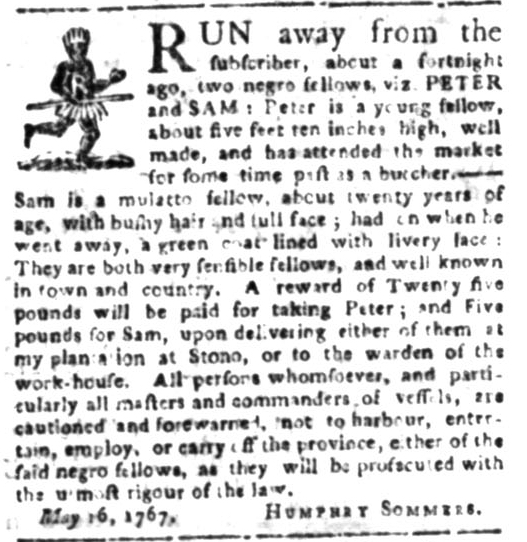
The Slavery Adverts 250 Project chronicles the role of newspaper advertising in perpetuating slavery in the era of the American Revolution. The project seeks to reveal the ubiquity of slavery in eighteenth-century life from New England to Georgia by republishing advertisements about enslaved people – for sale as individuals or in groups, wanted to purchase or for hire for short periods, runaways who liberated themselves, and those who were subsequently captured and confined in jails and workhouses – in daily digests on this site as well as in real time via the @SlaveAdverts250 Twitter feed, utilizing twenty-first-century media to stand in for the print media of the eighteenth century.

The project aims to provide modern audiences with a sense of just how often colonizers encountered these advertisements in their daily lives. Enslaved men, women, and children appeared in print somewhere in the colonies almost every single day. Those advertisements served as a constant backdrop for social, cultural, economic, and political life in colonial and revolutionary America. Colonizers who did not purport to own enslaved people were still confronted with slavery as well as invited to maintain the system by purchasing enslaved men, women, and children or assisting in the capture of so-called “runaways” who sought to free themselves from bondage. The frequency of these newspaper advertisements suggests just how embedded slavery was in colonial and revolutionary American culture in everyday interactions beyond the printed page.

These advertisements also testify to the experiences of enslaved men, women, and children, though readers must consider that those experiences have been remediated through descriptions offered by enslavers rather than enslaved people themselves. Often unnamed in the advertisements, enslaved men, women, and children were not invisible or unimportant in early America.

These advertisements appeared in colonial American newspapers 250 years ago today.

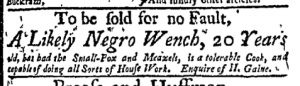
Jun 4 - Massachusetts Gazette Slavery 1
Massachusetts Gazette (June 4, 1767).

**********

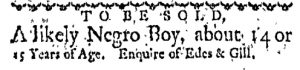
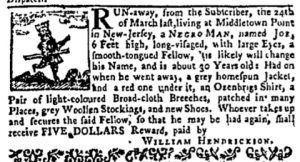
Jun 4 - New-York Gazette Weekly Post-Boy Slavery 1
New-York Gazette: Or, the Weekly Post-Boy (June 4, 1767).

**********

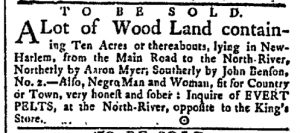
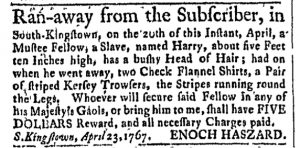
Jun 4 - New-York Gazette Weekly Post-Boy Slavery 2
New-York Gazette: Or, the Weekly Post-Boy (June 4, 1767).

**********

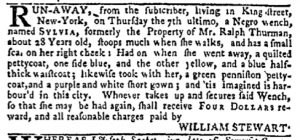
Jun 4 - New-York Gazette Weekly Post-Boy Slavery 3
New-York Gazette: Or, the Weekly Post-Boy (June 4, 1767).

**********

Jun 4 - Pennsylvania Gazette Supplement Slavery 1
Supplement to the Pennsylvania Gazette (June 4, 1767).

**********

Jun 4 - Pennsylvania Gazette Supplement Slavery 2
Supplement to the Pennsylvania Gazette (June 4, 1767).

**********

Jun 4 - Pennsylvania Gazette Supplement Slavery 3
Supplement to the Pennsylvania Gazette (June 4, 1767).

**********

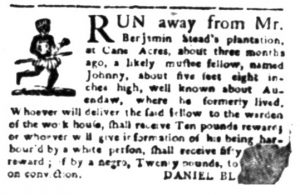
Jun 4 - Virginia Gazette Slavery 1
Virginia Gazette (June 4, 1767).

**********

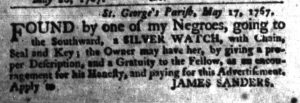
Jun 4 - Virginia Gazette Slavery 2
Virginia Gazette (June 4, 1767).

**********

Jun 4 - Virginia Gazette Slavery 3
Virginia Gazette (June 4, 1767).

Summary of Slavery Advertisements Published May 28 – June 3, 1767

These tables indicate how many advertisements for slaves appeared in colonial American newspapers during the week of May 28 – June 3, 1767.

Note:  These tables are as comprehensive as currently digitized sources permit, but they may not be an exhaustive account.  They includes all newspapers that have been digitized and made available via Accessible Archives, Colonial Williamsburg’s Digital Library, and Readex’s America’s Historical Newspapers.  There are several reasons some newspapers may not have been consulted:

  • Issues that are no longer extant;
  • Issues that are extant but have not yet been digitized (including the Pennsylvania Journal); and
  • Newspapers published in a language other than English (including the Wochentliche Philadelphische Staatsbote).

**********

Slavery Advertisements Published May 28 – June 3, 1767:  By Date

Slavery Adverts Tables 1767 By Date May 28

**********

Slavery Advertisements Published May 28 – June 3, 1767:  By Region

Slavery Adverts Tables 1767 By Region May 28

Slavery Advertisements Published June 3, 1767

The Slavery Adverts 250 Project chronicles the role of newspaper advertising in perpetuating slavery in the era of the American Revolution. The project seeks to reveal the ubiquity of slavery in eighteenth-century life from New England to Georgia by republishing advertisements about enslaved people – for sale as individuals or in groups, wanted to purchase or for hire for short periods, runaways who liberated themselves, and those who were subsequently captured and confined in jails and workhouses – in daily digests on this site as well as in real time via the @SlaveAdverts250 Twitter feed, utilizing twenty-first-century media to stand in for the print media of the eighteenth century.

The project aims to provide modern audiences with a sense of just how often colonizers encountered these advertisements in their daily lives. Enslaved men, women, and children appeared in print somewhere in the colonies almost every single day. Those advertisements served as a constant backdrop for social, cultural, economic, and political life in colonial and revolutionary America. Colonizers who did not purport to own enslaved people were still confronted with slavery as well as invited to maintain the system by purchasing enslaved men, women, and children or assisting in the capture of so-called “runaways” who sought to free themselves from bondage. The frequency of these newspaper advertisements suggests just how embedded slavery was in colonial and revolutionary American culture in everyday interactions beyond the printed page.

These advertisements also testify to the experiences of enslaved men, women, and children, though readers must consider that those experiences have been remediated through descriptions offered by enslavers rather than enslaved people themselves. Often unnamed in the advertisements, enslaved men, women, and children were not invisible or unimportant in early America.

These advertisements appeared in colonial American newspapers 250 years ago today.

Jun 3 - Georgia Gazette Slavery 1
Georgia Gazette (June 3, 1767).

**********

Jun 3 - Georgia Gazette Slavery 2
Georgia Gazette (June 3, 1767).

**********

Jun 3 - Georgia Gazette Slavery 3
Georgia Gazette (June 3, 1767).

**********

Jun 3 - Georgia Gazette Slavery 4
Georgia Gazette (June 3, 1767).

**********

Jun 3 - Georgia Gazette Slavery 5
Georgia Gazette (June 3, 1767).

**********

Jun 3 - Georgia Gazette Slavery 6
Georgia Gazette (June 3, 1767).

June 2

What was advertised in a colonial American newspaper 250 years ago today?

Jun 2 - 6:2:1767 South-Carolina Gazette and Country Journal Page 4
South-Carolina Gazette and Country Journal (June 2, 1767).

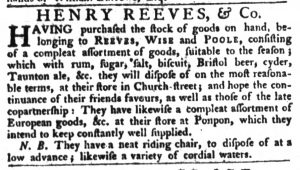
“HENRY REEVES, & Co. … hope the continuance of their friends favours.”

Henry Reeves and Company pursued a new enterprise in the wake of the partnership Reeves, Wise, and Poole coming to an end. Reeves and Company acquired the remaining inventory of the former partnership, “consisting of a compleat assortment of goods, suitable to the season,” which they offered for sale “on the most reasonable terms.” They also let potential customers know that they operated at two locations, a store on Church Street in Charleston and another store in Pon Pon, a settlement to the southwest of the busy port.

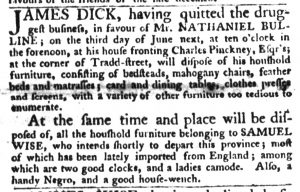
As one partnership concluded and another began, Reeves and Company aimed to serve a clientele that had already been established and cultivated: they “hope the continuance of their friends favours, as well as those of the late copartnership.” To some extent, they invoked a form of brand loyalty by inviting potential customers already familiar with and satisfied by the goods formerly offered by Reeves, Wise, and Poole to continue shopping with Reeves and Company. However, given that the partnership did not produce the merchandise it sold, this precursor to brand loyalty especially depended instead on customer service and relationships established with the proprietors. Note that Reeves and Company referred to “friends” rather than “customers.” They were not the only advertisers to do so. In the same issue of the South-Carolina Gazette and Country Journal, Samuel Wise announced that he had “declined business for the present” and intended to travel to England. Unlike Reeves and Company, Wise did not promote any merchandise. Instead, he wished to settle affairs with former customers who still owed money on their accounts. As part of his announcement, he “beg[ged] leave to return his thanks for the favours of his friends.” Other advertisements for consumer goods and services did not invoke the language of friendship.
In the decade before the Revolution, advertisers sometimes addressed customers as friends, doing so most often at times of transition, such as the creation of a new partnership or in the process of settling accounts. This softened the hard edges of the marketplace by reframing existing obligations and potential interactions at times when changes in circumstances made advertisers most vulnerable to financial difficulties.

Slavery Advertisements Published June 2, 1767

The Slavery Adverts 250 Project chronicles the role of newspaper advertising in perpetuating slavery in the era of the American Revolution. The project seeks to reveal the ubiquity of slavery in eighteenth-century life from New England to Georgia by republishing advertisements about enslaved people – for sale as individuals or in groups, wanted to purchase or for hire for short periods, runaways who liberated themselves, and those who were subsequently captured and confined in jails and workhouses – in daily digests on this site as well as in real time via the @SlaveAdverts250 Twitter feed, utilizing twenty-first-century media to stand in for the print media of the eighteenth century.

The project aims to provide modern audiences with a sense of just how often colonizers encountered these advertisements in their daily lives. Enslaved men, women, and children appeared in print somewhere in the colonies almost every single day. Those advertisements served as a constant backdrop for social, cultural, economic, and political life in colonial and revolutionary America. Colonizers who did not purport to own enslaved people were still confronted with slavery as well as invited to maintain the system by purchasing enslaved men, women, and children or assisting in the capture of so-called “runaways” who sought to free themselves from bondage. The frequency of these newspaper advertisements suggests just how embedded slavery was in colonial and revolutionary American culture in everyday interactions beyond the printed page.

These advertisements also testify to the experiences of enslaved men, women, and children, though readers must consider that those experiences have been remediated through descriptions offered by enslavers rather than enslaved people themselves. Often unnamed in the advertisements, enslaved men, women, and children were not invisible or unimportant in early America.

These advertisements appeared in colonial American newspapers 250 years ago today.

Jun 2 - South-Carolina Gazette and Country Journal Slavery 1
South-Carolina Gazette and Country Journal (June 2, 1767).

**********

Jun 2 - South-Carolina Gazette and Country Journal Slavery 2
South-Carolina Gazette and Country Journal (June 2, 1767).

**********

Jun 2 - South-Carolina Gazette and Country Journal Slavery 3
South-Carolina Gazette and Country Journal (June 2, 1767).

**********

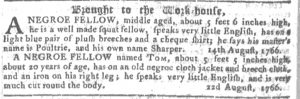
Jun 2 - South-Carolina Gazette and Country Journal Slavery 7
South-Carolina Gazette and Country Journal (June 2, 1767).

**********

Jun 2 - South-Carolina Gazette and Country Journal Slavery 4
South-Carolina Gazette and Country Journal (June 2, 1767).

**********

Jun 2 - South-Carolina Gazette and Country Journal Slavery 5
South-Carolina Gazette and Country Journal (June 2, 1767).

**********

Jun 2 - South-Carolina Gazette and Country Journal Slavery 6
South-Carolina Gazette and Country Journal (June 2, 1767).

**********

Jun 2 - South-Carolina Gazette and Country Journal Supplement Slavery 1
Supplement to the South-Carolina Gazette and Country Journal (June 2, 1767).

**********

Jun 2 - South-Carolina Gazette and Country Journal Supplement Slavery 2
Supplement to the South-Carolina Gazette and Country Journal (June 2, 1767).

**********

Jun 2 - South-Carolina Gazette and Country Journal Supplement Slavery 3
Supplement to the South-Carolina Gazette and Country Journal (June 2, 1767).

**********

Jun 2 - South-Carolina Gazette and Country Journal Supplement Slavery 4
Supplement to the South-Carolina Gazette and Country Journal (June 2, 1767).

**********

Jun 2 - South-Carolina Gazette and Country Journal Supplement Slavery 5
Supplement to the South-Carolina Gazette and Country Journal (June 2, 1767).

**********

Jun 2 - South-Carolina Gazette and Country Journal Supplement Slavery 6
Supplement to the South-Carolina Gazette and Country Journal (June 2, 1767).

June 1

What was advertised in a colonial American newspaper 250 years ago today?

Jun 1 - 6:1:1767 New-York Gazette
New-York Gazette (June 1, 1767).

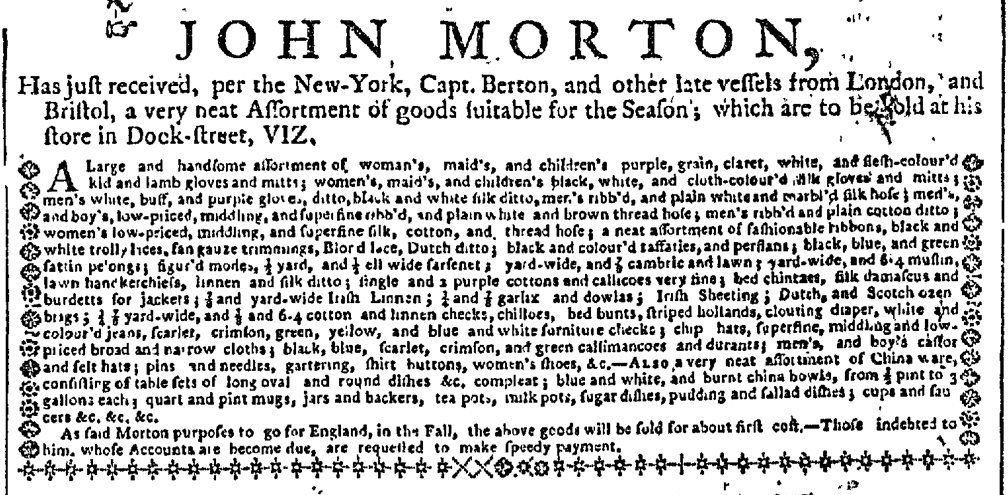
“JOHN MORTON, Has just received … a very neat Assortment of goods.”

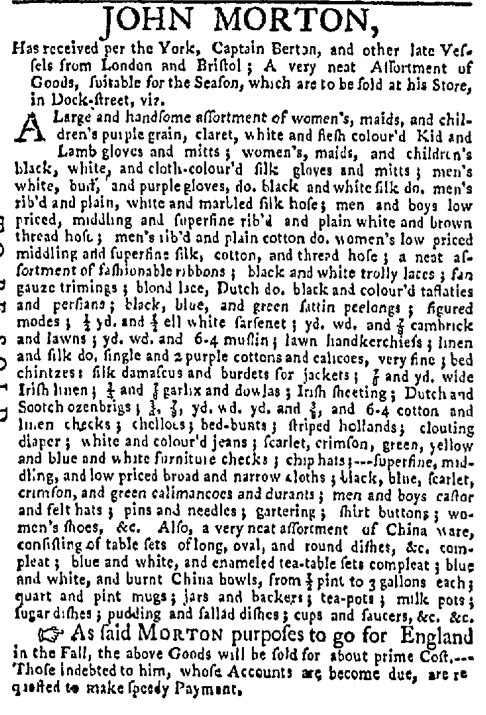
The layout of John Morton’s advertisement on the front page of the June 1, 1767, edition of the New-York Gazette would have attracted attention because it so significantly deviated from most other eighteenth-century advertisements. In his list-style advertisement, the text extended across two columns. In most cases, if a newspaper advertisement occupied space in two columns at all it was because of length, overflowing from one column into the next. That was not, however, necessary when it came to Morton’s advertisement. William Weyman, the printer of the New-York Gazette, or a compositor working in his printing shop made design decisions that not only yielded a unique advertisement for Morton but also produced a distinctive first page for the newspaper compared to the other three printed in New York and nearly two dozen more throughout the colonies.

Jun 1 - 6:1:1767 First Page of New-York Gazette
New-York Gazette (June 1, 1767).

Why assert that the printer and compositor were responsible for the typographical elements of Morton’s advertisement rather than merely responding to requests made by a paying customer who generated the copy? The New-York Gazette was not the only newspaper that carried Morton’s notice during the first week of June. It also appeared in the New-York Mercury on the same day and again in the New-York Journal three days later. Although the content of the advertisement was consistent across the three publications, the layout differed significantly. In the Mercury, Morton’s notice took the standard form of most list-style advertisements, a dense paragraph. In the Journal, the compositor introduced more white space that made it easier to distinguish among the assortment of merchandise by creating two columns and listing a small number of items on each line. These differences were the most substantial, but the three advertisements also had variations in font size and the inclusion of printing ornaments. The Gazette, for example, included a decorative border on three sides, but was the only one that did not use a manicule to draw attention to Morton’s final plea for former customers “to make speedy payment.”

Although advertisers wrote their commercial notices themselves, printers and compositors exercised primary responsibility for layout and other typographical elements of most eighteenth-century advertisements. There were occasional exceptions. Jolley Allen and William Palfrey, for instance, both negotiated for specific design aspects of their advertisements, but generally innovative visual effects originated in the imaginations of members of the printing trade who then experimented with their execution.

Jun 1 - 6:1:1767 New-York Mercury
New-York Mercury (June 1, 1767)
Jun 1 - 6:4:1767 New-York Journal
New-York Journal (June 1, 1767).

Slavery Advertisements Published June 1, 1767

The Slavery Adverts 250 Project chronicles the role of newspaper advertising in perpetuating slavery in the era of the American Revolution. The project seeks to reveal the ubiquity of slavery in eighteenth-century life from New England to Georgia by republishing advertisements about enslaved people – for sale as individuals or in groups, wanted to purchase or for hire for short periods, runaways who liberated themselves, and those who were subsequently captured and confined in jails and workhouses – in daily digests on this site as well as in real time via the @SlaveAdverts250 Twitter feed, utilizing twenty-first-century media to stand in for the print media of the eighteenth century.

The project aims to provide modern audiences with a sense of just how often colonizers encountered these advertisements in their daily lives. Enslaved men, women, and children appeared in print somewhere in the colonies almost every single day. Those advertisements served as a constant backdrop for social, cultural, economic, and political life in colonial and revolutionary America. Colonizers who did not purport to own enslaved people were still confronted with slavery as well as invited to maintain the system by purchasing enslaved men, women, and children or assisting in the capture of so-called “runaways” who sought to free themselves from bondage. The frequency of these newspaper advertisements suggests just how embedded slavery was in colonial and revolutionary American culture in everyday interactions beyond the printed page.

These advertisements also testify to the experiences of enslaved men, women, and children, though readers must consider that those experiences have been remediated through descriptions offered by enslavers rather than enslaved people themselves. Often unnamed in the advertisements, enslaved men, women, and children were not invisible or unimportant in early America.

These advertisements appeared in colonial American newspapers 250 years ago today.

Jun 1 - Boston-Gazette Slavery 1
Boston-Gazette (June 1, 1767).

**********

Jun 1 - Boston-Gazette Slavery 2
Boston-Gazette (June 1, 1767).

**********

Jun 1 - Boston-Gazette Slavery 3
Boston-Gazette (June 1, 1767).

**********

Jun 1 - New-York Gazette Slavery 1
New-York Gazette (June 1, 1767).

**********

Jun 1 - New-York Mercury Slavery 1
New-York Mercury (June 1, 1767).

**********

Jun 1 - New-York Mercury Slavery 2
New-York Mercury (June 1, 1767).

**********

Jun 1 - New-York Mercury Slavery 3
New-York Mercury (June 1, 1767).

**********

Jun 1 - New-York Mercury Slavery 4
New-York Mercury (June 1, 1767).

**********

Jun 1 - New-York Mercury Slavery 5
New-York Mercury (June 1, 1767).

**********

Jun 1 - New-York Mercury Slavery 6
New-York Mercury (June 1, 1767).

**********

Jun 1 - New-York Mercury Slavery 7
New-York Mercury (June 1, 1767).

**********

Jun 1 - New-York Mercury Slavery 8
New-York Mercury (June 1, 1767).

**********

Jun 1 - New-York Mercury Slavery 9
New-York Mercury (June 1, 1767).

**********

Jun 1 - New-York Mercury Slavery 10
New-York Mercury (June 1, 1767).

**********

Jun 1 - New-York Mercury Slavery 11
New-York Mercury (June 1, 1767).

**********

Jun 1 - Newport Mercury Slavery 1
Newport Mercury (June 1, 1767).

**********

Jun 1 - South Carolina Gazette Slavery 1
South Carolina Gazette (June 1, 1767).

**********

Jun 1 - South Carolina Gazette Slavery 2
South Carolina Gazette (June 1, 1767).

**********

Jun 1 - South Carolina Gazette Slavery 3
South Carolina Gazette (June 1, 1767).

**********

Jun 1 - South Carolina Gazette Slavery 4
South Carolina Gazette (June 1, 1767).

**********

Jun 1 - South Carolina Gazette Slavery 5
South Carolina Gazette (June 1, 1767).

**********

Jun 1 - South Carolina Gazette Slavery 6
South Carolina Gazette (June 1, 1767).

**********

Jun 1 - South Carolina Gazette Supplement Slavery 1
Supplement to the South Carolina Gazette (June 1, 1767).

**********

Jun 1 - South Carolina Gazette Supplement Slavery 2
Supplement to the South Carolina Gazette (June 1, 1767).

**********

Jun 1 - South Carolina Gazette Supplement Slavery 3
Supplement to the South Carolina Gazette (June 1, 1767).

**********

Jun 1 - South Carolina Gazette Supplement Slavery 4
Supplement to the South Carolina Gazette (June 1, 1767).

**********

Jun 1 - South Carolina Gazette Supplement Slavery 5
Supplement to the South Carolina Gazette (June 1, 1767).