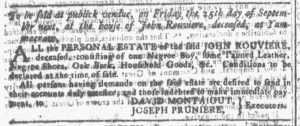
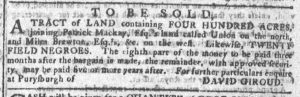
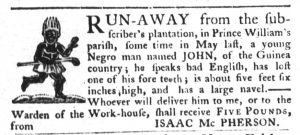
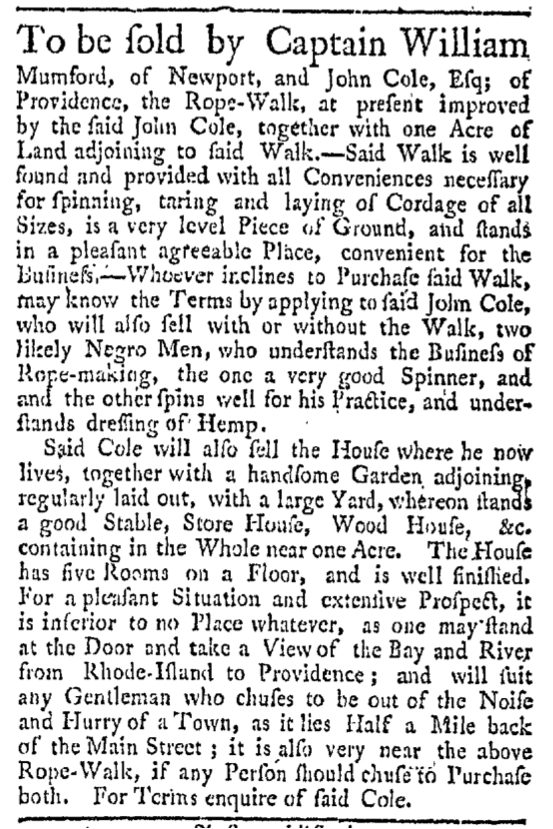
These tables indicate how many advertisements for slaves appeared in colonial American newspapers during the week of August 20-26, 1767.
Note: These tables are as comprehensive as currently digitized sources permit, but they may not be an exhaustive account. They includes all newspapers that have been digitized and made available via Accessible Archives, Colonial Williamsburg’s Digital Library, and Readex’s America’s Historical Newspapers. There are several reasons some newspapers may not have been consulted:
Issues that are no longer extant;
Issues that are extant but have not yet been digitized (including the Pennsylvania Journal); and
Newspapers published in a language other than English (including the Wochentliche Philadelphische Staatsbote).
**********
Slavery Advertisements Published August 20-26, 1767: By Date
**********
Slavery Advertisements Published August 20-26, 1767: By Region
The Slavery Adverts 250 Project chronicles the role of newspaper advertising in perpetuating slavery in the era of the American Revolution. The project seeks to reveal the ubiquity of slavery in eighteenth-century life from New England to Georgia by republishing advertisements about enslaved people – for sale as individuals or in groups, wanted to purchase or for hire for short periods, runaways who liberated themselves, and those who were subsequently captured and confined in jails and workhouses – in daily digests on this site as well as in real time via the @SlaveAdverts250 Twitter feed, utilizing twenty-first-century media to stand in for the print media of the eighteenth century.
The project aims to provide modern audiences with a sense of just how often colonizers encountered these advertisements in their daily lives. Enslaved men, women, and children appeared in print somewhere in the colonies almost every single day. Those advertisements served as a constant backdrop for social, cultural, economic, and political life in colonial and revolutionary America. Colonizers who did not purport to own enslaved people were still confronted with slavery as well as invited to maintain the system by purchasing enslaved men, women, and children or assisting in the capture of so-called “runaways” who sought to free themselves from bondage. The frequency of these newspaper advertisements suggests just how embedded slavery was in colonial and revolutionary American culture in everyday interactions beyond the printed page.
These advertisements also testify to the experiences of enslaved men, women, and children, though readers must consider that those experiences have been remediated through descriptions offered by enslavers rather than enslaved people themselves. Often unnamed in the advertisements, enslaved men, women, and children were not invisible or unimportant in early America.
These advertisements appeared in colonial American newspapers 250 years ago today.
What was advertised in a colonial American newspaper 250 years ago today?
South-Carolina Gazette and Country Journal (August 25, 1767).
“Coarse shoes for Negroes.”
From fabrics to foodstuffs to decorative housewares, James McCall sold an array of merchandise at “Messrs. LLOYD and NEYLE’s store in Broad-street” in Charleston. He carried clothing items intended for a variety of customers. For instance, his advertisement distinguished between “men’s buck gloves” and “women’s white unglazed kid gloves and mitts, with flowered backs.”
McCall made even greater distinctions among his assortment of shoes for all sorts of colonists: “women and girls leather and black callimanco shoes and pumps, men and boys shoes and pumps, coarse shoes for Negroes, a great choice of childrens black leather and Morocco shoes and pumps.” This short catalog of shoes and their intended wearers underscores that not everyone who eventually wore clothing sold by McCall qualified as customers in their own right. The slaves who donned the “coarse shoes for Negroes” never visited the store or made their own selections. They put consumer goods to use, but they did not participate in obtaining them. They did not engage in the processes of imagining alternatives and making choices about which shoes and other clothing items to acquire and wear.
Advertisements for consumer goods targeted broad swaths of the colonial population, but they also excluded or did not envision direct participation by enslaved men, women, and children. In addition to McCall’s “coarse shoes for Negroes,” advertisers in South Carolina and other colonies with significant slave populations frequently announced that they sold “NEGRO CLOTH” (as did Atkins and Weston in the same issue of the South-Carolina Gazette and Country Journal that carried McCall’s advertisement). Slaveholders purchased negro cloth, a coarse material, to outfit their slaves, even as they selected among almost innumerable textiles of higher quality for their own apparel.
In publishing an extensive list of shoes he stocked, McCall marketed fashion to prospective customers, but not when it came to “coarse shoes for Negroes.” In that case, McCall merely advertised provisions. The “coarse shoes for Negroes” would have more appropriately appeared in other parts of the advertisement, along with “flour in barrels” or the half dozen different kinds of nails. “Negroes” certainly used some of the clothing items McCall imported and sold, but they did not qualify as customers. Their participation in the consumer culture was circumscribed by their status as slaves.
The Slavery Adverts 250 Project chronicles the role of newspaper advertising in perpetuating slavery in the era of the American Revolution. The project seeks to reveal the ubiquity of slavery in eighteenth-century life from New England to Georgia by republishing advertisements about enslaved people – for sale as individuals or in groups, wanted to purchase or for hire for short periods, runaways who liberated themselves, and those who were subsequently captured and confined in jails and workhouses – in daily digests on this site as well as in real time via the @SlaveAdverts250 Twitter feed, utilizing twenty-first-century media to stand in for the print media of the eighteenth century.
The project aims to provide modern audiences with a sense of just how often colonizers encountered these advertisements in their daily lives. Enslaved men, women, and children appeared in print somewhere in the colonies almost every single day. Those advertisements served as a constant backdrop for social, cultural, economic, and political life in colonial and revolutionary America. Colonizers who did not purport to own enslaved people were still confronted with slavery as well as invited to maintain the system by purchasing enslaved men, women, and children or assisting in the capture of so-called “runaways” who sought to free themselves from bondage. The frequency of these newspaper advertisements suggests just how embedded slavery was in colonial and revolutionary American culture in everyday interactions beyond the printed page.
These advertisements also testify to the experiences of enslaved men, women, and children, though readers must consider that those experiences have been remediated through descriptions offered by enslavers rather than enslaved people themselves. Often unnamed in the advertisements, enslaved men, women, and children were not invisible or unimportant in early America.
These advertisements appeared in colonial American newspapers 250 years ago today.
South-Carolina Gazette and Country Journal (August 25, 1767).
**********
South-Carolina Gazette and Country Journal (August 25, 1767).
**********
South-Carolina Gazette and Country Journal (August 25, 1767).
**********
South-Carolina Gazette and Country Journal (August 25, 1767).
**********
South-Carolina Gazette and Country Journal (August 25, 1767).
**********
South-Carolina Gazette and Country Journal (August 25, 1767).
**********
South-Carolina Gazette and Country Journal (August 25, 1767).
**********
South-Carolina Gazette and Country Journal (August 25, 1767).
What was advertised in a colonial American newspaper 250 years ago today?
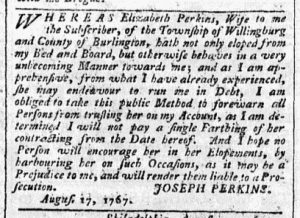
Pennsylvania Chronicle (August 24, 1767).
“I am obliged to take this public Method to forewarn all Persons from trusting her on my Account.”
“I am obliged to take this method solemnly to declare, that those charges against me have not the least foundation in truth.”
Joseph Perkins’ advertisement concerning the misbehavior of his wife, Elizabeth, made its second appearance in the August 24, 1767, edition of the Pennsylvania Chronicle, having previously appeared in the issue with the same date inserted at the end of the notice, August 17. More elaborate than many “runaway wife” advertisements, this one was particularly notable because it garnered a response in print from its subject. Most such advertisements went unanswered in the newspapers, but occasionally bold women refused to allow their husbands to exercise exclusive control over shaping the narrative presented to the public.
Pennsylvania Chronicle (August 24, 1767).
Elizabeth may have anticipated that her husband would publish this sort of advertisement and checked Philadelphia’s newspapers for it. At the very least, she read or heard about it within days of its publication and set about responding to it with her own advertisement, dated August 22. Readers of the Pennsylvania Chronicle could piece together the story, encountering Eliazabeth’s response on the third page and the original notice reprinted on the fourth and final page. (In the next issue, either the editor or compositor made a decision to run the related advertisements one after the other. They appeared as the final two items in the August 31 edition, Joseph’s initial notice first, followed by Elizabeth’s rebuttal. Instead of a series of advertisements unrelated to each other, that issue concluded with a narrative drama.)
Joseph had leveled the usual accusations against his wife: she “behaves in a very unbecoming Manner towards me” and “she may endeavor to run me in Debt.” Elizabeth turned the tables by “solemnly” declaring “that those charges against me have not the least foundation in truth.” She went on to describe “disorderly company” that her husband invited into their home and the “notorious scenes of disorder” his guests created. To underscore the point, she deployed racialized language, asserting that she had been subjected to treatment “that would have shocked a savage of the Ohio.” To escape this abuse, she had taken the only option available to her: she fled to her mother’s house.
Historians of early American often read runaway wife advertisements as evidence of women’s agency. Even though written and published by men, they demonstrate that women did not always bow to the patriarchal order within their households. At the same time, however, the very nature of runaway wife advertisements, especially the warnings not to engage in commercial exchanges with runaway wives, suggest a rather constrained agency in which men continued to exert control over women’s access to credit and consumer goods. That did not have to be the end of the story. Some runaway wives, like Elizabeth Perkins, also turned to the public prints, to offer alternate accounts that further illuminated the circumstances of their departure.
The Slavery Adverts 250 Project chronicles the role of newspaper advertising in perpetuating slavery in the era of the American Revolution. The project seeks to reveal the ubiquity of slavery in eighteenth-century life from New England to Georgia by republishing advertisements about enslaved people – for sale as individuals or in groups, wanted to purchase or for hire for short periods, runaways who liberated themselves, and those who were subsequently captured and confined in jails and workhouses – in daily digests on this site as well as in real time via the @SlaveAdverts250 Twitter feed, utilizing twenty-first-century media to stand in for the print media of the eighteenth century.
The project aims to provide modern audiences with a sense of just how often colonizers encountered these advertisements in their daily lives. Enslaved men, women, and children appeared in print somewhere in the colonies almost every single day. Those advertisements served as a constant backdrop for social, cultural, economic, and political life in colonial and revolutionary America. Colonizers who did not purport to own enslaved people were still confronted with slavery as well as invited to maintain the system by purchasing enslaved men, women, and children or assisting in the capture of so-called “runaways” who sought to free themselves from bondage. The frequency of these newspaper advertisements suggests just how embedded slavery was in colonial and revolutionary American culture in everyday interactions beyond the printed page.
These advertisements also testify to the experiences of enslaved men, women, and children, though readers must consider that those experiences have been remediated through descriptions offered by enslavers rather than enslaved people themselves. Often unnamed in the advertisements, enslaved men, women, and children were not invisible or unimportant in early America.
These advertisements appeared in colonial American newspapers 250 years ago today.
What was advertised in a colonial American newspaper 250 years ago this week?
New-York Gazette (August 17, 1767).
“They will be presented to the Publick in a Catalogue.”
Garret Noel continued to stock “A Very extensive Assortment of Books” nearly a month after his advertisement concerning a shipment that just arrived on the Amelia first appeared in the July 20, 1767, edition of the New-York Gazette. That the second line of his notice, proclaiming that he “Has this Day receiv’d” new inventory, was slightly outdated mattered little compared to two other aspects of the advertisement.
Noel, a prolific advertiser, informed potential customers that his “extensive Assortment of Books” covered a wide variety of topics, including “History, Divinity, Law, Physic, [and] Poetry.” In fact, he now carried so many new books that they were “too numerous” to list all the titles in newspaper advertisements. Instead, he resorted to another medium, a book catalog printed separately and often distributed free of charge as a means of inciting demand. Noel indicated that his catalog was “publishing with all the speed possible.” No extant copy exists, but that does not mean that Noel’s catalog never made it to press. According to the American Antiquarian Society’s online catalog, Noel previously published four other catalogs in 1754/55, 1755, 1759, and 1762. The partnership of Noel and Hazard later published a catalog in 1771. Perhaps Noel never printed the catalog promised in this advertisement but instead suggested that it existed as a means of luring potential customers to his shop, but the evidence suggests a fairly good chance that he did indeed publish this marketing tool to supplement his frequent newspaper advertisements. While fairly complete collections of many eighteenth-century newspapers have survived into the twenty-first century, other printed materials have not. Newspaper advertisements suggest that many more book catalogs likely circulated in the eighteenth century than can be found in archives today.
While awaiting publication of the catalog, Noel also informed existing customers who had placed orders that they could send for them. This announcement did matter more at the time the bookseller originally inserted the advertisement in the New-York Gazette. With a new shipment that had just arrived he likely had not yet had time to send notices to every customer awaiting an order. An announcement in the newspaper presented an opportunity for eager customers to obtain their purchases as quickly as possible (and potentially saved the bookseller time and energy in contacting customers individually). That this portion of Noel’s notice continued to run for so many weeks also served to inform potential customers that they could also submit special orders.
Garret Noel offered two forms of customer service intended to cater to consumers and convince them to purchase his merchandise. He distributed a catalog detailing his “Very extensive Assortment of Books,” introducing potential customers to titles they may not have previously considered. He also accepted orders and informed clients as soon as they arrived, exhibiting how eagerly he sought to serve his patrons.
Some of their other advertisements were more modest, but even as they placed notices for purposes other than marketing their goods the Russells made sure to remind readers and potential customers that they “have to sell a large Assortment of English Goods and Hard-Ware” at low prices. Such was the case in this advertisement announcing that they sought tenants to rent “a Convenient Dwelling-House” in the northern part of Providence. This was not the first time they adopted such a strategy in their advertisements. Six months earlier they had evenly divided the space in a previous advertisement, first issuing a call for prospective renters for what might have been the same “Convenient Dwelling-House” and then hawking their “compleat Assortment of English GOODS” and, especially, “Excellent Bohea Tea, which for smell and flavor, exceeds most any ever imported.”
The Russells’ advertisement from August 1767 was not nearly as elaborate, yet the shopkeepers still determined that it should fulfill multiple purposes. They may have figured that as long as circumstances forced them once again to advertise a house for rent in the Providence Gazette that they might as well attempt to gain as much of a return on their investment in advertising as possible. Greater numbers of competitors had turned to the local newspaper to advertise throughout the spring and summer. Having previously established their reputation as retailers in the public prints, Joseph and William Russell reminded readers that they sold similar merchandise also advertised by William Brown, John Mathewson, Benjamin West, and others elsewhere in the issue.
The Slavery Adverts 250 Project chronicles the role of newspaper advertising in perpetuating slavery in the era of the American Revolution. The project seeks to reveal the ubiquity of slavery in eighteenth-century life from New England to Georgia by republishing advertisements about enslaved people – for sale as individuals or in groups, wanted to purchase or for hire for short periods, runaways who liberated themselves, and those who were subsequently captured and confined in jails and workhouses – in daily digests on this site as well as in real time via the @SlaveAdverts250 Twitter feed, utilizing twenty-first-century media to stand in for the print media of the eighteenth century.
The project aims to provide modern audiences with a sense of just how often colonizers encountered these advertisements in their daily lives. Enslaved men, women, and children appeared in print somewhere in the colonies almost every single day. Those advertisements served as a constant backdrop for social, cultural, economic, and political life in colonial and revolutionary America. Colonizers who did not purport to own enslaved people were still confronted with slavery as well as invited to maintain the system by purchasing enslaved men, women, and children or assisting in the capture of so-called “runaways” who sought to free themselves from bondage. The frequency of these newspaper advertisements suggests just how embedded slavery was in colonial and revolutionary American culture in everyday interactions beyond the printed page.
These advertisements also testify to the experiences of enslaved men, women, and children, though readers must consider that those experiences have been remediated through descriptions offered by enslavers rather than enslaved people themselves. Often unnamed in the advertisements, enslaved men, women, and children were not invisible or unimportant in early America.
These advertisements appeared in colonial American newspapers 250 years ago today.
What was advertised in a colonial American newspaper 250 years ago today?
New-Hampshire Gazette (August 21, 1767).
“Choice London BOHEA TEA, to be sold by Henry Appleton, at £4 10s. Old Tenor by the Dozen.”
Henry Appleton advertised “Choice London BOHEA TEA” in the August 21, 1767, edition of the New-Hampshire Gazette. His was one of nearly two dozen paid notices that appeared in that issue, its format distinguishing it from the others. Appleton’s advertisement ran in a single line across the bottom of the third page, extending nearly the width of three columns. At a glance, it could have been mistaken for the colophon printed on the other side of the page.
Why did Appleton’s advertisement have such a unique layout? A few other advertisements were nearly as brief, yet they had been set as squares of text within the usual three-column format of the New-Hampshire Gazette. The brevity of Appleton’s notice alone did not justify its unusual layout.
Who made the decision to treat Appleton’s advertisement differently? Perhaps Appleton, wishing to draw special attention to it, made arrangements with Daniel and Robert Fowle, the printers, to deploy an innovative format. Perhaps the Fowles or someone working in their printing office opted to experiment with the appearance of advertising on the page.
Perhaps neither the advertiser nor the printers put that much consideration into Appleton’s notice. If it had been submitted late or somehow overlooked, running it in a single line across the bottom of the page may have been the result of practicality rather than an intentional effort to challenge the conventions of eighteenth-century advertising.
As far as potential customers were concerned, however, the origins likely would have been less important than the effects. Readers scanning the contents of the issue would have encountered Appleton’s advertisement three times instead of passing over it only once. Its unique format demanded at least one close reading to determine what kind of information it contained, whereas advertisements that conformed to the standard layout did not elicit the same curiosity merely from their appearance.
Even in a short advertisement, Henry Appleton incorporated appeals to price and quality, but the format of his advertisement – whether intentionally designed or not – made it much more likely that consumers would spot those appeals and consider purchasing his merchandise.