November 13

What was advertised in a colonial American newspaper 250 years ago today?

Nov 13 - 11:13:1767 Connecticut Journal
Connecticut Journal (November 13, 1767).

“Advertisements of not more Length than Breadth, are inserted Three Weeks for Three Shillings.”

Thomas Green and Samuel Green launched a new newspaper, the Connecticut Journal; and New-Haven Post-Boy, on October 23, 1767. Like many other colonial printers, they used the colophon not only to provide the particulars concerning publication but also as an advertisement for the newspaper itself: “All Persons may be supplied with this Paper at Six-Shillings a Year.”

Yet colonial newspapers rarely had sufficient subscribers to make them sustainable business ventures. In addition to subscriptions, advertisements accounted for an important revenue stream. To that end, the Greens also issued a call for advertisers in the colophon. In the process, they provided a relatively rare indication of the costs of advertising in eighteenth-century newspapers.

How much did it cost Michael Todd to place an advertisement for the “GOOD Assortment of Winter Goods” at “his Store in New-Haven” in the November 13 issue? According to the colophon, “Advertisements of not more Length than Breadth, are inserted Three Weeks for Three Shillings, and Six-Pence each Week afterwards; and long Ones in Proportion.” Todd’s advertisement was approximately half again as long as it was wide. He would have paid four shillings and six pence to run it for the first three weeks and then another nine pence for each week thereafter. (Todd and other advertisers received a discount for subsequent insertions because the labor of setting the type had already been completed.) If Todd ran his advertisement for only three weeks the cost would have been equivalent to three-quarters of a yearly subscription. Running it for a fourth week would have raised the shopkeeper’s cost (and the printers’ revenue) to the same as a subscription.

Advertisements were indeed good for business, especially the printing business. The amount of space devoted to advertising in the Connecticut Journal gradually expanded during its first month of publication, a development the Greens welcomed and sought to further cultivate in order to improve the prospects for their new publication. They met with some success. The Connecticut Journal continued publication for more than fifty years, issuing its final edition in December 1820. Advertising filled one-third of the space in that issue.

Slavery Advertisements Published November 13, 1767

The Slavery Adverts 250 Project chronicles the role of newspaper advertising in perpetuating slavery in the era of the American Revolution. The project seeks to reveal the ubiquity of slavery in eighteenth-century life from New England to Georgia by republishing advertisements about enslaved people – for sale as individuals or in groups, wanted to purchase or for hire for short periods, runaways who liberated themselves, and those who were subsequently captured and confined in jails and workhouses – in daily digests on this site as well as in real time via the @SlaveAdverts250 Twitter feed, utilizing twenty-first-century media to stand in for the print media of the eighteenth century.

The project aims to provide modern audiences with a sense of just how often colonizers encountered these advertisements in their daily lives. Enslaved men, women, and children appeared in print somewhere in the colonies almost every single day. Those advertisements served as a constant backdrop for social, cultural, economic, and political life in colonial and revolutionary America. Colonizers who did not purport to own enslaved people were still confronted with slavery as well as invited to maintain the system by purchasing enslaved men, women, and children or assisting in the capture of so-called “runaways” who sought to free themselves from bondage. The frequency of these newspaper advertisements suggests just how embedded slavery was in colonial and revolutionary American culture in everyday interactions beyond the printed page.

These advertisements also testify to the experiences of enslaved men, women, and children, though readers must consider that those experiences have been remediated through descriptions offered by enslavers rather than enslaved people themselves. Often unnamed in the advertisements, enslaved men, women, and children were not invisible or unimportant in early America.

These advertisements appeared in colonial American newspapers 250 years ago today.

Nov 13 - South-Carolina and American General Gazette Slavery 1
South-Carolina and American General Gazette (November 13, 1767).

**********

Nov 13 - South-Carolina and American General Gazette Slavery 2
South-Carolina and American General Gazette (November 13, 1767).

**********

Nov 13 - South-Carolina and American General Gazette Slavery 3
South-Carolina and American General Gazette (November 13, 1767).

**********

Nov 13 - South-Carolina and American General Gazette Slavery 4
South-Carolina and American General Gazette (November 13, 1767).

**********

Nov 13 - South-Carolina and American General Gazette Slavery 5
South-Carolina and American General Gazette (November 13, 1767).

**********

Nov 13 - South-Carolina and American General Gazette Slavery 6
South-Carolina and American General Gazette (November 13, 1767).

**********

Nov 13 - South-Carolina and American General Gazette Slavery 7
South-Carolina and American General Gazette (November 13, 1767).

**********

Nov 13 - South-Carolina and American General Gazette Slavery 8
South-Carolina and American General Gazette (November 13, 1767).

November 12

What was advertised in a colonial American newspaper 250 years ago today?

Nov 12 - 11:12:1767 Massachusetts Gazette
Massachusetts Gazette (November 12, 1767).

“Joshua Blanchard Going into another Trade, Is selling his GOODS.”

It would have been difficult for readers not to notice Joshua Blanchard’s advertisement in the November 12, 1767, edition of the Massachusetts Gazette. It occupied the entire first column on the first page. In addition, it had a different format than most other advertisements that listed consumer goods. On the left Blanchard listed his inventory; on the right he indicated prices. Approximately fifty entries included specific prices that potential customers could expect to pay at Blanchard’s shop. Throughout the eighteenth century, merchants and shopkeepers rarely inserted prices in their advertisements. When they did, they usually confined themselves to a small number of items. Blanchard, on the other hand, provided an extensive guide to retail prices at his shop on Dock Street.

Why did Blanchard take this extraordinary step? He had previously emphasized the “VERY LOW Price at which he sells” in other advertisements, but had mocked the popular practice of “enumerating every Particular, even to Pins and Needles.” Apparently he changed his mind when he decided to have a going-out-of-business sale. He opened his advertisement by explaining that because he was “Going into another Trade” that he was “selling his GOODS.” He listed specific prices as a means of attracting attention, inciting demand for his merchandise, and demonstrating that he meant business. Prospective customers did not need to worry that Blanchard would lure them into his shop with promises of low prices only to end up haggling over prices similar to those of his competitors. Instead, they knew in advance how much he charged for dozens of items.

Blanchard ceased listing prices about two-thirds of the way through his advertisement, switching to two columns that merely listed other merchandise. Space constraints and the cost of placing a lengthier advertisement may have prevented him from providing prices for every item. Or, he might not have intended to list prices for his entire inventory, preferring instead to use the first items in his advertisement to draw customers into his shop and trusting that they would then encounter other bargains that they could not resist.

Eighteenth-century retailers did not usually use sales as a means of marketing their wares, certainly not to the extent that the practice became standard in the twentieth and twenty-first centuries, but some did experiment with the concept. In effect, Joshua Blanchard advertised a going-out-of-business sale in the fall of 1767.

Slavery Advertisements Published November 12, 1767

The Slavery Adverts 250 Project chronicles the role of newspaper advertising in perpetuating slavery in the era of the American Revolution. The project seeks to reveal the ubiquity of slavery in eighteenth-century life from New England to Georgia by republishing advertisements about enslaved people – for sale as individuals or in groups, wanted to purchase or for hire for short periods, runaways who liberated themselves, and those who were subsequently captured and confined in jails and workhouses – in daily digests on this site as well as in real time via the @SlaveAdverts250 Twitter feed, utilizing twenty-first-century media to stand in for the print media of the eighteenth century.

The project aims to provide modern audiences with a sense of just how often colonizers encountered these advertisements in their daily lives. Enslaved men, women, and children appeared in print somewhere in the colonies almost every single day. Those advertisements served as a constant backdrop for social, cultural, economic, and political life in colonial and revolutionary America. Colonizers who did not purport to own enslaved people were still confronted with slavery as well as invited to maintain the system by purchasing enslaved men, women, and children or assisting in the capture of so-called “runaways” who sought to free themselves from bondage. The frequency of these newspaper advertisements suggests just how embedded slavery was in colonial and revolutionary American culture in everyday interactions beyond the printed page.

These advertisements also testify to the experiences of enslaved men, women, and children, though readers must consider that those experiences have been remediated through descriptions offered by enslavers rather than enslaved people themselves. Often unnamed in the advertisements, enslaved men, women, and children were not invisible or unimportant in early America.

These advertisements appeared in colonial American newspapers 250 years ago today.

Nov 12 - Massachusetts Gazette Slavery 1
Massachusetts Gazette (November 12, 1767).

**********

Nov 12 - Massachusetts Gazette Supplement Slavery 1
Supplement to the Massachusetts Gazette (November 12, 1767).

**********

Nov 12 - New-York Journal Supplement Slavery 1
Supplement to the New-York Journal (November 12, 1767).

**********

Nov 12 - New-York Journal Supplement Slavery 2
Supplement to the New-York Journal (November 12, 1767).

**********

Nov 12 - New-York Journal Supplement Slavery 3
Supplement to the New-York Journal (November 12, 1767).

**********

Nov 12 - Pennsylvania Gazette Slavery 1
Pennsylvania Gazette (November 12, 1767).

**********

Nov 12 - Pennsylvania Gazette Slavery 2
Pennsylvania Gazette (November 12, 1767).

**********

Nov 12 - Pennsylvania Gazette Slavery 3
Pennsylvania Gazette (November 12, 1767).

**********

Nov 12 - Pennsylvania Gazette Slavery 4
Pennsylvania Gazette (November 12, 1767).

**********

Nov 12 - Pennsylvania Gazette Slavery 5
Pennsylvania Gazette (November 12, 1767).

**********

Nov 12 - Pennsylvania Gazette Slavery 6
Pennsylvania Gazette (November 12, 1767).

**********

Nov 12 - Pennsylvania Gazette Supplement Slavery 1
Pennsylvania Gazette (November 12, 1767).

**********

Nov 12 - Virginia Gazette Slavery 1
Virginia Gazette (November 12, 1767).

**********

Nov 12 - Virginia Gazette Slavery 2
Virginia Gazette (November 12, 1767).

**********

Nov 12 - Virginia Gazette Slavery 3
Virginia Gazette (November 12, 1767).

**********

Nov 12 - Virginia Gazette Slavery 4
Virginia Gazette (November 12, 1767).

**********

Nov 12 - Virginia Gazette Slavery 5
Virginia Gazette (November 12, 1767).

**********

Nov 12 - Virginia Gazette Slavery 6
Virginia Gazette (November 12, 1767).

**********

Nov 12 - Virginia Gazette Slavery 7
Virginia Gazette (November 12, 1767).

**********

Nov 12 - Virginia Gazette Slavery 8
Virginia Gazette (November 12, 1767).

**********

Nov 12 - Virginia Gazette Slavery 9
Virginia Gazette (November 12, 1767).

November 11

What was advertised in a colonial American newspaper 250 years ago today?

Nov 11 - 11:11:1767 Pennsylvania Chronicle Extraordinary
Pennsylvania Chronicle Extraordinary (November 11, 1767).

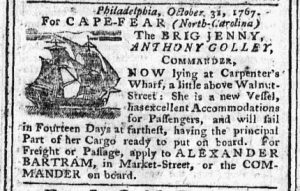
“She is a new Vessel, has excellent Accommodations for Passengers.”

The various commodities marketed in eighteenth-century newspapers testify to the networks of exchange that crisscrossed the Atlantic, but the advertisements also reveal the movement of people. Almost every advertisement in the November 11, 1767, extraordinary issue of the Pennsylvania Chronicle, for instance, featured some element of mobility.

Six advertisements offered passage from Philadelphia to faraway places, including Cape Fear, North Carolina; Grenada; Barbados; Londonderry; and London. Half simply stated that readers could arrange either “Freight or Passage,” but the others promoted their “excellent Accommodations for Passengers” to attract travelers. Due to the size of the port city, newspapers published in Philadelphia regularly carried such advertisements, but similar advertisements also appeared frequently in newspapers from smaller cities and towns.

Some colonists used advertisements to announce their arrival. For instance, one “YOUNG MAN … lately arrived from England” placed an employment notice in the Pennsylvania Chronicle, informing his new neighbors that he “would be glad to serve any Gentleman as Clerk.” The anonymous ‘YOUNG MAN” requested that anyone interested in hiring him “Inquire of the PRINTER.” He also indicated his willingness to extend his journey when he expressed interest in positions available “either in Town or Country.”

Three additional advertisements documented recent departures of indentured servants who absconded from their masters. One reported that Abraham Weaver, am English linen weaver who ran away from Amos Garrett in Swan Creek in Maryland, had been seen with a widow who might attempt to pass as his wife. Garrett suspected that “they may make for Philadelphia or the eastern-shore of Maryland.” John Odenheimer of Philadelphia indicated that his servant, a German named Eberhard Hirschman, had been “seen in Lancaster, at the Sign of the Highlander” the previous week. These runaways attempted to put considerable distance between themselves and their masters.

Newspaper advertisements like these depicted a flurry of movement of people, not just commodities, throughout the Atlantic world and beyond in the eighteenth century. Those who purchased passage on ships traveled for various reasons, commercial and personal. Some, like the “YOUNG MAN … lately arrived from England,” embraced mobility as a means of encountering new opportunities, but others, including many indentured servants, found that their experiences in new places did not live up to their expectations. They made new departures, frustrating masters who had bought their services for a period of years. American colonists lived in an extremely mobile society. Advertisements for consumer goods and services often insinuated social mobility, but other paid notices revealed significant geographic mobility as well.

Summary of Slavery Advertisements Published November 5-11, 1767

These tables indicate how many advertisements for slaves appeared in colonial American newspapers during the week of November 5-11, 1767.

Note:  These tables are as comprehensive as currently digitized sources permit, but they may not be an exhaustive account.  They includes all newspapers that have been digitized and made available via Accessible Archives, Colonial Williamsburg’s Digital Library, and Readex’s America’s Historical Newspapers.  There are several reasons some newspapers may not have been consulted:

  • Issues that are no longer extant;
  • Issues that are extant but have not yet been digitized (including the Pennsylvania Journal); and
  • Newspapers published in a language other than English (including the Wochentliche Philadelphische Staatsbote).

**********

Slavery Advertisements Published November 5-11, 1767:  By Date

Slavery Adverts Tables 1767 By Date Nov 5

**********

Slavery Advertisements Published November 5-11, 1767:  By Region

Slavery Adverts Tables 1767 By Region Nov 5

Slavery Advertisements Published November 11, 1767

The Slavery Adverts 250 Project chronicles the role of newspaper advertising in perpetuating slavery in the era of the American Revolution. The project seeks to reveal the ubiquity of slavery in eighteenth-century life from New England to Georgia by republishing advertisements about enslaved people – for sale as individuals or in groups, wanted to purchase or for hire for short periods, runaways who liberated themselves, and those who were subsequently captured and confined in jails and workhouses – in daily digests on this site as well as in real time via the @SlaveAdverts250 Twitter feed, utilizing twenty-first-century media to stand in for the print media of the eighteenth century.

The project aims to provide modern audiences with a sense of just how often colonizers encountered these advertisements in their daily lives. Enslaved men, women, and children appeared in print somewhere in the colonies almost every single day. Those advertisements served as a constant backdrop for social, cultural, economic, and political life in colonial and revolutionary America. Colonizers who did not purport to own enslaved people were still confronted with slavery as well as invited to maintain the system by purchasing enslaved men, women, and children or assisting in the capture of so-called “runaways” who sought to free themselves from bondage. The frequency of these newspaper advertisements suggests just how embedded slavery was in colonial and revolutionary American culture in everyday interactions beyond the printed page.

These advertisements also testify to the experiences of enslaved men, women, and children, though readers must consider that those experiences have been remediated through descriptions offered by enslavers rather than enslaved people themselves. Often unnamed in the advertisements, enslaved men, women, and children were not invisible or unimportant in early America.

These advertisements appeared in colonial American newspapers 250 years ago today.

Nov 11 - Georgia Gazette Slavery 1
Georgia Gazette (November 11, 1767).

**********

Nov 11 - Georgia Gazette Slavery 2
Georgia Gazette (November 11, 1767).

**********

Nov 11 - Georgia Gazette Slavery 3
Georgia Gazette (November 11, 1767).

**********

Nov 11 - Georgia Gazette Slavery 4
Georgia Gazette (November 11, 1767).

**********

Nov 11 - Georgia Gazette Slavery 5
Georgia Gazette (November 11, 1767).

**********

Nov 11 - Georgia Gazette Slavery 6
Georgia Gazette (November 11, 1767).

**********

Nov 11 - Georgia Gazette Slavery 7
Georgia Gazette (November 11, 1767).

**********

Nov 11 - Georgia Gazette Slavery 8
Georgia Gazette (November 11, 1767).

**********

Nov 11 - Georgia Gazette Slavery 9
Georgia Gazette (November 11, 1767).

November 10

What was advertised in a colonial American newspaper 250 years ago today?

Nov 10 - 11:10:1767 South-Carolina Gazette and Country Journal
South-Carolina Gazette and Country Journal (November 10, 1767).

“A very compleat assortment.”

In the fall of 1767 John Dawson and Company imported a “NEAT cargo of GOODS for the season.” They placed an advertisement in the November 10, 1767, edition of the South-Carolina Gazette and Country Journal, informing potential customers in Charleston and its hinterland that they carried new merchandise.

Unlike some of their competitors, Dawson and Company did not list any specific items they stocked. In the same issue, John Scott enumerated dozens of items, as did John Edwards and Company. Scott sold everything from “bed blankets” to “black lace” to “gunpowder.” Edwards and Company provided even more elaborate descriptions of their wares, including “striped and floured fashionable silks and ribbons” and “copper-plate and common blue and white chimney tiles.” In a much shorter advertisement, the proprietors of “STOTT’s MANCHESTER WARE-HOUSE” named about a dozen items, such as ribbons, hats, and handkerchiefs. Each of these advertisers made it easy for readers to imagine the wonders they would encounter at their shops.

Dawson and Company, however, relied on a different tactic to incite consumer interest in their merchandise. Rather than presenting potential customers with explicit choices, they stated that the “NEAT cargo of GOODS” they had just imported would be “added to their other stock.” This combination yielded “a very compleat assortment” to satisfy their customers. Dawson and Company did not linger over the particulars; instead, they asserted that “the choice has been carefully attended to,” suggesting that they had devoted special effort in selecting their inventory. Prospective customers, they implied, would find the items they wanted and needed among Dawson and Company’s “very compleat assortment.”

Dawson and Company may not have had the means to make the same investment in advertising as John Scott or John Edwards and Company. In limited space, they advanced an alternate version of the popular appeal to consumer choice, promising that they did indeed stock a vast array of goods even though they did not publish an extensive list in the public prints.

Slavery Advertisements Published November 10, 1767

The Slavery Adverts 250 Project chronicles the role of newspaper advertising in perpetuating slavery in the era of the American Revolution. The project seeks to reveal the ubiquity of slavery in eighteenth-century life from New England to Georgia by republishing advertisements about enslaved people – for sale as individuals or in groups, wanted to purchase or for hire for short periods, runaways who liberated themselves, and those who were subsequently captured and confined in jails and workhouses – in daily digests on this site as well as in real time via the @SlaveAdverts250 Twitter feed, utilizing twenty-first-century media to stand in for the print media of the eighteenth century.

The project aims to provide modern audiences with a sense of just how often colonizers encountered these advertisements in their daily lives. Enslaved men, women, and children appeared in print somewhere in the colonies almost every single day. Those advertisements served as a constant backdrop for social, cultural, economic, and political life in colonial and revolutionary America. Colonizers who did not purport to own enslaved people were still confronted with slavery as well as invited to maintain the system by purchasing enslaved men, women, and children or assisting in the capture of so-called “runaways” who sought to free themselves from bondage. The frequency of these newspaper advertisements suggests just how embedded slavery was in colonial and revolutionary American culture in everyday interactions beyond the printed page.

These advertisements also testify to the experiences of enslaved men, women, and children, though readers must consider that those experiences have been remediated through descriptions offered by enslavers rather than enslaved people themselves. Often unnamed in the advertisements, enslaved men, women, and children were not invisible or unimportant in early America.

These advertisements appeared in colonial American newspapers 250 years ago today.

Nov 10 - South-Carolina Gazette and Country Journal Slavery 12
South-Carolina Gazette and Country Journal (November 10, 1767).

**********

Nov 10 - South-Carolina Gazette and Country Journal Slavery 1
South-Carolina Gazette and Country Journal (November 10, 1767).

**********

Nov 10 - South-Carolina Gazette and Country Journal Slavery 13
South-Carolina Gazette and Country Journal (November 10, 1767).

**********

Nov 10 - South-Carolina Gazette and Country Journal Slavery 2
South-Carolina Gazette and Country Journal (November 10, 1767).

**********

Nov 10 - South-Carolina Gazette and Country Journal Slavery 3
South-Carolina Gazette and Country Journal (November 10, 1767).

**********

Nov 10 - South-Carolina Gazette and Country Journal Slavery 4
South-Carolina Gazette and Country Journal (November 10, 1767).

**********

Nov 10 - South-Carolina Gazette and Country Journal Slavery 5
South-Carolina Gazette and Country Journal (November 10, 1767).

**********

Nov 10 - South-Carolina Gazette and Country Journal Slavery 6
South-Carolina Gazette and Country Journal (November 10, 1767).

**********

Nov 10 - South-Carolina Gazette and Country Journal Slavery 14
South-Carolina Gazette and Country Journal (November 10, 1767).

**********

Nov 10 - South-Carolina Gazette and Country Journal Slavery 7
South-Carolina Gazette and Country Journal (November 10, 1767).

**********

Nov 10 - South-Carolina Gazette and Country Journal Slavery 8
South-Carolina Gazette and Country Journal (November 10, 1767).

**********

Nov 10 - South-Carolina Gazette and Country Journal Slavery 9
South-Carolina Gazette and Country Journal (November 10, 1767).

**********

Nov 10 - South-Carolina Gazette and Country Journal Slavery 10
South-Carolina Gazette and Country Journal (November 10, 1767).

**********

Nov 10 - South-Carolina Gazette and Country Journal Slavery 11
South-Carolina Gazette and Country Journal (November 10, 1767).

November 9

What was advertised in a colonial American newspaper 250 years ago today?

Nov 9 - 11:9:1767 Boston-Gazette
Boston-Gazette (November 9, 1767).

“Manufactured in Braintree.”

Most eighteenth-century advertisements for consumer goods and services did not include any sort of headline other than the advertiser’s name in a larger font than the rest of the copy. Peter Etter and Sons, however, published an advertisement with the headline “Manufactured in Braintree” in the November 9, 1767, edition of the Boston-Gazette. Etter and Sons promoted their locally produced stockings, gloves, caps, and thread to consumers primed to purchase goods made by their fellow colonists. They also depended on the politics of the unfolding imperial crisis to make their wares more attractive to colonial consumers.

In placing their advertisement, the Etters took advantage of current events, especially the Boston town meeting that took place on October 28. According to the coverage in the previous issue of the Boston-Gazette, the “Freeholders and other Inhabitants of the Town” had determined that they needed to address both the imbalance of trade between Britain and the colonies and the impending duties on certain imported goods once the Townshend Act went into effect on November 20. Bostonians voted to approve non-importation and non-consumption agreements. In order for those measures to succeed, they promised that they would “encourage the Use and Consumption of all Articles manufactured in any of the British American Colonies, and more especially in this Province.” Etter and Sons could hardly have imagined a more effective endorsement for their enterprise!

Notably, their advertisement did not appear in the November 2 issue that carried the news of the town meeting. The Etters inserted it only after the news had spread throughout the colony and beyond via multiple newspapers, realizing that prospective customers would likely be especially amenable to acquiring domestic manufactures. Still, they assured readers of the quality of their stockings and other garments: “the above-mentioned Goods have been sufficiently try’d, and the Goodness and Wear approv’d.” In addition, they revealed their own commitment to purchasing supplies from local producers, as encouraged by the resolutions from the town meeting. “It having been reported that some Families in the Country have rais’d some raw Silk,” Etter and Sons stated, “they will pay Cash for the same, at the Price commonly given in Georgia,” a colony with more experience in its attempts to cultivate silk throughout the colonial period.

Etter and Sons did not explicitly invoke politics in their advertisement, but readers of the Boston-Gazette could hardly have missed the context in which they launched their appeals about garments “Manufactured in Braintree” rather than imported from England. Etter and Sons encouraged readers to consider the political ramifications of the decisions they made when it came to acquiring consumer goods.