Slavery Advertisements Published November 19, 1767

The Slavery Adverts 250 Project chronicles the role of newspaper advertising in perpetuating slavery in the era of the American Revolution. The project seeks to reveal the ubiquity of slavery in eighteenth-century life from New England to Georgia by republishing advertisements about enslaved people – for sale as individuals or in groups, wanted to purchase or for hire for short periods, runaways who liberated themselves, and those who were subsequently captured and confined in jails and workhouses – in daily digests on this site as well as in real time via the @SlaveAdverts250 Twitter feed, utilizing twenty-first-century media to stand in for the print media of the eighteenth century.

The project aims to provide modern audiences with a sense of just how often colonizers encountered these advertisements in their daily lives. Enslaved men, women, and children appeared in print somewhere in the colonies almost every single day. Those advertisements served as a constant backdrop for social, cultural, economic, and political life in colonial and revolutionary America. Colonizers who did not purport to own enslaved people were still confronted with slavery as well as invited to maintain the system by purchasing enslaved men, women, and children or assisting in the capture of so-called “runaways” who sought to free themselves from bondage. The frequency of these newspaper advertisements suggests just how embedded slavery was in colonial and revolutionary American culture in everyday interactions beyond the printed page.

These advertisements also testify to the experiences of enslaved men, women, and children, though readers must consider that those experiences have been remediated through descriptions offered by enslavers rather than enslaved people themselves. Often unnamed in the advertisements, enslaved men, women, and children were not invisible or unimportant in early America.

These advertisements appeared in colonial American newspapers 250 years ago today.

Nov 19 - Massachusetts Gazette Slavery 1
Massachusetts Gazette (November 19, 1767).

**********

Nov 19 - Massachusetts Gazette Slavery 2
Massachusetts Gazette (November 19, 1767).

**********

Nov 19 - New-York Journal Supplement Slavery 1
Supplement to the New-York Journal (November 19, 1767).

**********

Nov 19 - New-York Journal Supplement Slavery 2
Supplement to the New-York Journal (November 19, 1767).

**********

Nov 19 - Pennsylvania Gazette Slavery 1
Pennsylvania Gazette (November 19, 1767).

**********

Nov 19 - Pennsylvania Gazette Slavery 2
Pennsylvania Gazette (November 19, 1767).

**********

Nov 19 - Pennsylvania Gazette Supplement Slavery 1
Supplement to the Pennsylvania Gazette (November 19, 1767).

**********

Nov 19 - Pennsylvania Gazette Supplement Slavery 2
Supplement to the Pennsylvania Gazette (November 19, 1767).

**********

Nov 19 - Pennsylvania Gazette Supplement Slavery 3
Supplement to the Pennsylvania Gazette (November 19, 1767).

**********

Nov 19 - Virginia Gazette Slavery 1
Virginia Gazette (November 19, 1767).

**********

Nov 19 - Virginia Gazette Slavery 2
Virginia Gazette (November 19, 1767).

**********

Nov 19 - Virginia Gazette Slavery 3
Virginia Gazette (November 19, 1767).

**********

Nov 19 - Virginia Gazette Slavery 4
Virginia Gazette (November 19, 1767).

**********

Nov 19 - Virginia Gazette Slavery 5
Virginia Gazette (November 19, 1767).

**********

Nov 19 - Virginia Gazette Slavery 6
Virginia Gazette (November 19, 1767).

**********

Nov 19 - Virginia Gazette Slavery 7
Virginia Gazette (November 19, 1767).

**********

Nov 19 - Virginia Gazette Slavery 8
Virginia Gazette (November 19, 1767).

**********

Nov 19 - Virginia Gazette Slavery 9
Virginia Gazette (November 19, 1767).

**********

Nov 19 - Virginia Gazette Slavery 10
Virginia Gazette (November 19, 1767).

**********

Nov 19 - Virginia Gazette Slavery 11
Virginia Gazette (November 19, 1767).

November 18

What was advertised in a colonial American newspaper 250 years ago today?

Nov 18 - 11:18:1767 Georgia Gazette
Georgia Gazette (November 18, 1767).

“Several other articles too tedious to mention.”

Samuel Douglass and Company did not want prospective customers to merely take them at their word that they stocked “A COMPLEAT ASSORTMENT of EUROPEAN and EAST-INDIA GOODS.” To demonstrate their extensive inventory they published a newspaper advertisement that listed hundred of items available at their shop. That advertisement began at the bottom of one column and entirely filled the next, making it rather unique among advertisements in the Georgia Gazette in the 1760s. Other merchants and shopkeepers in Savannah sometimes placed list-style advertisements, but the longest typically extended one-quarter or one-third of a column.

Due to its length, Douglass and Company’s advertisement was one of the most prominent items in the November 18, 1767, edition of the Georgia Gazette. It accounted for slightly more than one of the eight columns of content in the issue, certainly a significant investment for Douglass and Company and a windfall for printer James Johnston. The Georgia Gazette sometimes struggled to attract advertisers, as demonstrated by the generous white space that separated paid notices in other issues, but in this instance shorter advertisements had an even more compact appearance as the result of efforts to make them all fit within the standard four-page issue.

Although an advertisement of such length was rather extraordinary in the Georgia Gazette, it would not necessarily have looked out of place to colonists. Regular readers would have certainly noticed it because it deviated from the advertisements that usually appeared in that newspaper, but newspapers printed in other colonies circulated so widely that readers likely would have encountered similar lengthy advertisements in other publications. Douglass and Company may have figured that if shopkeepers in other colonial ports found the method effective enough that they repeatedly placed notices that filled an entire column that it might be worth trying the same strategy in their local newspaper as a means of distinguishing themselves from their competitors.

In placing this advertisement, Douglass and Company announced to the residents of Savannah and its hinterland that even though they resided in the most recently established colony they still had access to the same variety of consumer goods sold in Boston, Charleston, New York, Philadelphia, and elsewhere throughout the colonies. To underscore that point, they concluded their list by asserting that they also carried “several other articles too tedious to mention.”

Summary of Slavery Advertisements Published November 12-18, 1767

These tables indicate how many advertisements for slaves appeared in colonial American newspapers during the week of November 12-18, 1767.

Note:  These tables are as comprehensive as currently digitized sources permit, but they may not be an exhaustive account.  They includes all newspapers that have been digitized and made available via Accessible Archives, Colonial Williamsburg’s Digital Library, and Readex’s America’s Historical Newspapers.  There are several reasons some newspapers may not have been consulted:

  • Issues that are no longer extant;
  • Issues that are extant but have not yet been digitized (including the Pennsylvania Journal); and
  • Newspapers published in a language other than English (including the Wochentliche Philadelphische Staatsbote).

**********

Slavery Advertisements Published November 12-18, 1767:  By Date

Slavery Adverts Tables 1767 By Date Nov 12

**********

Slavery Advertisements Published November 12-18, 1767:  By Region

Slavery Adverts Tables 1767 By Region Nov 12

Slavery Advertisements Published November 18, 1767

The Slavery Adverts 250 Project chronicles the role of newspaper advertising in perpetuating slavery in the era of the American Revolution. The project seeks to reveal the ubiquity of slavery in eighteenth-century life from New England to Georgia by republishing advertisements about enslaved people – for sale as individuals or in groups, wanted to purchase or for hire for short periods, runaways who liberated themselves, and those who were subsequently captured and confined in jails and workhouses – in daily digests on this site as well as in real time via the @SlaveAdverts250 Twitter feed, utilizing twenty-first-century media to stand in for the print media of the eighteenth century.

The project aims to provide modern audiences with a sense of just how often colonizers encountered these advertisements in their daily lives. Enslaved men, women, and children appeared in print somewhere in the colonies almost every single day. Those advertisements served as a constant backdrop for social, cultural, economic, and political life in colonial and revolutionary America. Colonizers who did not purport to own enslaved people were still confronted with slavery as well as invited to maintain the system by purchasing enslaved men, women, and children or assisting in the capture of so-called “runaways” who sought to free themselves from bondage. The frequency of these newspaper advertisements suggests just how embedded slavery was in colonial and revolutionary American culture in everyday interactions beyond the printed page.

These advertisements also testify to the experiences of enslaved men, women, and children, though readers must consider that those experiences have been remediated through descriptions offered by enslavers rather than enslaved people themselves. Often unnamed in the advertisements, enslaved men, women, and children were not invisible or unimportant in early America.

These advertisements appeared in colonial American newspapers 250 years ago today.

Nov 18 - Georgia Gazette Slavery 1
Georgia Gazette (November 18, 1767).

**********

Nov 18 - Georgia Gazette Slavery 2
Georgia Gazette (November 18, 1767).

**********

Nov 18 - Georgia Gazette Slavery 3
Georgia Gazette (November 18, 1767).

**********

Nov 18 - Georgia Gazette Slavery 4
Georgia Gazette (November 18, 1767).

**********

Nov 18 - Georgia Gazette Slavery 5
Georgia Gazette (November 18, 1767).

**********

Nov 18 - Georgia Gazette Slavery 6
Georgia Gazette (November 18, 1767).

**********

Nov 18 - Georgia Gazette Slavery 7
Georgia Gazette (November 18, 1767).

**********

Nov 18 - Georgia Gazette Slavery 8
Georgia Gazette (November 18, 1767).

**********

Nov 18 - Georgia Gazette Slavery 9
Georgia Gazette (November 18, 1767).

November 17

What was advertised in a colonial American newspaper 250 years ago today?

Nov 17 - 11:17:1767 South-Carolina Gazette and Country Journal
South-Carolina Gazette and Country Journal (November 17, 1767).

“ELIZABETH ROFFE HAS just imported … a fresh assortment of GOODS.”

On November 16, 1767, the Boston Post-Boy published an “Address to the LADIES,” a poem that advised women to refrain from purchasing imported goods in favor of wearing “cloaths of your own make and spinn.” In addition to donning homespun, the anonymous poet recommended that women substitute Labrador tea indigenous to North America for Bohea and Hyson cultivated in other parts of the world and shipped through English ports. The poet also gave advice for courtship: “agree that you’ll not married be / To such as will wear London Fact’ry” and instead encourage relationships only with men who clothed themselves in “our own Manufact’ry.” Despite this brief acknowledgment that men purchased imported textiles and other goods, the poet positioned women as the primary consumers in the colonies, a common assumption among poets and essayists who critiqued consumer culture in the public prints in the decades before the American Revolution. The author underscored the urgency of following these instructions by stating that “money’s so scarce, and times growing worse,” referring to an imbalance of trade with Britain that drained the colonies of hard currency. Concerns about “times growing worse” may have also included the imposition of the Townshend Act in less than a week.

The “Address to the LADIES” portrayed women as consumers. It did not, however, address women as purveyors of consumer goods. The poet imagined women’s participation in the marketplace confined to consumption alone, envisioning even the acts of production required to generate homespun as individual labors that did not extend to marketing, selling, or otherwise participating in commerce as retailers rather than shoppers. Yet women operated their own shops and ran other businesses throughout the colonies, especially in the largest and busiest port cities.

Female entrepreneurs were certainly underrepresented among advertisers who promoted consumer goods and services in eighteenth-century newspapers, but they were not completely absent. The day after readers in Boston perused the “Address to the LADIES” the South-Carolina Gazette and Country Journal ran two advertisements placed by women. Katharine Lind and Elizabeth Roffe each inserted list-style advertisements that named dozens of items they recently imported and stocked in their shops in Charleston. They also advanced other appeals made by their male counterparts, including price and quality.

Even as the author of the “Address to the LADIES” called on women to practice politics through their consumer choices, he or she overlooked the important role women played on the other side of the production/consumption equation. Calling on female retailers to alter their relationships with English merchants who supplied their wares, however, would have required also lecturing their male counterparts. That would have distributed responsibility to both men and women, whereas imagining consumption as predominantly a feminine pursuit conveniently allocated blame to women alone. It made them responsible for the vices and disadvantages associated with importing and purchasing an array of goods instead of relying on American manufactures. This scapegoating ignored the entrepreneurial efforts of women like Lind and Roffe while simultaneously sparing their male peers from critique.

Slavery Advertisements Published November 17, 1767

The Slavery Adverts 250 Project chronicles the role of newspaper advertising in perpetuating slavery in the era of the American Revolution. The project seeks to reveal the ubiquity of slavery in eighteenth-century life from New England to Georgia by republishing advertisements about enslaved people – for sale as individuals or in groups, wanted to purchase or for hire for short periods, runaways who liberated themselves, and those who were subsequently captured and confined in jails and workhouses – in daily digests on this site as well as in real time via the @SlaveAdverts250 Twitter feed, utilizing twenty-first-century media to stand in for the print media of the eighteenth century.

The project aims to provide modern audiences with a sense of just how often colonizers encountered these advertisements in their daily lives. Enslaved men, women, and children appeared in print somewhere in the colonies almost every single day. Those advertisements served as a constant backdrop for social, cultural, economic, and political life in colonial and revolutionary America. Colonizers who did not purport to own enslaved people were still confronted with slavery as well as invited to maintain the system by purchasing enslaved men, women, and children or assisting in the capture of so-called “runaways” who sought to free themselves from bondage. The frequency of these newspaper advertisements suggests just how embedded slavery was in colonial and revolutionary American culture in everyday interactions beyond the printed page.

These advertisements also testify to the experiences of enslaved men, women, and children, though readers must consider that those experiences have been remediated through descriptions offered by enslavers rather than enslaved people themselves. Often unnamed in the advertisements, enslaved men, women, and children were not invisible or unimportant in early America.

These advertisements appeared in colonial American newspapers 250 years ago today.

Nov 17 - South-Carolina Gazette and Country Journal Slavery 1
South-Carolina Gazette and Country Journal (November 17, 1767).

**********

Nov 17 - South-Carolina Gazette and Country Journal Slavery 2
South-Carolina Gazette and Country Journal (November 17, 1767).

**********

Nov 17 - South-Carolina Gazette and Country Journal Slavery 3
South-Carolina Gazette and Country Journal (November 17, 1767).

**********

Nov 17 - South-Carolina Gazette and Country Journal Slavery 4
South-Carolina Gazette and Country Journal (November 17, 1767).

**********

Nov 17 - South-Carolina Gazette and Country Journal Slavery 5
South-Carolina Gazette and Country Journal (November 17, 1767).

**********

Nov 17 - South-Carolina Gazette and Country Journal Slavery 6
South-Carolina Gazette and Country Journal (November 17, 1767).

**********

Nov 17 - South-Carolina Gazette and Country Journal Slavery 7
South-Carolina Gazette and Country Journal (November 17, 1767).

**********

Nov 17 - South-Carolina Gazette and Country Journal Slavery 8
South-Carolina Gazette and Country Journal (November 17, 1767).

November 16

What was advertised in a colonial American newspaper 250 years ago today?

Nov 16 - 11:16:1767 Boston Evening-Post
Boston Evening-Post (November 16, 1767).

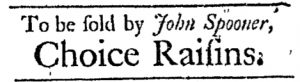
“To be sold by John Spooner, Choice Raisins.”

Considered on its own, John Spooner’s advertisement seems to do little by way of marketing. At a glance, this item appears to be merely an announcement. Its length – short enough to publish in a modern tweet (even a few days ago before Twitter doubled the numbers of characters) – did not allow Spooner to develop appeals to consumers, though he did make a nod toward quality by describing his raisins as “Choice.” The typography may have also drawn readers’ eyes, though the phrase “Choice Raisins” was no larger than the names of advertisers John Hunt, Henry Laughton, and Joshua Blanchard elsewhere on the same page.

The potential effectiveness of this advertisement cannot be understood by examining the copy and the layout alone. Taking into account its placement on the page relative to the specific content of other items, Spooner’s advertisement becomes much more powerful as an example of product placement in the eighteenth century.

Nov 16 - 11:16:1767 Recipe Boston Evening-Post
Boston Evening-Post (November 16, 1767).

It appeared in the middle column on the front page, immediately after a “Receipt

to make RAISIN WINE.” T. and J. Fleet, the printers of the Boston Evening-Post, reported that they were “desired to publish” the recipe “for the benefit of the public,” though they did not indicate who made that recommendation. While Spooner may not have had any influence on the layout of news items and advertisements, the placement of his advertisement for “Choice Raisins” right after the recipe for raisin wine certainly seems like more than a fortunate coincidence. It raises suspicions that Spooner may not have considered it necessary to devise more extensive copy because he planned to have the recipe do the necessary marketing to incite demand for his raisins.

Even though it appeared as a separate and distinct item, perhaps the recipe should be considered one portion of a slightly longer advertisement. Some of its instructions suggested that consumers needed to obtain raisins as soon as possible if they wished to make their own raisin wine. The first line advised that readers should begin the process in October or November. Given that it appeared in print midway through November, readers needed to make haste getting started. That included purchasing the necessary supplies, especially raisins. The recipe eventually acknowledged that the process “may be begun in February or March,” but concluded with an assertion that “the fall is the best time.” The recipe then almost seamlessly flowed into Spooner’s advertisement for “Choice Raisins.”

The placement of the recipe and Spooner’s advertisement suggests deliberate product placement in an eighteenth-century newspaper. On its own, Spooner’s notice does not appear particularly innovative, but when considered in the context it may very well have deployed the most sophisticated marketing strategy of any advertisement in that issues of the Boston Evening-Post.

Slavery Advertisements Published November 16, 1767

The Slavery Adverts 250 Project chronicles the role of newspaper advertising in perpetuating slavery in the era of the American Revolution. The project seeks to reveal the ubiquity of slavery in eighteenth-century life from New England to Georgia by republishing advertisements about enslaved people – for sale as individuals or in groups, wanted to purchase or for hire for short periods, runaways who liberated themselves, and those who were subsequently captured and confined in jails and workhouses – in daily digests on this site as well as in real time via the @SlaveAdverts250 Twitter feed, utilizing twenty-first-century media to stand in for the print media of the eighteenth century.

The project aims to provide modern audiences with a sense of just how often colonizers encountered these advertisements in their daily lives. Enslaved men, women, and children appeared in print somewhere in the colonies almost every single day. Those advertisements served as a constant backdrop for social, cultural, economic, and political life in colonial and revolutionary America. Colonizers who did not purport to own enslaved people were still confronted with slavery as well as invited to maintain the system by purchasing enslaved men, women, and children or assisting in the capture of so-called “runaways” who sought to free themselves from bondage. The frequency of these newspaper advertisements suggests just how embedded slavery was in colonial and revolutionary American culture in everyday interactions beyond the printed page.

These advertisements also testify to the experiences of enslaved men, women, and children, though readers must consider that those experiences have been remediated through descriptions offered by enslavers rather than enslaved people themselves. Often unnamed in the advertisements, enslaved men, women, and children were not invisible or unimportant in early America.

These advertisements appeared in colonial American newspapers 250 years ago today.

Nov 16 - Boston Evening-Post Slavery 1
Boston Evening-Post (November 16, 1767).

**********

Nov 16 - Boston Evening-Post Slavery 2
Boston Evening-Post (November 16, 1767).

**********

Nov 16 - Boston Evening-Post Slavery 3
Boston Evening-Post (November 16, 1767).

**********

Nov 16 - Boston Post-Boy Slavery 1
Boston Post-Boy (November 16, 1767).

**********

Nov 16 - Boston-Gazette Slavery 1
Boston-Gazette (November 16, 1767).

**********

Nov 16 - New-York Mercury Slavery 1
New-York Mercury (November 16, 1767).

**********

Nov 16 - New-York Mercury Slavery 2
New-York Mercury (November 16, 1767).

**********

Nov 16 - New-York Mercury Slavery 3
New-York Mercury (November 16, 1767).

**********

Nov 16 - New-York Mercury Slavery 4
New-York Mercury (November 16, 1767).

**********

Nov 16 - New-York Mercury Slavery 5
New-York Mercury (November 16, 1767).

**********

Nov 16 - New-York Mercury Slavery 6
New-York Mercury (November 16, 1767).

**********

Nov 16 - New-York Mercury Supplement Slavery 1
Supplement to the New-York Mercury (November 16, 1767).

**********

Nov 16 - New-York Mercury Supplement Slavery 2
Supplement to the New-York Mercury (November 16, 1767).

November 15

What was advertised in a colonial American newspaper 250 years ago this week?

Nov 15 - 11:12:1767 Virginia Gazette
Virginia Gazette (November 12, 1767).

“A large ASSORTMENT of STATIONARY.”

Purdie and Dixon’s advertisement reveals several aspects of consumer culture, commercial exchange, and everyday life in colonial America, yet when considered alone it tells only a partial story of print culture and advertising practices in the eighteenth century. When disembodied from the rest of the newspaper in which it appeared, this advertisement does not fully communicate how readers would have interacted with its visual aspects. Viewers get a sense of the typography – different font sizes, the selective use of italics and capitals, and the deployment of white space – but cannot compare those details to their treatment in other advertisements. Only in examining the entire page or the entire issue does the full significance of the typographical choices become apparent.

When viewing Purdie and Dixon’s notice in isolation, it would be natural to consider the size of the font throughout most of the advertisement to be the standard or default size. The quasi-headline “STATIONARY” stands out not only because it appeared in italics and capitals but especially because the compositor chose a font significantly larger than that used for the remainder of the text. Yet it would be a mistake to assume that font size replicated what was used in other advertisements in the same issue. Throughout the rest of the newspaper, both advertisements and news items appeared in a significantly smaller font, making them appear more dense and more difficult to read. By printing their advertisement in a larger font, Purdie and Dixon called special attention to it.

In addition, this advertisement occupied a privileged place in the November 12, 1767, edition of the Virginia Gazette. The four-page issue featured slightly over one page of news items; advertisements filled nearly three pages. About one-third of a column of news flowed onto the second page before a header for “Advertisements” indicated the purpose of the remaining content. Purdie and Dixon’s advertisement, with its larger font, appeared at the top of the second (and middle) column on the second page. This positioned it at the head of the first full column devoted to advertising, practically implying that the advertisements began there rather than at the header (printed with much smaller type). As a result of these typographical decisions, readers turning from the first to second page likely noticed Purdie and Dixon’s advertisement before their gaze landed anywhere else. Any readers who intended to continue perusing the news could hardly help but notice “STATIONARY” immediately to the right of what little news appeared on the second page. (Purdie and Dixon may have been especially keen to sell as much stationery as quickly as possible since the Townshend Act, which assessed new duties on imported paper, was scheduled to go into effect just eight days after their advertisement appeared.)

While it may be tempting to dismiss all of this as circumstantial, keep in mind that Alexander Purdie and John Dixon printed the Virginia Gazette. While they may not have set the type themselves, the compositor would have acted on their behalf as the publishers of the newspaper. The typography benefited their business interests in particular, an element that gets lost when viewing just their advertisement but not the entire page or the rest of the issue in which it appeared. As printers, they exercised power over what appeared in their publication, but they also exercised privilege in the presentation of the selected contents.

To examine the entire issue of the Virginia Gazette, visit Colonial Williamsburg’s Digital Library.

November 14

What was advertised in a colonial American newspaper 250 years ago today?

Nov 14 - 11:14:1767 Providence Gazette
Providence Gazette (November 14, 1767).

“He has two swift-sailing small Sloops, which ply constantly between Providence and Newport.”

Readers of the Providence Gazette encountered two advertisements for ferries between Providence and Newport on the final page of the November 14 edition. The operators adopted different strategies in promoting their services. Thomas Lindsey and Benjamin Lindsey inserted a short, streamlined advertisement to announce that their “STAGE-BOATS … ply twice a Week … with GOODS and PASSENGERS.” They made a nod toward customer service, assuring prospective customers that they “may depend on being faithfully served,” and concluded with standard language about the “excellent Accommodations for Passengers.” They dressed up their advertisement with a woodcut of a ship, which likely attracted attention since it was the only image that accompanied an advertisement in the entire issue.

Joshua Hacker devised a much more extensive advertisement. Even without a woodcut, its length and the table of fees distinguished it visually from the other advertisements on the same page. Hacker elaborated on many of the marketing appeals made by the Lindseys; he also launched additional appeals intended to convince prospective clients to choose him over his competitors. While the Lindseys sailed twice a week, Hacker’s sloops “set off every Day … Wind and Weather permitting.” Instead of using formulaic phrases that consistently appeared in other advertisements offering passage, Hacker expanded on the “exceeding good Accommodations,” promising that passengers “can be as comfortable on board … as in their Parlours.” Hacker did not merely reiterate stock phrases used in advertisements throughout the colonies. He exerted additional effort in writing copy to make it resonate with potential customers.

He also incorporated additional justifications for selecting his business over others. Not only did he make an appeal to price – “the very cheapest rates” – he provided a list of more than a dozen specific rates, including nine pence for a single passenger, three shillings for a four-wheeled carriage, and three shillings for a barrel of cargo. To cultivate customers, he also offered some services gratis. He informed those who wished to ship goods between the two ports that “he hath a convenient Store for depositing such Goods,” a warehouse where they would be stored for free. Hacker also made an appeal to his long experience, noting that he had “for upwards of ten Years, carried on this Business.”

Neither the Lindseys nor Hacker merely announced that they operated ferry and freight service between Providence and Newport. Both advanced appeals intended to make their businesses attractive to prospective clients, yet their approaches differed significantly. The Lindseys relied on methods already in use by their counterparts who advertised similar services in other colonial ports. Hacker, however, offered a much more innovative advertisement that further developed existing marketing strategies.