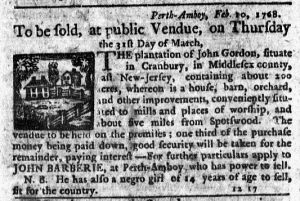
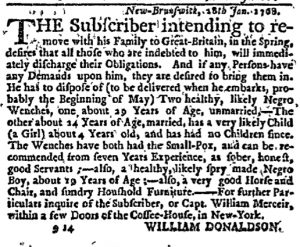
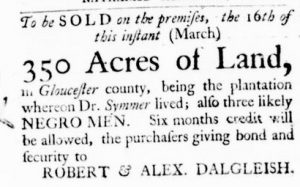
The Slavery Adverts 250 Project chronicles the role of newspaper advertising in perpetuating slavery in the era of the American Revolution. The project seeks to reveal the ubiquity of slavery in eighteenth-century life from New England to Georgia by republishing advertisements about enslaved people – for sale as individuals or in groups, wanted to purchase or for hire for short periods, runaways who liberated themselves, and those who were subsequently captured and confined in jails and workhouses – in daily digests on this site as well as in real time via the @SlaveAdverts250 Twitter feed, utilizing twenty-first-century media to stand in for the print media of the eighteenth century.
The project aims to provide modern audiences with a sense of just how often colonizers encountered these advertisements in their daily lives. Enslaved men, women, and children appeared in print somewhere in the colonies almost every single day. Those advertisements served as a constant backdrop for social, cultural, economic, and political life in colonial and revolutionary America. Colonizers who did not purport to own enslaved people were still confronted with slavery as well as invited to maintain the system by purchasing enslaved men, women, and children or assisting in the capture of so-called “runaways” who sought to free themselves from bondage. The frequency of these newspaper advertisements suggests just how embedded slavery was in colonial and revolutionary American culture in everyday interactions beyond the printed page.
These advertisements also testify to the experiences of enslaved men, women, and children, though readers must consider that those experiences have been remediated through descriptions offered by enslavers rather than enslaved people themselves. Often unnamed in the advertisements, enslaved men, women, and children were not invisible or unimportant in early America.
These advertisements appeared in colonial American newspapers 250 years ago today.
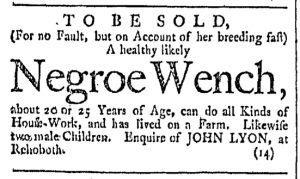
Boston Evening-Post (March 7, 1768).
**********
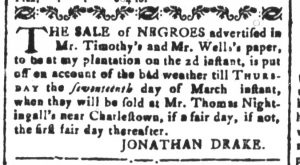
New-York Gazette and Weekly Mercury (March 7, 1768).
**********
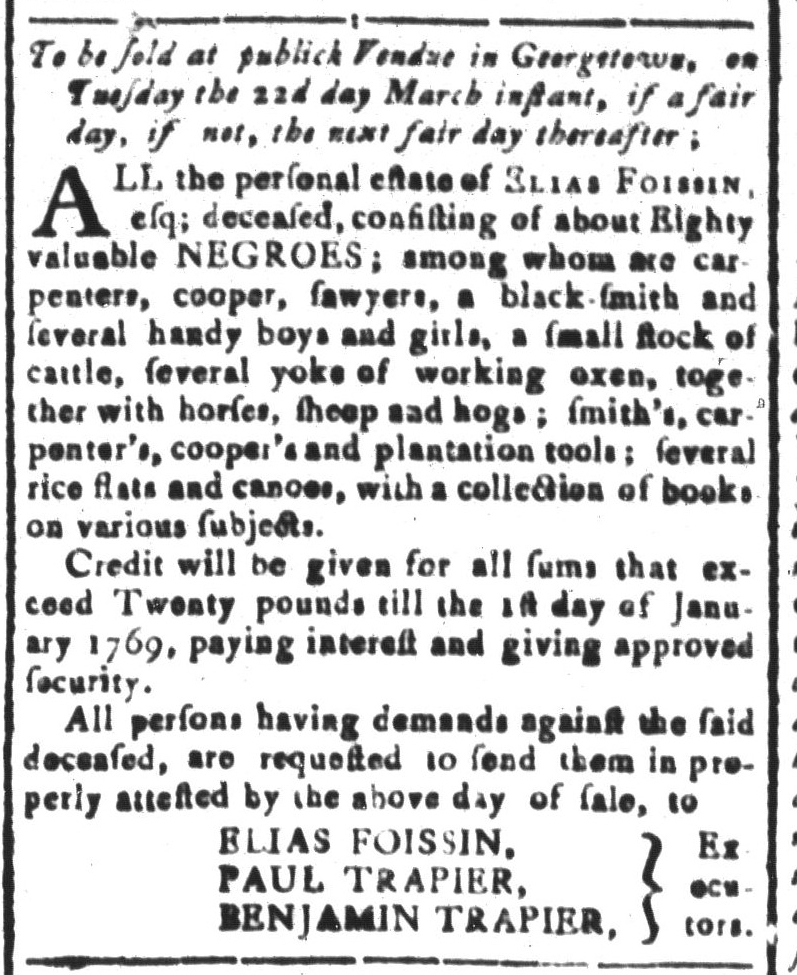
Supplement to New-York Gazette and Weekly Mercury (March 7, 1768).
**********
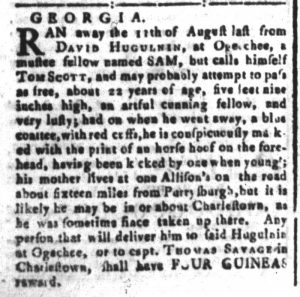
Supplement to New-York Gazette and Weekly Mercury (March 7, 1768).
**********
New-York Gazette: Or, the Weekly Post-Boy (March 7, 1768).
What was advertised in a colonial American newspaper 250 years ago this week?
South-Carolina and American General Gazette (March 4, 1768).
“To be sold on Tuesday the 8thof March … A Very valuable PLANTATION.”
Regular visitors to the Adverts 250 Project have likely noticed that six days of the week the project features an advertisement originally published 250 years ago that day but once a week it instead features an advertisement from 250 years ago that week. This reflects the publication schedule for newspapers in the colonial era. With the exception of the occasional supplements and extraordinary issues, printers distributed their newspapers once a week. Printers, however, chose which day of the week to publish their newspapers. Nearly half chose Monday, with a fair number also opting for Thursday or Friday. The rest selected Tuesday, Wednesday, or Saturday, but none published their newspaper on Sunday.
That explains why the Adverts 250 Project sometimes examines an advertisement published 250 years ago that week, but only once a week. For the past two years such entries have fallen on Wednesdays because those were the days that corresponded to the dates (rather than days of the week) of publication. In other words, consider this chart:
A date that falls on a Wednesday in 2018 fell on a Sunday in 1768.
A date that falls on a Thursday in 2018 fell on a Monday in 1768.
A date that falls on a Friday in 2018 fell on a Tuesday in 1768.
A date that falls on a Saturday in 2018 fell on a Wednesday in 1768.
A date that falls on a Sunday in 2018 fell on a Thursday in 1768.
A date that falls on a Monday in 2018 fell on a Friday in 1768.
A date that falls on a Tuesday in 2018 fell on a Saturday in 1768.
This held true for the first two months of 2018, but not after March 1. Why not? The year 1768 was a leap year. It included an extra day, February 29, that does not occur in 2018. Since February 28, 1768, fell on a Sunday, the Adverts 250 Project and the Slavery Adverts 250 Project conveniently treated February 28 and February 29 as a single day last week. Today is the first day that the shift caused by the leap day becomes readily apparent, especially for the Slavery Adverts 250 Project since it will no longer republish advertisements on Tuesdays instead of Wednesdays. Starting today, the revised publication chart looks like this:
A date that falls on a Tuesday in 2018 fell on a Sunday in 1768.
A date that falls on a Wednesday in 2018 fell on a Monday in 1768.
A date that falls on a Thursday in 2018 fell on a Tuesday in 1768.
A date that falls on a Friday in 2018 fell on a Wednesday in 1768.
A date that falls on a Saturday in 2018 fell on a Thursday in 1768.
A date that falls on a Sunday in 2018 fell on a Friday in 1768.
A date that falls on a Monday in 2018 fell on a Saturday in 1768.
This version will be accurate for the next two years. At the end of February 2020, however, it will need to be updated again. Actually, it will revert to the previous chart since 2020 will be a leap year. February 2020 will have a leap day that February 1770 did not, causing the shift to move one day in the other direction.
Both charts make it clear that the Adverts 250 Project is an On This Date project rather than an On This Day project. The analysis of the advertisements only occasionally acknowledges the day of the week that they were originally published, usually to provide context concerning eighteenth-century printing practices. This consideration of the distinction between the date and the day demonstrates yet another way that modern readers do not experience eighteenth-century newspapers in the same way as the original readers since any association with a particular day of the week has been largely removed in most instances. A unit of time that seems quite natural in 2018 – such as Sunday, March 4 through Saturday, March 10 – would have been deemed completely artificial in 1768 – Friday, March 4 through Thursday, March 10. That being said, such a week would have made perfect sense to the printers of the Connecticut Journal, the New-Hampshire Gazette, the New-London Gazette, and the South-Carolina and American General Gazette since they published their newspapers on Fridays. For almost everyone else, a week that ran Friday through Thursday would have seemed arbitrary. Most colonial newspapers included both the day and date of publication in their mastheads, but the former disappears from most citation practices. The day of publication is not imperative in creating a unique temporal identifier for specific issues of newspapers, but overlooking it completely does erase part of the experience of producing and reading newspapers in eighteenth-century America.
What was advertised in a colonial American newspaper 250 years ago today?
Providence Gazette (March 5, 1768).
“All persons … will not repent coming so far down town.”
Location! Location!! Location!!! Today many businesses promote the convenience associated with their location, but an awareness of the potential effect of location on the success of a business goes back to the colonial era. James Brown and Benoni Pearce, for instance, promoted their shops “On the West Side of the Great-Bridge” in Providence by advising that “their Customers coming from the Westward, may save both Time and Shoe-Leather” by visiting their establishments rather than crossing to the other side of the river to browse the wares sold by merchants and shopkeepers there.
Other entrepreneurs, however, admitted that their location might present certain disadvantages if potential customers considered them too far out of the way. In his advertisement in the March 5, 1768, edition of the Providence Gazette, Nicholas Cooke announced that he sold “a Quantity of Dry Goods” at his shop “At the lower End of the Town.” Cooke realized that being situated at the outskirts of town was not an ideal location. Attracting customers required making alternate marketing appeals, such as emphasizing consumer choice. In addition to highlighting his “Quantity of Dry Goods,” Cooke also deployed the word “assortment” to describe certain categories of merchandise: “An assortment of Irish linen, checks and stripes” and “a large and neat assortment of glass, stone and earthen ware.” He had so many of those housewares that he proclaimed his inventory was “too large to enumerate.” In addition, he also stocked “many other articles” sure to delight shoppers.
To further justify making the trip to “the lower End of the Town,” Cooke also explained that he offered prices that his competitors could not beat. He stated that because he “imported the above goods directly from England” that he “can afford them as cheap as can be sold by any in this place.” He promised customers a bargain, assuring them that they “will not repent coming so far down town.” Brown and Pearce also attempted to convince certain prospective customers to venture beyond the nearest shops. Those who resided “on the other Side” of the Great Bridge would not “save both Time and Shoe-Leather” by visiting their shops, but they would be “well paid for crossing the Pavements, and be kindly received and well used.”
Eighteenth-century shopkeepers sometimes promoted their location when doing so worked to their advantage, but they did not neglect to acknowledge when they were located in a spot that consumers might not consider ideal. In such instances, they attempted to convince prospective customers that a variety of other benefits outweighed the inconvenience of traveling farther to their shops.
The Slavery Adverts 250 Project chronicles the role of newspaper advertising in perpetuating slavery in the era of the American Revolution. The project seeks to reveal the ubiquity of slavery in eighteenth-century life from New England to Georgia by republishing advertisements about enslaved people – for sale as individuals or in groups, wanted to purchase or for hire for short periods, runaways who liberated themselves, and those who were subsequently captured and confined in jails and workhouses – in daily digests on this site as well as in real time via the @SlaveAdverts250 Twitter feed, utilizing twenty-first-century media to stand in for the print media of the eighteenth century.
The project aims to provide modern audiences with a sense of just how often colonizers encountered these advertisements in their daily lives. Enslaved men, women, and children appeared in print somewhere in the colonies almost every single day. Those advertisements served as a constant backdrop for social, cultural, economic, and political life in colonial and revolutionary America. Colonizers who did not purport to own enslaved people were still confronted with slavery as well as invited to maintain the system by purchasing enslaved men, women, and children or assisting in the capture of so-called “runaways” who sought to free themselves from bondage. The frequency of these newspaper advertisements suggests just how embedded slavery was in colonial and revolutionary American culture in everyday interactions beyond the printed page.
These advertisements also testify to the experiences of enslaved men, women, and children, though readers must consider that those experiences have been remediated through descriptions offered by enslavers rather than enslaved people themselves. Often unnamed in the advertisements, enslaved men, women, and children were not invisible or unimportant in early America.
These advertisements appeared in colonial American newspapers 250 years ago today.
What was advertised in a colonial American newspaper 250 years ago today?
South-Carolina and American General Gazette (March 4, 1768).
“LIVE WILD TURKIES.”
An advertisement seeking “LIVE WILD TURKIES” occupied a strange place on the sixth and final page of the March 4, 1768, edition of the South-Carolina and American General Gazette. The text was rotated and printed near the bottom of the page, nestled between another advertisement and the colophon that advised readers that the newspaper had been “Printed by ROBERT WELLS, at the Old Printing-House, Bookseller’s and Stationer’s Shop on the BAY.” Indeed, this advertisement was one of several that gave the page a strange appearance, though one not completely uncommon in eighteenth-century newspapers. In an attempt to squeeze as much content as possible onto the fifth and sixth pages, two sides of a single sheet, the compositor had rotated several advertisements already set in type. This created a fourth column of text perpendicular to the other three columns on the page.
Compositors deployed this trick when using paper that deviated from the usual size for their newspapers. Although the digitized images of the South-Carolina and American General Gazette are not supplemented with metadata that indicates the measurements of each page, it is possible to reach some reasonable conclusions through close examination of the contents. First, this newspaper usually ran four columns per page. That was the case for the first four pages of the March 4 issue, all of which would have been printed on a single sheet and folded in half to yield four distinct pages. The fifth and sixth pages, however, featured only three columns plus the narrow column of rotated text. Viewed on a screen as part of a database of digitized images of eighteenth-century newspapers, the fourth page and the sixth page appear the same size. When printing those images, both take on the standard size of a sheet of office paper. Further examination of the contents, however, suggests that the originals were different sizes. Upon comparing several advertisements on the fifth and sixth pages of the March 4 issue to their appearance in previous issues, it seems that the compositor used type that had already been set when preparing the new pages. The sheet must have been smaller, wide enough for only three columns with just enough space to rotate some of the short advertisements and squeeze them into an extra narrow column at the edge of the page. Not wanting to waste any space, the compositor did have to set two advertisements, each approximately half as wide as the standard column. The advertisement concerning “LIVE WILD TURKIES” thus found a spot near the bottom of the sixth page. Another advertisement of a similar size mirrored its location on the other side of the sheet, that one announcing “To be Let, A Genteel LODGING ROOM and a very good Cellar, by WILLIAM GOWDEY.”
The last two pages of the March 4 issue may appear unusual to twenty-first century eyes, but eighteenth-century readers would have been familiar with this strategy. The printer and compositor of the South-Carolina and American General Gazette selected a sheet just large enough to contain the news and advertisements for publication that week. At a time when imported paper was taxed under the Townshend Act, this may have been an especially important method of lowering the costs of publication.
Final page of the March 4, 1768, edition of the South-Carolina and American General Gazette.
The Slavery Adverts 250 Project chronicles the role of newspaper advertising in perpetuating slavery in the era of the American Revolution. The project seeks to reveal the ubiquity of slavery in eighteenth-century life from New England to Georgia by republishing advertisements about enslaved people – for sale as individuals or in groups, wanted to purchase or for hire for short periods, runaways who liberated themselves, and those who were subsequently captured and confined in jails and workhouses – in daily digests on this site as well as in real time via the @SlaveAdverts250 Twitter feed, utilizing twenty-first-century media to stand in for the print media of the eighteenth century.
The project aims to provide modern audiences with a sense of just how often colonizers encountered these advertisements in their daily lives. Enslaved men, women, and children appeared in print somewhere in the colonies almost every single day. Those advertisements served as a constant backdrop for social, cultural, economic, and political life in colonial and revolutionary America. Colonizers who did not purport to own enslaved people were still confronted with slavery as well as invited to maintain the system by purchasing enslaved men, women, and children or assisting in the capture of so-called “runaways” who sought to free themselves from bondage. The frequency of these newspaper advertisements suggests just how embedded slavery was in colonial and revolutionary American culture in everyday interactions beyond the printed page.
These advertisements also testify to the experiences of enslaved men, women, and children, though readers must consider that those experiences have been remediated through descriptions offered by enslavers rather than enslaved people themselves. Often unnamed in the advertisements, enslaved men, women, and children were not invisible or unimportant in early America.
These advertisements appeared in colonial American newspapers 250 years ago today.
South-Carolina and American General Gazette (March 4, 1768).
**********
South-Carolina and American General Gazette (March 4, 1768).
**********
South-Carolina and American General Gazette (March 4, 1768).
**********
South-Carolina and American General Gazette (March 4, 1768).
**********
South-Carolina and American General Gazette (March 4, 1768).
**********
South-Carolina and American General Gazette (March 4, 1768).
**********
South-Carolina and American General Gazette (March 4, 1768).
**********
South-Carolina and American General Gazette (March 4, 1768).
**********
South-Carolina and American General Gazette (March 4, 1768).
**********
South-Carolina and American General Gazette (March 4, 1768).
**********
South-Carolina and American General Gazette (March 4, 1768).
**********
South-Carolina and American General Gazette (March 4, 1768).
**********
South-Carolina and American General Gazette (March 4, 1768).
**********
South-Carolina and American General Gazette (March 4, 1768).
What was advertised in a colonial American newspaper 250 years ago today?
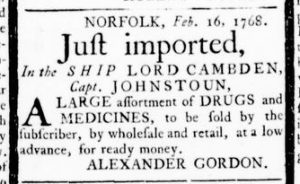
Virginia Gazette [Rind] (March 3, 1768).“Just imported … A LARGE assortment of DRUGS and MEDICINES.”
All of the advertisements in the March 3, 1768, edition of William Rind’s Virginia Gazette included a unique visual feature: bold lines on either side of either side of the column. The advertisements, however, were not the only content that received this treatment. Throughout the entire issue, from the first page to the last, such lines separated all of the columns of news, essays, advertisements, and other items. Why?
Virginia Gazette [Purdie & Dixon] (March 3, 1768).These heavy lines were a typographical convention that expressed mourning. Francis Fauquier, the lieutenant governor of the Virginia colony who had served as acting governor in the absence of the Earl of Loudon and Jeffery Amherst for the past decade, died on March 3, 1768. Rind honored him by transforming the usual appearance of his newspaper. Readers knew at a glance that someone important had passed away. The announcement appeared on the second page, made even easier to locate because it was the only item in the entire issue that also had wide lines printed above and below. An outline composed of printing ornaments enclosed the announcement, further distinguishing it from the other content. Alexander Purdie and John Dixon also marked Fauquier’s death in their Virginia Gazette, though they restricted the typographical intervention to a box that enclosed the announcement. The visual aspects of the remainder of their newspaper did not deviate from standard practices. Still, their treatment of Fauquier was exceptional. Death notices for colonists regularly appeared in eighteenth-century newspapers, but only the most influential were demarcated in this manner.
Virginia Gazette [Rind] (March 3, 1768).Colonists sometimes adapted this convention for other purposes. The day before the Stamp Act went into effect, for instance, Benjamin Franklin and David Hall enclosed the first and last pages of the October 31, 1765, edition of the Pennsylvania Gazette with dark and heavy lines as a symbol of mourning for the rights colonists lost at the hands of Parliament. A single news item on the third page received similar typographical treatment. It lamented “the most UNCONSTITUTIONAL ACT that ever these Colonies could have imagined, to wit, The STAMP ACT.”
Although Fauquier had dissolved the House of Burgesses when members passed several resolutions in opposition to the Stamp Act, he also gained a reputation for being sympathetic to the colonists and often advocated in their interests. Issues of both newspapers that bore the name Virginia Gazette that announced his death also included the eighth letter from John Dickinson’s series of “Letters from a Farmer in Pennsylvania.” The bold lines of mourning in Rind’s newspaper ran alongside this letter from “A FARMER.” As much as colonists mourned the loss of a popular acting governor, many likely also considered it appropriate that the typography of mourning extended to Dickinson’s essay about taxation without representation, not unlike Franklin and Hall’s treatment of the Stamp Act a few years earlier.
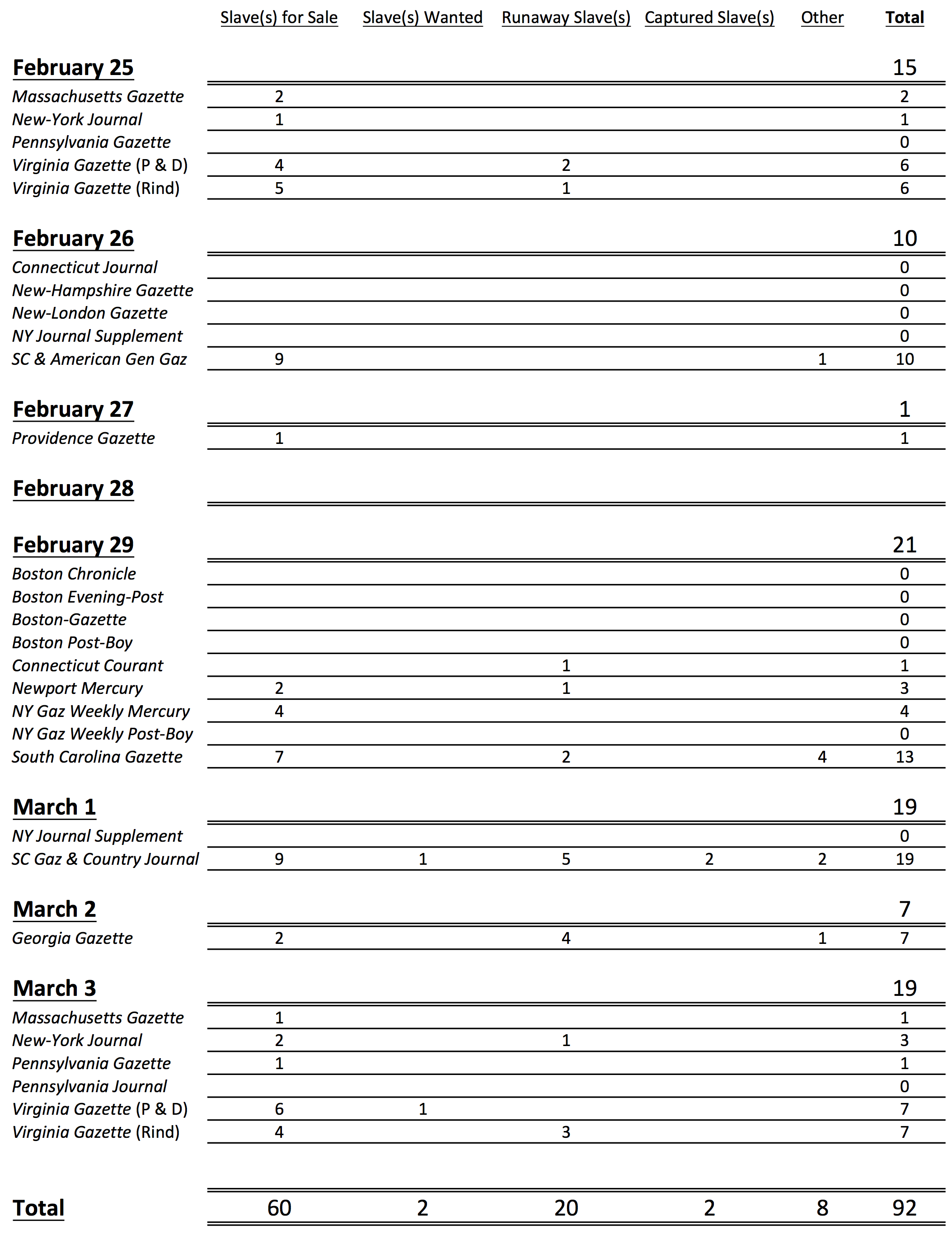
These tables indicate how many advertisements for slaves appeared in colonial American newspapers during the week of February 25 – March 3, 1768.
Note: These tables are as comprehensive as currently digitized sources permit, but they may not be an exhaustive account. They includes all newspapers that have been digitized and made available via Accessible Archives, Colonial Williamsburg’s Digital Library, and Readex’s America’s Historical Newspapers. There are several reasons some newspapers may not have been consulted:
Issues that are no longer extant;
Issues that are extant but have not yet been digitized (including the Pennsylvania Journal); and
Newspapers published in a language other than English (including the Wochentliche Philadelphische Staatsbote).
**********
Slavery Advertisements Published February 25 – March 3, 1768: By Date
**********
Slavery Advertisements Published February 25 – March 3, 1768: By Region
The Slavery Adverts 250 Project chronicles the role of newspaper advertising in perpetuating slavery in the era of the American Revolution. The project seeks to reveal the ubiquity of slavery in eighteenth-century life from New England to Georgia by republishing advertisements about enslaved people – for sale as individuals or in groups, wanted to purchase or for hire for short periods, runaways who liberated themselves, and those who were subsequently captured and confined in jails and workhouses – in daily digests on this site as well as in real time via the @SlaveAdverts250 Twitter feed, utilizing twenty-first-century media to stand in for the print media of the eighteenth century.
The project aims to provide modern audiences with a sense of just how often colonizers encountered these advertisements in their daily lives. Enslaved men, women, and children appeared in print somewhere in the colonies almost every single day. Those advertisements served as a constant backdrop for social, cultural, economic, and political life in colonial and revolutionary America. Colonizers who did not purport to own enslaved people were still confronted with slavery as well as invited to maintain the system by purchasing enslaved men, women, and children or assisting in the capture of so-called “runaways” who sought to free themselves from bondage. The frequency of these newspaper advertisements suggests just how embedded slavery was in colonial and revolutionary American culture in everyday interactions beyond the printed page.
These advertisements also testify to the experiences of enslaved men, women, and children, though readers must consider that those experiences have been remediated through descriptions offered by enslavers rather than enslaved people themselves. Often unnamed in the advertisements, enslaved men, women, and children were not invisible or unimportant in early America.
These advertisements appeared in colonial American newspapers 250 years ago today.
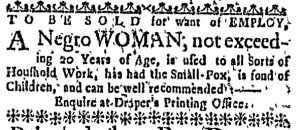
Massachusetts Gazette (March 3, 1768).
**********
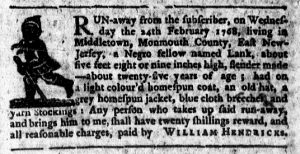
New-York Journal (March 3, 1768).
**********
New-York Journal (March 3, 1768).
**********
Supplement to the New-York Journal (March 3, 1768).
Who was the subject of an advertisement in a colonial American newspaper 250 years ago today?
Georgia Gazette (March 2, 1768).
“Any person that may bring me his head, hand, or foot, after that time, shall be rewarded.”
To one extent or another, each newspaper advertisement concerning slaves testified to a horrific system of bondage, but Joseph Gibbons’s notice concerning Limus, a runaway, exhibited even greater brutality than most. In several consecutive issues of the Georgia Gazette, Gibbons presented a proposition for the fugitive: “If the said Limus will return to his duty in ten days he shall not be whipped, but if not, any person that may bring me his head, hand, or foot, after that time, shall be rewarded.” Most slaveholders called on others to assist in the capture of runaways, promising rewards for the safe return of their human property. They did not usually mention any consequences the runaways might eventually endure. Gibbons, on the other hand, did not reserve inflicting punishments on Limus as his sole domain. Instead, he encouraged the dismemberment or even murder of the runaway.
That Gibbons extended an alternative to this ruthless punishment indicates that he expected that Limus had some sort of access to information that appeared in the colony’s only newspaper. Why attempt to strike a bargain that if Limus “will return to his duty in ten days he shall not be whipped” unless he believed that some combination of reading and conversation would eventually transmit his terms to the runaway? The merciless threat of rewarding “any person that may bring his head, hand, or foot” after the deadline had passed also would have worked more effectively if Gibbons anticipated that Limus would become aware of it. These stark choices were designed to terrorize and persuade the fugitive to return of his own accord, but they depended on overlapping networks of white and black colonists spreading news via print and word of mouth. Even though the vast majority of slaves were not literate, they still had means of acquiring and sharing news in early America. Even though white colonists may not have always been aware or attempted to downplay how much slaves knew about the contents of newspapers, some of them did acknowledge that slaves did indeed have access to information that appeared in the public prints.