March 11

What was advertised in a colonial American newspaper 250 years ago today?

Mar 11 - 3:11:1768 New-London Gazette
New-London Gazette (March 11, 1768).

“The Cutler’s or Whitesmith’s business is still carried on at my shop, and in a much steadier and careful manner than usual.”

As spring approached in 1768, Benjamin Butler, a cutler, needed to do some damage control or risk losing business to his competitors. A journeyman employed in his workshop had tarnished Butler’s reputation by producing inferior goods, causing Butler to take out an advertisement in the New-London Gazette to explain the situation. He hoped to convince prospective customers to give his workshop another chance now that he had remedied the problem.

After announcing that “the Cutler’s or Whitesmith’s business is still carried on at my shop,” Butler declared that work currently undertaken in the shop was completed “in a much steadier and careful manner than usual.” Here he already acknowledged that quality had been lacking for some time, but he then provided an explanation. For several months he had turned over the operation of the shop “to a journeyman, that was great part of his time incapable of performing good work.” Butler did not pull any punches about the reason the journeyman produced shoddy work: “strong drink.” Having made this confession, the cutler petitioned prospective customers to wipe clean the slate. He had resumed doing the jobs that came into the workshop himself. That being the case, he assured “Those who will favour me with their custom” that they could “depend upon being served in the best manner.”

Butler addressed his advertisement to “the public” rather than his former customers. Although he may have contacted some of them individually to make amends, he wanted the entire community to know that he was aware of the problem in his workshop and had addressed it. After all, customers could spread news of their discontent via word of mouth. In case that had happened, Butler harnessed the power of print in his efforts to dispel any lasting harm to his image. By issuing a mea culpa in a newspaper advertisement distributed far and wide in the colony, he encouraged prospective customers not to dismiss his workshop when they had need of a cutler’s services in the future. In this case, Butler advertised not only to incite demand but also to rehabilitate the reputation associated with the goods that came out of his workshop.

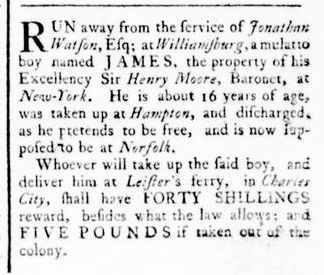
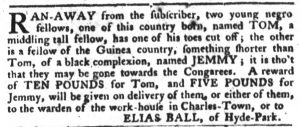
Slavery Advertisements Published March 11, 1768

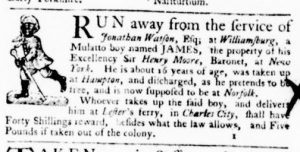
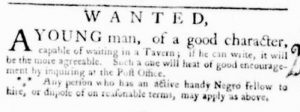
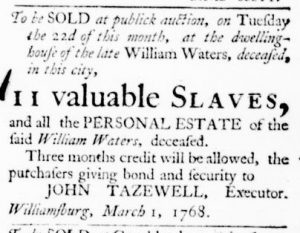
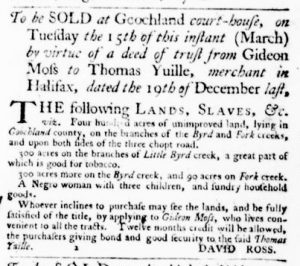
The Slavery Adverts 250 Project chronicles the role of newspaper advertising in perpetuating slavery in the era of the American Revolution. The project seeks to reveal the ubiquity of slavery in eighteenth-century life from New England to Georgia by republishing advertisements about enslaved people – for sale as individuals or in groups, wanted to purchase or for hire for short periods, runaways who liberated themselves, and those who were subsequently captured and confined in jails and workhouses – in daily digests on this site as well as in real time via the @SlaveAdverts250 Twitter feed, utilizing twenty-first-century media to stand in for the print media of the eighteenth century.

The project aims to provide modern audiences with a sense of just how often colonizers encountered these advertisements in their daily lives. Enslaved men, women, and children appeared in print somewhere in the colonies almost every single day. Those advertisements served as a constant backdrop for social, cultural, economic, and political life in colonial and revolutionary America. Colonizers who did not purport to own enslaved people were still confronted with slavery as well as invited to maintain the system by purchasing enslaved men, women, and children or assisting in the capture of so-called “runaways” who sought to free themselves from bondage. The frequency of these newspaper advertisements suggests just how embedded slavery was in colonial and revolutionary American culture in everyday interactions beyond the printed page.

These advertisements also testify to the experiences of enslaved men, women, and children, though readers must consider that those experiences have been remediated through descriptions offered by enslavers rather than enslaved people themselves. Often unnamed in the advertisements, enslaved men, women, and children were not invisible or unimportant in early America.

These advertisements appeared in colonial American newspapers 250 years ago today.

Mar 11 - New-London Gazette Slavery 1
New-London Gazette (March 11, 1768).

**********

Mar 11 - South-Carolina and American General Gazette Slavery 1
South-Carolina and American General Gazette (March 11, 1768).

**********

Mar 11 - South-Carolina and American General Gazette Slavery 2
South-Carolina and American General Gazette (March 11, 1768).

**********

Mar 11 - South-Carolina and American General Gazette Slavery 3
South-Carolina and American General Gazette (March 11, 1768).

**********

Mar 11 - South-Carolina and American General Gazette Slavery 4
South-Carolina and American General Gazette (March 11, 1768).

**********

Mar 11 - South-Carolina and American General Gazette Slavery 5
South-Carolina and American General Gazette (March 11, 1768).

**********

Mar 11 - South-Carolina and American General Gazette Slavery 6
South-Carolina and American General Gazette (March 11, 1768).

**********

Mar 11 - South-Carolina and American General Gazette Slavery 7
South-Carolina and American General Gazette (March 11, 1768).

**********

Mar 11 - South-Carolina and American General Gazette Slavery 8
South-Carolina and American General Gazette (March 11, 1768).

**********

Mar 11 - South-Carolina and American General Gazette Slavery 9
South-Carolina and American General Gazette (March 11, 1768).

**********

Mar 11 - South-Carolina and American General Gazette Slavery 10
South-Carolina and American General Gazette (March 11, 1768).

**********

Mar 11 - South-Carolina and American General Gazette Slavery 11
South-Carolina and American General Gazette (March 11, 1768).

**********

Mar 11 - South-Carolina and American General Gazette Slavery 12
South-Carolina and American General Gazette (March 11, 1768).

**********

Mar 11 - South-Carolina and American General Gazette Slavery 13
South-Carolina and American General Gazette (March 11, 1768).

**********

Mar 11 - South-Carolina and American General Gazette Slavery 14
South-Carolina and American General Gazette (March 11, 1768).

**********

Mar 11 - South-Carolina and American General Gazette Slavery 15
South-Carolina and American General Gazette (March 11, 1768).

**********

Mar 11 - South-Carolina and American General Gazette Slavery 16
South-Carolina and American General Gazette (March 11, 1768).

March 10

What was advertised in a colonial American newspaper 250 years ago today?

Mar 10 - 3:10:1768 Virginia Gazette Purdie and Dixon
Virginia Gazette [Purdie & Dixon] (March 10, 1768).
“SAGATHIES, duroys, grandurells.”

In March 1768, John Carter advertised dozens of items in stock at his store in Williamsburg, placing identical notices in the Virginia Gazette published by Alexander Purdie and John Dixon and the Virginia Gazette published by William Rind. His inventory included an array of textiles, among them “SAGATHIES, duroys, grandurells, … black silk satinet, black velverets, black and coloured jennets, silk damascus, … nankeen, India dimity, … [and] warpt and stript hollands.” The names of fabrics on this list seem incomprehensible to most twenty-first-century readers, but they would have been quite familiar to eighteenth-century readers and consumers throughout the British Atlantic world. Merchants and shopkeepers from New England to Georgia published similar lists in the advertisements they inserted in local newspapers.

Wholesalers and retailers distributed such lists with full confidence that their prospective customers understood this language of consumption. They knew that readers possessed such familiarity with imported textiles that they could make distinctions between, for instance, duroys and jennets, without needing additional explanation in the advertisements. They expected that consumers could assess the relative cost and quality of certain fabrics from the names alone. In turn, both sellers and prospective customers conceived of a hierarchy of textiles tied to the status of those who most often purchased or donned them. For example, they associated certain textiles, such as osnaburgs, with laboring and enslaved people, fully aware that middling sorts and the gentry had the means to avoid such coarse fabric.

Phrases like “blue cambrick handkerchiefs” and “yellow flowered serges for table covers” might not conjure particularly vivid images for modern readers, but they would have for the colonists who read Carter’s advertisement in the 1760s. Colonial consumers would have been able to imagine not only the appearance of these and other items but also how they felt to touch or to wear. This testifies to how actively colonists participated in the consumer revolution of the eighteenth century, acquiring both goods and knowledge of an extensive assortment of items available in the marketplace.

Summary of Slavery Advertisements Published March 4-10, 1768

These tables indicate how many advertisements for slaves appeared in colonial American newspapers during the week of March 4-10, 1768.

Note:  These tables are as comprehensive as currently digitized sources permit, but they may not be an exhaustive account.  They includes all newspapers that have been digitized and made available via Accessible Archives, Colonial Williamsburg’s Digital Library, and Readex’s America’s Historical Newspapers.  There are several reasons some newspapers may not have been consulted:

  • Issues that are no longer extant;
  • Issues that are extant but have not yet been digitized (including the Pennsylvania Journal); and
  • Newspapers published in a language other than English (including the Wochentliche Philadelphische Staatsbote).

**********

Slavery Advertisements Published March 4-10, 1768:  By Date

Slavery Adverts Tables 1768 By Date Mar 4

**********

Slavery Advertisements Published March 4-10, 1768:  By Region

Slavery Adverts Tables 1768 By Region Mar 4

Slavery Advertisements Published March 10, 1768

The Slavery Adverts 250 Project chronicles the role of newspaper advertising in perpetuating slavery in the era of the American Revolution. The project seeks to reveal the ubiquity of slavery in eighteenth-century life from New England to Georgia by republishing advertisements about enslaved people – for sale as individuals or in groups, wanted to purchase or for hire for short periods, runaways who liberated themselves, and those who were subsequently captured and confined in jails and workhouses – in daily digests on this site as well as in real time via the @SlaveAdverts250 Twitter feed, utilizing twenty-first-century media to stand in for the print media of the eighteenth century.

The project aims to provide modern audiences with a sense of just how often colonizers encountered these advertisements in their daily lives. Enslaved men, women, and children appeared in print somewhere in the colonies almost every single day. Those advertisements served as a constant backdrop for social, cultural, economic, and political life in colonial and revolutionary America. Colonizers who did not purport to own enslaved people were still confronted with slavery as well as invited to maintain the system by purchasing enslaved men, women, and children or assisting in the capture of so-called “runaways” who sought to free themselves from bondage. The frequency of these newspaper advertisements suggests just how embedded slavery was in colonial and revolutionary American culture in everyday interactions beyond the printed page.

These advertisements also testify to the experiences of enslaved men, women, and children, though readers must consider that those experiences have been remediated through descriptions offered by enslavers rather than enslaved people themselves. Often unnamed in the advertisements, enslaved men, women, and children were not invisible or unimportant in early America.

These advertisements appeared in colonial American newspapers 250 years ago today.

Mar 10 - Massachusetts Gazette Supplement Slavery 1
Supplement to the Massachusetts Gazette (March 10, 1768).

**********

Mar 10 - Massachusetts Gazette Supplement Slavery 2
Supplement to the Massachusetts Gazette (March 10, 1768).

**********

Mar 10 - New-York Journal Slavery 1
New-York Journal (March 10, 1768).

**********

Mar 10 - New-York Journal Slavery 2
New-York Journal (March 10, 1768).

**********

Mar 10 - New-York Journal Slavery 3
New-York Journal (March 10, 1768).

**********

Mar 10 - New-York Journal Slavery 4
New-York Journal (March 10, 1768).

**********

Mar 10 - Pennsylvania Gazette Slavery 1
Pennsylvania Gazette (March 10, 1768).

**********

Mar 10 - Pennsylvania Gazette Slavery 2
Pennsylvania Gazette (March 10, 1768).

**********

Mar 10 - Pennsylvania Gazette Supplement Slavery 1
Supplement to the Pennsylvania Gazette (March 10, 1768).

**********

Mar 10 - Virginia Gazette Purdie and Dixon Slavery 1
Virginia Gazette [Purdie & Dixon] (March 10, 1768).

**********

Mar 10 - Virginia Gazette Purdie and Dixon Slavery 2
Virginia Gazette [Purdie & Dixon] (March 10, 1768).

**********

Mar 10 - Virginia Gazette Purdie and Dixon Slavery 3
Virginia Gazette [Purdie & Dixon] (March 10, 1768).

**********

Mar 10 - Virginia Gazette Purdie and Dixon Slavery 4
Virginia Gazette [Purdie & Dixon] (March 10, 1768).

**********

Mar 10 - Virginia Gazette Purdie and Dixon Slavery 5
Virginia Gazette [Purdie & Dixon] (March 10, 1768).

**********

Mar 10 - Virginia Gazette Purdie and Dixon Slavery 6
Virginia Gazette [Purdie & Dixon] (March 10, 1768).

**********

Mar 10 - Virginia Gazette Rind Slavery 1
Virginia Gazette [Rind] (March 10, 1768).

**********

Mar 10 - Virginia Gazette Rind Slavery 2
Virginia Gazette [Rind] (March 10, 1768).

**********

Mar 10 - Virginia Gazette Rind Slavery 3
Virginia Gazette [Rind] (March 10, 1768).

**********

Mar 10 - Virginia Gazette Rind Slavery 4
Virginia Gazette [Rind] (March 10, 1768).

**********

Mar 10 - Virginia Gazette Rind Slavery 5
Virginia Gazette [Rind] (March 10, 1768).

**********

Mar 10 - Virginia Gazette Rind Slavery 6
Virginia Gazette [Rind] (March 10, 1768).

March 9

What was advertised in a colonial American newspaper 250 years ago today?

Mar 9 - 3:9:1768 Georgia Gazette
Georgia Gazette (March 9, 1768).

“Credit will be given till next crop for the land.”

After acquiring a wharf and storehouse in the summer of 1766, William Moore turned to the Georgia Gazette to advertise the goods that passed through his “factorage business.” His notices usually included several commodities imported from the Caribbean, including sugar, molasses, and “Jamaica, Barbados, and Antiqua Rum,” but he also acquired and sold grocery items, maritime supplies, and other goods from both the mainland and Europe. He did not specify any particular method of payment in his advertisement in the March 9, 1768, edition of the Georgia Gazette, only mentioning that “The above articles … will be disposed of on very reasonable terms.” By implication, Moore expected to be paid in cash, especially considering the terms he set for the sale of a “TRACT of LAND … about seven miles from town.” However, the structure of the advertisement suggested that there might be room for negotiation.

Moore’s advertisement had three parts. The first announced the land for sale, noting that the parcel consisted of 350 acres “of which about 100 acres are cleared and under good fence.” The second part listed the goods “to be sold by the subscriber, at his wharf” in Savannah. Moore had revised an advertisement he previously inserted in the Georgia Gazette, one devoted exclusively to the commodities available “AT HIS WHARF.” In it, he had specified that he sold these items “on very reasonable terms for cash.” Like many other merchants and shopkeepers, Moore had become wary of extending credit to customers. The third part of his new advertisement consisted of a single line, a nota bene that advised prospective buyers that “Credit will be given till next crop for the land.” Here it seemed as though Moore made a distinction between the terms he was willing to extend to someone who purchased the land and the terms for buying his commodities. He did not explicitly mention paying in cash for those goods, but he also did not make a point of offering the same credit that he was willing to consider for the land.

The structure of the advertisement presented mixed messages, perhaps by design. Why did Moore choose to append a nota bene about credit for the land purchase? Why had he not mentioned this option in the first part of the advertisement, the portion that described the land? It seemed artificial to separate the description of the land and the terms for payment. Perhaps Moore positioned the information about accepting credit for the land immediately after describing the commodities he sold at his wharf as a means of underscoring that he expected to be paid in cash for the latter. On the other hand, even if he preferred cash he may have opted not to mention it explicitly and positioned his comment about credit strategically as a means of inviting those who believed they were in a good position to secure credit to broach the subject. Through the structure of his advertisement, Moore implied the possibility of credit without extending a blanket invitation to every prospective customer who read the Georgia Gazette.

Slavery Advertisements Published March 9, 1768

The Slavery Adverts 250 Project chronicles the role of newspaper advertising in perpetuating slavery in the era of the American Revolution. The project seeks to reveal the ubiquity of slavery in eighteenth-century life from New England to Georgia by republishing advertisements about enslaved people – for sale as individuals or in groups, wanted to purchase or for hire for short periods, runaways who liberated themselves, and those who were subsequently captured and confined in jails and workhouses – in daily digests on this site as well as in real time via the @SlaveAdverts250 Twitter feed, utilizing twenty-first-century media to stand in for the print media of the eighteenth century.

The project aims to provide modern audiences with a sense of just how often colonizers encountered these advertisements in their daily lives. Enslaved men, women, and children appeared in print somewhere in the colonies almost every single day. Those advertisements served as a constant backdrop for social, cultural, economic, and political life in colonial and revolutionary America. Colonizers who did not purport to own enslaved people were still confronted with slavery as well as invited to maintain the system by purchasing enslaved men, women, and children or assisting in the capture of so-called “runaways” who sought to free themselves from bondage. The frequency of these newspaper advertisements suggests just how embedded slavery was in colonial and revolutionary American culture in everyday interactions beyond the printed page.

These advertisements also testify to the experiences of enslaved men, women, and children, though readers must consider that those experiences have been remediated through descriptions offered by enslavers rather than enslaved people themselves. Often unnamed in the advertisements, enslaved men, women, and children were not invisible or unimportant in early America.

These advertisements appeared in colonial American newspapers 250 years ago today.

Mar 9 - Georgia Gazette Slavery 1
Georgia Gazette (March 9, 1768).

**********

Mar 9 - Georgia Gazette Slavery 2
Georgia Gazette (March 9, 1768).

**********

Mar 9 - Georgia Gazette Slavery 3
Georgia Gazette (March 9, 1768).

**********

Mar 9 - Georgia Gazette Slavery 4
Georgia Gazette (March 9, 1768).

**********

Mar 9 - Georgia Gazette Slavery 5
Georgia Gazette (March 9, 1768).

March 8

What was advertised in a colonial American newspaper 250 years ago today?

Mar 8 - 3:8:1768 South-Carolina Gazette and Country Journal
Addition to the South-Carolina Gazette and Country Journal (March 8, 1768).

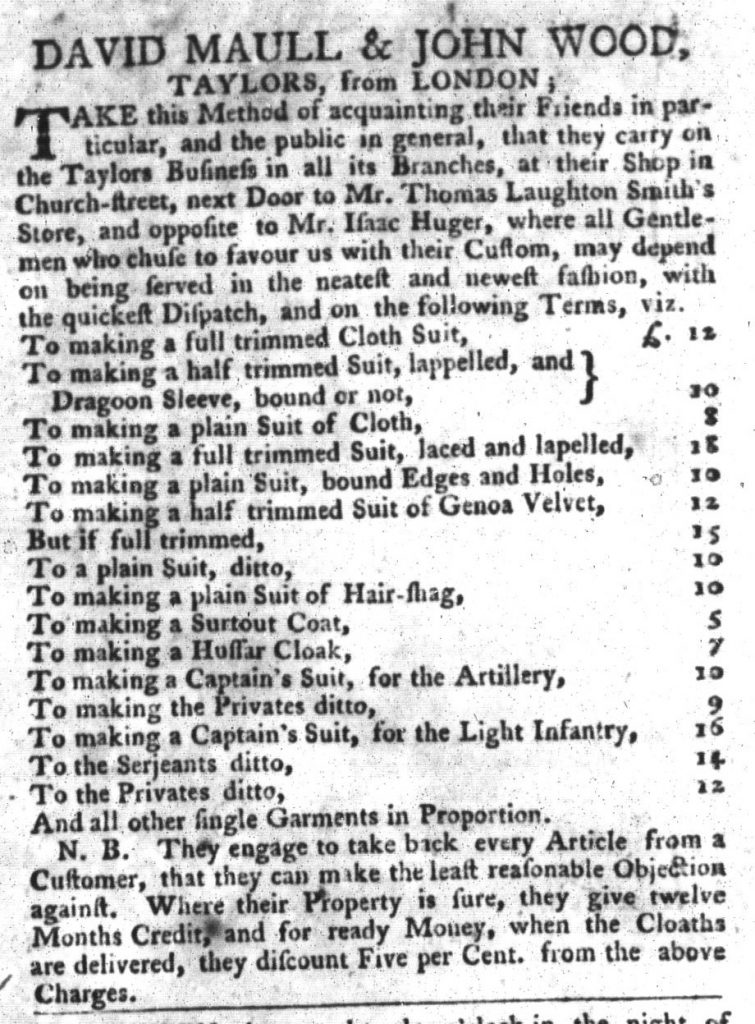
“They carry on the Taylors Business in all its Branches.”

David Maull and John Wood’s advertisement was one of nearly a dozen that appeared in the two-page Addition to the South-Carolina Gazette and Country Journal published by Charles Crouch on March 8, 1768. It accompanied the regular four-page issue of that newspaper and a two-page Supplement. Crouch distributed supplements so often that many readers may have come to expect them as standard, made necessary by the number of advertisements submitted to the printing office. Indeed, the supplements usually contained advertising exclusively, even when advertisements accounted for nearly half of the space in regular issues.

The Addition, however, did not follow this pattern. Only two of the six columns (three on each side of the halfsheet) were filled with advertising. The ninth of John Dickinson’s “LETTERS from a FARMER in PENNSYLVANIA, to the Inhabitants of the BRITISH COLONIES” occupied nearly the entire first page. In it, the “FARMER” explained the necessity of local representation in firmly established assemblies. The Addition also included news from Boston and Philadelphia as well as a poem, “The Batchelor’s Reasons for taking a Wife.”

What Crouch termed an Addition his counterparts in other cities and towns usually called an Extraordinary in their efforts to distinguish such publications from the more common supplements often distributed with the standard issues of their newspapers. Whatever the nomenclature, Crouch’s Addition of March 8, 1768, further establishes a pattern. During the period of the imperial crisis between the imposition of the Stamp Act in 1765 and the outbreak of military hostilities in 1775, the colonies alternately experienced periods of intense discord with Britain and periods of relative calm. In early March 1768 the Townshend Act had been in effect for just over three months. Colonists had commenced non-importation agreements at the beginning of the year. From New England to Georgia, newspapers reported discontent and political outrage, often in supplements and extraordinary issues that proliferated during those times that the imperial crisis intensified.

At most times advertising, especially the revenue it generated for printers, facilitated the dissemination of news and editorial items. Supplements devoted to advertising made delivering the news and other content possible. During periods of conflict, however, publishing the news sometimes led to the broader or more frequent distribution of advertising. Such appears to have been the case with Crouch’s Addition from March 8, 1768. As he went about publishing Dickinson’s “LETTER IX” and news from Boston and Philadelphia, the printer needed to fill an entire halfsheet. The poem took up half a column. Two of the advertisements promoted the printer’s own wares, but the others had previously appeared as paid notices. Perhaps those who placed them paid for this insertion as well. Even if that were the case, the Addition upended the usual relationships between news and advertisements in colonial newspapers. In this case, publishing the news led to readers being exposed to more advertising rather than the usual situation of advertising bringing the news.

Slavery Advertisements Published March 8, 1768

The Slavery Adverts 250 Project chronicles the role of newspaper advertising in perpetuating slavery in the era of the American Revolution. The project seeks to reveal the ubiquity of slavery in eighteenth-century life from New England to Georgia by republishing advertisements about enslaved people – for sale as individuals or in groups, wanted to purchase or for hire for short periods, runaways who liberated themselves, and those who were subsequently captured and confined in jails and workhouses – in daily digests on this site as well as in real time via the @SlaveAdverts250 Twitter feed, utilizing twenty-first-century media to stand in for the print media of the eighteenth century.

The project aims to provide modern audiences with a sense of just how often colonizers encountered these advertisements in their daily lives. Enslaved men, women, and children appeared in print somewhere in the colonies almost every single day. Those advertisements served as a constant backdrop for social, cultural, economic, and political life in colonial and revolutionary America. Colonizers who did not purport to own enslaved people were still confronted with slavery as well as invited to maintain the system by purchasing enslaved men, women, and children or assisting in the capture of so-called “runaways” who sought to free themselves from bondage. The frequency of these newspaper advertisements suggests just how embedded slavery was in colonial and revolutionary American culture in everyday interactions beyond the printed page.

These advertisements also testify to the experiences of enslaved men, women, and children, though readers must consider that those experiences have been remediated through descriptions offered by enslavers rather than enslaved people themselves. Often unnamed in the advertisements, enslaved men, women, and children were not invisible or unimportant in early America.

These advertisements appeared in colonial American newspapers 250 years ago today.

Mar 8 - South-Carolina Gazette and Country Journal Slavery 9
South-Carolina Gazette and Country Journal (March 8, 1768).

**********

Mar 8 - South-Carolina Gazette and Country Journal Slavery 1
South-Carolina Gazette and Country Journal (March 8, 1768).

**********

Mar 8 - South-Carolina Gazette and Country Journal Slavery 2
South-Carolina Gazette and Country Journal (March 8, 1768).

**********

Mar 8 - South-Carolina Gazette and Country Journal Slavery 3
South-Carolina Gazette and Country Journal (March 8, 1768).

**********

Mar 8 - South-Carolina Gazette and Country Journal Slavery 4
South-Carolina Gazette and Country Journal (March 8, 1768).

**********

Mar 8 - South-Carolina Gazette and Country Journal Slavery 5
South-Carolina Gazette and Country Journal (March 8, 1768).

**********

Mar 8 - South-Carolina Gazette and Country Journal Slavery 6
South-Carolina Gazette and Country Journal (March 8, 1768).

**********

Mar 8 - South-Carolina Gazette and Country Journal Slavery 7
South-Carolina Gazette and Country Journal (March 8, 1768).

**********

Mar 8 - South-Carolina Gazette and Country Journal Slavery 8
South-Carolina Gazette and Country Journal (March 8, 1768).

**********

Mar 8 - South-Carolina Gazette and Country Journal Supplement Slavery 1
Supplement to the South-Carolina Gazette and Country Journal (March 8, 1768).

**********

Mar 8 - South-Carolina Gazette and Country Journal Supplement Slavery 2
Supplement to the South-Carolina Gazette and Country Journal (March 8, 1768).

**********

Mar 8 - South-Carolina Gazette and Country Journal Supplement Slavery 3
Supplement to the South-Carolina Gazette and Country Journal (March 8, 1768).

**********

Mar 8 - South-Carolina Gazette and Country Journal Supplement Slavery 4
Supplement to the South-Carolina Gazette and Country Journal (March 8, 1768).

**********

Mar 8 - South-Carolina Gazette and Country Journal Supplement Slavery 5
Supplement to the South-Carolina Gazette and Country Journal (March 8, 1768).

**********

Mar 8 - South-Carolina Gazette and Country Journal Supplement Slavery 6
Supplement to the South-Carolina Gazette and Country Journal (March 8, 1768).

**********

Mar 8 - South-Carolina Gazette and Country Journal Supplement Slavery 7
Supplement to the South-Carolina Gazette and Country Journal (March 8, 1768).

**********

Mar 8 - South-Carolina Gazette and Country Journal Addition Slavery 1
Addition to the South-Carolina Gazette and Country Journal (March 8, 1768).

March 7

What was advertised in a colonial American newspaper 250 years ago today?

Mar 7 - 3:7:1768 Boston Post-Boy Supplement
Supplement to the Boston Post-Boy (March 7, 1768).

“(Being a Stranger) in order to establish an Acquaintance, he proposes to sell them for a very small Profit.”

William Scott was new to Boston. On account of “being a Stranger” he had not yet established any sort of personal or commercial reputation among local residents. Readers of the Boston Post-Boy were unfamiliar with him and his business practices, even if the goods he offered for sale seemed familiar enough. Realizing that this worked to his disadvantage in a crowded marketplace where prospective customers had existing relationships with other wholesalers and retailers, Scott determined that he needed to introduce himself to the community and entice them to the shop he kept “in the House wherein Mr. Copeland the Taylor, and Mr. Adams the Barber keep their Work-Shops, next Door to the Sign of General Wolfe, on Dock-Square.”

To that end, Scott promised low prices, pledging to sell his wares “for a very small Profit.” He invited prospective customers to give him a chance, proclaiming that “such as please to make Tryal will find it much to their Advantage in dealing with him.” In addition, “such as buy in the Wholesale Way to sell again, shall have proper Encouragement.” Whether they wished to make purchases for household use or to stock their own shops, Scott offered bargains to all who read his advertisement. Although he did not use the terminology, the strategy he deployed paralleled what eventually became known as a “grand opening sale.” Scott had just set up his business and to get customers through the door he trumpeted the deals they would enjoy in his shop. He aimed “to establish an Acquaintance” with Bostonians who could become regular customers once they knew him and had opportunities to examine his merchandise.
Merchants and shopkeepers frequently made appeals to price in newspaper advertisements published throughout the eighteenth century, but Scott managed to give that strategy an innovative twist. Rather than mention that he sold “on the most reasonable Terms” in passing, he instead constructed his advertisement around his plan to introduce himself to consumers by offering bargain prices. For all intents and purposes, he launched his business with a sale to attract attention.