Slavery Advertisements Published June 14, 1768

The Slavery Adverts 250 Project chronicles the role of newspaper advertising in perpetuating slavery in the era of the American Revolution. The project seeks to reveal the ubiquity of slavery in eighteenth-century life from New England to Georgia by republishing advertisements for slaves – for sale, wanted to purchase, runaways, captured fugitives – in daily digests on this site as well as in real time via the @SlaveAdverts250 Twitter feed, utilizing twenty-first-century media to stand in for the print media of the eighteenth century.

The project aims to provide modern audiences with a sense of just how often colonists encountered these advertisements in their daily lives. Enslaved men, women, and children appeared in print somewhere in the colonies almost every single day. Those advertisements served as a constant backdrop for social, cultural, economic, and political life in colonial and revolutionary America. Colonists who did not own slaves were still confronted with slavery as well as invited to maintain the system by purchasing slaves or assisting in the capture of runaways. The frequency of these newspaper advertisements suggests just how embedded slavery was in colonial and revolutionary American culture in everyday interactions beyond the printed page.

These advertisements also testify to the experiences of enslaved men, women, and children, though readers must consider that those experiences have been remediated through descriptions offered by slaveholders rather than the slaves themselves. Often unnamed in the advertisements, enslaved men, women, and children were not invisible or unimportant in early America.

These advertisements appeared in colonial American newspapers 250 years ago today.

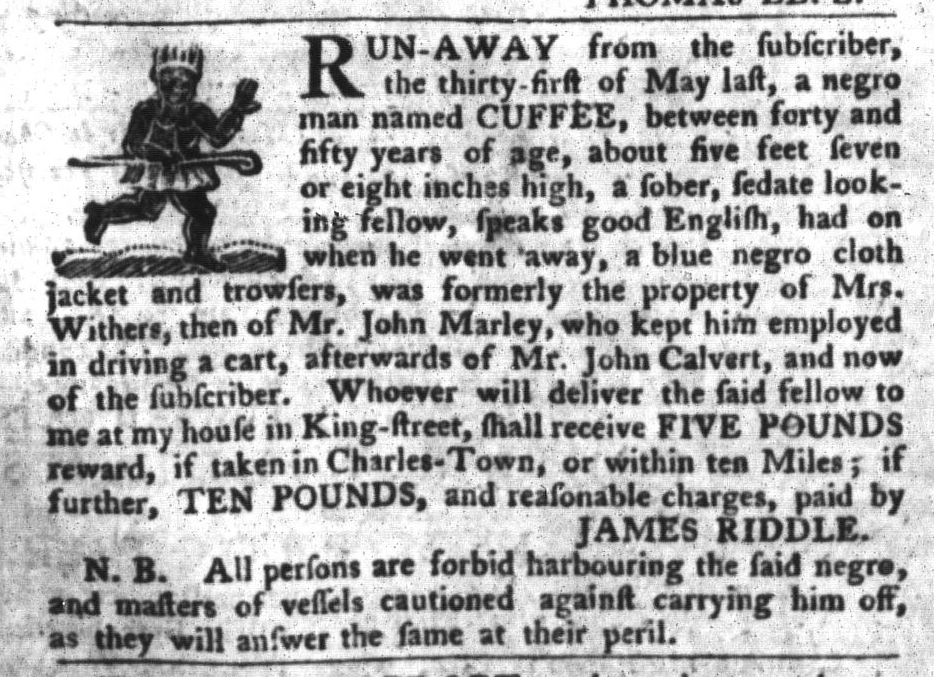
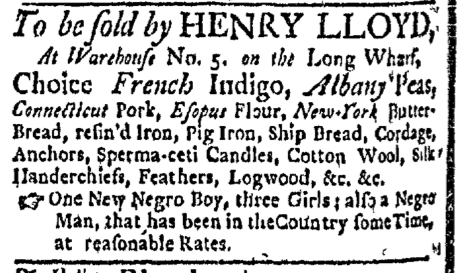
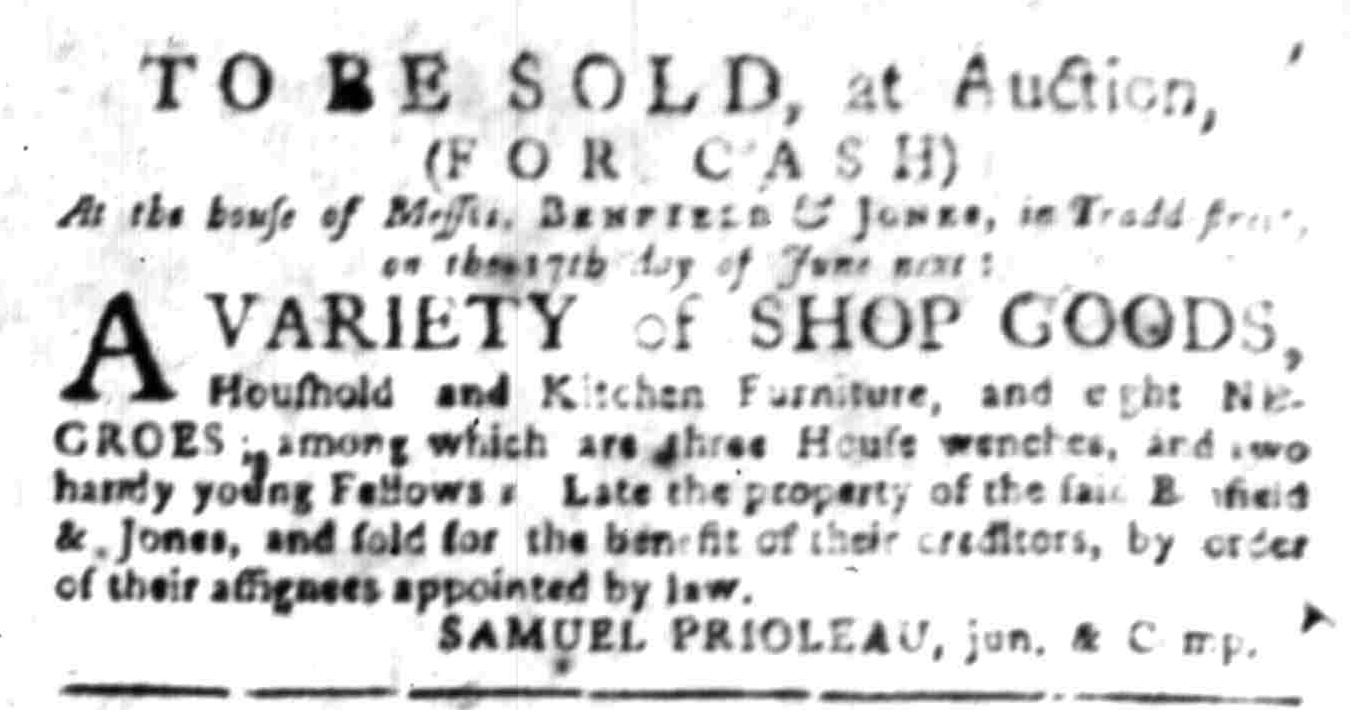
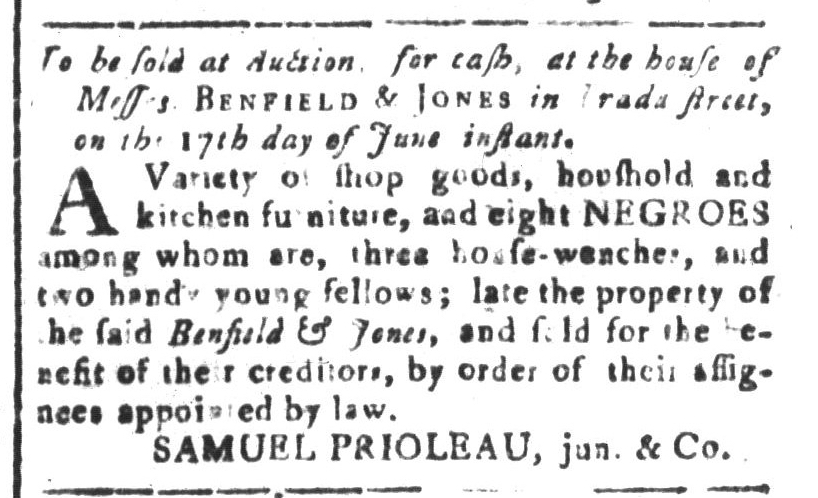
Jun 14 - South-Carolina Gazette and Country Journal Slavery 1
South-Carolina Gazette and Country Journal (June 14, 1768).

**********

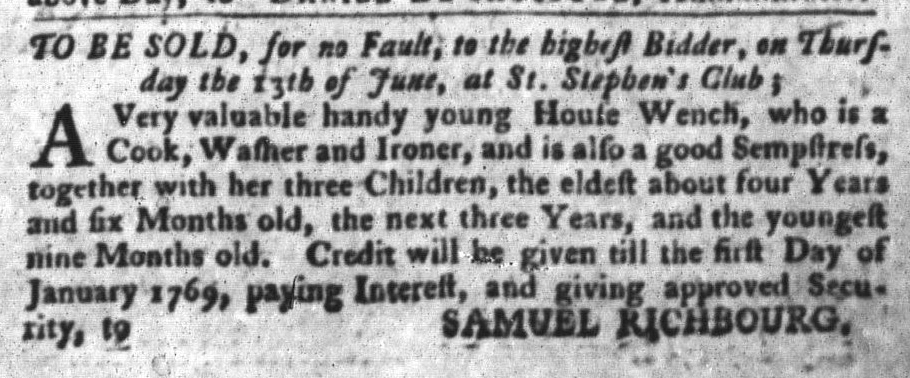
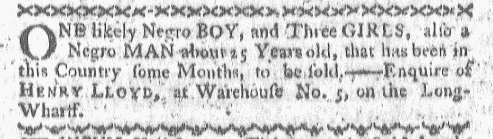
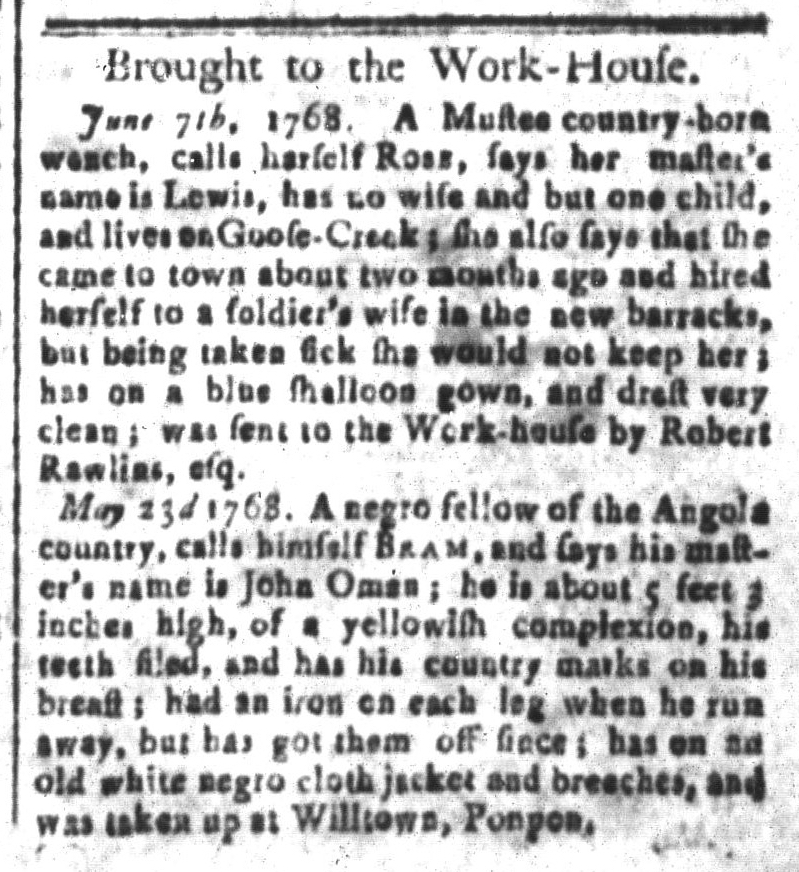
Jun 14 - South-Carolina Gazette and Country Journal Slavery 2
South-Carolina Gazette and Country Journal (June 14, 1768).

**********

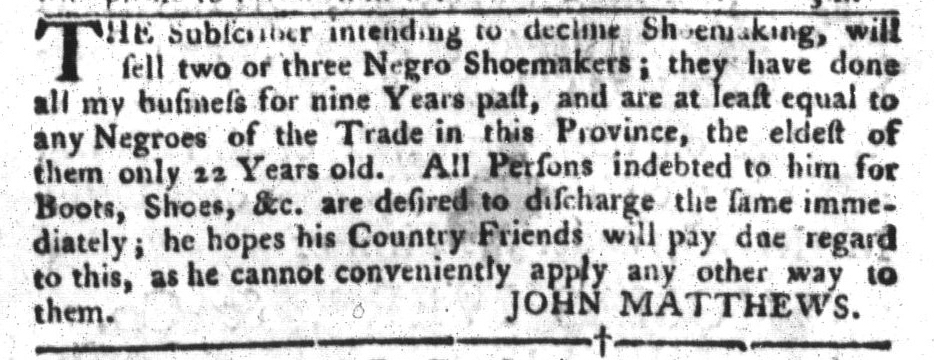
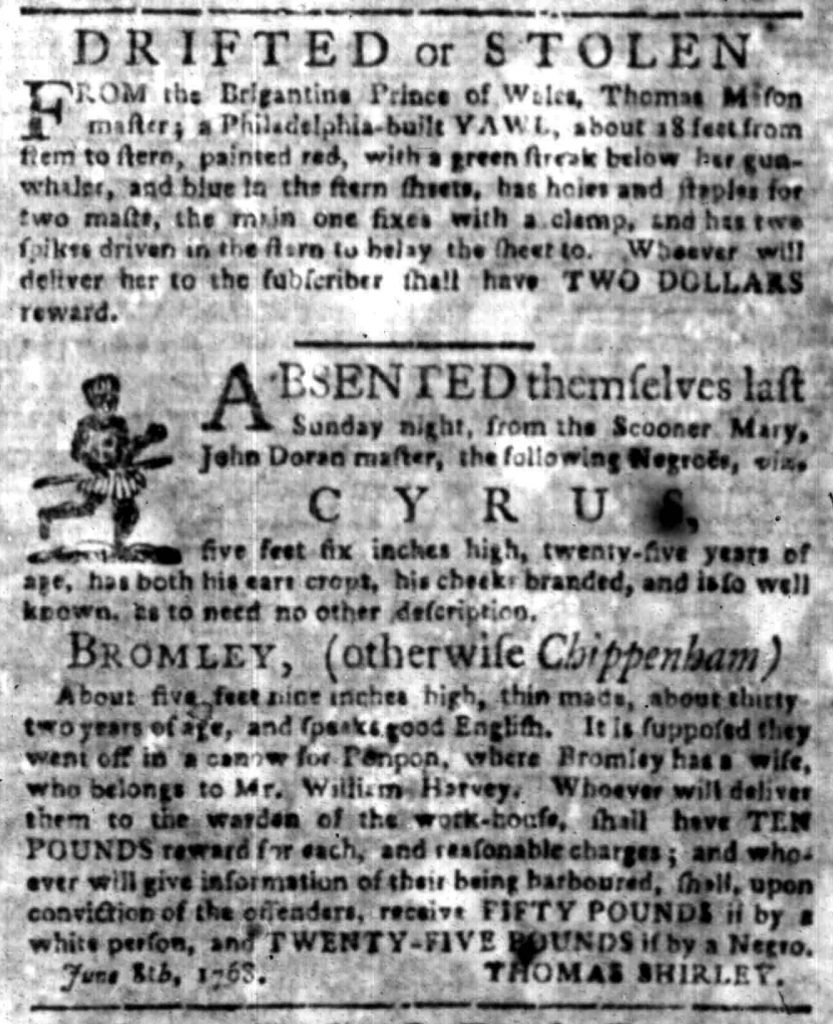
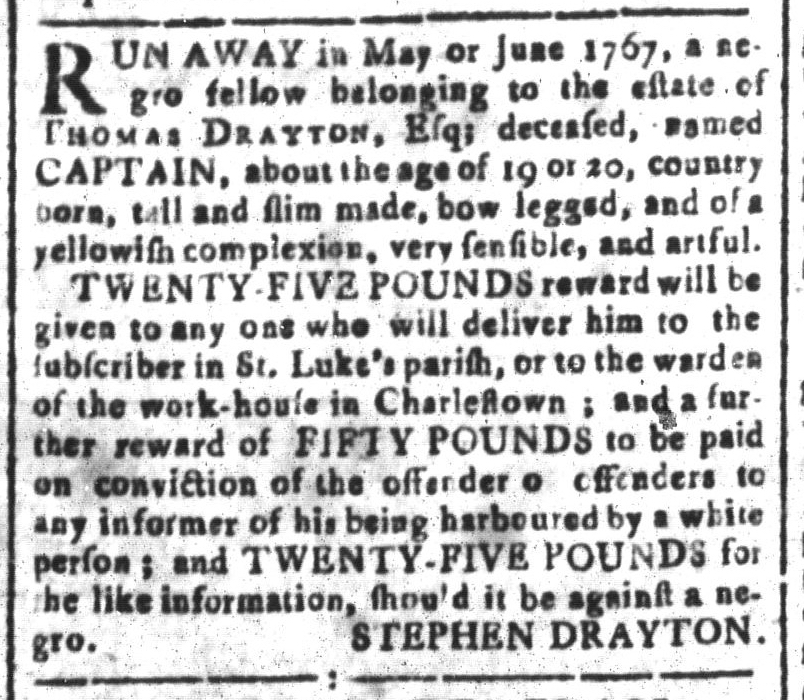
Jun 14 - South-Carolina Gazette and Country Journal Slavery 3
South-Carolina Gazette and Country Journal (June 14, 1768).

**********

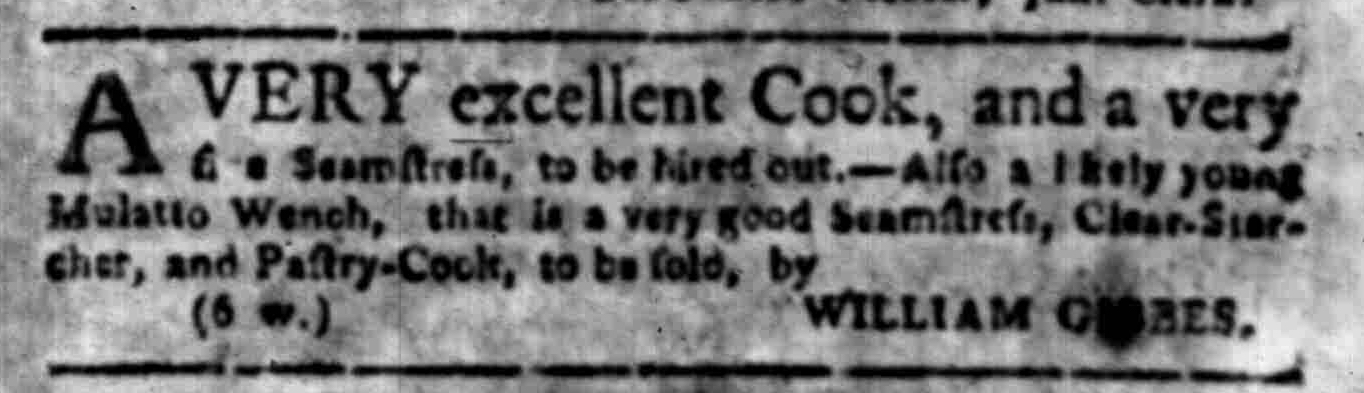
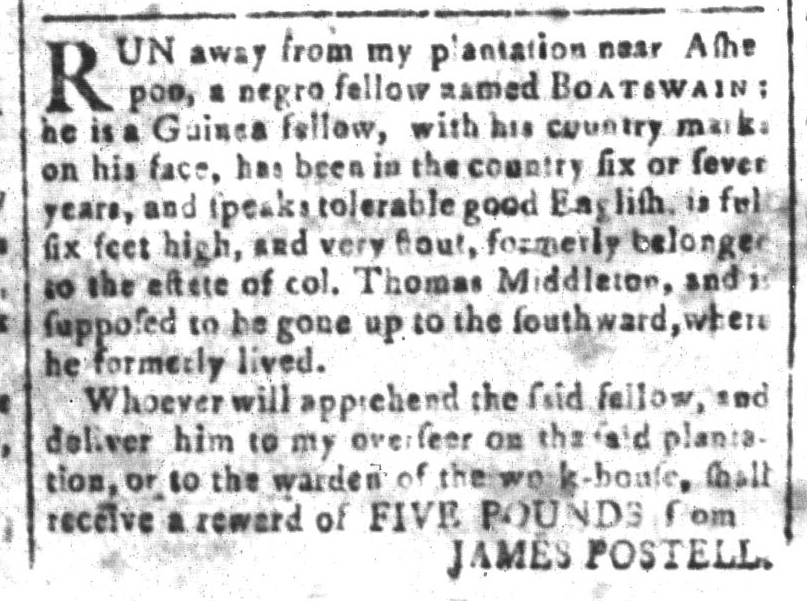
Jun 14 - South-Carolina Gazette and Country Journal Slavery 4
South-Carolina Gazette and Country Journal (June 14, 1768).

**********

Jun 14 - South-Carolina Gazette and Country Journal Slavery 5
South-Carolina Gazette and Country Journal (June 14, 1768).

**********

Jun 14 - South-Carolina Gazette and Country Journal Slavery 6
South-Carolina Gazette and Country Journal (June 14, 1768).

**********

Jun 14 - South-Carolina Gazette and Country Journal Slavery 7
South-Carolina Gazette and Country Journal (June 14, 1768).

**********

Jun 14 - South-Carolina Gazette and Country Journal Slavery 8
South-Carolina Gazette and Country Journal (June 14, 1768).

**********

Jun 14 - South-Carolina Gazette and Country Journal Slavery 9
South-Carolina Gazette and Country Journal (June 14, 1768).

**********

Jun 14 - South-Carolina Gazette and Country Journal Supplement Slavery 1
Supplement to the South-Carolina Gazette and Country Journal (June 14, 1768).

**********

Jun 14 - South-Carolina Gazette and Country Journal Supplement Slavery 2
Supplement to the South-Carolina Gazette and Country Journal (June 14, 1768).

**********
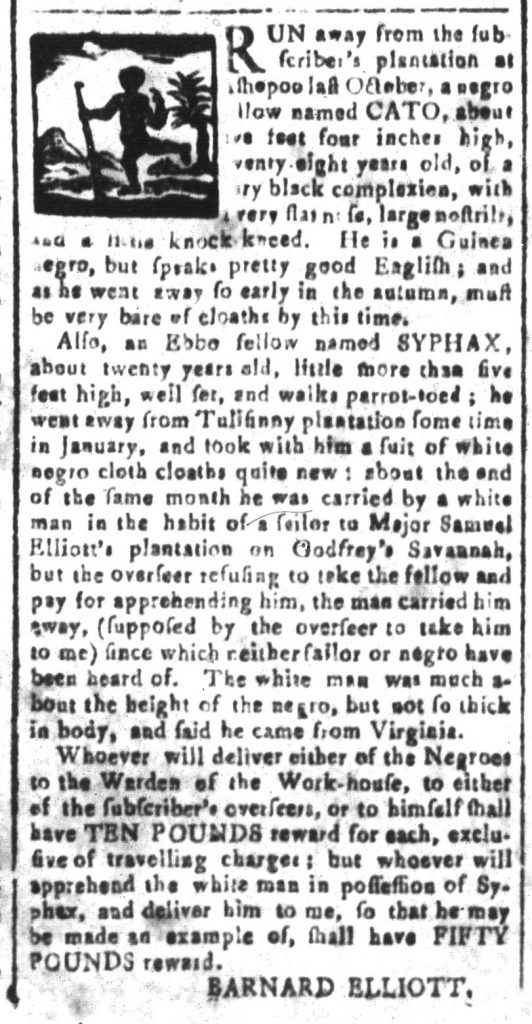
Jun 14 - South-Carolina Gazette and Country Journal Supplement Slavery 3
Supplement to the South-Carolina Gazette and Country Journal (June 14, 1768).

**********

Jun 14 - South-Carolina Gazette and Country Journal Supplement Slavery 4
Supplement to the South-Carolina Gazette and Country Journal (June 14, 1768).

**********

Jun 14 - South-Carolina Gazette and Country Journal Supplement Slavery 5
Supplement to the South-Carolina Gazette and Country Journal (June 14, 1768).

June 13

What was advertised in a colonial American newspaper 250 years ago today?

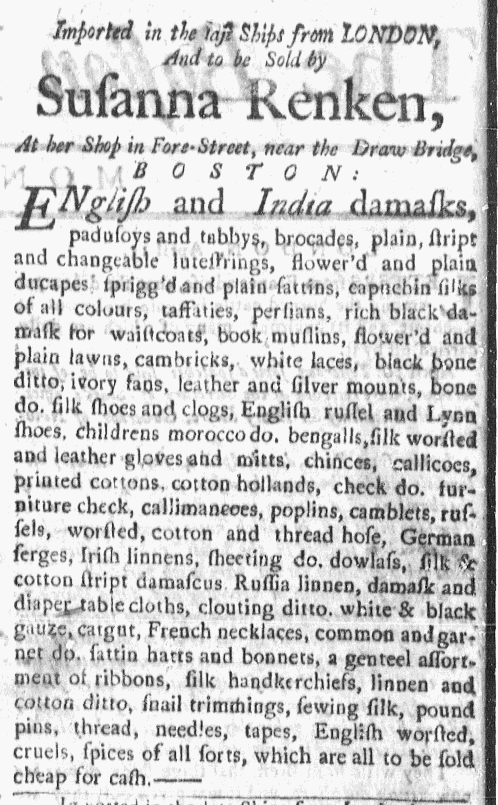
Jun 13 - 6:13:1768 Boston Post-Boy
Boston Post-Boy (June 13, 1768).

“To be Sold by Susanna Renken, At her Shop in Fore-Street.”

Susanna Renken was one of several women who took to the pages of the several newspapers published in Boston to advertise the assortment of seeds she stocked and sold in late winter and early spring in the late 1760s. In February 1768 she commenced this annual ritual among the sisterhood of the city’s seed sellers. Over the course of the next couple of weeks Rebeckah Walker, Bethiah Oliver, Elizabeth Clark, and Lydia Dyar and the appropriately named Elizabeth Greenleaf also inserted their own advertisements. As had been the case in previous years, their notices sometimes comprised entire columns in some newspapers, a nod towards classification in an era when printers and compositors exerted little effort to organize advertisements according to their content or purpose.

Even though some of these female seed sellers indicated that they sold other goods, usually grocery items, most did not intrude in the public prints to promote themselves in the marketplace throughout the rest of the year. They published their advertisements for seeds for a couple of months and then disappeared from the advertising pages until the following year. Susanna Renken was one of the few exceptions to that trend. Her advertisement for seeds concluded with brief mention of her other wares: “ALSO,–English goods, China cups and saucers, to be sold cheap for cash.” Nearly four months later she followed up with a much more extensive advertisement that listed dozens of items available at her shop, an advertisement that replicated those placed by other shopkeepers – male and female – who did not sell seeds (or, at least, did not promote seeds as their primary commodity in other advertisements).

What explains the difference between the strategies adopted by Renken and other female seed sellers? Did Renken better understand the power of advertising than her peers? After all, in addition to being one of the few to place additional notices she was the first to advertise in 1768, suggesting some understanding of being the first to present her name to the public that year. Was she more convinced than the others that advertising yielded a return on her investment that made it profitable to budget for additional notices? Alternately, Renken may have diversified her business more than other female seed sellers. She may have stocked a much more extensive inventory of imported dry goods than competitors who carried primarily seeds and groceries and perhaps a limited number of housewares. If that were the case, Renken may have earned a living as a “she-merchant” throughout the year while other female seed sellers participated almost exclusively in that trade and did not need to advertise during other seasons.

It is impossible to reconstruct the complete story of what distinguished Renken and her entrepreneurial activities from the enterprises of Clark, Dyar, Greenleaf, and other female seed sellers by consulting their advertisements alone. Many of those who trod the streets of Boston in the 1760s, however, would have possessed local knowledge that provided sufficient context for better understanding why Renken inserted addition advertisements and her competitors were silent throughout most of the year, especially if Renken continuously operated a shop with an assortment of merchandise and the others pursued only seasonal work when the time came to distribute seeds to farmers and gardeners.

Slavery Advertisements Published June 13, 1768

The Slavery Adverts 250 Project chronicles the role of newspaper advertising in perpetuating slavery in the era of the American Revolution. The project seeks to reveal the ubiquity of slavery in eighteenth-century life from New England to Georgia by republishing advertisements for slaves – for sale, wanted to purchase, runaways, captured fugitives – in daily digests on this site as well as in real time via the @SlaveAdverts250 Twitter feed, utilizing twenty-first-century media to stand in for the print media of the eighteenth century.

The project aims to provide modern audiences with a sense of just how often colonists encountered these advertisements in their daily lives. Enslaved men, women, and children appeared in print somewhere in the colonies almost every single day. Those advertisements served as a constant backdrop for social, cultural, economic, and political life in colonial and revolutionary America. Colonists who did not own slaves were still confronted with slavery as well as invited to maintain the system by purchasing slaves or assisting in the capture of runaways. The frequency of these newspaper advertisements suggests just how embedded slavery was in colonial and revolutionary American culture in everyday interactions beyond the printed page.

These advertisements also testify to the experiences of enslaved men, women, and children, though readers must consider that those experiences have been remediated through descriptions offered by slaveholders rather than the slaves themselves. Often unnamed in the advertisements, enslaved men, women, and children were not invisible or unimportant in early America.

These advertisements appeared in colonial American newspapers 250 years ago today.

Jun 13 - Boston Evening-Post Slavery 1
Boston Evening-Post (June 13, 1768).

**********

Jun 13 - Boston Post-Boy Slavery 1
Boston Post-Boy (June 13, 1768).

**********

Jun 13 - Boston-Gazette Slavery 1
Boston Gazette (June 13, 1768).

**********

Jun 13 - Boston-Gazette Slavery 2
Boston Gazette (June 13, 1768).

**********

Jun 13 - Connecticut Courant Slavery 1
Connecticut Courant (June 13, 1768).

**********

Jun 13 - New-York Gazette Weekly Mercury Slavery 1
New-York Gazette and Weekly Mercury (June 13, 1768).

**********

Jun 13 - New-York Gazette Weekly Mercury Slavery 2
New-York Gazette and Weekly Mercury (June 13, 1768).

**********

Jun 13 - New-York Gazette Weekly Mercury Slavery 3
New-York Gazette and Weekly Mercury (June 13, 1768).

**********

Jun 13 - New-York Gazette Weekly Mercury Slavery 4
New-York Gazette and Weekly Mercury (June 13, 1768).

**********

Jun 13 - New-York Gazette Weekly Mercury Slavery 5
New-York Gazette and Weekly Mercury (June 13, 1768).

**********

Jun 13 - New-York Gazette Weekly Mercury Slavery 6
New-York Gazette and Weekly Mercury (June 13, 1768).

**********

Jun 13 - New-York Gazette Weekly Mercury Slavery 7
New-York Gazette and Weekly Mercury (June 13, 1768).

**********

Jun 13 - New-York Gazette Weekly Post-Boy Slavery 1
New-York Gazette: Or, the Weekly Post-Boy (June 13, 1768).

**********

Jun 13 - New-York Gazette Weekly Post-Boy Slavery 2
New-York Gazette: Or, the Weekly Post-Boy (June 13, 1768).

**********

Jun 13 - Newport Mercury Slavery 1
Newport Mercury (June 13, 1768).

**********

Jun 13 - South Carolina Gazette Slavery 1
South-Carolina Gazette (June 13, 1768).

**********

Jun 13 - South Carolina Gazette Slavery 7
South-Carolina Gazette (June 13, 1768).

**********

Jun 13 - South Carolina Gazette Slavery 8
South-Carolina Gazette (June 13, 1768).

**********

Jun 13 - South Carolina Gazette Slavery 2
South-Carolina Gazette (June 13, 1768).

**********

Jun 13 - South Carolina Gazette Slavery 9
South-Carolina Gazette (June 13, 1768).

**********

Jun 13 - South Carolina Gazette Slavery 3
South-Carolina Gazette (June 13, 1768).

**********

Jun 13 - South Carolina Gazette Slavery 4
South-Carolina Gazette (June 13, 1768).

**********

Jun 13 - South Carolina Gazette Slavery 5
Postscript to the South-Carolina Gazette (June 13, 1768).

**********

Jun 13 - South Carolina Gazette Slavery 6
Postscript to the South-Carolina Gazette (June 13, 1768).

June 12

What was advertised in a colonial American newspaper 250 years ago this week?

Jun 12 - 6:9:1768 New-York Journal
New-York Journal (June 9, 1768).

“The Fire-Works will be disposed in the following Order.”

Colonists in New York, especially those who read the New-York Journal, were aware that “two Italian Brothers” who created fireworks shows visited the city and resided among them in the spring of 1768. To draw audiences for their shows, the brothers adopted marketing strategies similar to those deployed by other itinerant entertainers in eighteenth-century America. They initially introduced themselves to a community that considered them strangers, presenting their credentials before their first public exhibition. In advertisements published in May they described themselves as “two Italian Brothers from Turin, (Engineers to the King of Sardinia).” They also informed New Yorkers that they had previously presented “very surprising Specimens of their Abilities before the Royal Family in Spain and with great Applause before his Royal Highness the Duke of Gloucester, and all the Nobility at Bath.” They proclaimed that colonists in New York could witness the same fireworks demonstrations that had entertained some of the most powerful and important personages in Europe.

Subsequent advertisements dispensed with such puffery in favor of local testimonials to their skills as both engineers and entertainers. They no longer needed to assert that they had performed for nobility on the other side of the Atlantic because reports of their first shows at Ranelagh Gardens in New York spread by word of mouth. Such testimonials likely evoked less skepticism since a general buzz among those who had seen the fireworks or knew someone who had seen the fireworks or even knew someone who knew someone who had attended the performance provided more certain verification about the quality and entertainment value of the show than a list of dignitaries on the other side of the ocean. Indeed, the “two Italian Brothers” trumpeted that they had “given such Specimens of their Abilities (to the general Satisfaction of the Spectators) at the Fire-Works), which they have formerly exhibited” at Ranelagh Gardens that “some of the principal Gentlemen of this City” had encouraged them to put on another show.

In that regard they also followed a script established by other itinerant entertainers in their advertisements: begin by announcing a single performance or limited time engagement but upon establishing a reputation in the local marketplace extend the stay and promise bigger and bolder spectacles to assure prospective viewers that they too could witness the same entertainments that had captured the attention of so many of their friends and neighbors. For the fireworks engineers, this meant presenting a show “more curious than either of the former,” this one composed of four parts (each described in detail) rather than the three parts that comprised their first exhibition at Ranelagh Gardens. Like other performers who traveled from city to city in the colonies, the “two Italian Brothers” attempted to manage expectations for their shows in the press, inserting advertisements that first introduced them to the public and, later, others that offered one more chance to participate (and avoid being excluded from) an event that loomed large in local popular culture.

June 11

What was advertised in a colonial American newspaper 250 years ago today?

Jun 11 - 6:11:1768 Tillinghast 1 Providence Gazette
Providence Gazette (June 11, 1768).

“NICHOLAS TILLINGHAST Has to sell, GOOD Fyal Wine.”

Readers of the Providence Gazette encountered a rather brief advertisement at the end of the last column of the third page of the June 11, 1768, edition. Limited to four lines, it announced that “NICHOLAS TILLINGHAST Has to sell, Very good Bohea Tea, Which he will warrant, CHEAP for CASH.” On the following page they encountered a second advertisement placed by Tillinghast, this one slightly longer and listing other goods for sale, including “GOOD Fyal Wine” (from Faial in the Azores), “Brandy,” and “choice Vinegar.” In terms of both word count and the amount of space they occupied on the page, both were among the shortest advertisements in that issue. In comparison, Joseph and William Russell ran an advertisement that contained approximately the same number of words as Tillinghast’s second advertisement, but the bold typography – especially the way they deployed fonts of various sizes – made their advertisement appear twice as long.

Jun 11 - 6:11:1768 Tillinghast 2 Providence Gazette
Providence Gazette (June 11, 1768).

Visually, neither of Tillinghast’s advertisements were as flashy as the one placed by the Russells. He relied on a different strategy to capture a place in the minds of prospective customers. He could have placed a single advertisement that included “Very good Bohea Tea” alongside his wine, brandy, and vinegar. Instead, he opted for multiple advertisements that repeatedly introduced him, his wares, and his promises of low prices to consumers. The iterative aspect of his marketing strategy made it more difficult for readers to quickly pass over a single advertisement. In placing multiple advertisements in a single issue of the Providence Gazette he imprinted his name and business in the minds of readers.

This became a much more common strategy in the last decades of the eighteenth century as well as a staple marketing method in nineteenth-century newspapers when some advertisers inserted dozens or more advertisements in a single issue. Although he did not as fully develop the technique as subsequent advertisers, Tillinghast’s efforts at repetition could be considered a precursor to later marketing campaigns that relied on frequent and multiple reiteration.

Slavery Advertisements Published June 11, 1768

The Slavery Adverts 250 Project chronicles the role of newspaper advertising in perpetuating slavery in the era of the American Revolution. The project seeks to reveal the ubiquity of slavery in eighteenth-century life from New England to Georgia by republishing advertisements for slaves – for sale, wanted to purchase, runaways, captured fugitives – in daily digests on this site as well as in real time via the @SlaveAdverts250 Twitter feed, utilizing twenty-first-century media to stand in for the print media of the eighteenth century.

The project aims to provide modern audiences with a sense of just how often colonists encountered these advertisements in their daily lives. Enslaved men, women, and children appeared in print somewhere in the colonies almost every single day. Those advertisements served as a constant backdrop for social, cultural, economic, and political life in colonial and revolutionary America. Colonists who did not own slaves were still confronted with slavery as well as invited to maintain the system by purchasing slaves or assisting in the capture of runaways. The frequency of these newspaper advertisements suggests just how embedded slavery was in colonial and revolutionary American culture in everyday interactions beyond the printed page.

These advertisements also testify to the experiences of enslaved men, women, and children, though readers must consider that those experiences have been remediated through descriptions offered by slaveholders rather than the slaves themselves. Often unnamed in the advertisements, enslaved men, women, and children were not invisible or unimportant in early America.

These advertisements appeared in colonial American newspapers 250 years ago today.

Jun 11 - Providence Gazette Slavery 1
Providence Gazette (June 11, 1768).

June 10

What was advertised in a colonial American newspaper 250 years ago today?

Jun 10 - 6:10:1768 New-Hampshire Gazette
New-Hampshire Gazette (June 10, 1768).

“The Particulars would be too tedious to insert in an Advertisement.”

William Appleton, a frequent advertiser in the New-Hampshire Gazette, promoted “A very valuable Collection of BOOKS & STATIONARY” in the June 10, 1768, edition. Appleton did not deploy to a marketing strategy frequently used by booksellers and others who stocked books and stationery in their advertisements published in newspapers throughout the colonies: inserting an extensive list of the titles available and the various sorts of paper and other writing accouterments. Instead, he simply stated that “The Particulars would be too tedious to insert in an Advertisement.” Appleton left it to the imaginations of prospective customers to conjure his wares. He encouraged their curiosity, hoping that he had sufficiently enticed potential patrons to visit his shop.

By the time readers encountered Appleton’s advertisement on the final page of the June 10 issue, they had likely noticed Richard Champney’s lengthy advertisement, extending two-thirds of a column, listing scores of goods on the first page. Elsewhere on the same page as his notice, Thomas Martin ran an advertisement approximately twice as long as Appleton’s, most of it devoted to naming his merchandise. Martin stocked everything from “Loaf Sugar” to “Childrens Shoes and Stockings” to Hollow Iron Ware.” Two advertisements of similar length flanked Appleton’s notice on the right and left. Even in those Henry Appleton enumerated more than a dozen items and Peter Pearce twice that number. Presenting consumers with an array of options intended to please and entertain accounted for one of the most popular marketing strategies in eighteenth-century advertising.

Appleton made a nod in that direction in the second half of his advertisement, noting that he also sold “Silver WATCHES of the best sort – Silver & gilt Shoe and Knee BUCKLES, NECKLASSES, and EARINGS, for the Ladies.” This, however, was a truncated list. Appleton concluded by more broadly invoking “a general Assortment of Jewelry Ware, &c. &c. &c.” Once again, he encouraged prospective customers to imagine the possible treasures among his inventory when he inserted the eighteenth-century abbreviation for et cetera (&c.) three times in succession.

Appleton operated his business in a crowded marketplace. To distinguish his advertisement from others, he departed from one of the most common strategies for inciting demand among potential customers. His competitors and others provided lists of their inventory; no matter how lengthy, however, those lists seemed starkly finite compared to Appleton’s assertion that “The Particulars would be too tedious to insert in an Advertisement.” He made an appeal to consumer choice that required purchasing less rather than more space in his local newspaper.

Slavery Advertisements Published June 10, 1768

The Slavery Adverts 250 Project chronicles the role of newspaper advertising in perpetuating slavery in the era of the American Revolution. The project seeks to reveal the ubiquity of slavery in eighteenth-century life from New England to Georgia by republishing advertisements for slaves – for sale, wanted to purchase, runaways, captured fugitives – in daily digests on this site as well as in real time via the @SlaveAdverts250 Twitter feed, utilizing twenty-first-century media to stand in for the print media of the eighteenth century.

The project aims to provide modern audiences with a sense of just how often colonists encountered these advertisements in their daily lives. Enslaved men, women, and children appeared in print somewhere in the colonies almost every single day. Those advertisements served as a constant backdrop for social, cultural, economic, and political life in colonial and revolutionary America. Colonists who did not own slaves were still confronted with slavery as well as invited to maintain the system by purchasing slaves or assisting in the capture of runaways. The frequency of these newspaper advertisements suggests just how embedded slavery was in colonial and revolutionary American culture in everyday interactions beyond the printed page.

These advertisements also testify to the experiences of enslaved men, women, and children, though readers must consider that those experiences have been remediated through descriptions offered by slaveholders rather than the slaves themselves. Often unnamed in the advertisements, enslaved men, women, and children were not invisible or unimportant in early America.

These advertisements appeared in colonial American newspapers 250 years ago today.

Jun 10 - New-Hampshire Gazette Slavery 1
New-Hampshire Gazette (June 10, 1768).

**********

Jun 10 - New-London Gazette Slavery 1
New-London Gazette (June 10, 1768).

**********

Jun 10 - South-Carolina and American General Gazette Slavery 2
South-Carolina and American General Gazette (June 10, 1768).

**********

Jun 10 - South-Carolina and American General Gazette Slavery 1
South-Carolina and American General Gazette (June 10, 1768).

**********

Jun 10 - South-Carolina and American General Gazette Slavery 3
South-Carolina and American General Gazette (June 10, 1768).

**********

Jun 10 - South-Carolina and American General Gazette Slavery 4
South-Carolina and American General Gazette (June 10, 1768).

**********

Jun 10 - South-Carolina and American General Gazette Slavery 5
South-Carolina and American General Gazette (June 10, 1768).

**********

Jun 10 - South-Carolina and American General Gazette Slavery 6
South-Carolina and American General Gazette (June 10, 1768).

**********

Jun 10 - South-Carolina and American General Gazette Slavery 7
South-Carolina and American General Gazette (June 10, 1768).

**********

Jun 10 - South-Carolina and American General Gazette Slavery 8
South-Carolina and American General Gazette (June 10, 1768).

**********

Jun 10 - South-Carolina and American General Gazette Slavery 9
South-Carolina and American General Gazette (June 10, 1768).

**********

Jun 10 - South-Carolina and American General Gazette Slavery 10
South-Carolina and American General Gazette (June 10, 1768).

**********

Jun 10 - South-Carolina and American General Gazette Slavery 11
South-Carolina and American General Gazette (June 10, 1768).

June 9

What was advertised in a colonial American newspaper 250 years ago today?

Jun 9 - 6:9:1768 Massachusetts Gazette Draper
Massachusetts Gazette [Draper] (June 9, 1768).
“Choice N.E. Flour of Mustard.”

Thomas Walley’s advertisement in the June 9, 1768, edition of the Massachusetts Gazette included an interesting mixture of imported and locally produced wares. He first promoted the imported goods: figs, tea, sugar, coffee, rice, and other groceries. Then he shifted attention to two products produced in New England: “choice Starch made in BOSTON” and “choice N.E. Flour of Mustard.” In describing each as “choice,” Walley indicated that they achieved the same quality as imported goods. He further underscored that the starch was “equal to Poland.”

He devoted significantly more space to mustard seeds, inserting a nota bene that made the advertisement half again as long. Walley had previously advertised “Choice New-England Flour of Mustard … which by repeated Trials is found to be extraordinary good, therefore needs no further Recommendation.” In his new advertisement he called on colonists not only to purchase mustard produced locally but also to participate in making it available as an option for all consumers. He offered cash for mustard seed, but he encouraged “Persons in the Country [to] endeavour to raise and save more Mustard Seed than they have done heretofore” for reasons other than financial gain. He depicted such efforts as “serving their Country” since “N.E. Flour of Mustard” was “certainly found to be preferable to any that is imported.” In what ways was it preferable? Walley did not mean solely the quality or taste. Instead, he invoked a movement to encourage “domestic manufactures” and the consumption of goods produced in the colonies as a means of resistance to abuses perpetrated by Parliament, including the Townshend Act that had gone into effect the previous November. Over the past several months, newspapers throughout the colonies published or reprinted the resolutions of, first, the Boston Town Meeting and, in response, other towns that determined to decrease their dependence on goods imported from or via Britain.

Walley’s advertisement demonstrates that the idealism did not always keep pace with the practical realities. After all, he deployed “Choice Turkey FIGS” recently imported as the headline for an advertisement that eventually turned its attention to goods produced in the colonies. A series of advertisements encouraged colonists to drink “LABRADORE TEA” instead of imported “Best Bohea Tea,” but the demand for imported teas continued. Colonists could not produce some of the groceries listed in Walley’s advertisement. The merchant realized that was the case. Still, he encouraged colonists to modify their behaviors concerning products that were readily available, such as “Starch made in BOSTON,” as well as participate in bringing greater quantities of others, especially “N.E. Flour of Mustard,” into the local marketplace.

Summary of Slavery Advertisements Published June 3-9, 1768

These tables indicate how many advertisements for slaves appeared in colonial American newspapers during the week of June 3-9, 1768.

Note:  These tables are as comprehensive as currently digitized sources permit, but they may not be an exhaustive account.  They includes all newspapers that have been digitized and made available via Accessible Archives, Colonial Williamsburg’s Digital Library, and Readex’s America’s Historical Newspapers.  There are several reasons some newspapers may not have been consulted:

  • Issues that are no longer extant;
  • Issues that are extant but have not yet been digitized (including the Pennsylvania Journal); and
  • Newspapers published in a language other than English (including the Wochentliche Philadelphische Staatsbote).

**********

Slavery Advertisements Published June 3-9, 1768:  By Date

Slavery Adverts Tables 1768 By Date Jun 3

**********

Slavery Advertisements Published June 3-9, 1768:  By Region

Slavery Adverts Tables 1768 By Region Jun 3